This Week in Conspiracy (13 Nov 2011)

November 13, 2011

Well, I’ve done it again. I spent another week in the trenches, occasionally poking my head over the parapet, and taunting the forces of conspiracy theory.

Bob

On with the pain!

Twit of the Week:

It was that crazy-haired spray-on tan nutjobby from Ancient Aliens, after the whole premise of the modern History Channel was lampooned on South Park:

Tsoukalos: Good. Let them. Deep down they know (!) we’re on the right track… No worries. RT @kuhnlevel u inspire me but my history profs hate u! lol

Original Tweet: http://twitter.com/Tsoukalos/status/134686039854948352

Conspiracy Theory of the Week

That’s it folks. Keep it crazy. I’m off next week to do some field work on Saturday, and then I’ll be going to Alabama to give a talk about conspiracy theories to a group of freethinkers there. Yay!

(Did you notice that Anonymous completely dropped off the map this week? It’s now known as Ignominious!)

RJB


This Week in Conspiracy (7 Nov 2011)

November 7, 2011

We survived CSICon, and the audience survived my epic spiel (which was never certain). I met some pretty fab folks and enjoyed myself mightily. Eve did too. But just because we played hooky for a few days doesn’t mean that I could help but see the crazy stuff that streamed in on my mail, twitter, and reader feeds.

Let get it on.

This Week in I Made More as a Graduate Student than Anonymous Has Pulled In

I’m pretty sure that Anonymous is losing money hand over fist in the American market. This is as it should be.

And the other crazy:

Twit of the week:

This came from the @poopy_poo, who is the soul of the age: “@davidicke I hope all your 13,000 followers will be attending wembley next year mr Icke, very excited to be coming :-)”

RJB


Review of “Anonymous:” The Essex Rebellion Was an Inside Job

November 7, 2011

So, we finally saw Anonymous. To begin with, the traffic sucked, the popcorn was disappointing and the soda machines refused to give me an adequate diet Coke (machine 1 was a mix of diet Coke and some red Hi-C-like substance; machine 2 mostly just gave me carbonated water). I suppose I can’t blame Roland Emmerich and John Orloff for these problems, but I’m not feeling generous.

One of the previews was for “William Shakespeare’s Coriolanus,” directed by and starring Ralph Fiennes. Shakespeare is listed as a writer on the IMDB page. Edward de Vere, seventeenth earl of Oxford, is not.

Anonymous begins with Shakespeare-denier Sir Derek Jacobi entering a modern-day theater (that sports “Anonymous” on its sign) and beginning to recite one of Ben Jonson’s poems in praise of Shakespeare in big-time over-the-top fashion. Then he stops and questions Shakespeare’s identity. He first lists the works attributed to Shakespeare, including “thirty-seven plays.” Almost all scholars now count thirty-eight plays. Why no love for Two Noble Kinsmen? Perhaps because it was written long after Oxford’s death?

All these plays, sonnets and miscellaneous poems and “not a single manuscript in Shakespeare’s hand.” Except–quite possibly–Hand D of Sir Thomas More, of course (which, naturally, Sir Derek doesn’t mention). All we have, says Sir Derek, are six barely legible signatures, each one spelled differently. We’ve been over this one repeatedly. See the fourth reason that Roland Emmerich is an idiot.

Shakespeare was the son of a glove-maker and had a grammar school education. Sir Derek doesn’t draw any conclusions from this, but the snobby implication is that it is unlikely that such a person could write the works attributed to Shakespeare.

Shakespeare’s daughters were “irrefutably illiterate.” Emmerich mentions this in his ten reasons Shakespeare is a fraud. I had a niggling suspicion about this, but since Susanna and Judith’s literacy has nothing to do with the authorship of their father’s works, I lazily ignored it. In the comments, Fretful Porpentine pointed out Emmerich’s error. Here is the signature of Susanna Hall (née Shakespeare). So, Sir Derek was irrefutably spouting a lie. Oh, but little facts don’t stop Shakespeare deniers. Apparently her signature is “painfully formed,” and she uses three different versions of the letter “a.” Thus she, like her sister, was functionally illiterate. Now since, as Fretful Porpentine notes and even Anonymous admits, reading and writing were two separate skills in Tudor England, this is highly dubious. If Susanna could write her name, she could read. One website contrasts the handwriting of Susanna and her father with that of her husband, John Hall: “His signature is what one would expect from a man who wrote in a clear Italian hand. Would that his father-in-law’s signatures had had such clarity and consistency.” John Hall wrote in an italic hand. Clearly, he was highly literate. Susanna and Shakespeare wrote in Secretary Hand. Clearly, they were functionally illiterate boobs.

Finally, Sir Derek brings up the will, which doesn’t mention Shakespeare’s plays or books. See reason 10 here. So, Sir Derek proposes to offer us a different story. At this point the film moves into the past. I should point out that I took copious notes, but even at the best of times, my handwriting is pretty horrible. That’s right: I am functionally illiterate. When I’m writing in a darkened movie theater, I am even more illiterater (see?).

The cinematography is rather beautiful, especially the scene of Elizabeth’s funeral procession. The facial hair is also extremely impressive. Also, the movie makes no fucking sense. It moves backward and forward in time, but Ben Jonson stays the same age and other characters age at significantly different rates. In particular, Elizabeth and William Cecil, Lord Burghley, seem to age at roughly 3 times the rate of everyone else. This is confusing.

In an early scene, when the queen is very old, she is told that she is to be presented with a play written by “[pregnant pause] Anonymous.” She’s thrilled because she loves plays and “[pregnant pause] Anonymous.” I suppose this is the justification for the film’s title (rather than the more appropriate Pseudonymous). Except it doesn’t make any fucking sense. The play in question is Midsummer Night’s Dream, which, it transpires, Oxford wrote for the court when he was an adolescent. He also played Puck. Everyone at court knows he wrote the play. There was nothing hidden about it. It seems Oxford wrote a whole bunch of plays for court in his youth, including the Prince Hal plays. Again, none of this is hidden, so there is no real reason to refer to him as “[pregnant pause] Anonymous.”

At some point, Oxford attends a public performance of a Jonson play with Southampton (who, we will eventually discover, is his son by Elizabeth; Oxford is also Elizabeth’s son [ick], as is Essex). Shakespeare is AWI (Acting While Intoxicated). Christopher Marlowe has the hots for Southampton. Playwrights Thomas Nashe and Thomas Dekker are essentially non-entities: one’s fat and the other’s skinny, if that helps. All the playwrights, including the highly educated Marlowe, have noticeably less educated-sounding accents than the court characters. All the playwrights seem to be untalented hacks compared to the Incomparable Genius that is Oxford. Marlowe’s a conniving dick; Jonson is kind of a sniveling weasel, although he has integrity and a genuine love of great poetry (i. e. Oxford’s).

Perhaps now is the time to mention how excessively unpleasant all the characters are. Elizabeth is petty and solely driven by emotion. When she discovers that she is pregnant by [her son] Oxford, she declares that she will marry him, even though he is already married: “I LOVE HIM!!!! she screeches, in all caps). She seems utterly useless at statecraft, no more than a pawn of the Cecils. The Cecils (William,  Lord Burghley, and his son Robert) are practically mustache-twirling villains (they plot to murder Oxford, Essex and Southampton; when that fails, they connive to make it appear that Essex and Southampton are in open rebellion against the queen. That’s right, the Essex Rebellion was an inside job). They are also poetry/pleasure-loathing Puritans (“plays are the work of the devil,” says Burghley), a characterization that is simply incorrect, as far as I can tell. Southampton and Essex are pretty and uninteresting (the same is largely true of Oxford as a young man, but he is more actively unpleasant).

And then there’s Shakespeare. He is a drunken, unscrupulous, moronic, conniving, self-aggrandizing, semi-literate (can read but can’t write), inarticulate, barely coherent, petty, malicious, blackmailing, murderous (kills Marlowe for threatening to expose him) little toad. It’s hard to imagine anyone more unappealing. Yet, somehow Oxford manages to be worse. I suppose what makes Oxford so thoroughly reprehensible is the filmmakers’ attempts to make him seem a paragon of, well, everything. Oxford certainly seems to think he’s wonderful. Toward the end of the film, he admits that he’s failed at pretty much everything. But it’s not really his fault, you see. It’s the Cecils’ fault. Also, it’s because of his single-minded devotion to his poetry. The only thing he didn’t fail at is the one thing he didn’t do (write Shakespeare’s poetry). He points out that he had been one of the richest peers in England, but at the end of his life, he is impoverished. Why? Because of his devotion to his Muse. How the fuck much did parchment cost in Elizabethan England? Oh, also he claims Burghley stole his inheritance. Whatever. When he witnesses a performance of Henry V, he silently mouths the St. Crispin’s Day speech and weeps at the beauty of his own words. Barf.

Anyway, after seeing the Jonson play, he has an idea: he can use the public theater to spread his ideas and, somehow, win a kingdom for his son. In this, of course, he fails miserably. Oxford wants Jonson to produce the plays under his (Jonson’s) name. Oxford can’t be seen to write plays in his position (except for all those plays he’s already known for writing; sure, they were written as court entertainments, but you’d think someone might notice some similarity. Nuppers).

Oxford assures Jonson that his plays will make him the richest and most popular playwright in London. He’s modest like that. Jonson doesn’t really want to do it. He has integrity, you’ll remember, and he wants to be known for his own work. But for the sake of the wonderful plays, Jonson agrees. Shakespeare, of course, has no integrity, and when the crowd begins chanting “playwright, playwright” after Henry V, Shakespeare leaps forward and takes credit, to Oxford’s horror: “An actor, for God’s sake.”  Jonson, of course, was also an actor for a time (in real life), but in the film, he tells Shakespeare that playwrights don’t have time to act. Tell that to Nathan Field.

Oxford’s next play is Romeo and Juliet. He announces to Jonson that it’s in iambic pentameter. “What, all of it?” exclaims Jonson, “Is that possible?” Everyone’s amazed that it’s completely in verse. It’s not, of course. And A Midsummer Night’s Dream, which was ostensibly written decades earlier, is also predominantly in verse (in reality, the two plays were probably written close together in time, along with Richard II). There were plenty of plays before Shakespeare that were in iambic pentameter, as well. The first English drama in blank verse was Gorboduc or Ferrex and Porrex from 1561.

Some other stupid things: I’ve hinted that there are some problems with the chronology of the plays. Here are some more: Hamlet appears to be written shortly after Romeo and Juliet, and Marlowe is still alive when it is performed. He sneaks off to tattle to Robert Cecil about it. Everyone explicitly makes a connection between the character of Polonius and Lord Burghley. Later, Jonson will similarly tattle about Richard III (which therefore must have been written after Hamlet), though he agonizes over what he’s done. Richard III is supposed to satirize Robert Cecil, who was apparently somewhat hunchbacked. The film suggests that Richard was never portrayed as hunchbacked before the play.

This tendency of rival poets to go around accusing Shakespeare/Oxford of writing seditious plays is, of course, preposterous. Edmund Tilney held the position of Master of the Revels. He was the official censor, and all plays had to be approved by him. If the plays were as obviously seditious as the film suggests, Tilney would never have approved them.

Oxford writes Richard III specifically to achieve…I have no idea what…in his struggles against the Cecils and his plots to promote his son. His plan backfires spectacularly, and the Cecils use it to manufacture the Essex Rebellion. In fact, shortly before the rebellion, some of the conspirators paid the Lord Chamberlain’s Men to perform Richard II (that’s 2nd, not 3rd) at the Globe. The play was not new at the time. Augustine Phillips, a member of the company, testified at Essex’s trial.

There are more things in the movie that are stupid. So many more. But thinking about it makes me sad and stabby, so I’ll leave you with this brief précis of stupidity.

But remember,
The Essex Rebellion Was an Inside Job!

A Review of Anonymous, Commonly Attributed to John Orloff

November 7, 2011

As the closing credits rolled on Anonymous and Eve and I shouted our disapproval at the names that appeared on the screen (“Shame!” “Fail!” “Weak!”), a pair of old ladies in front of us started laughing.

“We were here for the 3:00 show,” one of them told us, “but the power went out. So they gave us free passes to see it again. I’m glad they did because I didn’t know what was going on the first time I saw it!”

And that’s the movie in a nutshell, a turd in a teapot, a tale told by an idiot, directed by a total spazz, and performed by a troupe of misguided failures.

The story was incoherent. Queen Elizabeth is a total ho, boinking everything that moves in her court. This includes her bastard son, the Earl of Oxford, Edward de Vere. Yuck and REALLY? (Several times in the movie, as Elizabeth was having a snit fit, Eve and I would turn to each other and say in our Queenie voice, “Who’s Queen?” Only really super cool people will laugh at that joke.)

The story was not told chronologically, which was a problem. It starts in the modern era, at a play or a lecture or something called “Anonymous.” It’s not clear. But what you do get, right out of the gate, is a completely useless series of questions by the character Underinformed Git (played by himself, Derek Jacobi), “Why aren’t books mentioned in Shakespeare’s will?” (What part of the “the whole damned estate” don’t you get, Rollo?) So, we were 2 minutes in, and I already wanted to kick a puppy.

Then we go almost to the end of the narrative proper, when Ben Jonson is getting done over good by the local constabulary for reasons that are not clear until the end. He’s hiding the plays written by de Vere-as-Shake-Speare. Jonson must be in on it because he is someone with credibility whose actual work (his elegy on Shakespeare faces the famous woodcut in the First Folio) totally f’in demolishes the Oxfordian fantasy before it got started. And then there is the little problem of the “Sweet Swan of Avon” elegy written, also by Jonson. Oh and the fact that Shakespeare was publishing long after de Vere was worm food. The solution? Make Jonson a conspirator and give him all of the plays to leak to Shakespeare slowly after de Vere’s death. Aaand your evidence for this is….apparently that you need it to be just so.

So, uh, then they are performing A Midsummer Night’s Dream, and everyone in court knows that it was written by a Bieber-aged de Vere…but then they all apparently forget that. My horse-drawn carriage has already thrown a wheel in that plot-hole.

Oxford is orphaned and raised by the Cecils who are advisors to the Queen. Turns out, go figure, that de Vere is smarter than all his tutors. The scene in which we are introduced to his Greek tutor, Latin tutor, cosmology tutor, etc. serves no functional purpose to the plot; it actually only underlines for Oxfordian cultists that de Vere had exactly the type of education they think that you need to write Shakespeare’s work. There were little nods to the in-group like that throughout the movie. For instance, you pan across Oxford’s office and see a falcon, you can almost hear Emmerich wondering out loud about how Shakespeare could know the vocabulary related to falconry if he was a bumpkin. And then you can almost hear a whoosh and a smack as I lose it.

OH! The movie is so insulting to the playwrights of the age. They were basically all hacks and they sat together in the peanut gallery. The treatment of Shakespeare was basically defamation. Shakespeare was slightly less fluent in English than Jesse Ventura, perpetually drunk, and usually whoring. They even suggested that Shakespeare killed Christopher Marlowe! Anything you can do to make him look bad, s’pose. At one point the playwrights are at their whore-and-ale house, the Randy Badger (or something), and Jonson throws down, daring Shakespeare to write his name. Lamest. Challenge. Ever.

Did I mention that it made no sense and that it left two old ladies very confused?

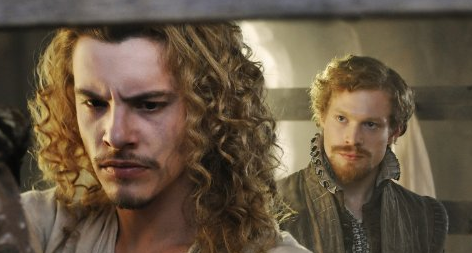
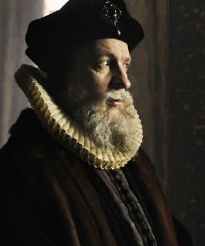
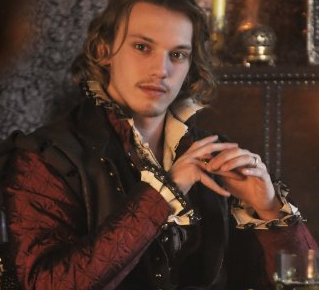
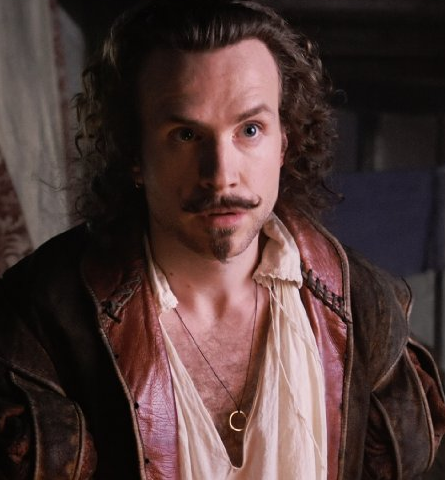
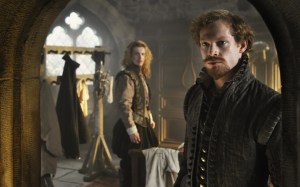
There was one really phenomenal aspect to the film, however, the mustaches. Whoever did the facial arrangements should get an Oscar(tm). If you could roll that clip I brought…..

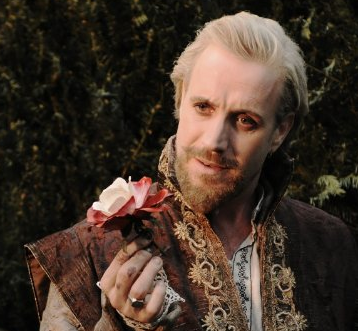
“F’in roses how do they work?” –Wm. Shkspere

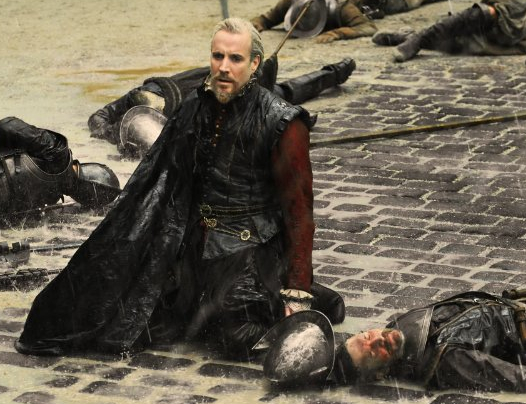
First the Queen dumps him and then there’s a rebellion. Ed’s having a crappy day.

It’s been only 3 days, and I forget who this is. Well acted, my friend. But look at that beard!

Bad guy who is not Shakespeare.

“Fauntleroy, why do you never return my text messages?”

Lord Melchett: “BAAAAAAAAAA!”

“What would you, the audience, do?”

Seriously, Shakespeare’s facial wig carries the performance.

If they had spent half as much time grooming the plot as they did these guys’ upper lips, the movie would have passed. But it was badly told to the point that only a true believer could possibly invest in it. The infuriating thing at the end, however, was not that it crapped on the Bard, who can take care of himself, but that the little old ladies in front of us wondered out loud if their understanding of history had always been that bad. “No,” I assured them. “Roland Emmerich is just a bad person.”

RJB


The Week in Conspiracy (31 Oct 2011 edition)

October 31, 2011

Hello, hello from the city where pants are optional, New Orleans. I gave my talk about anti-Jesuit and anti-Catholic conspiracy theories yesterday, and then we bopped along Canal Street to the Smarti Gras party.

  • I know that when I need medical advice, I go to a strung-out, obviously intoxicated rapper. I mean, not me, Vigilant Citizen:

This week in straight to DVD:

Here is a compilation of reviews of Anonymous, a film in which Roland Emmerich does to Shakespeare what he does to little models of the White House.

“In London, the Flat Earth Society explains that we live on a giant disk. In Petersburg, Ky., the Creation Museum shows cave men and dinosaurs frolicking together. And in a movie theater near you, “Anonymous,” which opened Friday, reveals how the Earl of Oxford wrote Shakespeare’s plays.”

No week in conspiracy this week, folks! Tomorrow, I’ll be talking to Jon Ronson, who is Skyping into a few classes at Georgia Tech. Pretty exciting!

RJB


The Other 5 Reasons Roland Emmerich is an Idiot

October 24, 2011

Here beginneth Part the Second (see here for Part the First):

6. Not edumucated enough.

Considering the anti-intellectual slant of Shakespeare-deniers (expressed by a comment on this post from screenwriter John Orloff), this one is rich.  As Emmerich says, “no records prove that Shakespeare ever attended the Stratford Grammar School.” True, no records survive before the nineteenth century. “Yet the work of William Shakespeare the writer shows extensive knowledge of [a bunch of stuff] as well as aristocratic activities such as royal tennis and falconry. Call me a snob….” Yup, you’re a big snob…. “but even if he was a genius, he couldn’t have pulled that one off without leaving a trace of his learning.” I don’t get it. Aren’t all those examples Emmerich provided evidence of Shakespeare’s learning? Not just formal education, but a continuing interest in learning things and, you know, reading stuff? “William Shakespeare had the largest English vocabulary of any writer in history. Not quite grammar school level I would say.” Well, then, you would be wrong. Again. First of all, “education” in Shakespeare’s day meant classical education: Latin and Greek. They weren’t learning English composition, much less creative writing. Second, as Shakespeare scholars have pointed out repeatedly, Shakespeare’s education was perfectly sufficient. James Shapiro notes that a grammar school education “was roughly equivalent to a university degree today, with a better facility in Latin than that of a typical classics major” (Contested Will, p. 276).

And let us not forget the things Shakespeare got wrong. In The Winter’s Tale, Shakespeare provided Bohemia with a coastline and a desert that it doesn’t actually have. Ben Jonson considered such mistakes risible. If you click the link above, you can see how Oxfordians have danced around this issue, and, if you scroll down a bit, you can see the history of the word “dildos.” It has nothing to do with the authorship question, but it’s fun. Shakespeare also kindly bestowed a harbor on Padua in The Taming of the Shrew.

7.  “Here is a big one:” if Emmerich had been Shakespeare, he wouldn’t have retired so early.

So what? What does Emmerich’s interminable drive to make splashy, bad movies have to do with Shakespeare? Emmerich adds that, after Shakespeare retired to Stratford (which was not the tiny town Emmerich makes it out to be), he never wrote “a single poem, play or sonnet again.” Okay, first, sonnets are poems. Second, argument from ignorance. How do you know he didn’t write anything ever again? Just because they don’t survive doesn’t mean they never existed. Finally, Shakespeare’s last plays (all collaborations) were probably written after after Shakespeare had largely retired and been replaced as principle playwright by John Fletcher.

“I would never compare myself to Shakespeare.” Oh, good, then shut up. “But to me the idea of retiring from directing and moving back to my hometown and never to be associated with movies again is just completely unthinkable.” Do you have a wife and kids in your hometown? And as we’ve seen, Shakespeare did continue to be associated with the theater (see more here). So, no, the explanation is not that he ran out of “idears.”

8. There is no record of Shakespeare traveling abroad, but he mentions Italy and other foreign lands a lot in his plays.

Argument from ignorance: we have no records of Shakespeare traveling abroad; therefore he must never have traveled abroad. Actually, we just don’t know. Even if he never left England, there were ways of finding out stuff about other countries. In the Renaissance they had a primitive version of Google earth.  It was called a “map.” And while Shakespeare didn’t have access to Wikipedia, there were these things called “books.” Oh, and while he couldn’t watch the Travel Channel (Emmerich actually sarcastically suggests this) there were travelers that he could talk to. And let us not forget Bohemia’s coastline and desert and Padua’s harbor.

9. The Stratford monument may have been altered to show Shakespeare as a writer.

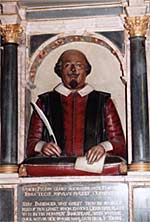
Shakespeare’s monument was erected sometime between his death in 1616 and the publication of the First Folio in 1623 (the Folio mentions the monument). It shows Shakespeare with his arms resting on a cushion and holding a quill in one hand and a piece of paper in the other.

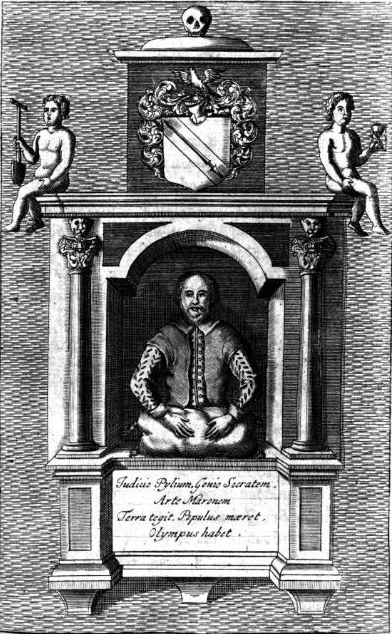
Emmerich points out that there were renovations to the monument. This is true. It was also repainted several times. He points out that in an early “engravement,” Shakespeare isn’t holding quill and paper; instead he is holding a “sack of grain.” The engraving appeared in William Dugdale’s Antiquities of Warwickshire published in 1656. Here it is:

First of all, while historians agree that the monument was renovated, I don’t think they believe it was renovated as early as 1656 (only a few decades after its erection). Secondly, the “sack of grain” is pretty clearly an awkward representation of the cushion, which is cut from the same hunk of stone as the bust (including the forearms and hands that rest on it). Why there is no quill and paper, I don’t know. Here is a discussion of the Dugdale engraving.

Also, you will notice that, even in the engraving, there is an inscription beneath the bust. This is what it says: “IVDICIO PYLIVM, GENIO SOCRATEM, ARTE MARONEM, TERRA TEGIT, POPVLVS MÆRET, OLYMPVS HABET.” Translation, “In judgment a Pylius [Nestor], in wit a Socrates, in art a Maro [Virgil]; the earth buries [him], the people mourn [him], Olympus possesses [him].” Not the inscription of a grain merchant. Although it is not visible in the engraving, there is also an English epithet (on the same slab as the Latin and so necessarily contemporary with it). It says (in modernized spelling): “Stay passenger, why goest thou by so fast? Read if thou canst, whom envious Death hath placed within this monument, Shakespeare, with whom quick nature died, whose name doth deck the tomb far more than cost, sith all that he hath writ leaves living art, but page, to serve his wit.” In other words, quill or no, the monument absolutely identifies Shakespeare as a writer, as is clear even in Dugdale’s rather bad drawing.

10. The bloody will.

“Can you believe that the last will of William Shakespeare of Stratford does not mention any books or manuscripts?” Why, yes, Roland: I can believe that, and if you can’t, your disbelief is merely an argument from incredulity. “Didn’t he care what would happen to his life’s work after his death?” Okay, I’m just going to copy and paste what I said about the will in my first post on this blog:

As for the will…well, Oxfordians get very excited about the will.  Shakespeare doesn’t mention his library, his books or his plays.  True, but he didn’t personally own the plays: they belonged to the acting company.  Those that were published became the property of the publisher.  He doesn’t mention books, but nor does he mention many specific items: the bulk of his estate was entailed.  Shapiro, citing  James Orchard Halliwell-Phillipps, notes that when Shakespeare’s son-in-law John Hall went to prove Shakespeare’s will, he apparently had with him “an inventory of the testator’s household effects” (qtd. in Shapiro, p. 50).  Shapiro continues:

Whatever valuable books, manuscripts, or letters Shakespeare owned and was bequeathing to his heirs would have been listed in this inventory rather than in the will itself (which explains, as Jonathan Bate has observed, why the surviving wills of such Elizabethan notables as the leading theologian Richard Hooker and the poet Samuel Daniel fail, like Shakespeare’s, to list any books at all).  (p. 50)

So, there you have it: arguments from ignorance, arguments from incredulity, arguments from snobbery and romanticism and arguments from what Roland Emmerich would have done if he’d been Shakespeare. And not a single iota of evidence to support the case for another author. [Emmerich mode] I chust don’t buy it [/Emmerich mode].

ES

RESOURCES:

The Norton Shakespeare.  Gen. ed. Stephen Greenblatt.  New York and London: Norton, 1997.  Texts based on the Oxford Edition, gen. eds. Stanley Wells and Gary Taylor.

The Riverside Shakespeare.  2nd ed.  Text. ed. G. Blakemore Evans.  Boston: Houghton, 1997.

Shakespeare: Life and Times. Palomar College. http://shakespeare.palomar.edu/life.htm.

Shapiro, James.  Contested Will: Who Wrote Shakespeare.  New York: Simon, 2010.

Shapiro, James. “Hollywood Dishonors the Bard.” New York Times 16 Oct. 2011

Wells, Stanley.  Shakespeare & Co.: Christopher Marlowe, Thomas Dekker, Ben Jonson, Thomas Middleton, John Fletcher, and the Other Players in His Story.  New York: Vintage, 2006.


Good news! Roland Emmerich’s stinker Anonymous release limited!

October 24, 2011

Heheh. I just saw news that the release of Anonymous has gone from 2000 theaters to 250. Eve and I would be happy to take credit for this if it weren’t for the fact that the whole world instantly realized that the entire premise was ridiculous. Also, I haven’t seen a positive review yet. Rollo is saying that it’s his idea. Go with that, kiddo. Embrace the fail.

So, what is to be made of this apparent straight-to-DVD upcoming box office failure? Other than “fun of”?

RJB


This Week in Conspiracy (23 Oct 2011)

October 23, 2011

I won’t have time to do everything that I need to in the few days that I have before CSICon. But I make a point of doing this, even if it hurts a little.

So, given the time crunch, I’m going to do as much as I can in an hour. GO!

  • In additional Shakespeare news, Forbes’s Alex Knapp wrote a piece, “Yes, Shakespeare Wrote Shakespeare” and got inundated with…enthusiastic correspondence. He contacted me and Eve about coming up with a reply to the specific claims of Shakespeare deniers, and we’re happy to help. Also, John Orloff, the screenwriter of Anonymous, left a smudge in the comments on my post about his indignation at the HuffPo.
  • Holy crap! I thought Ron Paul reminded me of someone! It’s Pat Buchanan!
  • Godlike Productions stepped in it this week when they tweeted:

They actually tweeted the word "Negro".

Conspiracy Theory of the Week:

You win! Please! Stop sending me this! Everyone I have ever met since I got out of short-pants has sent me this at least twice! Are you guys coordinating this??? Hey, I’m “just asking questions.”

Hey, not bad for an hour.

RJB


“Anonymous” Screenwriter John Orloff: Name Dropping and Wrong

October 18, 2011

John Orloff, who wrote the screenplay for the badly titled Anonymous (as Eve points out, it should be Pseudonymousout-stupided the Huffington Post on their own turf, which is no mean feat. He took issue with the phrase “urban legend.” I agree. They should have used the phrase, “unfettered clacking bollocks.” I intend to use his little screed in future classes to teach logical fallacies. His letter went as follows:

I’d like to think current and past US Supreme Court Justices don’t believe in Urban Legends. Namely, Justices Stevens, Blackmun, O’Connor and Scalia all think there is reason to doubt the validity of the actor William Shakespeare having written the plays history ascribes to him.

Wow. Not a Shakespearean scholar among them. Ok, you’re name dropping, but the sad fact is that just because you don’t like to think about it doesn’t mean it’s not true. This is the appeal to personal incredulity. “I can’t believe that these smart people would believe an urban legend, therefore, Shakespeare wasn’t Shakespeare.”

As does historian David McCullough. As do authors such as Mark Twain (whose last book, “Is Shakespeare Dead” is dedicated to the issue), Henry James (who said he was “haunted by the conviction that the divine William is the biggest and most successful fraud ever perpetrated on an unsuspecting Public”), and Walt Whitman (to name a few).

This is a classic appeal to false authority. You could fart sonnets like an angel and still not have a rollicking clue about the reams of scholarship backing the mainstream view.

As do Shakespearean actors Sir John Gielgud, Sir Derek Jacobi, and Orson Welles (who directed and starred in several Shakespeare plays).

Yawn. Appeal to false authority. Sorry.

And Mark Rylance, who is not only perhaps the greatest Shakespearean actor of his generation, but a man who was also the Artistic Director of the Globe Theater in London for ten years. Think about that last name; the man who ran the Globe theater for a decade doesn’t think Shakespeare wrote a single word.

Wow. I’m willing to bet if I look in my university databases I’ll find he never had to publish a goddamned thing under peer review:

  • Academic Search Complete ( 0 )
  • Research Library ( 0 )
  • Project Muse ( 0 )
  • MLA International Bibliography ( 1 )
  • Essay & General Literature Index ( 0 )
  • Arts & Humanities Citation Index ( 0 )
  • Humanities Int’l Index ( 0 )

That single entry is in a book about the resurrection of the Globe Theater, and it does not address authorship. And it’s not you like are citing an independent authority, since he’s in the freaking movie. “Well, my friends think so,” is as unconvincing as, “My mom says I’m smart.”

And we can add Sigmund Freud in there as well.

SO!?!

An Urban Myth is something proven to be false. I’m not sure we’re there on this particular issue.

Well, I disagree with your definition of urban myth, but the burden of proof is not on mainstream academia. We don’t default to the position that you know your head from your ham hocks.

And how do you know that someone wasn’t scared by Eddie Murphy in an elevator?

Either way, I am reminded of Winston Churchill’s statement on the subject when he was asked about the Authorship Issue. His response? He replied he wasn’t that interested in Oxford because, in his words: “I don’t like to have my myths tampered with”.

He meant the Shakespeare myth.

He meant, “Get stuffed, bozo. I’m not interested.” It doesn’t matter how many amateurs you say you surround yourself with, you’re still sitting on the short bus. (Yes, the actors and directors have a skill set that is completely unrelated to scholarship.)

Your software is broken, kiddo. Don’t try to contribute to the Great Discussion, because you’ll only embarrass yourself.

RJB


Shakespeare Denialism: The Roland Emmerich Study Guide

October 17, 2011

The very first post on this-here blog was inspired by news of the upcoming Roland Emmerich film, Anonymous, an action-packed, incest-filled, conspiracy-fueled Elizabethan thriller that suggests that Edward de Vere was the real author of the works attributed to Shakespeare. He was also the son of Elizabeth I. He was also her lover. Ew.

If you have been waiting with bated breath for the release, your breathing will soon return to normal: Anonymous will be released later this month. Huzzah.

While some skeptics have been having conniptions about the film, others have wondered what the big deal is. After all, it’s just a movie. Of course, so was Oliver Stone’s JFK, but like Anonymous, it was also propaganda for a genuine conspiracy theory. Anonymous features several prominent Shakespeare denialists, like Derek Jacobi and Mark Rylance, who will no doubt use the film’s release to promote their conspiracy theories, and since they sound more intelligent and less crazy than other conspiracists, like 9/11 truther Charlie Sheen, people will perhaps pay attention to them. After all, they’re Just Asking Questions.

Promotional materials for the film are also in the form of denialist propaganda. Emmerich has produced a video in which he presents ten reasons to doubt Shakespeare’s authorship. Most of his reasons are based on arguments from ignorance and have been refuted repeatedly (no letters, no school records, no mention of his works in the will, etc.). He also mentions that in an early illustration (1656) of Shakespeare’s monument in Stratford, Shakespeare appeared to be holding a bag of grain rather than a quill and parchment. Emmerich implies that the monument was changed to suggest that Shakespeare was a writer. He doesn’t consider the possibility that the illustration was just inaccurate.

For a number of reasons, this argument seems stupid. Even if Shakespeare didn’t write Shakespeare, by the time the monument was built (sometime between Shakespeare’s death in 1616 and the publication of the First Folio in 1623), Shakespeare was quite widely known for writing Shakespeare. Portraying him as a writer made sense. Portraying him holding a sack of grain seems a bit silly, unless it was meant to be an oh-so-subtle hint by someone in the know. Moreover, when the monument was actually restored in the eighteenth century, it was noted that the bust and the cushion (which supports Shakespeare’s hands, the quill and the parchment) were made from a “single piece of limestone.” The alteration would involve changing the sack to a cushion and entirely recarving Shakespeare’s lower arms–at a minimum. That’s a clever bit of alteration.

Despite the stale and silly nature of the arguments, Youyoung Lee of the Huffington Post finds them “powerful” and says that Emmerich “makes some pretty solid points.” Apparently screenwriter John Orloff found that praise insufficient and objected to Lee’s use of the term “urban legend.” The Huffington Post kindly printed his objection, which consists entirely of false appeals to authority. It should be noted that none of the authorities he pompously cites are or were Shakespeare scholars.

But wait: there’s more.  The film’s producers and educational marketing firm Young Minds Inspired (more here) have produced a study guide to accompany the film.* The “target audience” is “students in English literature, theater and British history classes.” It has been sent to college instructors who have been encouraged to copy the brochure and share it with colleagues. The first objective of the guide is “to encourage critical thinking by challenging students to examine the theories about the authorship of Shakespeare’s works and to formulate their own opinions.” That sounds great, but, of course, it’s just more JAQing off. While feigning objectivity, the brochure supports Shakespeare denialism.

The brochure says that authorship question has intrigued academics and inspired debate among experts for centuries. It doesn’t mention that there is, in fact, no real debate among actual experts. The denialist slant of the brochure is quite clear on the “References and Resources” page, which overwhelmingly favors Oxford-as-Shakespeare sources and gives scant attention to real Shakespeare scholars, such as James Shapiro, author of Contested Will: Who Wrote Shakespeare. The brochure authors toss Shakespeareans a couple of bones: Samuel Schoenbaum’s Shakespeare’s Lives and E. K. Chambers’ William Shakespeare: A Study of Facts and Problems. I wonder if they think the latter is a denialist work or assume readers will think that it is.

While it is infuriating that conspiracist propaganda is being marketed as study material it is equally outrageous that a film advertisement is being palmed off as an educational guide. In the section on “How to Use this Program,” teachers are assured that “It is not necessary to see the film to complete the activities,” yet all the pages but the first feature the words “Uncover the true genius of William Shakespeare. See Anonymous–in theaters October 28, 2011″ in big, red, all-cap letters at the bottom. The first page is headed “Anonymous” and the brochure is followed by an enormous poster for the film.

Furthermore, the instructions for the follow-up activity for Activity 2 begin, “After the students have seen Anonymous…” so it is necessary to see the film to complete Activity 2. The instructions for Activity 3 include the words “Before seeing the film Anonymous…,” so it’s necessary to see the film to complete Activity 3. There are only three activities.

So, no, Anonymous is NOT just a movie: it is a huge propaganda machine that wants desperately to sway viewers and students. Oh, and I know that this is nitpicky, but I don’t get the title. Perhaps I’ll understand after I (cringe) see the damned thing, but surely it should be Pseudonymous. I want to make the sequel, Anonymous 2. This blood-and-guts, sexy action romp will argue that Anonymous was not the real author of Beowulf.

[spoiler alert] The real author was…the Earl of Oxford, who, it transpires, was (is?) a time-traveling reptilian alien. I mean, he’d have to be, right? He’s connected to the royal family after all. [/spoiler alert].

*Bill Blakemore of ABC.com provides an interesting analysis of the study guide.

ES?

Update: James Shapiro has written an article on the film for the New York Times.