Going Berserk

April 19, 2011

Who hasn’t at one time or another gone berserk? And by “gone berserk,” of course I mean become enraged, howled like an animal and then killed indiscriminately. What, just me? Ha ha, just kidding. Really.

But what does it really mean “to go berserk”? Berserks (Old Norse berserkr, pl. berserkir) were fearsome Viking Age warriors. They appear frequently in sagas, but it is difficult to separate legend from reality in the sagas. Sometimes they had supernatural abilities and sometimes they were stock characters–bullies who served as a foil for the protagonist. Where can we find the truth?

Where else but the History Channel. A few years ago History International ran a program called Unconventional Warfare. The first segment deals with the Trojan Horse. According to the narrator, no one really knows whether the story of the Trojan Horse is true or not, so you know off the bat that this is going to be another serious, hard-hitting, scholarly look at history.

The segment on berserks begins well enough, with information provided by real, genuine experts (and General Wesley Clark for some reason). Okay, the fact that the History Channel manages to bollox up their credentials may be a bit of a concern. They properly credit Ruth Mazo Karras as “Historian, Univ. of Minnesota,” but they identify Anatoly Liberman (more here) as a “Scandinavian Historian” at the Univ. of Minnesota as well. In fact, Liberman teaches in the department of German, Scandinavian and Dutch, and much of his work focuses on linguistics and philology. Similarly, they identify Paul Acker* as a “Norse Historian” at Saint Louis University, and, to be fair, he does look a bit like a Viking who’s given up raiding for academia. However, he is a professor of English rather than a historian. They don’t bother to give John Lindow (more here) any academic qualifications at all, identifying him as “Author ‘Handbook on Norse Mythology.'”

Regardless, the misidentified academics give a good summary of the berserks: they were fierce fighters who whipped themselves into a frenzy and fought in the front lines. In legendary tales, they are described as wearing bear or wolf skins (berserkr means “bear shirt”). They supposedly fought without armor and could not be harmed by weapons or fire. In reality, of course, they could be harmed and killed, but for the duration of  the berserker rage, they may have seemed impervious.

But what, asks the narrator, caused the berserker rage? Acker says, “Through their training and initiations, they whipped themselves into frenzy: that’s part of their jobs.”  The narrator, of course, knows better: “Some theorize, however, that the berserkers had a little help–from mood-altering substances.” Karras notes that “If you read a lot of modern works that refer to berserks, they talk about how they may have used either alcoholic beverages or perhaps hallucinogenic mushrooms to bring on the rage.”

Now, at this point, you can sense the word “however” hurtling across the room, desperate to make it before the camera cuts away, but, alas, to no avail. Magic mushrooms is what the History Channel wanted, and once someone mentioned them, they stopped. The point of Unconventional Warfare is to compare strategies used in the past to ones used much more recently. The berserks and their magic mushrooms are compared to Somali warriors who use a narcotic weed to become more aggressive.

None of the academics were told that this was the point of the segment. They only knew that the History Channel was doing a segment on berserks. When asked about the magic mushrooms, Acker and presumably Karras (quite possibly the others as well) explained that while some have speculated that the berserks used hallucinogens, there is absolutely NO evidence. There is nothing in the literature to suggest that the berserks used anything but training, natural aggression and the gift of Odin to work themselves into a frenzy. They may well have had a bit of a tipple now and then, but that hardly separates them from anyone else in Viking society.

If this is how they do history, perhaps it’s just as well that they stick with monsters and doomsday.

But enough about historical berserks; let’s talk about the literary and legendary ones–they’re much more fun. First the stock characters. These guys wander around, acting like bullies and intimidating people until they get their comeuppance from the saga protagonist. In Grettis saga, Grettir fights and kills a mound-dweller (an undead guy who attacks Grettir when Grettir is robbing his grave), a draugr (an ueber-nasty undead guy), a she-troll, a giant, a bear and lots of people. LOTS of people, including a number of berserks. Grettir meets a group of twelve berserks, led by a couple of brothers named Thorir Paunch and Ogmund the Evil.

They came from Halogaland and were bigger and stronger than anybody else. They would go berserk and spare nothing when they flew into a rage. They used to take away men’s wives and daughters and keep them for a week or two, then return them. Wherever they went, they used to plunder and cause other trouble (Saga of Grettir the Strong, p. 42)

Grettir pretends to befriend them, then gets them drunk and fights them (the alcohol is of no benefit to them, by the way). When they realize what is happening, the berserks, of course, go “berserk and [begin] howling like dogs” (p. 46). While they’re howling, Grettir thrusts a spear through Thorir and Ogmund, who bumps into him. Then he takes out the other berserks.

Later, when Grettir is staying with a man named Einar, a group of berserks arrive, and the leader challenges Einar “either to hand over his daughter or defend her if he was man enough” (p. 95).  Einar consults with Grettir, and the berserk becomes impatient:

The berserk thought that Grettir and the farmer were stalling. He started to howl loudly and bite the edge of his shield. He put his shield in his mouth, spread his lips over the corner of it and acted like a savage. Grettir strode over to him and when he came alongside the berserk’s horse he kicked the bottom of the shield up into his mouth so hard that his face ripped open and his jaws fell down to his chest (p. 95)

Then Grettir cuts off his head, and the other berserks decide to be on their way–rather quickly. Throughout the sagas, the beginning of the berserker rage is signaled by howling and shield-biting. Some of the Isle of Lewis chessman seem to depict shield-biting berserks:


As far as I know, Grettir is the only person who has the sense to kick the shield back into the berserk’s mouth. Not all berserks are slightly comic bullies, however. Some have supernatural powers. Examples may be found in Egils saga. Egil was a great warrior, an exceptional poet and a truly phenomenal drunk (again, though, his drunkenness is unrelated to his frenzies). Jesse L. Byock has argued that Egil may have suffered from Paget’s disease, which has a genetic component. Based on his saga, Egil may also have suffered from a genetic predisposition for berserkerism.

Egil’s grandfather is named Ulf. He is big and strong and a good farmer. As evening rolls around, however, he turns bad-tempered and is known as Kveldulf or Evening Wolf. You might as well wear a name tag that says, “Hi, I’m a werewolf. Ask me how.” He has two sons, Thorolf and Grim, known as Skallagrim (Bald Grim). Thorolf is tall, strong, brave, handsome, honorable (by saga standards) and an all-round swell guy. Grim is big, strong, ugly, troublesome and, like his father, has a tendency to shape-shift. Skallagrim has sons named Thorolf and Egil. Thorolf II is a carbon-copy of Thorolf I. Egil is big, strong, freakishly ugly and has the family tendency to shape-shift. The non-berserk Thorolfs both die young; the berserks all die of old age.

In one of Skallagrim’s rages, he seizes one of Egil’s friends and “[dashes] him to the ground so fiercely that he was crushed by the blow and died on the spot” (Egil’s Saga p. 63). He then seizes twelve-year-old Egil, who is rescued by his foster mother who is “as strong as a man and well versed in the magic arts” (p. 63). Skallagrim is described by an enemy as being “as vicious as a wolf” (p. 42), and Egil is mistaken for a bear on one occasion (p. 104). According to the narrator:

It is said that people who could take on the character of animals, or went berserk, became so strong in this state that no one was a match for them, but also that just after it wore off they were left weaker than usual (p. 46)

Kveldulf, Skallagrim and Egil also tend to befriend people with similar berserker characteristics. For instance, there is Egil’s friend, Onund Sjoni: “Not everyone agreed that he was not a shape-shifter” (p. 130).  Although Egil’s connection to berserker madness is less explicit than Kveldulf’s and Skallagrim’s, he performs one of the best killings in all the Icelandic family sagas. He is fighting a duel against a man named Atli, who is “strong and courageous, an experienced dueller, and skilled in the magic arts” (p. 128). Egil is able to hack Atli’s shield to bits and land blows, but the sword is unable to bite. His own shield is beginning to split, so

He threw down his sword and shield, ran for Atli and grabbed him with his hands. By his greater strength, Egil pushed Atli over backwards, then sprawled over him and bit through his throat. Atli died on the spot. Egil rushed to his feet and ran over to the sacrificial bull, took it by the nostrils with one hand and by the horns with the other, and swung it over on to its back, breaking its neck (p. 128)

Let this be a warning to you, History Channel: don’t mess with berserks.

ES

*Full disclosure: Professor Acker was my dissertation director. When the History Channel came a-filming, they collected several graduate students to sit listening in rapt attention while Prof. Acker delivered a faux lecture. We were cut.

References:

Byock, Jesse L. “Egil’s Bones.” Scientific American. Vol. 272. Jan. 1995, pp. 82-87

Egil’s Saga. Tr. Bernard Scudder. The Sagas of Icelanders: A Selection. New York: Viking, pp. 8-184.

The Saga of Grettir the Strong. Tr. Bernard Scudder. London: Penguin, 2005.


The week in conspiracy (19 April 2011)

April 19, 2011

You remember last time when I said that global events were coming to a head in the coming week? Boy, I sure was wrong because this week– THIS WEEK– represents the culmination of vast clandestine machinations.

Conspiracy Theory of the Week (or so):


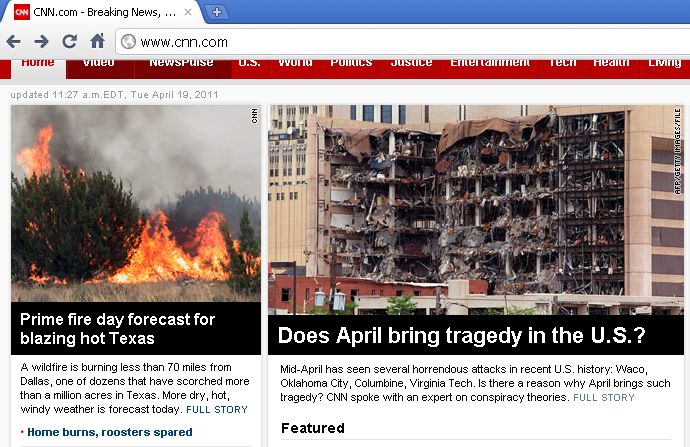
Guess who’s on the front page of CNN.com

April 19, 2011

You’re reading his blog!

No kidding.

Here’s the article, which was an email exchange I had with their reporter.

RJB


CBS fails to fulfill the promise of broadcasting

April 14, 2011

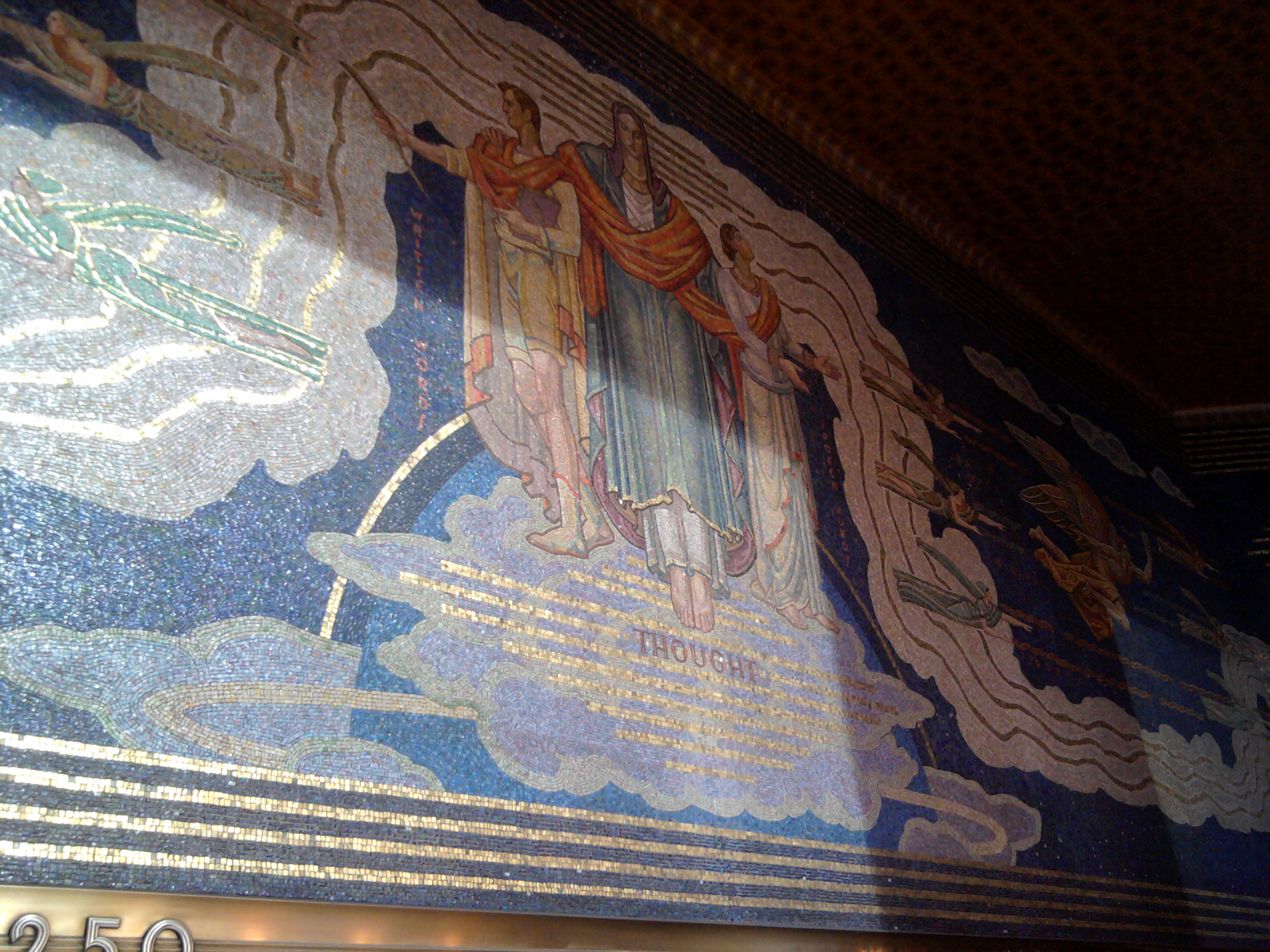
Last week, I was in New York City, rocking the NECSS groove, and I made a point to go see one of my favorite murals, Barry Faulkner’s 1933 “Intelligence Awakens Mankind,” which adorns the centerpiece of Rockefeller Center, the old RCA (now GE) Building.

Barry Faulkners "Intelligence Awakens Mankind" 1933

It is a mural that expresses optimism about the dawning age of mass communication (it was the RCA Building…get it?). In the center, Intelligence, personified as a woman, sends out golden beams, or “thought”, via the Spoken Word and Written Word:

See?

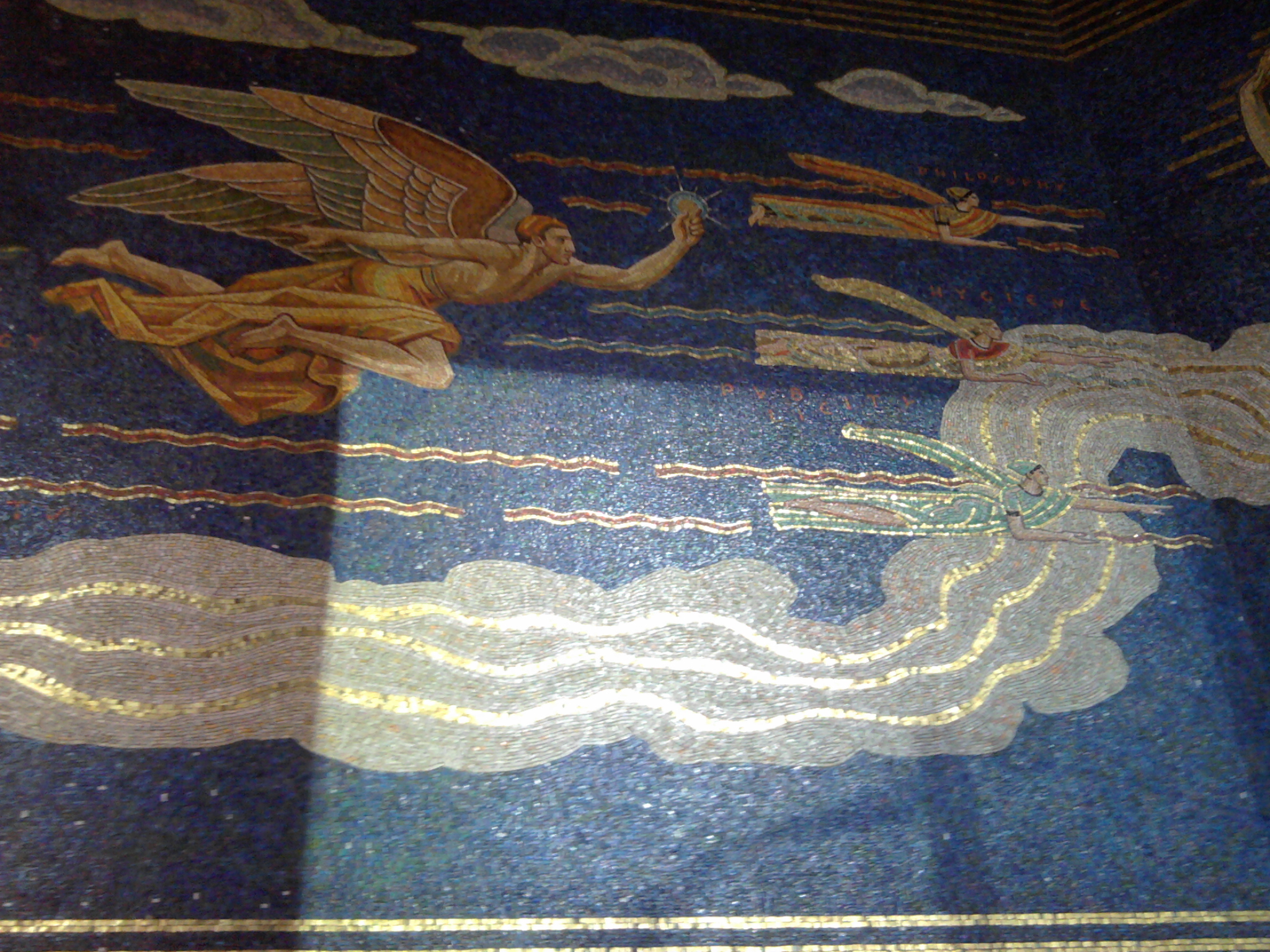
Radio waves, personified as angels, speed through the air carrying messages about fields such as “Philosophy,” “Biology,” and “Hygiene.”

Allegory! Its like telling two stories at once!

The information from the various fields of knowledge form a sort of force field, a protective barrier, if you will, around citizens:

See? Good information protects people!

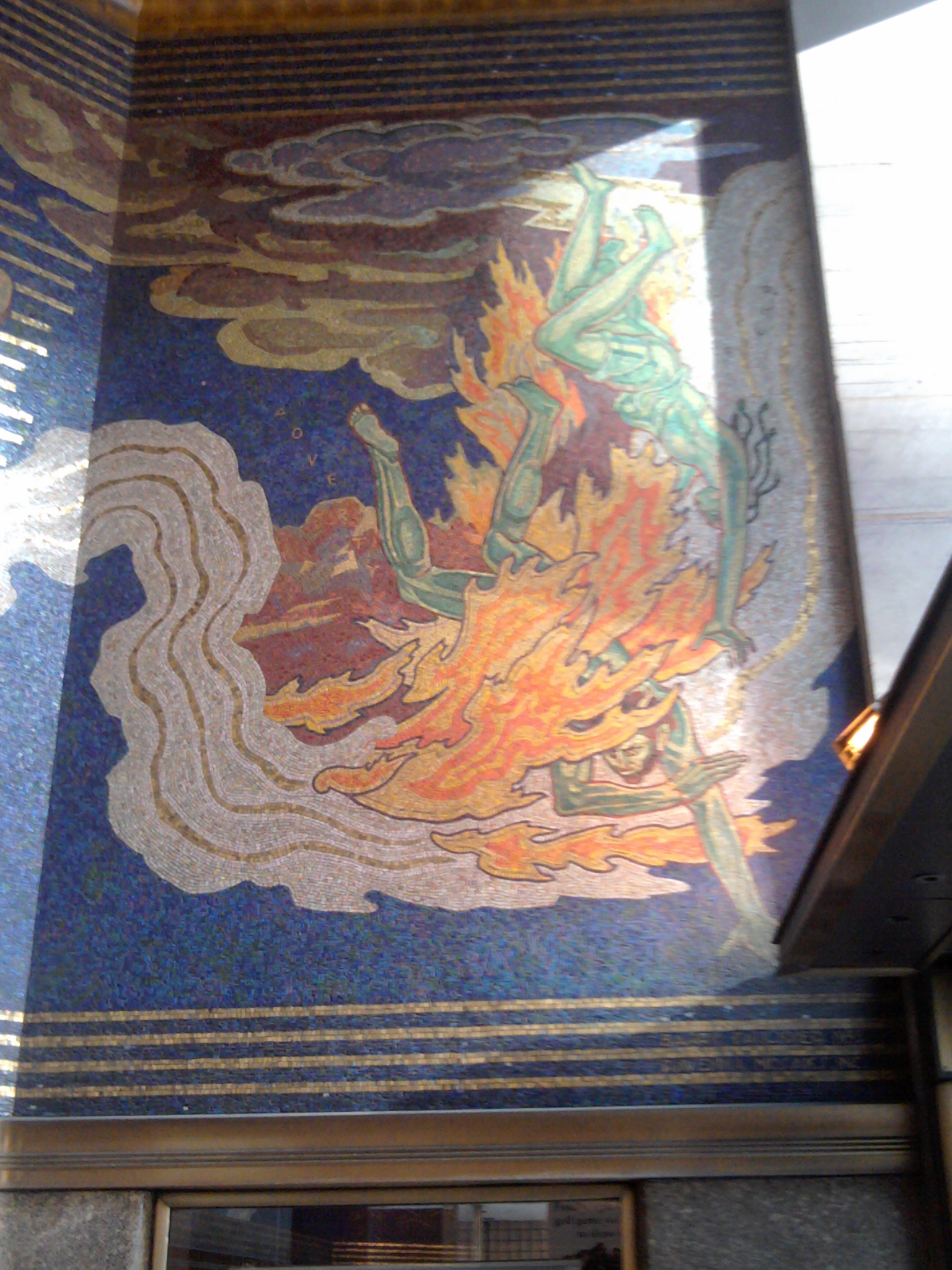
Now that they people are protected, demons like “Ignorance” and “Fear” can’t reach them, and they explode into flames:

Suck it, Ignorance!

This, then, is the ideal that workers at NBC (who know occupy the old RCA Building) encounter every morning when they arrive at work.

No matter what NBC champions, enlightening and protecting people through knowledge, however, is simply not what CBS stands for.

Elyse Anders recently started a petition to ask CBS Outdoor to take down a highly deceptive advertisement on the JumboTron on 42nd street in Times Square that suggests vaccines are somehow risky. The man paying for the ad, Joe Mercola, is as far I can tell the worst self-described medical expert ever to not leave a roll of gauze in a patient.

How bad is Mercola? So bad that the FDA sent him a letter demanding that he stop making illegal claims. As far as I can tell, he’s not getting better at what he does. Stephen Barrett of quackwatch.com has found that Mercola’s long history of fake medicine includes declarations that fluoride is unsafe. He opposes mammograms and amalgam fillings. Joe Mercola is a public health menace, and CBS is his willing and informed business partner.

CBS is now allowing this crank to put out misleading information that hurts children and the immunocompromised. CBS, in a real sense, is promoting things that only hurt its audience.

And they have not even responded to the torrent of letters protesting this filthy deal.

Vaccination is safe. It is effective. It is deeply unethical to take money to allow others to suggest otherwise. It is profit gained from a willingness to see children suffer. It is profit gained from a willingness to see people suffer from vaccine-preventable diseases.

It’s amazing how cheap CBS’s reputation was.

Writing letters (including a protest by the American Academy of Pediatricians) seems not to have an effect on CBS’s practices, so it’s time let the public know what CBS is doing.

Tweet @CBSOutdoor and @CBSTweet with the hashtag #VaxCBS to tell them how you feel about them running this ad. Maybe #justinbieber while you’re at it.

You might also write a letter to the relevant CBS executives:

Leslie.Moonves@cbs.com, Joseph.Ianniello@cbs.com, Richard.Jones@cbs.com, Angeline.Straka@cbs.com, AGAmbrosio@cbs.com, LJBriskman@cbs.com, GDSchwartz@cbs.com MDFranks@cbs.com, Wally.Kelly@cbsoutdoor.com, Dana.Wells@cbsoutdoor.com, John.Clements@cbsoutdoor.com, Bill.Murphy@cbsoutdoor.com, Jodi.Senese@cbsoutdoor.com, Richard.Sauer@cbsoutdoor.com, Richard.Ament@cbsoutdoor.com, Lou.Formisano@cbsoutdoor.com, Christian.Eidt@cbsoutdoor.com, Liz.Caprio@cbsoutdoor.com, Ray.Nowak@cbsoutdoor.com, Phil.Stimpson@cbsoutdoor.com

I appreciate it, folks.

RJB


The Week in Conspiracy (26 March 2011)

March 27, 2011

More news that validates everything regarding whatever position I advocated last week about who’s really in control. I mean, it’s staring you in the face, man! Or woman. Or reptillian-human uberlord.

JV — Did the AIDS crisis hinder or help the Homosexual Movement?

RE — In terms of finances, government-sponsored AIDS programs proved to be the goose that laid the golden egg, and millions of dollars of “health” funds has made their way into homosexual political/activist organizations. AIDS has the added “benefit” of helping to reduce the “surplus population,” in keeping with the New World Order’s relentless campaign against the proliferation of people. Unfortunately, the useful idiots that dominate the “gay” leadership have yet to figure that out, or if they have, they are silent so as not to loose their salaries, or possibly their lives.

Conspiracy Theory of the Week!

Almost forgot about this one! A group that seems to represent the (few probably delusional) family members of 9/11 victims (but sounds more like it is Architects and Engineers for 9/11 Truth) launched an ad campaign to raise an awareness of WTC 7. As badly as I feel for some of these people, I can’t help but remind you that your personal tragedy does not give you expertise any more than having expelled a child from her uterus makes Jenny McCarthy an infectious disease specialist.

That’s what I got for now, people. Keep the tin foil tightly wrapped!

RJB


Hurrah for Dr. Madden!

March 8, 2011

Last night, when Eve brought this article to my attention, she asked, “Do you remember Tom Madden?”

I imagined John Madden. “Yeah.”

“You know he’s an expert on the Crusades?”

How nice for John Madden, I thought. “No.”

Sensing that something was wrong with my brain, Eve said, “Thomas Madden, from the SLU history department?”

“Oh, yeah, yeah.” I said. I think I covered myself pretty well.

Turns out a few years ago Dr. Madden wrote an article that appeared in the National Review, called “Not Dead Yet,” about the Naked Archaeologist’s The Lost Tomb of Jesus. Calling Simcha Jacobovici a “Naked Archaeologist,” mind you, is like calling me a “Bejeweled Pro Wrestler”–he is neither an archaeologist nor is he naked. “Fully Clothed Failure” seems more apt.

Regardless, it was published in March 2008 to commemorate the one-year anniversary of the release of the  Discovery Channel’s misguided airing of James Cameron’s goofy documentary, and it seems to fit within the scope of this site.

Enjoy!

RJB


The Week in Conspiracy 6 March 2011

March 6, 2011

This week saw the beginning of the end. It’s all coming together now. If you can believe it, it’s even more sensational than the previous week, which I misidentified as the climax of history. That’s this current week. Yes. For sure this time. I know this because it was announced on Twitter that today, March 6, is the beginning of the world uprising.

Conspiracy Theory of the Week:

I’m not enamored with the judgment of The View’s producers putting Alex Jones on, so I am going to air an oldie but goodie, Alex Jones getting slapped around by…some guy:

RJB


What I Found at the TV Station…

February 26, 2011

On Thursday, after a morning setting up a website for my students to work on, I hopped into a taxi and sped off to the local CBS affiliate, WGCL. A few days ago, in my conspiracy theory post, I mentioned that I would kill to see the emails that they got following the chemtrail story they ran back on the 2nd of this month. Luckily, it did not come to killing. And I don’t think that I would kill to see them anymore. I might beat someone up to see them, but doing them in? Nah.

The emails that the station receives, I am told, are publicly available. Some of the emails that come in from viewers get forwarded to the station for archiving, and they are printed and grouped by month. The administrator who maintains the archive, if I understood her correctly, said that I was the first person ever to come in and ask to see the letters to the station since she had been there. So, wow.

Now, I was interested in the chemtrail responses specifically, but I was surprised by people the number of people just sort of writing in to say how pretty the anchors are or ask them out on dates, which made it one of the creepier folders that I have ever gone through. The chemtrail letters were were mixed in among responses to other stories.

Some of the replies went on for a couple of pages, but most of them were short thank yous for running the story at all. A fairly typical excerpt from the letters, most of which were addressed to the reporter, Jeff Chirico, would include Brent’s comments:

“If you have the opportunity, ask [Georgia Tech’s own] Dr. Jim St. John why the plane in the photo I provided kept turning around and spraying more chemicals in over a particular area. […] I assure you if you continue to report on this, you will be ordered to stop and if you dont your job will be taken from you. It has happened to dozens of other reporters who have taken the risk of uncovering government lies. […] Would you be willing to consider doing a report on the negative effects of fluoridated tap water? If so, I can provide government documents labeling fluoride as poison and would be more than happy to find respectable and qualified individuals to offer their opinion. Thanks again, I know that it can ruin careers if you even hint at the government lying about something.”

From a practical standpoint, many of these assertions are absurd, and they seem to me to be more of a retrofitting of an overarching narrative that can explain to Brent why nobody takes chemtrails seriously. For instance, the claim that exposing government lies will ruin the career of an investigative reporter must have provided a snicker in the newsroom. (Woodward and Bernstein’s careers certainly didn’t suffer from exposing a humdinger of a government whopper!) I would say that Brent is looking at the news, seeing that nobody is reporting on chemtrails, asking why, and coming up with an answer that accommodates his worldview. I would challenge Brent to find one reporter who was fired because they got too close to the truth. (This is not to say that there might not be people out there who have been fired for, among other things, talking about chemtrails, but a growing obsession with chemtrails may be a sign of something other than getting too close to the truth.)

Albert wrote in, but his message seemed confused.

“You did good by running the report… but are you REALLY following truth or are you a collared dog on a leash? […] The meteorologist [there were two] you had on was total disinfo. Contrails are like a propeller wash in a boat…they dissipate. PERIOD!!!”

He also tried to present undeniable proof, as he saw it, that the government was secretly spraying us, and he found that information on the web at http://downloads.climatescience.gov/sap/sap2-3/sap2-3-final-report-all.pdf. (Does anyone else sense something slightly amiss here?)

The report he linked doesn’t mention airplanes, doesn’t mention intentional spraying, doesn’t mention aluminum, and doesn’t in any way suggest that there is a vast government program to spray. It is an examination of the impact “anthropogenic aerosols,” and these seem to include the smoke from fires and different forms of pollution. The report’s introduction is accurate:

This report critically reviews current knowledge about global distributions and properties of atmospheric aerosols, as they relate to aerosol impacts on climate. It assesses possible next steps aimed at substantially reducing uncertainties in aerosol radiative forcing estimates. Current measurement techniques and modeling approaches are summarized, providing context. As a part of the Synthesis and Assessment Product in the Climate Change Science Program, this assessment builds upon recent related assessments, including the Fourth Assessment Report of the Intergovernmental Panel on Climate Change (IPCC AR4, 2007) and other Climate Change Science Program reports. The objectives of this report are (1) to promote a consensus about the knowledge base for climate change decision support, and (2) to provide a synthesis and integration of the current knowledge of the climate-relevant impacts of anthropogenic aerosols for policy makers, policy analysts, and general public, both within and outside the U.S government and worldwide.

Nary a word about spraying out of airplanes. PERIOD!!!

Matt wrote in to say:

“You guys have just diminished your credibility regarding the contrail/chemtrail issue. I suppose you didn’t read the Reuters article regarding the UN admitting they are doing chemtrail experiments for ‘global warming.’ You in your bias in only bringing in a “Dr.” for the opposing side of the issue in your story just makes this laughable. People are smarter and that’s why they’re turning off from this kind of propaganda and going onto real news from the Internet. Thanks for not bringing all the facts into the story. I recommend doing some research before diminishing your credibility on another issue.”

Clearly, some people are impossible to please. Matthew runs a film production house in Missoula, Montana, which he advertises in his signature line. A quick visit shows a number of projects related to all sorts of conspiracies, from the Illuminati to the Federal Reserve to…yes, the moon landing conspiracy. Yeah.

John’s letter to Chirico gives a short list of sources he encourages the reporter to read, including “Owning the Weather by 2025.” This was fascinating, but it also says in the opening lines that the technologies discussed are beyond current capacity and, on page 14, preliminary theoretical foundations have been discontinued by the government. Big fail for the idea that we are currently spraying! Also, it restricts the concept to its military applications (the actual title is “Weather as a Force Multiplier: Owning the Weather in 2025”), and the report mentions neither aluminum nor geoengineering. At the end, of his email, John adds,

“The problem with denial is it is built into people’s self-awareness, getting peopel to change their self-awareness is like changing a Zebra’s stripes. So those who deny the truth, right before their very eyes, must be ignored as they add no intelligent discussion, only blind ignorance and that includes your weatherman.”

A wonderful example of how one can justify to themselves not even listening to the other side. Folks like John have moved away from debate and negotiation to deliberately excluding anything that could upset their preexisting beliefs.

Snowleopard, from France, says:

“A handful of men controlled the world and its resources, they now want to control our health and fertility, they are desperate to bring down human fertility, that is why there has been a revolution in Tunisia and Egypt, the tyrant did not want to spray their people and their families with these [toxins] it is incredible that [dictators] have come to the limit, but [the] usa (cia, Illuminati, bilderberg) they do so without mercy. God save american people, it’s a good people but so blind, so blind (9/11).”

This was a truly novel interpretation of the revolutions in the Middle East, that the uprisings are apparently being orchestrated by America because the dictators are too nice. I don’t even know what to say to that. I have no doubt that Gaddafi, however, would not hesitate for a moment to spray his people. I read a report today that he was firing antiaircraft guns into crowds.

Katrina writes in and asserts: “The chemtrail pictures from all states sure do speak volumes, don’t they?” To which the only rational reply is, “They sure indicate that planes are flying over every state! But that’s about it!”

She encourages Jeff to follow up on the story and push the story into the national spotlight. By way of leads, she offers:

  • Bill Gates has dumped millions into geoengineering research.
  • In December 2010, 190 nations vowed not to move forward with geoengineering research. The US was NOT one of them.
  • Have our rain/snow tested for an increase in aluminum and sulfur
  • The World Health Organization reports 4 million lives will be lost each year to geoengineering our climate through aerosol spraying. The pollution from this science could have devastating consequences on our health and environment.
  • The US government published a document titled “Owning the Weather in 2025.”

The one that gets me is the suggestion that we test for increases of aluminum in our snow and water. Even if you find an increase, it does not tell you anything about where it is coming from. Sigh.

A new review of the week in conspiracy theory is coming out tomorrow. Thanks to Jeff Chirico and Cary Bond at WGCL for sharing the global response to their segment with me! Hopefully, I will see a real, live controlled demolition tomorrow morning. None of this silly 9/11 stuff!

RJB


The Week in Conspiracy: The I Should Be Grading Edition (20 Feb 2011)

February 21, 2011

I’m sorry if I got you all worried last week when I said that global events were coming to a head. It was this week. This week is the most consequential week in history as we scream toward the culmination of vast, unseen machinations. I swear.


Conspiracy Theory of the Week

David Horowitz is usually so wrong he makes me vomit blood, but this week he had a pretty funny Top 13 Zionist Animal Conspiracy Theories. I shall go back to opposing everything he has stood for for the last twenty years tomorrow.

RJB


Do We Need to Involve Shakespeare in this Argument?

February 20, 2011

Recently, novelist and attorney Scott Turow and other members of the Authors Guild wrote an op-ed piece for the New York Times called “Would the Bard Have Survived the Web?” in which the authors bemoan the prevalence of copyright infringement and piracy on the Internet. They warn of a dire future if copyright is not strictly protected:

Certainly there’s a place for free creative work online, but that cannot be the end of it. A rich culture demands contributions from authors and artists who devote thousands of hours to a work and a lifetime to their craft. Since the Enlightenment, Western societies have been lulled into a belief that progress is inevitable. It never has been. It’s the result of abiding by rules that were carefully constructed and practices that were begun by people living in the long shadow of the Dark Ages. We tamper with those rules at our peril.

Oh noes!!!1!!1 teh internets will send us hurtling back to the barbarity of the time before teh movable type printing press! I can’t imagine what relevance the early Middle Ages could have to the question of modern copyright law except to suggest an over-dramatic sense of Badness. Oh, and they also talk about Shakespeare for some reason. I say “for some reason” because, as the authors make clear, the first copyright law was enacted in 1709, almost 100 years after Shakespeare’s death. I don’t know, there’s something about the playhouses’ admission charge being a “paywall.” Plus, hey, Dark Ages=Bad; Shakespeare=Good.

The Turow piece has inspired a response from Kevin L. Smith, the Scholarly Communications Officer at Duke University. According to the Scholarly Communications Office, Smith is “both a librarian and an attorney experienced in copyright and technology law.” Smith says,

It seems a little bit unfair to critique these editorials because they are usually manifestly uninformed; several critiques of Turow have already appeared, and I don’t want to seem to be piling on.

Nevertheless…

…he does so. And I’m afraid I have to say, “A plague o’ both your houses!” On the one hand, I admit that my immediate reaction is “Oh, boo hoo, Scott Turow isn’t making enough money.” In addition, using a writer who made a nice living without modern copyright protection as an example of why authors need copyright protection is definitely a bit problematic.  Also, they were rude about my beloved Middle Ages.

On the other hand, Smith actually strikes me as “manifestly uninformed” and perhaps a bit hard of reading. For one thing, he attributes the New York Time piece to Turow alone. In fact, Turow has two co-authors, Paul Aiken and James Shapiro. Shapiro is the Larry Miller Professor of English and Comparative Literature at Columbia University. Among Shapiro’s publications are the books Rival Playwrights : Marlowe, Jonson, Shakespeare; Shakespeare and the Jews; 1599: A Year in the Life of Shakespeare and Contested Will: Who Wrote Shakespeare? He is currently working on a book called The Year of Lear: Shakespeare in 1606. Granted, Turow is the best-known of the three authors, but under the circumstances, it seems borderline dishonest to ignore the contribution of so eminent a Shakespeare scholar. Who do you think knows more about Shakespeare, Smith or Shapiro?

Smith summarizes Turow, Aiken and Shapiro’s argument as follows:

The core of the argument is that Shakespeare and his contemporaries flourished because their work was rewarded financially, owing to the innovation of producing plays in an enclosed environment and sharing the income from theater admissions with the playwrights.  Turow then analogizes this physical barrier to theater admission with the “cultural paywall” of copyright in order to argue that the Internet threat to copyright must be addressed with stronger laws.

This is a fair summary, as is Smith’s criticism of the analogy between theater admission and copyright. However, Smith goes on to say,

First, Shakespeare lived before there were any copyright laws in England….so his productivity is evidence that there are ways to support authorship other than with copyright.  In truth, it was not so much his share of theater revenues that paid Shakespeare’s bills as it was patronage.

In the first place, it should be noted that Turow, Aiken and Shapiro themselves note that the first copyright law was not passed until well after Shakespeare’s time. Secondly, the assertion that “patronage” was Shakespeare’s main source of income is simply not true. The acting company to which Shakespeare belonged had a patron. It had to: according to the 1572 Act for the Punishment of Vagabonds and for the Relief of the Poor and Impotent, any acting troupe that lacked an aristocratic patron was regarded as a group of vagabonds. Shakespeare’s livelihood, however, did not depend primarily on the company’s patron; he made a good living from the company’s earnings and business deals.

We don’t really know if Shakespeare himself ever had a patron. He dedicated two poems to the Earl of Southampton (perhaps significantly, he produced these poems when the theaters were closed because of an outbreak of plague), but we don’t know whether or not Southampton actually was Shakespeare’s patron. Regardless, any money he may have received from Southampton for these two poems is trivial compared to the income he earned as actor, shareholder and principal playwright for the Lord Chamberlain’s/King’s Men.

Smith further argues that

The second reason Turow’s choice of a hero for his piece is unfortunate is that Shakespeare was, himself, a pirate (in Turow’s sense), basing most of his best known plays on materials that he borrowed from others and reworked.  If Boccaccio, or Spenser, or Holinshed had held a copyright in the modern sense in their works, Shakespeare’s productions could have been stopped by the courts (as unauthorized derivative works).

While it is certainly true that Shakespeare’s plots are not original, Spenser and Boccaccio also borrowed material. Since none of them were affected by modern copyright law, it seems unfair to imagine what would happen if only Shakespeare were constrained by it. In addition, Boccaccio’s work would, I assume, have been out of copyright by the time Shakespeare was writing. Holinshed was writing non-fiction, so I don’t think he could have won a lawsuit against a playwright (think about what happened when the authors of the non-fictional Holy Blood, Holy Grail tried to sue novelist Dan Brown for plagiarism).

What I suppose I find most odd about both the Turow et al. piece and the Smith piece is that neither discusses the publication of Shakespeare’s works. We know there were pirated editions of Shakespeare’s plays printed in his lifetime; we also know that the acting companies, which owned the plays, weren’t too happy about such piracy. Shapiro discusses the publication process in Contested Will, so he knows all about it, and it seems more germane to the issue than the performance of those plays.

Shakespeare, what do you think of these two articles calling on you to defend two opposing positions?

That’s what I thought.

ES

Big shout out to Maria Walters, a.k.a. Masala Skeptic, of skepchick.org for pointing me toward the Smith article.