Who hasn’t at one time or another gone berserk? And by “gone berserk,” of course I mean become enraged, howled like an animal and then killed indiscriminately. What, just me? Ha ha, just kidding. Really.
But what does it really mean “to go berserk”? Berserks (Old Norse berserkr, pl. berserkir) were fearsome Viking Age warriors. They appear frequently in sagas, but it is difficult to separate legend from reality in the sagas. Sometimes they had supernatural abilities and sometimes they were stock characters–bullies who served as a foil for the protagonist. Where can we find the truth?
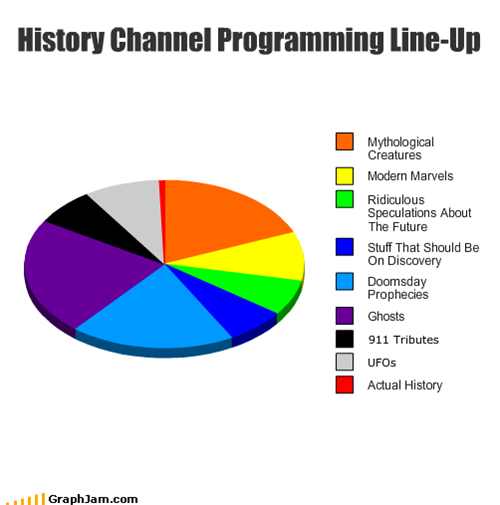
Where else but the History Channel. A few years ago History International ran a program called Unconventional Warfare. The first segment deals with the Trojan Horse. According to the narrator, no one really knows whether the story of the Trojan Horse is true or not, so you know off the bat that this is going to be another serious, hard-hitting, scholarly look at history.
The segment on berserks begins well enough, with information provided by real, genuine experts (and General Wesley Clark for some reason). Okay, the fact that the History Channel manages to bollox up their credentials may be a bit of a concern. They properly credit Ruth Mazo Karras as “Historian, Univ. of Minnesota,” but they identify Anatoly Liberman (more here) as a “Scandinavian Historian” at the Univ. of Minnesota as well. In fact, Liberman teaches in the department of German, Scandinavian and Dutch, and much of his work focuses on linguistics and philology. Similarly, they identify Paul Acker* as a “Norse Historian” at Saint Louis University, and, to be fair, he does look a bit like a Viking who’s given up raiding for academia. However, he is a professor of English rather than a historian. They don’t bother to give John Lindow (more here) any academic qualifications at all, identifying him as “Author ‘Handbook on Norse Mythology.'”
Regardless, the misidentified academics give a good summary of the berserks: they were fierce fighters who whipped themselves into a frenzy and fought in the front lines. In legendary tales, they are described as wearing bear or wolf skins (berserkr means “bear shirt”). They supposedly fought without armor and could not be harmed by weapons or fire. In reality, of course, they could be harmed and killed, but for the duration of the berserker rage, they may have seemed impervious.
But what, asks the narrator, caused the berserker rage? Acker says, “Through their training and initiations, they whipped themselves into frenzy: that’s part of their jobs.” The narrator, of course, knows better: “Some theorize, however, that the berserkers had a little help–from mood-altering substances.” Karras notes that “If you read a lot of modern works that refer to berserks, they talk about how they may have used either alcoholic beverages or perhaps hallucinogenic mushrooms to bring on the rage.”
Now, at this point, you can sense the word “however” hurtling across the room, desperate to make it before the camera cuts away, but, alas, to no avail. Magic mushrooms is what the History Channel wanted, and once someone mentioned them, they stopped. The point of Unconventional Warfare is to compare strategies used in the past to ones used much more recently. The berserks and their magic mushrooms are compared to Somali warriors who use a narcotic weed to become more aggressive.
None of the academics were told that this was the point of the segment. They only knew that the History Channel was doing a segment on berserks. When asked about the magic mushrooms, Acker and presumably Karras (quite possibly the others as well) explained that while some have speculated that the berserks used hallucinogens, there is absolutely NO evidence. There is nothing in the literature to suggest that the berserks used anything but training, natural aggression and the gift of Odin to work themselves into a frenzy. They may well have had a bit of a tipple now and then, but that hardly separates them from anyone else in Viking society.

If this is how they do history, perhaps it’s just as well that they stick with monsters and doomsday.
But enough about historical berserks; let’s talk about the literary and legendary ones–they’re much more fun. First the stock characters. These guys wander around, acting like bullies and intimidating people until they get their comeuppance from the saga protagonist. In Grettis saga, Grettir fights and kills a mound-dweller (an undead guy who attacks Grettir when Grettir is robbing his grave), a draugr (an ueber-nasty undead guy), a she-troll, a giant, a bear and lots of people. LOTS of people, including a number of berserks. Grettir meets a group of twelve berserks, led by a couple of brothers named Thorir Paunch and Ogmund the Evil.
They came from Halogaland and were bigger and stronger than anybody else. They would go berserk and spare nothing when they flew into a rage. They used to take away men’s wives and daughters and keep them for a week or two, then return them. Wherever they went, they used to plunder and cause other trouble (Saga of Grettir the Strong, p. 42)
Grettir pretends to befriend them, then gets them drunk and fights them (the alcohol is of no benefit to them, by the way). When they realize what is happening, the berserks, of course, go “berserk and [begin] howling like dogs” (p. 46). While they’re howling, Grettir thrusts a spear through Thorir and Ogmund, who bumps into him. Then he takes out the other berserks.
Later, when Grettir is staying with a man named Einar, a group of berserks arrive, and the leader challenges Einar “either to hand over his daughter or defend her if he was man enough” (p. 95). Einar consults with Grettir, and the berserk becomes impatient:
The berserk thought that Grettir and the farmer were stalling. He started to howl loudly and bite the edge of his shield. He put his shield in his mouth, spread his lips over the corner of it and acted like a savage. Grettir strode over to him and when he came alongside the berserk’s horse he kicked the bottom of the shield up into his mouth so hard that his face ripped open and his jaws fell down to his chest (p. 95)
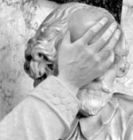
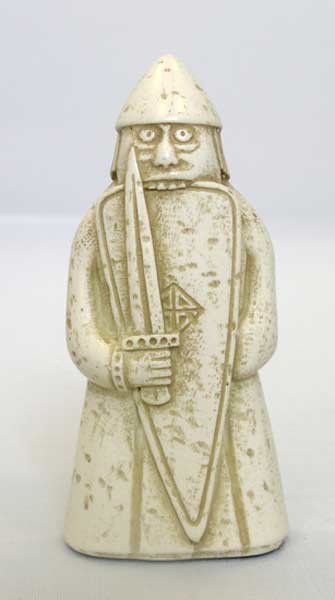
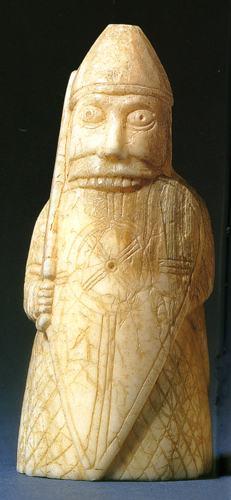
Then Grettir cuts off his head, and the other berserks decide to be on their way–rather quickly. Throughout the sagas, the beginning of the berserker rage is signaled by howling and shield-biting. Some of the Isle of Lewis chessman seem to depict shield-biting berserks:
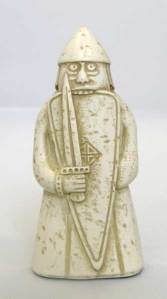
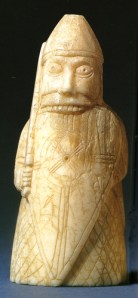 As far as I know, Grettir is the only person who has the sense to kick the shield back into the berserk’s mouth. Not all berserks are slightly comic bullies, however. Some have supernatural powers. Examples may be found in Egils saga. Egil was a great warrior, an exceptional poet and a truly phenomenal drunk (again, though, his drunkenness is unrelated to his frenzies). Jesse L. Byock has argued that Egil may have suffered from Paget’s disease, which has a genetic component. Based on his saga, Egil may also have suffered from a genetic predisposition for berserkerism.
Egil’s grandfather is named Ulf. He is big and strong and a good farmer. As evening rolls around, however, he turns bad-tempered and is known as Kveldulf or Evening Wolf. You might as well wear a name tag that says, “Hi, I’m a werewolf. Ask me how.” He has two sons, Thorolf and Grim, known as Skallagrim (Bald Grim). Thorolf is tall, strong, brave, handsome, honorable (by saga standards) and an all-round swell guy. Grim is big, strong, ugly, troublesome and, like his father, has a tendency to shape-shift. Skallagrim has sons named Thorolf and Egil. Thorolf II is a carbon-copy of Thorolf I. Egil is big, strong, freakishly ugly and has the family tendency to shape-shift. The non-berserk Thorolfs both die young; the berserks all die of old age.
In one of Skallagrim’s rages, he seizes one of Egil’s friends and “[dashes] him to the ground so fiercely that he was crushed by the blow and died on the spot” (Egil’s Saga p. 63). He then seizes twelve-year-old Egil, who is rescued by his foster mother who is “as strong as a man and well versed in the magic arts” (p. 63). Skallagrim is described by an enemy as being “as vicious as a wolf” (p. 42), and Egil is mistaken for a bear on one occasion (p. 104). According to the narrator:
It is said that people who could take on the character of animals, or went berserk, became so strong in this state that no one was a match for them, but also that just after it wore off they were left weaker than usual (p. 46)
Kveldulf, Skallagrim and Egil also tend to befriend people with similar berserker characteristics. For instance, there is Egil’s friend, Onund Sjoni: “Not everyone agreed that he was not a shape-shifter” (p. 130). Although Egil’s connection to berserker madness is less explicit than Kveldulf’s and Skallagrim’s, he performs one of the best killings in all the Icelandic family sagas. He is fighting a duel against a man named Atli, who is “strong and courageous, an experienced dueller, and skilled in the magic arts” (p. 128). Egil is able to hack Atli’s shield to bits and land blows, but the sword is unable to bite. His own shield is beginning to split, so
He threw down his sword and shield, ran for Atli and grabbed him with his hands. By his greater strength, Egil pushed Atli over backwards, then sprawled over him and bit through his throat. Atli died on the spot. Egil rushed to his feet and ran over to the sacrificial bull, took it by the nostrils with one hand and by the horns with the other, and swung it over on to its back, breaking its neck (p. 128)
Let this be a warning to you, History Channel: don’t mess with berserks.
ES
*Full disclosure: Professor Acker was my dissertation director. When the History Channel came a-filming, they collected several graduate students to sit listening in rapt attention while Prof. Acker delivered a faux lecture. We were cut.
References:
Byock, Jesse L. “Egil’s Bones.” Scientific American. Vol. 272. Jan. 1995, pp. 82-87
Egil’s Saga. Tr. Bernard Scudder. The Sagas of Icelanders: A Selection. New York: Viking, pp. 8-184.
The Saga of Grettir the Strong. Tr. Bernard Scudder. London: Penguin, 2005.


 Posted by Bob
 Skeptical Humanities
