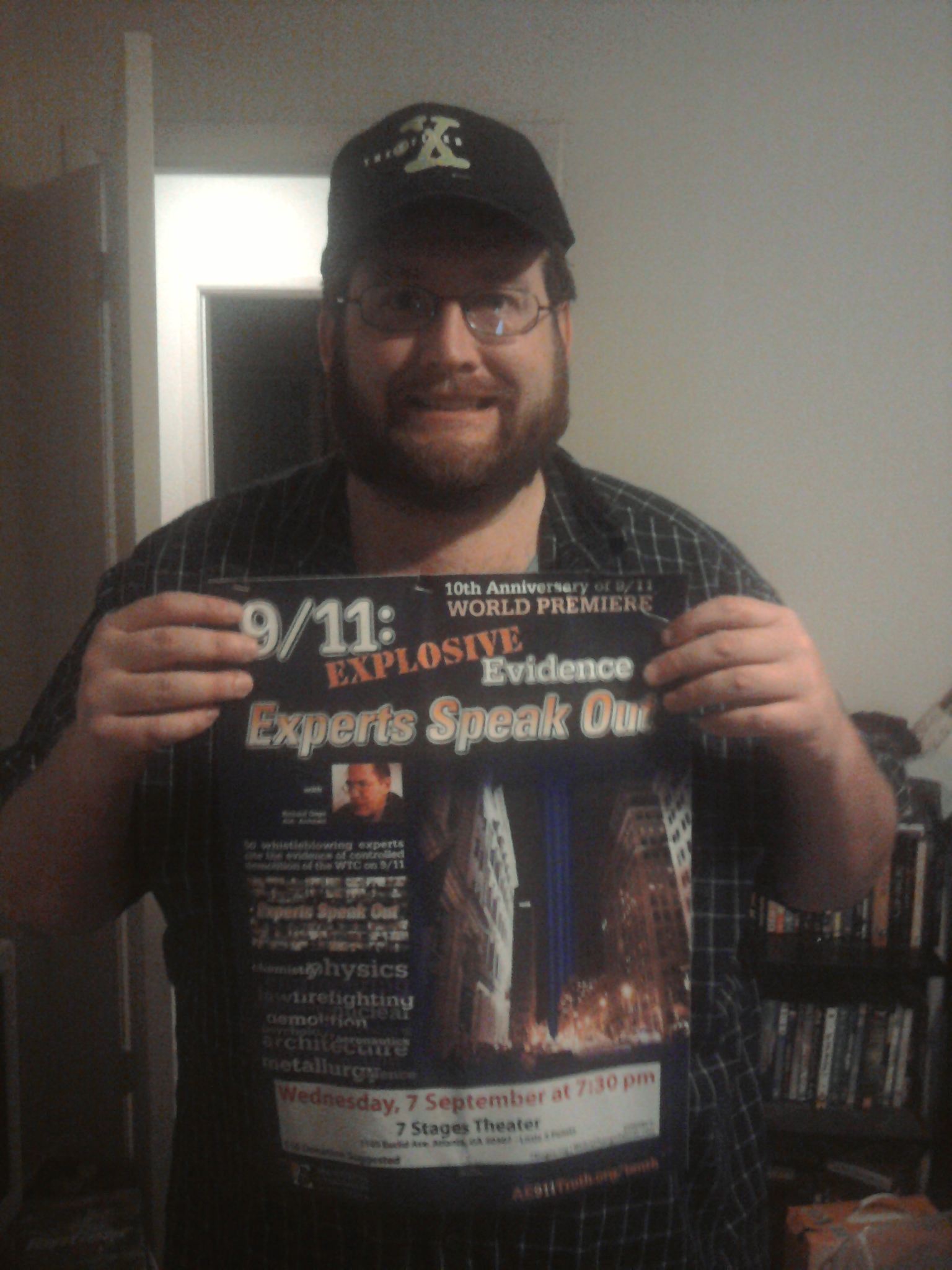
A very short This Week in Conspiracy (3 Oct 2011)

October 3, 2011

Another week, another colossal load of conspiracy dumped onto my metaphorical lawn, providing much needed nutrients.

The only reason I am allowing myself to write one up tonight is because I graded quite a lot. I even resisted the urge to push less-than-promising papers to the back of the pile; I just powered through them. So, my reward is to take an hour or so out of my insane life and do a little conspiracy theory round up.

Hitler. How could you possibly doubt this?

Bob;

Any human who has the capacity to research for let’s say…, 50 hours of hardcore internet and even library backup; for purities sake, of Communist history. Will find the Boleshivk’s were Zionist and Jewish and you are probably both. The cards are being flipped, so fast now, like a game of concentration. Flip, Israel; Flip, U.S.S. Liberty; Flip US of I; Flip, 911; Flip, Cast Lead; Flip, Israel; Flip JFK, RFK, MLK; Flip, US of I; Flip, Paper Clip; Flip; Israel, Flip, IAEA,; Flip, US of I; Flip, Nuke n Stratosphere, Hemisphere, Needle; Flip, Israel; Flip, Chinese in the West, Yiddish n the East, and Spanish down South and you penche gringos can have East of the Rockies, West of the Miss, North of Tejas, and South of Canada. Get used to equality; you’re all niggers now!

Conspiracy Theory of the Week:

From Eve: The Beatles Never Existed.

That’s all for now. I only had an hour and 15 minutes to write this one up. Next time there will be more, I promise. Would I lie to you?

RJB


…And on the fifth and sixth days, God created dragons

October 3, 2011

Are you sitting comfortably? Good, then we’ll begin.

In today’s lesson we’ll be discussing a wondrous book from the fine folks at Answers in Genesis. It’s Dragons: Legends & Lore of Dinosaurs, by Bodie Hodge, son-in-law of Ken Ham, and Laura Welch, with illustrations by Bill Looney, published by Master Books in the year of our Lord, 2011. Actually, now that I look more closely, I see that it wasn’t written by Hodge and Welch. Indeed, it wasn’t written at all. Rather, it was “compiled and edited” by Hodge and Welch. Was it divinely inspired? Divinely regurgitated? Just plain regurgitated from Answers in Genesis? It certainly wasn’t intelligently designed.

Actually, that’s a bit unfair: the illustrations are impressive, and there are many foldouts, little booklets and envelopes and Advent calendar-like windows to open. It looks like a fun kids’ book, like Dragonology: The Complete Book of Dragons or The Dinosaur Museum: An Unforgettable, Interactive Virtual Tour through Dinosaur History. The only minor problem with Dragons: Legends and Lore of Dinosaurs is its content.

Here is the basic argument, as I understand it: many cultures have dragon stories; therefore, there must be some truth in these stories. Many depictions and descriptions of dragons more or less resemble various dinosaurs. Sort of. Except for the bits that don’t really fit, but those can be dismissed. Thus, evolution is wrong.

It’s outrageous that impressionable children should be exposed to such drivel. The appalling grammar could have a devastating effect on them.

Oh, the science is kind of weak, too. And the history. And the authors’ grasp on mythology, folklore, theology, logic and literature is pretty shaky. But, my God, the grammar! I mean, how hard is it to write coherent, grammatically correct sentences in a 24-page picture book (and page 1 is the publication/copyright page)? If I were to share every inelegant sentence, I’d have to re-type the whole book, and that would be a violation of copyright. Also, I suspect my brain would try to escape. So, I’ll only be able to give you a brief sampling.

The authors preface their work by advising readers to

Begin at the place where truth has been shrouded by blind science and fact has been silenced for foolish mysticism and magic. Equip yourself with faith as your shield and logic as your sword. (p. 2)

Damn you, truth-shrouding blind science! Fortunately, the authors’ shield is strong. Their sword, however, is a limp clump of rusted metal. They note that there are many variations in the stories of dragons:

The challenges in deciphering these encounters is [sic] to separate possible fact from obvious fiction, taking into account clues found in the original translations of these events. (p. 2)

Another challenge are to make your subject and verb agree. But, as they say, it is always very important to go back to “original translations.” And what will you find in these works?

…terrifying creatures [that] were give [sic] names like Abraxas, Fafnir, Grendel, Brinsop, and Manasa. (p. 2)

Yes, they said “Grendel.” Yes, Grendel from Beowulf. Yes, they said that he’s a dragon. Indeed, in an insert dedicated to Beowulf, they say,

An ancient Anglo-Saxon account of the heroic Beowulf has him slaying fierce dragons that are plaguing the King of Dane [sic]. One dragon was named Grendel, and Beowulf kills both Grendel and its mother, another dragon. (p. 19)

Young Earth Creationists have an infuriating interest in Beowulf, but that’s a rant for another time and place. For now, I’ll just offer this:

CreatioWulf

Lo, we have heard in the days of yore of the folly of the Creationists, of the book-believers, how they made Grendel, man-shaped destroyer of the Danes, into a dragon, a dinosaur of old. That was bad scholarship.–from the Original Translation

Another place where we can find dragons is the flag of Wales. The red dragon (depicted on the flag) fought an invading white dragon:

Fearing destruction would continue, the dragons were tricked and captured while they slept, then imprisoned beneath the earth for centuries. (Insert p. 4)

Dear Mr. Hodge and Ms. Welch: It is not necessary to dangle every participle. Yours very sincerely, The English language.

There are also dragons in Peru:

Whether the ancient Nasca, Moche, or later Incan nation, Peru is known for dragons and many other pieces of art that illuminate dragons. (p. 5)

That sentence is so pain-inducing, I don’t even know what to say about it.  But never mind, to illustrate their point, the authors include pictures from “a couple of authentic Peruvian replicas.” Just in case you thought “original translations” was an anomaly, they offer up “authentic replicas.” In YEC world, up is down, translations are originals, replicas are authentic, and science works to obscure truth.

In a helpful, educational section, the authors provide the names used for dragons in various languages, including…wait for it…

Click to enbiggen

Austrian! AUSTRIAN! And no, in case you’re wondering, German is not mentioned.

I could go on, but I’m getting dizzy and queasy. The most terrifying thing about the book is the overwhelmingly positive customer reviews on Amazon. This one is typical:

This is actually a very interesting and fun to read book. despite the biased opinions of those who cling desperatley to their faith in evolution this book was not written by “nuts” but rather studied professors and scientists who have spent years reaserching the topic. I found the book was interesting however not for my younger son of two years but my older son of 4 found it fasinating. And it will not lead to an incorrect conception of science but a more wide view of human history and maybe even a greater imagination. This is a fantastic book. I highly recomend it. It even surprised me how big it was. I was expecting something a bit smaller but it turned out to be a much bigger book with very big nicely drawn pictures.

I don’t know where the author got the idea that Hodge and Welch are “studied professors and scientists,” but I can understand why he or she was impressed with the quality of the book’s writing.

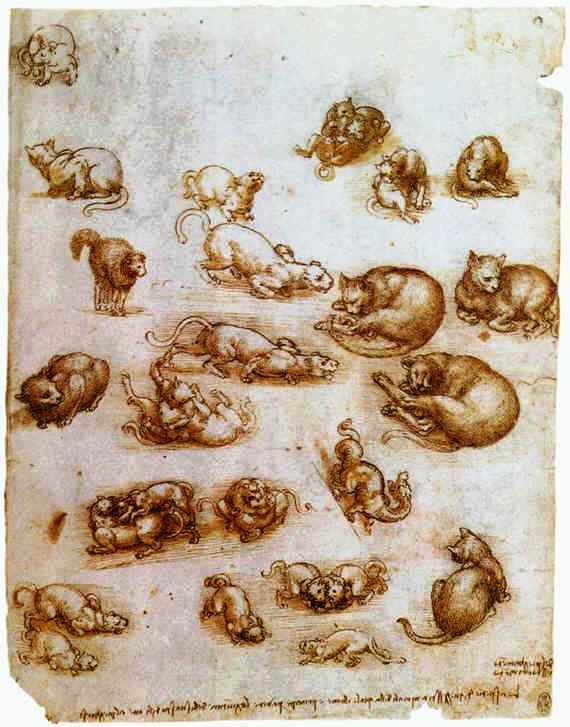
To end on a more cheerful note, here is an actual genius’s take on the evolution of the dragon:

Drawing by Leonardo da Vinci

ES


In Praise of Sutton Hoo Woo

September 14, 2011

All right, I admit it, I am writing this post mostly as an excuse to use the phrase “Sutton Hoo woo.” It’s a lovely phrase. Try saying it. Go ahead; I’ll wait.

See, wasn’t that satisfying?

More seriously, though, we’ve all heard psychics claiming that they have worked with the police and provided material assistance in finding missing persons and dead bodies and in solving cases. In every instance, these claims have proved to be dubious, at best. We’ve also heard of dowsers claiming to have found…well, all sorts of things using their magic sticks.

The excavation of the Sutton Hoo ship burial may be an instance where fringe beliefs actually did contribute to the discovery of a great treasure and human remains (sort of). Now, right off the bat, I should make two things clear: in the first place, it’s unclear to what extent unconventional beliefs contributed to England’s greatest archaeological discovery. Secondly, I’m not saying that anything extraordinary actually happened. Ghosts and magic sticks didn’t actually lead to the discovery, but the belief in ghosts and magic sticks may have acted as a catalyst. I guess what I’m saying is that someone who is a bit of a woo can also be a Big Damn Hero.

In this case, our Big Damn Hero is the delightfully named Mrs. Pretty. Edith May Pretty was the daughter of a wealthy northern industrialist. In 1926, she married Col. Frank Pretty, and the two of them bought Sutton Hoo House, a large Edwardian mansion near Woodbridge in Suffolk. In 1930, Mrs. Pretty found herself pregnant at the age of 47. Four years later, her husband died.

After her husband’s death, Mrs. Pretty became interested in spiritualism, frequently travelling to London to consult with a spiritualist medium. According to Joseph Allen McCullough, Mrs. Pretty “claimed to have strange dreams and visions of the place, including a vivid dream where an Anglo-Saxon funeral procession buried the body of their king inside a ship in the largest of the mounds.”  According to the video below, it was a friend of Mrs. Pretty’s who saw the ghosts:

Mrs. Pretty also had a nephew who was a dowser. He said there was treasure under Mound 1. Armed with this supernatural information, Mrs. Pretty decided to hire herself an archaeologist. She consulted with Guy Maynard, curator of the Ipswich Museum, who suggested Basil Brown, a self-taught but conscientious and successful excavator. She paid him 30 shillings a week and provided him with accommodation in the chauffeur’s cottage and the assistance of two estate workers (one of whom was named Tom Sawyer).

Based (allegedly) on the supernatural insights she had gained, Mrs. Pretty suggested that Brown excavate Mound 1.  Brown did begin to excavate Mound 1 (using a long probe designed by Mrs. Pretty), but concluded, logically if erroneously, that Mound 1 had been looted. Instead he turned to Mounds 2, 3 and 4. Mounds 3 and 4 were cremation burials that had been looted. Mound 2–one of the largest mounds–produced a number of scattered rivets. It was a ship burial, but it too had been looted.

The next year (1939), Mrs. Pretty again suggested that Brown excavate Mound 1. He did so, with extraordinary results. As with Mound 2, he found ship rivets, but in Mound 1, they were still in place. The dark coloration of the sandy soil also showed the outline of an enormous ship (larger than any other Migration Era or Viking Age ship yet discovered).  At this point, the Office of Works and the British Museum got involved, even though they had other things to worry about: the Office of Works was busy building airstrips, and the British Museum was busy crating up its treasures and sending them to the London Underground for safekeeping in anticipation of WWII. Consequently, the initial excavation was a rather hurried affair, but worth it. Mound 1 proved to be an unlooted, probably royal Anglo-Saxon ship burial:

The ship

The helmet

Recreation of helmet made by Tower of London armourers

Buckle

Shoulder clasp

No body or bones were actually found, but in subsequent excavations, phosphate traces were found in the soil, suggesting that a body had once lain there. The soil is highly acidic; almost no wood from the ship survived either.

After the treasures were unearthed, a coroner’s inquest was held to decide who was the rightful owner: the crown or Mrs. Pretty. The court decided that the treasure belonged to Mrs. Pretty. Martin Carver, who led the most recent excavations at Sutton Hoo, describes what happened after the inquest:

Charles Phillips [who led the British Museum excavation] mentions family pressure to keep the jewellery, but Mrs. Pretty’s own position is less certain. Her spiritualist counsellor soon came to stay with her, and Phillips took a stroll with him that evening on the heath, volunteering his opinion that a presentation of all the finds to the nation “would be a splendid gesture” (Carver, p. 22)

Ultimately, Mrs. Pretty did donate the treasure to the British Museum, “thus making the most generous donation to the Museum ever made in the lifetime of a donor. Mrs Pretty was offered the honour of Dame of the British Empire, which she declined” (Carver, p. 22). The treasure was then taken to the London Underground for the duration of the war.

So, how much influence did spiritualism and dowsing have in the discovery of the ship burial? I have no idea. Certainly, some of the claims seem exaggerated. Carver downplays the influence: “whatever her sensitivity to the attentions of solicitous phantoms, Mrs Pretty was no stranger to scientific archaelogy” (p. 4). She had visited the pyramids in Egypt, and her father had gotten permission to excavate the remains of a Cistercian Abbey near their family home in Cheshire:

She would have been aware of the responsibilities of excavating burial mounds, and had already refused to allow enthusiastic amateurs to try their hand. In her case a keen eye and an educated curiosity would have encouraged investigation as surely as any interest in the other world. (Carver, p. 4)

More importantly, there is nothing mystic about the discovery: Mrs. Pretty lived on an estate that had big, honking mounds in the back yard. No one knew exactly what they were, but the idea that they were burials was hardly outlandish. And with pagan burials comes treasure. There had been rumors of treasure for centuries. Certainly the looters thought there was treasure. Nor is the interest in Mound 1 particularly surprising. It’s really big (admittedly, so is Mound 2).

Still, it seems likely that Mrs. Pretty’s interest in spiritualism and her faith in her nephew’s dowsing may have played some role in her decision to hire someone to excavate, and her spiritualist medium may have encouraged her to donate the treasure to the British Museum.

Edith May Pretty: First Class Woo.  Big Damn Hero.

ES

REFERENCES:

Bruce-Mitford, Rupert. The Sutton Hoo Ship Burial: A Handbook. London: British Museum, 1972.

Carver, Martin. Sutton Hoo: Burial Ground of Kings? Philadelphia: University of Pennsylvania Press, 1998.


This Week in Conspiracy 9/11/11

September 11, 2011

I wouldn’t have thought ten years ago that I would be doing what I’m doing now, blogging the strange ins and outs (mostly outs) of the conspiracist mind. If you haven’t heard, it’s been a decade since the World Trade Center attack. The country has not yet fully recovered from that incomprehensible day. I remember groping for some semblance of a narrative to explain what was unfolding in front of my eyes, and I clearly remember the sense of watching the second tower collapsing with a sense of the unreal.

Eventually that narrative emerged, but there are, as always, holdouts against reality, and to these people I now turn. There may be some old stuff in here. The deluge of 9/11 conspiracist stuff I’ve gotten on Twitter this week includes a lot of rehashed, long debunked stuff, especially youtube videos.

  • Who controlled the planes?
  • Wow. I found something worse than Rebecca Black. It was through David Icke’s site. This greasy cheese-eating troll and his bopping idiot consort better never meet a family member or they’re going to get disemboweled:

And that’s all. We’ll have double dose next week, as there is a lot of stuff I could not get to, like, all the non-9/11 conspiracy theories.

Update: A few weeks ago the archive.org put up a collection of 9/11 related news from the day of the attacks and other materials. I am told (below) that it is a woo-free zone.

RJB


Interview with American Freethought

September 11, 2011

I caught up with John and David from the American Freethought podcast at Dragon*Con, and they asked me to be on their show for the 9/11 episode. That interview is up right now. Go. Listen. Subscribe.

I am currently working on the 9/11 version of the “week in conspiracy,” but there is a lot. Go figure.

RJB


Superstitions as a Window Into Culture: Whooping Cough Cures

September 7, 2011

As Dragon*Con approached, I gathered my thoughts and made notes for a panel about superstition. As you might imagine, while as a general skeptic I have some opinions about the matter, I found that I was having a hard time conjuring examples on the fly.

Bother.
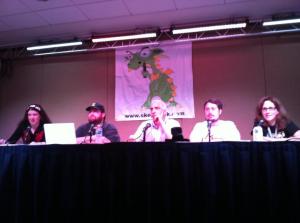
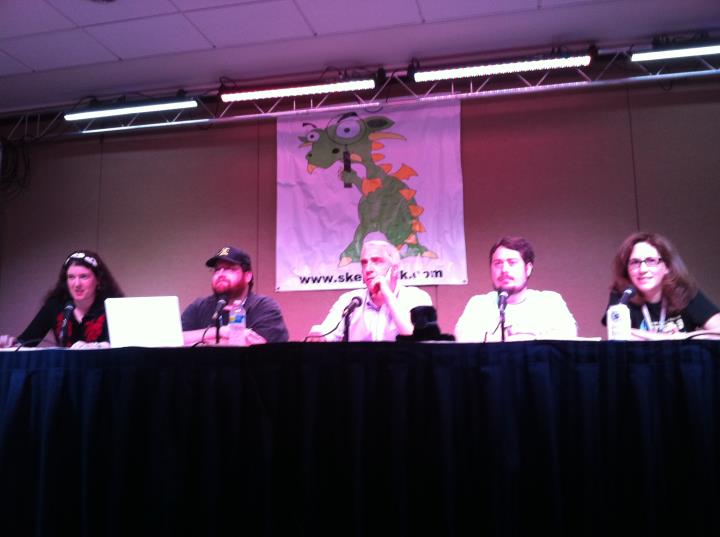
Dragon*Con Superstition Panel: Kylie Sturgess, Bob Blaskiewicz, Steve Novella, Stephen King, Barbara Drescher (photo by Maria Walters)

Enter Opie and Tatem’s Oxford Dictionary of Superstitions, which I picked up and started reading a few weeks ago. It opens with a surprising use for adulterers: if you secretly rub your warts on them, you will be cured. Personally, I think that this was more likely an adulterer detection test–rub your warts on the suspected adulterer and if the warts clear up, well, it’s a mixed blessing.

The volume focuses on the folk wisdom and superstitions in the British Isles, but I find that by reading them, really do get a sense of the ways of life of the people who embraced the practices. In fact, the type of superstitions that you encounter can tell you a lot about the region it comes from. In a fishing community, if you saw a bowl turned over, you might be wary of going out in your boat for fear of capsizing. In a mining town, if you found your work shoes tipped over in the morning, you might be excused for not going down in the hole that day. Superstitions reflect the fears, hopes and values of the people who harbor them.

You can tell a lot about the lives from people from what they fear. As most of the superstitions in the Oxford Dictionary date from the 19th century and earlier (there was intense interest in “collecting” folklore in the 19th century), they reflect the concerns of rural, largely agricultural communities, for instance, warding off droughts and keeping your pollinating bees in the loop about the head of the household’s health. Hives were abandoned, however, and droughts still occurred, perpetuating the need for the superstitions. But I found something I was not expecting as I sifted through this tome, something that spawned so many proposed cures and protections in all ages across the British Isles that it must have been a matter of near-obsessive concern–whooping cough.

Now, the compilers of the dictionary did not miss the importance of the themes running through the superstitions, so even though a whooping cough cure might be listed under “caterpillar” and another under “running water,” those two entries will also be found in the subject index under “whooping cough.” This is a very useful index. Now, the dates that I am giving here are approximate–sometimes the source is a printed interview of remembering their childhood–for the most part, however, the superstition was alive within the lifetime of someone living when the reference was made. Also, I should point out that with a single exception, the metaphorical interpretations that follow are my own, though I think that they are realistically plausible speculations.

A number of clear themes in British superstitions surrounding whooping cough emerge from the catalog assembled by Opie and Tatem. One motif that sticks out–and illustrates that everyone knew exactly what was at stake when a child contracted whooping cough–is the theme of burial, which appears in a number of guises. The most straightforward example is the practice, recorded in the 1830s, of “dipping the persons affected nine times in an open grave” (49). Modified versions of this dipping practice–perhaps an allusion to baptism, or possibly trying to “fake out” death by pseudo-burial–appear at other times as well. One that is clearly related is to take a child to a mill and dipping them in the hopper. As late as the early 20th century, people recalled patients being taken to a grain mill during an epidemic, and the miller starting up the mill and saying, “In the name of the Father, Son and Holy Ghost, grind away this disease.” You might have to repeat this several times for optimal results (248). A shallower burial might suffice, when one digs a shallow hole and puts the patient face down to breathe into it, possibly to bury only the disease itself (48). Another version was to take a child into a cave. In the 1810s, one might seek to propitiate the “aerial beings” by taking the child into a cave and chanting: “Hob-hole Hob! my bairn’s got kink-cough: take’t off; take’t off” (67). Opie and Tatem found a machine age variation on this theme, hanging the head of a child out of the window of a train going through a tunnel (321), because if fresh coal smoke doesn’t cure an irritated respiratory system, I don’t know what will.

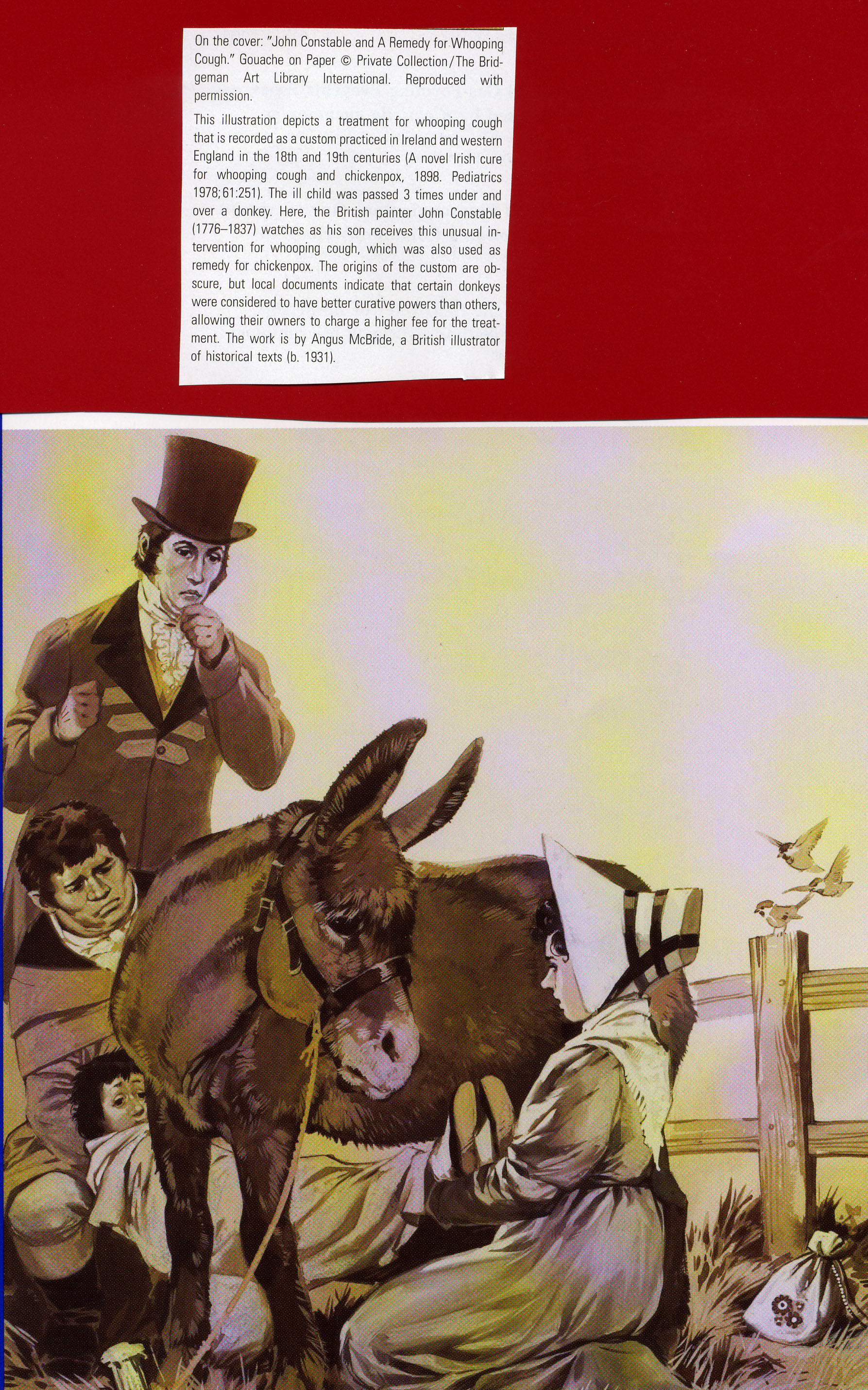
Cures for whooping cough often involved a surprisingly large amount of cruelty to very small animals. For instance, there is a whole suite of superstitions that involve hanging something from the afflicted’s neck. The whooping cough, of course, constricts the airways of very small children, and the attention to the neck may reflect an application of the magical cure to the site of the problem. In the 1850s, one might take a caterpillar and put it in a little bag around a baby’s neck. As the caterpillar died, so did the cough abate (64). a decade later, you might take a dead beetle, hang it around the neck of a child with whooping cough and as the bug rotted away, the cough vanished too. In the 1890s, one might take nine hairs off the back of a donkey (there’s that number 9 again), put it in a bag around the neck of the sick kid. When I wondered why the hell one would look at a donkey’s back and say, “Hey, that could be a cure for whooping cough!” I found an interesting photo:

Donkeys.

Donkeys have dark crosses on their back! Now this is really interesting, and now I wonder if the story of Jesus riding into Jerusalem on a donkey in the Bible might have been inspired by this probably fairly common sight. The cross then becomes a sort of divine butt-print and an ever-present reminder to the faithful of that particular story. Clever that! [Note: see Pacal’s excellent correction below!] Also, this suggests reasons for a really bizarre cure, passing the child underneath a donkey, which was recorded in the 1820s and remembered as late as the 1930s (122-123). This also seems to be related to a few other practices, for instance, passing the baby underneath a piebald horse (305). Also, one might pass the child through the arched roots of a bramble bush, specifically cited as a symbolic rebirth (37). Lacking a donkey, you could pass the child under the belly of a piebald horse, whose breath was also thought to be curative (305-306).
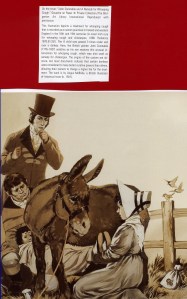
Courtesy Bill Atkinson.

Getting back to things that were traditionally hung around the neck of children, items usually associated with squeezing were also employed, including the corset lace of the child’s godmother (with 9 knots in it!) or the garter of the child’s godfather (174-175).

Getting back to cruelty to small animals, in the 1850s, one might pass small snails between the hands of the afflicted and hang them by a string in the chimney. The cough was thought to leave as the snails died. An earlier version involved wrapping a house spider in muslin above the mantle and letting it die. One might also feed the hair of the sick baby to a dog, hiding the hair in bread and butter. If the dog dies, the baby will recover. Lastly, in the 1850, one might consider “[p]utting a trout’s head into the mouth of the sufferer and…letting the trout the breathe into the child’s mouth.” I wonder if this one too had a symbolic association with asphyxiation, though I could be wrong be wrong about that; it was also thought that putting a live toad’s head in your mouth would transfer the sickness to the toad (170). You could also try a soup with nine(!) frogs in it, as was recorded in Yorkshire. For some reason, it was important that nobody saw the frogs as you carried them home and prepared the soup, especially, I imagine, the person who was sick (170).

Trout were considered an important curative, it seems, for whooping cough. An interesting one remembered in the 1930s suggested that drinking milk a trout has been made to swim in would be beneficial. You could also drown the fish in beer, which you then drank (162-3). Other lactic treatments for the “kink-cough” included drinking new milk from a wooden bowl made of holly (201), though ivy-wood bowls worked too (214), and, in the 1860s, “For the Hooping cough . . . let the patient drink some milk which a ferret has lapped” (148).

An especially innovative cure involved feeding afflicted children either roasted or fried mice. Also you could powder mice and put them into the patient’s morning and evening beverage (268), though, as Barbara Drescher observed at the panel, if you add water to powdered mice, you just get mice. Pliny, by the way, thought that serving a boiled mouse to a child cured bedwetting (267-8). Useful little guys.

There are comparatively few overtly religious superstitions. In a practice that went back to at least the 1770s, those afflicted with whooping cough would go to Catholic Chruches to drink out of the challice after Mass, even Jews, it is reported (93-4). Of course, if you don’t like going into churches, you can always fast on a Sunday and carry a sick child to three parishes (298).

A kid with whooping cough is a miserable creature indeed; how could you possibly make him more miserable? Well, how about forcing him to drink seawater at low tide? When he vomited, the sickness was thought to disperse on the tide with the sick (407).

Lastly, two superstitions that I simply can’t even imagine how they were supposed to work. Porridge made over a stream flowing from east to west was thought to be a better remedy than any old porridge (430). Finally, you could give the afflicted a piece of bread made by a woman who has successively married two men, both of whom shared the same last name; this is apparently a variation on the older tradition of taking the bread of a woman who did not have to change her surname when she married (277).

As you can see, the variety and strangeness of the folk cures for whooping cough reveal how horrible the disease was and suggests the lengths that people would go to to cure it. We don’t have these superstitions anymore. We don’t need them. We have safe and effective vaccinations. Adults who have not had a dTap (or tDap) booster in the last 10 years should plan to get vaccinated during their next checkup. Write that down. You don’t do it for yourself as much as you do if to keep clear the narrow airways of children too young to be vaccinated.

Congratulations to Maria Walters, Jamie Bernstein, and the original MoFo herself, Elyse Anders, for the Women Thinking Freely pertussis booster clinic at Dragon*Con. Special thanks to Bill (“The Amazing Bearded Man”) Atkinson of the CDC and the workers from the Cobb County Health Department who made it possible and to the folks at Dragon*Con who put aside space for us. Thanks to Sanofi who donated 100 doses of flu vaccine to the cause of public health, one dose of which I am currently enjoying with minimal autism–it was very popular and we were out quickly. We managed to give out 250 doses of whooping cough and flu vaccine. Next year, we’re going to rock it even harder!

Bob and Eve get shot at Dragon*Con. FLU shot!

RJB

Reference:

Opie, Iona and Moira Tatem. Oxford Dictionary of Superstitions. New York: Oxford UP, 1996.

Nellie Vaughn: The Vampire who Wasn’t a Vampire

July 21, 2011

Nellie Vaughn was never a vampire. Now, you may be saying, “Well, duh!” but the point is that she was never suspected of being a vampire by her family and friends. Her body was never exhumed*; she was never found to be in an insufficient state of decomposition; her internal organs were never removed and burnt. This all may seem very normal. After all, most people are spared the indignity of being dug up and burned as vampires. What makes Nellie unusual is that nearly a hundred years after her death, she acquired an undeserved reputation as a vampire, and her story illustrates how legends can develop.

Between (roughly) 1790 and 1899, at least a dozen bodies were exhumed in New England because family members and neighbors suspected them of being vampires. Actually “vampire” isn’t the right word. The people involved in these rituals apparently didn’t use the word and, according to George R. Stetson, weren’t even familiar with it. Rather, they were trying to halt the relentless depredations of consumption.** As folklorist Michael E. Bell notes in his excellent book on the subject, Food for the Dead: On the Trail of New England’s Vampires, the New Englanders seem to have been practicing a kind of folk medicine by digging up people who had died of consumption and burning their hearts (and sometimes their livers and lungs). Sometimes the ashes were mixed into a solution and given to an afflicted family member as a treatment. The term “vampire” is convenient though, but keep in mind, these were not animated corpses wandering around and sucking people’s blood.

The best known of these New England vampires was the last, Mercy Brown. Her mother Mary died of consumption on December 8, 1883; her sister Mary Olive died six months later on June 16, 1884. Several years later, Mercy’s brother Edwin became ill and left for Colorado, the climate of which was thought to be salubrious for consumptives. For a while, his condition seemed to improve. Meanwhile, Mercy became ill and died at the age of nineteen on January 18, 1892. Around the same time, Edwin’s condition deteriorated, and he returned home to die. Friends and neighbors urged Mercy and Edwin’s father George to have the bodies of his wife and daughters exhumed. George himself did not believe in this superstition, but he acceded to the wishes of his neighbors and, in March, sent a message to Dr. Harold Metcalf, who had treated Mercy, asking him to autopsy the bodies. George did not attend. The two Marys, who had been dead between seven and eight years, were essentially skeletons with some tissue and hair still attached. Mercy, who had been dead for only a couple of months, hadn’t even been buried yet: her body had been stored in a crypt until the ground became soft enough to dig a grave. Dr. Metcalf removed the heart and liver and declared them to be in the condition one would expect. Nonetheless, the neighbors burnt the heart, mixed it with water or medicine and gave it to Edwin. He died shortly thereafter.

The exhumation of Mercy’s body received a great deal of publicity almost immediately. The reporters who wrote about the event were familiar with the word “vampire” and the European vampire tradition and imposed certain sensational elements onto the Mercy Brown story. An article about Mercy Brown was found among Bram Stoker’s papers.

Although Mercy Brown is the best-known of the New England vampires, she was not unique. Similar rituals occurred all over New England, but especially in Rhode Island and the area of Connecticut that borders Rhode Island. Nellie Vaughn was not one of the vampires. According to her death certificate, she died of pneumonia, not consumption; there seem to have been no other deaths in her family that could blamed on her. But somehow, by the 1970s, she had earned a reputation as a vampire. This reputation has attracted visitors and vandals to the cemetery behind the Plain Meeting House Baptist Church in West Greenwich, RI. In 1977, a newspaper article reported that Nellie’s was

the only sunken grave in the cemetery and continues to sink into the earth. “No vegetation or lichen will grown on the grave,” reports a local university professor[,] despite numerous attempts by grave tenders and the curious. Along the bottom of the grave are inscribed the words, “I am waiting and watching for you” (qtd. in Bell 82)

Oooh, spooooky. But a creepy inscription does not a vampire make, especially if the inscription is a perfectly common sentiment looking forward to resurrection and reunion in heaven (and the inscription was probably chosen by Nellie’s parents). There has to be more to it than that, surely. Well, yes, there is.  The historic church is remote and only has a semiannual service. Otherwise, it is boarded up (its apparent abandonment may itself attract vandals). According to a 1982 article in the Providence Journal-Bulletin:

“As far as we can tell, it started 15 years ago when a teacher at Coventry High School told his students that there was a vampire buried in a cemetery off [state route] 102,” reports church historian Evelyn Smith (qtd. in Bell 82).

The teacher didn’t name the vampire or the cemetery. Presumably, he meant Mercy Brown, buried in Exeter, RI, but some intrepid students, armed with this lack of information, went on a vampire hunt and found Nellie Vaughn, buried in West Greenwich, RI. Her age was about right, her date of death was about right, and there was that spooky inscription. Mission accomplished: vampire found.

There’s a problem with this explanation, though. Bell went to West Greenwich and interviewed a number of people, including former town clerk Cora Lamoureux and unofficial town historian and genealogist Blanche Albro. They were understandably upset by the vandalism to the church and graveyard and by Nellie’s undeserved reputation as a vampire. As Blanche said:

[W]e never had one [a vampire] ’til this kooky teacher. And the only reason she started it, ’cause it says, ‘watching and waiting for you’ on her stone in the cemetery (Bell 86).

Notice how the teacher from Coventry, who was a “he” in the newspaper article, has become a “she?” Bell was never able to track down the teacher from Coventry. People said they knew who he/she was–Blanche said her nephew was there when the vampire story was told–but Bell was never able to get a name or details. So, while the story seems plausible and may indeed be true, the “teacher from Coventry” seems to have a whiff of legend about him/her (as does the professor at the local university who reported that no vegetation grows on Nellie’s grave). He or she has become part of the story. Bell equates the teacher with the FOAF (friend of a friend) who tends to be at the center of urban (and rural) legends.

But, wait, there’s more! Now Nellie’s become a ghost, and why? because she’s pissed that people think she’s a vampire. Charles T. Robinson, in his book New England Ghost Files, reports on the experiences of Marlene Chatfield, who has had several ghostly encounters with Nellie. On one occasion, a woman’s voice said, “I am perfectly pleasant.” As quahog.org notes, this “must be some kind of ghost code for ‘I am pure evil,’ because red scratches then appeared on [Marlene’s] husband’s face, prompting him to leave the cemetery.” On another occasion, Marlene met a young woman in the cemetery who said she was with a local historical society. When they got to Nellie’s grave, Marlene asked the woman what she thought of Nellie’s reputation as a vampire. The woman said it was silly. Then her behavior changed, and she began repeating the phrase “Nellie is not a vampire.” Marlene freaked out and hurried back to her car. When she looked back, the woman was gone! [cue spooky music]. Marlene believes that Nellie’s ghost returns because she is troubled by her reputation as a vampire. This is why she assures people that she is perfectly pleasant. Her assertion would be more compelling if she didn’t then attack people.

For those keeping score:

  • Nellie is a vampire
  • No she isn’t
  • The story was started by a teacher from Coventry
  • Maybe it wasn’t
  • A college professor said no vegetation grows on the grave
  • Maybe he didn’t
  • Nellie’s ghost appears because she’s unhappy that people think she is a vampire
  • She claims to be perfectly pleasant
  • She isn’t

This, gentle reader, is how legends are born and grow. One woman Bell interviewed not only believed that Nellie Vaughn was a vampire but that the semiannual service at the Plain Meeting House Baptist Church was a black mass attended by devil worshipers. Because of vandalism, Nellie’s gravestone has been moved to an undisclosed location (it had been broken up). Now that no one knows where the grave is, grass grows on it.

I keep saying that Nellie Vaughn’s reputation as a vampire is undeserved, but, let’s be fair, Mercy Brown doesn’t really deserve the reputation either. The poor girl lost her mother and her sister, watched her brother get sick and then died herself at nineteen. Then people hauled her out of her temporary crypt, cut out her heart and liver and burnt them. And it didn’t help her brother. Because of Mercy’s fame, her grave has also attracted vandalism (at one point her gravestone was stolen) and stories of hauntings.

But while we know that she was thought to harbor some sort of evil influence, there is something odd about her story as well. I’ve given the chronology above: Mercy’s mother and sister died years before Mercy began showing symptoms of consumption, and, although she predeceased her brother Edwin, he became ill before she did. Therefore, Mercy herself could not conceivably have been responsible for her mother’s and sister’s deaths nor for her brother’s illness. This doesn’t seem entirely logical and doesn’t fit with the pattern of European vampires. None of the contemporary reports explains this discrepancy, but it seems likely that the malevolent force that was held responsible for consumption infected the dead in much the same way that consumption itself infected the living. It may have moved from one corpse to the next. The corpse with the (reasonably) fresh heart was the one that was currently infected by the evil.

*Actually, her body was moved from a family plot to a public cemetery, but the exhumation had nothing to do with vampirism.

**I use the non-medical term “consumption” advisedly. While “consumption” usually refers to primary pulmonary tuberculosis, it could also be applied to other respiratory ailments.

ES

REFERENCES:

Bell, Michael E. Food for the Dead: On the Trail of New England’s Vampires. New York: Carroll and Graf, 2001. Will be reprinted in Oct. 2011. Currently available as an e-book.

Stetson, George R. “The Animistic Vampire in New England.” American Anthropologist 9 (1896): 1-13.


Was the Flag Raising at Iwo Jima Staged?

June 18, 2011

Oh, I’m getting rusty, people. I almost let this one slip past me. About a month ago I was listening to On the Media, one of my favorite podcasts. Paul Waldman and Peter Gourevitch were debating whether or not we needed to see an image of Osama bin Laden’s corpse. (I happen to think not, but whatever.) This exchange took place:

PAUL WALDMAN: We didn’t need the photograph of the Marines raising the flag at Iwo Jima to make us understand that we had won World War II, but it communicated a great deal about what we understood about that event, what it was supposed to represent, what it was supposed to tell us about us.

PHILIP GOUREVITCH: The image of Iwo Jima is exactly the opposite. It happens also to be a staged reenactment, as we now know, but it’s an image of American soldiers triumphing over intense adversity at the end of a grueling battle, hoisting their flag in pride over their nation. What you’re talking about is a headshot of Hitler with his brains blown out and showing. We don’t have that. And I don’t think there’s been a failure to achieve closure on World War II in the absence of it.

I groaned when I heard this because I teach classes about WWII, but I let it slide. A better blogger would have dropped everything, said good-bye to the wife, and set out to the library to put this sucker in the ground. I am unfortunately not that blogger.

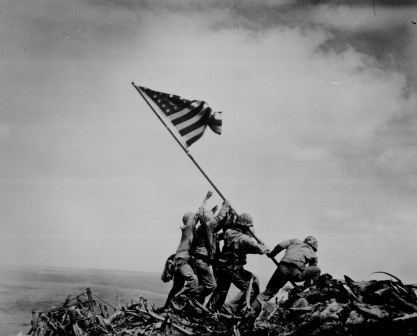
I drag out this photo in almost every class I teach at some point. It’s the classic Joe Rosenthal photo of Marines erecting a flag at the summit of Mt. Suribachi, perhaps one of the most widely reprinted images of all time, and it’s not hard to see why:

The photo was taken after three days of fighting on Iwo Jima. Iwo Jima, I think you will find, sucked. It was a Japanese home island, and it was a fortress of the most formidable type. The Japanese had been preparing it for years, digging caves and tunnels in the volcanic rock and covering every inch of the island with artillery and machine guns, so that there was nowhere safe on the island for an invader. It was a perfect nightmare to attack. A US team could seal one spider hole with explosives, and the Japanese soldier who had been in there would pop up behind you and shoot you from there. All of the artillery and mortars would have been pre-sighted, that is, the Japanese would have placed targets of known size and distance to help them aim quickly, accurately and effectively. Look at this map, which shows the artillery and defensive positions on the island, and then consider that every one of those little dots housed either a machine gun, mortar or high explosive artillery. Iwo Jima was a calculated, engineered hell.

Contrary to what Gourevich says, the flag was not raised at the end of the battle, but at the beginning of a month-long struggle on the island. Indeed, only three of the men in the image survived the battle. Nonetheless, Iwo Jima was late in the war (Feb-March 1945), when Japan’s defeat was no longer a question. The only question was at what cost would Japan be defeated. As US troops were finally stepping on and taking over a home island, it represented the beginning of a new, final chapter.

The only feature to speak of on the entire island was Mt. Suribachi, itself riddled with man-made caves and bunkers. It loomed over the soldiers the entire time, and it must have been discouraging to know that the enemy was spotting you from the heights he commanded.

Symbolically, the mountain came to represent something other than a strategic position on an island. Indeed, it represented, on the eve of American victory in the Pacific, a long struggle that started at Pearl Harbor. (Perhaps this is is the “grueling battle” Gourevich was talking about.)

On the Media‘s listeners, God bless ’em, did not let Gourevich’s comment slide, as Bob Garfield reported in the next week’s listener mailbag segment:

Many of you responded to Gourevitch’s point that the photo of Iwo Jima was staged. Listener Brian Vargo writes, quote, “It is irresponsible to let someone say that on air. I cannot fathom how a program titled On the Media would allow something like that to go unchallenged.”

And listener Ben Bradley concurred. “My grandfather is in that picture,” he wrote. “I would like you to know that the flag-raising picture was not staged.”

Tim Zinnen brought the facts to bear on the issue when he wrote, quote, “Please correct for your listeners the statement your guest from The New Yorker made that the photo of the flag-raising at Iwo Jima was staged. It was not. It was a snapshot of the raising of a second larger flag. To say the photo was staged gives the wrong impression that the photographer directed the placement and positioning of the Marines and Corpsmen. There’s a difference between a staged photo and a photo of a staged event. All flag-raisings are staged events.”

The issue has sparked years of controversy, and we’ve addressed it on the show before. To say the photograph was staged is wrong. However, it was also not of the original triumphal moment. As listener Tim Zinnen wrote, the photo captured the raising of a second flag. Photographer Joe Rosenthal, who took the image, has never disputed that fact.

The sequence of events that led to the raising of the flag are fairly well-known, so I am always slightly flummoxed, if flummoxing is what I am getting at, about how this story that the image was posed continues to circulate. I suspect that part of it is that the picture is so damned good–I think it may be one of the most perfect combat photos ever taken. The figures have exquisite triangular composition; the path your eye follows from the flag, down the pole and to the men is as natural as any composition I’ve ever seen. Their task is instantly identifiable, but the men, in a manner consistent with so many combat and military photographs, are almost indistinguishable from one another. They could have been anyone’s brother, father or husband. The image exudes the message of collective, anonymous effort toward a single goal on the verge of completion.

The event of the raising itself is thoroughly documented. The first patrol to reach the top of Suribachi raised a small flag at the summit:

So, not all that majestic or anything, but seeing the Americans claim the mountain set off cheers as well as a blaring of horns in the harbor.

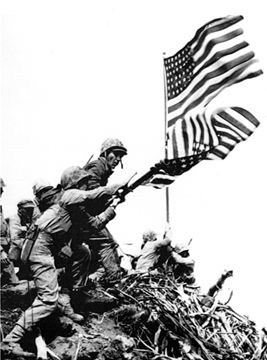
Secretary of the Navy James Forrestal was offshore and wanted the flag as a souvenir (and so did the battalion that raised and owned the flag, by the way), so soon a second flag was erected. The officer in command at the summit, a Lt. Schrier, coordinated the raising of a second larger flag with the simultaneous lowering of the smaller flag. This moment was captured too:

This second raising was still being carried out under combat conditions not conducive for posing a photograph.

Joe Rosenthal, the AP photographer whose photograph would become famous, had missed the initial flag raising and was on the summit shooting photos of the harbor when he saw the men preparing the second raising.  The second raising was a planned event, to be sure, and Rosenthal snapped several photos.

The raising was filmed from almost the same angle as Rosenthal’s photograph:

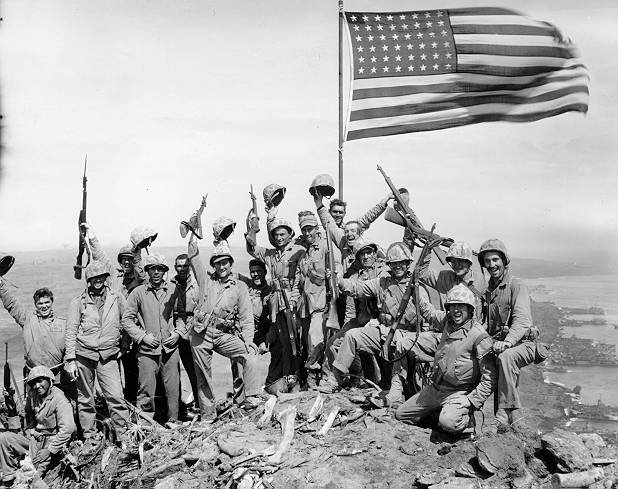
What is interesting about the photograph is that Rosenthal had no idea that he had taken perhaps the most iconic photograph of the war. He did not have access to his images while he was on the island, and he did not develop the film–it was developed days later, on Guam. The person responsible for seeing that the image got widespread release was actually an AP editor, John Bodkin. Indeed, when someone told Rosenthal that his photo was on the cover of every newspaper on the planet, he asked, “The posed one?” You see, he had taken a posed photograph of the men under the flag:

Rosenthal hadn’t seen his iconic photo (and he in fact may have thought that he missed the shot–he wasn’t even looking through the view finder when he took it). But his reaction to hearing of his photo’s fame, his misapprehension of which photo had been selected, slipped into history and became the foundation of the alternative, unsinkable rumor that remains today.

RJB

For more about the image, I recommend:

Bradley, James. Flags of Our Fathers. New York: Bantam, 2001.

Casaregola, Vincent. Theaters of War: America’s Perceptions of World War II. New York: Palgrave-Macmillan, 2009. See especially, pgs 106-109.


The Week in Conspiracy (12 June 2011)

June 15, 2011

You thought that you could slip by while I was at Skepticamp, didn’t you, you little conspiracy theories? Well, it’s not that easy. I’m ever vigilant and on the case. This week brought more grotesque news analysis from the goof-o-sphere. Let’s get into it.

Conspiracy theory of the week.

For me, it was hands down “Palin birtherism.” It’s the idea that Sarah Palin pretended to have a child…for some reason. It made it into Skepticamp Atlanta, and I’m still irritated with annoyance and irritation. So, the Palin emails were released in the last few days, and they talk about this issue. And her office was clearly befuddled by the allegations. And I resent having to defend Sarah Palin on any point, but you have to be fair. As Eve just said over my shoulder, because she did a long series of stupid things while leaking (radiator?) fluid, that does not mean that she was never pregnant.

Man, I was annoyed.

RJB


Skepticamp Atlanta: Live, Online, All-Nude!

June 10, 2011

Oh well, 2 out of 3 is not bad.

Tomorrow, Atlanta Skeptics are leaving the bar (for once) to put on a two-day online extravaganza: Skepticamp 2011: This Time It’s Personal. We will be streaming live on the Internet, so you may be able to see my talk or Eve’s talk. I’ll be doing a bit about my visit to the TruthCon at 1:00PM Eastern, while Eve will go at 1:30 and will be talking about the history of profanity.

I am embedding a widget linky doodad below, but in case that does not work, you can click on this link to get to the live web stream. Remember to ask questions in the chat and to introduce yourselves?


    Vodpod videos no longer available.
    RJB