The Week in Conspiracy (24 April 2011)

April 24, 2011

That sneaky cabal of globalist Marxist weasels has made me look the fool again by delaying their plans for taking over everything by one week. But ne’er matter! We’re on to them, and by exposing their plans, somehow that’s going to make everything better.

But I’m still sleeping in the HAARP-proof bunker tonight.

Conspiracy theory of the Week:

By the way, sifting through my Google Alerts this week was pretty amazing, as I came across myself several times. That’s new.

RJB


CNN wrap-up…

April 20, 2011

Check me out. I’m now an expert. Heheh. Anyway, ego-stroking aside, I was reading through the comments with great interest. On a blog the people who reply are generally interested in what you have to say. Sure you get an occasional person who just did not get the point, but most people are on the same wavelength.

The people replying on the CNN post, however, wow…the audience is noticeably different. Most of the critics, honestly, didn’t get past the headline. I could have written filthy limericks and nobody would have noticed. Either that or reading comprehension is WAY down. Regardless, I thought I would compile my favorite replies because I have 10 minutes.

phatchunk99

CNN brings dumb articles everyday. Are we going to see a repeat again today?

MrsLaceyB

Hey, a lot of other news sources have done this story too. So, ease up, readers. I’ve seen this story published year after year on various news websites. Chicago Tribune, Huffington Post, and numerous other sites have the same type of story except they didn’t even try to oppose the coincidences, they just brought it to our attention. I agree with the professor, its confirmation theory, people tend to seek out what they want to hear. The news media loves to put fear into the heart of Americans to manipulate us.
(Always agree with the professor.)
angbahoko
Tactically thinking and speaking, spring time and fall time has probably the most ideal weather for those who want to carry out a terror attack. April is the beginning of Spring. Most people are busy doing their thing and are outside more often, thus more activity (more distraction) and less attention from the guarding eyes. The change in season (warmer climate) easily provokes the temper of violent people. Summer is even worse, thus more road rage and homicides during summer time.
The only problem with this, though I generally agree that violence is probably more likely during nice weather, is that the ATF set the timeline for Waco. When my cross-country rampage comes around, my top is going to be down.

longtooth

I’ve seen a lot of inane and desperate attempts at filler stories, but this one takes the cake. CNN, where have you gone? Look at the BBC website, and hang your head in shame.

MadMelGibson

What an irresponsible story. You could say that about any month. Its called coincidence.
Again, he didn’t read or understand it. But it’s Mel Gibson, so what do you expect?

NathanS

The American people know about the Bomb squad trucks that were witnessed at the scene an hour before the explosion in oklahoma… Coincidence? You do the math, oh wait you won’t because CNN didn’t say it first.

Guest

“Conspiracy theories are a contemporary mythology, not unlike the Greek gods. Everything that happens has a reason, and the gods affect the course of human events through direct intervention.”Now why did the author feel the need to specify which gods are mythological? These two sentences sum up the absurdity of all religions. It’s certainly not limited to Greek mythology.
Only because they are clearly agents with motivation that are a lot like people, that they walk among us and have human form but can do anything. They live like elites on their holy mountain and are inaccessible to mere mortals. There was a reason I said that and the image in my head was of Athena deflecting an arrow aimed at her champion. Sure, it was just a crummy shot, but Athena gets the credit. Besides, I did say, “really seem to me to be a secular version of religious mythology.”

sonnycam

good analysis there, CNN……..ever heard of COINCIDENCE?? idiots
There’s an irony buried in this analysis. But at least he gets to walk away feeling smug.

alwaysrite9

If you read the article, you would have noticed that CNN is debunking conspiracy theories – so, if you consider the debunking to be paranoid, doesn’t that mean that you are actually the paranoid. Gotta go, time for “Twilight Zone” . . .
That one made me happy.
antil

“Following the election of [Barack] Obama, however, there was a steep rise in the number of hate groups”

“last year on the 19th of April, gun advocates had a rally in Washington””in the mythology that has grown up around Waco and Oklahoma City among self-identified patriots, the 19th has become a sort of high holiday””Conspiracy theorists”

I see what you did there. Talk about tying unrelated thing together…

These people are laboring under the demonstrable delusion that Obama is designing to take away their guns; it is a conspiracy theory that is at the heart of just about every fascist take-over scenario dreamed up by modern conspiracists. They are related, and I never said that everyone there was conspiracy theorist.

BeyochKnowlz

Didn’t Shakespeare write “April is the cruelest month”? This has been going on for centuries.

turtle995

I am a Jewish interdimensional shapeshifting reptilian space alien that works as a banker for the CIA. Why can’t we all just get along?
Win.

LiberaI

“Conspiracy theory expert.” What a joke.
Heheh.

NewEditi0n

April showers bring May conspiracies.

BGko

This guy they interviewed missed the boat. Actually April 19th to May 1st is an Occult Holiday time period in which blood sacrifice is required. On April 19th in particular, a sacrifice by fire is required, hence we have Waco, OK City, BP, etc ,etc ,etc…. I know it sounds wacky, but this is truth. Research deeper into the occult and you’ll find our government, media, etc is absolutely riddled with it, but you won’t see it unless you know what you’re looking for. You’ll find many such ‘disasters’ fall on occult holidays for good reason. You don’t have to believe in it, what matters is that they believe in it and act accordingly.

Wait…there was a boat? Why wasn’t I told?

SeekTruth911

Put simply, the globalist elite are very much obsessed with numerology because they believe in Satanic forces that empower them. I think that’s a bunch of bull pucky but THEY believe it.
Just google “dark secrets inside bohemian grove” to see the political and financial leaders of the world performing a mock human sacrifice to an ancient god known as Moloch.Also google David Gergen Bohemian Grove and just look at his reaction.

Kjcube

“He teaches a course examining conspiracy theories and runs a blog” well that settles it then… stupid CNN
I thought you had to be an expert to teach college classes on…your subject. The blog is just gravy for me.
BP2U
This ‘expert’ apparently doesn’t know that more suicides occur in Spring, as people come out of a long depressing winter only to see everyone else (except themselves) change for the better. It’s not a conspiracy, that’s just how it works.The tax time and 4/20 connection are also practical.Next time, ask normal people instead of these so-called ‘experts’ 😛

You’re right. Columbine was probably about taxes. And experts. Pish! What do they know?

NikkiNouse

It has been reported that levels of male testosterone are highest in April, probably from evolutionary survival mechanisms over millions of years. Not surprising, then, that male-initiated violence increases this time of year.
Aleforge

I agree with some of the others, its warmer out so people start picking up new hobbies. I almost started a cult but ended up doing some yard work instead. Maybe next year. *shrug*
Ketone

Can the professor cite any violent acts that actually were deliberately planned to coincide with the Battles of Lexington and Concord? He says the timing of Waco was merely “an unhappy coincidence”. Bringing up Lexington and Concord sounds nice but does it have any meaning?
Clearly not to you.
joeisking4
This article is ridiculous. While I’m not one to tone it down just to please a few sensitive people but cnn should really be more careful when putting out pointless articles such as this. Copy cats do exist and want to add their names to the long list of April tragedies. This is pointless journalism. Call me crazy, but this seems like a ploy to further violence so a few writers and editors can have their time to shine.
Imagining sinister motivations much? Dude, I want to study you.
nocode42
Confirmation bias is the single greatest threat we face today. It has allowed complete lunatics from both sides of the spectrum to basically hijack national politics with the kind of delusional sense of certain righteousness that produces suicide bombers. And there is literally no way to speak reason to such people… they could watch Obama’s birth with their own eyes and their brain would tell them the eyes are lying and their grandmaster’s right.
I like the next exchange a lot:

GixxerJoe

CNN forgot about April 19, 1775. Typical libtards.

nocode42

Both battles were mentioned in the article you didn’t read. Thanks for illustrating the concept of confirmation bias though. Your idiocy might be instructive to others.
Heheh.
GHull
You forgot the oil spill starting on April 20th. These dates are intentional. Illuminati mind control and sick cult like belief systems causes these dates to be used. Get real CNN. This is a piece intent on debunking people like Alex Jones and John Fitzgerald Kennedy.
Glades2
The Bible says that many things happen spiritually that we are not aware of – the week before or after Easter was also near or almost at the same time of these events, and represents the suffering of Christ for our sins, so it’s possible that spiritually evil tries to counter this sacrifice by generating evil in different forms. In fact, at the time of the Columbine shooting, Rachel Scott’s Father said that the thought kept coming to him (as said in the book “Rachel’s Tears”) that what was happening was “a spiritual event”, so again it does seem that many things happen for spiritual reasons, that we cannot see or understand by God’s permitting Will, for the good of mankind…
Oh, shut up. Er, I mean…good point!

sarcastr0

I can’t believe CNN’s obvious bias against interdimensional shapeshifting reptilian space aliens living in hollowed-out artificial moons. Obvious liberal bias.
That was my favorite comment, by the way.
Starter1977
CNN-you puppets for the illegal corrupt government..please see that you are controlled and you don’t even know it. You think you are high game, you are a joke and are being controlled like a video game. WAKE UP. Obviously the middle of April has an increase as it is Hitlers Birthday tomorrow. Every year he makes sure another event happens around the anniversary. And quit playing dumb like you actually think Hitler is dead. Wake up your fruitcakes and quit playing dumb..I guess that’s what you become after getting brainwashed by your controlled school system.
That one wasn’t.
andruha
Actually, I thought this article wasn’t half-bad. Granted, CNN asked inane question — they are trying to play the average American — but the expert was pretty interesting. I like his comparison to Greek Mythology — interesting interpretation.
Ah, that’s more like it.
So that’s that. I will never mention the CNN article again. Unless I’m drunk or think you might be interested in or benefit from being told about it.
RJB

Going Berserk

April 19, 2011

Who hasn’t at one time or another gone berserk? And by “gone berserk,” of course I mean become enraged, howled like an animal and then killed indiscriminately. What, just me? Ha ha, just kidding. Really.

But what does it really mean “to go berserk”? Berserks (Old Norse berserkr, pl. berserkir) were fearsome Viking Age warriors. They appear frequently in sagas, but it is difficult to separate legend from reality in the sagas. Sometimes they had supernatural abilities and sometimes they were stock characters–bullies who served as a foil for the protagonist. Where can we find the truth?

Where else but the History Channel. A few years ago History International ran a program called Unconventional Warfare. The first segment deals with the Trojan Horse. According to the narrator, no one really knows whether the story of the Trojan Horse is true or not, so you know off the bat that this is going to be another serious, hard-hitting, scholarly look at history.

The segment on berserks begins well enough, with information provided by real, genuine experts (and General Wesley Clark for some reason). Okay, the fact that the History Channel manages to bollox up their credentials may be a bit of a concern. They properly credit Ruth Mazo Karras as “Historian, Univ. of Minnesota,” but they identify Anatoly Liberman (more here) as a “Scandinavian Historian” at the Univ. of Minnesota as well. In fact, Liberman teaches in the department of German, Scandinavian and Dutch, and much of his work focuses on linguistics and philology. Similarly, they identify Paul Acker* as a “Norse Historian” at Saint Louis University, and, to be fair, he does look a bit like a Viking who’s given up raiding for academia. However, he is a professor of English rather than a historian. They don’t bother to give John Lindow (more here) any academic qualifications at all, identifying him as “Author ‘Handbook on Norse Mythology.'”

Regardless, the misidentified academics give a good summary of the berserks: they were fierce fighters who whipped themselves into a frenzy and fought in the front lines. In legendary tales, they are described as wearing bear or wolf skins (berserkr means “bear shirt”). They supposedly fought without armor and could not be harmed by weapons or fire. In reality, of course, they could be harmed and killed, but for the duration of  the berserker rage, they may have seemed impervious.

But what, asks the narrator, caused the berserker rage? Acker says, “Through their training and initiations, they whipped themselves into frenzy: that’s part of their jobs.”  The narrator, of course, knows better: “Some theorize, however, that the berserkers had a little help–from mood-altering substances.” Karras notes that “If you read a lot of modern works that refer to berserks, they talk about how they may have used either alcoholic beverages or perhaps hallucinogenic mushrooms to bring on the rage.”

Now, at this point, you can sense the word “however” hurtling across the room, desperate to make it before the camera cuts away, but, alas, to no avail. Magic mushrooms is what the History Channel wanted, and once someone mentioned them, they stopped. The point of Unconventional Warfare is to compare strategies used in the past to ones used much more recently. The berserks and their magic mushrooms are compared to Somali warriors who use a narcotic weed to become more aggressive.

None of the academics were told that this was the point of the segment. They only knew that the History Channel was doing a segment on berserks. When asked about the magic mushrooms, Acker and presumably Karras (quite possibly the others as well) explained that while some have speculated that the berserks used hallucinogens, there is absolutely NO evidence. There is nothing in the literature to suggest that the berserks used anything but training, natural aggression and the gift of Odin to work themselves into a frenzy. They may well have had a bit of a tipple now and then, but that hardly separates them from anyone else in Viking society.

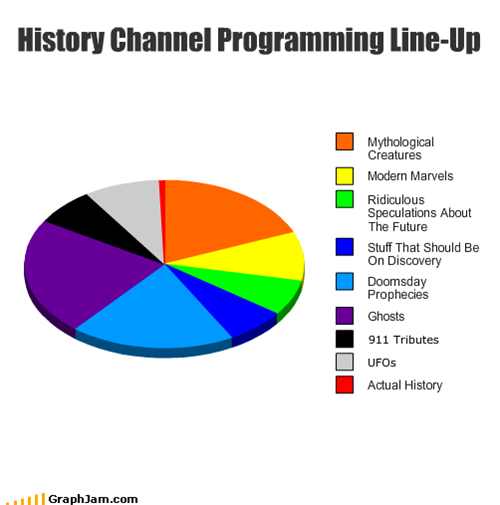
If this is how they do history, perhaps it’s just as well that they stick with monsters and doomsday.

But enough about historical berserks; let’s talk about the literary and legendary ones–they’re much more fun. First the stock characters. These guys wander around, acting like bullies and intimidating people until they get their comeuppance from the saga protagonist. In Grettis saga, Grettir fights and kills a mound-dweller (an undead guy who attacks Grettir when Grettir is robbing his grave), a draugr (an ueber-nasty undead guy), a she-troll, a giant, a bear and lots of people. LOTS of people, including a number of berserks. Grettir meets a group of twelve berserks, led by a couple of brothers named Thorir Paunch and Ogmund the Evil.

They came from Halogaland and were bigger and stronger than anybody else. They would go berserk and spare nothing when they flew into a rage. They used to take away men’s wives and daughters and keep them for a week or two, then return them. Wherever they went, they used to plunder and cause other trouble (Saga of Grettir the Strong, p. 42)

Grettir pretends to befriend them, then gets them drunk and fights them (the alcohol is of no benefit to them, by the way). When they realize what is happening, the berserks, of course, go “berserk and [begin] howling like dogs” (p. 46). While they’re howling, Grettir thrusts a spear through Thorir and Ogmund, who bumps into him. Then he takes out the other berserks.

Later, when Grettir is staying with a man named Einar, a group of berserks arrive, and the leader challenges Einar “either to hand over his daughter or defend her if he was man enough” (p. 95).  Einar consults with Grettir, and the berserk becomes impatient:

The berserk thought that Grettir and the farmer were stalling. He started to howl loudly and bite the edge of his shield. He put his shield in his mouth, spread his lips over the corner of it and acted like a savage. Grettir strode over to him and when he came alongside the berserk’s horse he kicked the bottom of the shield up into his mouth so hard that his face ripped open and his jaws fell down to his chest (p. 95)

Then Grettir cuts off his head, and the other berserks decide to be on their way–rather quickly. Throughout the sagas, the beginning of the berserker rage is signaled by howling and shield-biting. Some of the Isle of Lewis chessman seem to depict shield-biting berserks:

As far as I know, Grettir is the only person who has the sense to kick the shield back into the berserk’s mouth. Not all berserks are slightly comic bullies, however. Some have supernatural powers. Examples may be found in Egils saga. Egil was a great warrior, an exceptional poet and a truly phenomenal drunk (again, though, his drunkenness is unrelated to his frenzies). Jesse L. Byock has argued that Egil may have suffered from Paget’s disease, which has a genetic component. Based on his saga, Egil may also have suffered from a genetic predisposition for berserkerism.

Egil’s grandfather is named Ulf. He is big and strong and a good farmer. As evening rolls around, however, he turns bad-tempered and is known as Kveldulf or Evening Wolf. You might as well wear a name tag that says, “Hi, I’m a werewolf. Ask me how.” He has two sons, Thorolf and Grim, known as Skallagrim (Bald Grim). Thorolf is tall, strong, brave, handsome, honorable (by saga standards) and an all-round swell guy. Grim is big, strong, ugly, troublesome and, like his father, has a tendency to shape-shift. Skallagrim has sons named Thorolf and Egil. Thorolf II is a carbon-copy of Thorolf I. Egil is big, strong, freakishly ugly and has the family tendency to shape-shift. The non-berserk Thorolfs both die young; the berserks all die of old age.

In one of Skallagrim’s rages, he seizes one of Egil’s friends and “[dashes] him to the ground so fiercely that he was crushed by the blow and died on the spot” (Egil’s Saga p. 63). He then seizes twelve-year-old Egil, who is rescued by his foster mother who is “as strong as a man and well versed in the magic arts” (p. 63). Skallagrim is described by an enemy as being “as vicious as a wolf” (p. 42), and Egil is mistaken for a bear on one occasion (p. 104). According to the narrator:

It is said that people who could take on the character of animals, or went berserk, became so strong in this state that no one was a match for them, but also that just after it wore off they were left weaker than usual (p. 46)

Kveldulf, Skallagrim and Egil also tend to befriend people with similar berserker characteristics. For instance, there is Egil’s friend, Onund Sjoni: “Not everyone agreed that he was not a shape-shifter” (p. 130).  Although Egil’s connection to berserker madness is less explicit than Kveldulf’s and Skallagrim’s, he performs one of the best killings in all the Icelandic family sagas. He is fighting a duel against a man named Atli, who is “strong and courageous, an experienced dueller, and skilled in the magic arts” (p. 128). Egil is able to hack Atli’s shield to bits and land blows, but the sword is unable to bite. His own shield is beginning to split, so

He threw down his sword and shield, ran for Atli and grabbed him with his hands. By his greater strength, Egil pushed Atli over backwards, then sprawled over him and bit through his throat. Atli died on the spot. Egil rushed to his feet and ran over to the sacrificial bull, took it by the nostrils with one hand and by the horns with the other, and swung it over on to its back, breaking its neck (p. 128)

Let this be a warning to you, History Channel: don’t mess with berserks.

ES

*Full disclosure: Professor Acker was my dissertation director. When the History Channel came a-filming, they collected several graduate students to sit listening in rapt attention while Prof. Acker delivered a faux lecture. We were cut.

References:

Byock, Jesse L. “Egil’s Bones.” Scientific American. Vol. 272. Jan. 1995, pp. 82-87

Egil’s Saga. Tr. Bernard Scudder. The Sagas of Icelanders: A Selection. New York: Viking, pp. 8-184.

The Saga of Grettir the Strong. Tr. Bernard Scudder. London: Penguin, 2005.


The week in conspiracy (19 April 2011)

April 19, 2011

You remember last time when I said that global events were coming to a head in the coming week? Boy, I sure was wrong because this week– THIS WEEK– represents the culmination of vast clandestine machinations.

Conspiracy Theory of the Week (or so):


Guess who’s on the front page of CNN.com

April 19, 2011

You’re reading his blog!

No kidding.

Here’s the article, which was an email exchange I had with their reporter.

RJB


NECSS, etc….

April 17, 2011

What a week it has been. I feel like it simply rolled over me. It’s late in the semester, and every little thing just feels five times as important. And because I have had the awesome foresight to make everything due at the point of the semester when I am most tired, well, things really are piling up.

I was, however, able to take a few days off and mosey up to NYC to attend NECSS, the Northeast Conference on Science and Skepticism, which was a hoot at a holler, verily. I had been in New Jersey, as you doubtlessly know, to deliver a paper (posted on this site a few days ago) about science and literary theory. I delivered the paper in New Brunswick in the afternoon and then skipped off to the train station, where I caught a ride to Penn Station.

Penn Station is a crime against aesthetics, but I wasn’t there to sightsee. I was there to leave. I got in a cab and took it up, or possibly down, to my hotel, the Ameritania. I had scoped it online to see if there were bedbugs, because I am a scaredy baby man and didn’t want to bring them home. I had found conflicting reports on bedbug infestation sites, but I decided to go with buggirl’s recommended bedbug watchdog site and decided that it would be ok, as long as my luggage was always only in the bathtub. Except when I was using it.

Now, I was under the impression that the conference hotels and assorted social venues were right around the corner from each other, but they really weren’t, as I found out using my $10-day hotel Internet connection. No matter. I had to go find the bar where the first Drinking Skeptically was being held.

It was a hoot, of course. Luminaries of the skeptical movement were there. I think that the first person I recognized was Carl Zimmer, the science writer. But eventually the balcony of the bar filled with nerds, and all was right in the world.

Talked to a variety of the Skepchicks, caught up briefly with Joe Anderson, met some pleasant folks from Canada (also known as “Canadians”) who had taken the bus from…I think the North Pole. Met folks from all over the country, several of whom were attending one of these types of events for the first time. I also ran into a couple of people who I only knew virtually, which is always a treat. Podcasters, JREF people, astronomers, all sorts of folks were there.

And so I left early.

I didn’t leave because of all the people, but because I had a sense that my time in NYC was going to be taken up almost entirely by NECSS events, and, hey, I had seen some pretty cool stuff from the cab on the way down to the bar. I decided to try to walk back to my probably not infested hotel.

It was mostly a straight shot down 5th Avenue, just one turn, albeit something like 20 blocks away.

I came upon the Empire State Building, and not some ersatz Empire State Building, but a real and proper one. I admired the deco and contemplated how it had been constructed by Daleks during the Depression. There is apparently a deco font that all storefronts need to use on their signs, and while I appreciate the effort, it seemed a little forced to me. I moved on.

When I was a little kid, I visited New York a couple of times, and perhaps of all the things that I saw when I was nine, the coolest by far was the New York Public Library, not because I was a tediously bookish nine-year old, but because Ghostbusters had been filmed there. I walked past and drank it in, remembering when I was a kid, and recognizing something from a favorite movie made the movie just a little bit more real, and the boundaries between reality and fiction dissolved a little.

“Oh! THAT’S high-class!” a girl with an Australian accent yelled.

A guy was pissing on the steps of the library.

I turned and walked away as the drunk staggered through a puddle of his own urine to catch up with his inebriate friends.

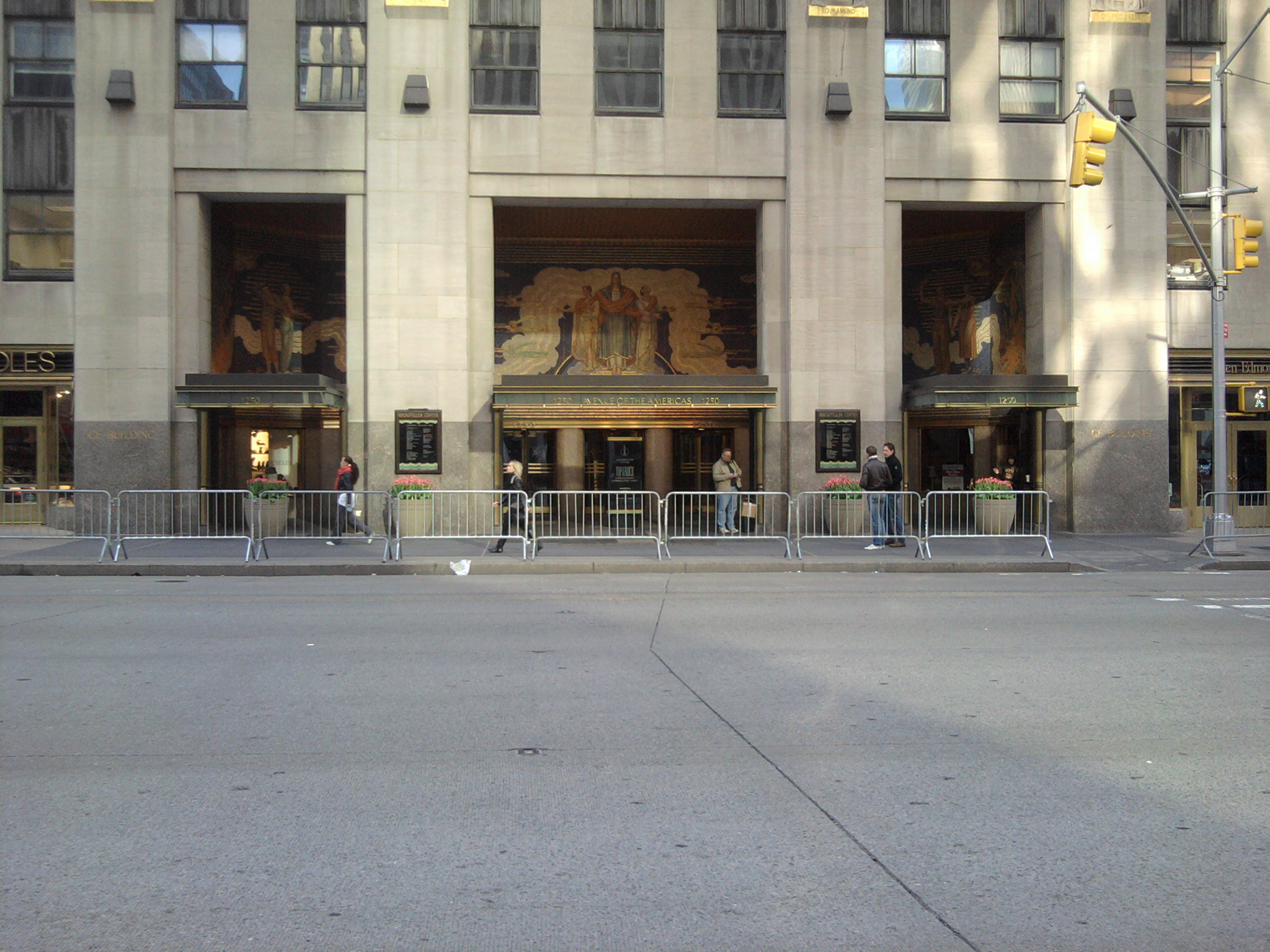
I soon came upon Rockefeller Center, and I walked over to contemplate the NBC-ness of it all. I watched ice skaters showboating while novices flailed helplessly on the rink. Following a hunch, I decided to circle the building. I was looking for a mosaic, Barry Faulkner’s “Intelligence Awakens Mankind” (1933). It was put up on the RCA (now GE) Building facade. I wrote about this a few days ago, so I won’t rehash it, but it was a complete thrill for me to see. I curated the business records of the mosaic firm that installed the mosaics, and I had only seen images of them in black and white, so I was completely tickled to see them in vibrant color.

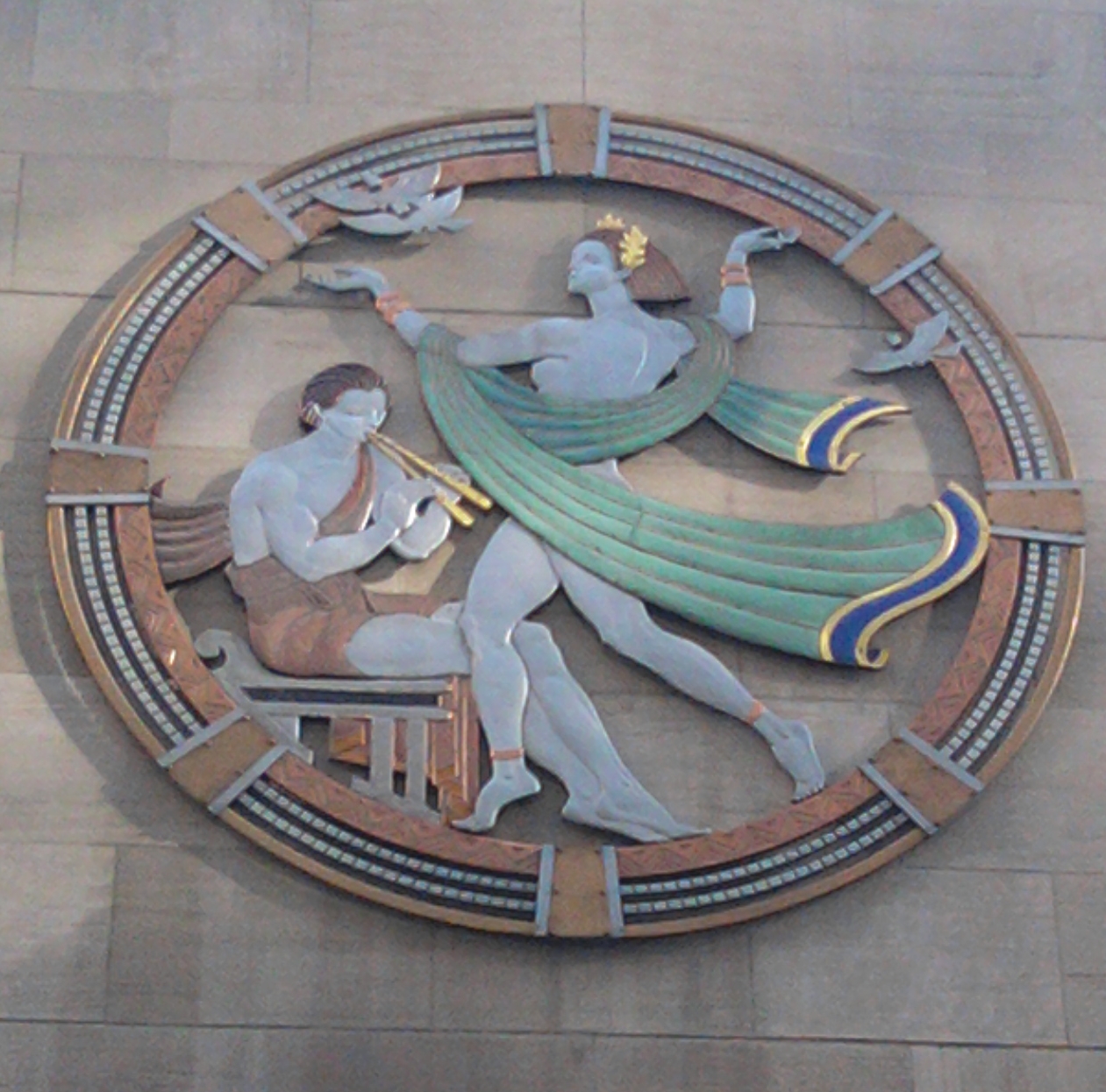
Just around the corner from the Faulkner mural, another artist who worked with the Ravenna Mosaic Company, Hildreth Meiere, was represented on the side of Radio City Music Hall. Her giant medallions representing theater…

…music…

…and dance…

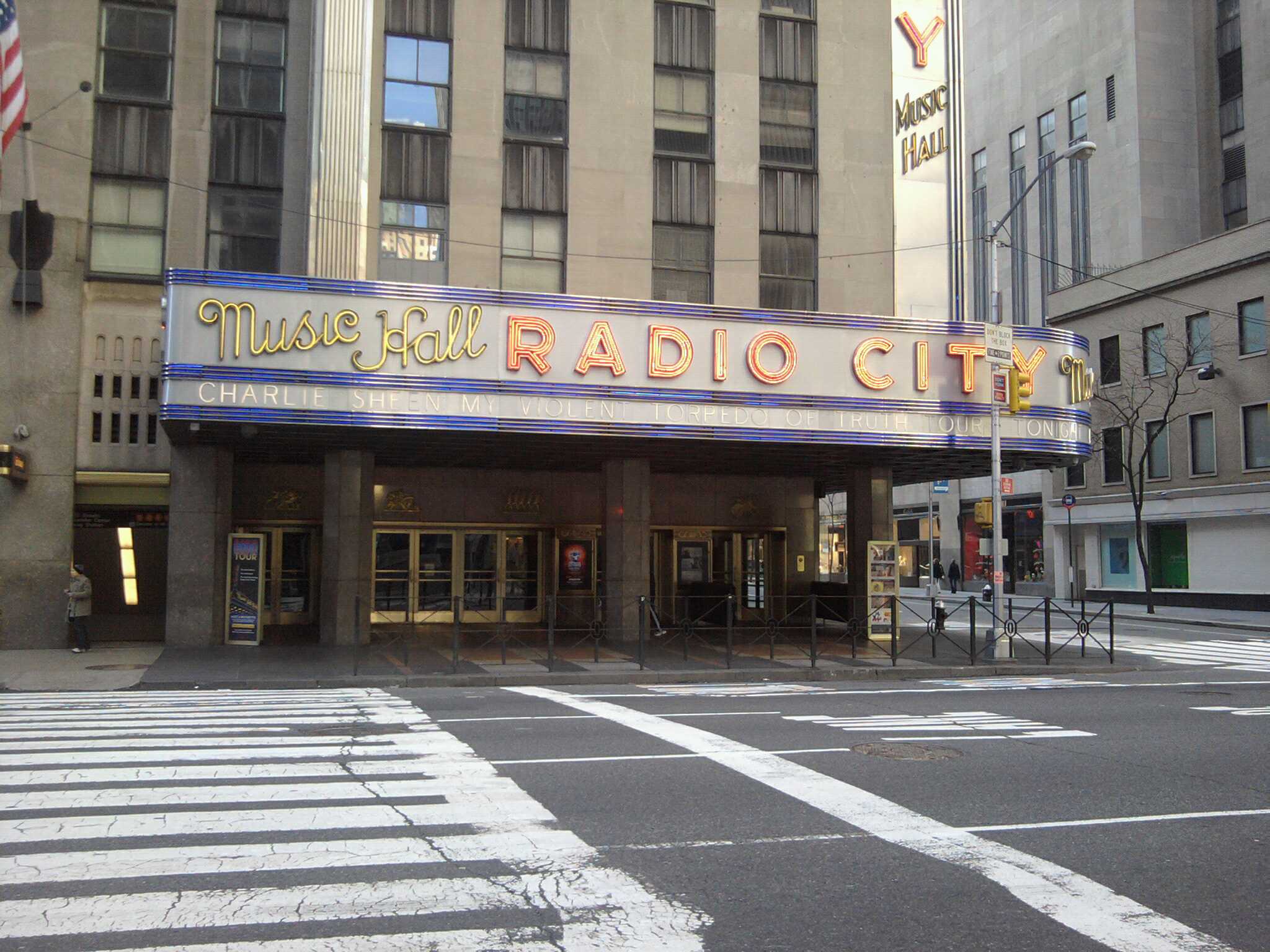
…are beautiful examples of the deco style. (Meiere is without a doubt one of the most monumentally under-appreciated artists of the 20th century. Unfortunately, there was no medallion to represent what was appearing at Radio City Music Hall at the time, Charlie Sheen’s Violent Torpedo of Truth Tour:

Click to embiggen. I took the outside photos the next morning before things started.

A little farther down, I found more mosaics, none that I was familiar with, in the tympanum of the 5th Avenue Presbyterian Church.

Don’t you judge me.

I decided to plow into Times Square and see what was what. At this point it was about 11:00. Nothing prepared me for the blaze of lights and sheer mass of people. It was rather overwhelming, and I ducked into a back street, where I promptly got myself lost. No matter. Cabbies are there to rescue yokels like me. He told me that he knew I was from out of town because I hailed him from the sidewalk. A New Yorker, he told me, stepped into the middle of the street. I believe him. I gave him my hotel’s address, which turns out was only a few blocks down and around the corner. I hurried through the lobby to the elevator and got off on the 6th floor.

It was a long Friday. It would be a long Saturday.

RJB


CBS fails to fulfill the promise of broadcasting

April 14, 2011

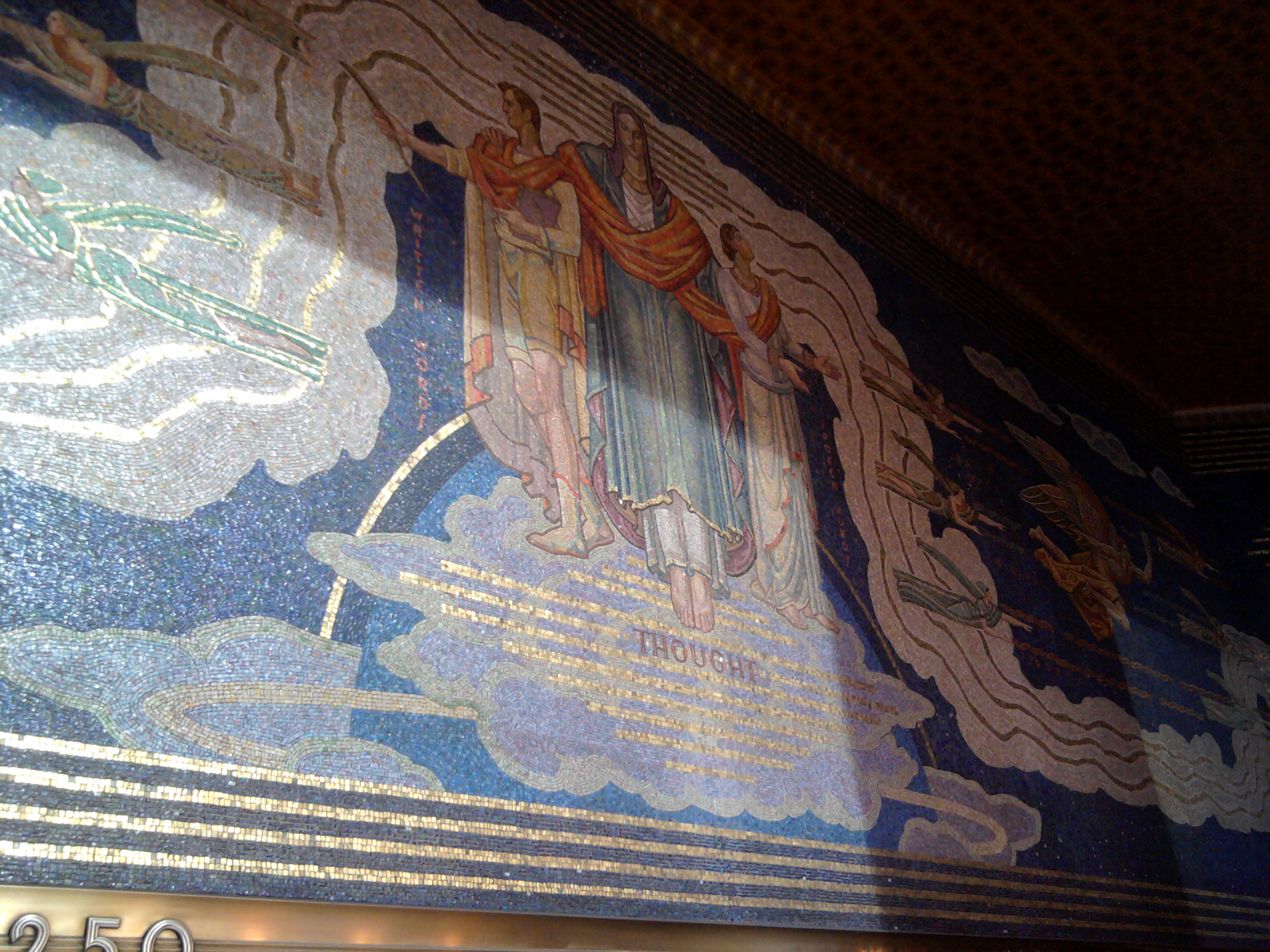
Last week, I was in New York City, rocking the NECSS groove, and I made a point to go see one of my favorite murals, Barry Faulkner’s 1933 “Intelligence Awakens Mankind,” which adorns the centerpiece of Rockefeller Center, the old RCA (now GE) Building.

Barry Faulkners "Intelligence Awakens Mankind" 1933

It is a mural that expresses optimism about the dawning age of mass communication (it was the RCA Building…get it?). In the center, Intelligence, personified as a woman, sends out golden beams, or “thought”, via the Spoken Word and Written Word:

See?

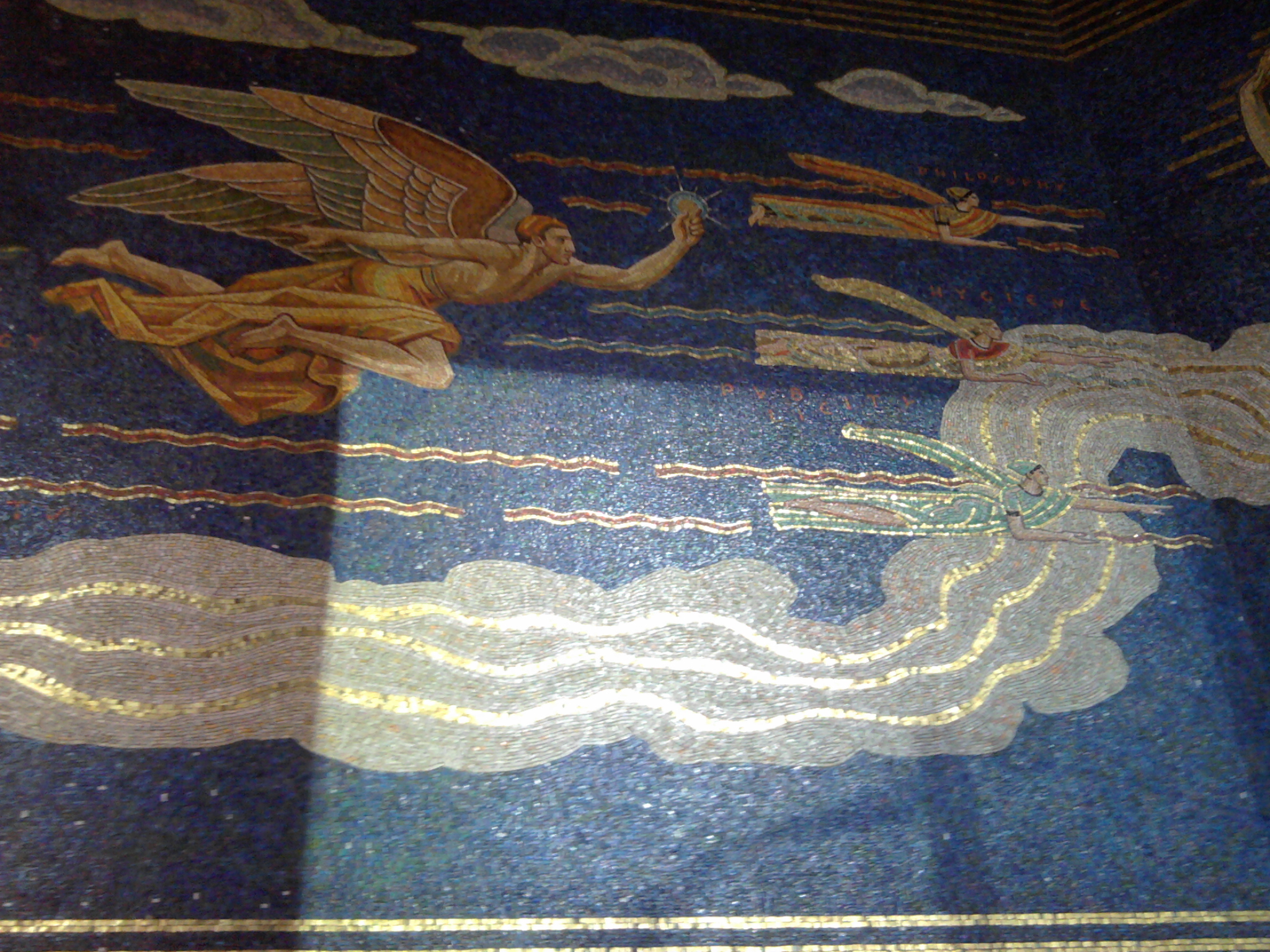
Radio waves, personified as angels, speed through the air carrying messages about fields such as “Philosophy,” “Biology,” and “Hygiene.”

Allegory! Its like telling two stories at once!

The information from the various fields of knowledge form a sort of force field, a protective barrier, if you will, around citizens:

See? Good information protects people!

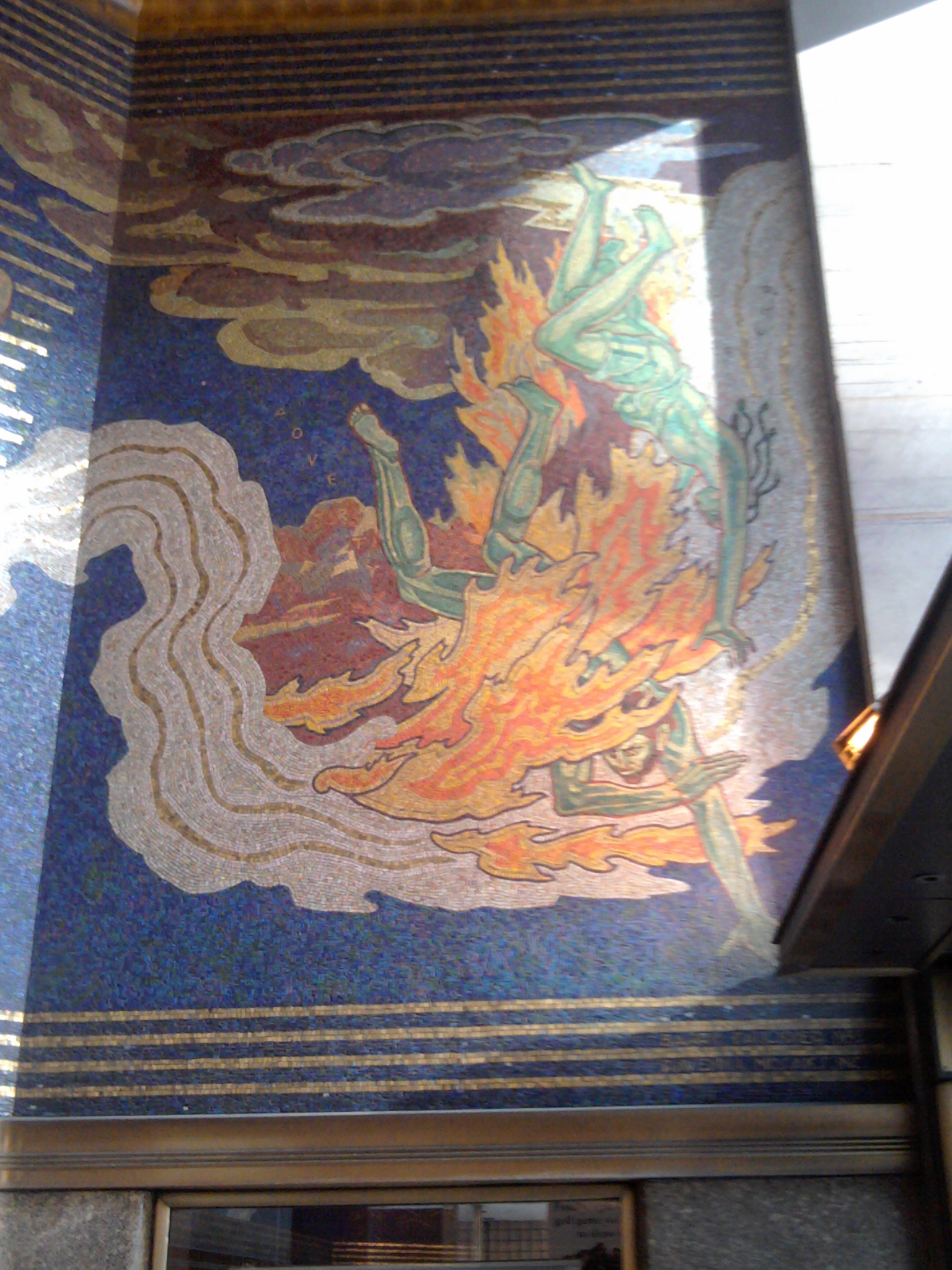
Now that they people are protected, demons like “Ignorance” and “Fear” can’t reach them, and they explode into flames:

Suck it, Ignorance!

This, then, is the ideal that workers at NBC (who know occupy the old RCA Building) encounter every morning when they arrive at work.

No matter what NBC champions, enlightening and protecting people through knowledge, however, is simply not what CBS stands for.

Elyse Anders recently started a petition to ask CBS Outdoor to take down a highly deceptive advertisement on the JumboTron on 42nd street in Times Square that suggests vaccines are somehow risky. The man paying for the ad, Joe Mercola, is as far I can tell the worst self-described medical expert ever to not leave a roll of gauze in a patient.

How bad is Mercola? So bad that the FDA sent him a letter demanding that he stop making illegal claims. As far as I can tell, he’s not getting better at what he does. Stephen Barrett of quackwatch.com has found that Mercola’s long history of fake medicine includes declarations that fluoride is unsafe. He opposes mammograms and amalgam fillings. Joe Mercola is a public health menace, and CBS is his willing and informed business partner.

CBS is now allowing this crank to put out misleading information that hurts children and the immunocompromised. CBS, in a real sense, is promoting things that only hurt its audience.

And they have not even responded to the torrent of letters protesting this filthy deal.

Vaccination is safe. It is effective. It is deeply unethical to take money to allow others to suggest otherwise. It is profit gained from a willingness to see children suffer. It is profit gained from a willingness to see people suffer from vaccine-preventable diseases.

It’s amazing how cheap CBS’s reputation was.

Writing letters (including a protest by the American Academy of Pediatricians) seems not to have an effect on CBS’s practices, so it’s time let the public know what CBS is doing.

Tweet @CBSOutdoor and @CBSTweet with the hashtag #VaxCBS to tell them how you feel about them running this ad. Maybe #justinbieber while you’re at it.

You might also write a letter to the relevant CBS executives:

Leslie.Moonves@cbs.com, Joseph.Ianniello@cbs.com, Richard.Jones@cbs.com, Angeline.Straka@cbs.com, AGAmbrosio@cbs.com, LJBriskman@cbs.com, GDSchwartz@cbs.com MDFranks@cbs.com, Wally.Kelly@cbsoutdoor.com, Dana.Wells@cbsoutdoor.com, John.Clements@cbsoutdoor.com, Bill.Murphy@cbsoutdoor.com, Jodi.Senese@cbsoutdoor.com, Richard.Sauer@cbsoutdoor.com, Richard.Ament@cbsoutdoor.com, Lou.Formisano@cbsoutdoor.com, Christian.Eidt@cbsoutdoor.com, Liz.Caprio@cbsoutdoor.com, Ray.Nowak@cbsoutdoor.com, Phil.Stimpson@cbsoutdoor.com

I appreciate it, folks.

RJB


Fingerprints of the Norse Gods

April 14, 2011

I’ve been reading Graham Hancock’s unnecessarily lengthy tome Fingerprints of the Gods (hey Graham, if I wanted to read a travelogue, I’d’ve bought a travelogue: get to the point). It’s been slow going because every couple of sentences, my eyeballs roll into the back of my skull, and I have to wait for them to return to their normal position before continuing.

As I was reading, I began to get an idea for a blog post: I would write a parody in which I traced suspicious parallels between Mesopotamian, Mesoamerican and Old Norse mythology. Perhaps I’d begin with Hancock’s discussion of the Babylonian god Marduk‘s conquest of the chaos monster Tiamat:

…[A] great plan of world creation began to take shape in his mind. His first move was to split Tiamat’s skull and cut her arteries. Then he broke her into two parts “like a dried fish,” using one half to roof the heavens and the other to surface the earth. From her breasts he made mountains, from her spittle, clouds, and he directed the rivers Tigris and Euphrates to flow from her eyes. (Hancock p. 144. Hancock’s source is the New Larousse Encyclopedia of Mythology, pp. 60)

He compares Marduk to Quetzalcoatl, who

in his incarnation as the creator deity, took the role of Marduk while the part of Tiamat was played by Cipactli, the “Great Earth Monster.” Quetzalcoatl seized Cipactli’s limbs “as she swam in the primeval waters and wrenched her body in half, one part forming the sky and the other the earth.” From her hair and skin he created grass, flowers and herbs; “from her eyes, wells and springs; from her shoulders, mountains.” (Hancock p. 144. Hancock’s sources are Adela Fernandez, Pre-Hispanic Gods of Mexico, p. 59 and Inga Glendinnen, Aztecs, p. 177)

Well, one can hardly miss the parallels to Ymir, the primordial giant in Old Norse Mythology. Ymir was formed in the thawing ice of Ginnungagap, the great void that lay between the extreme heat of Muspelheim and the extreme cold of Niflheim.  A male and female were formed from the sweat of Ymir’s left armpit, and one of his legs sired a son on the other. These were the first frost giants (Snorri Sturluson, Poetic Edda, Gylfaginning, ch. 5). Odin and his brothers Vili and Ve killed Ymir:

When he fell, so much blood gushed from his wounds that with it they drowned all the race of the frost giants except for one who escaped with his household. The giants call that one Bergelmir. He, together with his wife, climbed up on to his wooden box, and there they kept themselves safe. From them come the races of the frost giants….” (Snorri, Gylfaginning, ch. 7)

ZOMG! A flood that destroyed an entire race, except for just enough individuals to replenish the race! Hancock goes on and on about flood stories. It doesn’t really matter how dissimilar they are. If they involve floods (and sometimes even if they don’t), they have to be related in some way.  But wait, there’s more! After killing Ymir, Odin and his brothers created the world using bits of his body:

They took Ymir and they moved him into the middle of Ginnungagap and made from him the world. From his blood they made the sea and the lakes. The earth was fashioned from the flesh, and mountain cliffs from the bones. They made stones and gravel from the teeth, the molars and those bones that were broken.

…With the blood that gushed freely from the wounds, they made the sea, and by fashioning that sea around, they belted and fastened the earth. Most men would think it impossible to cross over this water.

…They also took his skull and from it made the sky. They raised it over the earth and under each of the four corners they placed a dwarf.

…[The gods built a fortress wall to protect the world from the giants.] As material for the wall, they used the eyelashes of the giant Ymir and called this stronghold Midgard…. They took his brain, threw it up into the air, and from it they made the clouds. (Snorri, Gylfaginning, ch. 8 )

In my parody, I was going to ask a lot of rhetorical questions that began “Is it simply a coincidence that…?” and “Or is it perhaps possible that…?” Then I’d note the big fuss Hancock makes over Mesoamerican gods who are described as white and mention all the works of art that he identifies as “clearly” representing bearded Caucasians. Heck, you can’t get much whiter than Scandinavians and still have melanin, and their gods are generally depicted as bearded. Finally, I was going to mention the Mayan god Votan, whom Hancock describes as “pale-skinned, bearded and wearing a long robe” (p. 103). Hey, Wotan/Woden/Odin/Oðinn was pale-skinned and bearded and often wore a cloak. If only this Votan fella was one-eyed. Could this possibly be a coincidence? (yes, yes it could).

I was saddened–for many reasons–to learn that people have seriously made this argument (see here as well as Votan link above). So, I plowed on with my reading, when, lo, I came across the following in a chapter called “The Many Masks of the Apocalypse:”

There is one ancient culture that perhaps preserves more vivid memories in its myths than any other; that of the so-called Teutonic tribes of Germany and Scandinavia, a culture best remembered through the songs of the Norse scalds and sages. The stories those songs retell have their roots in a past which may be much older than scholars imagine and which combine familiar images with strange symbolic devices and allegorical language to recall a cataclysm of awesome magnitude. (Hancock, p. 204)

Yay! Hancock made the Norse connection! I’m not sure why he thinks that the roots of Old Norse mythology may be much older than scholars imagine, except that he thinks ALL old cultures are somehow much older than we imagine. In a lengthy indented quotation, Hancock describes a Norse apocalypse in which he sees similarities to Mesoamerican, and ancient Iranian stories, among many others. All these stories involve cold and dark. In the Norse version he recounts, a giantess gives birth to a brood of wolves sired by the giant wolf Fenrir, son of Loki. One of the wolves devours the sun. The disappearance of the sun brings about a period of intense cold and brutality (known as fimbulvetr, awful or great winter). Fenrir escapes from his bonds. The world tree Yggdrasil is shaken violently; mountains split. “Abandoned by the gods, men were driven from their hearths and the human race was swept from the surface of the earth. The earth itself was beginning to lose its shape. Already the stars were coming adrift from the sky and falling into the gaping void” (Larousse, p. 279 qtd. in Hancock, p. 205). The fire giant Surt sets the earth alight; then the seas and rivers overflow; however, an undisclosed number of people survive, enclosed within Yggdrasil. They are the progenitors of a new race of men.

Now, in reading Hancock, I’ve found some odd things about the way he uses and cites sources. Of course, many of his sources are of an extremely dubious nature (Velikovsky and Sitchin, to name two). But one thing that concerns me is that when he’s recounting mythology, he often does not cite primary sources (or translations of primary sources). In some cases, I suppose, the primary sources may not be accessible, or they may not have been translated into English. But in some cases, for one indented quote, he will name more than one source, at least one of which is not a primary source. This has led me to suspect that he is picking and choosing information that fits his ideas. His presentation of the Norse material confirmed my suspicions. Both the Poetic and Prose Eddas have been translated into English several times and are easily accessible. Hancock does not quote from a translation. He again quotes from the New Larousse Encyclopedia of Mythology. And I found the quotation odd in a number of ways. For one thing, there are some bits I don’t remember–for instance the dwarfs trying to find entrances to their underground dwellings–but perhaps I just missed or forgot those bits.

Larousse is available for free online. In consulting it, I noticed that Hancock has altered wordings here and there (or perhaps there is some variation in versions of Larousse: his page numbers don’t match mine, either). These alterations are trivial. A much bigger problem is that Hancock has omitted large chunks of the story without using ellipses. The story Hancock is recounting is that of Ragnarok, the doom of the gods. What Hancock has omitted from the story is…the doom of the gods. He doesn’t mention Odin, Thor, Frey, Tyr or Heimdall. He doesn’t even mention Loki who is the leader of the “bad guys” and the father or ancestor of some of the monsters (Fenrir and the other wolves and Hel, goddess of the underworld).

That’s a hell of an omission. Now, it could be argued that he left out those bits to save space, and it’s the other elements, the ones that relate to the fate of the sun and the earth, etc., that are most pertinent to the discussion. I don’t buy it. I think it allows him to skew the story. He follows the quotation with the comment, “The new world this Teutonic myth announces is our own” (p. 205). This statement is simply untrue. The events described haven’t happened yet. While Larousse recounts the story in the past tense, Snorri Sturluson uses the present tense in the Prose Edda. VÇŤluspĂĄ (the Prophecy of the Seeress), from the Poetic Edda, tells the story partly in the present tense, but it is clear that it describes events that have not yet occurred, since the seeress is addressing Odin, who is still alive (his death is foretold in the poem). Hancock adds: “Needless to say, like the Fifth Sun of the Aztecs and the Maya, it was created long ago and is new no longer” (p. 205). Again, this is not true. Ragnarok doesn’t parallel the beginning of the Fifth Sun, the beginning of the present age. From Hancock’s point of view, it would fit with December 23, 2012, the catastrophic end of an age (again, according to Hancock’s view).

This is some impressive cherry-picking. The story of Ragnarok is not obscure. It always refers to a future apocalyptic event. Now, granted, since the stories were told or recorded by Christians, one could argue that the Teutonic gods had died, but not in some world-destroying cataclysm that somehow relates to a real event we don’t seem to know about. They were simply supplanted by a new religion. Most of the myths Hancock discusses do concern disasters that happened in the distant past, but not all myths can be forced to tell the same story.

ES

REFERENCES

Hancock, Graham. Fingerprints of the Gods. New York: Crown, 1995.

New Larousse Encyclopedia of Mythology. Tr. Richard Aldington and Delano Ames. New York: Crescent, 1987. http://www.scribd.com/doc/2176365/New-Larousse-Encyclopedia-of-Mythology.

Snorri Sturluson. The Prose Edda. Tr. Jesse L. Byock. Penguin Classics. London: Penguin, 2005.

VÇŤluspĂĄ. Poetic Edda. Text with translation by Henry Adams Bellows available here.


The Topography of Ignorance: Science and Literary Theory

April 12, 2011

The following is a talk that I gave this weekend at the Northeastern Modern Language Association conference in New Brunswick, NJ at a panel on Science and Literary Theory.

Several years ago, I took a 19th-century American literature seminar during my PhD coursework. During that class, each student in turn would guide the discussion of the week’s reading. One week, a student working toward his Masters was leading a fairly typical class, expounding at some length on the finer points of Moby Dick, and though I don’t remember the specifics of my fellow student’s conclusion, I remember that he offered a baroque hypothesis about the politics of race and gender and misrepresentation. Even though he had brought up numerous interesting observations about the text, I’m not sure I really had any idea what my friend was talking about, but I was politely professional and said nothing. When the student had finished and received polite applause, the instructor, an Americanist with whom I agreed on almost nothing, asked the one question that had been haunting me ever since my undergraduate studies of literature and culture had taken a theoretical bent in graduate school.

“Do you really believe all that?” he asked.

I can’t think of a less polite thing to ask a graduate student, or, honestly, a more important question.

I’m a relative latecomer to the subject of the so-called “science wars.” I suspect that a lot of what I have to say has been covered by any number of philosophers, scientists and academic pundits. I tend to agree with the severest criticism directed at many of the major figures in theory, the type of criticism leveled by Paul Gross and Norman Levitt in their Higher Superstition. I think that the Sokal Hoax offers an important warning that academics in the humanities fail to heed at the expense of disciplinary credibility. The hoax, you’ll remember, was perpetrated by physicist Alan Sokal against the postmodernist journal Social Text in 1996. Social Text published Sokal’s article, “Transgressing the Boundaries: Towards a Transformative Hermeneutics of Quantum Gravity.” Saturated with scientific absurdities, the article aped postmodernist jargon, political posturing, and rhetorical habits. The fact that something which, had it appeared on the Internet (presumably in ALL CAPS), would have been blasted as purest pseudoscience, had appeared in a professional academic journal produced a scandal that was about as polarizing as any you are likely to find in the academy. The furor over what were widely taken to be the broader implications of the hoax, that literary and cultural studies is vacuous, deceptive and infantile suggests that Sokal had chomped down hard on an exposed nerve.

As I prepared my thoughts on this topic, I was struck by how similar at first glance the similarity between literary /slash/ cultural theory and the preparadigmatic state of the natural sciences that Thomas Kuhn describes in his The Structure of Scientific Revolutions. The state of literary theory is one in which practitioners are “able to take no common body of belief for granted” and “each writer…[feels] forced to build his field anew from its foundations” (13). Certainly, a major contributing factor to this state of affairs is that the proper object of Capital-T-Theory remains, despite, more than 30 years of practice, undefined. Possible candidates include literature and other communicative acts, social structures like institutions, the nature of power, systems of meaning, and the process of making meaning. Now might this might not be such a large problem when you are comparing different theories—certain texts which raise questions that postcolonial studies are better equipped to answer than, say, fat studies, which is now apparently a thing. But even within the various schools of thought, the proper object of study varies. Take, for instance, the range of possibilities in psychoanalytic theory. I have seen psychoanalytic literary criticism directed at authors, works, characters in the works, even entire cultures. Once, and I swear I’m not making this up, I saw an author claim that Much Ado About Nothing had analyzed him (Krims, introduction xv). I mean, what does that even mean? Professional psychiatry, with the exception of a dwindling cult of hardcore Freudians, has long recognized that Freud’s understanding of the mind was fundamentally flawed.

Now, I write and research about pseudoscience and other forms of pseudoscholarship, and as I was reading and reviewing commentaries on the state of Theory, some patterns emerged, which worryingly (for reasons I will explain later) are informed by my other work. The factions of theory, including identity (including feminist, race and queer), Marxist, psychoanalytic and deconstruction camps share numerous characteristics of the type of diseased, self-perpetuating thinking typical of conspiracy theorists and other demonstrably flawed systems of thought.

The first way in which literary and cultural theory behaves like a conspiracy theory (and other forms of wishful pseudoscholarship) is how very often the absence of evidence, or even direct counterevidence, is taken as evidence for the phenomenon or theory in question. By this logic, the more counterevidence a critic produces, the more the more powerful the theory appears to become. In the lore of UFO cover-ups, the overwhelming lack of evidence in favor of the hypothesis that UFOs are extraterrestrial in origin, much less piloted by aliens, is taken by the advocates of “disclosure” as positive evidence of the size of the conspiracy. When you present UFO theorists with evidence that no, aliens did not crash in Roswell, and that balloons with classified instruments designed to detect Soviet nuclear tests did, they reply that the documents and testimony is forged, and they walk away with a sense that you have only confirmed what they have been talking about.

Numerous commentators reflecting on the state of critical theory have found that this applies to various schools of theory. Jonathan Gottschall sums the problem up nicely:

Psychoanalysts have argued that citing evidence against their belief system is quite transparently–in itself–evidence for that system; criticism of Marxist or neo-Marxist notions can be dismissed as craven attempts to bolster the critic’s economic interests; and any criticism of the so-called race-class-gender-sexuality movements can be brushed off as spasms of rightist political reflexes […]. While these prophylactics against negative evidence have been potent, and while they help explain the impressive resilience of the dominant paradigm, they have also been primary obstacles to the generation of reliable knowledge. (39)

Embedded within this commentary is the assumption that theory means to be reliable, or at least in some sense apply to the real world. However, if there is to something to be saved of high theory, I believe that theorists must surrender this presumption of practical utility.

Perhaps the most direct contributor to the Sokal Hoax was the fact that these schools of theory have their own, alternative experts. This seems directly analogous to a group of 9/11 Truthers I have been corresponding with lately. One has told me, “Listen to the experts.” By experts, of course, he means his experts, who are an architect, a retired theologian and a physicist who happened to participate in one of the biggest science scandals of the 20th century, the cold fusion brouhaha of the late 1980s. As in the Truth community, certain groups of theorists have gurus whose credibility is left untouched by deep methodological and evidentiary flaws that would be unacceptable in any legitimate discipline, and whose work is immediately recognized as not just worthless, but misleading, by people who have genuine expertise. Take, for instance, Brian Vickers’ assessment of two of the largest superstars:

Freud’s work is notoriously speculative, a vast theoretical edifice elaborated with a mere pretense of corroboration, citing ‘clinical observations’ which turn out to be false, with contrary evidence suppressed, data manipulated, building up over a forty-year period a self-obscuring, self-protective mythology. The system of Derrida, although disavowing systematicity, is based on several unproven assumptions about the nature of language which are supported by a vast expanding web of idiosyncratic terminology (249).

These pseudo-experts misuse scientific terminology for opportunistic, rhetorical purposes, which I suspect are largely to lend them authority in the eyes of those who do not know better. And, let’s face it, this led to some of the most extravagant and embarrassing proclamations identified by Gross and Leavitt.

Conspiracy theories and critical theories also resemble one another in that the two are accompanied with a sense of righteousness or political commitment, that the theorist in some ways is crusading against an oppressive force. This is especially true in what Gottschall calls the “liberationist paradigm,” in which “Objectivity [is] just a synonym for white male subjectivity” (5). A colleague of mine who works on interregnum Caribbean slavery narratives found that Irish-Catholic males were forcibly impressed into indefinite periods of servitude and brought to tropical plantations in chains under Cromwell. When she named this, rightly I think, as slavery, a tenured colleague of hers who was a committed postcolonialist accused her of usurping the exclusivity of African slavery narratives in Caribbean studies. The correct answer to this, of course, is, “You’re damn right I am, if the African narrative alone doesn’t fit the facts,” but this is not a statement conducive to professional advancement.

Indeed, a lot the schools of theory seem to stem from popular political movements. One of the funny things about UFO contactees is how often the message that they receive from their extraterrestrial contacts are seemingly tailored to the relevant political movements and concerns of the day. During the Cold War, the benevolent Space Brothers warned us about the dangers of nuclear weapons; after the Cold War, they warned us about polluting the environment. It is probably not a coincidence that ecocriticism arrived at about the same time that the little green men started lecturing us about the importance of going green, as it were. Indeed, ecocritic Simon Estok says that “ecocriticism has distinguished itself, debates notwithstanding, first by the ethical stand it takes, its commitment to the natural world as an important thing rather than simply as an object of thematic study, and, secondly, by its commitment to making connections.” The editors of the ecocrit collection, Reading the Earth, argue that:

Implicit (and often explicit) in much of this new criticism is a call for cultural change. Ecocriticism is not just a means of analyzing nature in literature; it implies a move toward a more biocentric worldview, an extension of ethics, a broadening of humans’ conception of global community to include nonhuman life forms and the physical environment. Just as feminist and African American literary criticism call for a change in culture […] so too does ecological literary criticism advocate for cultural change by examining how the narrowness of our culture’s assumptions about the natural world has limited our ability to envision an ecologically sustainable human society. (qtd. in Estok)

In much the same way that conspiracy theories are fueled by political ideals, take, for instance the 9/11 Truthers who are absolutely convinced that they are exposing great evils, no matter how silly, and the anticommunists of the Cold War, who were convinced that they were doing no less than saving freedom itself, so too have critical theorists seen themselves as waging a good war on behalf of oppressed people, and in the case just mentioned, saving human society from itself.

A further point of similarity between literary theory and conspiracy theory is that they seem to come awareness of unknown truths about the ‘real’ nature of things through meticulous—some would say hypermyopic—attention to minutiae. For instance, take the typical JFK assassination buff. He can tell you about every little bit of evidence, the results of every single test, every little strange particle of nuance of evidence relevant and irrelevant to the events in Dealey Plaza. He is doing, essentially, a super-hyper close reading of the narrative of the assassination. The problem, of course, is that he has a bad grasp of the relative importance of various pieces of evidence to the narrative as a whole. On the basis of that extremely close reading, like the deconstructionist, he often stresses those elements that are external to the narrative. At the same time, both conspiracy theorists and literary theorists seem to evince a belief in the inevitability of political change caused by the simple fact that revealing that truth.

One of the characteristics of academic theory that allowed Sokal to convincingly impersonate serious theorists was deploying the specialized language of theory. While this is, as Kuhn recognizes, perhaps an inevitable part of professionalization and establishment of expertise in the empirical sciences, to the point that even specialists in the same academic departments might not even be able to communicate easily, in the case of theory (and especially in deconstruction) one wonders whether or specialists can communicate at all, as the verbal documents that they generate are at times grammatically correct, meaningless sentences rendered impenetrable with jargon. Edward Ervin’s Introductory Dictionary of Lacanian Psychoanalysis, started as a database designed to help him clarify for himself the terminology of Lacan’s seminars, but as he later reported:

As I tried to make sense of Lacan’s bizarre rhetoric, it became clearer to me that the obfuscatory language did not hide a deeper meaning but was in fact a direct manifestation of the confusion inherent in Lacan’s own fault. But whereas most of Lacan’s commentators preferred to ape the master’s style and perpetuate the obscurity, I wanted to dissipate the haze and expose whatever was underneath. […] Ironically, it was this attempt to open Lacanian theory up to criticism that played a major role in leading me to reject Lacanian theory itself. (42)

This use of language seems to me to be more in line with mysticism or possibly cult-speak than with conspiracy theory as such. It turns out that difference may simply be to deconstruction what “engrams” are to Scientologists, insofar as they serve as markers for members of in-group members and out-group members. Obfuscatory language does not shield theory from criticism; it shields it from legitimacy and relevance.

There is some encouraging news, of course, and this is that the practitioners of theory who fall into the category I’ve outlined comparatively few in number—you rarely bump into someone outside of a specialty journal who espouses wholehearted devotion to a single school of thought. Most literary and cultural criticism appropriates only what is relevant to the topic at hand and disregards the rest. Nonetheless, the theorists whose work is taken to be representative of the various schools of criticism tend to be more sensationalistic. A peculiar feature of much theory is a tacit appreciation of its mere “boldness,” as if claims of radical destabilization are laudable in themselves. True, we have found it desirable and enlightening to reexamine our underlying assumptions, and this has led to genuinely enlightened, more informed views on issues such as sexuality and race, but it does not follow that destabilisation in itself is desirable. It is not clear what the impact of intellectuals championing these causes is on society’s perception of sexuality, gender, race or ecology. Nonetheless, when theorists declaim on subject about which they know nothing, they devalue the work of other, more responsible scholars through an unfair guilt by association.

So, what’s to be done; how do we avoid another Sokal Hoax? Wouldn’t it be great and ironic if I yelled enthusiastically, “REVOLUTION!?”

This is an important question, as the humanities are chronically starved for funding. The answer depends on how literary theorists decide to describe their job, whether they see themselves as producers of knowledge who are developing ever more accurate and detailed understandings of the nature and working of literature and culture, or if they see themselves primarily as artists. In the first case, if theorists decide, that they want, to use Gottschall’s phrase: “the ability to systematically and decisively narrow out allotted portion of possibility space–to zoom in toward truth in the immense multidimensional hyperspace of error and vacuity” (9), they have failed.

Gottschall makes an intriguing proposal about how to move forward with the project of reducing error in literary studies, and that is plying statistical sampling and analysis to literary texts. He points out that the quantification of social phenomena has always met with popular resistance, but it has revealed underlying order to any number of social phenomena. Why should literature be any exception? I think that there are two major obstacles, neither of which is insurmountable or easy. The first may be described as inertia, an unwavering devotion to the notion that there are some things like literature can’t be quantified. This, of course, is merely a bald assertion, and without trials to examine whether or not such a project would be profitable, there is simply no basis for making that claim.

The second obstacle to the successful completion of the project is that the infrastructure of literary studies, as it currently exists, is not designed to produce scholars of the type that Gottschall proposes. It is designed to perpetuate theory as it already is. The problem with this is that programs in literary theory—or cultural studies writ large—do not have the expertise in statistics needed to become this sort of scholar at either the graduate or undergraduate level. As a result, I am afraid that it will take a rather substantial overhaul of theory programs to even begin down this road. That or interdisciplinary training through other departments.

One reform, I think, immediately available to all departments, and one that I believe is fundamental to improving the standing of theory, is raising awareness of cognitive biases and their ability to corrupt research. One of the most damaging and pervasive flaws in modern humanistic scholarship is the lack of awareness or concern for confirmation bias, which is a dangerous mental habit that determines what one accepts as relevant evidence. It is the propensity for people to seek out confirmatory instead of disconfirmatory evidence. For example, when you are posed with the question, “Is Ted an extrovert?” you are likely to ask questions like, “Does he have friends? Or does he like going out on weekends?” instead of paying attention to the fact that he plays chess and reads, the types of things introverts are likely to do. In life we unconsciously notice and value elements of the world that confirm our worldview to the exclusion of those that don’t. Numerous swindles depend on this very human propensity, and currently, when we are trained in theory we are being trained to give confirmation bias free range. When confronted with a mass of data, say, a novel or a culture, and you are able to forgive yourself for squinting a little bit, it is very, very easy to find evidence for anything. If your academic kink happens to be imperial conquest, you’ll find imperial conquest. If it’s patriarchy, you’ll find patriarchy. If it’s pandas, you’ll find pandas. And we don’t pay any attention to this tendency. I searched the entire MLA database for the phrase “confirmation bias” and it appears only once.

Another vital element of a program of reform that will lead to literary theory becoming a reliable tool for discerning the real world will be to replace scientific pseudoexperts like Freud and Lacan with actual experts in the relevant empirical sciences, especially in the science of the mind. This will require some additional training, and I’m not sure it’s the type of training that could reasonably be confined to a graduate education, but if you are going to invest the time in writing a dissertation about the products of the human mind, you cannot but improve your work by informing it with an awareness of the state of the empirical science. And when you address scientific matters you need to understand the limitations of that science as well. When you are talking about indeterminacy, you need to be aware that this is a property that is only useful when it is applied to the world of particles. You may employ indeterminacy as an artistic metaphor, of course, but when you do so, you must not mistake your metaphor for the real thing or imagine that because you have used the metaphor that you have somehow altered particle physics. When you critique the content of science, or any field of knowledge, as many theorists have, you need to address the relevant issues at the level of the experts, and this is very, very difficult without specialist training. It reminds me of a situation I believe Carl Sagan described when he looked into the claims of the pseudoscientist and psychoanalyst Immanuel Velikovsy, that Jupiter ejected the planet Venus and that a series of close passes by Venus to Earth caused a number of the miracles described in the Bible. Religious scholars scoffed at Velikovsky’s interpretation of biblical events but were impressed by his astronomical knowledge. Scientists thought that the biblical stuff was ok, but thought his astronomical proclamations were ridiculous.

The other option is to surrender pretentions to objectivity and describe theorists as artists. Art makes no claims on objective reality, and some very artful and elegant readings of texts can come out of even the most badly flawed pseudoscience. I think that it would be folly to not consider an Oedipal reading of Hamlet, even if there is no evidence of an Oedipus complex in the real world. Exciting art can be made when you filter a work of literature through a novel perspective. In doing so, you are doing what artists have done for ages, drawing on and responding to the zeitgeist. I consider that project to be akin to the various repinterpretations by Dali and Picasso of Velazquez’s Las Meninas, wherein something of the original artwork remains, but the style and aesthetic concerns of the modern artists dominate the interpretation. Take the Freudian example. In psychoanalytic criticism, a theorist may in practice substitute any symbol for any other symbol. This is immensely liberating for the imaginative, creative mind. But one should not imagine that the substitutions that the theorist makes are anything but the products of their own mind. So, if theory and interpretation abandon pretenses of objective analysis and embrace the posture that they are using science as a metaphor, we will do much to clarify the work that literary and cultural critics are accomplishing.

Something needs to change. High theory, as it is currently conceived and practiced, is a celebration of disordered thinking. To prevent further embarrassment to the profession and improve the quality of our work, we need to hold our theorists to high standards; and when it comes to matters of science, we need to hold them to the standards of the field they mean to critique. We need to raise the scientific literacy of our humanities faculties and educate our students about confirmation bias. Finally, when we deploy science as a metaphor, we need to frankly acknowledge it as such, just a metaphor. Thank you.

RJB

Postscript: After I gave this talk, a guy came up to me and said, “My dissertation adviser was one of the editors at Social Text. Oops! Heehee.  (I almost typed Sokal Text–eek!). He did in fact say that the editors schooled themselves in science afterwards, which is encouraging.

References:

Estok, Simon C. “A Report Card on Ecocriticism.” AUMLA : Journal of the Australasian Universities Modern Language Association 96 (Nov 2001): 220-238. Online at <http://www.asle.org/site/resources/ecocritical-library/intro/reportcard/&gt;

Evans, Dylan. “From Lacan to Darwin.” The Literary Animal: Evolution and the Nature of Narrative. Eds., Jonathan Gottschall and David Sloan Wilson. 34–55.

Gottschall, Jonathan. Literature, Science, and a New Humanities. New York: Palgrave Macmillan, 2008.

Gross, Paul R. and Leavitt, Norman. Higher Superstition: The Academic Left and Its Quarrels with Science. Baltimore: Johns Hopkins UP, 1998.

Krims, Marvin Bennett. The Mind According to Shakespeare: Psychoanalysis in the Bard’s Writing. Westport: Praeger, 2006. Introduction, xv.

Vickers, Brian. “Masters and Demons.” Theory’s Empire: An Anthology of Dissent. Eds. Daphne Patai and Will H. Corral. New York: Columbia UP, 2005. 247-270.


Back from NECSS…(Nek-c-Suh-Suh)

April 10, 2011

I’m back, and I feel a little exhausted. I enjoyed my weekend in New York immensely, and I was delighted to to find that so many of my Internet correspondents are also capable of taking physical form.

Last night was pretty wicked, I have to say. It was a bar that had Guinness…and that’s about all. George Hrab was playing to an appreciative crowd. When Phil “Better Astronomer Than His Pseudonym Implies” Plait got up on stage and did “Death from the Skies,” the place went bonkers. So much fun.

I’ll do a better write up soon, I swear. Need pizza.

RJB