Anonymous 2: This Time It’s Anonymous

March 22, 2012

As many of you are probably aware, I have been terribly harsh to Shakespeare deniers, er, I mean independent Shak-spear scholars. The very first post on this blog dealt with the Shakespeare authorship controversey. In particular, I have been quite mean and snarky about Roland Emmerich’s film Anonymous, as well as the propaganda educational materials released in association with the film. I have even been known to suggest that the title is a silly misnomer: if Edward de Vere produced plays under the name William Shakespeare, then those plays were by definition pseudonymous rather than anonymous.

I now realize that my support of the hidebound traditional theory was based on trivial reasons, such as the mountain of evidence that suggests that the works attributed to William Shakespeare were written primarily by William Shakespeare, actor and son of a Stratford glover, and the paucity of evidence that anyone else was the main author. I can now admit how closed minded I have been (or “close minded” as the more open minded often say). I have been a pawn of Big Shakespeare; I just wish I had been one of its better paid shills.

Yes, that’s right–the conspiracy theory is true. All Is True. But it goes so much deeper than anyone realizes. Shakespeare deniers skeptics often ask how Shakespeare could have had the knowledge to write all those nifty plays and poems. But, my golly gosh, how could any mere mortal? And how was Edward de Vere, 17th Earl of Oxford, able to continue to write plays after he died?

Is it possible that the Earl of Oxford was a time-traveling alien? Could he have written not just the works of Shakespeare, but many other literary classics as well? Why the hell not?

I have a “theory:”* as a member of the nobility, Oxford was, of course, a reptilian alien. I believe that’s actually requirement. “Blue blood” isn’t meant figuratively, you know. Unlike many of his little alien friends, he wasn’t really into piling up big rocks into pyramids or putting them in circles. He liked words–not alien words, which tend to involve a lot of z’s and k’s. No, bless him, he liked English in all its forms, so he traveled through time, scattering classics around like the others scattered big rocks.

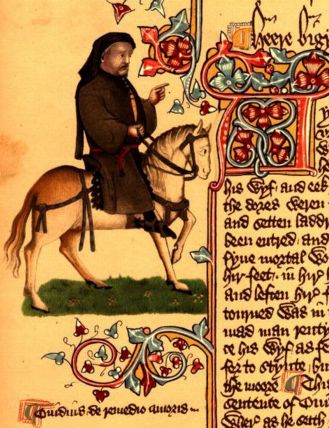
What, you want evidence? Fine, here’s some evidence: the Ellesmere Manuscript is one of the most important copies of The Canterbury Tales (along with the Hengwrt Manuscript by the same scribe).

Who was one of the early owners of the Ellesmere MS? John de Vere, 12th Earl of Oxford, (not quite direct) ancestor of our friend the 17th Earl. Coincidence? I think not.

Clearly Oxford lived in the 14th and 15th centuries disguised as his predecessor. He wrote great poetry and used the flunky Geoffrey Chaucer as a front.  I mean, how could Chaucer, the son of a vintner, have known Latin, French and Italian? How could he have had knowledge of the astrolabe? Hell, the guy couldn’t even spell his own name–he spelled “Geoffrey” “Galfridum”!

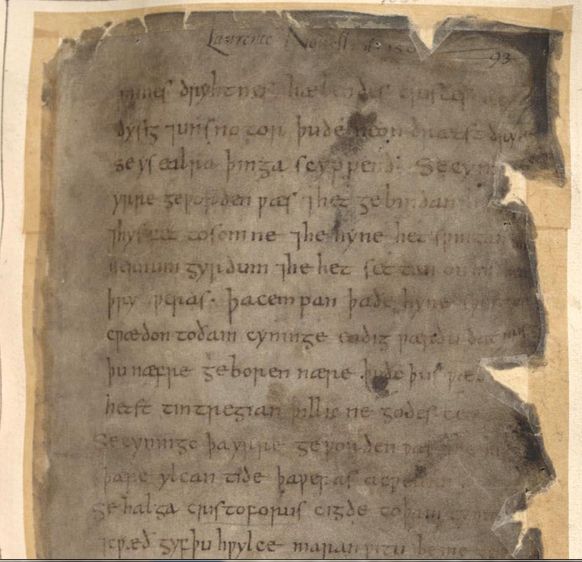
But wait, there’s more! The 17th earl was briefly a pupil of Lawrence Nowell. And who the hell was Lawrence Nowell, you ask? Well, there were actually two cousins, both named Lawrence Nowell. One was a churchman, and the other was an antiquarian who at one time owned and added his name to the Nowell Codex.

The Nowell Codex is the Beowulf Manuscript proper (at some point it was bound together with a later MS, the Southwick Codex; the combined text is called British Library MS Cotton Vitellius A xv). How did the Beowulf MS get into Nowell’s possession? Oh, I don’t know, maybe he had a time-traveling alien pupil who gave it to him. Hmmmm? I mean, how could Anonymous, the son of a ??, have written Beowulf? Not only could he not spell his name, he didn’t even have a name! How could he have written the poem when we don’t even know if he could write?

It’s all making sense now, isn’t it? Well it would, if you’d just open your mind. I find that a chainsaw helps.

*”Theory”: Wild speculation or insane declaration, proclaimed loudly and drunkenly. Not to be confused with anything known to scientists or scholars as a theory.


corpus-based analysis of linguistic trends

March 22, 2012

I’ve been invited to comment on the following article and the work which it summarises:

http://online.wsj.com/article/SB10001424052702304459804577285610212146258.html

Studies of this kind are by no means ‘alien’ to linguists, who are concerned with empirical aspects of language studies and thus are perhaps (understandably) more interested in the ‘scientific’ approach than many scholars in more traditional humanities subjects (indeed, at times we’ve arguably been overly concerned with the goal of behaving like scholars in the ‘harder’ sciences, and with the associated philosophical issues).  The view of a language as a system rather than a set of unordered phenomena (‘atoms and molecules’) – while not to be pressed too far (especially where vocabulary and/or ongoing change are at issue) – goes back at least a hundred years.  And there is much discussion of ‘cultural evolution’ in the linguistic literature.  More specifically, much modern linguistics is ‘corpus’-based; and, while this has led at times to absurd claims (e.g. some linguists deny that phenomena with extensive anecdotal exemplification are genuine, on the ground that for some reason they do not occur in the relevant corpora), this development has in general been highly beneficial, especially by way of putting hitherto-unknown figures to observed trends (both synchronic and diachronic) and thus assisting in their explanation in linguistic and extra-linguistic terms.  But new input from new sources, of the kind instantiated here, is wholly welcome.  And some of the points made here – for example the role of spell-checkers in promoting some variant forms at the expense of others, and the role of technology more generally in contributing to language change – are, if not wholly novel, striking, and warrant closer examination.

On the other hand, the search for universal principles and ‘laws’ in this domain is fraught with difficulties.  Strong claims on such fronts would require stronger evidence than is usually forthcoming.  A truly fairly compiled database, even for one language (particularly one as rich and varied as English), would be enormous and highly complex and would involve a plethora of factors, some of them yet to be fully understood.  Some such factors would involve pre-existing dialectological diversity and the varied and dynamically changing statuses of different varieties of the language.  For instance, the increasing worldwide preference for snuck over sneaked involves (doubtless among other things) the fact that the former form has long been dominant in American usage specifically; in this particular case, this factor has been strong enough to outweigh the greater simplicity and learnability (with no apparent counter-balancing ‘cost’) of regular past tense forms in –ed such as sneaked.

Incidentally, this example points up the possibility that grammatical changes may operate differently from those involving vocabulary per se.  The former (which are more clearly parts of linguistic systems) are certainly fewer (inevitably; there are far more common words than there are grammatical constructions) and slower-moving than the latter, as is shown by e.g. contemporary teenage British and Australian usage, heavily ‘Americanised’ at the lexical level but less so in respect of grammar – and still less for phonology (pronunciation), where English continues to diversify in some respects internationally and even within each country (this has been explained to a degree).

Linguists will look forward eagerly to further work of this kind.

Mark


‘fringe’ historical linguistics 4

March 20, 2012

Hi again, everybody!

Re the sweet-potato: thanks a lot for all your points, Pacal!  First: no, I have not been influenced by Thor Heyerdahl!  I was noting that in a few instances, including this one, where the words are of intermediate length and where there is some non-linguistic evidence, there might be a respectable (not certain) case for a diffusionist account of shared word-forms.  But yes, I should probably have said ‘Mesoamerican’ rather than ‘South American’ in respect of the origin of the sweet-potato (although opinions still seem to vary and I am not myself expert in such matters).  And I grant fully that most Central/South American words for the vegetable do not resemble Polynesian (k)umara (I never intended to be read as suggesting otherwise).  Re the word-forms which do appear partly shared: if this is not a coincidence (and I did and do not rule out this possibility; I said only that the hypothesis of an actual link was not implausible), it is conceivable that the plant itself diffused westwards from the Americas while the word-form later diffused eastwards from Polynesia (though other things being equal this is obviously a more complicated hypothesis than that of a single diffusion of word-and-thing).  But if this really is one of the ‘best’ cases for the hyper-diffusionists, their overall position is not promising – as Pacal and I would obviously agree.

I take on board Kenneth G’s point that in many cases it is not clear that anybody actually gets hurt by a strange belief about language.  But I would argue, with Pacal, that there are cases where harm of various kinds can arise from such beliefs (reinforcement of racism, religious fundamentalism or extreme nationalism; reliance upon ineffective therapies; etc.).  And of course I would hold, as a ‘modernist’, that (other things being equal) it is better to adhere to (probably) true ideas than to false ones.

The comment about amateur attempts to find ‘cognates’ at the phoneme level which I mentioned last time was made by Ken, not by Kenneth G (sorry for the mix-up!).

To return to my theme:

There are several especially interesting sub-sets of ‘fringe’ historical linguistic claims of the type I’ve been discussing.  The first of these sub-sets involves the alleged mutual intelligibility of languages generally believed to have had no common ancestor in historic times and no significant pre-modern contact.  For example, Cyclone Covey and Ethel Stewart have claimed that Uighur (Turkestan) and Navajo and the Na-Dene languages generally (USA) are (or recently were) mutually intelligible, explaining this in terms of some Asian groups having migrated to the Americas much more recently than is normally supposed.  Other such claims involve Basque or Gaelic being mutually intelligible with languages of the Americas, Crimean Tatar being mutually intelligible with Latvian, etc., etc.  In a broadly similar vein, Gavin Menzies claims that Chinese is widely spoken or at least understood in unexpected places such as Peru, because of the alleged circumnavigation and exploration of the globe by 15th-Century Chinese fleets.  But in no such case is there adequate evidence of genuine mutual intelligibility.

A related sub-set of cases is illustrated by Bruria Bergman’s claim that a temple chant used in Japan (with a trite and irrelevant meaning in Japanese, as is typical of such chants) is in fact in distorted Hebrew; in fact, it is much more easily, by way of a spoof, interpreted as, for instance, late Latin introduced by ‘Dark-Age’ Christian missionaries who are known to have been active in neighbouring parts of China (I myself was able to invent such a reading in twenty minutes).

There are two further special, overlapping groups of claims about: a) the deliberate or semi-deliberate conspiratorial concoction of languages or language data out of other known languages or reconstructed (or invented) languages (often by churches and other bodies with an alleged interest in deceiving humanity); and b) ancestor languages of a specific type involving very short words.  For cases of sub-type a), the relevant statistical considerations are much more difficult, since these considerations assume normal unplanned change.  These particular theories, although they are typically both implausible and indemonstrable, are thus almost immune to effective disproof along these lines.  However unsystematic and/or otherwise implausible a set of changes might be, it could occur if it was deliberately planned as part of a project of language concoction.

Examples of this type of claim include those of Polat Kaya (almost all words of almost all languages are really Turkish, deliberately corrupted and in this case often ‘anagrammatized’ so as to conceal their origin), Ior Bock (the source language is Finnish Swedish), Isaac Mozeson and others (Hebrew), Edo Nyland (Basque), P.N. Oak and his followers (Sanskrit), Michal Tsarion (Irish Gaelic, seen as a ‘secondary Ursprache’ arising after the fall of Atlantis), etc.  As before, the language identified as source is usually one favoured by the author, typically his own language or its ancestor.

By way of an additional feature (b), some cases of this special type, and a few of the otherwise ‘normal’ type as discussed above, involve the re-analysis of known linguistic forms (especially of the alleged ancestral forms) into sequences of monophonemic (single-phoneme), monosyllabic or other very short morphemes (meaningful word-parts) or words.   For example, some of those who assert that Hebrew is close to the Ursprache, and that the ultimate origins of Hebrew and Hebrew-derived words have been concealed, also propose monophonemic or other very short morphemes for early Hebrew.

Another such claim is that of John J. White, who uses the usual amateur philological and etymological methods to trace all languages back to an Ursprache called ‘Earth Mother Sacred Language’ (EMSL).  This alleged language had only very short morphemes.  White proposes fifteen basic morphemes; two of these are monophonemic (the vowels a and u), nine are monosyllabic (eight of these have the form Consonant-Vowel, the ninth is en) and the remaining four are disyllabic (Consonant-Vowel-Consonant-Vowel).

Each of EMSL’s very short morphemes has variant phonological forms (allomorphs).  One morpheme, de (basic sense ‘the’) has as many as nine variant initial consonants and various variant vowels.  The total number of ‘morphophonemic’ forms (word-shapes) is thus substantial; but all forms are allomorphs of the basic fifteen morphemes and derive their meanings from these.  For instance, za is a variant of de and therefore retains its sense (‘the’).  The supposed existence of so many very short and often widely differing forms with shared meanings obviously increases the freedom of the inventor enormously.  In particular, the acceptance of many variant vowels in each morpheme generates a theory in which the vowels, as White acknowledges, are often irrelevant.

In addition, in EMSL the ordering of these short morphemes is itself said not to be significant; a given sequence of morphemes will normally have the same meaning regardless of their linear order as spoken.  Thus both ty-re and ra-za – the same two morphemes, in opposite orders and also in variant forms – mean ‘the earth’.  This stipulation obviously increases the freedom of the inventor even further.

Some of the EMSL morphemes are transparently similar to short words with the same meaning in known languages; for example, ge (‘earth’) is very similar to the equivalent Ancient Greek form.  Others, such as ni (‘people’), are less obviously linked with known forms from familiar later languages and are more clearly the result of White’s very loose application of the comparative method.

White’s use of cross-linguistic data is typically naive.  For example, he deduces from the use of suffixed definite articles (the equivalents of ‘the’) in Albanian that this pattern may be of long standing in European languages generally (it is not), and he therefore frequently interprets final –de and its equivalents, in various languages, as a definite article; this includes the endings of English earth and the closely related German equivalent Erde.  He also interprets initial d(e)- in a similar way, for example treating de– in Latin deus (‘god’) and dea (‘goddess’) as an article – even though Latin has no definite article, meaning that these words, at least in their Latin guises, contain no material with that meaning.  In all such cases, White is of course implicitly rejecting known or very likely etymologies for the words in question.

More generally: it is possible for a few morphemes in a language to be very short, and indeed some may consist of only one phoneme.  These are usually grammatical morphemes/words rather than ‘lexical’ morphemes (normal dictionary words and word-roots); grammatical morphemes more generally are often especially short.  Most monophonemic morphemes involve vowel phonemes, as in English /ə/ = a (the indefinite article, as in a book), but this may also arise with certain types of consonantal phoneme, as in the case of Russian v, meaning ‘in’ or ‘to’.  (When speaking, linguists refer to the phone [ə] or the English phoneme /ə/ as schwa, from a Hebrew word.)

However, this pattern can apply to only a very few morphemes of any given language; and these monophonemic morphemes are still morphemes in precisely the same way as are other morphemes which consist of two or more phonemes.  Thus, English a contrasts grammatically and semantically with the diphonemic (two-phoneme) English definite article the, and is identified as a morpheme by the same methods of grammatical analysis.  (It itself also has a second, diphonemic allomorph: an before an initial vowel, as in an apple.)  Such morphemes are simply morphemes which happen to be monophonemic.  Where the phoneme /ə/ occurs in English words other than the indefinite article, for instance as the initial a– in around, it does not represent the indefinite article or its meaning.

And there are solid general linguistic reasons why the morphemes of a language cannot be predominantly monophonemic.  For instance, if most or all morphemes were monophonemic, the result would be a truly vast amount of homophony: different, unrelated morphemes/words with identical pronunciations.  Such a language would be unusable.  Even White’s system yields huge numbers of homophones.  (And even languages with predominantly monosyllabic morphemes and limited inventories of possible syllables – such as Chinese of various types – have had to develop special systems in order to have vocabularies of adequate sizes.)

Claims of this kind, like claims regarding the ‘concoction’ of languages, are highly implausible but very difficult to refute.  Very many longer words of known languages will contain each given sound, and it is not difficult to concoct accounts deriving the meanings of these words from those allegedly associated with each sound making up the longer, known word (especially where their order is said not to be significant, as in EMSL).  Where the etymologies do lend themselves to serious examination, the derivations are typically far-fetched and naturally in conflict with those generally accepted.

More next time on a particularly sensationalistic claim of this last type; then more special types of ‘fringe’ claim in this area.

Mark


This Week in Conspiracy (19 March 2012)

March 19, 2012

Well, it’s me, and I have been very busy for the last few weeks. I did manage to strike the UFO post off of my list, but I have about 4 rather largish projects going simultaneously.

Anyway, I have another piping hot collection of fresh conspiracy theories that will rock your socks off. These span the last two weeks. I apologize because I can’t be more comprehensive this week, but I will get to the rest of it soon.

South Pasadena Farmers’ Market vendor Sharon Palmer is being held on $2 million bail after being arrested by Ventura County sheriffs on 39 counts, including money-laundering and grand theft.

She’s apparently a convicted felon who did not disclose her criminal history while soliciting funds. Oh, and they sell a dangerous product, raw milk. Mike sure seems scared by this prosecution. Wonder why?

  • Speaking of charlatans getting what’s coming to them, I saw Contagion this week, and while it is satisfying to see Jude Law end up in prison, it is even better when he plays an online health “expert” profiting from fear. Vigilant Citizen saw it too, and makes some basic mistakes when while analyzing the movie. Gymnasiums commandeered to provide beds for the sick (and which are clearly evoking images of the public wards during the Spanish influenza), in VC’s diseased mind, become “FEMA camps,” with all the attendant semantic baggage:

FEMA aid station in Contagion

Army camp during the 1918 Spanish Flu outbreak

VC also captions a picture of Law being arrested: “Krumwiede is arrested due to the contents of his blog. Contagion sends out a powerful message against ‘alternative’ information sources: Diverging from ‘official sources’ is dangerous and against the law,” and this is simply flat wrong. The prosecutor (I presume) tells the Adams stand-in that he wishes he could take away Krumwiede’s computer, but he can’t. Freedom to be a completely irresponsible idiot rings! Huzzah! Also, as far as I can tell, VC takes issue with the idea that someone can catch a disease from contact with their mom. I think this means he is rejecting germ theory.

Twit of the week:

  • Angelina Joli & George Clooney are white empire evil actions promoters. Don’t believe it? Both are members of the CFR. Believe it know ? — FederalJack (@FederalJack)

No conspiracy theory of the week this week, folks.

I’ve got an interview in St. Louis this week for a pretty nifty looking job in Wisconsin, and I’m volunteering at the CCCC conference. It’s all very exciting. Now, if you’ll excuse me, I need to grade until my eyes bleed.

RJB


‘fringe’ historical linguistics 3

March 14, 2012

Hi everybody!

Thanks again for the various comments!

Kenneth G draws attention to the tendency for religious (especially Christian) material in English to be couched in language similar to that of the 1611 King James Bible (to varying degrees, and with varying levels of accuracy).  The idea clearly exists that the language of the oldest well-known versions of texts deemed sacred is itself ‘special’ (even where, as here, it is obvious to all but the very least well-informed that these versions are only translations).  This is perhaps a weaker form of the idea that the original language of a body of scripture (Hebrew, Sanskrit, etc) has special status – and, in extreme versions, represents the Ursprache.  More later on some such cases.

Kenneth’s comment about amateur attempts to find ‘cognates’ at the phoneme level (individual speech-sounds, seen here as bearing consistent meanings across languages) foreshadows my upcoming account of cases of this kind (watch this space!).

From what I said, it will be obvious that I agree with Kenneth that bias does not necessarily lead to error; and it may even be the case, as he suggests, that multiple accounts with different biases can sometimes yield a more reliable conclusion than an attempt to avoid all bias, which perhaps can never succeed in full.  (But I am reluctant to be too ‘post-modernist’ about such matters!)

Pacal reasonably says: ‘If only the practitioners of the word list game would get [my point about systematicity] through their thick skulls’.  Unfortunately, even at this late date there is little sign of this actually happening.  For instance, reliance on lists of unsystematically similar words pervades Stan Hall’s posthumous 2011 book Savage Genesis: The Missing Page (see my review of this book on the British ASKE web-site, at http://www.aske-skeptics.org.uk/savage_genesis.html).  Like most such writers, Hall – who identifies many words from around the world as derived from Hungarian and/or Sumerian – has wilfully failed to consult linguists, and thus appears utterly ignorant of this key point.  If he hoped to interest people with the relevant knowledge in his linguistic ideas (as opposed to misleading the untutored), Hall should have learned the basics of the subject; and then, if he still held to his views, he should have attempted to show either a) that his own equations are in fact systematic (that is, that most of the very many apparent inconsistencies can be explained away) or b) that the conventional standards of evidence, in particular the requirement for systematicity, should be loosened so as to render such equations at least arguable.

Some amateurs, apprised of the objections to their claims, actually recommend this latter approach (b).  But see below on the consequences of any major loosening of the standards of evidence for cognatehood.

As I said last time, I’ll now go into further detail on the issues discussed earlier and their significance for ‘fringe’ historical linguistic claims.  Some of the text presented here is based on sections of my forthcoming book on these matters.

The precise probability of accidental (unsystematic) similarity between words in different languages depends upon a number of factors:

a) the degrees of phonological and semantic similarity (phonetic form on the one hand and meaning on the other) required if words are to be seen as prima facie likely to be shared between languages

[Such decisions are often arbitrary to a degree; for example, scholars might disagree as to whether a word san meaning ‘scarlet’ in one language and a word zen meaning ‘orange’ in another language were similar enough in form and/or meaning to be regarded, prima facie, as probably shared (but note that the degree of phonological systematicity across the vocabularies, as discussed last time, will often be helpful in resolving such cases).]

b) the lengths of the words (for example, if two languages not known to be connected share a very short word-form such as [sa] with the same meaning, this could very well be accidental, whereas if they share a form such as [tolpesveblig], again with the same meaning, or with transparently related meanings, this is less likely)

[There are, of course, ‘borderline’ cases involving intermediate word-lengths; and where there is supporting non-linguistic evidence – especially where contact and borrowing are in question – some such cases may be fairly persuasive (even if systematicity cannot be demonstrated).  For example, three-syllable words of the form kumara or umara, meaning ‘sweet-potato’, occur on both sides of the South Pacific, and this vegetable, apparently of South American origin, has long been cultivated in Polynesia.  It is thus not unlikely that the sweet-potato diffused by means of unrecorded transoceanic contact; this would probably have involved intrepid (but non-literate ) Polynesian voyagers reaching what is now Peru/Chile and bringing the plant and borrowed names for it back to their homelands.}

c) the cross-linguistic frequencies of phonemes (speech-sounds) and phoneme-sequences (very widely-shared sounds such as [e], [s], etc. or common sound-sequences such as [til] or [po] are more likely to be shared by chance than sounds and sequences found in relatively few languages)

[I’m restricting myself here to international phonetic symbols (always given in [square brackets] by linguists) which correspond in form and approximate pronunciation with familiar Roman letters; I’ll introduce unfamiliar phonetic symbols only if necessary, and I’ll explain them when I first use them.]

d) the phonological and semantic systems of the relevant languages (these considerations are often rather technical where phonology is in question)

However, in any given case the precise probability of accidental (unsystematic) similarity is easily shown to be much greater than most non-linguists (including ‘fringe’ writers such as those discussed here) imagine.   There are millions of words and word-parts in the several thousand known languages; and there are only so many common sounds and sound combinations.  The calculable probability of pairs of superficially and unsystematically similar words in apparently unrelated languages having very similar or the same senses by chance is in fact much higher than non-linguists – including non-mainstream writers of the kind I’m discussing here – generally imagine.  Therefore, superficial phonetic similarity between isolated words and/or meaningful word-parts taken from different languages is in itself no evidence of cognatehood or of any genuine, non-accidental connection, even if there are many such words or if their meanings too are similar.  If the meanings are not really especially similar, or are merely alleged to be related as part of some writer’s theory, the case is even weaker.  There is vast scope for accidental similarity between the words of unconnected languages.

And indeed, as noted, it is phonological (and also grammatical) systems which are normally decisive in establishing genuine links, not superficially similar words per se.  But few ‘fringe’ writers know enough linguistics to deal adequately with phonology or grammar.  Indeed, the vast bulk of the ‘evidence’ associated with non-standard amateur claims involves vocabulary, which is replete with superficial similarities.  The analysis of vocabulary requires much less understanding of linguistic theory and methodology.

In fact, any major loosening of the standards of evidence for cognatehood, such as are required by claims such as those I’m discussing here, would have the consequence that very many alternative proposals (involving, for example, a whole range of different languages of origin for the same words) would be roughly equally plausible.  But these proposals all contradict each other; only one of them, if any, could be correct.  In that event, the reasonable conclusion would probably be that we could not say much at all about philology or older etymologies with any confidence.  Mainstream linguists would regard this conclusion as a last resort and as not warranted by the actual evidence.

In addition, etymologizing should (for obvious reasons) be based not upon well-known contemporary forms, as often occurs in the ‘fringe’ literature, but instead upon the forms of the relevant words in the oldest available versions of the languages in question – and upon the ranges of known cognate forms in the relevant language ‘families’.

Another issue here involves known or very well-grounded established etymologies for words, involving the often well-established histories of these language ‘families’.  Many of the novel etymological claims discussed here fly in the faces of known or very probable etymologies, which are often very well supported with historical and linguistic evidence.  For example, Michal Tsarion proposes an outlandish etymology for the English word bishop, ignoring the well-established Greek etymology; Gene Matlock advances equally bizarre Sanskrit etymologies for a wide range of words with known etymologies, for instance deriving the modern coining Australia (with its transparent Latin etymology: ‘southern [land]’) from Astralaya, supposedly meaning ‘land of missiles’.

Proposers of such alternative etymologies obviously need to argue that theirs are more plausible than the established ones.  But this is very seldom even attempted; readers are simply invited to accept the alternative etymologies, and the established ones are mentioned, if at all, only to be glibly dismissed.  This renders many of the etymologies offered seriously implausible or indeed impossible.

Other etymological claims deal mainly with the very remote past where the actual etymologies for words and word-parts are obscure and uncertain, or simply cannot be established, at least by current methods.  The point here is not that novel etymologies offered by non-mainstream writers are known to be wrong but that there is no particular reason to believe that they are correct.

In some cases multiple etymologies with different sources are posited for the very same word or morpheme.  For example, Don Smithana offers a double etymology for the –osis suffix in the Canadian lake-name Winnipegosis.  Etymological ‘blends’ of this kind do occur, but are predictably very rare; any such claim must be very strongly supported.

More next time on various special types of ‘fringe’ claim in this area.

Mark


UFOs in 1608 France?

March 12, 2012

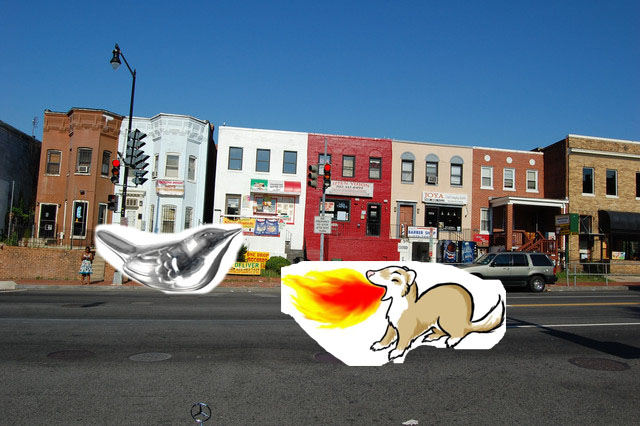
Yesterday afternoon, while I was waiting for my bus I heard a loud WOOSH overhead and saw a gigantic silver bird–it must have been 40-feet across–land on top of Federal Reserve Building across from the station. It then made a noise unlike any other I head before, a “screeeeeeee-reeeeeeeeeee screeeeeeee-reeeeeeeeeee!” that shattered windows all over Midtown Atlanta, much to the amazement of everyone present. As we watched this monster in horror, we felt and then heard a rumbling in the streets. Without warning, a herd of ferrets, each the size of a double-decker bus, came tearing around the corner. Also, they were breathing fire. The silver bird and gigantic flaming ferrets then did battle with Laser Tag for the rest of the afternoon. Luckily, I snapped a picture of the battle:
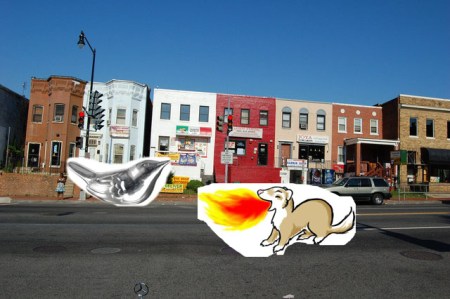
Actual Recreation

What do you think the chances are that this actually happened? Less than none, I’m betting. Congratulations! You’ve earned your critical thinker merit badge!

A similar story has been sitting on my desk for quite a while, and it’s time to purge it from my “to do” list. Did you know that there was a massive battle between the Genovese military and UFOs in 1608? Me neither. This story seems to pop up every few years on the Internet, especially in forums where people are looking for evidence of otherworldly visitations long before the 20th century’s first flying saucers appeared. What UFOlogists are looking for in these apparitions are depictions that are “uncontaminated” with modern notions of UFOs. At first glance, this logic might seem to make sense; however, UFOlogists seem to forget that their interpretations of these sightings are still contaminated with expectations wrought of modern UFO lore. The post that first brought the Genovese story to my attention appeared on Above Top Secret. The source of the story, Discours des terribles et espouvantables signes apparus sur la mer de Gennes, was written shortly after the reported events, and several versions are available online.

I faced a couple of barriers when I decided I wanted to look into this story. First, my 17th-century Mediterranean history is a little shabby (as is yours, admit it). Second, I don’t read archaic French. I ran the original test through Google Translator, and found that Google doesn’t either, translating the title into: “Speech and of the terrible espouvantables signs appeared on the Mer de Gennes.” Third, I’m not all that familiar with the specific type of publication, a “chapbook,” that this account first appeared in. Fourth, except where people are simply copying and pasting modern interpretations of the supposed UFO encounter, there seems to be no single, straightforward, consistent or universally agreed upon modern translation. As is often the case with folklore, embellishments and additions accumulate, and this is complicated by the fact that the French text has been subjected to numerous translations; take the ATS source above–it seems to be a translation from archaic French to Italian to English. Where to start?

Oh, as they say, merde.

The first thing I’m going to do is not worry too much about which modern version of the story I choose as my starting point. When we eventually go back to the earliest versions of the story, whatever we learn there will shed light on the accuracy of all subsequent versions. So, let’s start with the event as it is described by Albert Rosales at UFOinfo.com in his catalog of ancient UFO sightings.

Location. Genoa, Italy
Date: August 22 1608
Time: unknown
Locals reportedly saw a bizarre creature emerging from sea right off the coast. It was described as a human shaped figure covered in scales and with what appeared to be “snakes” protruding from its hands. Canon fire was directed towards the creature without any apparent effect. Around the same time off the coast of Nice in France fishermen saw an object that descended towards the sea, a blood-like substance was seen to drop from the object. Others saw three “vessels” moving at high speed above the city. The three vessels then approach the local fortress and descend to the water causing a great boiling of the sea and emitting ochre-red vapor. To the great stupor of those present, two humanoid beings, with large heads and large luminous eyes dressed in red scaly combination outfits emerge from the vessels. These humanoids appeared to be connected to their vessels by long tubes. The humanoids spent several hours involved in “strange” work around their vessels. Meanwhile soldiers in the fortress shot cannon at the intruders without any apparent effect.
HC addendum Source: CUN Genoa, Also Jean Pierre Petit France Type: E & B

Location: Near Marseilles, France
Date: August 25 1608
Time: evening
Three days later, a single vessel appeared near Marseilles over the fishing village of Martigues, and again displayed the same erratic flight maneuvers that had been displayed over Nice. It stopped in midair and two beings got out, appearing to engage in an aerial duel of some kind. The following week there was a heavy fall of red rain, and in the months after churches were packed with worshipers begging to be spared whatever disastrous fate that was about to befall them. While accounts of these events are sometimes ambiguously worded, it is remarkable that so many people in three separate locations could have imagined such strange occurrences at a time when no flying machines existed.
HC addendum Source: http://www.subversiveelement.com/UfoNiceFrance.html Type: B?

We’ll start with the last assertion first:

“While accounts of these events are sometimes ambiguously worded, it is remarkable that so many people in three separate locations could have imagined such strange occurrences at a time when no flying machines existed.”

It would be remarkable if so many people in different locations could have such experiences independently of one another in such a short period of time. But that’s not what we have here. We have a single account, variously republished in a number of chapbooks (or “canards” in French–I believe the English term only arrives later). Chapbooks were inexpensive little books meant for wide popular consumption, not durability (much like modern newspapers are not meant to last, but be printed in volume). There could be as few as eight pages in one of these little pocket-sized books. As I said, there are a number of retellings/partial translations of the purported source, identified as the Discours des terribles et espouvantables signes apparus sur la Mer de Gennes on a number of UFO sites, but I can’t rely on them to check the story’s accuracy. The first thing to do is identify the original. I enlisted Eve’s assistance, which is always a good idea.

We first noticed that a surprising number of editions of this story exists, most dating from 1608 and 1609. Most printings actually provide a city of publication and refer to the source of the text it is republishing. A chapbook printed by Parisian bookseller might read: “Jouxte la copie de Lyon” (“following the Lyon edition”). Ideally, you would be able to work backward through the various editions to get to the source; however, in this case, there are references to more editions than actually seem to have survived. We found that one version had been copied from a Lyon printing, but we could not find any reference to any extant copy of that edition. Eve and I turned the Internet inside out…hitting WorldCat, GoogleBooks, JSTOR, every dang database and resource at our disposal to try and find it. No go.

All was not lost, however. While we seemed unable “follow the begats,” as it were, back to the original, we did find that these earliest versions of the story were remarkably consistent with one another, with changes barely more substantive than varied spellings, which at any rate had not yet been standardized. The remarkably stable text suggests a common source.

We contacted historian Yannis Deliyannis, who has looked into the Discours and discusses it in some detail on his blog, Chronicon Mirabilium. We asked him if he had some information about the publishing history of the chapbook. He reports that six contemporary versions of the account are known to exist, two are referenced by other sources and are known to have existed but were lost, and a final, the Genoan edition, is only mentioned as the source for one version of the chapbooks, but there is no corroboration that the book exists. Deliyannis suspects that this lost apocryphal version may have been invented to lend credibility to the edition that claimed to be based on it. We agree; there need not be a Genoan edition. Deliyannis also notes that the number of times that this little book was reprinted suggests that it was a very popular chapbook.*

Even if we can’t go all the way back to the purported “Genoa” edition, we can look at the editions that do exist and come up with a pretty faithful version. And by “we” I mean “other people,” namely, my co-editor Eve, fellow Brittain postdoc Jennifer Orth-Veillon, and Yannis Deliyannis.

(Translation of the “Discours des terribles et espouvantables signes apparus sur la Mer de Gennes” by Eve Siebert, perfected by Yannis Deliyannis, with thanks to Jennifer Orth-Veillon for her help early on.) Eve’s insight that English and French words share a lot of common roots was OED ninjacraft at its most deadly!)

Our direct translation differs from the the modern UFOlogical version in several significant ways.  How does Rosales’ version of the Discours square with what originally appeared? Let’s see:

“Locals reportedly saw a bizarre creature emerging from sea right off the coast. It was described as a human shaped figure covered in scales and with what appeared to be ‘snakes’ protruding from its hands. Canon fire was directed towards the creature without any apparent effect.”

This is sort of close. In the original, however, a variety of monsters appear, popping up in the ocean with two snakes in each hand. Some are in human form and some are more dragon-like, and they are all covered in scales. Also, Rosales does not mention the terrifying cries that these creatures are supposed to have emitted. Most importantly, while UFOlogists always mention that canon were used against the apparitions (perhaps the idea that the military got involved suggests authenticity to them), they never mention what is called the “true remedy.” The Capuchins order processions, fasting, and the saying of the Forty Hours, the latter being the “nuclear option” of penance. These details demonstrate that within the story, the apparitions respond to prayer, underscoring the religious, not factual-historical, nature of the text. I take it back; Rosales’ account is not close at all.

“Around the same time off the coast of Nice in France fishermen saw an object that descended towards the sea, a blood-like substance was seen to drop from the object.”

No. This is wrong. No flying object is associated with the rain of “true and natural blood” described in the Discours. There are no fisher-folk. What is reported is a rain of blood throughout the south of France. The phenomenon of a “red rain” is well-known. In August and September 2001, a widely reported red rain fell in the Indian state of Kerala. Despite widespread accounts that alien cells discolored the water, the real culprit seems to have been “lichen-forming alga spores of local origin.” Red rain can also be caused by wind-born red dust and by other terrestrial mechanisms. The red rain in the south of France, as far as I can tell, is the only event in these stories that is historically verifiable. The naturalist Nicolas-Claude Fabri de Peiresc investigated a red rain there in 1608 and decided that it was, charmingly, butterfly droppings.

Back to Rosales:

Others saw three ‘vessels’ moving at high speed above the city. The three vessels then approach the local fortress and descend to the water causing a great boiling of the sea and emitting ochre-red vapor. To the great stupor of those present, two humanoid beings, with large heads and large luminous eyes dressed in red scaly combination outfits emerge from the vessels. These humanoids appeared to be connected to their vessels by long tubes. The humanoids spent several hours involved in “strange” work around their vessels. Meanwhile soldiers in the fortress shot cannon at the intruders without any apparent effect.

This scene takes place back in Genoa. Three carriages appear, each pulled by six fiery dragons. (You do not get to change the carriages to “vessels” unless you want to argue that they are dragon-powered UFOs.) There is no mention of them charging the fortress, boiling the sea, or emitting a vapor, red or otherwise. They are being manned by the same apparitions that were seen earlier, still with flying serpents in their hands. There is no mention of their head size, their eye-luminosity, their “scaly combination outfits,” or doing “strange work” in the air while connected to tubes. They merely bellow loudly, scaring a few people to death. Again, the narrator mentions that after the Te Deum was sung, nobody ever saw the carriages again. What is interesting is that the first part of this episode seems to be a description of an image that often accompanies the account of Genoa:
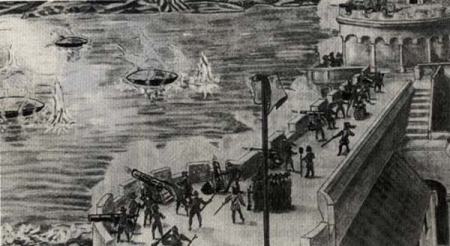
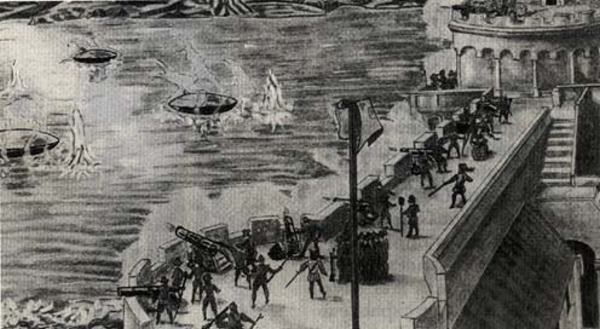
The problems are numerous. 1) I haven’t seen a source of this image and don’t assume that it accompanies any original edition of the text. 2) It’s not a photograph, so nobody should treat it like it’s an accurate depiction of anything. 3) I don’t even know if it is contemporary to the chapbooks. It doesn’t resemble any Renaissance print I’ve ever seen, though, to be fair…I’m an Americanist who has experience mostly with Renaissance commonplace books in English. (As we shall see, this image only later came to be linked with the story.)

Three days later, a single vessel appeared near Marseilles over the fishing village of Martigues, and again displayed the same erratic flight maneuvers that had been displayed over Nice.

Woah, cowboy! Erratic flight maneuvers? You’re just making things up there. Two men appear in the sky. They are armed and have shields (and no, not like the starship Enterprise). No vehicles, no UFO acrobatics. Two people engaged in combat for two hours, with a brief time-out for a rest. (I swear it’s in there.) A few days later, they are back, wailing on each other “so that they seemed like blacksmiths beating on the anvil.” The next day, they appear on horseback and do combat. On the third day, the combatants reappear, this time in fortresses in the sky. They fire cannon at each other for seven hours, and when the air clears of smoke and the smell of gunpowder, the men are gone.

In the modern version of the story, then, we see a number of important elements suppressed, especially the religious significance applied to the events, the efficacy of prayer as a remedy, and the appearance of dragons. At the same time, elements that fit more closely into the modern UFO narrative are either stressed (“Look–things flying!”, “Look–lizard people!”) or added (“red scaly combination outfits” and EVAs). The modern story, at least as it is retold by UFOlogists, is nothing like the original.

Being able to dismiss the modern version of the UFO story leaves us with another problem. Did strange beasties appear in the sky over the Mediterranean in 1608?

Of course the hell not.

Let’s start the analysis with what we would expect the record to reflect if these apparitions had occurred. There would be multiple, mutually confirming independent reports, including Church, civil, and military records, about the goings on. This type of archival research can only be conducted on-site. Luckily, Diego Cuoghi has visited the archives of Genoa to investigate the original story.  He found no evidence that anything remarkable whatsoever was reflected in the Senate records of the day.  Cuoghi’s research is really rather good, as he identifies the time and place when modern UFOlogists changed the story of the carriages to ovals and when the image of the battle was first–and forever–linked to the story: 1970s France. And let’s face it, with the exception of Tokyo, where this sort of thing happens every other day, someone would have mentioned Gamera and Zigra having it out on the front lawn.

Of course, other scholars would not have bothered to go so far as to actually search the archives. Most would have recognized the fantastic elements for what they were. They would recognize the long-standing tradition of visions in the sky dating as far back as Revelation (clearly influencing this text) and the subgenre of visions of aerial combat presaging disasters. They would have fit the Discours squarely within that tradition. In one collection of 500 French chapbooks/canards examined by Jean-Pierre Seguin at the Bibliothèque Nationale in the 1960s, 51 entries were stories of celestial visions. Seguin’s abstract offers his take on the context and content of this massive collection, and they offer a good guide to the UFOlogist who is interested in getting to the truth:

The Bibliothèque Nationale has some five hundred news-sheets, of the kind called ‘broadsides’ or ‘coqs’, printed between 1529 and 1631, date of publication of the first Gazettes. The stories found in these sheets, some true and some imaginary, some very long and detailed, others quite short and unprecise, differ considerably according both to the subject matter and to the author’s personality. Yet, they all have in common certain fixed characteristics — which they share with contemporary daily newspapers. But, the XVIth and XVIIth century reporters as well as their readers were more concerned with the ‘moral’ of the news item than with its novelty, its oddness or its sensational aspect. The analysis of this ‘moral’ contributes to a better understanding of those troubled times.

So, it turns out that this type of literature was not meant to be taken literally, but understood in terms of the moral lesson it delivered; in the case of the Discours, the message is “pray and repent.” It should therefore not be used as evidence of alien visitation.

*Deliyannis has found a probable sister text, an account of a Maltese dragon that contains similar language and themes as the Discours.  He also identifies a possible historical event that might have initiated the story, albeit heavily embellished, though he cautions that his conclusion is speculative.

Thanks to Eve, Jennifer, and Yannis for their critical contributions to this entry. Without you, nothing!

Works Cited

Cuoghi, Diego. “L’UFO DI GENOVA DEL 1608: Negli Articoli e Nelle testimonianze.” Blog. http://bit.ly/yEJWCm

Davis, Jennifer R. and Michael McCormick. The long morning of medieval Europe: new directions in early medieval studies. 2008. Online. http://bit.ly/wUxSRa

Deliyannis, Yannis. Chronicon Mirabilium. Blog.

Dunning, Brian. “Alien Downpour: The Red Rain of India.” Skeptoid Podcast. Skeptoid Media, Inc., 21 Sep 2010. Web. 12 Mar 2012. http://skeptoid.com/episodes/4224

“Forty Hours’ Devotion.” Catholic Encyclopedia. Online. http://bit.ly/wNUCQQ

L’INFORMATION EN FRANCE AVANT LE PÉRIODIQUE: 500 CANARDS IMPRIMÉS ENTRE 1529 ET 1631 (suite et fin) Jean-Pierre Seguin Arts et traditions populaires, T. 11e, No. 3e/4e (Juillet-Decembre 1963), pp. 203-280. http://www.jstor.org/stable/41003032

Rosales, Albert. “2357BC – 1869 HUMANOID SIGHTING REPORTS.” Website. http://bit.ly/w0pQZ7

Sampath, S. T.K. Abraham, V. Sasi Kumar and C.N. Mohanan. “Coloured Rain: A Report on the Phenomenon.” 2001. http://bit.ly/jHoxli

RJB

‘fringe’ historical linguistics 2 (including comments on comments!)

March 6, 2012

Hi again, all!

Thanks very much for the appreciative and well-informed reactions to my first post!  I’ll start with some responses to the issues you’ve raised.

As has been noted, the theory of a recent Proto-World is in fact difficult to reconcile with various pieces of evidence, notably the modern archaeological evidence that modern humans had spread as far as remote Australia by 40,000 (or even 60,000) years BP, presumably already using languages related to other human languages (as are the contemporary Aboriginal languages).

Some enthusiastic commentators have asked for information about language ‘super-families’: larger, deep-time ‘families’, each giving rise to recognized later/smaller ‘families’.  One of you specifically mentioned Nostratic, which is a supposed deep-time common ancestor of Indo-European and some other ‘families’ including Semitic (Arabic, Hebrew etc.), Uralic (Finnish etc.) and Dravidian (Southern India); the exact composition of the Nostratic ‘super-family’ varies among its advocates.  Now down the track I may well have things to say about ‘super-families’ and about ‘Nostratic specifically; but many of the ‘Nostraticists’ and the advocates of other ‘super-families’ are themselves professional linguists (although they constitute minorities in accepting such theories), and much of this material is thus outside my remit here.  Controversial ideas are not by any means always ‘fringe’.  (But I still welcome comments and queries on these matters and will try to engage in discussions of them!)

On the other hand, there will definitely be more to say in this context about some specific languages which have attracted ‘fringe’ as well as mainstream attention, such as Etruscan (written in a known script but apparently ‘genetically’ isolated and still only marginally intelligible) and Sumerian (the earliest known written language and another which, while now largely understood, is again regarded as ‘genetically’ isolated) – also about the ‘cuneiform’ script used originally for Sumerian and later applied to unrelated Mesopotamian languages.  Comments on specific non-mainstream historical ‘linguists’ such as Jordan Maxwell and Michal Tsarion are also forthcoming! 

If readers’ patience with me holds out, I will also have something to say about ‘Inuit words for snow’ and related matters – but not under the present heading, since these issues are essentially non-historical in character.  If it appears after some time that I’m forgetting to get back to this, please nudge me!

OK, to resume:  As I said in Post 1, the language identified by ‘fringe’ writers as Proto-World may be a known (ancient) language or a language which has been reconstructed or invented by the author in question.   Where the language is a familiar one, it is usually an ancient language favoured [British spelling!] by the author, often the ancestor of her own language or even a known older stage of that language.  Biblical Hebrew, regarded by many as the Ursprache in pre-scientific times, remains popular in this respect, but there are many others, especially revered classical languages such as Sanskrit and Ancient Greek.  Languages of unknown or disputed ‘genetic’ affiliation, such as Hungarian, Sumerian and especially the genuinely mysterious Basque (another ‘genetically’ isolated language), are also commonly identified as ancestor languages.

The identification of a language dear to the writer as the Ursprache – or as otherwise especially important – does not of course itself show that the writer is biased, or even mistaken; but it excites reasonable suspicion as to unscholarly motives.

Other claims of this first sub-type do not involve an ultimate Ursprache but rather alleged more recent (but still ancient) ‘genetic’ links between specific cultures and languages which are normally deemed unconnected (one such writer is Michal Tsarion, who proposes a ‘secondary Ursprache’ which allegedly emerged after a catastrophe; see further later).

The second way in which unacknowledged links between languages are said to have arisen (see Post 1) involves ‘borrowing’ or ‘transfer’.  In cases of this kind, an individual word (or other linguistic feature) from one language is taken over by another language in a contact situation, as in genuine cases such as English restaurant, borrowed from French.  For example, members of one culture are said to have completed long voyages and to have arrived in the territory of the other, and the cultures and languages are supposed to have influenced each other.  (Claims of this kind clearly do not directly involve an Ursprache.) Some such cases involve the theories of Barry Fell, Thor Heyerdahl etc. about unrecognized early transoceanic contact.

In all these various types of case – even where language is not itself of especial interest to the writers in question – linguistic forms (spoken and/or written) are very commonly invoked, because they (with their meanings) appear prima facie much more specific and much more easily identifiable than most other cultural traits, and the probability of chance similarity seems much lower.  For instance, it is observed that the male name Madoc is found in Welsh and that the male name Modoc is found in Mandan (USA).  It is held that these two forms are so similar that they are very probably etymologically related; and on the basis of a limited number of individual pairs of this kind it is deduced that the Welsh and the Mandans had a common ancestor culture or experienced influential contact in remote times.  In this specific case, it is normally this latter which is at issue; the matter involves the American voyage of the medieval Welsh prince Madoc, an event not accepted as historical by mainstream scholarship.

In fact, in the absence of continuous textual evidence it can be established that words are cognates – that they descend from a common ancestor word or root in a common ancestor language, or that one of them is itself that common ancestor word – only if they display systematic correspondences in their phonology (the structural sound-units that make them up), repeated over large numbers of word-sets.  See for instance the systematic correspondences between synonymous (related) words, in the ‘subfamily’ of Indo-European languages derived from spoken Latin and known as ‘Romance’, in word sets such as Latin canis, French chien, Italian cane, Spanish can [later replaced by an unrelated word] (all meaning ‘dog’), Latin panis, French pain, Italian pane, Spanish pan (all meaning ‘bread’), Latin manus, French main, Italian mano, Spanish mano (all meaning ‘hand’), etc., etc.  In each word-set, Latin -an- has become –ain/-ien in French, –ane in Italian, –an in Spanish.  Such patterns exist because language change is very largely systematic and regular.

In ignorance of this, one might easily imagine, for instance, that Latin habere and German haben are cognates; after all, they are very similar (they differ only in respect of their grammatical endings), they both mean ‘to have’, and in this case we know independently that the languages themselves are ‘genetically’ related (that is, they have a common ancestor, the ancestor of all the Indo-European languages, although they are members of different ‘subfamilies’ of Indo-European).  But in fact these words are not cognate; they are unrelated, and their similarity is unsystematic and accidental.  German haben does have a Latin cognate, but this is capere (‘take’).  In fact, word-initial Latin csystematically corresponds with German h-; other examples are canis/Hund (‘dog’), centum/hundert (‘hundred’), etc.

The reverse pattern also occurs; for example, English cow and beef, which now sound (and look, in spelling) very different, are in fact demonstrably systematically related and cognate; they do have a common deep-time (Indo-European) ancestor word.

Correspondences are less predictable where contact and borrowing are in question, partly because these involve interaction between two sound-systems and often individual words; but they are still fairly systematic, not merely haphazard, and any claim that a word has the phonological shape that it has because it has been borrowed from a given other language must be supported.

Next time I’ll go into further detail on these issues and their significance for ‘fringe’ historical linguistic claims.

Thanks again for all the interest!

Mark


This Week in Conspiracy (4 March 2012)

March 4, 2012

Georgia seems to have survived yet another assault of tornados sent to us by HAARP, probably to silence the beacon of reason that is this website. Of course, now that Skeptical Humanities is an international affair, it will be harder to take us down. Muahahaha!

So, this is the Week in Conspiracy, my take on the week in weak. And this week was not weak in terms of its weakness. It was powerful weak.

The biggest story on the scaredy-sphere this week was the death of right-winger and all around truly horrid person Andrew Breitbart, which I imagine was a tragedy for someone, somewhere. Probably someone like Rush Limbaugh.  For those of you who aren’t familiar with him, you’re lucky, but he would fake stories about supposed devious doings on the left, which, for some reason, the media took seriously. Think of the Shirley Sherrod affair a few years back. Breitbart.

Conspiracy theories appeared almost instantaneously. Alex Jones wondered if the Obama crime machine was responsible for the death. He goes so far as to wonder if there is a Stalinist purge of Administration critics in the works. Truth Excavator wonders:

“Was Breitbart becoming too big of a problem, and needed to be taken out, mafia-style? This is only speculation at this point. But 43 is too young for someone to die of natural causes, so let the conspiracy theories fly and we’ll see where the truth lands.”

People die of natural causes at young ages all the time. Insofar as Breitbart being a big problem, Obama is head and shoulders above whatever goofball the Republicans put up against him in November. The going theory among the less than scrupulous is that Breitbart was going to release college video footage of Obama. Why risk killing someone? As for the question, “Cui bono?” which is being asked all over the conspirasphere, clearly the conspiracy theorists have benefited and are therefor the most likely killers of Andrew Breitbart. Of course Breitbart predicted something would happen on the first of March. Did the CIA use a “heart attack gun” on Breitbart? A poison dart? Perhaps the autopsy will get to the truth. The best part of this story was a comment thread following Gawker’s coverage about the conspiracy theories that exploded on Twitter after Breitbart’s death was announced.

Conspiracy Theory of the Week

I can imagine it now–an adviser to Ron Paul shuffles up to the candidate and whispers: “Dr. Paul, why don’t you stand here in front of this big freaking Confederate flag and bitch about how the Civil War deprived white people of rights…OH, F*CK I WAS JOKING!”

RJB


‘fringe’ historical linguistics 1

March 2, 2012

This is the first part of a series of posts dealing with this subject.  I’m trying not to assume any knowledge of linguistics but please stop me if anything needs further explanation (or indeed if you’d like to challenge anything, add comments, etc).

When modern linguistics first developed, in the nineteenth century, the discipline was mainly historical in nature.  It was concerned chiefly with language change and language origins: the origins and ancestry of languages over historic time, and the origins of particular words (etymologies) and constructions/systems (grammar, sound-systems, etc.)  Although the twentieth century saw the very extensive growth of various branches of NON-historical linguistics, historical linguistics remains an important sub-field of the subject.   And one of the most important sub-fields of non-mainstream (‘fringe’) linguistic thought is ‘fringe’ historical linguistics: non-mainstream claims and theories about these very matters.

So: there are many non-standard ideas – most of them ‘hyper-diffusionist’ (see below) and many of them sensationalistic – about the origins, relationships and histories of languages, especially ancient languages.  These ideas are rejected by those professional linguists who are aware of them but often attract support among fringe historians and indeed among the general public.  I’m commenting here on these non-standard claims and theories in my capacity as a professional linguist associated with the world-wide skeptical movement.  At this stage I’m focusing upon claims regarding LANGUAGES (and their words, etc.) rather than scripts and inscriptions (I’ll talk about these later).

Many of the writers in question here have never studied linguistics, and some apparently do not know that the subject exists.  Some of them are specifically interested, as amateurs, in language or in particular languages.  But even these authors typically write in apparent ignorance of the subject; for instance, they generally show little or no awareness of recent historical linguistic theory.

Others among these authors are mainly interested in history itself, and present linguistic data and argumentation by way of support for their views on historical or archaeological issues.  In many cases these writers are motivated in large part by nationalistic and/or religious sentiments.

Like other ‘fringe’ thinkers, writers of all these kinds generally believe that their ideas are rejected or ignored by the mainstream not because of weaknesses in them but as a result of prejudice and hidebound adherence to established ideas – and, of course, the desire to protect the status of mainstream scholars.

Claims and theories of this type may involve:

ancestor languages

historical relationships between languages (involving alleged common origin and/or contact)

the etymologies of specific words (including onomastics, the study of names) and the development of constructions/systems

‘out-of-place’(spoken) languages (found used or understood in unexpected locations)

(etc.)

These claims are often associated with general historical claims involving entire cultures and peoples.  These typically assert that some geographically (and in some cases temporally) separated cultures and – crucially in this present context – the associated languages, which are normally thought of as unconnected, were in fact closely linked.

There are two main ways in which this is said to have occurred.  The first way involves the cultural diffusion of ‘genetically’ related languages from the language used in an earlier common source civilization, which is itself often one unknown to mainstream scholarship (for example, Plato’s Atlantis).  (‘Genetically’ here does not imply the BIOLOGICAL inheritance of specific languages or linguistic features; these are acquired, CULTURAL traits and this term is used by way of an analogy.  I’ll talk about the second way later.)

In many cases this civilization is said (in a HYPER-diffusionist tone) to have been the ultimate ancestor civilization of all humanity.  Its language is thus identified as the ultimate ancestor language of all humanity, the Ursprache or, in current linguistic terminology, Proto-World.

Two key points here:

1) It is not certain that there ever was ONE single Proto-World; humanity may have developed language more than once.  It IS possible that all known human languages (whether still used or not) descend from one common ancestor, either because humanity did in fact develop language only once and the phenomenon diffused from that one starting-point, or because only one ultimate ancestor language, out of a number which once existed, has left any surviving descendant languages.  On the other hand, it is possible that the known languages descend from multiple ancestors. There are on present reckoning at least fifty ‘families’ of ‘genetically’ related languages (including some ‘genetically’ isolated single languages) which by definition cannot currently be shown to have ever had common ancestors; the best known such ‘family’ is Indo-European, which includes English, most other European languages ancient and modern, the North Indian languages descended from spoken Sanskrit, ancient and modern Persian, etc.  (Some linguists seek to establish deeper-time relationships between these ‘families’ by means of overtly statistical methods.)  We remain ignorant on this issue precisely because of Point 2).

2) As is generally agreed by historical linguists, on the evidence available, Proto-World or multiple ancestor languages must have been spoken so long ago (at least 70,000 years BP, probably more like 150,000) that (given the observed range of rates of linguistic change) it/they cannot possibly be reconstructed in any detail.  Using statistical methods such as those mentioned in Note 1, a few ‘maverick’ linguists HAVE argued that more recent dates for Proto-World should be accepted, and thus that Proto-World (along with other very ancient ancestor languages closely descended from it) CAN be reconstructed in part.  However, most of this work is now dated, and all of it is marginal to the mainstream at best; much of it involves methodology which, at least nowadays, is regarded by most linguists as too loose and approximate to be reliable.  Similar, often more extreme ideas have been developed by clearly non-mainstream authors.  These writers too consider that a single Ursprache/Proto-World (typically a language similar to their own ‘favourite’ ancient language; see later) existed relatively recently (within the last 20-30,000 years, or even more recently) and CAN be reconstructed in part.

The language identified as Proto-World may be a known (ancient) language or a language which has been reconstructed or invented by the author in question.  More on this next time!

Mark


I’m very pleased to be a new contributor to skeptical humanities!

March 1, 2012

Hi all!  If you’d like to know about my background, please see my recently-posted mini-bio.

My first set of contributions is going to involve my own most central area of interest as a skeptical linguist: a summary of the main issues regarding non-mainstream (‘fringe’) claims regarding the etymologies of words and historical links between languages, and explanations of why such claims very typically don’t hold up.  Comments and queries will of course be most welcome.  Please stand by for this material.

Mark Newbrook (currently with my beloved in England’s beautiful Lake District)