Glad to see it! Sorry I missed it. But this weekend I came across something that is not even homeopathy. You’ll hear about it. Teehee.
RJB
Glad to see it! Sorry I missed it. But this weekend I came across something that is not even homeopathy. You’ll hear about it. Teehee.
RJB
 1 Comment |
  mass media, science |
  Permalink
 Posted by Bob
This weekend, I will be attending TruthCon, which brings together all sorts of energy healers and people interested in UFO disclosure and 9/11 conspiracy theorists and…oh, everything. It’s like a paradise for me and will likely be the most interesting conference I attend this year (all love to NeMLA and NECSS, btw!). Regardless, since I am going to be really busy this weekend, I thought I would write up the week that was weak a little early.
Forget two weeks ago. And last week. And three weeks ago. THIS week, without a doubt is the most important week in the history of the human species, if conspiracy theorists are right.
Conspiracy theory of the week:
Honorary conspiracy theory of the week:
Not a real conspiracy theory, but my brother totally got me with a facebook post about the GIGANTIC STORM OF DOOM (which, in the end, never materialized in St. Louis):
“NEWS FLASH!! Area Man Convinced Blizzard The Work Of Muslim Extremists: “I don’t know how exactly, but these fellas have found a way to manipulate our weather patterns. They really will stop at nothing to disrupt our American way of life.”
Well played, sir. Well played.
And that’s it for now, friends. I’m off into the breach!
RJB
1 Comment | conspiracy theory, history, humanities, mass media, politics, science, Uncategorized | Permalink
Posted by Bob
Several years ago, one of my writing assignments was for students to find an op-ed they disagreed with and write a rebuttal. One student picked as her article a letter from the editor of Nature or Science entitled, “The Logical Fallacies Creationists Make.” It was a list of about 20 arguments commonly heard from creation advocates (or “intelligent design” advocates) followed by a critique of each one. In my student’s paper, she first named each fallacy and then made it. For instance, in response to the old equivocation that “evolution is only a theory” (a scientific theory is not a “guess” in the sense that we colloquially use the term “theory”), she offered as a rebuttal, “But evolution is only a theory.” I decided, as I read her paper in horror, that I would add evolution and creationism to my list of forbidden paper topics–like “abortion,” “gun control,” and “campus drinking policies.”
Last semester, however, given that I was teaching a writing class called “Writing About Science and Pseudoscience,” it seemed irresponsible for me to avoid what is perhaps the most controversial and socially relevant pseudoscience in the U.S., intelligent design.
I also made it clear that I in no way intended to offend or comment on anyone’s religious beliefs (teaching at a public university, I was acutely aware of my responsibilities to protect the religious rights of my students). At the same time, a guiding tenet of my class was that if you make claims about the observable world and represent what you do as science, your assertions are open to scrutiny and evaluation, as all science is open to challenge. Indeed, nothing purporting to be a science can justifiably claim to be protected religious speech. So, I made it clear to students that I did not intend to critique “creationism,” but that I was looking specifically at “creation science” a.k.a. “intelligent design.”
I had selected two movies for students to watch about Intelligent Design. The first was Ben Stein’s Expelled: No Intelligence Allowed. The second was Judgment Day: Intelligent Design on Trial, an episode of NOVA that told the story behind the First Amendment case in Dover, PA. I had students watch Expelled first and then watch the NOVA episode. (Many students opted to watch these online or in their dorms instead of at the optional evening movie viewing sessions). Soon students started sending me emails indignantly protesting the treatment of advocates of intelligent design at the hands of “Big Science” (a term that Stein uses). One student wrote to me to ask about why people were being kicked out of labs, especially when they had good evidence and can prove it.
As you can see, one of the risks that you run when you teach using extraordinary claims is that some students may find the claims of propagandists like Stein convincing. But this is precisely why well-produced but ill-evidenced works should be addressed in an environment where all evidence is interrogated and all claims are challenged.
During the next class period, I discussed Expelled. I don’t like to simply lecture in a writing class–I find that the give and take of discussion is usually more productive–but Expelled leaves out a lot of information relative to a full understanding of the issues, including the state of evolutionary theory (very, very robust), and the status of intelligent design as a pseudoscience. In a nutshell, Stein’s argument is that Big Science is suppressing Intelligent Design, a viable scientific theory being practiced by reputable scientists, by denying ID proponents tenure, research and publication opportunities, in favor of what it knows is a failing theory (evolution) for ideological, probably atheistic, reasons. Stein argues that this is dangerous because it could ultimately lead to social abuses of the type perpetrated by the Nazis. My students agreed that this was a fair statement of the essential argument of the movie. We find in this thesis a number of testable claims, and in my lecture I took each one in turn.
It’s hardly a fair fight to put the cumulative weight of the evidence from so many scientific disciplines that suggest all life descended from a common ancestor against the bald assertion that “this animal or structure could only have been put together by an intelligence.” I sketched out the robust evidence that we have that suggests the deep, interconnected history of life on the planet, not a jot of which was mentioned in the movie. Indeed, the best argument that Stein was able to muster in the movie was a story by some supposedly maligned victim of the Big Science cabal that, after a few beers, evolutionists admit that the theory is in trouble. As we had already discussed the value of anecdote, my students asked a number of relevant questions, for instance, “Who said that and did you talk to them?” (Answers: They don’t say and probably not.)
A useful resource for teaching material like Stein’s is, as always, the National Center for Science Education. Their site Expelled Exposed is an invaluable compilation of background information, putting Expelled‘s claims in context, and satisfied most of my students, I suspect, that the claims of persecution were likely exaggerated. Another useful source about the wealth of evidence for evolution is Richard Dawkins’ The Greatest Show on Earth.
Later in the section on evolution, I included perhaps the most eloquent argument on behalf of design, William Paley’s Natural Theology, in which he develops the famous watchmaker analogy. I included it because students deserve to be exposed to the best arguments, not merely lame and deceitful ones like Stein’s. (In class, I suspended judgment about whether or not Stein was deliberately deceitful in the movie. When students asked, I said I didn’t know. At any rate, Stein’s intent was not the point.)
The last reading I included was a chapter of Richard Dawkins’ The Blind Watchmaker. While flipping through Dawkins looking for something suitable for the class, I found myself rejecting potential readings because of his tone, which can be, how you say, condescending and occasionally bracingly so? I did not want to offend my students, but it occurred to me that censuring Dawkins’ readings on the off-chance they would offend a student would give my students an inaccurate and decidedly biased view of the debate over the teaching of evolution, so I picked a chapter at the end of The Blind Watchmaker and ran with it.
Now, I realized that it was entirely possible that despite my best efforts to limit the scope of my lectures to creation science, a student might take offense at what I said and complain to my superiors. For this reason, I made sure to record every class and alerted my students to the fact that I was recording my talk.
Because I was especially interested in what the students thought of the talk about Stein’s movie, the first of six classes over two weeks, I used the peer-review and final project writing groups to allow students to submit their feedback anonymously. I asked them to email a paragraph to each group manager (my principle contact during the semester as they did their group projects) who would compile the responses into a single email without identifying information. The response to the lecture was decidedly positive, and I got a sense that students fell all along the religious spectrum between young-earth creationist to atheist (I didn’t ask).
Most surprising and pleasing about these responses was my students’ take on my own religion. When they ventured to interpret the lecture in light of what they perceived my religion to be, they revealed that they had no idea what my religious position was. Everybody who ventured a guess guessed differently, and that made me very happy.
Another choice I made that had an unexpectedly pleasant pedagogical outcome came about by giving a lecture about a controversial topic without taking hardly any questions–there were severe time constraints. By the next class students were bursting with questions and dying to jump in. I can say that without a doubt the most lively conversations I have ever had in my teaching career came in the period after I discussed Stein and the evidence of evolution. I played traffic cop, more or less, and let the students duke it out.
I won’t shy away from teaching evolution/ID again. It was one of the most rewarding, productive and invigorating subjects I have ever worked into a syllabus.
RJB
8 Comments | conspiracy theory, mass media, rhetoric and composition, science, science writing/reporting, Uncategorized | Permalink
Posted by Bob
Wikipedia takes a lot of heat. People enjoy complaining about it. Some argue that it is biased one way or another, just ask Conservapedia. A more serious complaint concerns its accuracy: since anyone can edit it, mistakes, jokes and lies inevitably sneak in.
Personally, I love Wikipedia: I want to marry it and have its children. It’s a great resource. If you want to find out some information about…almost anything really, and you want to do it quickly, Wikipedia is a useful place to start. Yes of course one must look at it carefully and skeptically, and one would probably want to verify most information before relying on it. But, hey, what’s that there at the bottom of the page? Is it a list of footnotes and sources? Yes, it is! Yee haw! Wikipedia also does a good job of flagging problems, such as a lack of citations, apparent bias and the presence of weasel words.
So, if used with care, it’s a good resource. It’s not a good source, however. I discourage students from citing it in papers for a number of reasons. For one thing, the content is constantly in flux: information that was there when a student wrote a paper may be gone by the time someone else reads the paper. And, of course, dubious content may be hiding among the reliable and verifiable information.
There are other problems as well. A few years ago, I was looking for some basic information on Francis Beaumont (I think it was he; the entry has changed, of course). I found what I was looking for, but the entry sounded very strange. When I reached the end, I realized why: there was a notice saying it had come from an edition of the Encylopedia Britannica that was no longer in copyright. There’s nothing wrong with that: it’s not plagiarism, and it’s not copyright infringement. It is, however, very old and out-of-date information. If I recall correctly, the entry had been written by Algernon Charles Swinburne. More recently, I have seen entries that apparently “incorporate” material from works no longer in copyright. This is even worse. How would you cite such an entry? You should cite the original source, but which bits come from the original source?
Another problem is plagiarism. The internet is rife with plagiarism. You can find the same phrase/sentence/paragraph/passage/entire article repeated over and over and over, often with the same typos. It can be virtually impossible to track down the original. Oh, in some cases Blogger A will properly cite his immediate source (Blogger B), but chances are that that isn’t the original, and Blogger B simply copy and pasted from somewhere else, without mentioning her source. Quite frequently, the repeated passage can be found somewhere on Wikipedia. I have always suspected that Wikipedia is usually the ultimate source of the plagiarized versions. I still believe that it often is, but occasionally, Wikipedia may include plagiarized material as well.
Case in point: I have been reading Holy Blood, Holy Grail by Michael Baigent, Richard Leigh and Henry Lincoln (I am doing this, dear Reader, so you don’t have to). I spend about an hour reading the book and noting the many dubious claims. Then I spend several hours looking up the dubious claims. Then I bang my head a hard surface for a bit. Then I sit quietly petting a cat until I feel calmer. During the looking-up-dubious-claims phase, I often find myself drawn to Wikipedia. It’s certainly better than the conspiracy sites that either believe and repeat everything in Holy Blood, Holy Grail or think that HB,HG is just a smokescreen for a different conspiracy. Generally, I have found Wikipedia a good place to begin, and I use the footnotes/list of sources to follow up what I find there. But when I looked up Catharism, I found this:
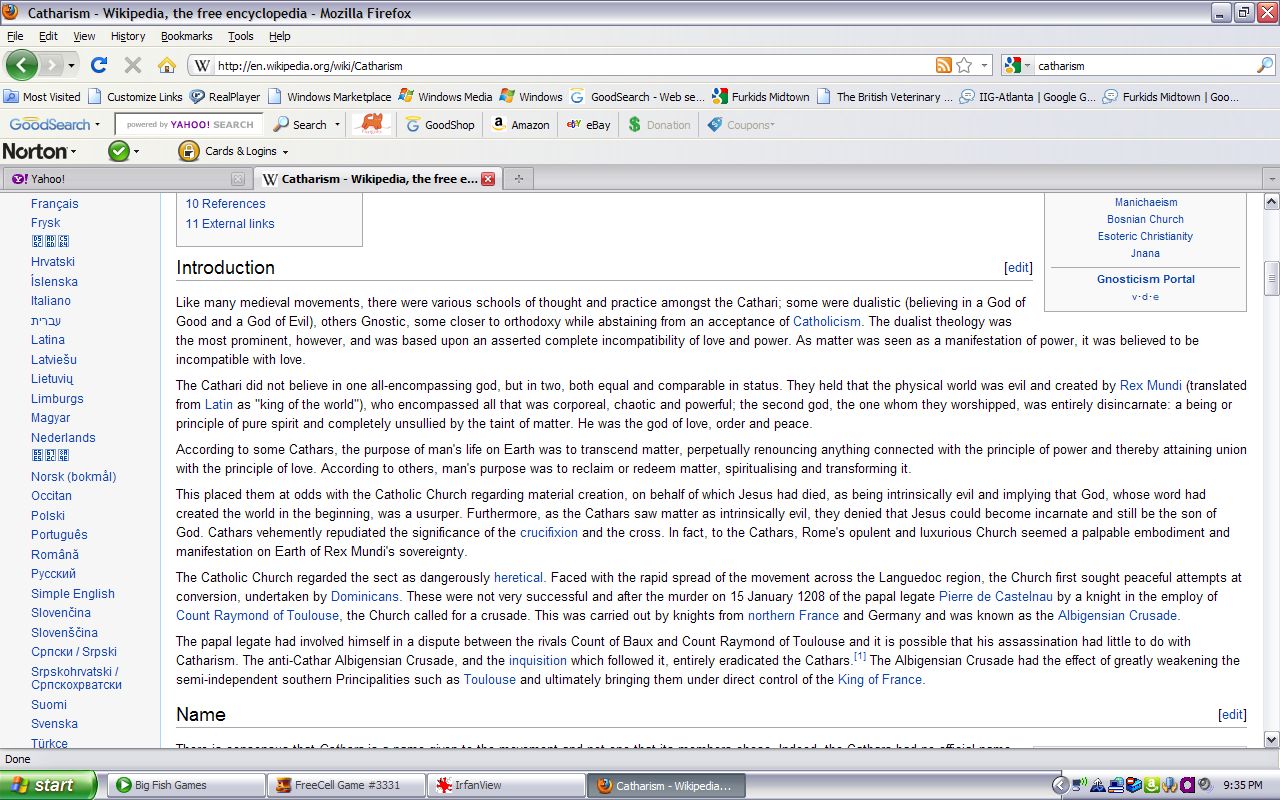
This is the passage in question:
The dualist theology was the most prominent, however, and was based upon an asserted complete incompatibility of love and power. As matter was seen as a manifestation of power, it was believed to be incompatible with love.
The Cathari did not believe in one all-encompassing god, but in two, both equal and comparable in status. They held that the physical world was evil and created by Rex Mundi (translated from Latin as “king of the world”), who encompassed all that was corporeal, chaotic and powerful; the second god, the one whom they worshipped, was entirely disincarnate: a being or principle of pure spirit and completely unsullied by the taint of matter. He was the god of love, order and peace.
According to some Cathars, the purpose of man’s life on Earth was to transcend matter, perpetually renouncing anything connected with the principle of power and thereby attaining union with the principle of love. According to others, man’s purpose was to reclaim or redeem matter, spiritualising and transforming it.
This placed them at odds with the Catholic Church regarding material creation, on behalf of which Jesus had died, as being intrinsically evil and implying that God, whose word had created the world in the beginning, was a usurper. Furthermore, as the Cathars saw matter as intrinsically evil, they denied that Jesus could become incarnate and still be the son of God. Cathars vehemently repudiated the significance of the crucifixion and the cross. In fact, to the Cathars, Rome’s opulent and luxurious Church seemed a palpable embodiment and manifestation on Earth of Rex Mundi’s sovereignty.
Oooh, deja vu! Hadn’t I just read that somewhere? Oh, yeah, here:
But the Cathars carried this dichotomy much further than orthodox Catholicism was prepared to…. For the Cathars a perpetual war was being waged throughout the whole of creation between two irreconcilable principles–light and darkness, spirit and matter, good and evil. Catholicism posits one supreme God, whose adversary, the Devil, is ultimately inferior to Him. The Cathars, however, proclaimed the existence not of one god, but of two with more or less comparable status. One of these gods–the “good” one–was entirely discarnate, a being or principle of pure spirit, unsullied by the taint of matter. He was the god of love. But love was deemed wholly incompatible with power; and material creation was a manifestation of power. Therefore, for the Cathars, material creation–the world itself–was intrinsically evil. All matter was intrinsically evil. The universe, in short, was the handiwork of a “usurper god,” the god of evil–or, as the Cathars called him, “Rex Mundi,” ” “King of the World.”
….According to some Cathars the purpose of man’s life on earth was to transcend matter, to renounce perpetually anything connected with the principle of power, and thereby to attain union with the principle of love. According to other Cathars man’s purpose was to reclaim and redeem matter, to spiritualize and transform it….
In the eyes of the Roman Church the Cathars were committing serious heresies in regarding material creation, on behalf of which Jesus had supposedly died, as intrinsically evil and implying that God, whose “Word” had created the world “in the beginning,” was a usurper. Their most serious heresy, however, was their attitude toward Jesus himself. Since matter was intrinsically evil, the Cathars denied that Jesus could partake of matter, become incarnate in the flesh, and still be the Son of God….
In any case, all Cathars vehemently repudiated the significance of both the Crucifixion and the cross….And…Rome, whose opulent, luxurious Church seemed to the Cathars a palpable embodiment and manifestation on earth of Rex Mundi’s sovereignty. (Holy Blood, Holy Grail, New York: Bantam-Dell, 1982, pp. 53-54)
This portion of the Wikipedia entry clearly seems to be a condensed version of the material in HB,HG (the parts in red appear nearly word-for-word in Wikipedia). If I found this in a student paper, I would call it plagiarism, and there would be consequences. I should note that the information is not wrong: it is one of the longest passages I’ve come across in HB,HG so far (close to two pages) that hasn’t contained questionable information. Still, the borrowing serves as an example of why Wikipedia should be viewed with skepticism.
ES
5 Comments | history, mass media | Tagged: Catharism, Holy Blood Holy Grail, plagiarism, Wikipedia | Permalink
Posted by Eve
If the conspiracy theorists are to be trusted, it has been the most momentous week in the entire of global history, just like last week. And the rest of the world didn’t even manage to even notice. Shame on you, entire world.
Onto the news that is news to the rest of us:
Conspiracy Theory of the Week
Though it is in the spirit of the aflockalypse two weeks ago, this headline has a sort of “Beowulf is an anonymous medieval poem written by Robert Cotton in the 18th century”-quality to it (that’s an actual opening line from a paper Eve once received):
Wow. I mean. Wow.
RJB
3 Comments | conspiracy theory, mass media, politics | Permalink
Posted by Bob
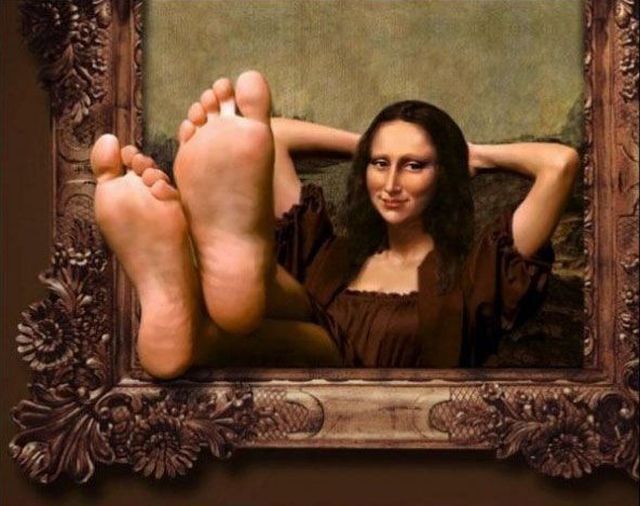
The recent accounts in the media that an Italian researcher had uncovered tiny letters in the eyes of the Mona Lisa seemed suspicious, especially since in no account that I have seen has anyone bothered to print a picture of the supposed micro-signature. Well, Joe Nickell has seen this sort of claim before, and he has some background on the people who are making this extraordinary claim. (Spoiler: They harbor all manner of improbable beliefs.)
RJB
Leave a Comment » | art, humanities, mass media, Uncategorized | Permalink
Posted by Bob
On the Media, one of my favorite podcasts, interviewed Seth Mnookin about his new book, The Panic Virus, which is about the vaccine scare brought on by Andrew Wakefield, who remains happily complicit in unprecedented child suffering and death.
I am excited about this in particular because host Bob Garfield uses the phrase “false balance” to describe the disproportional representation of vaccine fears in the media despite vaccines’ statistically insignificant risks.
We included On the Media in the podcast section of the website because Bob Garfield, Brooke Gladstone and their producers and contributors do a fantastic job of showing how often-unseen forces affect the news and media consumed by the public. I’ve been hooked ever since 2004, when they explained exactly how everyone on NPR sounds so damned good. The report is a classic, and I still recommend it.
Oh, this week they also mention Allen Gribben’s shamefully bowdlerized new edition of Huckleberry Finn, which substitutes the word “nigger” with the word “slave.” They are not the same thing, Allen. I was going to hurl a pithy Twain quote at him (“Censorship is telling a man he can’t have a steak just because a baby can’t chew it”), but I can’t verify that it is actually Twain’s. Oh well.
RJB
1 Comment | humanities, literature, mass media, race, science, science writing/reporting | Permalink
Posted by Bob
Historiann has a humdinger of an article on the popular perception of the liberal arts:
“History Under Attack”: Tony Grafton is spoiling for a fight
Huzzah!
B
2 Comments | history, humanities, mass media | Permalink
Posted by Bob
 Skeptical Humanities