National Commission on the Humanities Formed

February 18, 2011

The humanities have a hard time getting respect, if by respect you mean funding. Sure, we’re (often) the ones teaching the basic research, thinking and documentation skills that underpin the rest of a valuable education…blah blah whine. I often think that popular apathy toward the humanities, especially literature and cultural criticism, stems from the topics to which we choose to apply those important, cross-disciplinary skills. That is to say, that students often resent, say, that we are looking at the business culture of the Renaissance or the works of Theodore Dreiser or 17th-century Norwegian mysticism or whatever. Yes, these are the topics that float the boat of the instructor, who has devoted his or her life to the study of these topics. I know that I picked my areas of study, war and literature and extraordinary claims because I’m fascinated about them, but I certainly do not expect my students to love those topics with the myopic, passionate intensity that I devote to them. At the same time, however, I expect them to recognize that the research practices, habits of thought and underlying curiosity I bring to the study of, say, conspiracy theory, has value in all areas of education.

The incessant beating that the humanities seem to get as university budgets shrink fundamentally undermine the mission of the university. We’re not trying to crank out people as effete, feckless and dull as we are. We’re trying to arm our students with the ability to become self-directed, fulfilled, lifelong learners, as well as college students worth bragging about.

A number of muckety-mucks from Research-1 institutions are pooling their brainpower to give the humanities a boost, according to the Chronicle. This is swell and all, but I agree with the first comment that other types of schools need to be represented. I have a feeling that the smart students are the ones who are going to be taking their core courses, including the core humanities courses, at less expensive institutions of higher ed before moving on to the R1s. Their instructors will be a part of the field and should be included.

Thus ends my mid-afternoon proclamation. Perhaps I will see folks tonight at Virtual Drinking Skeptically? http://virtualds.org/ I think Eve will be participating as well.

RJB


Excellent Tribute to an Awesome Soldier

February 17, 2011

In the spirit of my current class, Writing about World War II, I thought I would pass along the following announcement. Early this year, Maj. Dick Winters of the 101st AB died at age 92, I think he was. His story and that of Easy Company was depicted in the Spielberg/Hanks/Ambrose collaboration Band of Brothers. We’ll be watching parts of the series later in the semester.

Well, the cast of Band of Brothers is coming together again to raise money for a monument to Winters in Normandy. They are going to jump out of planes, and donations go toward sponsoring parachutes. If you don’t donate, I presume the cast of Band of Brothers splatters.

http://jumpingforheroes.blogspot.com/

I great, creative, and appropriate fundraiser, I thought. Will they remember to yell, “Curahee!” I wonder?

RJB


The Great Gatsby for NES

February 17, 2011

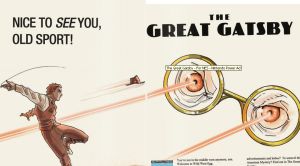
It is, in a word, awesome. You’re Nick and you are looking for Gatsby. The only thing between you and your objective is an army of waiters and flappers. Luckily, you have booze on your side!

http://greatgatsbygame.com/

Love it.

RJB


The Week in Conspiracy: 14 Feb 2011

February 14, 2011

Forget what I said last week. That’s just peanuts compared to how important this week was in the unfolding of global events that will lead to our inevitable doom! Shall we?

  • You can almost hear Philip Jones resisting the urge to type this entire story in capital letters and centered in the middle of his page. Luckily, reason won out: “Google: Zionist Engine of Mind and Genetic Control.”
  • In a sinister turn of events, Long Island Sky Watch, your source for news about the chemtrail menace, has discovered…schmutz in snow! DUM DUM DUMMMMM!
  • From WorldNetDaily comes the warning that Islamists are invading CPAC! Yes, it is the silliest thing ever written, folks.
  • Alex Jones: “Texas hippies: ‘Give us uranium'”:

See?

Conspiracy Theory of the Week:

This week it’s not a conspiracy that caught my fancy so much as a parody of Glenn Beck’s conspiracies. Behold the Glenn Beck Conspiracy Theory Generator!

Also, I would like to thank Glenn Beck for going a conspiracy theory too far with his socialist caliphate conspiracy this week! That cracked me up!

RJB


The books on my nightstand…

February 14, 2011

I like books. Love the things. Have stacks of them. My shelves are lined 2 or 3 rows deep, and they sag under the weight of all the damned books. As you might expect, I often read more than one book at a time. Right now is an especially bad time, as I am working on…I think a half-dozen.

I am currently reading three books about the so-called “science wars,” that is, (certain) postmodernists’ almost New Agey assault on science. This is in preparation for a panel about science and literature I am sitting on in New Jersey this April. I’m excited about this conference because, hey, science and literature! I’ll be talking about the responsibilities, as I see them, of scholars in the humanities when discussing science. That conference will end with a trip to NECSS for me. Yay!

Eve and I have been talking about doing a series of posts on The Da Vinci Code, and so I’ve been reading for that. We decided that in order to write about it, we should each have read the novel as well as Holy Blood, Holy Grail (the alternate history the novel is heavily based on) and a book about topics covered in the novel, which I happened across in a used bookstore a few weeks ago. Before I go to sleep, I’ve been reading encyclopedia entry length essays about various topics in classical, medieval, and Renaissance history that Dan Brown failed to understand. Last night, I was reading about the Merovingians. I was happy to see a Merovingian named Sigebert, because I suspect that his name is etymologically the same as Eve’s last name, Siebert (victory bright). It’s the little things, really, that keep me going.

On top of that, I have started on a Voynich Manuscript kick that I can’t seem to, uh, kick. Gotta scratch that itch. I had not posted to Skeptical Humanities for a few days, and I was looking for something quick and easy to do, and, damn it, I came across someone writing total bollocks about the Voynich Manuscript. I will, of course, have to write about it at some length now, because it is such an interesting, inscrutable object and so easy to completely misunderstand. Georgia Tech, my current academic mothership, does not have an extensive humanities collection, so I was off at Emory’s library this morning, where the boughs sag low under the weight of humanities databases. I gathered a couple of articles for review, including some seminal ones from the 1930s. In the stacks, I found a copy of the original academic “translation,” and were it not for a nagging sense of reality I would have brought it home with me to read. (I already have one book about the manuscript here. And, yes, I am reading that one too.) Emory’s catalog claimed to have a copy of a report by NSA cryptographers about the manuscript, but when I went to the government documents section, there was nothing remotely similar to it to be found on the shelves.

It’s probably just as well, what with the two book projects I picked up.

The first will be a chapter-length contribution to a undergraduate-level collection of criticism about technology in literature. That’s due at the end of the semester. The second is more closely related to the stuff I am doing here. I’m not going to announce it here because it is only just past the “good idea” phase (I’ve only had one meeting about it). The other writing project is the article about TruthCon, which I have been working on tonight.

Tomorrow morning, I take my classes to the University Archives. In the evening, at 5:00, I’ll be screening episodes of The Pacific. Hopefully, I’ll be able to get a little work done in the 5 hours between the end of class and the beginning of the movie. (I think I have committee meetings, however….Dang.)

I love my job. It’s a great gig. I just have almost no time! Hopefully tomorrow night I’ll have a new week in conspiracy up for you. There were some real humdingers this week!

RJB


10:23 campaign appears on NPR

February 8, 2011

Glad to see it! Sorry I missed it. But this weekend I came across something that is not even homeopathy. You’ll hear about it.  Teehee.

RJB


Favorite souvenir from the TruthCon

February 6, 2011

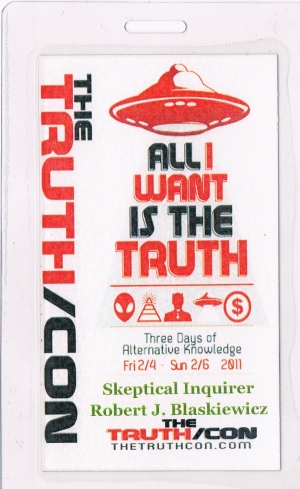
I can almost guarantee you that none of the other conferences I’ll attend this year will have as nifty a badge!

RJB


The Week in Conspiracy (3 Feb 2011)

February 3, 2011

This weekend, I will be attending TruthCon, which brings together all sorts of energy healers and people interested in UFO disclosure and 9/11 conspiracy theorists and…oh, everything. It’s like a paradise for me and will likely be the most interesting conference I attend this year (all love to NeMLA and NECSS, btw!). Regardless, since I am going to be really busy this weekend, I thought I would write up the week that was weak a little early.

Forget two weeks ago. And last week. And three weeks ago. THIS week, without a doubt is the most important week in the history of the human species, if conspiracy theorists are right.

Conspiracy theory of the week:

Honorary conspiracy theory of the week:

Not a real conspiracy theory, but my brother totally got me with a facebook post about the GIGANTIC STORM OF DOOM (which, in the end, never materialized in St. Louis):

“NEWS FLASH!! Area Man Convinced Blizzard The Work Of Muslim Extremists: “I don’t know how exactly, but these fellas have found a way to manipulate our weather patterns. They really will stop at nothing to disrupt our American way of life.”

Well played, sir. Well played.

And that’s it for now, friends. I’m off into the breach!

RJB


Brief listening round up…

February 3, 2011

A few items that I wanted to share with you before I left for work:

That is all. Your day may now officially begin.

RJB


Creation “Science” in the Writing Classroom

February 1, 2011

Several years ago, one of my writing assignments was for students to find an op-ed they disagreed with and write a rebuttal. One student picked as her article a letter from the editor of Nature or Science entitled, “The Logical Fallacies Creationists Make.” It was a list of about 20 arguments commonly heard from creation advocates (or “intelligent design” advocates) followed by a critique of each one. In my student’s paper, she first named each fallacy and then made it. For instance, in response to the old equivocation that “evolution is only a theory” (a scientific theory is not a “guess” in the sense that we colloquially use the term “theory”), she offered as a rebuttal, “But evolution is only a theory.” I decided, as I read her paper in horror, that I would add evolution and creationism to my list of forbidden paper topics–like “abortion,” “gun control,” and “campus drinking policies.”

Last semester, however, given that I was teaching a writing class called “Writing About Science and Pseudoscience,” it seemed irresponsible for me to avoid what is perhaps the most controversial and socially relevant pseudoscience in the U.S., intelligent design.

I also made it clear that I in no way intended to offend or comment on anyone’s religious beliefs (teaching at a public university, I was acutely aware of my responsibilities to protect the religious rights of my students). At the same time, a guiding tenet of my class was that if you make claims about the observable world and represent what you do as science, your assertions are open to scrutiny and evaluation, as all science is open to challenge. Indeed, nothing purporting to be a science can justifiably claim to be protected religious speech. So, I made it clear to students that I did not intend to critique “creationism,” but that I was looking specifically at “creation science” a.k.a. “intelligent design.”

I had selected two movies for students to watch about Intelligent Design. The first was Ben Stein’s Expelled: No Intelligence Allowed. The second was Judgment Day: Intelligent Design on Trial, an episode of NOVA that told the story behind the First Amendment case in Dover, PA. I had students watch Expelled first and then watch the NOVA episode. (Many students opted to watch these online or in their dorms instead of at the optional evening movie viewing sessions). Soon students started sending me emails indignantly protesting the treatment of advocates of intelligent design at the hands of “Big Science” (a term that Stein uses). One student wrote to me to ask about why people were being kicked out of labs, especially when they had good evidence and can prove it.

As you can see, one of the risks that you run when you teach using extraordinary claims is that some students may find the claims of propagandists like Stein convincing. But this is precisely why well-produced but ill-evidenced works should be addressed in an environment where all evidence is interrogated and all claims are challenged.

During the next class period, I discussed Expelled. I don’t like to simply lecture in a writing class–I find that the give and take of discussion is usually more productive–but Expelled leaves out a lot of information relative to a full understanding of the issues, including the state of evolutionary theory (very, very robust), and the status of intelligent design as a pseudoscience. In a nutshell, Stein’s argument is that Big Science is suppressing Intelligent Design, a viable scientific theory being practiced by reputable scientists, by denying ID proponents tenure, research and publication opportunities, in favor of what it knows is a failing theory (evolution) for ideological, probably atheistic, reasons. Stein argues that this is dangerous because it could ultimately lead to social abuses of the type perpetrated by the Nazis. My students agreed that this was a fair statement of the essential argument of the movie. We find in this thesis a number of testable claims, and in my lecture I took each one in turn.

It’s hardly a fair fight to put the cumulative weight of the evidence from so many scientific disciplines that suggest all life descended from a common ancestor against the bald assertion that “this animal or structure could only have been put together by an intelligence.” I sketched out the robust evidence that we have that suggests the deep, interconnected history of life on the planet, not a jot of which was mentioned in the movie. Indeed, the best argument that Stein was able to muster in the movie was a story by some supposedly maligned victim of the Big Science cabal that, after a few beers, evolutionists admit that the theory is in trouble. As we had already discussed the value of anecdote, my students asked a number of relevant questions, for instance, “Who said that and did you talk to them?” (Answers: They don’t say and probably not.)

A useful resource for teaching material like Stein’s is, as always, the National Center for Science Education. Their site Expelled Exposed is an invaluable compilation of background information, putting Expelled‘s claims in context, and satisfied most of my students, I suspect, that the claims of persecution were likely exaggerated. Another useful source about the wealth of evidence for evolution is Richard Dawkins’ The Greatest Show on Earth.

Later in the section on evolution, I included perhaps the most eloquent argument on behalf of design, William Paley’s Natural Theology, in which he develops the famous watchmaker analogy. I included it because students deserve to be exposed to the best arguments, not merely lame and deceitful ones like Stein’s. (In class, I suspended judgment about whether or not Stein was deliberately deceitful in the movie. When students asked, I said I didn’t know. At any rate, Stein’s intent was not the point.)

The last reading I included was a chapter of Richard Dawkins’ The Blind Watchmaker. While flipping through Dawkins looking for something suitable for the class, I found myself rejecting potential readings because of his tone, which can be, how you say, condescending and occasionally bracingly so? I did not want to offend my students, but it occurred to me that censuring Dawkins’ readings on the off-chance they would offend a student would give my students an inaccurate and decidedly biased view of the debate over the teaching of evolution, so I picked a chapter at the end of The Blind Watchmaker and ran with it.

Now, I realized that it was entirely possible that despite my best efforts to limit the scope of my lectures to creation science, a student might take offense at what I said and complain to my superiors. For this reason, I made sure to record every class and alerted my students to the fact that I was recording my talk.

Because I was especially interested in what the students thought of the talk about Stein’s movie, the first of six classes over two weeks, I used the peer-review and final project writing groups to allow students to submit their feedback anonymously. I asked them to email a paragraph to each group manager (my principle contact during the semester as they did their group projects) who would compile the responses into a single email without identifying information. The response to the lecture was decidedly positive, and I got a sense that students fell all along the religious spectrum between young-earth creationist to atheist (I didn’t ask).

Most surprising and pleasing about these responses was my students’ take on my own religion. When they ventured to interpret the lecture in light of what they perceived my religion to be, they revealed that they had no idea what my religious position was. Everybody who ventured a guess guessed differently, and that made me very happy.

Another choice I made that had an unexpectedly pleasant pedagogical outcome came about by giving a lecture about a controversial topic without taking hardly any questions–there were severe time constraints. By the next class students were bursting with questions and dying to jump in. I can say that without a doubt the most lively conversations I have ever had in my teaching career came in the period after I discussed Stein and the evidence of evolution. I played traffic cop, more or less, and let the students duke it out.

I won’t shy away from teaching evolution/ID again. It was one of the most rewarding, productive and invigorating subjects I have ever worked into a syllabus.

RJB