The following is a talk that I gave this weekend at the Northeastern Modern Language Association conference in New Brunswick, NJ at a panel on Science and Literary Theory.
Several years ago, I took a 19th-century American literature seminar during my PhD coursework. During that class, each student in turn would guide the discussion of the week’s reading. One week, a student working toward his Masters was leading a fairly typical class, expounding at some length on the finer points of Moby Dick, and though I don’t remember the specifics of my fellow student’s conclusion, I remember that he offered a baroque hypothesis about the politics of race and gender and misrepresentation. Even though he had brought up numerous interesting observations about the text, I’m not sure I really had any idea what my friend was talking about, but I was politely professional and said nothing. When the student had finished and received polite applause, the instructor, an Americanist with whom I agreed on almost nothing, asked the one question that had been haunting me ever since my undergraduate studies of literature and culture had taken a theoretical bent in graduate school.
“Do you really believe all that?” he asked.
I can’t think of a less polite thing to ask a graduate student, or, honestly, a more important question.
I’m a relative latecomer to the subject of the so-called “science wars.” I suspect that a lot of what I have to say has been covered by any number of philosophers, scientists and academic pundits. I tend to agree with the severest criticism directed at many of the major figures in theory, the type of criticism leveled by Paul Gross and Norman Levitt in their Higher Superstition. I think that the Sokal Hoax offers an important warning that academics in the humanities fail to heed at the expense of disciplinary credibility. The hoax, you’ll remember, was perpetrated by physicist Alan Sokal against the postmodernist journal Social Text in 1996. Social Text published Sokal’s article, “Transgressing the Boundaries: Towards a Transformative Hermeneutics of Quantum Gravity.” Saturated with scientific absurdities, the article aped postmodernist jargon, political posturing, and rhetorical habits. The fact that something which, had it appeared on the Internet (presumably in ALL CAPS), would have been blasted as purest pseudoscience, had appeared in a professional academic journal produced a scandal that was about as polarizing as any you are likely to find in the academy. The furor over what were widely taken to be the broader implications of the hoax, that literary and cultural studies is vacuous, deceptive and infantile suggests that Sokal had chomped down hard on an exposed nerve.
As I prepared my thoughts on this topic, I was struck by how similar at first glance the similarity between literary /slash/ cultural theory and the preparadigmatic state of the natural sciences that Thomas Kuhn describes in his The Structure of Scientific Revolutions. The state of literary theory is one in which practitioners are “able to take no common body of belief for granted” and “each writer…[feels] forced to build his field anew from its foundations” (13). Certainly, a major contributing factor to this state of affairs is that the proper object of Capital-T-Theory remains, despite, more than 30 years of practice, undefined. Possible candidates include literature and other communicative acts, social structures like institutions, the nature of power, systems of meaning, and the process of making meaning. Now might this might not be such a large problem when you are comparing different theories—certain texts which raise questions that postcolonial studies are better equipped to answer than, say, fat studies, which is now apparently a thing. But even within the various schools of thought, the proper object of study varies. Take, for instance, the range of possibilities in psychoanalytic theory. I have seen psychoanalytic literary criticism directed at authors, works, characters in the works, even entire cultures. Once, and I swear I’m not making this up, I saw an author claim that Much Ado About Nothing had analyzed him (Krims, introduction xv). I mean, what does that even mean? Professional psychiatry, with the exception of a dwindling cult of hardcore Freudians, has long recognized that Freud’s understanding of the mind was fundamentally flawed.
Now, I write and research about pseudoscience and other forms of pseudoscholarship, and as I was reading and reviewing commentaries on the state of Theory, some patterns emerged, which worryingly (for reasons I will explain later) are informed by my other work. The factions of theory, including identity (including feminist, race and queer), Marxist, psychoanalytic and deconstruction camps share numerous characteristics of the type of diseased, self-perpetuating thinking typical of conspiracy theorists and other demonstrably flawed systems of thought.
The first way in which literary and cultural theory behaves like a conspiracy theory (and other forms of wishful pseudoscholarship) is how very often the absence of evidence, or even direct counterevidence, is taken as evidence for the phenomenon or theory in question. By this logic, the more counterevidence a critic produces, the more the more powerful the theory appears to become. In the lore of UFO cover-ups, the overwhelming lack of evidence in favor of the hypothesis that UFOs are extraterrestrial in origin, much less piloted by aliens, is taken by the advocates of “disclosure” as positive evidence of the size of the conspiracy. When you present UFO theorists with evidence that no, aliens did not crash in Roswell, and that balloons with classified instruments designed to detect Soviet nuclear tests did, they reply that the documents and testimony is forged, and they walk away with a sense that you have only confirmed what they have been talking about.
Numerous commentators reflecting on the state of critical theory have found that this applies to various schools of theory. Jonathan Gottschall sums the problem up nicely:
Psychoanalysts have argued that citing evidence against their belief system is quite transparently–in itself–evidence for that system; criticism of Marxist or neo-Marxist notions can be dismissed as craven attempts to bolster the critic’s economic interests; and any criticism of the so-called race-class-gender-sexuality movements can be brushed off as spasms of rightist political reflexes […]. While these prophylactics against negative evidence have been potent, and while they help explain the impressive resilience of the dominant paradigm, they have also been primary obstacles to the generation of reliable knowledge. (39)
Embedded within this commentary is the assumption that theory means to be reliable, or at least in some sense apply to the real world. However, if there is to something to be saved of high theory, I believe that theorists must surrender this presumption of practical utility.
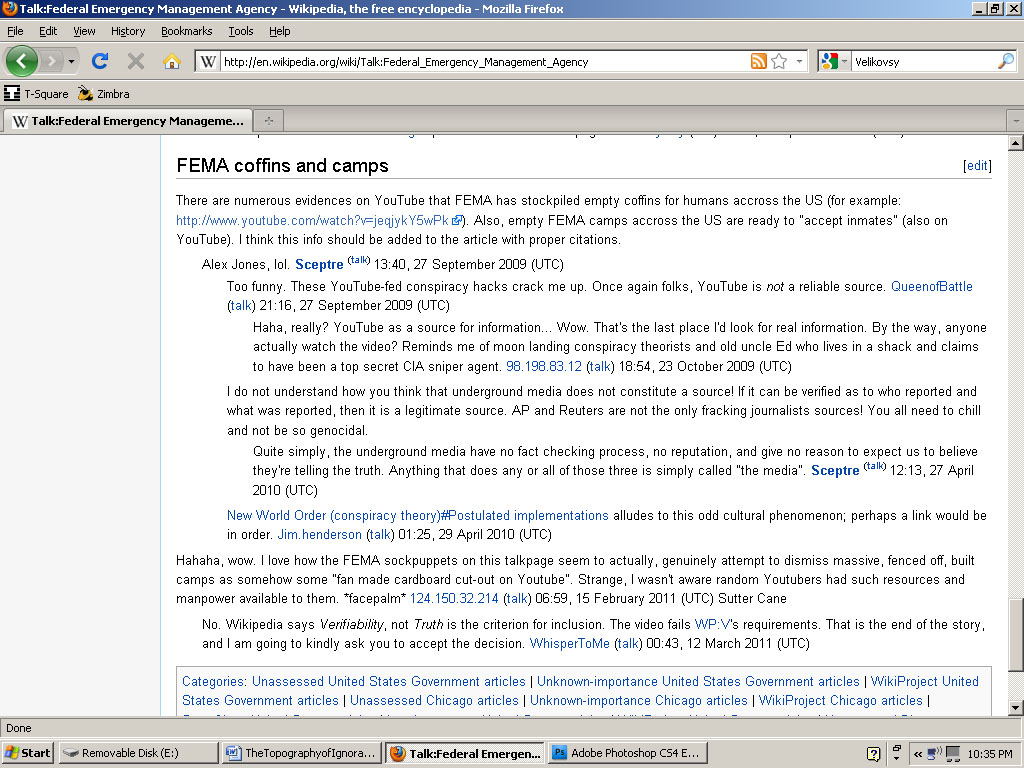
Perhaps the most direct contributor to the Sokal Hoax was the fact that these schools of theory have their own, alternative experts. This seems directly analogous to a group of 9/11 Truthers I have been corresponding with lately. One has told me, “Listen to the experts.” By experts, of course, he means his experts, who are an architect, a retired theologian and a physicist who happened to participate in one of the biggest science scandals of the 20th century, the cold fusion brouhaha of the late 1980s. As in the Truth community, certain groups of theorists have gurus whose credibility is left untouched by deep methodological and evidentiary flaws that would be unacceptable in any legitimate discipline, and whose work is immediately recognized as not just worthless, but misleading, by people who have genuine expertise. Take, for instance, Brian Vickers’ assessment of two of the largest superstars:
Freud’s work is notoriously speculative, a vast theoretical edifice elaborated with a mere pretense of corroboration, citing ‘clinical observations’ which turn out to be false, with contrary evidence suppressed, data manipulated, building up over a forty-year period a self-obscuring, self-protective mythology. The system of Derrida, although disavowing systematicity, is based on several unproven assumptions about the nature of language which are supported by a vast expanding web of idiosyncratic terminology (249).
These pseudo-experts misuse scientific terminology for opportunistic, rhetorical purposes, which I suspect are largely to lend them authority in the eyes of those who do not know better. And, let’s face it, this led to some of the most extravagant and embarrassing proclamations identified by Gross and Leavitt.
Conspiracy theories and critical theories also resemble one another in that the two are accompanied with a sense of righteousness or political commitment, that the theorist in some ways is crusading against an oppressive force. This is especially true in what Gottschall calls the “liberationist paradigm,” in which “Objectivity [is] just a synonym for white male subjectivity” (5). A colleague of mine who works on interregnum Caribbean slavery narratives found that Irish-Catholic males were forcibly impressed into indefinite periods of servitude and brought to tropical plantations in chains under Cromwell. When she named this, rightly I think, as slavery, a tenured colleague of hers who was a committed postcolonialist accused her of usurping the exclusivity of African slavery narratives in Caribbean studies. The correct answer to this, of course, is, “You’re damn right I am, if the African narrative alone doesn’t fit the facts,” but this is not a statement conducive to professional advancement.
Indeed, a lot the schools of theory seem to stem from popular political movements. One of the funny things about UFO contactees is how often the message that they receive from their extraterrestrial contacts are seemingly tailored to the relevant political movements and concerns of the day. During the Cold War, the benevolent Space Brothers warned us about the dangers of nuclear weapons; after the Cold War, they warned us about polluting the environment. It is probably not a coincidence that ecocriticism arrived at about the same time that the little green men started lecturing us about the importance of going green, as it were. Indeed, ecocritic Simon Estok says that “ecocriticism has distinguished itself, debates notwithstanding, first by the ethical stand it takes, its commitment to the natural world as an important thing rather than simply as an object of thematic study, and, secondly, by its commitment to making connections.” The editors of the ecocrit collection, Reading the Earth, argue that:
Implicit (and often explicit) in much of this new criticism is a call for cultural change. Ecocriticism is not just a means of analyzing nature in literature; it implies a move toward a more biocentric worldview, an extension of ethics, a broadening of humans’ conception of global community to include nonhuman life forms and the physical environment. Just as feminist and African American literary criticism call for a change in culture […] so too does ecological literary criticism advocate for cultural change by examining how the narrowness of our culture’s assumptions about the natural world has limited our ability to envision an ecologically sustainable human society. (qtd. in Estok)
In much the same way that conspiracy theories are fueled by political ideals, take, for instance the 9/11 Truthers who are absolutely convinced that they are exposing great evils, no matter how silly, and the anticommunists of the Cold War, who were convinced that they were doing no less than saving freedom itself, so too have critical theorists seen themselves as waging a good war on behalf of oppressed people, and in the case just mentioned, saving human society from itself.
A further point of similarity between literary theory and conspiracy theory is that they seem to come awareness of unknown truths about the ‘real’ nature of things through meticulous—some would say hypermyopic—attention to minutiae. For instance, take the typical JFK assassination buff. He can tell you about every little bit of evidence, the results of every single test, every little strange particle of nuance of evidence relevant and irrelevant to the events in Dealey Plaza. He is doing, essentially, a super-hyper close reading of the narrative of the assassination. The problem, of course, is that he has a bad grasp of the relative importance of various pieces of evidence to the narrative as a whole. On the basis of that extremely close reading, like the deconstructionist, he often stresses those elements that are external to the narrative. At the same time, both conspiracy theorists and literary theorists seem to evince a belief in the inevitability of political change caused by the simple fact that revealing that truth.
One of the characteristics of academic theory that allowed Sokal to convincingly impersonate serious theorists was deploying the specialized language of theory. While this is, as Kuhn recognizes, perhaps an inevitable part of professionalization and establishment of expertise in the empirical sciences, to the point that even specialists in the same academic departments might not even be able to communicate easily, in the case of theory (and especially in deconstruction) one wonders whether or specialists can communicate at all, as the verbal documents that they generate are at times grammatically correct, meaningless sentences rendered impenetrable with jargon. Edward Ervin’s Introductory Dictionary of Lacanian Psychoanalysis, started as a database designed to help him clarify for himself the terminology of Lacan’s seminars, but as he later reported:
As I tried to make sense of Lacan’s bizarre rhetoric, it became clearer to me that the obfuscatory language did not hide a deeper meaning but was in fact a direct manifestation of the confusion inherent in Lacan’s own fault. But whereas most of Lacan’s commentators preferred to ape the master’s style and perpetuate the obscurity, I wanted to dissipate the haze and expose whatever was underneath. […] Ironically, it was this attempt to open Lacanian theory up to criticism that played a major role in leading me to reject Lacanian theory itself. (42)
This use of language seems to me to be more in line with mysticism or possibly cult-speak than with conspiracy theory as such. It turns out that difference may simply be to deconstruction what “engrams” are to Scientologists, insofar as they serve as markers for members of in-group members and out-group members. Obfuscatory language does not shield theory from criticism; it shields it from legitimacy and relevance.
There is some encouraging news, of course, and this is that the practitioners of theory who fall into the category I’ve outlined comparatively few in number—you rarely bump into someone outside of a specialty journal who espouses wholehearted devotion to a single school of thought. Most literary and cultural criticism appropriates only what is relevant to the topic at hand and disregards the rest. Nonetheless, the theorists whose work is taken to be representative of the various schools of criticism tend to be more sensationalistic. A peculiar feature of much theory is a tacit appreciation of its mere “boldness,” as if claims of radical destabilization are laudable in themselves. True, we have found it desirable and enlightening to reexamine our underlying assumptions, and this has led to genuinely enlightened, more informed views on issues such as sexuality and race, but it does not follow that destabilisation in itself is desirable. It is not clear what the impact of intellectuals championing these causes is on society’s perception of sexuality, gender, race or ecology. Nonetheless, when theorists declaim on subject about which they know nothing, they devalue the work of other, more responsible scholars through an unfair guilt by association.
So, what’s to be done; how do we avoid another Sokal Hoax? Wouldn’t it be great and ironic if I yelled enthusiastically, “REVOLUTION!?”
This is an important question, as the humanities are chronically starved for funding. The answer depends on how literary theorists decide to describe their job, whether they see themselves as producers of knowledge who are developing ever more accurate and detailed understandings of the nature and working of literature and culture, or if they see themselves primarily as artists. In the first case, if theorists decide, that they want, to use Gottschall’s phrase: “the ability to systematically and decisively narrow out allotted portion of possibility space–to zoom in toward truth in the immense multidimensional hyperspace of error and vacuity” (9), they have failed.
Gottschall makes an intriguing proposal about how to move forward with the project of reducing error in literary studies, and that is plying statistical sampling and analysis to literary texts. He points out that the quantification of social phenomena has always met with popular resistance, but it has revealed underlying order to any number of social phenomena. Why should literature be any exception? I think that there are two major obstacles, neither of which is insurmountable or easy. The first may be described as inertia, an unwavering devotion to the notion that there are some things like literature can’t be quantified. This, of course, is merely a bald assertion, and without trials to examine whether or not such a project would be profitable, there is simply no basis for making that claim.
The second obstacle to the successful completion of the project is that the infrastructure of literary studies, as it currently exists, is not designed to produce scholars of the type that Gottschall proposes. It is designed to perpetuate theory as it already is. The problem with this is that programs in literary theory—or cultural studies writ large—do not have the expertise in statistics needed to become this sort of scholar at either the graduate or undergraduate level. As a result, I am afraid that it will take a rather substantial overhaul of theory programs to even begin down this road. That or interdisciplinary training through other departments.
One reform, I think, immediately available to all departments, and one that I believe is fundamental to improving the standing of theory, is raising awareness of cognitive biases and their ability to corrupt research. One of the most damaging and pervasive flaws in modern humanistic scholarship is the lack of awareness or concern for confirmation bias, which is a dangerous mental habit that determines what one accepts as relevant evidence. It is the propensity for people to seek out confirmatory instead of disconfirmatory evidence. For example, when you are posed with the question, “Is Ted an extrovert?” you are likely to ask questions like, “Does he have friends? Or does he like going out on weekends?” instead of paying attention to the fact that he plays chess and reads, the types of things introverts are likely to do. In life we unconsciously notice and value elements of the world that confirm our worldview to the exclusion of those that don’t. Numerous swindles depend on this very human propensity, and currently, when we are trained in theory we are being trained to give confirmation bias free range. When confronted with a mass of data, say, a novel or a culture, and you are able to forgive yourself for squinting a little bit, it is very, very easy to find evidence for anything. If your academic kink happens to be imperial conquest, you’ll find imperial conquest. If it’s patriarchy, you’ll find patriarchy. If it’s pandas, you’ll find pandas. And we don’t pay any attention to this tendency. I searched the entire MLA database for the phrase “confirmation bias” and it appears only once.
Another vital element of a program of reform that will lead to literary theory becoming a reliable tool for discerning the real world will be to replace scientific pseudoexperts like Freud and Lacan with actual experts in the relevant empirical sciences, especially in the science of the mind. This will require some additional training, and I’m not sure it’s the type of training that could reasonably be confined to a graduate education, but if you are going to invest the time in writing a dissertation about the products of the human mind, you cannot but improve your work by informing it with an awareness of the state of the empirical science. And when you address scientific matters you need to understand the limitations of that science as well. When you are talking about indeterminacy, you need to be aware that this is a property that is only useful when it is applied to the world of particles. You may employ indeterminacy as an artistic metaphor, of course, but when you do so, you must not mistake your metaphor for the real thing or imagine that because you have used the metaphor that you have somehow altered particle physics. When you critique the content of science, or any field of knowledge, as many theorists have, you need to address the relevant issues at the level of the experts, and this is very, very difficult without specialist training. It reminds me of a situation I believe Carl Sagan described when he looked into the claims of the pseudoscientist and psychoanalyst Immanuel Velikovsy, that Jupiter ejected the planet Venus and that a series of close passes by Venus to Earth caused a number of the miracles described in the Bible. Religious scholars scoffed at Velikovsky’s interpretation of biblical events but were impressed by his astronomical knowledge. Scientists thought that the biblical stuff was ok, but thought his astronomical proclamations were ridiculous.
The other option is to surrender pretentions to objectivity and describe theorists as artists. Art makes no claims on objective reality, and some very artful and elegant readings of texts can come out of even the most badly flawed pseudoscience. I think that it would be folly to not consider an Oedipal reading of Hamlet, even if there is no evidence of an Oedipus complex in the real world. Exciting art can be made when you filter a work of literature through a novel perspective. In doing so, you are doing what artists have done for ages, drawing on and responding to the zeitgeist. I consider that project to be akin to the various repinterpretations by Dali and Picasso of Velazquez’s Las Meninas, wherein something of the original artwork remains, but the style and aesthetic concerns of the modern artists dominate the interpretation. Take the Freudian example. In psychoanalytic criticism, a theorist may in practice substitute any symbol for any other symbol. This is immensely liberating for the imaginative, creative mind. But one should not imagine that the substitutions that the theorist makes are anything but the products of their own mind. So, if theory and interpretation abandon pretenses of objective analysis and embrace the posture that they are using science as a metaphor, we will do much to clarify the work that literary and cultural critics are accomplishing.
Something needs to change. High theory, as it is currently conceived and practiced, is a celebration of disordered thinking. To prevent further embarrassment to the profession and improve the quality of our work, we need to hold our theorists to high standards; and when it comes to matters of science, we need to hold them to the standards of the field they mean to critique. We need to raise the scientific literacy of our humanities faculties and educate our students about confirmation bias. Finally, when we deploy science as a metaphor, we need to frankly acknowledge it as such, just a metaphor. Thank you.
RJB
Postscript: After I gave this talk, a guy came up to me and said, “My dissertation adviser was one of the editors at Social Text. Oops! Heehee. (I almost typed Sokal Text–eek!). He did in fact say that the editors schooled themselves in science afterwards, which is encouraging.
References:
Estok, Simon C. “A Report Card on Ecocriticism.” AUMLA : Journal of the Australasian Universities Modern Language Association 96 (Nov 2001): 220-238. Online at <http://www.asle.org/site/resources/ecocritical-library/intro/reportcard/>
Evans, Dylan. “From Lacan to Darwin.” The Literary Animal: Evolution and the Nature of Narrative. Eds., Jonathan Gottschall and David Sloan Wilson. 34–55.
Gottschall, Jonathan. Literature, Science, and a New Humanities. New York: Palgrave Macmillan, 2008.
Gross, Paul R. and Leavitt, Norman. Higher Superstition: The Academic Left and Its Quarrels with Science. Baltimore: Johns Hopkins UP, 1998.
Krims, Marvin Bennett. The Mind According to Shakespeare: Psychoanalysis in the Bard’s Writing. Westport: Praeger, 2006. Introduction, xv.
Vickers, Brian. “Masters and Demons.” Theory’s Empire: An Anthology of Dissent. Eds. Daphne Patai and Will H. Corral. New York: Columbia UP, 2005. 247-270.


 Posted by Bob







 Skeptical Humanities