In the Corner of Brian’s Mind

February 18, 2015

Note: This essay is cross-posted at Skepticality, where it appears in easy-to-swallow podcast form.

On the Virtual Skeptics this past week, I had a good long grump about the media and how it was treating NBC news anchor Brian Williams. The short version of the story, at an event sponsored by NBC Williams gave a speech about a retiring helicopter pilot who had flown Williams while Williams was a correspondent in during the Iraq War. It sounded like that they had been through some pretty hairy stuff, because, Williams said, their helicopter was forced down by a rocket propelled grenade. Veterans who were a part of that mission disputed Williams’ version of events on social media, and soon, Williams was on the air apologizing for making misstatements.

Now as the media went back to look for more instances of Williams’ misstatements, I was all in a huff. I saw this as a wonderful opportunity to educate people about the fallibility of memory. As I was considering this, I was rather dismayed to see so many people online going on about what a liar Williams was. And these were skeptics. I didn’t think that they had any more information than I did, and surely they must have seen how we self-appointed skeptical purists were going on about how memories are unreliable. But they kept insisting that you’d remember if you were shot down or not. My sense is maybe not. I’ve had a World War II veteran who was in a unit stationed in Italy tell me that he was in the Battle of the Bulge, an impossibility.

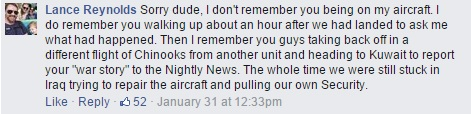
There is the illusion of course that highly meaningful and important events are more firmly etched into our memories, but the truth of the matter is that so-called flashbulb memories, like every other memory, is subject to the same processes of change over time. But the perception, the misperception, that is, that highly significant memories are durable likely explains a general defaulting to believing the veterans like Lance Reynolds, who flew that mission and took Williams along. On facebook, Reynolds challenged Williams’ account:

hehe

Certainly, goes the logic, this event where Reynolds had just been shot at and was in harm’s way would have been more significant to him than it would be to someone on a more or less passive journalistic assignment, and therefore Reynolds would remember it. He has no incentive to lie. But Williams filed a report about this particular mission. In the online clip of that report, Tom Brokaw introduces the segment by saying that Williams had “A close call in the skies over Iraq”. He was in a Chinook helicopter. There were stories among the air crew that iraqis dressed as civilians had been shooting, and this is mentioned in the context of looking down at civilians as the Chinooks fly over their heads. We hear a radio broadcast about a helicopter that has taken fire while Williams’ group is in the air: “We took fire on the way in. We currently are NOT under fire, NOT under fire.” Williams’ Chinook is ordered down and not told why. The Chinook “ahead of them” (how far ahead is not said) has been grazed by an RPG fired from the back of a pickup truck, they realize. The crew of the helicopter did not grant an interview. The helicopters are forced to hunker down for 2 days, as there is a sandstorm. There was an armored unit there from the 3rd infantry, who coincidentally, confirm of the image of the fighters, irregulars fighting from the back of pickup trucks. Williams credits 3rd ID for looking after the perimeter. After 2 nights they leave. At the end of the report, Williams explains on their first night, they heard machine gun fire, a group of Iraqi irregulars with an RPG were stopped at the perimeter, presumably trying to get into position to shoot at the helicopters, one of which Williams was sleeping in. Ultimately a 6-hour mission became something like a 50-hour mission.

This story is NOT that different from the one that he told the crowd at Madison Square Garden. All the elements are there–only their relationship to one another is altered. Heck, he even gets the bit about the 3d ID that Reynolds apparently doesn’t remember (though you don’t see people noting the veterans’ memories are wrong too). And even Brokaw, in the introduction to the original segment, seems to dramatize what has happened a bit, maybe. But initially Williams doesn’t take any credit for anything special. The reporting seems OK. In my opinion one need not invoke deceit to explain what happened, and if you are willing to defer to what Ray Hyman called the “principle of charity,” I thought that perhaps we should not jump on him so badly. It was reasonable to think that he was guilty of nothing more than having a completely normal human brain.

So that’s kind of what I was thinking when NBC decided to slap a 6 month suspension on Williams, saying in a memo:

“By his actions, Brian has jeopardized the trust millions of Americans place in NBC News. His actions are inexcusable and this suspension is severe and appropriate.”

At this announcement I was indignant. I thought, how could we waste such a brilliant opportunity to educate people about how fallible memory is? That the really interesting thing about this non-story was how normal it was? And I imagined that the people who were happily dancing around the Williams sacrificial pyre smugly confident that their memories were intact and reliable, and I was annoyed some more. My hard won skeptical superpowers had paid off. I enjoyed the most satisfying and aggravating emotion: righteous indignation. It’s so good to be right. I could just bathe in that creamy feeling all day.

Aaaand then the next day I read an article in New York Magazine suggesting that there may well be a host of other incidents where Williams’ may have exaggerated his role in stories. And at least one of them is of a type that, if it turns out to be a fabrication, will be less easily explainable. I can see his meeting the Pope at Catholic University becoming less accurate over time. I can even see him inadvertently slightly nudging himself ever closer to the events surrounding the fall of the Berlin wall as reasonable. Both accounts are questioned by the magazine, but the one that really seems like it could be his undoing is his claim about a SEAL Team 6 during the Iraq war, making friends with the SEALs and then this, according to the magazine:

He also claimed that, nearly a decade after this supposed embed, a member of SEAL Team 6 sent him a souvenir from the raid on bin Laden’s compound in Pakistan. “I got a white envelope and in it was a thank-you note, unsigned,” Williams said during […] a Late Show appearance. “And in it was a piece of the fuselage of the blown-up Black Hawk in that courtyard. Sent to me by one of my friends.”

It seems improbable that the Williams would have been with a group of SEALs flying into Baghdad 3 days into the war, when US forces did not reach Baghdad until the 10th of April, about 20 days after the ground invasion began. But, unlike the way SEAL Team 6 members describe Williams as being “embedded” Williams never uses that word in the clip with Letterman. So, maybe he’s misremembering the date of his flight to Bagdhad? Like maybe it was like 3 days after the coalition reached Baghdad? But it seems super weird that one of the people he befriended sent him a piece of fuselage of the (still classified) helicopter that crashed in Bin Laden’s compound….for some reason committing what, god, has to be a major security violation. And that’s the bit that I think may well get him in trouble, because there is apparently some tangible evidence that could be checked, though the provenance is in Williams’ account to Lettermen is obscure…

BUT THERE I GO AGAIN. Pretending that I could possibly figure out what was happening among special forces 12 years ago in Iraq! On what basis? Listen, when a story appears in the media, I try to understand, and all I have to go on are narratives. I’m constantly reminding myself that these narratives are reconstructions based on memories and evidence put next to each other and assembled into something transmissible–a story. But inherent to storytelling, and I don’t think that I am equivocating on the meaning of “storytelling” here, are characters and plots, and some of these characters and plots are more transmissible in the media than others. It’s easier for a headline to say that Williams’s story is “false” than it is to say it is “inaccurate in a number of ways but perhaps understandable with a good understanding of the workings of memory”  It’s easier for someone on the air to say that X journalist is a liar than it is to bring on memory experts and give the public a lesson in the weird, clever wrongness of memory and then ask the audience to filter the story through that model of memory to come up with a complicated and nuanced view of Williams as partially both engineer of his own demise and victim of human imperfection. The public wants a story; the media needs a story. And with the story comes villains and heroes, and what is Williams? I honestly have no idea.

Following this story is a frustrating exercise in humility, that just drives home hard learned lessons that I easily forget. That I have to be willing to be confused. I have to be patient. Ultimately I need to be willing to admit when I just don’t know and that that is sometimes the best, only correct answer. In the case of Brian Williams’ wartime exploits, I have a lot of information that may or may not be relevant to whether or not he is telling the truth. Currently I have no way of determining what is relevant and what is not. And I’m just going to have to be ok with that for the time being.

Links:


Shilling for Big History

March 11, 2014

Note: This essay is cross-posted at Skepticality.

Last December, a metal detectorist named Bruce Campbell was plying his retirement hobby in a tidal mud flat on Vancouver Island, when he came across a rare Edward VI shilling. The silver coin was minted between 1551 and 1553, the span of Edward’s brief reign. You’ll remember that Edward was the son of Henry VIII and the half brother of Elizabeth I. The date of the coin has recently fueled speculation about the earliest date that Westerners explored the northern Pacific and the west coast of Canada. If the deposit of the coin is roughly contemporary with the date stamped on it, say within 30 years or so, it would push back the earliest visitation of the coast by the English some 200 years.

The metal detectorist shared his find with an online hobbyist community, and when they recognized the coin, one of them contacted an independent scholar named Samuel Bawlf, who had written about the idea that perhaps Sir Francis Drake had visited the region, and perhaps even made it as far as south Alaska, in 1579, during his eventual circumnavigation of the globe. Bawlf is excited because other 2 other old coins have been found in the area, a 1571 sixpence dug up in 1930 and another coin with a similar date unearthed on Quadra Island, which is nearby. This it seems supports Bawlf’s idea.

To Bawlf.

I honestly don’t know where to begin, so let’s start with who Drake was.

Sir Francis Drake is best known for being a pirate, harassing Spanish galleons in the years before the Spanish Armada. He was extremely successful, seizing the modern equivalent of tens of millions of dollars worth of cargo from the Spanish. It is generally accepted that in the summer 1579, Drake was along the Pacific coast of what is now the United States, and there is much speculation about how far up the coast he made it. There are some fairly good indicators of the extent of his travel; he certainly made it as far as mid-California and might have even made it as far as Oregon (which seems to be about the farthest north that mainstream scholars are reasonably comfortable placing him). The method of placing him comes from ethnographic work deriving from detailed descriptions of the natives, their dress and culture stemming from the trip. During this summer sojourn, he apparently encountered flows of ice. Drake completed this journey by circumnavigating the globe.

The idea that Bawlf puts forward is that Drake was looking for a Northwest Passage on behalf of Queen Elizabeth, an endeavor which would have economic and military implications that the rival Spain could not know about. Therefore, at her order, it was a completely secret mission. While on this secret mission, however Drake deposited coins along the way to the natives in the region to show that they had been there in case some other European power showed up. On the face of, this seems incompatible with the idea that it was a super-secret mission that nobody could know about.

Also, there is the matter of how countries staked claims of new territories. While I may not have examined enough, I don’t see examples of Brits claiming territory through depositing coins in the literature–and the idea seems problematic to me as there are other ways that coins could make it to unexplored territory, such as trade. As such, coins alone would not establish a presence. As best I can tell claiming territory during this time is a messy process. It starts with discovery and landing with the intention of making claims of land. The strength of new claims is improved by establishing settlements and colonial government, extensively mapping an area and waterways, setting up commercial ties with natives, initiating exploration of the region, fortification, and active defense. Matters of territorial ownership might also be clarified through negotiation and treaties. Nothing remotely like any of these patterns appears in the historical record until the late 18th century, when Spain and England vied for control of the region and almost went to war over it. If the British staked a claim…they did absolutely nothing with it for 200 years, and they seem to not have invoked Drake’s prior claim to it in the later squabble with Spain.

So, what does the discovery of this shilling tell us? The coin by itself tells us very little. Interpreting finds like this is all about determining context. Without context, the coin tells us only that at some point a coin ended up in the tidal mud. The only hint of context that we have is that on the same outing, according to the Tribune-Review, Campbell found the shilling: “along with a rare 1891 Canadian nickel, a 1960s dime and penny from 1900.” Now, it doesn’t say that they were physically clustered together. That’s frustrating, because if so, we’d be able to say that the deposit was dropped no sooner than the 1960s, which would not require us to rewrite our understanding of the Pacific Northwest. Nonetheless, it was a grand day out for a new metal detectorist.

The hobbyist who contacted Bawlf (named Herbst) about the find speculated about the context:

“You don’t find things like that in Victoria,” Herbst told the Times Colonist. “The fact that it was found in a layer of mud on the foreshore, to me, I recognized that that was probably an ancient aboriginal village down there. … I knew it was possibly significant.”

So, it was probably an aboriginal village, said some guy on the Internet. I spent a little time looking for aboriginal archaeological sites in the region and haven’t had much luck–I know that’s because I am researching outside my area, since Canadian authorities have well established protocols for documenting and reporting finds of archaeological materials including human remains. According to the rough description of the site given in the Times Colonist, that Campbell was poking around at low tide “on the mud flats on the Gorge, just down by Curtis Point.” That seems to place him in the Victoria Harbor region, and that entire promontory of land is the aboriginal home of the Songhee people. There’s comparatively little written about this tribe, though their later history is intertwined with the growth of Victoria. This would likely have been the tribe that Drake would have encountered. I have been able to find no tradition of stories of contact with European sailors in the Songhee tradition before 1790, at which time the Spanish reached the region. The Herbst hypothesis at this point it looks like speculation that is not bolstered by anything, and certainly no evidence is offered. As best I can tell, the coin is being used to argue for the existence of an aboriginal settlement and the aboriginal settlement is being used as an argument for why the coin was there in the first place. This seems shaky.

So the coin is apparently completely out of any independent or meaningful context, at least as far as news reports are concerned. For that reason it does not clarify anything, only become fuel for speculation. An interesting side note about this part of the shore. The area that the coin was found in was a popular area for swimmers at least up until the 1930s. There might be no end to the cultural contamination of the site that might influence what one might find in the area. We should perhaps not be especially surprised if anything that a swimmer or tourist could possibly bring out there ended up there. Coins are small, portable, and completely losable. We are being asked to accept that the true context of these coins are other old coins throughout the region, occasionally on other islands, without convergent supporting evidence that that should be the case.

Another problem that the Drake hypothesis faces (or, in a turn of classic conspiracy theory benefits from) is that the original records of Drake’s travels were destroyed in a fire. But some contemporary accounts remain. None of them indicate travel to areas recognizable as Canada or Alaska. But what about the ice that appears in those early accounts? Does that not suggest that Drake was summering far further north than historians have given him credit for? Well, probably not.  Apparently, the dendrochronology of giant redwoods from the years surrounding Drake’s travels suggest that there was little growth in the trees that year, suggesting that the weather was unusually dry or cold. There is therefore apparently no pressing reason to extrapolate from the observation of ice that Drake had to be so far north.

The takeaway of all this, I think, is that the breathless reporting of a single find that overturns the entire known history of a region is to be taken with a grain of salt in much the same way we should avoid concluding that a single observation should completely overturn decades of established science. Of course, it is tempting for a journalist to report the bigger, slightly more sensational story, though it beggars belief how someone could not think that the exploits of Drake and his crew were not sensational enough to hold our interest.

 RJB


Sir Arthur Conan Doyle and the Cottingley Fairies

February 4, 2014

Note: The following essay originally appeared on Skepticality.

This is Bob Blaskiewicz from SkepticalHumanities.com and VirtualSkeptics.com.

I’ve always wondered about the Cottingley Fairy hoax. European spiritualism and fairy folk are a little out of my realm of expertise, but what the heck, let’s give it a go. In some ways, I suppose, the stage was set for the Cottingley Fairies by Romanticism, which celebrated the common man and elevated his culture. This, in turn, led to a reappraisal of national folk traditions in Europe in the 19th century, as seen in the collection and study of folk tales by Anglo-Irish literary luminaries Lady Gregory and Jane Wilde, who was Oscar Wilde’s mother and gathered and published a collection of Irish fairy lore in 1888. This just happens to be the same period that manufactured gnomes (or gartenzwerge) were appearing in German gardens and becoming popular in Europe. Do with that factoid as you will.

If you aren’t familiar with the Cottingley Fairy story, in 1917, two girls, 9-year old Frances Griffiths and her 16-year old cousin, Elsie Wright, presented photographic evidence that they had been cavorting with fairies in the woods behind Elsie’s house in Yorkshire.

See?

See?

A second series of photos appeared in 1920, the year that Sir Arthur Conan Doyle published a credulous article about them in The Strand, brought the number of fairy photos to 5. But one photo is iconic, the image of Frances sitting in a glen with 4 fairies dancing around her as she gazes off into the distance. In reality, the fairies were copies of images from a popular children’s book, Princess Mary’s Gift Book, held up up with hatpins. The girls admitted this in the 1980s. But as often is the case with claims of the extraordinary the hoax itself is not so interesting, rather it’s the fact that people actually believed this stuff. One of the biggest questions, and the one that has always interested me, is how did someone like Sir Arthur Conan Doyle, who wrote one of the most analytical, forensically minded characters in literary history, Sherlock Freaking Holmes, come to believe that these fairies were real.

However, I think that the idea that an author must share personal characteristics with their literary inventions–and the corollary belief that all fiction is somehow autobiographical– is one that often leads people to strange, insupportable conclusions. I can think of no better example of this than the notion that the key to Shakespeare’s “real” identity is somehow hidden in the plays or in the sonnets. That somehow in order to write about the nobility that one needs to have been a noble, or that to write about Italy, one would need to have travelled to Italy, or that to write a series of sonnets that one has to have had one’s own real-life dark lady and a pretty pool boy. I think that there is a tendency to think about Conan Doyle in terms of his creation Sherlock Holmes, who it is admitted by all other characters in the novels as a universal genius. People think that any mind that could create a character as clever as Sherlock Holmes must be at least as shrewd. (Honestly, if you look more closely, you realize that Holmes, much like Hannibal Lector, is simply given knowledge by his author that he otherwise could not possibly know.)

The book that came out of Conan Doyle’s exposure to the Cottingley Fairies, 1921’s The Coming of the Fairies, is, in a word, a hot mess. It’s a quick read–one night should do it for you. The book is really a collection of writings, letters, testimonials, and previously published articles about fairy folk, with special attention to the photos taken by Frances and Elsie. Despite the pretense in his introduction that he’s just laying the facts on the table for analysis, you can tell, Conan Doyle is a true believer. Throughout, when he quotes someone raising a reasonable objection, you can see Conan Doyle inventing reasons to dismiss them. But there are a couple of historical particulars that make the telling of the fairy story really interesting, especially with respect to the types of special pleading that the believers came up as well as the unstated assumptions about childhood and class that are especially jarring to the modern ear.

For instance, it seems likely that Conan Doyle harbored a highly romanticized idea of childhood that may have blinded him to the possibility that the two girls were not being completely honest. It is the very purity and innocence of children, by some mechanism as of yet unknown, that allowed the children to see the fairies. Edward Gardner, who was Conan Doyle’s proxy and collaborator on the investigation, and who was known, according to Conan Doyle, for his “reputation for sanity and character” (23), worries that the window of opportunity afforded by the girls’ abilities may be closing as it is just a matter of time before one of the girls “will ‘fall in love’ and then–hey presto!!” (25). Conan Doyle himself thought that perhaps the girls’ powers of perception would have flagged in the three years between the taking of the first photos and Gardner’s visit to them in Yorkshire, because “I was well aware that the processes of puberty are often fatal to psychic power.”

Another presupposition that seems to have blinded Conan Doyle and Gardner to the possibility of a hoax was that the girls’ artisan class precluded them from designing elaborate photographic hoaxes involving double exposures and so on. But they were not expecting something so staggeringly simple as paper dolls on a stick. Conan Doyle opens the first chapter, “The series of incidents set forth in this little volume represent either the most elaborate and ingenious hoax ever played upon the public, or else the constitute an event in human history which may in the future appear to have been epoch-making in its character” (13).

I think that most interesting for science enthusiasts is how Conan Doyle was sensible of the need to put the existence of these little creatures in a modern scientific context. Very few people had ever seen fairies while awake, and most of Conan Doyle’d experiencers claim to have been especially psychic. This worked well for Conan Doyle, who was above all a committed Spiritualist and had a great interest in seeing the claimed abilities of these sensitive people (and thereby proof of the afterlife) proved with photographic evidence. He makes a move familiar in modern new age circles of saying that perhaps the critters existed in another frequency and that perceiving them was a matter of tuning. Perhaps, he thought, some sort of fairy detecting goggles would be developed that would allow regular people to perceive fairyland.

There is nothing, strictly speaking, preventing little winged people living in your garden other than the course that evolution happens to have taken. Well, that and house cats. Nonetheless, Conan Doyle and his correspondents spend a surprising amount of time talking about how they can reconcile the existence of these little creatures with evolution. The solution is that the fairy is descended from butterflies, while the gnome “has more of the moth.” They even attempt to sketch out the biogeography of fairy folk and other ethereal critters by analyzing masses of anecdotes from around the world.

Throughout the book, fairies seem to embody a close relationship with nature, one buoyed by happiness, music, and a carefree idyllic existence. According to Gardner, “For the most part, amid the busy commercialism of modern times, the fact of [fairies’] existence has faded to a shadow, and a most delightful and charming field of nature study has too long been veiled. In this twentieth century there is promise of the world stepping out of some of its darker shadows.” We can’t avoid the immediate context of this statement, as the previous decade had seen mankind perfect mass death on the battlefields of Europe, a conflict that took Conan Doyle’s son. As the industrial engines that had powered commercialism turned to manufacturing corpses on unfathomable scales, perhaps the escapism and innocence of childhood visions seemed overpoweringly attractive to these spiritual seekers. We may be certain that the surge in interest in spiritualism during and after WWI was related to the loss of a generation of European youth in much the same way spiritualism prospered in the wake of the American Civil War. A harmonious and joyous return to nature, which just happened to confirm the powers of those who could communicate with that lost generation, was perhaps seen as restorative to a crippled Europe.

An excellent review of some of the issues raised by the Cottingley incident can be found in Carole Silver’s study, “On the Origin of Fairies: Victorians, Romanticism, and Folk Belief.”

This is Bob Blaskiewicz from SkepticalHumanities.com and VirtualSkeptics.com.


Refael Elisha Cohen: A Family’s Misery Exploited

December 25, 2013

I would rather be doing anything other than writing this right now, but as Susan Gerbic has put it, advocates of science and evidence-based medicine have “drawn a line in the sand” and I don’t feel that we can yield an inch.

For the last few weeks, skeptics have been following the heartbreaking plight of the family of Refael Elisha Cohen, a 6-year old with medulloblastoma, a devastating brain tumor. According to the family, every single medical option has been tried–chemotherapy, surgery and radiation–but the monster has come back. At this late stage, there are compassionate options, palliative care and the relief of pain.

The family, understandably, is still looking for something, ANYTHING that might conceivably help their son. This desperation has sadly driven them into the hands of Stanislaw Burzynski at just the time that he needs a little good PR. The family has embarked on a campaign, appealing to the White House for a compassionate use exemption so that Refael Elisha can receive antineoplastons, Burzynski’s “signature” drug, which have been pumped into generations of cancer patients but have never met the most basic requirements of the scientific community. (In fact, we have seen 3 high profile campaigns simultaneously, unprecedented in the two years I’ve been following the clinic.)

While there are no demonstrable benefits of antineoplaston therapy, there are known side effects, about 3 pages worth, according to the Clinic’s own patient consent form. Because nobody wants to see a child die, a hundred thousand people have signed the petition to allow a compassionate exemption for Rafael Elisha. I share the generous sentiment of these signers, that a child deserves a regular life. Yet, knowing what that Clinic is after two years of continual searching for evidence that the treatment might work, having read the stories of literally hundreds of former patients, I can say without fear of contradiction that to support this family’s quest for antineoplaston therapy puts cancer patients in harm’s way.

I’ve largely remained silent about this campaign, which has featured prominently in the global Jewish press. It seems clear in the numerous reports that have appeared in the press that the family has not received accurate information about Burzynski, the treatment, or the prospects for that drug’s approval. An article came to my attention this morning that I felt I needed to answer, “Houston Boy Battles Brain Tumor; Needs Community Support.” written by the Campaign to Save Refael Elisha Cohen and which appeared in the online Jewish Voice. I hope that the two sentences I submitted in the comments will appear, but just in case they don’t, I figured that I would use my own venue as an opportunity to critique some of the points that were made.

According to the press release published at the Jewish Voice (which is all I can call this appeal, even if it is touching and sincere), a group of volunteers are collecting and sorting leads from around the world for potential treatments. I would like to offer them an additional source, if they have not seen it, clinicaltrials.gov, which lists all active registered clinical trials. Currently, there are 57 trials currently open for treatments into the type of tumor Rafael Elisha has. Any one of these trials is a better option than any illusory trial that the clinic might dangle in front of this family, and I hope they look into these options. I’m certain that Rabbi and Mrs. Cohen will understand that all anyone wants is for their child to heal, and if there was any evidence that the Burzynski Clinic had anything promising, that I would go down to Houston and hold the front door open for them.

In fact, there is one medical option which several prominent cancer researchers continually taught as the most promising for brain tumors.

The latter is called antineoplaston therapy, developed by Doctor Stanislaw Burzynski. The therapy uses peptides and amino acids’ and is manufactured in a block long pharmaceutical laboratory which operates directly under FDA Supervision. The FDA recognizes that the trials show efficiency, but has pulled its approval in 2012 pending reapproval possibly within the year. Current negotiation process is over interpretation of argumentative technicalities.

I would suggest that the statement that antineoplastons are “taught as the most promising for brain tumors” could not possibly be less true, as evidenced by this USA Today article, “Experts Dismiss Doctor’s Cancer Claims.” There is no evidence that any cancer, much less the intractable ones that Burzynski has claimed success for, are caused by “antineoplaston deficit,” which is the entire premise of the therapies. Lack of antineoplastons are simply not recognized as a cause of cancer. Secondly, as far as I can tell, Burzynski has never identified a therapeutic target for these drugs. Instead, we get vague words that sound nice like, “it turns off the cancer cells,” but we are not given an explanation of how that is supposed to happen. I’m willing to bet that if you were to ask the Cohen family how this drug is supposed to work, they won’t be able to tell you either. And if they have the mechanism, I’d honestly be eager to hear it.

The statement that “the FDA recognizes that the trials show efficacy” is purest bunk. There are no clinical trials that would demonstrate this. None. Burzynski has never completed and published a single clinical trial. The tumors he treats, especially the brain tumors, have a pretty high turnover rate. You would think that in over 15 years he might have managed to publish a single clinical trial, but he hasn’t. As part of a deal with the FDA 16 years ago, Burzynski agreed to only treat patients with ANP under the auspices of a clinical trial. So he opened dozens and never published a single finished one. We should not be surprised, of course, when his lawyer says of the Clinic’s trials:

[W]e decided to hit the FDA with everything at the same time. All of his current patients would be covered in a single clinical trial which Burzynski called “CAN-1.” As far as clinical trials go, it was a joke. Clinical trials are supposed to be designed to test the safety or efficacy of a drug for a disease. It is almost always the case that clinical trials treat one disease.

The CAN-1 protocol had almost two hundred patients in it and there were at least a dozen different types of cancers being treated. And since all the patients were already on treatment, there could not be any possibility of meaningful data coming out of the so-called clinical trial. It was all an artifice, a vehicle we and the FDA created to legally give the patients Burzynski’s treatment. The FDA wanted all of Burzynski’s patients to be on an IND, so that’s what we did.

….and that…

Burzynski personally put together seventy-two protocols to treat every type of cancer the clinic had treated and everything Burzynski wanted to treat in the future. […]

Make no mistake. Burzynski’s publication history, which is open for ANYONE to see at clinicaltrials.gov, is perhaps the most abysmal ever put forward as a marketing tool with a straight face. What he offers instead is his cherry-picked best cases and case series. While we delight that these people have survived, and while we understand why these patients support Burzynski so fervently, they tell us nothing about whether or not the treatment works. If you are only looking at the people who happened to survive, say, there are a dozen, just by looking at them you don’t know how many died. 20? 40? 1,000? 10,000? You don’t know because you are only looking at the survivors. This is why his claimed results are meaningless without published clinical trials. The family and friends of the Cohens should be demanding that Burzynski publish his damned trials so that the FDA will have no choice BUT to allow antineoplastons. Instead, the well-wishing allies of the Cohens are demanding an end-run around the scientific approval process, which is designed to bring effective drugs to market safely. Early this year, Burzynski told the BBC on camera that “Phase II clinical trials were completed just only a few months ago.” Don’t take my word for it. Start at 23:35 or follow the link above:

This was in the spring, which means that it’s been about a year since Burzynski “completed” his clinical trials. Now it is his obligation to publish. If they work, any delay can be attributed directly to his not publishing his results.

Because the clinical trials are supposedly already “completed.” He just told you that himself. As of last month, at least, Liz Szabo at USA Today could report:

Even his staunchest supporters wonder why Burzynski’s drugs are nowhere close to receiving FDA approval. […]

In fact, the FDA hasn’t had a chance to approve Burzynski’s drugs. He has never officially asked.

Although Burzynski said he has completed 14 intermediate-phase studies, he has yet to file a new drug application, the final step toward getting a drug approved.

So, why the end run around regulation if his drugs work? Again, his treatment is “nowhere close to receiving FDA approval.” Why does this family believe otherwise? If nothing else, I would be keenly interested in knowing that.

The statement that the process of restarting trials is due to “current negotiation process […] over interpretation of argumentative technicalities,” is also tragically inaccurate. According to a warning letter issued 2 days after the Cohen family launched their petition to the White House, the issues are not mere technicalities. I quote Liz Szabo of USA Today again:

In letters to Burzynski and his research institute posted online Wednesday, the FDA says that Burzynski inflated success rates for experimental drugs that he calls antineoplastons. The FDA also says Burzynski failed to report side effects and to prevent patients from repeatedly overdosing.

The FDA placed Burzynski’s clinical trial on hold last year after the death of a 6-year-old boy, Josia Cotto, of Linden, N.J. The FDA also conducted several months of inspections of Burzynski’s research.

But when the FDA asked to see the child’s medical files, Burzynski sent the agency records that were different than those stored in his office, giving the appearance that the records had been altered, according to the warning.

Burzynski’s failure to keep accurate patient records “raises concerns about subject safety and data integrity, as well as concerns about the adequacy of safeguards in place at your site to protect patients.”

We’re talking about over a hundred overdoses and no evidence to suggest that the Burzynski took steps to prevent them from continuing.  These are basic regulatory issues. Would you willingly send someone to a restaurant that had an unbroken, decade-long string of failed health and safety inspections? Then why would you ever send a child with cancer to a clinic with the exact same record? Even if they were selling conventional treatment, you wouldn’t send a child there. None of this is the regulators’ fault, mind you. Again, Burzynski is responsible and his supporters should hold him to account. Nobody can say the FDA hasn’t given him a chance!
According to today’s letter in the Jewish Times:
Ironically, the Cohens reside 10 minutes away from the Burzinsky clinic. They can see the meds that can potentially save their son even touch the medicine but cannot administer the antineoplaston due to the FDA clinical hold.
If the family was allowed to handle a bag of the antineoplastons, given the true state of Burzynski’s business and trials, it was unfathomably cruel and cynical. I truly hope that did not happen.

According to the press release:

Firstly let us state in crystal clear turn the Cohens are rational, intelligent people. They have researched the Burzynski option on many levels and encourage people to watch the eponymous film “The Burzynski movie part 1 & 2”. In doing so one can readily comprehend why the Cohens are doing their utmost to obtain this treatment. Who within reason could blame them?

Nobody doubts this, but these poor people are also under duress and running out of time. The two Burzynski two movies are veridically worthless.  Again, you have a handful of anecdotes from a few people who happen to have survived and no opposing views. This has been an effective recruiting tool for the desperate, but as this oncologist’s analysis reveals, the director clearly did not understand the patient files that were given to him. The second movie is simply dishonest by omission. Furthermore, the director is clearly a true believer and given to irresponsibly demonizing critics instead of taking into account contradictory evidence. Take for instance his comments about a prominent Burzynski critic who started his online skeptical career debunking Holocaust deniers:

Screen shot 2013-04-05 at 11.15.52 AM

 Nobody blames the Cohen family for their petition or their desire that their son survive. However, the whole reason that decade-long record of overdoses, inaccurate outcomes, and make no mistake, untold millions of dollars raised and clearly wasted on apparently unpublishable clinical trials, were allowed to happen is because Burzynski’s desperate patients campaigned for him the last time he faced regulatory sanctions. So when those lobbying for Burzynski charge that skeptics:

actively speaking against the petition while strong arming others to follow suit are trying to directly hurt the compassionate work of over 80 strong volunteers who are working around the clock to aid the Cohen family

…they are correct, because it has happened before and untold hundreds of cancer patients bore the consequences of that kindness. Uninformed compassion can and has done immense damage in the past. It is my sincere hope that Refael Elisha Meir ben Devorah is healed entirely and he that does not suffer.

For people who want to understand why I and dozens of other skeptics are fighting, this video puts our campaign in context. Please watch it before accusing skeptics of being heartless:

If, after reviewing the evidence, you believe that the Burzynski Clinic needs to be held responsible for its clearly deficient clinical trials, visit thehoustoncancerquack.com for information about how you can help stop this.

RJB


Christmas Movie Review: Chupacabra vs. the Alamo

December 23, 2013

Spoiler alert: It sucked.

Since it premiered on SyFy in March of this year, the Erik Estrada vehicle Chupacabra vs. the Alamo has been lurking in the shadows, waiting for its moment to pounce. Today it sprang from its hiding place, cinematically ripping my throat out and leaving me a lifeless, tattered corpse.

I finished watching this movie 20 minutes ago, and I can honestly say I remember absolutely nothing about it.

As mentioned, the movie starred Erik Estrada who played….whose character was named….I think that he was in some sort of government job that let him wear leather, carry a shotgun, and ride a motorcycle. He was surrounded by characters who worked high school Spanish into every other sentence, though the computer-animated chupacabras were more convincing than most of their accents. Some of the characters, I believe, were younger than Erik (who am I kidding, they all were), but some especially so, and so I think those were supposed to be some sort of offspring or something.

Estrada’s character, we were assured, was not the complete asshole that he was. His family had been torn apart, not by chupacabras, but by death and crime. Estrada’s character is a widower and his kids are wayward. The boy child has trouble with the law, running in a gang of some sort. The other, the she-child, has trouble with mild parenting.

The movie opens with four drug dealers…apparently smuggling illegal things out of the US to Mexico via a tunnel. As the smugglers (or as I like to think of them, “coyotes without mange”) prepare to send the duffle bags full of, oh, let’s say dirty laundry, they are attacked by unseen chupacabras who first disarm them and then gnaw on their carotid arteries. This, for some reason, is Erik Estrada’s character’s problem, and he shows up on the scene to be vaguely sexist and unlikable. He, of course, has a new partner. We’re not told what was wrong with the previous partner, but I think that suicide is likely.

So, imagine the scene. Estrada is standing in someone’s lungs, which have been ripped out by an unknown animal. His partner, whose name is unimportant, finds a huge animal apparently dying of bullet wounds, and when she suggests that perhaps this animal might be related to the entrails seeping into Estrada’s socks, our hero is all like, “whatever,” and proceeds to be the worst investigator in the history of whatever agency he was supposed to be working for. Instead he goes to have some sort of family drama.

Or something.

So, it turns out that the chupacabras are sneaking into the country through the drug tunnels and taking jobs from mangey American canids. They maraud about San Antonio eating the occasional 30-pack of horny teenagers and commandeering large abandoned industrial sites, where they arrange police ambushes. At some point, the unlikable cop guy teams up with hoodlums, and the movie takes on dimensions of Future War. Instead of large flannel wearing gentlemen, however, everyone has bandannas and the special effects are so bad I longed for forced-perspective dinosaurs. In the climactic scene, the uneaten hooligans and the cop and his family somehow lure all of the chupacabras, which also have rabies–did I mention that they have rabies? they all have rabies– into the Alamo. Then they blow up the Alamo. The end.

Everyone involved with this cinematic war crime should be placed in front of an unconvincing green screen, tied to a stake, and have digital flames inserted onto them in post. I demand an apology.

RJB


The Big Pharma Conspiracy Theory

November 25, 2013

When I’m not saving the world, I’m writing and talking about conspiracy theories. Last week, a reviewed article I wrote about the Big Pharma conspiracy theory for the journal Medical Writing was published. It’s called “The Big Pharma Conspiracy Theory,” which suddenly seems somehow uninventive as titles go, even if it is completely accurate.

Sadly, my spot as a caller with the American History Guys on Backstory was cut, so if you want to hear me not talking to them you can listen to the episode “Grassy Knolls,” which is out now.

RJB


On Veterans’ Day, a Memorial to My Grandfather

November 11, 2013

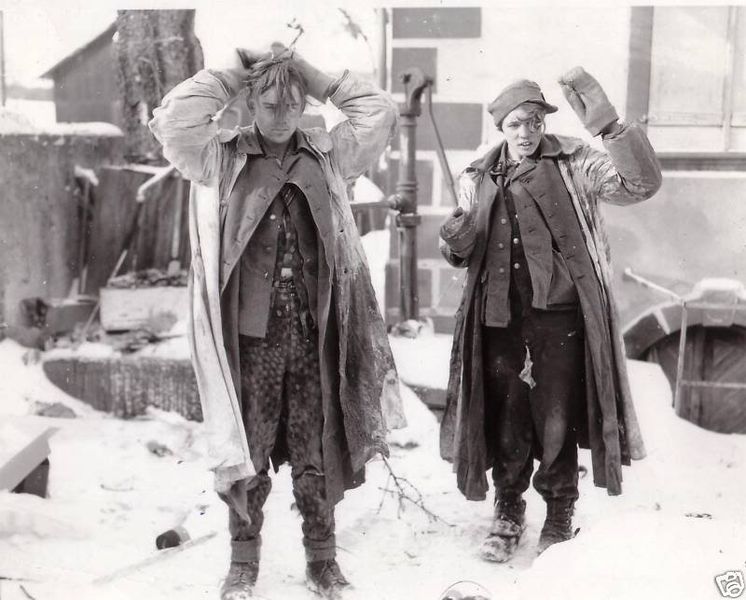
The day I moved into my first apartment, way back in 1998 or so, I wrote the following account of a battle my grandfather participated in. I did not know John Blaskiewicz, as he died the year before I was born. I knew he was a replacement in the 103d Infantry Division who had been sent to Europe after the ASTP program had been abruptly shut down. (I hear he and others were annoyed.) This division, the “Cactus Division” fought in south France and Germany and ended the war outside of Innsbruck Austria. But that’s all I knew. I had always been curious about his wartime experiences and, with my father, researched his unit, got in touch with veterans from his unit, and, over time, built up a picture of the only battle he ever spoke about publicly. Indeed, I found that it was the only battle that every single veteran talked about unprompted.

[Update, 6/29/2015:Most of the direct quotations in this narrative come from Richard M. Stannard’s oral history of 2nd Battalion of the 410th, Infantry: An Oral History of a WWII American Infantry Battalion, which is required reading for anyone interested in the history of the 103d ID.]

The Battle at Schillersdorf

The terrain the 410th occupied following the withdrawal as “a lot like [a] golf course, rolling and open with patches of woods, and deep snow.” In the days preceding the attack at Schillersdorf, the Germans reconnoitered and patrolled boldly. Sgt. Ray Millek, who led a machinegun squad for Company E [Easy], remembered holding the line: “Before things heated up, we were in two houses straddling a road to block infiltrators. Along comes this real pretty girl, and she asked to go through our roadblock to the next town. Oh, God, she was making these eyes at me, and she spoke English. I told her the Germans were holding the town she wanted to go to, but she said, ‘That’s my home. I want to go back.’ I let her through. I’ve often thought about that. When she got to the next village, she probably told the Germans there were only three or four of us on a roadblock.” Indeed, the precision of the coming German strike would demonstrate how well-informed the enemy had been.

At the time, Easy Company endured poor leadership, likely the most dangerous threat to any combat unit. In the Army, a unit’s movement, material and information was determined by the immutable chain of command. Officers at every level could be held directly responsible for his subordinates’ actions because their actions, in theory, originated at their superiors’ command. A well-trained, physically fit and well-supplied company of war-hardened veterans, can be squandered in a hopeless battle, wasted in pursuit of insignificant objectives, or can empower an inferior enemy by injudicious inaction. Soldiers relied on their officers to lead them into battle and to monitor their progress; as such commanders’ decisions and actions significantly impacted troop morale and effectiveness. The effects of a corrupted chain of command rippled throughout the ranks; Hitler, for instance, sacrificed often-superior weaponry, defensive advantages and a generation of experienced soldiers at key points to the elimination of a reliable chain of command by which he sought to consolidate power. Millek painted an unfavorable picture of his Company’s captain: “The captain we had at the time was a son of a bitch. Scared to death. He’d whimper and lay in bed and ask me to do this, do that, do everything for him. ‘Go to Battalion. See what’s what,’ things that he as a captain should have been doing, and he’d be laying in bed drunker than hell. It was easy to get booze up there. I think he had a couple of runners who scrounged for him. A pack of cigarettes would get you anything that you wanted. When the krauts hit us, he was worthless.”

“[He was] a strange man to be in the infantry,” First Lieutenant Martin E. Shelley recalled. “He’d only been an administrator. He told me to find him an orderly who could speak German because his job was going to be to keep him in schnapps. He didn’t interfere, just stayed in his little room at the CP. When we got our whisky allowance, you wouldn’t see him until the whisky was gone.”

Following Easy’s withdrawal to Offwiller, the Company’s CO made a tactical error that would only be corrected at the cost the lives of many GI lives. Second Lieutenant Hugh Chance commanded Easy Company’s Third Platoon. His platoon represented the leftmost extreme of the 103rd’s line. He remembered his CO’s orders: “It was snowing like everything. The CO told the Second and Third Platoons to set up outposts a mile and a half or two miles ahead of the MLR [Main Line of Resistance]…. The 36th Engineers [of the 40th ID] were supposed to be on the line to our left, but I walked all along their sector and couldn’t find anybody. When I told company headquarters that our left flank was wide open, we were ordered to stay anyway.” At no point during the several days that Chance’s platoon kept the outpost did Easy Company’s CO take steps to guard the 2nd battalion’s flank.

Captain Alfred J. Torrance commanded G Company from Rothbach. In contrast to his counterpart in Easy Company, Torrance was an effective commander who was well-liked by his men. “He was a hell of a good man, a man everybody felt they could trust,” commented Clyde Rucker. “He was concerned about the guys’ welfare. I don’t know if all the officers were.” John Woodside, a machine gunner in the Fourth Platoon, described Torrance as, “a good leader, but not a glory hound. He always told us he didn’t want a bunch of heroes; he wanted a bunch of live soldiers. In training, we thought that he was too hard on us, but we found out he was right when we got overseas.” Paradoxically, Torrance’s effectiveness was reflected in the fact that he touted the highest casualty rate in the Regiment at 128 percent (as opposed to Easy Company, who had the lowest at 50 percent). Indeed, when George Company launched its final assault on Germany, it was at only 75% full strength. The effectiveness of his command drew him more hazardous assignments, which in turned opened holes in the ranks that would be filled with green replacements. Robert Loyd, one of Torrance’s riflemen rationalized the situation: “They asked us to do a lot of things they wanted done right, and they figured Al Torrance was the guy to do it. A price had to be paid.”

At 2100 on Jan 22, the Germans exploited the gap between the left flank of the 410th and the right flank of the 45th ID and launched near-simultaneous attacks against Company E’s CP at Offwiller and Company G’s Command Post at Rothbach. The Germans attacked Easy’s CP from behind. Ray Millek, who was a sergeant in charge of a machinegun squad in Easy’s Second Platoon: “…[W]e heard firing to our rear. I called…[First Sargent Orland Woodbeck of Easy’s first platoon] at the CP in Offwiller. ‘There’s a few civilians coming into town,’ he says. ‘We’ll handle them.’ What he didn’t know was that krauts on skis in civilian clothes had gotten into Offwiller by coming over the mountain from behind.” Chance made note of the route the Germans followed that allowed them to attack the Second Battalion from behind: “They’d come over the mountain through that unprotected left flank.”

The situation at Easy’s CP quickly deteriorated and it became evident that the camp would have to be abandoned. First Sergeant Woodbeck called up to Lt. Chance’s platoon. “The town’s full of them,” he told chance. “Battalion said to tell you fellas to get out of there the best way you can.’” There was either not enough time for Woodbeck to contact Sgt. Millek’s Outpost before the retreat, or the communication lines had been cut. The staff soon realized that there was no prospect of an organized retreat. First Lt. Shelley reported: “[T]here was gunfire all around the CP. We decided it was time to get out of there and back to the MLR…. Our captain was in a drunken stupor, but I got him awake and told him the Germans were right across the street. ‘Call my jeep driver,’ he said, and he took off.” With that, Easy’s CO abandoned his company to fend for itself.

Capt. Torrance, at George Company’s CP in Rothbach, was notified by the Battalion of the Easy’s Company’s situation at Offwiller. “I considered sending some men to counterattack,” he remembered, “but I wasn’t allowed to. Our job was to hold. We followed the prearranged plan. My rifle platoons pulled out of Rothbach and went into holes above the town.” He called a meeting and was informing his staff of the situation when the Germans hit his CP. According to Woodside, the machine gunner, Torrance “called his sergeants and platoon leaders back to a meeting to give ‘em a little information about what was going on. While he was talking about what was going to happen, it started happening. Loren Becker [Woodside’s sergeant] never could get back to us. Those storm troopers come off that mountain like a bat out of hallelujah.”

Captain Torrance’s reconnaissance sergeant, Robert Schroeder, was at George Company’s CP during the opening volley of the German attack at Rothbach. “We didn’t expect anybody, ‘cause we hadn’t heard any firing from Easy. First thing I knew was when a guard outside out CP shouted a challenge. The guy answered in American, so I didn’t get suspicious, but our guard said, ‘You kraut son of a bitch,’ and opened fire. Then all hell broke loose.”

Torrance ordered an evacuation of the CP, ordering Sgt. Schroeder to hold until no more equipment could be evacuated. Schroeder lingered until the house across the street was stormed by enemy troopers, and then followed Torrance up the hill. Woodside’s machine gun crew, however, was stranded in a house at the edge of town. Both Torrance and Schroeder wondered how the machine gunners were left behind. They likely never heard about the retreat, as their sergeant had been unable to reach them during the fight.

Stranded in Rothbach, Woodside and his crewmates caught hell. “I was firing out the window when a bazooka round hit right below me,” he remembered. “The next one come over the window sill and exploded. It knocked out three of my men, blew my leg almost off, and set me afire. I got the brunt of it. The other three men was all right when they woke up. One of ‘em was Bert Irwen. I don’t remember the others.”

Not knowing that he’d been on fire, the other soldiers wrapped Woodside in blankets. He remained conscious, but in was shock. The burns were excruciating: “I thought my guts was blown out. I finally asked someone to see what kind of shape my guts was in. [Another soldier] took the blanket off; I was burning down there. All the clothes in my middle was burned off.”

Easy’s CP, minus one CO, attempted to execute the preplanned retreat. The evacuation plan called for them to follow a German anti-tank ditch to Rothbach, where they would pass through G Company. They were not aware that the Germans had taken the town. Lt. Shelley remembered the retreat: “It was dark…, 10 degrees below zero and lots of snow. Pfc. Joseph Kennedy was in the lead. I was right behind him when he saw these figures and called out the password. The answer brrrrrrrrp from a German burp gun. He just did a flip-flop, hit right in the forehead. I’m sure he never knew what happened.”

Leaderless, the men of Easy’s CP knew they were trapped and outgunned. First Lt. Shelly and the others abandoned the escape plan and retreated—away from American lines. One soldier in the group, desperate to escape, stripped down to the skin and put his light gray thermals over his uniform. He sneaked off, hoping that he had adequately camouflaged himself. The men who stayed back shortly heard machinegun fire and assumed the worst.

“We…laid there in our little ditch real quiet,” Lt. Shelley recalled. “I told the men not open fire till I gave the command. We didn’t have to wait long, probably about midnight, when here come the Germans wearing white snow capes. We picked up one, then another one. Oh, oh, there’s a whole line coming, very slowly. When they were about 50 or 60 feet away, we opened fire and shot every round we had. The next thing that we knew, they came yelling like Comanche Indians and jumped into the ditch.”

“Of course, the Germans didn’t know that we were disarmed when they jumped in that ditch,” First Sgt. Orland Woodbeck remembered. “It’s a wonder nobody was hurt. Would the Germans have survived if the circumstances had been reversed? We-l-l-l-l, I don’t know. They probably wouldn’t have.”

The Germans quickly took the stranded Americans prisoner. First Lt. Shelley surrendered his last weapon: “All I had left was a hand grenade. I pulled the pin and thought about dropping it and being one of those kamikazes, but I also thought, “What is this gonna do in the winning of the war?” I’m standing there with this armed grenade in my hand when this big tall German guy comes up behind me and says, ‘Raus mit!’ I took my watch off, tightened the band around the grenade and let it drop in the snow. The time comes when you have to realize the jig is up….

“I’ve often wondered what happened to the grenade. I hope some poor cuss didn’t find it after the snow melted and say “Wow, there’s a wristwatch.”

“They made us clasp our hands behind out heads,” Lt. Woodbeck recalled. “The Germans, when they surrendered, had a tradition of throwing their helmets away and putting on field caps. We didn’t do anything like that. How to surrender was not part of our training.”

Sgt. Millek held his position at the fringes of the American line, unaware that the CP to his rear had been captured. “The firing back there kept on for maybe an hour,” he reported. “When I called Woodbeck again, the line was dead. Woodbeck and the captain and the whole company headquarters had been captured. I told my guys, ‘There’s something wrong back there. We’re getting out of here, but don’t go back by the road.’ They pulled back, carefully skirting the town.

Lt. Chance’s group had also bypassed Offwiller when they encountered Millek’s group. “[T]here on the other side of town was a whole group waiting, Rhye’s and Millek’s men and my platoon,” Chance recalled, “Sixty or seventy men in that bright moonlight on the snow, standing there in the open. There was no panic, but it panicked me to find everybody waiting for me. Well, I didn’t do anything but run ahead of them and beg them to get some distance between us and the town.”

Lieutenant Chance took command of the group and led the stealthy retreat. “Lieutenant Chance took us over fences, through back alleys, and what have you to get us back to the main line,” mortar sergeant Sam Natta remembered. Even though the entire CP had been captured, thanks to Lt. Chance’s decisiveness not a single man on the Outpost line was killed. “All our people made it back safely to the MLR. Chance’s boys and John Rhye’s and mine. How Chance made the decision to take that route I don’t know, but he saved us. He must have done it on instinct.”

At Offwiller, deficient command certainly did not hinder the German cause. 2nd Lt. John Crow, CO of H Company, recalled: “The most serious charge of dereliction, against the commander of E Company, was never proven. The company commander was accused by his men of abandoning them on 22 January 1945.” The discipline and efficiency displayed by the SS as they seized Easy Company’s Offwiller Outpost impressed Crow: “Attacking E Company’s outpost in pitch-darkness, they leaped into the defenders’ ditch and took them all prisoner without shooting a man.” Twenty-nine men had been captured, which accounted for all POWs and MIAs that Easy suffered in the European Theater of Operations [ETO].

***

On the hill above Rothbach, GIs were distributed white camouflage. According to Sgt. Duus, a rifleman in G’s Second Platoon, “Sergeant Huskey [walked] along the parapet in front of our holes telling everyone what the situations was, to stay awake, and keep our eyes and ears open.” The next morning, from his position above Rothbach, Lt. Torrance noticed a head that appeared above a windowsill in a house below. He squeezed off a shot with his rifle, the head disappeared, and American swearing was heard below—the missing machine gunners. A group made its way down to the edge of town to evacuate the group. Luckily, Torrance’s bullet had grazed Elmer Brawe’s head, knocking him down and stunning him. Brawe, Woodside, Irwin and the other soldier were evacuated. Woodside needed special help being evacuated as Schroeder remembered: “There wasn’t much bleeding but he was in terrible pain. To get him out of there, we had to carry him up an icy 45-degree slope that was covered with snow. Once or twice we lost him off the litter.”

Back on the hill, Torrance got a call from his colonel: “Some of your mortarmen were so confused in this night fight they lost their lines,” he said. Mortarmen in the Fourth Platoon had fled to the First Battalion reserve unobserved.

“‘Well, get their asses back up here,’ ” Torrance responded, “‘I’ll get them back in position.’ And I did.”

***

In the wake of the night’s casualties, forward units at the left of the Regimental line were retracted to the MLR, and the Regimental CO, sensing a possible attack, moved the 1st Bn Outpost to Ingwiller at 2215, Jan 22.

On the 23rd, forward units of the Second Battalion absorbed machinegun fire from enemy units at Offwiller. That afternoon German artillery fired at F [Fox] Company while Easy was mortared. A prisoner revealed that 2 battalions of SS troopers occupied Rothbach. They were members of Hitler’s elite 6th SS “Gebirgs” (Mountain) Division “Nord”. This well-equipped, veteran Division had been formed in Finland in 1942, had since campaigned in both Finland and Norway and had only been transferred to the western front since Christmas. The Americans strengthened their defenses.

The morning of Jan 24 brought heavy shelling in Co. G’s sector and the withdrawal of the 3rd Bn Outpost, which was driven back through Bischholtz and through Muhlhausen. The 3rd Bn reserve, Co. L, was moved into position at Zutzendorf at 0918 as the Battalion’s forward units retreated to the MLR. That afternoon, the 410th’s anti-tank company knocked out two tanks that had been spotted by units above Rothbach, and at 1710, 2nd Battalion again was shelled.

***

At 0443 on January 25th the Germans laid down an artillery barrage against Co. K on the 3rd Battalion’s left flank. When the artillery lifted, SS infantry, supported by two tanks, attacked and overran Company K. Companies F and G who were on the line were not attacked, though F’s right flank was exposed as K fell back. Spilman Gibbs, Fox Company CO, recalled, “[T]he company commander panicked and pulled out, leaving my flank wide open. He was asleep in a house; wasn’t even on the line.” Within twelve minutes of the initial barrage the Germans punctured the Cactus Division’s Main Line of Resistance. Co. K’s support was committed at 0455, as was 3rd Battalions reserve.

The Germans advanced rapidly. During the first wave of the attack, three machine gun flank guards, Pfc M. L. Jacobs, Cpl. J. W. Pike and Pvt. Richard C. Hawn, oblivious to the fact that they were facing an SS battalion, decided to hit their attackers from behind. They set out from behind the house that they defended against the first wave and encountered a Nazi. Jacobs fired, the German dropped and the three ducked into an adjacent courtyard. Jacobs tried to enter one of the buildings on the plaza, but his tugs at the door were met by those of a soldier on the other side. Not knowing whether the occupant was friend or foe, Jacobs dove under a wagon in the courtyard while Pike and Hawn took shelter in an outhouse. From under the wagon, Jacobs watched a group of Germans emerge from the building. A friendly dog threatened to reveal Jacobs’ hiding spot as the Germans searched the premises. The three carefully made their way to a nearby barn. After they had made their way to the hayloft, German soldiers entered the barn and established the CP of an SS Battalion at the site. Under such perilous conditions, the GIs sweated out the next two days.

Within ten minutes of the Nazi breakthrough, the enemy was poised to strike at the Second Battalion’s CP in Schillersdorf. Co. K’s reserves and Co. L, Third Battalion’s reserve, were committed at 0455 to stanch the breakthrough. Men from E’s withdrawn Outpost manned foxholes in the field outside of Schillersdorf, although some of the men had been rotated into town for the night. Frank Kania was a jeep driver for H Company who was attached to Easy and running supplies to Schillersdorf for several days. His group was billeting in one of the houses. “There were three jeeps in the courtyard,” he recalled. “That morning, the woman of the house came running and yelled, ‘Boche come, boche come.’ That was our only warning. We grabbed our belongings, and the sergeant says, ‘We’ll all start the jeeps at once. Then follow me.’ He smashed through the barnyard door with the rest of us behind him. Here came the krauts up the street from the right. Luckily, he turned left.”

Sgt. Millek, the machine gunner from Easy’s Outpost, had been rotated into town the night the attack came: “There was about six of us in a house, all asleep, when we heard firing outside. We ran outside. There was this one fellow, I won’t mention his name [likely Cecil Shaw], I put him up in a barn where he could see real good and told him, ‘You see anything out there shoot it.’”

Sgt. Sam Natta, who commanded one of Easy’s mortar platoons, remembered: “We were in reserve when word came down that the Germans had taken the town. The whole mortar section [two squads] was thrown in to reinforce the riflemen. We didn’t know what to expect.” Natta saw the supply sergeant’s jeep burst out of the barn. It had been mounted with a .50 caliber machine gun. “I jumped on,” he remembered, “and tried to fire it, but it froze after one shot, so I joined up with a machine gun sergeant who had a brand-new light machine gun. Whoever was supposed to have cleaned off the Cosmoline (a thick protective grease) hadn’t, and that gun jammed too.” A concussion grenade knocked the machine gunner and Sgt. Natta down and they took cover between two buildings.

Sgt. Millek described the scene at the CP outside his billet: “The battalion medics were set up right across the street, and this doctor captain comes running over and grabs me and says, ‘Don’t let them get me. I’m Jewish,’ and I said, “Don’t worry. None of us is gonna get captured.’ ” Lt. Chance, who had led the evacuation of Easy’s outposts on the 22nd, was also in Schillersdorf when it was raided. “I was in the supply room. Some of the men and I ran into the street and blocked [the SS] for awhile, but there were too many. Capt. Bruno Lambert, the battalion surgeon, hollered over at us, ‘Help me get these vehicles and the wounded out of town. You know what they’ll do to me if they can.’ He was a German Jew.”

First Lt. Leonard B. Dogget, who lead Easy’s First Platoon, assembled a group of soldiers from his company to counterattack and delay the Germans long enough to evacuate the Battalion medics and Chaplain Capt. William C. Kleffman. Staff Sargent Melvin Seiler, who led a rifle squad in Dogget’s platoon, remembered: “…Doggett came around and said, ‘They broke through the line up front, and they’re headed this way.’ Next thing I knew, SS troops wearing white camouflage parkas and all schnapped up were shooting at anything in their sites.”

Once the SS attacked, Sgt. Seiler recalled: “My squad made for the woods. ‘Spread out,’ I told my people, ‘and hold them off as long as you can. If they keep coming, fall back a little.’ Pretty soon, we were back in town, and the Germans were too. We held them there until almost everybody escaped. Then we piled into trucks and jeeps and got out of there.”

At 0515, the German troopers stormed the Second Battalion’s CP. Richard Branton describes the German assualt: “Apparently the Germans knew exactly where important installations were located as they struck first the message center and then the building that housed the Command Post Proper.” The ensuing firefight was desperate. Reverend Kleffman was at the Battalion aid station: “The gunfire got closer and closer, and then their tanks came in. My first thought was to evacuate anybody that was wounded. Our doctor had already fled for his life.” Machine gunner Cecil W. Shaw, who was defending the town from the rafters of a barn, managed to knock out one enemy machine gun before another forced him from his position. Reverend Kleffman, still at the aid station, reported that Shaw “held them off until we got the jeep loaded. I picked him up as we left.” Shaw threw a few grenades and they sped out of town. “We were the last ones out of Schillersdorf,” Reverend Kleffmen recalled. “Then the Germans came in and blew up the hospital unit.” Sgt. Millek apparently had a different view of Shaw’s actions: “I was getting them started out of town when somebody ran by me like a bullet. It was that son of a bitch I’d put up in the barn.

“I asked him about it later. ‘I wasn’t going to stay out there alone,’ he says. I don’t blame him now, but it wasn’t funny at the time.”

Despite Company E’s efforts, which had slowed the German assault, the evacuation of Schillersdorf, however, remained outpaced by the SS advance. 60 mm mortar gunner Pfc. Dennis Bellmore was a member of the group covering the Battalion staffs’ retreat. Wounded and aware that the staff needed more time to evacuate, Bellmore decided to make a stand at an intersection. Sgt. Ray Mysliwiec described what happened next: “I was alongside Dennis Bellmore, brave soul that he was. He was the gunner in my mortar squad. He stood and opened fire with his .45. We didn’t know they had a tank with them. That’s what blew the building apart and killed Dennis. Or maybe it was a bazooka. You hear different stories. The wall collapsed, and he was trapped under the bricks.” As the staffers and soldiers fell back, the reports of Bellmore’s .45 pistol answered bursts of Nazi submachine gun fire for five minutes before falling silent. “[W]e didn’t know [that Bellman had been hit] until we were 100 yards away,” Sgt. Natta recalled, “We tried to get back to him, but there was no way. It was a bad thing for us, feeling like there was someone we couldn’t help. They recovered his body when the town was retaken. He was badly burned.” Pfc. Bellman had purchased his comrades’ safety with his life.

Sgt. Millek described the retreat from Schillersdorf. “The medics had at least one wounded man across a stretcher across the back of a jeep. They got out okay. Then the rest of us dropped out of the town. As we moved back in, we could hear firing, but my own group didn’t fire a shot until we got to the high ground and set up our machine guns. By that time, the krauts had Schillersdorf and came on through the town in some of our captured jeeps. We opened up and turned a couple of them over.

“I remember this kid, a rifleman that I’d converted to a machine gunner. I don’t think that he’d ever fired a machine gun except in training. It was colder than hell, but here he was laying in the snow smiling and shooting. The cold made his nose run and the snot was froze on his face. He was all smiles when he hit those jeeps, but all I could think of was that frozen snot.”

Sgt. Mysliwiec remembered evacuating the town: “Two of our guys grabbed a machine gun and took off. I was all by myself. What the hell, we all ran like scared rabbits. The Germans just kept pouring in. I think I was one of the last ones to get out. I ran from one side of the road to the other till I got to the edge of town and saw they’d stopped firing at me. As I lay in the snow, catching my breath, I could hear a lot of German singing. They had captured Schillersdorf.”

***

Colonel Harding, 410th Regimental Commander, made plans to retake contain the breakthrough and retake Schillersdorf. Co. C blocked from Menchhoffen and by 0530 Companies A and B were in position to counterattack. At 0630, Company L was dispatched to Schillersdorf. When L Company reached the town, they realized that they were engaging a different type of unit. The SS was Hitler’s legion of Nazi fanatics, an elite fighting force that would not surrender. On this occasion, they were whipped into a drunken frenzy and charged through the snow-covered streets in white camouflage, howling at the top of their lungs. Robert Briggs of L Company’s weapons platoon described the SS troopers as “screaming demons” who “just kept coming.” John C. Calhoun, a 3rd Battalion medic assigned to Company L described them as “drugged, drunk and crazy. They screamed as they ran into our machine guns, rifles and mortars.” John P. White, a weapons platoon messenger for Co. L, specifically remembered an SS trooper who, armed only with a rifle, charged a larger group of GIs and was instantly shot dead. One of the GIs in the group, however, in a despondent rage over recent news that his brother had been killed elsewhere in ETO, emptied an extra clip into the corpse’s head.

The SS used psychological tactics to frighten, confuse and demoralize the troops they fought. Almost every account of the 410th’s dealings with the SS mentions their screaming. Years later, John Blaskiewicz, who seldom spoke of the war, revealed to his family that the only time that he was truly afraid during was listening to the night-piercing shrieks and swears of the invisible German troopers as they raced through Schillersdorf. Elmer Unnerstall, and infantryman who was out of action with an abscessed tooth at the time of his unit’s counterattack, recalled that when he reentered the line he found that the SS had nailed the dogtags of fallen GIs to the doors in Schillersdorf. The sheer force and speed with which the Germans punched through the Division’s line and the efficiency with which they carried out their objectives at the Battalion CP, contributed the chaos in the ranks.

The SS also infiltrated enemy lines and fought in disguise, a daring and dangerous practice, as those who were captured would be summarily shot as spies. On Jan 22, a guard at the bridge in Bousbach had been shot by someone disguised in an FFI uniform, the same night that men evacuated from Company E’s overrun Outpost reported that the assault had been carried out by soldiers dressed as GIs. At Schillersdorf, John White encountered the remains of a German machine gunner donning a Red Cross armband. The extent of German reconnoitering prior to the attack at Schiffersdorf will perhaps never be known, but the fact that during these days, troops only attacked, and in every case took, command posts, is testament to the quality of intelligence that the Germans enjoyed. They exploited every advantage the Americans gave them. They made full use and effective use of Company E’s ineffective leadership and his tactical blundering, and while the SS may not have known the caliber of leadership, they may have surmised it after he knowingly kept the regiment’s flank exposed for several days.

Despite the enemy’s furious efforts, however, although the MLR had not been restored, the Americans stanched the Germans’ penetration at Schillersdorf by 0730. The German assault on the Battalion communications center meant to isolate as many units as possible from the coordinating chain of command, forcing companies and commanders to make uninformed, independent decisions. When the advance was stopped, Company L was sent to the edge of the town. Medic John Calhoun described what happened next, “They walked in the dark 11/2 kilometers and got into an apple orchard as the SS were digging foxholes and setting machine guns. L Co crossed the road to higher ground. [Company I] (as light came) fired mortars into the vineyard where [L Company] was digging foxholes. Finally, [L Company] got the attention of [I Company], and they stopped the mortars. Twenty men in [L Company] were lost, God rest their souls.” Confusion, it seems, was likely the Nazis’ most effective weapon at Schillersdorf.

Having contained the German penetration, Harding’s troops positioned themselves to restore the Main Line of Resistance. By 0800, Company E was dispatched to the town to secure the right flank, and at 0900 the 1st Battalion launched the assault that would clear Schillersdorf of the enemy. Company A (later to be joined by Company C) and two attached tanks assaulted enemy strong points in the town while Bravo Company would pass through the town and restore the gap in the line that the SS had forced. Col. Harding ordered the bruised Company L to eliminate any pockets of resistance that the 1st Battalion had missed.

Soldiers resented having to retake ground. It was difficult to be satisfied with yielding territory friends had already died fighting for, but it was harder to be content with the prospects of the additional casualties the reoccupation of the territory would entail. Towns posed special hazards to advancing GIs. Advancing through a town’s open streets violated one of the most fundamental rules of soldiering: remain as inconspicuous as possible. The less visible the soldier, the less likely someone who wanted to kill him and his buddies would know where to find him. Attacking through open streets between houses occupied by the concealed enemy was tantamount to suicide. In order to advance through villages under cover, infantrymen relied on coordinated efforts of tank and bazooka crews. Branton tells how the 1st Battalion worked its way through Schillersdorf: “House-to-house fighting continued fiercely during the day. The Infantry and tank teams did their work. The tanks blasted one house ahead of the foot troops who then used bazookas and rifle grenades to blow open the side walls of houses. The Cactus men went from one house to another covered all the way.” After the town was retaken, Reverend Kleffman reportedly encountered the corpse of an American dough in the snow. The position of the frozen body suggested that the man had been begging for his life when he was executed.

With the assistance of the 411th Infantry’s Second Battalion, the main line of resistance was restored by the next morning, although afterwards the Cactus Division patrolled the enemy much more aggressively. At day’s end, The 410th held a line composed of, from left to right, Companies E, G, F, B, the 2nd Bn of the 411th Infantry Regiment, and I. Even though the 410th had recovered Schillersdorf at high cost, they inflicted staggering losses on their attackers. On 1 Feb, the interrogation of a German deserter revealed him to be a member of the 3rd Battalion of the 12th SS Mountain Division (Regiment?), the group that had occupied Schillersdorf. Of the 360 men that participated in the attack, he reported, the Germans had lost all but 60.
746px-Schillersdorf

Two of the German survivors.


The Burzynski Clinic: A Lesson About the Importance of Stories…

November 8, 2013

Last night, Tim Farley broke news that the FDA’s findings into Burzynski’s research practices had been published in the online FOIA reading room. In response, the James Randi Educational Foundation has released its videos of the sessions devoted to Burzynski and other quacks. I talked about a project I have been involved with and contribute to as an English teacher, telling the stories of the patients who did not make it:

David Gorski–Why We Fight, Part 1: Stanislaw Burzynski vs. Science-Based Medicine

Bob Blaskiewicz–Why We Fight, Part 2: “It’s All About the Patients”

TAM panel on science-based medicine:


The Shellackistan in Khazakstan

September 28, 2013

If the G+ discussion with the pseudonymous Burzynski supporter happens at 900AM, it will appear here:


RJB


Virtual Skeptics: Season 2 Episode 2 Rethink911, Mummies and Congress

September 12, 2013

The Virtual Skeptics is a fun little show Eve and I do with Brian Gregory, Sharon Hill and Tim Farley. It’s on Wed nights at 8:00PM EST.

I talked about a 9/11 Truth poll that was not unlike this poll:

Eve looked into a mummy. Metaphorically.

Sharon gave us the news blur, a quick run through of a number of weird news stories, including the least lucky guy in the world (spontaneous human combustion).

Tim looked at tools that can help skeptics track bills as they move through Congress.

So check us out. We’re pretty awesome.