Introducing our new contributor, linguist Mark Newbrook

March 1, 2012

Eve and I are happy to introduce a new contributor to Skeptical Humanities, linguist Mark Newbrook. Mark has years of experience exploring the fringe theories of language from a skeptical, professional perspective. According to his bio:

Mark was born and brought up in Wirral near Liverpool in North-West England, where he now lives again.  He completed a BA (Honours) in Classics at Corpus Christi College, Oxford and went on to take an MA and a PhD in linguistics at the University of Reading, specialising in variationist historical dialectology and associated attitudinal matters. Subsequently he spent many years as a lecturer (professor) and researcher in linguistics in Singapore, Hong Kong and Australia.  While in Australia, Mark combined his professional activities with his broad based interest in skepticism to become one of the few ‘skeptical linguists’ around; he was linguistics consultant to Australian Skeptics and now occupies similar roles in the equivalent British organisations. He has authored several books and many articles and reviews on various aspects of linguistics; and he has recently completed the first-ever general skeptical survey work on fringe linguistics (forthcoming).

Welcome, Mark! We look forward to working with you!

By the way, we are looking to build a community of scholars here, so if you would like to contribute to the site, let us know and we’ll see what we can work out. Professionals in all areas of the humanities are welcome.

RJB


This Week in Conspiracy (26 February 2012)

February 26, 2012

It’s been a stressful week here at Casa Blaskiewicz. While I have gotten used to a certain sort of stress in the last week or so, I now turn the one thing that allows me to decompress so rapidly that I almost get the bends, the Week in Conspiracy. Honestly, there was not a lot this week. Maybe this is a sign that we are coming to our collective senses? (I’m not holding my breath.)

“To whom will you compare me? Who is my equal?” asks the Holy One. “Look up into the heavens. Who created all the stars? He brings them out like an army, one after another, calling each by its name. Because of his great power and incomparable strength, not a single one is missing.”

So, uh. Apparently there are lots of stars, and…that’s what Hubble found, against all expectation, I imagine. Of course, stars devoured by black holes might be “missing,” but saying that would just be sinking to their level.

Conspiracy Theory of the Week

Two were notable this week.

That’s it for now. I’m heading back down the mine shaft to work on another piece, which is growing to rather biggish proportions. Let’s just say I’m “brushing up on my archaic French.”

RJB


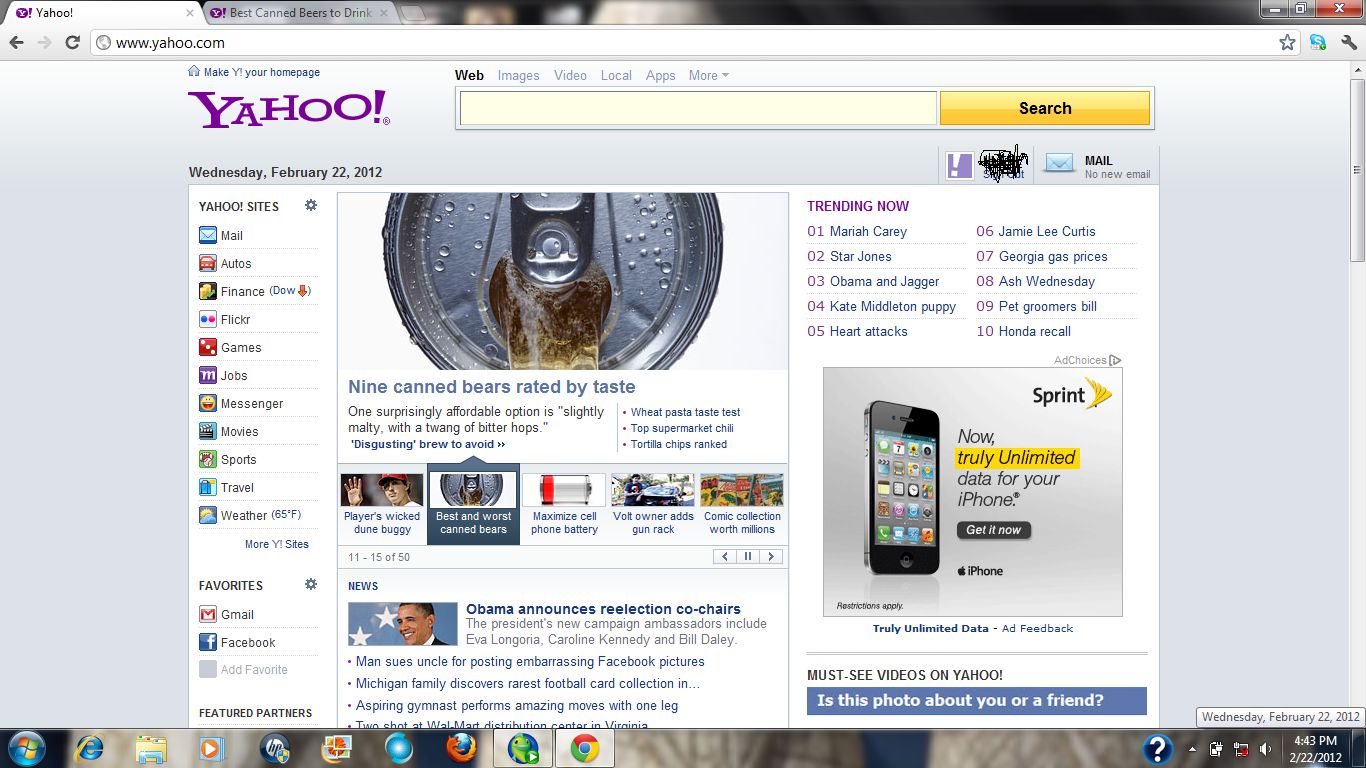
Canned Bears

February 22, 2012

Thank you, Yahoo. I’ve been wondering who had the best-tasting canned bears.


Bad News Today

February 21, 2012

I got really crummy news today after 3 breathless weeks of waiting. So, here’s a puppy who can’t get off his back:

Don’t worry. It has a happy ending:

RJB


This Week in Conspiracy (19 February 2012)

February 19, 2012

Just got back from Alabama (no banjo on my knee), where Eve was giving a talk about creationist interpretations of Beowulf to the Alabama Freethinkers. It was a rollicking good time prefaced by a spicy sausage potluck.

It was a rather slow week for conspiracy, truth be told. I saw a lot of leftover speculation about Whitney Houston’s death, all of which was as dull as it was predictable. Don’t try to confuse us, conspiracy theorists. We know that she is living in Bahrain with Michael Jackson, away from the prying eyes of the world.

VH1
1515 Broadway
New York, NY 10036
Tel. 212-258-7800
Fax 212-846-1753

Conspiracy theory item of the week:
This is more of a conspiracy than theory, but the documents leaked from the Heartland Institute suggest that they are actively seeking to discredit the science of global warming, over which there has long since ceased to be debate among knowledgeable experts. I thought this might get picked up by Science Friday this week, but alas! Maybe next week, because this is important.

Conspiracy Theory of the Week:

This week’s winner came from Weird Al Yankovic, who I know from going to one of his shows can totally rock a peacock outfit:

Al Yankovic @alyankovic:
Why do they not make urinal PIES? #CakeConspiracy

Please sign the Weird Al at the Superbowl Half-Time Show Petition. I would actually watch the Superbowl again. The NFL needs to make this happen. I don’t do a lot of advocacy, but this is the defining issue of my generation.

That’s it for now. I’m working on a write-up about a pretty nifty little topic. I hope to have it ready in the next week or so.

RJB


Yay! Eve and Bob on Skepticality

February 14, 2012

Just a quick heads up. Two weeks ago, Eve and I were interviewed by Derek Colanduno for Skepticality about Shakespeare deniers and the movie Anonymous. That episode is now up and available for your downloading pleasure.

I was disappointed that he edited out the pillow fight and crank call to John Orloff. Oh well.

RJB


This Week in Conspiracy (11 February 2012)

February 13, 2012

In the beginning, it was a dark and stormy night, so you can call me Ishmael. Or Al. Doesn’t matter.

Lemme tell you, as I start this post, it’s unpleasant in Atlanta, kids. The wind was pretty impressive this evening, as was, not coincidentally, the amount a certain tree near my apartment can bend without breaking and my sudden desire to purchase renter’s insurance. But not even 2 tons of wood accelerating at 9.8 m/s/s through my roommate’s bedroom would stop me from bringing you the week in conspiracy.

Let’s just hope it doesn’t come to that.

  • I don’t know what this is…but I like the idea…Space Nazis!:

That’s it for this week, folks. No conspiracy theory of the week. Oddly, nothing struck me as absurd enough. I hope that doesn’t mean that I am building up a tolerance. I’ve started working on a story about UFOs in the Renaissance. I may try to peddle it to, well, Ben Radford. We’ll see. Take it easy! Also, Eve, who has been a little AWOL lately, is working on something utterly hilarious. I hope that will be up soon.

RJB


Skeptical Book Review: Reading Outside of Your Discipline, or A Psychologist, a Magician, and an Archaeologist Walk Into a Bookstore

February 8, 2012

If a very literate thief were to break into my apartment, I like to think he would take a moment to browse and appreciate my bookshelves. It’s a varied collection, which includes a massive collection of cheap paperbacks I picked up for my masters and doctoral exams, a huge number of obscure lit books by well known authors which are only ever read by professors, books of theory and poetry, a lot of science books, a collection of primary sources photocopied at cost from the finest archives around the world, a shelf of WWII memoirs and histories, a pony-load of anthologies, rhetorics piled out the wazoo, and a heap of books that can only be described as “flaky to the nth degree” (think of the ouvre of Jenny McCarthy). This ne’er-do-well, just before my cats mauled him beyond recognition, I like to think, would be slightly confused by my collection, which serves the bastard right for breaking into my apartment in the first place.

Our thief, as the cats flayed him alive with their razor-sharp, serrated tongues, would in his dying moments probably wish that I would come home from my vacation, but in all likelihood I’d be too busy playing tourist. I’m as pleased as punch to wear a stupid Hawaiian shirt and wander the streets of an unfamiliar city gawking. I also like to pick up souvenirs when I travel, specifically, I like to buy a book in each town I visit. It gives me something to do during downtime, and I can always recall what I was interested in at the time I was traveling. For instance, the last time I was in New Orleans (CSICon excluded), visiting the D-Day Museum with my grandmother, I bought the collected short fiction of F. Scott Fitzgerald at the airport bookstore. That’s presumably when I started using the phrase “a _____ as big as the Ritz” in everyday conversation.

Anyway, my recent trip to CSICon in New Orleans was no exception. Not only was the solar-fusion yellow Hawaiian shirt in full effect, but I also returned with three more books than I arrived with. What struck me about this particular collection of reads was the variety of disciplines they touched on. At the CSICon book display, I picked up The Truth about Uri Geller, the classic work of flair-trousered debunkery by magician James Randi, and 50 Great Myths of Popular Psychology by Scott O. Lilienfeld, Steven Jay Lynn, Jon Ruscio, and Barry L. Beyerstein. (Scott, I should mention, was my conspiracy theory session’s chair.) Down the street from the conference hotel, at Crescent City Books, I picked up Frauds, Myths and Mysteries: Science and Pseudoscience in Archaeology, 6th ed., by Kenneth L. Feder.

These books, together, only make sense on a skeptic’s bookshelf, which is one of the reasons I am so attracted to skepticism as a methodological framework for scholarship–it gives one a large set of tools that can be applied to widely divergent areas of study. While I have chops in a couple of disciplines, I also have the flexibility to begin to assess the contents of novel claims, even if I am not an authority in all areas.

The value of these books, to me at least, is how each contributes to my mental map of my own limitations, which is important to know if you want to avoid making unwarranted, unsupportable and silly claims. The subjects of these books span the range of topics from deliberate deception, in the case of Geller, to inadvertent yet pervasive misinformation, in the case of popular psychology.

James Randi’s The Truth About Uri Geller is a skeptical standard, as is anything written by James Randi. Besides being a magician, Randi also has to be a bit of an acrobat, one the one hand laying bare that Uri Geller, the 1970s spoon bending Israeli, was little more than a stage performer, all the while protecting the secrets of the craft and so forth.

Much of the book is documentary, culled from sources reporting on Geller’s rise to prominence in the US. Randi spends a lot of time showing how the media was fooled, and how misremembering and misreporting fed into the Geller myth. Occasionally, Randi illustrates precisely how a trick was accomplished by publishing evidence of Geller’s mistakes. My favorite was Geller’s attempt to take a “psychic photograph” on a camera that still had its lens cap on. This “test” of Geller’s abilities was performed in a private residence, and illustrates how a patient and talented performer can multitask. In this case, he said that the photograph had been taken (it had not), but then later in the test, he had his test administrators leave the room to write something on a slip of paper. While they were out of the room, he removed the camera and snapped a photo. Randi can confidently assert this because Geller did not realize that the lens had an extra-wide field of view and caught his FACE in the shot, thoroughly debunking himself! Randi replicates effect, and the conclusion is undeniable.

You walk away from the book admiring Geller’s skill as a magician and manager of illusions, but with no respect for him as a person. Geller’s talent for peeks, distraction, and causing confusion is undeniable. But his trickery, which seems inexplicable to the untrained eye, withers under the scrutiny of his technical equals and moral betters.

Next is Kenneth Feder’s Frauds, Myths, and Mysteries: Science and Pseudoscience in Archaeology. I read the sixth edition. Feder provides a general guide to distinguishing good archaeology from not-as-great archaeology. Feder pays special attention to a number of hoaxes and sensational claims about civilizations past. In doing so, he builds up models of how archaeologists treat and interpret evidence.

Personally, I think that much pseudo-archaeology, including ancient alien hypotheses and so-called biblical archaeology (which seeks to establish that one’s own literal interpretation of the Bible is the correct one), do not meet nearly enough informed criticism in the popular press. Feder lays bare what we would expect to find if these extraordinary claims are found to be true and how news evidence fits into a much larger body of evidence about humanity’s past.

The most important warning that Feder delivers, it seems to me, is to be especially wary of those claims that give you exactly what you most expect or hope to find. Many of the hoaxes and instances of scientific fraud Feder takes the reader through, like Piltdown, succeeded because people embrace agreeable finds. While it may seem staggeringly obvious in hindsight, the satisfaction of expectations and justification of prejudices seems to be especially compelling to the public. At the same time, those most memorable, earth-shattering claims are the most likely to be repeated in the media and repeated. An understanding of the standards of practice and the process of archaeology is an important safeguard against embracing impossibilities. Critical thinking exercises at the end of each chapter drive home the important points and encourage readers to consider the implications of issues raised in the chapters.

As questions at the end of chapters usually do. (Sigh.)

The final book that I brought home from New Orleans was 50 Great Myths of Popular Psychology by…a whole lot of psychologists. Fine, I’ll type them all out: Scott O. Lilienfeld, Steven Jay Lynn, Jon Ruscio, and Barry L. Beyerstein (abbreviated to  “L.L. RuBe”). L.L. RuBe looks at a large number of popular popular misconceptions about how our minds work. The topics covered, from the idea that we use only 10% of our brains to the idea that people commonly repress traumatic memories, are those sorts of things that have seeped into the culture. Again, the explanations for why these ideas are popular vary, but often they seem to patch over gaps in actual knowledge, and L.L. Rube does an excellent job filling those in with solid science.

An interesting and unexpected feature is a list of topics that the authors, numerous as they were, simply did not have time to cover. At the end of each chapter, they remind you that they have only scratched the the tip of the volcano. Uhhh… That metaphor slipped away from me like a slippery thing. I can easily see using this book in my writing about science and pseudoscience class as an invention source for first-year research questions, for instance.

Review Questions:

1) Can you tell where Bob forced together two versions of this post? If not, check to see if you have a lobotomy scar.

2) At what point did Bob simply run out of steam?

RJB


This Week in Conspiracy (5 February 2012)

February 6, 2012

BAM! Finished another article and sent it off tonight. What next? I could watch Puppy Bowl reruns….Aw shucks, let’s do a conspiracy theory round-up!

Conspiracy Theory of the Week: Ron Paul Edition

First, an irony of epic proportions. It turns out Ron Paul’s biggest donor is a Bilderberger.

Also, and I know I posted this earlier, but I love, freaking LOVE, this video at the Georgia Guidestones by a Ron Paul supporter/conspiracy theorist. Make sure you watch until after the wind dies down, because, wow, there is some profound linguistic analysis.

Conspiracy is so much fun!

Anyway, I have a couple of reviews in the pipeline, so stay tuned. Keep it classy, Internet!

RJB


A Brief Note on the Sokal Hoax

January 31, 2012

Yesterday, chum of the Skeptical Humanities site, Sharon Hill of the Doubtful News blog, posted a generally excellent piece about skeptics putting on hoaxes. Go read it. But be ye warned, she ventures like a deer into the barreling Mack track that is Skeptical Humanities when she says:

Many other hoaxes can be found on the Museum of Hoaxes website including the famous Sokal hoax where Alan Sokal sent in a paper full of gobbledegook words to a journal to see if it would be accepted. It was. He succeeded in dramatically demonstrating the decline in standards of humanities journals and embarrassing his field into reaction.

Well, not exactly. Sokal was a physicist, who was attempting to make a point about certain critics’ misuse of scientific terminology and a sort of absurd posturing that one often sees in the postmodern camps of literary theory.

In the schools of thought that concerned Alan Sokal, all language is basically a game and meaning is never absolute. He was prompted to perpetrate the hoax after he read Higher Superstition: The Academic Left and Its Quarrels with Science, by Gross and Levitt. In Higher Superstition, the authors, both working scientists, look at a lot of the big names in critical theory, including Lacan, Derrida, Kristeva, and others and show in excruciating detail how utterly unqualified to have an opinion about the scientific matters on which they publish. Most of what they find is gobbledegook, not unlike the science word-salad of newage gurus like Deepak Chopra and Ramtha, the guy from outer space who lives inside a lady.

Gross and Levitt notice that there are some similarities between the schools of thought that accrete around these academic gurus. In these cliques, you are generally rewarded for exaggerating the socially liberating potential of… whatever text you are looking at, whether it is Finnegans Wake or the back of a Happy Meal. (I’d rather read the back of a Happy Meal, to be honest.) They notice a particular ritual vocabulary, the presence of which seems to validate whatever is being said by the critical theorist, but which is impenetrable to mortals. And, lastly, they especially focus on the ways in which critical theory has presumed to critique not only the language in which science is communicated, but the content of the science itself, that is, that in the extreme forms of this criticism, all reality is merely a linguistic construct, often one that somehow offends the political principles that motivate the cultural critics. Therefore, the critic concludes: “Science is wrong. I just recreated the entire world. I’m pretty much a genius.”

You’d like to think that I’m joking, but take Sandra Harding’s closer to her book, The Science Question in Feminism:

“When we began theorizing our experience…we know our task would be a difficult though exciting one. But I doubt that in our wildest dreams we ever imagined that we would have to reinvent both science and theorizing itself to make sense of women’s social experience.”

So, this sort of self-important posturing by the scientifically illiterate does exist, and this is what Gross and Levitt demonstrated in spades in their book. How far can it go, wondered NYU physicist Alan Sokal?

Pretty far, it turns out.

Sokal submitted a paper to the postmodern critical journal, Social Text, called, “Transgressing the Boundaries: Towards a Transformative Hermeneutics of Quantum Gravity.” It’s a screamer. It makes no sense. The editors of Social Text accepted it without any changes (they had asked for some, but Sokal refused, and they ran it anyway). It seems they were excited to have a physicist speaking their language and trusted him.

Oops.

When “Transgressing the Boundaries” went to press, Sokal released yet another article in a different publication exposing the hoax. I was an undergraduate at the time and missed the controversy the first time around, but it was intense and still ignites fierce debate about the meaning of the hoax, academic honesty, and a whole range of other issues, many of which Sharon identifies with respect to other hoaxes. I discussed this hoax in a paper I gave in April, “The Topography of Ignorance: Science and Literary Theory.”

What is important for the purpose of this post is that the Sokal Hoax does not actually demonstrate what people have said that it demonstrates. A sample size of one does simply does not qualify all-inclusive statements like “[Sokal] succeeded in dramatically demonstrating the decline in standards of humanities journals….” He did, after all, only show that one journal of a specific academic bent, postmodern criticism, was WAY too uncritical about what it accepted, not that humanities journals are in decline.

The type of problem that Social Text represented back in the day (it is not often noted that the editors re-schooled themselves in science after the hoax was revealed, much to their credit) should not reflect on the myriad of other journals that use accumulated evidence and genuine expertise to make statements and meaningful arguments about history, linguistics and languages, literature, rhetoric, media, music, ethics, philosophy, theology, and all the other fields of study that fall under the purview of the humanities writ large. Yes, critical theory sometimes is wacky, but sometimes it’s sensible, even enjoyable. No, critical theory is not the humanities, though by the grandiose posturing that some practitioners have adopted, you might be tempted to think that they were.

This is the point of this blog, to show that there is more to the humanities than theorizing feminist algebra, whatever that is, and to remind our friends in the sciences that we are doing serious, scholarly work as well.

RJB