The Language of Pseudoscience

May 28, 2011

On April 20th, I was a guest on Inside the Black Box, a science-themed radio show produced at Georgia Tech. Well, they have archived the show, which makes me very happy, because now I get to hear myself speak, which as you can imagine is something I enjoy immensely! Also, I am dying to know if they kept in a calculus joke I made that they thought might be too dirty for the archives. I know! I can make calculus positively obscene!

The topic is “The Language of Pseudoscience” (mp3 file) and it draws on a course that I taught in the Fall of 2010.

RJB


Cogito, ergo not ergotism: The Salem Witch Trials

May 19, 2011

After a grueling week of covering conspiracy theories, I thought that I would pick up a gauntlet not so much thrown down as dropped suggestively by Ryan F in the comments of Eve’s wildly successful berserker post a few weeks back:

I’d love to see a similar takedown of ergotism and the Salem Witch Trials; I always have a few students who latch on to that one. There really is an appeal to the mundane scientific explanation for a cultural phenomenon that doesn’t quite fit with modern sensibilities.

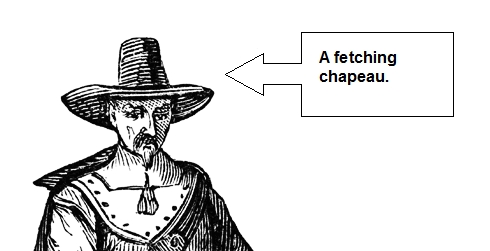
So, instead of conspiracy theories, today I’m going to talk about…a lot of people who thought there was a Satanic conspiracy afoot! But this is different because the characters in this story are wearing amusing headgear:

One of the perennial questions of American history is, “What the hell was wrong with the Puritans?” In my opinion, a lot. Let’s face it, the Netherlands didn’t want them, and you had to be a real jerk to make yourself unwelcome in the Netherlands in 1630, let me tell you.

Anyway, between September 1692 and May of 1693, 19 men and women were executed on charges of witchcraft in the towns surrounding Salem, MA, and one man was crushed to death as the court sought to force him into entering a plea. A variety of causes have been suggested for the witch mania that seized New England that year. In truth, it seems likely that a number of factors contributed to the Witch Trials; it is also apparent that the forces that initiated the craze were not the same ones that perpetuated it. Among factors that contributed in various degrees are gender and class (which were related), social and individual psychology, the social structure and beliefs of the townspeople, and, finally, the separation of church and state, which in Salem was about 2 blocks.

I have taught the Salem incident in past conspiracy theory courses. I tend to put a lot of weight on the theological background that made witchery seem like a plausible explanation. In really, truly unacceptably rough terms, the social order was thought to reflect a divine order. The maintenance of a system of covenants (women and children/father, head of household/government, government/God) was seen as ensuring the health of the relationship between the colony and the Lord. When that tranquility was disturbed, one might easily interpret that as someone having made a covenant with someone other than God, wink wink nudge nudge. It also makes a stunning lesson about standards of evidence.

But I digress.

In the 1970s, Linnda R. Caporael, a psychology graduate student at UC, Santa Barbara, published a new hypothesis in Science. She posited that ergotism might account for the physical symptoms that were reported by those making accusations of witchcraft. Ergotism is caused by…wait for it…ergot poisoning. Ergot (Claviceps purpura) is a fungus that grows on various cereals and has a special hankering for rye:

Ergot on wheat. Hold the mayo.

Caporael gives a cursory history of the madness outbreak (entire careers can be consumed by the scholarship around the Witch Trials), and considers three possible explanations 1) fraud on the part of the accusers, 2) psychological/ psychiatric issues, and 3) “physiological explanations.” Because Caporael finds that the possibility of physical ailments causing the outbreak have not been considered in depth before, the review of that literature is necessarily very brief, and she means to fill in the blank. She mentions that “A modern [1949] historian [Marion Lena Starkey] reports a journalist’s suggestion that Tituba had been dosing the girls with preparations of jimson weed, a poisonous plant brought to new England from the West Indies in the early 160o’s” (23), but the reference is not immediately available to me, so it is not clear when the journalist was writing or what evidence the journalist was citing.

Most of the studies of ergot that I have come across stress the effects of ergotism on cattle and livestock, which would be eating the affected grains. Ergot has medical uses, most notably as a vasoconstrictor, and most modern human cases of ergotism are the result of overdose on ergot-based medications. Ergot also contains alkaloid precursors to LSD, and so they share similar structures.

As you might expect given the pharmacology above, the types of symptoms associated with ergotism have to do with vasoconstriction resulting in dry gangrene and insults to the nervous system resulting in convulsions and hallucinations. It is the later suite of symptoms that lead Caporael to hypothesize convulsive ergotism as a possible culprit.

Caporael’s evidence falls into a couple of different categories. The first is “growing conditions.” There was ergot in the region, so it was a possible contaminant of rye stores. Also, she says that the crucial growing period, between April and Thanksgiving 1961, was warm and stormy, as evidenced in Puritan diaries, ideal growing conditions for the fungus. Her second line of evidence is “localization.” Three of the eight afflicted girls lived in the Putnam residence, and Putnam’s farm was large, as indicated by his will. Presumably, the agricultural yield from his substantial land holdings, if they were the source of the ergotism, would be dispersed more widely among the population. And this is how she explains the second group of afflicted girls:

The two afflicted girls, the daughter and niece of Samuel Parris, lived in the parsonage almost exactly in the center of the village. Their exposure to contaminated grain from western land [including Putnam’s] is also explicable. Two-thirds of Parris’s salary [as parson] was paid in provisions; the villagers were taxed proportionately to their landholding. Since Putnam was one of the largest landholders and an avid supporter of Parris in the minister’s community disagreement’s, an ample store of ergotized grain would be anticipated in Parris’s larder. (192)

Another sick girl was a servant in the household of the man who was presumably the town’s only doctor. Because Ann Putnam was often sick, he probably visited her a lot and got payments in ergotized grain. Another servant girl, this one on a farm near a river, may have been poisoned from her own Master’s fields, but Caporael says this case is questionable and possibly fraud (on the basis of the timing and nature of the accusation, as well as a second-hand report of the servant admitting to lying).

Another servant on an outlying farm is a bit of a puzzle. She alone was afflicted in the household (though pretty much everyone, including the kids was accused of witchcraft). There is a record of her once staying in town overnight, however. Because this girl had two bouts with the affliction, Caporael entertains the notion that she may have been poisoned the first time and then under psychological duress during the second episode.

I take these first two lines of evidence as an attempt to establish the plausibility of the ergotism hypothesis. The last line of evidence is the testimony of the trial, of which there is a staggering bunch. Caporael is looking for the symptoms of ergotism in the testimony.

After Caporael re-establishes that the outbreak of witches was an abnormal reaction, a strange paragraph follows:

The affected girls’ behavior seemed to be no secret in early spring. Apparently it was the great consternation that some villagers felt induced Mary Sibley to direct the making of the witch cake of rye meal and the urine of the afflicted. This concoction was fed to a dog, ostensibly in the belief that the dog’s subsequent behavior would indicate the action of any malefic magic. The fate of the dog is unknown; it is quite plausible that it did have convulsions, indicating to the observers that there was witchcraft involved in the girls’ afflictions. […]

The importance of the witch cake has incident has generally been overlooked. (25)

Hold on…I must have missed something. There is no contemporary record whatsoever of a dog having convulsions (or not)? If it did have any symptoms at all…surely it would have been mentioned somewhere? Where did the “importance of the incident” happen?

Regardless, lack of dog testimony aside, Caporael mentions the spectral evidence (images of the accused or of their familiars who appeared to the afflicted), and “epileptiform” convulsions which she believes are consistent with convulsive ergotism. She also notes that “[c]omplaints of vomiting and ‘bowels almost pulled out’ are common in the depositions of the accusers.” She also refers to pinches and burning sensations that might signify some sort of ergotic neuropathy.

She then points to what is slightly worse evidence than the dog:

“When examined in the light of a physiological hypothesis, the content of so called delusional testimony, previously dismissed as imaginary by historians, can be reinterpreted as evidence of ergotism. After being choked and strangled by the apparition of a witch sitting on his chest, John Londer testified that a black thing came through the window and stood before his face.”

It was a little monkey-man thing, but that’s almost completely unimportant because we already have enough to determine precisely what Londer was describing, sleep paralysis. The pressure on the chest that becomes someone sitting on you (probably because his body is still “asleep”), the sensation that there are people around you, this is classic sleep paralysis. And it’s very cool to see how confusing sensory data, even when they are fairly common, get interpreted through the filter of the experiencer’s culture. If Londer were alive now, he’d testify that little gray aliens with big dark eyes were standing around his bed. Throughout history, the specters have been variously represented as the recently deceased (as in reports of vampirism and the wacky cures that communities developed for that–exhumation, beheading, staking or cremation!); when the waking dream has a sexual element, the phantoms have become incubi and succubi, and so on. Now they’re “grays.”

Within about, oh, 20 minutes of the publication of Caporael’s paper, the thesis was completely demolished Nicholas P. Spanos and Jack Gottlieb. Their article, “Ergotism and the Salem Village Witch Trials,” appeared in the December 1976 edition of Science.

Spanos and Gottlieb raise a question that occurred to me while I was reading Caporael, “So, were there any cases of gangrene?” I mean, ergot causes both gangrene and neurological symptoms. If uncontrolled doses were being consumed by the public, surely someone would have contracted gangrene. Or maybe the animals? Most of the studies of ergotism that I found were veterinary, after all. But they take it one step further than my uninformed musings and deploy a full arsenal of reasons why ergotism is unlikely. For instance, convulsive ergotism has been seen in groups where “the inhabitants have suffered from severe vitamin A deficiency” (1390). They note that Salem was affluent enough and had enough fish to avoid such a disease. They note that children, really young children, are the most likely to succumb to ergotism, but in Salem that the ages of the girls trend well over 15 (only 3 of 11 were younger).
The fact that entire families, who you would think would be eating the same food, were not laid low casts further doubt on the hypothesis.

In the case of the gastrointestinal symptoms (vomiting and diarrhea) that Caporeal discovered in the depositions, Spanos and Gottlieb find much less than would be expected. One instance that Caporael cited as “bowels almost pulled out” in the original text reads like this: “Abigail hath been greviously vexed with the apparition of Eliz: Proctor the wife of John Proctor of Salem, by which apparition she has been greviously pinched, had also her bowels almost pulled out…”. It’s unclear that this is actually explosive at either end of the digestive tract, or whether it is a cramp or…even real. It seems to be a retelling, not an ongoing, verified complaint. Indeed, the three girls who mention what might be construed as gastrointestinal symptoms all had a single bout. There is no mention of vomiting. (Oh! Perhaps Regan in The Exorcist, which was released a few years before the paper, had ergotism! I sense a publication!)

They further notice that there is no record of ergotism being cured by the reading of particular Bible passages in the medical literature. There is no reason why someone who had ergot poisoning would appear to be fine (“hale and hearty”) outside of court, as was the case with these girls. The descriptions of hallucinations and apparitions are not consistent with the types that people report having when they are on LSD (remember, ergot and LSD share some characteristics), such as halos around objects, long-lasting afterimages, rainbow-like colors, etc. Seeing people who aren’t there while awake is reportedly a comparatively rare effect of LSD. The girls did not reportedly display the ravenous hungers that follow ergotic convulsions. The reports of burning sensations are clearly triggered by external suggestion. Lastly, nobody reported that the girls’ skin hues changed, as would be expected with ergotism. When the epidemic ended, it ended. There are no reports of the permanent neurological damage that people who had been ingesting ergot for months would have displayed. Ergotism is in almost in every way a bad match unless you are willing to cherry-pick symptoms.

Nonetheless, while Gottlieb and Spanos put a stake through the heart of the notion that ergotism caused witches, they did inadvertently prove that the reanimated corpse of a discredited theory can wander aimlessly through pop culture.

In 1982, historian Mary K. Matossian, who had been studying the effects of mold poisoning on history and culture, resurrected the theory. Her principal objection to the Gottlieb and Spanos is  that:

“The Salem court record does not mention certain symptoms often associated with mild or early ergotism, such as headache, nausea, diarrhea, dizziness, chills, sweating, livid or jaundiced skin, and the ravenous appetite likely to appear between firs. If these symptoms were present, they may not have been reported because they were not commonly associated with witchcraft.”

They didn’t note that the sufferers had changed color, eh? I’d like to refer you to a specialist in this area:


They also would have noticed bits of people falling off, I imagine.

Most of Matossian’s reply is, “Well, you can’t disprove ergotism.” But that’s not positive evidence of ergotism. Matossian does offer more circumstantial evidence of conditions that might have been conducive to ergot, like tree rings, but again, we get nothing that remotely looks like ergotism in the record. Of course, her hypothesis got picked up by the New York Times, and the rest, as they say, is the History Channel.

In a strange way, I feel that this issue could be settled using Baysian analysis. As you probably do not remember because nobody was reading Skeptical Humanities at the time, Baysian analysis appeared in our examination of whether FDR had polio or an autoimmune condition. By looking at the frequencies of different symptoms in known polio cases, researchers were able to assign a very, very low probability that FDR’s particular cluster of symptoms would have appeared in a genuine polio case.

I looked for descriptive surveys of known ergotism outbreaks in human populations, but did not find any. (Be fair, I’m way outside my area here.) If you took a couple of large studies of outbreaks (or lots of little studies), it seems to me that you might be able to assign a likelihood of seeing an outbreak that has the variety of symptoms like the one at Salem.

So, there. Now you have homework. Go do that.

RJB

Sources:

Caporael, Linnda R. “Ergotism: The Satan Loosed in Salem?” Science 192.4234 (2 Apr. 1976): 21-26.

Matossian, Mary K. “Ergot and the Salem Witchcraft Affair,” American Scientist 70 (1982): 355-357.

Spanos, Nicholas P. and Jack Gottlieb. Science 194.4272 (24 Dec. 1976): 1930-1934.


The Palimpsest of History: WWII in Images

April 28, 2011

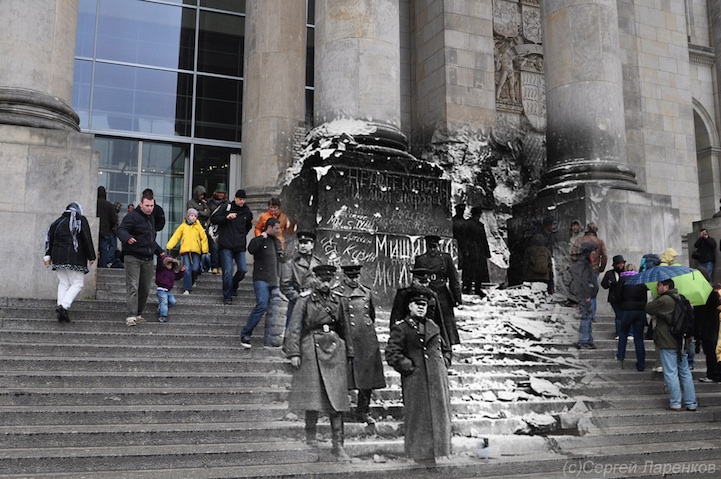
I wanted to share a link with you that hit the web big about a year ago, but is related to the course I am currently teaching on World War II. Photographer Sergey Larenkov’s stunning then-and-now-at-the-same-time photos conjure the ghosts of the past dramatically and make us the modern world in a new way.

It’s like cubist multiperspectivism on crack.  My Modern Metropolis also posted an interview with Larenkov, with more photos, including photos of Hitler in Paris.

RJB


Popeye the Sailor vs. the Japanese

April 26, 2011

Here’s a little find that a student researching his final paper on WWII sent to me. It comes fully stocked with all of the racist characterizations of the Japanese that one expects from the period. It may be the first cartoon that I have seen that addresses Japanese ritual suicide. (Warning: may be offensive to humans.)

As it so happens, I am reading David Livingston Smith’s  book on dehumanization, Less Than Human: Why We Demean, Enslave and Exterminate Others. It’s quite good and, I imagine, very accessible for a variety of audiences.

Sigh.

RJB


The Topography of Ignorance: Science and Literary Theory

April 12, 2011

The following is a talk that I gave this weekend at the Northeastern Modern Language Association conference in New Brunswick, NJ at a panel on Science and Literary Theory.

Several years ago, I took a 19th-century American literature seminar during my PhD coursework. During that class, each student in turn would guide the discussion of the week’s reading. One week, a student working toward his Masters was leading a fairly typical class, expounding at some length on the finer points of Moby Dick, and though I don’t remember the specifics of my fellow student’s conclusion, I remember that he offered a baroque hypothesis about the politics of race and gender and misrepresentation. Even though he had brought up numerous interesting observations about the text, I’m not sure I really had any idea what my friend was talking about, but I was politely professional and said nothing. When the student had finished and received polite applause, the instructor, an Americanist with whom I agreed on almost nothing, asked the one question that had been haunting me ever since my undergraduate studies of literature and culture had taken a theoretical bent in graduate school.

“Do you really believe all that?” he asked.

I can’t think of a less polite thing to ask a graduate student, or, honestly, a more important question.

I’m a relative latecomer to the subject of the so-called “science wars.” I suspect that a lot of what I have to say has been covered by any number of philosophers, scientists and academic pundits. I tend to agree with the severest criticism directed at many of the major figures in theory, the type of criticism leveled by Paul Gross and Norman Levitt in their Higher Superstition. I think that the Sokal Hoax offers an important warning that academics in the humanities fail to heed at the expense of disciplinary credibility. The hoax, you’ll remember, was perpetrated by physicist Alan Sokal against the postmodernist journal Social Text in 1996. Social Text published Sokal’s article, “Transgressing the Boundaries: Towards a Transformative Hermeneutics of Quantum Gravity.” Saturated with scientific absurdities, the article aped postmodernist jargon, political posturing, and rhetorical habits. The fact that something which, had it appeared on the Internet (presumably in ALL CAPS), would have been blasted as purest pseudoscience, had appeared in a professional academic journal produced a scandal that was about as polarizing as any you are likely to find in the academy. The furor over what were widely taken to be the broader implications of the hoax, that literary and cultural studies is vacuous, deceptive and infantile suggests that Sokal had chomped down hard on an exposed nerve.

As I prepared my thoughts on this topic, I was struck by how similar at first glance the similarity between literary /slash/ cultural theory and the preparadigmatic state of the natural sciences that Thomas Kuhn describes in his The Structure of Scientific Revolutions. The state of literary theory is one in which practitioners are “able to take no common body of belief for granted” and “each writer…[feels] forced to build his field anew from its foundations” (13). Certainly, a major contributing factor to this state of affairs is that the proper object of Capital-T-Theory remains, despite, more than 30 years of practice, undefined. Possible candidates include literature and other communicative acts, social structures like institutions, the nature of power, systems of meaning, and the process of making meaning. Now might this might not be such a large problem when you are comparing different theories—certain texts which raise questions that postcolonial studies are better equipped to answer than, say, fat studies, which is now apparently a thing. But even within the various schools of thought, the proper object of study varies. Take, for instance, the range of possibilities in psychoanalytic theory. I have seen psychoanalytic literary criticism directed at authors, works, characters in the works, even entire cultures. Once, and I swear I’m not making this up, I saw an author claim that Much Ado About Nothing had analyzed him (Krims, introduction xv). I mean, what does that even mean? Professional psychiatry, with the exception of a dwindling cult of hardcore Freudians, has long recognized that Freud’s understanding of the mind was fundamentally flawed.

Now, I write and research about pseudoscience and other forms of pseudoscholarship, and as I was reading and reviewing commentaries on the state of Theory, some patterns emerged, which worryingly (for reasons I will explain later) are informed by my other work. The factions of theory, including identity (including feminist, race and queer), Marxist, psychoanalytic and deconstruction camps share numerous characteristics of the type of diseased, self-perpetuating thinking typical of conspiracy theorists and other demonstrably flawed systems of thought.

The first way in which literary and cultural theory behaves like a conspiracy theory (and other forms of wishful pseudoscholarship) is how very often the absence of evidence, or even direct counterevidence, is taken as evidence for the phenomenon or theory in question. By this logic, the more counterevidence a critic produces, the more the more powerful the theory appears to become. In the lore of UFO cover-ups, the overwhelming lack of evidence in favor of the hypothesis that UFOs are extraterrestrial in origin, much less piloted by aliens, is taken by the advocates of “disclosure” as positive evidence of the size of the conspiracy. When you present UFO theorists with evidence that no, aliens did not crash in Roswell, and that balloons with classified instruments designed to detect Soviet nuclear tests did, they reply that the documents and testimony is forged, and they walk away with a sense that you have only confirmed what they have been talking about.

Numerous commentators reflecting on the state of critical theory have found that this applies to various schools of theory. Jonathan Gottschall sums the problem up nicely:

Psychoanalysts have argued that citing evidence against their belief system is quite transparently–in itself–evidence for that system; criticism of Marxist or neo-Marxist notions can be dismissed as craven attempts to bolster the critic’s economic interests; and any criticism of the so-called race-class-gender-sexuality movements can be brushed off as spasms of rightist political reflexes […]. While these prophylactics against negative evidence have been potent, and while they help explain the impressive resilience of the dominant paradigm, they have also been primary obstacles to the generation of reliable knowledge. (39)

Embedded within this commentary is the assumption that theory means to be reliable, or at least in some sense apply to the real world. However, if there is to something to be saved of high theory, I believe that theorists must surrender this presumption of practical utility.

Perhaps the most direct contributor to the Sokal Hoax was the fact that these schools of theory have their own, alternative experts. This seems directly analogous to a group of 9/11 Truthers I have been corresponding with lately. One has told me, “Listen to the experts.” By experts, of course, he means his experts, who are an architect, a retired theologian and a physicist who happened to participate in one of the biggest science scandals of the 20th century, the cold fusion brouhaha of the late 1980s. As in the Truth community, certain groups of theorists have gurus whose credibility is left untouched by deep methodological and evidentiary flaws that would be unacceptable in any legitimate discipline, and whose work is immediately recognized as not just worthless, but misleading, by people who have genuine expertise. Take, for instance, Brian Vickers’ assessment of two of the largest superstars:

Freud’s work is notoriously speculative, a vast theoretical edifice elaborated with a mere pretense of corroboration, citing ‘clinical observations’ which turn out to be false, with contrary evidence suppressed, data manipulated, building up over a forty-year period a self-obscuring, self-protective mythology. The system of Derrida, although disavowing systematicity, is based on several unproven assumptions about the nature of language which are supported by a vast expanding web of idiosyncratic terminology (249).

These pseudo-experts misuse scientific terminology for opportunistic, rhetorical purposes, which I suspect are largely to lend them authority in the eyes of those who do not know better. And, let’s face it, this led to some of the most extravagant and embarrassing proclamations identified by Gross and Leavitt.

Conspiracy theories and critical theories also resemble one another in that the two are accompanied with a sense of righteousness or political commitment, that the theorist in some ways is crusading against an oppressive force. This is especially true in what Gottschall calls the “liberationist paradigm,” in which “Objectivity [is] just a synonym for white male subjectivity” (5). A colleague of mine who works on interregnum Caribbean slavery narratives found that Irish-Catholic males were forcibly impressed into indefinite periods of servitude and brought to tropical plantations in chains under Cromwell. When she named this, rightly I think, as slavery, a tenured colleague of hers who was a committed postcolonialist accused her of usurping the exclusivity of African slavery narratives in Caribbean studies. The correct answer to this, of course, is, “You’re damn right I am, if the African narrative alone doesn’t fit the facts,” but this is not a statement conducive to professional advancement.

Indeed, a lot the schools of theory seem to stem from popular political movements. One of the funny things about UFO contactees is how often the message that they receive from their extraterrestrial contacts are seemingly tailored to the relevant political movements and concerns of the day. During the Cold War, the benevolent Space Brothers warned us about the dangers of nuclear weapons; after the Cold War, they warned us about polluting the environment. It is probably not a coincidence that ecocriticism arrived at about the same time that the little green men started lecturing us about the importance of going green, as it were. Indeed, ecocritic Simon Estok says that “ecocriticism has distinguished itself, debates notwithstanding, first by the ethical stand it takes, its commitment to the natural world as an important thing rather than simply as an object of thematic study, and, secondly, by its commitment to making connections.” The editors of the ecocrit collection, Reading the Earth, argue that:

Implicit (and often explicit) in much of this new criticism is a call for cultural change. Ecocriticism is not just a means of analyzing nature in literature; it implies a move toward a more biocentric worldview, an extension of ethics, a broadening of humans’ conception of global community to include nonhuman life forms and the physical environment. Just as feminist and African American literary criticism call for a change in culture […] so too does ecological literary criticism advocate for cultural change by examining how the narrowness of our culture’s assumptions about the natural world has limited our ability to envision an ecologically sustainable human society. (qtd. in Estok)

In much the same way that conspiracy theories are fueled by political ideals, take, for instance the 9/11 Truthers who are absolutely convinced that they are exposing great evils, no matter how silly, and the anticommunists of the Cold War, who were convinced that they were doing no less than saving freedom itself, so too have critical theorists seen themselves as waging a good war on behalf of oppressed people, and in the case just mentioned, saving human society from itself.

A further point of similarity between literary theory and conspiracy theory is that they seem to come awareness of unknown truths about the ‘real’ nature of things through meticulous—some would say hypermyopic—attention to minutiae. For instance, take the typical JFK assassination buff. He can tell you about every little bit of evidence, the results of every single test, every little strange particle of nuance of evidence relevant and irrelevant to the events in Dealey Plaza. He is doing, essentially, a super-hyper close reading of the narrative of the assassination. The problem, of course, is that he has a bad grasp of the relative importance of various pieces of evidence to the narrative as a whole. On the basis of that extremely close reading, like the deconstructionist, he often stresses those elements that are external to the narrative. At the same time, both conspiracy theorists and literary theorists seem to evince a belief in the inevitability of political change caused by the simple fact that revealing that truth.

One of the characteristics of academic theory that allowed Sokal to convincingly impersonate serious theorists was deploying the specialized language of theory. While this is, as Kuhn recognizes, perhaps an inevitable part of professionalization and establishment of expertise in the empirical sciences, to the point that even specialists in the same academic departments might not even be able to communicate easily, in the case of theory (and especially in deconstruction) one wonders whether or specialists can communicate at all, as the verbal documents that they generate are at times grammatically correct, meaningless sentences rendered impenetrable with jargon. Edward Ervin’s Introductory Dictionary of Lacanian Psychoanalysis, started as a database designed to help him clarify for himself the terminology of Lacan’s seminars, but as he later reported:

As I tried to make sense of Lacan’s bizarre rhetoric, it became clearer to me that the obfuscatory language did not hide a deeper meaning but was in fact a direct manifestation of the confusion inherent in Lacan’s own fault. But whereas most of Lacan’s commentators preferred to ape the master’s style and perpetuate the obscurity, I wanted to dissipate the haze and expose whatever was underneath. […] Ironically, it was this attempt to open Lacanian theory up to criticism that played a major role in leading me to reject Lacanian theory itself. (42)

This use of language seems to me to be more in line with mysticism or possibly cult-speak than with conspiracy theory as such. It turns out that difference may simply be to deconstruction what “engrams” are to Scientologists, insofar as they serve as markers for members of in-group members and out-group members. Obfuscatory language does not shield theory from criticism; it shields it from legitimacy and relevance.

There is some encouraging news, of course, and this is that the practitioners of theory who fall into the category I’ve outlined comparatively few in number—you rarely bump into someone outside of a specialty journal who espouses wholehearted devotion to a single school of thought. Most literary and cultural criticism appropriates only what is relevant to the topic at hand and disregards the rest. Nonetheless, the theorists whose work is taken to be representative of the various schools of criticism tend to be more sensationalistic. A peculiar feature of much theory is a tacit appreciation of its mere “boldness,” as if claims of radical destabilization are laudable in themselves. True, we have found it desirable and enlightening to reexamine our underlying assumptions, and this has led to genuinely enlightened, more informed views on issues such as sexuality and race, but it does not follow that destabilisation in itself is desirable. It is not clear what the impact of intellectuals championing these causes is on society’s perception of sexuality, gender, race or ecology. Nonetheless, when theorists declaim on subject about which they know nothing, they devalue the work of other, more responsible scholars through an unfair guilt by association.

So, what’s to be done; how do we avoid another Sokal Hoax? Wouldn’t it be great and ironic if I yelled enthusiastically, “REVOLUTION!?”

This is an important question, as the humanities are chronically starved for funding. The answer depends on how literary theorists decide to describe their job, whether they see themselves as producers of knowledge who are developing ever more accurate and detailed understandings of the nature and working of literature and culture, or if they see themselves primarily as artists. In the first case, if theorists decide, that they want, to use Gottschall’s phrase: “the ability to systematically and decisively narrow out allotted portion of possibility space–to zoom in toward truth in the immense multidimensional hyperspace of error and vacuity” (9), they have failed.

Gottschall makes an intriguing proposal about how to move forward with the project of reducing error in literary studies, and that is plying statistical sampling and analysis to literary texts. He points out that the quantification of social phenomena has always met with popular resistance, but it has revealed underlying order to any number of social phenomena. Why should literature be any exception? I think that there are two major obstacles, neither of which is insurmountable or easy. The first may be described as inertia, an unwavering devotion to the notion that there are some things like literature can’t be quantified. This, of course, is merely a bald assertion, and without trials to examine whether or not such a project would be profitable, there is simply no basis for making that claim.

The second obstacle to the successful completion of the project is that the infrastructure of literary studies, as it currently exists, is not designed to produce scholars of the type that Gottschall proposes. It is designed to perpetuate theory as it already is. The problem with this is that programs in literary theory—or cultural studies writ large—do not have the expertise in statistics needed to become this sort of scholar at either the graduate or undergraduate level. As a result, I am afraid that it will take a rather substantial overhaul of theory programs to even begin down this road. That or interdisciplinary training through other departments.

One reform, I think, immediately available to all departments, and one that I believe is fundamental to improving the standing of theory, is raising awareness of cognitive biases and their ability to corrupt research. One of the most damaging and pervasive flaws in modern humanistic scholarship is the lack of awareness or concern for confirmation bias, which is a dangerous mental habit that determines what one accepts as relevant evidence. It is the propensity for people to seek out confirmatory instead of disconfirmatory evidence. For example, when you are posed with the question, “Is Ted an extrovert?” you are likely to ask questions like, “Does he have friends? Or does he like going out on weekends?” instead of paying attention to the fact that he plays chess and reads, the types of things introverts are likely to do. In life we unconsciously notice and value elements of the world that confirm our worldview to the exclusion of those that don’t. Numerous swindles depend on this very human propensity, and currently, when we are trained in theory we are being trained to give confirmation bias free range. When confronted with a mass of data, say, a novel or a culture, and you are able to forgive yourself for squinting a little bit, it is very, very easy to find evidence for anything. If your academic kink happens to be imperial conquest, you’ll find imperial conquest. If it’s patriarchy, you’ll find patriarchy. If it’s pandas, you’ll find pandas. And we don’t pay any attention to this tendency. I searched the entire MLA database for the phrase “confirmation bias” and it appears only once.

Another vital element of a program of reform that will lead to literary theory becoming a reliable tool for discerning the real world will be to replace scientific pseudoexperts like Freud and Lacan with actual experts in the relevant empirical sciences, especially in the science of the mind. This will require some additional training, and I’m not sure it’s the type of training that could reasonably be confined to a graduate education, but if you are going to invest the time in writing a dissertation about the products of the human mind, you cannot but improve your work by informing it with an awareness of the state of the empirical science. And when you address scientific matters you need to understand the limitations of that science as well. When you are talking about indeterminacy, you need to be aware that this is a property that is only useful when it is applied to the world of particles. You may employ indeterminacy as an artistic metaphor, of course, but when you do so, you must not mistake your metaphor for the real thing or imagine that because you have used the metaphor that you have somehow altered particle physics. When you critique the content of science, or any field of knowledge, as many theorists have, you need to address the relevant issues at the level of the experts, and this is very, very difficult without specialist training. It reminds me of a situation I believe Carl Sagan described when he looked into the claims of the pseudoscientist and psychoanalyst Immanuel Velikovsy, that Jupiter ejected the planet Venus and that a series of close passes by Venus to Earth caused a number of the miracles described in the Bible. Religious scholars scoffed at Velikovsky’s interpretation of biblical events but were impressed by his astronomical knowledge. Scientists thought that the biblical stuff was ok, but thought his astronomical proclamations were ridiculous.

The other option is to surrender pretentions to objectivity and describe theorists as artists. Art makes no claims on objective reality, and some very artful and elegant readings of texts can come out of even the most badly flawed pseudoscience. I think that it would be folly to not consider an Oedipal reading of Hamlet, even if there is no evidence of an Oedipus complex in the real world. Exciting art can be made when you filter a work of literature through a novel perspective. In doing so, you are doing what artists have done for ages, drawing on and responding to the zeitgeist. I consider that project to be akin to the various repinterpretations by Dali and Picasso of Velazquez’s Las Meninas, wherein something of the original artwork remains, but the style and aesthetic concerns of the modern artists dominate the interpretation. Take the Freudian example. In psychoanalytic criticism, a theorist may in practice substitute any symbol for any other symbol. This is immensely liberating for the imaginative, creative mind. But one should not imagine that the substitutions that the theorist makes are anything but the products of their own mind. So, if theory and interpretation abandon pretenses of objective analysis and embrace the posture that they are using science as a metaphor, we will do much to clarify the work that literary and cultural critics are accomplishing.

Something needs to change. High theory, as it is currently conceived and practiced, is a celebration of disordered thinking. To prevent further embarrassment to the profession and improve the quality of our work, we need to hold our theorists to high standards; and when it comes to matters of science, we need to hold them to the standards of the field they mean to critique. We need to raise the scientific literacy of our humanities faculties and educate our students about confirmation bias. Finally, when we deploy science as a metaphor, we need to frankly acknowledge it as such, just a metaphor. Thank you.

RJB

Postscript: After I gave this talk, a guy came up to me and said, “My dissertation adviser was one of the editors at Social Text. Oops! Heehee.  (I almost typed Sokal Text–eek!). He did in fact say that the editors schooled themselves in science afterwards, which is encouraging.

References:

Estok, Simon C. “A Report Card on Ecocriticism.” AUMLA : Journal of the Australasian Universities Modern Language Association 96 (Nov 2001): 220-238. Online at <http://www.asle.org/site/resources/ecocritical-library/intro/reportcard/&gt;

Evans, Dylan. “From Lacan to Darwin.” The Literary Animal: Evolution and the Nature of Narrative. Eds., Jonathan Gottschall and David Sloan Wilson. 34–55.

Gottschall, Jonathan. Literature, Science, and a New Humanities. New York: Palgrave Macmillan, 2008.

Gross, Paul R. and Leavitt, Norman. Higher Superstition: The Academic Left and Its Quarrels with Science. Baltimore: Johns Hopkins UP, 1998.

Krims, Marvin Bennett. The Mind According to Shakespeare: Psychoanalysis in the Bard’s Writing. Westport: Praeger, 2006. Introduction, xv.

Vickers, Brian. “Masters and Demons.” Theory’s Empire: An Anthology of Dissent. Eds. Daphne Patai and Will H. Corral. New York: Columbia UP, 2005. 247-270.


Hurrah for Dr. Madden!

March 8, 2011

Last night, when Eve brought this article to my attention, she asked, “Do you remember Tom Madden?”

I imagined John Madden. “Yeah.”

“You know he’s an expert on the Crusades?”

How nice for John Madden, I thought. “No.”

Sensing that something was wrong with my brain, Eve said, “Thomas Madden, from the SLU history department?”

“Oh, yeah, yeah.” I said. I think I covered myself pretty well.

Turns out a few years ago Dr. Madden wrote an article that appeared in the National Review, called “Not Dead Yet,” about the Naked Archaeologist’s The Lost Tomb of Jesus. Calling Simcha Jacobovici a “Naked Archaeologist,” mind you, is like calling me a “Bejeweled Pro Wrestler”–he is neither an archaeologist nor is he naked. “Fully Clothed Failure” seems more apt.

Regardless, it was published in March 2008 to commemorate the one-year anniversary of the release of the  Discovery Channel’s misguided airing of James Cameron’s goofy documentary, and it seems to fit within the scope of this site.

Enjoy!

RJB


Is the Voynich Manuscript the Product of an Alien Intelligence?

February 19, 2011

Of course the hell not, but by sticking to the evidence, I find myself regrettably unable to run out into the quad and shout: “IT’S A COOKBOOK! THE VOYNICH MANUSCRIPT IS A COOKBOOK!” Sticking to evidence, however, has never been the strength of the writers at Above Top Secret, which delivered a rather soggy excuse for a story entitled: “Voynich Manuscript–Diary of an Alien or a Mad Man? 100 Years Older than First Thought.”

Already wrong, but I’ll get there.

The Voynich Manuscript is a genuine mystery. Currently housed in Yale’s Beineke Library, the Voynich MS totally skipped my mind when I went up there to do research for my dissertation. Nonetheless, it is there, which has until recently been just about the only thing we’ve known for sure about it.

According to Curt A. Zimansky, writing in Philological Quarterly (before it went all corporate–haha), says that the manuscript was originally found in the library of Rudolph II and that it was in the possession of Father Athanasius Kircher in 1666. It then dropped out of sight for centuries, until it was acquired by a Polish bookseller named Voynich in 1912 during one of his book buying tours of Europe. The provenance of the manuscript is only certain, as far as I can tell, once it is in Voynich’s hands. He found it in a trunk at Villa Mondragone, in Frascatti. Upon Voynich’s death, it passed into the hands of Hans Kraus and eventually ended up at Yale.

It’s a beautiful book–nearly 250 vellum pages–an example of fine craftsmanship, beautiful and elegant and nobody has the faintest idea what the crap it says. You see, it is written in an unknown script in a language that does not seem to exist outside of the manuscript. Based on the illustrations that accompany the text, scholars have divided up the book into parts, including the herbal section, astrological section,  biological section, cosmological section, pharmaceutical section, and “recipes,” but really, we have no idea how closely the text corresponds to the images. But even with the, say, “herbal” sections, the plants that appear are unknown. As Voynich is reported to have asked, “WTF?”

A lot of people have stepped forward to offer their interpretations of the MS. The first person to attempt to answer the question was an otherwise reputable scholar at Penn by the name of Newbold.

In April 1921, Newbold announced that he had deciphered the Voynich MS. Hurrah! He said that it was a monograph written in a secret hand by Roger Bacon. Bacon was a 13th-century English monk and one of the first Europeans to embrace empiricism and experiment; and such he is considered a founding father of modern science. Hurrah!

Among the fantastic revelations that Newbold, uh, revealed, was that the manuscript was written in two codes. The first was a surface code, a Latin-text cipher. This cipher was so rife with arbitrary rules of substitution and anagrams that it could yield basically anything. The second cipher was a more subtle, much more interesting cipher, the shorthand cipher. The premise of this cipher was that tiny, literally microscopic strokes appeared on each character, and that a complete reading of this second, more secret text depended on deciphering these marks.

He revealed that the Voynich MS revealed the invention of the telescope in the 13th century! Doctor mirabilis!

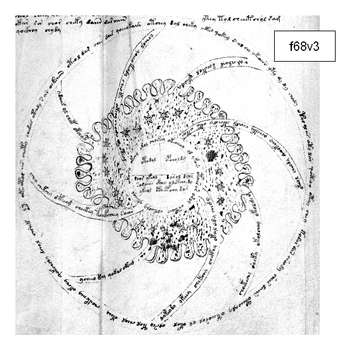
As evidence of this exceptional assertion, Newbold produced the Latin text which  he said was associated with a peculiar image in the manuscript:

The Latin decipherment Newbold associates with this diagram partially reads:

Vidi stellas in speculo concavo, in cochleae forma agglomeratas…

If my eyeballing of this snippet is correct, it reads: “In a concave mirror, I saw stars formed into the shape of a snail.” (That is, a spiral.) The rest of the passage makes this clear he is talking the Andromeda Galaxy:

Well, Holy Haleakala, Batman! Newbold pushed the history of the telescope back hundreds of years.

But, wait, there’s more! Bacon also invented the compound microscope, as evidenced by the images of what Newbold interpreted as ova and spermatozoa. (Not to mention the shorthand cipher itself, which could only be seen through a microscope.) The Voynich MS was the most important discovery in the history of science, and scholars generally accepted Newbold’s interpretation. Probably because nobody could understand his process of deciphering the manuscript.

In 1931, following Newbold’s death, John Matthews Manly wrote what should stand as one of the most thorough debunkings in the history of debunking, a spectacular and thorough treatment of Newbold’s assertions. He showed that the encryption that Newbold could not reliably generate text for the recipient. He illustrated that the cipher could achieve and had achieved “results” when applied to texts known not to be written by Bacon, to texts written long before the Voynich MS, and to mistranscriptions of the Voynich manuscript that Newbold used. In Newbold’s decipherments, sometimes the same passage revealed different messages. Manly demolished the content of the messages that Newbold had found to show that they could not square with what was known with the period. Newbold’s assertion defied even the laws of physics. Newbold apparently had simply shrugged off the objection that the Andromeda galaxy could not possibly have changed so radically in the time between the manuscript’s production and the 20th century. Also, he seemed not to worry that the spirals could not be seen by the naked eye even in a modern telescope–our images come from long exposures. It was in every way a thorough and complete trashing of the Newbold interpretation, and it left Newbold’s legacy in tatters. One may consider it a professional courtesy that Manly waited until Newbold had died before publishing his rebuttal.

It also meant that we had not progressed a single jot toward understanding what the heck this manuscript was.

As far as I can tell, the most interesting fabrication of Newbold’s mind was the secondary shorthand cipher. The little tails and swoops and signs that Newbold had found under a microscope were either clearly examples of ink bleeding into the cracks on the surface of the vellum and therefore meaningless, or they disappeared entirely when others looked at them. This strikes me as a close corollary to Lowell’s “discovery” of canals on Mars a few decades earlier, when the astronomer declared that he could see artificial channels on the surface of the Red Planet and spun a rather fanciful story to explain them. Turns out they weren’t there at all, but were artifacts of Lowell’s imagination.

By the way, I strongly recommend the conclusion of the Manly article as perhaps the epitome of the “don’t be a dick” school of skeptical criticism.

In the intervening years, a number of hypotheses have been floated about the content and meaning of the manuscript.In 1943, a bloke named O’Neill announced that he had deciphered the manuscript. In 1944, a botanist, James Feeley, have claimed that New World pepper plants and sunflowers appeared in the manuscript, which would place the manuscript after 1492. But even these botanical identifications are dubious, especially in the light of the vellum’s carbon-dating.

Without a doubt, my favorite “translation” appeared in Science in 1945, and it underlines why specialists in the humanities should be given their due respect. It came from Leonell C. Strong, who said that he had finally, really, actually cracked the code, but because of the current state of war, thought it was an inopportune time to reveal how he had uncovered its cryptological secrets (ahem, yeah). Voynich, Strong claimed, was written by 16th-century astrologer Anthony Askham. Most of the manuscript, he reported, discussed “the effects of plants on physiological processes in health and disease, especially, the diseases of women, and a conception of pre-Harveian generation and parturition” (608).

The cipher translated into something called “Medieval English,” which reads like: “When skuge uf tun’c-bag rip, seo oogon kum sli of se mosure-issue ped-stans sku-bent, stokked kimbo-elbow crawknot.” This passage, he says, is about the birth of a baby: “when the contents of the womb rip, the child comes slyly from the mother-issuing with the leg stance scewed and bent, while the arms, are knotted (above the head) like the legs of a crawfish.” I can’t imagine that anyone with a postgraduate degree in English at the time (Old English and history of English were still generally required graduate courses) did not howl with laughter when they read the “Medieval English.” It looks like it wants to be “Old English”: for instance, the “seo” is a feminine form for “that” and there are some…compound-y words. Unfortunately, it has the letter “k,” not found in Old English (you’d see it Old Norse), and words like “issue” that seem to be from a romance language. And it’s nothing like Middle English either. And what the hell’s up with that apostrophe? Strong further claimed that Ascham knew about antibiotics!

A group of cryptographers waiting to be released from the military after the Second World War spent their free time trying to decipher the sucker. I even found a reference to a report produced by the NSA on the shelves at Emory, but when I went to pull it, the report had mysteriously disappeared. Others have seen it, however, and report that the NSA was unable to crack the cipher. Take that, NSA! (Please don’t hurt me.)

A 2007 analysis of the characters by theoretical physicist Andreas Schinner suggests that the manuscript has been “generated by a stochastic (random) process rather than by encoding of encryption of language.” Damn it.

Nonetheless, crafty science types at the University of Arizona have at least pinned down the age of the vellum (which is slightly different from pinning down the age of the manuscript). The critters that died to make the MS snuffed it in the early 15th century. In the release at physorg.com, the author says that the writing doesn’t “resemble anything written–or read–by human beings.” This statement seems to have lead the imaginative author at ATS to a new hypothesis–aliens wrote it!

On vellum.

In the 15th century.

The poor guy writes, referring to the “galaxy” image above: “I will start with the picture that shocked me the most. To me, this is on par with the Sumerians knowing things they should not have been able to.”

Sigh. Me too, my friend. Me too.

RJB

References:

Kennedy, Gerry and Rob Churchill. The Voynich Manuscript: The Unsolved Riddle of an Extraordinary Book Which Has Defied Interpretation for Centuries. London: Orion, 2005.

Manly, John Matthews. “Roger Bacon and the Voynich MS.” Speculum 6.3 (1931): 345-391.

Schinner, Andreas. “The Voynich Manuscript: Evidence of the Hoax Hypothesis.” Cryptologia 31 (2007): 95-107.

Strong, Leonell C. “Anthony Askham, the Author of the Voynich Manuscript.” Science 101.2633 (15 June 1945): 608-609.

Zimansky, Curt A. “William F. Friedman and the Voynich Manuscript.” Philological Quarterly 49.4 (Oct 1970): 433-443.


National Commission on the Humanities Formed

February 18, 2011

The humanities have a hard time getting respect, if by respect you mean funding. Sure, we’re (often) the ones teaching the basic research, thinking and documentation skills that underpin the rest of a valuable education…blah blah whine. I often think that popular apathy toward the humanities, especially literature and cultural criticism, stems from the topics to which we choose to apply those important, cross-disciplinary skills. That is to say, that students often resent, say, that we are looking at the business culture of the Renaissance or the works of Theodore Dreiser or 17th-century Norwegian mysticism or whatever. Yes, these are the topics that float the boat of the instructor, who has devoted his or her life to the study of these topics. I know that I picked my areas of study, war and literature and extraordinary claims because I’m fascinated about them, but I certainly do not expect my students to love those topics with the myopic, passionate intensity that I devote to them. At the same time, however, I expect them to recognize that the research practices, habits of thought and underlying curiosity I bring to the study of, say, conspiracy theory, has value in all areas of education.

The incessant beating that the humanities seem to get as university budgets shrink fundamentally undermine the mission of the university. We’re not trying to crank out people as effete, feckless and dull as we are. We’re trying to arm our students with the ability to become self-directed, fulfilled, lifelong learners, as well as college students worth bragging about.

A number of muckety-mucks from Research-1 institutions are pooling their brainpower to give the humanities a boost, according to the Chronicle. This is swell and all, but I agree with the first comment that other types of schools need to be represented. I have a feeling that the smart students are the ones who are going to be taking their core courses, including the core humanities courses, at less expensive institutions of higher ed before moving on to the R1s. Their instructors will be a part of the field and should be included.

Thus ends my mid-afternoon proclamation. Perhaps I will see folks tonight at Virtual Drinking Skeptically? http://virtualds.org/ I think Eve will be participating as well.

RJB


Shakespeare and Skeptoid

February 8, 2011

In a recent episode of Skeptoid, Brian Dunning answered questions from students around the world. One student, Stephen from California, asked Dunning’s opinion about the Shakespeare authorship question. Briefly, Dunning concludes that “all available evidence supports Shakespeare as a real living author, and the only support for the opposing viewpoint is supposition.” He also notes that the authorship question “may be worthy of its own complete Skeptoid episode.”

I agree with Dunning’s conclusions, and think Shakespeare does warrant an episode to himself. If Dunning does choose to devote an episode to the authorship question, however, I hope he does better research and uses better sources than he did in this episode. The two sources he cites in this episode are from those two great literary heavyweights, Scientific American and physorg.com*. Why must skeptics appeal to science even when discussing the humanities? The Scientific American article was written by Michael Shermer, who has a Bachelor’s degree in Psychology/Biology, a Master’s in Experimental Psychology and a Ph.D. in the History of Science. He also seems to want to make history into a science: “But reasonable doubt should not cost an author his claim, at least not if we treat history as a science instead of as a legal debate.” He was responding to former Supreme Court Justice John Paul Stevens’ use of legalese in making his argument for the Earl of Oxford. But history is neither of these: it is its own field with its own methods and standards for scholarship. It may be messier than science and more open to interpretation, but that is largely unavoidable. It can’t be fixed by trying to make it into a science.

In introducing the physorg.com article, Dunning says:

Perhaps the most compelling reason to accept Shakespeare as the real author is his unique and recognizable writing style, which does not match that of the authors to which his works have been attributed by doubters. And this is not merely an unreliable, subjective opinion: It’s backed by hard science.

Again there is a suggestion that the humanities are only trustworthy when science is involved. Of course science can be a useful tool in literary studies. In this case, literary scholars used computational stylistics to detect Shakespeare’s hand in various works. That is to say, they used a computer program to compare Shakespeare’s diction, syntax, etc. to other writers from the period. For instance, a scholar would look at a work whose authorship is disputed and use the computer program to compare it to works by many different authors. The frequency with which certain typical features of a certain author appear in the disputed work suggests a likely attribution.

Obviously, a computer can sift through a huge amount of data at great speed. Still, it builds on work done for years by literary scholars who have painstakingly studied the language and usage of Shakespeare and his contemporaries. In addition, it is wildly optimistic to assume that such computer analyses will actually settle many questions. Someone else is bound to say, “Oh yeah, well my computer program said Shakespeare wrote this unattributed play.” Indeed, some of the conclusions drawn by the group headed by Arthur F. Kinney, director of the Massachusetts Center for Renaissance Studies at UMass Amherst, have already been questioned.  Kinney, for example, claims in the article cited by Dunning: “I have now proven that Shakespeare is part-author of Arden of Faversham. They guessed that in the 19th century but no one would believe it in the 20th century. Now we know.” He makes this argument at greater length in Shakespeare, Computers and the Mystery of Authorship. Sir Brian Vickers, however, has argued, based on his own computer analysis of the play, that Thomas Kyd is the sole author.**

Based on the thumbnail descriptions of studies in the physorg.com article, some of the conclusions just seem…odd. For instance, in regard to the play Sir Thomas More, we learn that

Timothy Watt at last proved that Hand D in the manuscript of a play called The Book of Sir Thomas More is Shakespeare’s own handwriting and so extends examples of his writing past the seven signatures which alone have been attributed to him.

In the first place, there are only six signatures that are more or less universally regarded as genuinely Shakespearean (I assume the seventh refers to a copy of William Lambarde’s Archaionomia. If that signature were considered genuine, it would prove that Shakespeare did indeed own at least one book. Although a number of eminent scholars have accepted the signature as likely genuine, the attribution is still in question). Moreover, how could a computer program that evaluates authors’ styles conclude that the passage was in Shakespeare’s handwriting? It seems, based on the article in Computers, Shakespeare and the Mystery of Authorship, that Watt concluded that Shakespeare was the author of the Hand D passage. At the end of the article, Watt argues that “[s]ince the nature of the manuscript indicates an author at work–correcting and amending along the way–rather than a scribe making a fair copy,” if Shakespeare is the author of the passage, it logically must be in his hand. In other words, the handwriting isn’t being used as evidence of Shakespeare’s authorship; Shakespeare’s authorship is used as evidence of his handwriting. At any rate, the study has not quelled questions about Sir Thomas More.

Another assertion in the physorg.com article concerns one of Shakespeare’s putative sources:

Kevin Petersen noted that although people think Shakespeare was influenced by Montaigne’s skepticism in his work from Richard II through Hamlet to The Tempest, and was the source of his skepticism in parts of many of his plays, in fact there is no indication of any Montaigne – in French or in the popular English translation.

This article did not make it into the book, so it is hard to judge. It is possible that the brief description misrepresents the argument, but, as stated, it just doesn’t make sense. In the first place, while many of Montaigne’s essays have been suggested as sources for Shakespeare, very few of them are widely accepted. Many of the most compelling arguments for Montaigne’s influence on Shakespeare concern The Tempest. In 1781, Edward Cappel suggested that Gonzalo’s “commonwealth” speech in Act 2, scene 1 of The Tempest very closely resembles a passage in John Florio’s 1603 translation of Montaigne’s “Of the Cannibals:”

I’ th’ commonwealth I would, by contraries,
Execute all things, for no kind of traffic
Would I admit; no name of magistrate;
Letters should not be known; riches, poverty,
And use of service, none; contract, succession,
Bourn, bound of land, tilth, vineyard, none;
No use of metal, corn or wine, or oil;
No occupation, all men idle, all;
And women too, but innocent and pure;
No sovereignty–
Seb.                                       Yet he would be king on’t.
Ant.  The latter end of his commonwealth forgets the beginning.
Gon.  All things in common nature should produce
Without sweat or endeavour. Treason, felony,
Sword, pike, knife, gun, or need of any engine
Would I not have; but nature should bring forth
Of it own kind all foison, all abundance,
To feed my innocent people.
Seb.  No marrying ‘mong his subjects?
Ant.  None, man, all idle–whores and knaves.
Gon.  I would with such perfection govern, sir,
T’ excel the golden age.  (2.1.145-66)

Here is Montaigne’s description of life among the Brazilian cannibals:

It is a nation…that hath no kind of traffic, no knowledge of letters, no intelligence of numbers, no name of magistrate nor of politic superiority, no use of service, of riches or of poverty, no contracts, no successions, no dividences, no occupation but idle, no respect of kindred but common, no apparel but natural, no manuring of lands, no use of wine, corn or metal. The very words that import lying, falsehood, treason, dissimulation, covetousness, envy, detraction, and pardon were never heard of amongst them. (“Of the Cannibals,” Bk 1, ch. 30 of The Essays by Michel de Montaigne, tr. by John Florio. Included in Orgel’s ed. of The Tempest, pp. 230-31)

No one claims that Shakespeare got his ideas for Gonzalo’s commonwealth from Montaigne–they were not original to Montaigne. It is the way those ideas are expressed: primarily in negatives. Neither Montaigne nor Shakespeare describes his Utopia in terms of what it is or what it has, but rather of what it is not and what it doesn’t have. In addition, many of the details are the same. And you do not need a computer program to point out the verbal parallels. Indeed, if a computer were to tell me that the verbal parallels did not exist, I’m afraid I would have to disbelieve it.

Computational stylistics is a useful tool, but it is naive to think that science can definitively answer questions that literary studies have failed to answer.  It can lend credence to arguments that Shakespeare had a hand in a particular work (or that a collaborator had a hand in a work generally attributed to Shakespeare alone), and it can question other attributions. It is less useful in the argument that Shakespeare wrote the works attributed to him. A particular disputed work, such as Arden of Faversham or Sir Thomas More, can be compared to Shakespeare’s acknowledged works, but when the entire corpus is disputed, to what can we compare it? One of the anti-Shakespeareans’ main arguments is that we have no works that can be definitively attributed to Shakespeare (this is not true, of course, but that’s the argument). Admittedly, we can compare “Shakespeare’s” works to those by Oxford, Bacon and Marlowe, but, with the exception of Marlowe, none of the main candidates wrote in the genres for which Shakespeare is known, which makes comparison more difficult. Not impossible, of course. Many idiosyncrasies are likely to be the same, regardless if the poet is writing drama or lyric poetry, but it’s certainly not going to be good enough to satisfy Oxfordians (not that anything is).

ES

*This article is taken word for word from a press release from the University of Massachusetts at Amherst.

**I have not yet read this article (I have ordered it from Inter-Library Loan), so I am basing my interpretation of it on second-hand accounts.

Further Reading:

Craig, Hugh and Arthur F. Kinney, eds. Shakespeare, Computers and the Mystery of Authorship. Cambridge UP, 2009.

Hodgen, Margaret. “Montaigne and Shakespeare Again,” Huntington Library Quarterly 16 (1952-53): 23-42.

Montaigne, Michel de. “Of the Cannibals.” The Essays. Tr. John Florio. 1603. Included in Orgel’s ed. of The Tempest, pp. 227-238).

Paster, Gail Kern. “Montaigne, Dido, and The Tempest: ‘How Came that Widow in?’” Shakespeare Quarterly 35 (1984): 91-94.

Prosser, Elaine. “Shakespeare, Montaigne, and the Rarer Action,” Shakespeare Studies 1 (1965): 261-64.

Shakespeare, William. The Tempest. Ed. Stephen Orgel. Oxford World’s Classics. Oxford UP, 1987.

Vickers, Brian. “Thomas Kyd, Secret Sharer.” Times Literary Supplement 18 Apr. 2008: 13-15.


The Week in Conspiracy (3 Feb 2011)

February 3, 2011

This weekend, I will be attending TruthCon, which brings together all sorts of energy healers and people interested in UFO disclosure and 9/11 conspiracy theorists and…oh, everything. It’s like a paradise for me and will likely be the most interesting conference I attend this year (all love to NeMLA and NECSS, btw!). Regardless, since I am going to be really busy this weekend, I thought I would write up the week that was weak a little early.

Forget two weeks ago. And last week. And three weeks ago. THIS week, without a doubt is the most important week in the history of the human species, if conspiracy theorists are right.

Conspiracy theory of the week:

Honorary conspiracy theory of the week:

Not a real conspiracy theory, but my brother totally got me with a facebook post about the GIGANTIC STORM OF DOOM (which, in the end, never materialized in St. Louis):

“NEWS FLASH!! Area Man Convinced Blizzard The Work Of Muslim Extremists: “I don’t know how exactly, but these fellas have found a way to manipulate our weather patterns. They really will stop at nothing to disrupt our American way of life.”

Well played, sir. Well played.

And that’s it for now, friends. I’m off into the breach!

RJB