Things that Went Bump in the Middle Ages (Part 1)

March 14, 2011

A few years ago, I used to frequent the Ghost Hunters discussion forum on Syfy.com. Many of the regular members were highly skeptical of TAPS and extremely good at analyzing questionable evidence from the program. As one might expect, however, most of the members believed in ghosts or at least believed that it was plausible that ghosts could exist. One of the reasons given for this belief was the ubiquity of ghost stories. Even noted skeptic Alison Smith at one time thought the commonness of ghost stories was the most compelling evidence for ghosts:

To me, the best evidence for the existence of ghosts was the way they permeated every culture. They crept across the globe. If they didn’t exist, then why would so many vastly different cultures believe in them?

Or, as a believer puts it (warning: website is very colorful):

Ghost stories, whether modern or of old, all seem to tell similar stories about ghosts’ tragedies, unfinished business, unrest, visitations, and hopeless roamings among the living.  Ghost stories also sometimes share common ghostly messages of warning to aid those still alive, or tell of spirits with ill intentions, seeking revenge from those who wronged them in life.  Some ghost stories truly enlighten, while other ghost stories paint a picture of hell to frighten!

I understand this point of view to an extent, but I have always found that the history of ghost stories argues against the reality of ghosts because the ghosts tend to fit the culture from which they come. Ghosts and ghost stories change radically over time and from culture to culture.

To begin with, what is a ghost? If you ask the guys from Ghost Hunters, Ghost Adventures, Ghost Lab, Ghost Wranglers, Ghost Snatchers, World’s Deadliest Ghost Catches, Martha Stewart’s UnLiving, etc., they would probably say something vague about “energy.” This isn’t entirely surprising, since the culture modern ghost stories come from combines New Age and schmience, which vaguely resembles science, but not that much. Wikipedia offers a more traditional definition: “the soul or spirit of a deceased person or animal that can appear, in visible form or other manifestation, to the living.” Probably most people would agree that ghosts are insubstantial.

Now, there are already problems with this description. Often ghosts are visible, sometimes as shadows and sometimes as “full-body apparitions.” Sometimes they appear solid; sometimes they are transparent. Ghosts can often be heard speaking, whispering, laughing or breathing with non-existent vocal cords and lungs, although some of them only make themselves heard by imprinting their disembodied voices on recorders. Sometimes ghosts can interact with physical objects: they touch/brush against/push/attack people; they make knocking sounds; they throw things; they play with equipment. They can disappear and walk through walls, but they don’t generally sink through floors or the ground (unless they do so dramatically at a place of burial, for instance). Do they have mass or not? Are they bound by gravity or not? As far as I can tell, ghosts are bound by the laws of physics, sort of, except when they aren’t.

And that’s modern ghosts. What are we to make of medieval ghosts such as this one?

[In Berwick-upon-Tweed] a certain wealthy man who…had been given over to sinful behaviour, died  and was buried. However, with Satan’s help he kept emerging at night from his tomb and wandering here and there to the sound of loudly barking dogs. Every night he was the cause of great terror to townspeople before his return at daybreak to the tomb…. The simpler folk of the town feared that they might accidentally run into the lifeless creature and be physically attacked; the more thoughtful were afraid that, unless something were done quickly, the air circulating around the town would become infected by the corpse and so lead to general sickness and death in the town. It was apparent to all that something had to be done, and so they brought together ten sturdy young men who dug up the offending corpse, dismembered it and burnt the pieces in a fire. Once this had been done, the nightly perturbations ceased… (William of Newburgh, Historia Rerum Anglicarum, Joynes 98-99).

William tells several similar tales. One dead man “entered the bedchamber of his sleeping wife…[and] attempted to lie upon her in the marital bed” (Joynes 97). After his wife employed watchmen, he attempted to attack his brothers and “took to prancing among the animals in the byre” (Joynes 97).  In another case, “the doors of every house were bolted, and nobody dared go out to attend to any business from sunset to sunrise for fear of being attacked by the wandering monster. But even such a precaution…was useless, since, by the circulation of air poisoned and infected by the corpse, the neighbourhood became filled with the sick and the dying who had inhaled the pestilence” (Joynes 101). In three of the four cases, the haunting stops when the body is dismembered/beheaded and/or burned. In the fourth case, such treatment is suggested, but Bishop Hugh of Lincoln instead has a letter of absolution placed on the corpse’s chest.

Now you may be thinking, “That isn’t a ghost–that’s a vampire or something.” But how do we decide on the taxonomy of the undead? How do we decide who’s a ghost, who’s a vampire, who’s a zombie, who’s a revenant? Most of our ideas about these classifications are fairly modern and to some extent derived from literature and film. In earlier time periods, it’s more difficult to say who’s what among the undead. William of Malmesbury and Walter Map also mention walking corpses, and Old Norse sagas are full of them. Though in Norse there are several words for such creatures, the words are generally translated as “ghost.” These “ghosts” spread illness, but they also attack and kill animals and humans directly. Somewhat oddly, on the blurb on the back cover of Denton Fox and Hermann Pálsson’s  translation of Grettir’s Saga, the undead fought by the hero are called “wraiths,” which is an almost perfectly inaccurate description.

A writer known as the “Monk of Byland” lived in the same area as William of Newburgh around 200 years later. He tells a number of tales that resemble William’s. One concerns

James Tankerlay, the one-time Rector of Kereby….His spirit began to wander at night as far as Kereby, and one evening he gouged out the eye of his concubine who still lived there. It is said that the abbot and chapter had his body in its coffin dug out of the grave and that they ordered Roger Wayneman to convey it to Gormyre. When he was about to throw the coffin into the water, the oxen drawing his wagon panicked and were almost drowned with fear (Joynes 123).

Some of the “spirits” shape-shift into animal form, but it is clear that they are corporeal. While they sometimes jump on a living person, they are generally less dangerous than William’s ghosts. Most want to right a wrong and/or to receive absolution. By the time the Monk of Byland was active (end of the fourteenth century), the doctrine of Purgatory was widely known and accepted, and this helps to explain the differences between his tales and those of William, who was writing when the doctrine was still developing.

Indeed, Purgatory was a great boon for the medieval ghost story. According to Jean-Claude Schmitt,

[the Church’s influence] enabled an inculcation of the faithful with a religious morality centered on the notions of sin, penance, and salvation, culminating at the end of the twelfth century in the “birth of Purgatory.”  Henceforth all Christians could hope to be saved, but only under the condition that after death, they would undergo salutary punishments–the duration and the intensity of which depended…[in part] on the suffrages (masses, prayers, and almsgiving) undertaken by relatives and friends….Otherwise the dead person might appear to a relative or close friend to demand the suffrages needed…. Eager to support and organize the unity of the living and the dead, the church gladly repeated tales of ghosts (4).

Jaques Le Goff points out that

Purgatory would become the prison in which ghosts were normally incarcerated, though they might be allowed to escape now and then to briefly haunt those of the living whose zeal in their behalf was insufficient (82).

He further notes that Purgatory was popularized in part by ghost stories (177). The ghosts might warn loved ones to mend their ways or announce an imminent death. They might want their heirs to return stolen property. Increasingly, though, they asked/demanded that relatives pay for masses or prayers to be said for their souls. Coincidentally, many of these ghost stories came out of monasteries that had become, since the introduction of Purgatory, factories that manufactured masses and prayers for the dead. While these ghosts were generally a bit tamer than those described by William and the Byland monk, they sometimes still appeared corporeal, and sometimes they retained pagan aspects, as when they appeared in a Wild Hunt (Schmitt 115).

While modern ghosts may warn loved ones or attempt to right wrongs, they rarely ask for suffrages anymore. Another thing that sets medieval ghosts apart from modern ones is their lack of ambiguity. Whether they were corporeal or incorporeal, whether they wanted to beg forgiveness or kill loved ones, they didn’t seem to have difficulty making themselves known. They were visible; usually they were able to communicate clearly. People saw them, heard them and sometimes felt them. The reporters hardly ever say, “What was that? Did you hear that?” When the only way to record ghostly phenomena was with quill, ink and parchment, the ghosts were bold and clear. Now that plumbers are armed with a dazzling variety of video and audio recorders, as well as other magical ghost hunting devices, the ghosts have gotten much more shy.  Odd that.

ES

References:

Le Goff, Jaques. The Birth of Purgatory. Trans. Arthur Goldhammer. Univ. of Chicago Press, 1984.

Joynes, Andrew, comp. and ed. Medieval Ghost Stories: An Anthology of Miracles, Marvels and Prodigies. Woodbridge, Suffolk: Boydell, 2001.

Schmitt, Jean-Claude. Ghosts in the Middle Ages: The Living and the Dead in Medieval Society. Trans. Teresa Lavender Fagan. Univ. of Chicago Press, 1998.

Simpson, Jacqueline. “Repentant Soul or Walking Corpse? Debatable Apparitions in Medieval England.” Folklore 114 (2003): 389-402.


Hurrah for Dr. Madden!

March 8, 2011

Last night, when Eve brought this article to my attention, she asked, “Do you remember Tom Madden?”

I imagined John Madden. “Yeah.”

“You know he’s an expert on the Crusades?”

How nice for John Madden, I thought. “No.”

Sensing that something was wrong with my brain, Eve said, “Thomas Madden, from the SLU history department?”

“Oh, yeah, yeah.” I said. I think I covered myself pretty well.

Turns out a few years ago Dr. Madden wrote an article that appeared in the National Review, called “Not Dead Yet,” about the Naked Archaeologist’s The Lost Tomb of Jesus. Calling Simcha Jacobovici a “Naked Archaeologist,” mind you, is like calling me a “Bejeweled Pro Wrestler”–he is neither an archaeologist nor is he naked. “Fully Clothed Failure” seems more apt.

Regardless, it was published in March 2008 to commemorate the one-year anniversary of the release of the  Discovery Channel’s misguided airing of James Cameron’s goofy documentary, and it seems to fit within the scope of this site.

Enjoy!

RJB


Is the Voynich Manuscript the Product of an Alien Intelligence?

February 19, 2011

Of course the hell not, but by sticking to the evidence, I find myself regrettably unable to run out into the quad and shout: “IT’S A COOKBOOK! THE VOYNICH MANUSCRIPT IS A COOKBOOK!” Sticking to evidence, however, has never been the strength of the writers at Above Top Secret, which delivered a rather soggy excuse for a story entitled: “Voynich Manuscript–Diary of an Alien or a Mad Man? 100 Years Older than First Thought.”

Already wrong, but I’ll get there.

The Voynich Manuscript is a genuine mystery. Currently housed in Yale’s Beineke Library, the Voynich MS totally skipped my mind when I went up there to do research for my dissertation. Nonetheless, it is there, which has until recently been just about the only thing we’ve known for sure about it.

According to Curt A. Zimansky, writing in Philological Quarterly (before it went all corporate–haha), says that the manuscript was originally found in the library of Rudolph II and that it was in the possession of Father Athanasius Kircher in 1666. It then dropped out of sight for centuries, until it was acquired by a Polish bookseller named Voynich in 1912 during one of his book buying tours of Europe. The provenance of the manuscript is only certain, as far as I can tell, once it is in Voynich’s hands. He found it in a trunk at Villa Mondragone, in Frascatti. Upon Voynich’s death, it passed into the hands of Hans Kraus and eventually ended up at Yale.

It’s a beautiful book–nearly 250 vellum pages–an example of fine craftsmanship, beautiful and elegant and nobody has the faintest idea what the crap it says. You see, it is written in an unknown script in a language that does not seem to exist outside of the manuscript. Based on the illustrations that accompany the text, scholars have divided up the book into parts, including the herbal section, astrological section,  biological section, cosmological section, pharmaceutical section, and “recipes,” but really, we have no idea how closely the text corresponds to the images. But even with the, say, “herbal” sections, the plants that appear are unknown. As Voynich is reported to have asked, “WTF?”

A lot of people have stepped forward to offer their interpretations of the MS. The first person to attempt to answer the question was an otherwise reputable scholar at Penn by the name of Newbold.

In April 1921, Newbold announced that he had deciphered the Voynich MS. Hurrah! He said that it was a monograph written in a secret hand by Roger Bacon. Bacon was a 13th-century English monk and one of the first Europeans to embrace empiricism and experiment; and such he is considered a founding father of modern science. Hurrah!

Among the fantastic revelations that Newbold, uh, revealed, was that the manuscript was written in two codes. The first was a surface code, a Latin-text cipher. This cipher was so rife with arbitrary rules of substitution and anagrams that it could yield basically anything. The second cipher was a more subtle, much more interesting cipher, the shorthand cipher. The premise of this cipher was that tiny, literally microscopic strokes appeared on each character, and that a complete reading of this second, more secret text depended on deciphering these marks.

He revealed that the Voynich MS revealed the invention of the telescope in the 13th century! Doctor mirabilis!

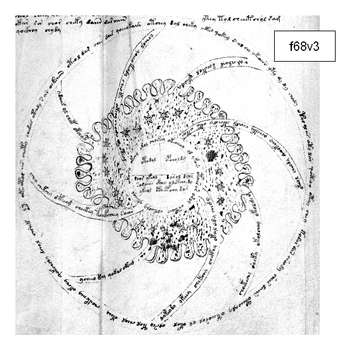
As evidence of this exceptional assertion, Newbold produced the Latin text which  he said was associated with a peculiar image in the manuscript:

The Latin decipherment Newbold associates with this diagram partially reads:

Vidi stellas in speculo concavo, in cochleae forma agglomeratas…

If my eyeballing of this snippet is correct, it reads: “In a concave mirror, I saw stars formed into the shape of a snail.” (That is, a spiral.) The rest of the passage makes this clear he is talking the Andromeda Galaxy:

Well, Holy Haleakala, Batman! Newbold pushed the history of the telescope back hundreds of years.

But, wait, there’s more! Bacon also invented the compound microscope, as evidenced by the images of what Newbold interpreted as ova and spermatozoa. (Not to mention the shorthand cipher itself, which could only be seen through a microscope.) The Voynich MS was the most important discovery in the history of science, and scholars generally accepted Newbold’s interpretation. Probably because nobody could understand his process of deciphering the manuscript.

In 1931, following Newbold’s death, John Matthews Manly wrote what should stand as one of the most thorough debunkings in the history of debunking, a spectacular and thorough treatment of Newbold’s assertions. He showed that the encryption that Newbold could not reliably generate text for the recipient. He illustrated that the cipher could achieve and had achieved “results” when applied to texts known not to be written by Bacon, to texts written long before the Voynich MS, and to mistranscriptions of the Voynich manuscript that Newbold used. In Newbold’s decipherments, sometimes the same passage revealed different messages. Manly demolished the content of the messages that Newbold had found to show that they could not square with what was known with the period. Newbold’s assertion defied even the laws of physics. Newbold apparently had simply shrugged off the objection that the Andromeda galaxy could not possibly have changed so radically in the time between the manuscript’s production and the 20th century. Also, he seemed not to worry that the spirals could not be seen by the naked eye even in a modern telescope–our images come from long exposures. It was in every way a thorough and complete trashing of the Newbold interpretation, and it left Newbold’s legacy in tatters. One may consider it a professional courtesy that Manly waited until Newbold had died before publishing his rebuttal.

It also meant that we had not progressed a single jot toward understanding what the heck this manuscript was.

As far as I can tell, the most interesting fabrication of Newbold’s mind was the secondary shorthand cipher. The little tails and swoops and signs that Newbold had found under a microscope were either clearly examples of ink bleeding into the cracks on the surface of the vellum and therefore meaningless, or they disappeared entirely when others looked at them. This strikes me as a close corollary to Lowell’s “discovery” of canals on Mars a few decades earlier, when the astronomer declared that he could see artificial channels on the surface of the Red Planet and spun a rather fanciful story to explain them. Turns out they weren’t there at all, but were artifacts of Lowell’s imagination.

By the way, I strongly recommend the conclusion of the Manly article as perhaps the epitome of the “don’t be a dick” school of skeptical criticism.

In the intervening years, a number of hypotheses have been floated about the content and meaning of the manuscript.In 1943, a bloke named O’Neill announced that he had deciphered the manuscript. In 1944, a botanist, James Feeley, have claimed that New World pepper plants and sunflowers appeared in the manuscript, which would place the manuscript after 1492. But even these botanical identifications are dubious, especially in the light of the vellum’s carbon-dating.

Without a doubt, my favorite “translation” appeared in Science in 1945, and it underlines why specialists in the humanities should be given their due respect. It came from Leonell C. Strong, who said that he had finally, really, actually cracked the code, but because of the current state of war, thought it was an inopportune time to reveal how he had uncovered its cryptological secrets (ahem, yeah). Voynich, Strong claimed, was written by 16th-century astrologer Anthony Askham. Most of the manuscript, he reported, discussed “the effects of plants on physiological processes in health and disease, especially, the diseases of women, and a conception of pre-Harveian generation and parturition” (608).

The cipher translated into something called “Medieval English,” which reads like: “When skuge uf tun’c-bag rip, seo oogon kum sli of se mosure-issue ped-stans sku-bent, stokked kimbo-elbow crawknot.” This passage, he says, is about the birth of a baby: “when the contents of the womb rip, the child comes slyly from the mother-issuing with the leg stance scewed and bent, while the arms, are knotted (above the head) like the legs of a crawfish.” I can’t imagine that anyone with a postgraduate degree in English at the time (Old English and history of English were still generally required graduate courses) did not howl with laughter when they read the “Medieval English.” It looks like it wants to be “Old English”: for instance, the “seo” is a feminine form for “that” and there are some…compound-y words. Unfortunately, it has the letter “k,” not found in Old English (you’d see it Old Norse), and words like “issue” that seem to be from a romance language. And it’s nothing like Middle English either. And what the hell’s up with that apostrophe? Strong further claimed that Ascham knew about antibiotics!

A group of cryptographers waiting to be released from the military after the Second World War spent their free time trying to decipher the sucker. I even found a reference to a report produced by the NSA on the shelves at Emory, but when I went to pull it, the report had mysteriously disappeared. Others have seen it, however, and report that the NSA was unable to crack the cipher. Take that, NSA! (Please don’t hurt me.)

A 2007 analysis of the characters by theoretical physicist Andreas Schinner suggests that the manuscript has been “generated by a stochastic (random) process rather than by encoding of encryption of language.” Damn it.

Nonetheless, crafty science types at the University of Arizona have at least pinned down the age of the vellum (which is slightly different from pinning down the age of the manuscript). The critters that died to make the MS snuffed it in the early 15th century. In the release at physorg.com, the author says that the writing doesn’t “resemble anything written–or read–by human beings.” This statement seems to have lead the imaginative author at ATS to a new hypothesis–aliens wrote it!

On vellum.

In the 15th century.

The poor guy writes, referring to the “galaxy” image above: “I will start with the picture that shocked me the most. To me, this is on par with the Sumerians knowing things they should not have been able to.”

Sigh. Me too, my friend. Me too.

RJB

References:

Kennedy, Gerry and Rob Churchill. The Voynich Manuscript: The Unsolved Riddle of an Extraordinary Book Which Has Defied Interpretation for Centuries. London: Orion, 2005.

Manly, John Matthews. “Roger Bacon and the Voynich MS.” Speculum 6.3 (1931): 345-391.

Schinner, Andreas. “The Voynich Manuscript: Evidence of the Hoax Hypothesis.” Cryptologia 31 (2007): 95-107.

Strong, Leonell C. “Anthony Askham, the Author of the Voynich Manuscript.” Science 101.2633 (15 June 1945): 608-609.

Zimansky, Curt A. “William F. Friedman and the Voynich Manuscript.” Philological Quarterly 49.4 (Oct 1970): 433-443.


Shakespeare and Skeptoid

February 8, 2011

In a recent episode of Skeptoid, Brian Dunning answered questions from students around the world. One student, Stephen from California, asked Dunning’s opinion about the Shakespeare authorship question. Briefly, Dunning concludes that “all available evidence supports Shakespeare as a real living author, and the only support for the opposing viewpoint is supposition.” He also notes that the authorship question “may be worthy of its own complete Skeptoid episode.”

I agree with Dunning’s conclusions, and think Shakespeare does warrant an episode to himself. If Dunning does choose to devote an episode to the authorship question, however, I hope he does better research and uses better sources than he did in this episode. The two sources he cites in this episode are from those two great literary heavyweights, Scientific American and physorg.com*. Why must skeptics appeal to science even when discussing the humanities? The Scientific American article was written by Michael Shermer, who has a Bachelor’s degree in Psychology/Biology, a Master’s in Experimental Psychology and a Ph.D. in the History of Science. He also seems to want to make history into a science: “But reasonable doubt should not cost an author his claim, at least not if we treat history as a science instead of as a legal debate.” He was responding to former Supreme Court Justice John Paul Stevens’ use of legalese in making his argument for the Earl of Oxford. But history is neither of these: it is its own field with its own methods and standards for scholarship. It may be messier than science and more open to interpretation, but that is largely unavoidable. It can’t be fixed by trying to make it into a science.

In introducing the physorg.com article, Dunning says:

Perhaps the most compelling reason to accept Shakespeare as the real author is his unique and recognizable writing style, which does not match that of the authors to which his works have been attributed by doubters. And this is not merely an unreliable, subjective opinion: It’s backed by hard science.

Again there is a suggestion that the humanities are only trustworthy when science is involved. Of course science can be a useful tool in literary studies. In this case, literary scholars used computational stylistics to detect Shakespeare’s hand in various works. That is to say, they used a computer program to compare Shakespeare’s diction, syntax, etc. to other writers from the period. For instance, a scholar would look at a work whose authorship is disputed and use the computer program to compare it to works by many different authors. The frequency with which certain typical features of a certain author appear in the disputed work suggests a likely attribution.

Obviously, a computer can sift through a huge amount of data at great speed. Still, it builds on work done for years by literary scholars who have painstakingly studied the language and usage of Shakespeare and his contemporaries. In addition, it is wildly optimistic to assume that such computer analyses will actually settle many questions. Someone else is bound to say, “Oh yeah, well my computer program said Shakespeare wrote this unattributed play.” Indeed, some of the conclusions drawn by the group headed by Arthur F. Kinney, director of the Massachusetts Center for Renaissance Studies at UMass Amherst, have already been questioned.  Kinney, for example, claims in the article cited by Dunning: “I have now proven that Shakespeare is part-author of Arden of Faversham. They guessed that in the 19th century but no one would believe it in the 20th century. Now we know.” He makes this argument at greater length in Shakespeare, Computers and the Mystery of Authorship. Sir Brian Vickers, however, has argued, based on his own computer analysis of the play, that Thomas Kyd is the sole author.**

Based on the thumbnail descriptions of studies in the physorg.com article, some of the conclusions just seem…odd. For instance, in regard to the play Sir Thomas More, we learn that

Timothy Watt at last proved that Hand D in the manuscript of a play called The Book of Sir Thomas More is Shakespeare’s own handwriting and so extends examples of his writing past the seven signatures which alone have been attributed to him.

In the first place, there are only six signatures that are more or less universally regarded as genuinely Shakespearean (I assume the seventh refers to a copy of William Lambarde’s Archaionomia. If that signature were considered genuine, it would prove that Shakespeare did indeed own at least one book. Although a number of eminent scholars have accepted the signature as likely genuine, the attribution is still in question). Moreover, how could a computer program that evaluates authors’ styles conclude that the passage was in Shakespeare’s handwriting? It seems, based on the article in Computers, Shakespeare and the Mystery of Authorship, that Watt concluded that Shakespeare was the author of the Hand D passage. At the end of the article, Watt argues that “[s]ince the nature of the manuscript indicates an author at work–correcting and amending along the way–rather than a scribe making a fair copy,” if Shakespeare is the author of the passage, it logically must be in his hand. In other words, the handwriting isn’t being used as evidence of Shakespeare’s authorship; Shakespeare’s authorship is used as evidence of his handwriting. At any rate, the study has not quelled questions about Sir Thomas More.

Another assertion in the physorg.com article concerns one of Shakespeare’s putative sources:

Kevin Petersen noted that although people think Shakespeare was influenced by Montaigne’s skepticism in his work from Richard II through Hamlet to The Tempest, and was the source of his skepticism in parts of many of his plays, in fact there is no indication of any Montaigne – in French or in the popular English translation.

This article did not make it into the book, so it is hard to judge. It is possible that the brief description misrepresents the argument, but, as stated, it just doesn’t make sense. In the first place, while many of Montaigne’s essays have been suggested as sources for Shakespeare, very few of them are widely accepted. Many of the most compelling arguments for Montaigne’s influence on Shakespeare concern The Tempest. In 1781, Edward Cappel suggested that Gonzalo’s “commonwealth” speech in Act 2, scene 1 of The Tempest very closely resembles a passage in John Florio’s 1603 translation of Montaigne’s “Of the Cannibals:”

I’ th’ commonwealth I would, by contraries,
Execute all things, for no kind of traffic
Would I admit; no name of magistrate;
Letters should not be known; riches, poverty,
And use of service, none; contract, succession,
Bourn, bound of land, tilth, vineyard, none;
No use of metal, corn or wine, or oil;
No occupation, all men idle, all;
And women too, but innocent and pure;
No sovereignty–
Seb.                                       Yet he would be king on’t.
Ant.  The latter end of his commonwealth forgets the beginning.
Gon.  All things in common nature should produce
Without sweat or endeavour. Treason, felony,
Sword, pike, knife, gun, or need of any engine
Would I not have; but nature should bring forth
Of it own kind all foison, all abundance,
To feed my innocent people.
Seb.  No marrying ‘mong his subjects?
Ant.  None, man, all idle–whores and knaves.
Gon.  I would with such perfection govern, sir,
T’ excel the golden age.  (2.1.145-66)

Here is Montaigne’s description of life among the Brazilian cannibals:

It is a nation…that hath no kind of traffic, no knowledge of letters, no intelligence of numbers, no name of magistrate nor of politic superiority, no use of service, of riches or of poverty, no contracts, no successions, no dividences, no occupation but idle, no respect of kindred but common, no apparel but natural, no manuring of lands, no use of wine, corn or metal. The very words that import lying, falsehood, treason, dissimulation, covetousness, envy, detraction, and pardon were never heard of amongst them. (“Of the Cannibals,” Bk 1, ch. 30 of The Essays by Michel de Montaigne, tr. by John Florio. Included in Orgel’s ed. of The Tempest, pp. 230-31)

No one claims that Shakespeare got his ideas for Gonzalo’s commonwealth from Montaigne–they were not original to Montaigne. It is the way those ideas are expressed: primarily in negatives. Neither Montaigne nor Shakespeare describes his Utopia in terms of what it is or what it has, but rather of what it is not and what it doesn’t have. In addition, many of the details are the same. And you do not need a computer program to point out the verbal parallels. Indeed, if a computer were to tell me that the verbal parallels did not exist, I’m afraid I would have to disbelieve it.

Computational stylistics is a useful tool, but it is naive to think that science can definitively answer questions that literary studies have failed to answer.  It can lend credence to arguments that Shakespeare had a hand in a particular work (or that a collaborator had a hand in a work generally attributed to Shakespeare alone), and it can question other attributions. It is less useful in the argument that Shakespeare wrote the works attributed to him. A particular disputed work, such as Arden of Faversham or Sir Thomas More, can be compared to Shakespeare’s acknowledged works, but when the entire corpus is disputed, to what can we compare it? One of the anti-Shakespeareans’ main arguments is that we have no works that can be definitively attributed to Shakespeare (this is not true, of course, but that’s the argument). Admittedly, we can compare “Shakespeare’s” works to those by Oxford, Bacon and Marlowe, but, with the exception of Marlowe, none of the main candidates wrote in the genres for which Shakespeare is known, which makes comparison more difficult. Not impossible, of course. Many idiosyncrasies are likely to be the same, regardless if the poet is writing drama or lyric poetry, but it’s certainly not going to be good enough to satisfy Oxfordians (not that anything is).

ES

*This article is taken word for word from a press release from the University of Massachusetts at Amherst.

**I have not yet read this article (I have ordered it from Inter-Library Loan), so I am basing my interpretation of it on second-hand accounts.

Further Reading:

Craig, Hugh and Arthur F. Kinney, eds. Shakespeare, Computers and the Mystery of Authorship. Cambridge UP, 2009.

Hodgen, Margaret. “Montaigne and Shakespeare Again,” Huntington Library Quarterly 16 (1952-53): 23-42.

Montaigne, Michel de. “Of the Cannibals.” The Essays. Tr. John Florio. 1603. Included in Orgel’s ed. of The Tempest, pp. 227-238).

Paster, Gail Kern. “Montaigne, Dido, and The Tempest: ‘How Came that Widow in?’” Shakespeare Quarterly 35 (1984): 91-94.

Prosser, Elaine. “Shakespeare, Montaigne, and the Rarer Action,” Shakespeare Studies 1 (1965): 261-64.

Shakespeare, William. The Tempest. Ed. Stephen Orgel. Oxford World’s Classics. Oxford UP, 1987.

Vickers, Brian. “Thomas Kyd, Secret Sharer.” Times Literary Supplement 18 Apr. 2008: 13-15.


The Week in Conspiracy (3 Feb 2011)

February 3, 2011

This weekend, I will be attending TruthCon, which brings together all sorts of energy healers and people interested in UFO disclosure and 9/11 conspiracy theorists and…oh, everything. It’s like a paradise for me and will likely be the most interesting conference I attend this year (all love to NeMLA and NECSS, btw!). Regardless, since I am going to be really busy this weekend, I thought I would write up the week that was weak a little early.

Forget two weeks ago. And last week. And three weeks ago. THIS week, without a doubt is the most important week in the history of the human species, if conspiracy theorists are right.

Conspiracy theory of the week:

Honorary conspiracy theory of the week:

Not a real conspiracy theory, but my brother totally got me with a facebook post about the GIGANTIC STORM OF DOOM (which, in the end, never materialized in St. Louis):

“NEWS FLASH!! Area Man Convinced Blizzard The Work Of Muslim Extremists: “I don’t know how exactly, but these fellas have found a way to manipulate our weather patterns. They really will stop at nothing to disrupt our American way of life.”

Well played, sir. Well played.

And that’s it for now, friends. I’m off into the breach!

RJB


The Dark Ages Conspiracy

February 1, 2011

Medievalists tend to go a bit twitchy when we hear the term “the Dark Ages.” Frankly, “Middle Ages” isn’t great either–a whole time period defined for eternity as “the boring bit between those two nifty eras, the Classical Age and the Renaissance.” It’s as if it was just a centuries-long place holder between great flowerings of culture. The “Dark Ages” is worse still, suggesting that the whole period (whether the term is used to refer to the entire medieval period or only the early Middle Ages) was dreary, dreadful and intellectually and culturally bereft. Many medievalists avoid the term and prefer terms such as “the early Middle Ages” and “the High Middle Ages.” Fortunately, there is no middle Middle Ages.

As I have mentioned previously, I have been reading Holy Blood, Holy Grail. As a result, I have been almost entirely drained of the will to live. Occasionally, I will read a sentence which almost makes sense, but generally the authors snatch nonsense from the jaws of sense. A case in point: at the beginning of their discussion of the Merovingian dynasty, they note that this was “probably the most impenetrable period of what are now called the Dark Ages. But the Dark Ages, we discovered, had not been truly dark.” Aha! I thought, at least they have the sense to realize that characterizations of the early Middle Ages are unfair and inaccurate. “On the contrary,” they continue, “it quickly became apparent to us that somebody had deliberately obscured them” (234).

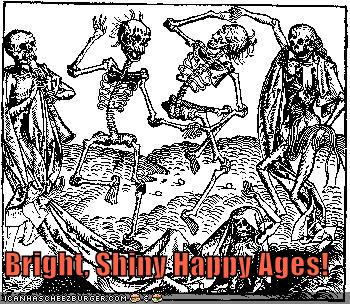
Wait, what? There was a conspiracy against the Dark Ages? I knew it! I’ll bet it was those filthy, stinking Renaissancers (and really, they were just as unwashed and smelly as medieval folk). Probably it was originally called the Bright, Shiny Happy Ages until those fops in ruffs showed up and “deliberately obscured them.” Oh, and by the way, the Black Death? Really just an outbreak of sniffles.


Dear Wikipedia, If You’re Going to Plagiarize…

January 26, 2011

Wikipedia takes a lot of heat. People enjoy complaining about it. Some argue that it is biased one way or another, just ask Conservapedia. A more serious complaint concerns its accuracy: since anyone can edit it, mistakes, jokes and lies inevitably sneak in.

Personally, I love Wikipedia: I want to marry it and have its children. It’s a great resource. If you want to find out some information about…almost anything really, and you want to do it quickly, Wikipedia is a useful place to start. Yes of course one must look at it carefully and skeptically, and one would probably want to verify most information before relying on it. But, hey, what’s that there at the bottom of the page? Is it a list of footnotes and sources? Yes, it is! Yee haw! Wikipedia also does a good job of flagging problems, such as a lack of citations, apparent bias and the presence of weasel words.

So, if used with care, it’s a good resource. It’s not a good source, however. I discourage students from citing it in papers for a number of reasons. For one thing, the content is constantly in flux: information that was there when a student wrote a paper may be gone by the time someone else reads the paper. And, of course, dubious content may be hiding among the reliable and verifiable information.

There are other problems as well. A few years ago, I was looking for some basic information on Francis Beaumont (I think it was he; the entry has changed, of course). I found what I was looking for, but the entry sounded very strange. When I reached the end, I realized why: there was a notice saying it had come from an edition of the Encylopedia Britannica that was no longer in copyright. There’s nothing wrong with that: it’s not plagiarism, and it’s not copyright infringement. It is, however, very old and out-of-date information. If I recall correctly, the entry had been written by Algernon Charles Swinburne. More recently, I have seen entries that apparently “incorporate” material from works no longer in copyright. This is even worse. How would you cite such an entry? You should cite the original source, but which bits come from the original source?

Another problem is plagiarism. The internet is rife with plagiarism. You can find the same phrase/sentence/paragraph/passage/entire article repeated over and over and over, often with the same typos. It can be virtually impossible to track down the original. Oh, in some cases Blogger A will properly cite his immediate source (Blogger B), but chances are that that isn’t the original, and Blogger B simply copy and pasted from somewhere else, without mentioning her source. Quite frequently, the repeated passage can be found somewhere on Wikipedia. I have always suspected that Wikipedia is usually the ultimate source of the plagiarized versions. I still believe that it often is, but occasionally, Wikipedia may include plagiarized material as well.

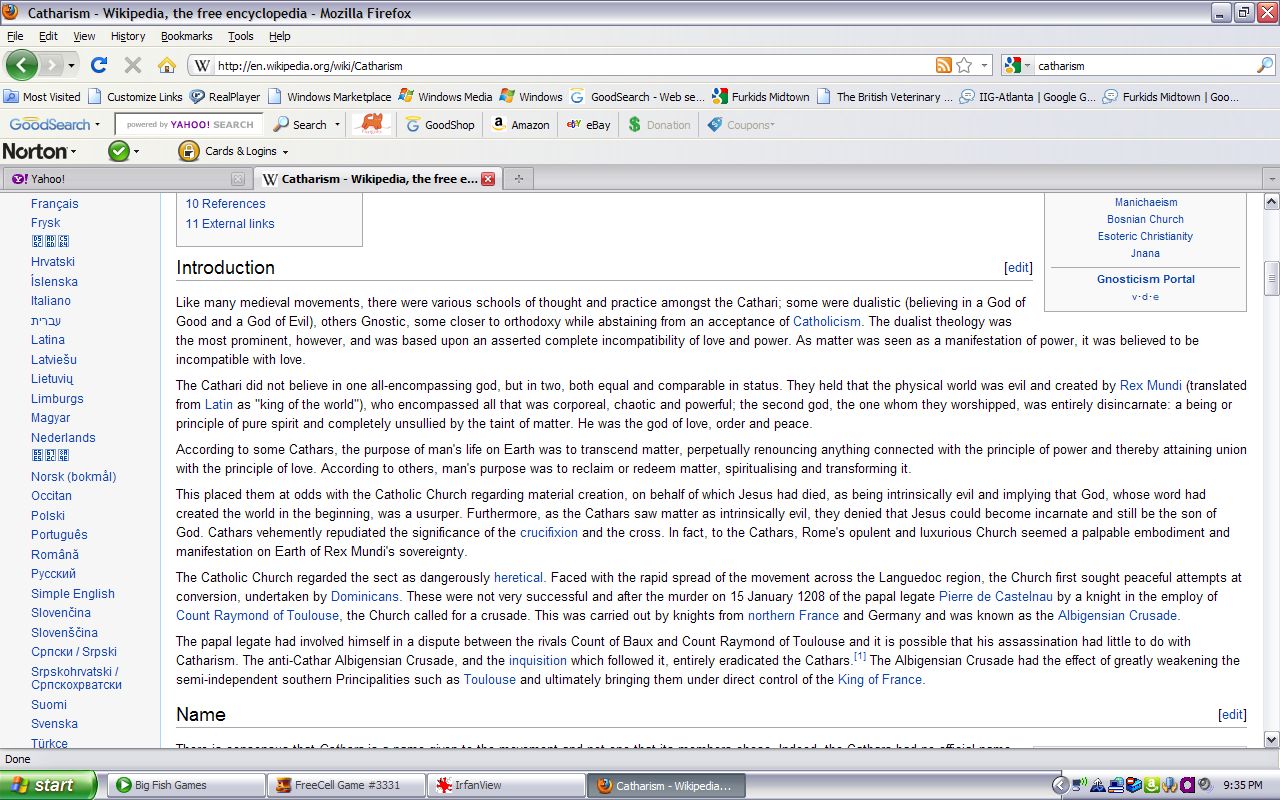
Case in point: I have been reading Holy Blood, Holy Grail by Michael Baigent, Richard Leigh and Henry Lincoln (I am doing this, dear Reader, so you don’t have to). I spend about an hour reading the book and noting the many dubious claims. Then I spend several hours looking up the dubious claims. Then I bang my head a hard surface for a bit. Then I sit quietly petting a cat until I feel calmer. During the looking-up-dubious-claims phase, I often find myself drawn to Wikipedia. It’s certainly better than the conspiracy sites that either believe and repeat everything in Holy Blood, Holy Grail or think that HB,HG is just a smokescreen for a different conspiracy. Generally, I have found Wikipedia a good place to begin, and I use the footnotes/list of sources to follow up what I find there. But when I looked up Catharism, I found this:

This is the passage in question:

The dualist theology was the most prominent, however, and was based upon an asserted complete incompatibility of love and power. As matter was seen as a manifestation of power, it was believed to be incompatible with love.

The Cathari did not believe in one all-encompassing god, but in two, both equal and comparable in status. They held that the physical world was evil and created by Rex Mundi (translated from Latin as “king of the world”), who encompassed all that was corporeal, chaotic and powerful; the second god, the one whom they worshipped, was entirely disincarnate: a being or principle of pure spirit and completely unsullied by the taint of matter. He was the god of love, order and peace.

According to some Cathars, the purpose of man’s life on Earth was to transcend matter, perpetually renouncing anything connected with the principle of power and thereby attaining union with the principle of love. According to others, man’s purpose was to reclaim or redeem matter, spiritualising and transforming it.

This placed them at odds with the Catholic Church regarding material creation, on behalf of which Jesus had died, as being intrinsically evil and implying that God, whose word had created the world in the beginning, was a usurper. Furthermore, as the Cathars saw matter as intrinsically evil, they denied that Jesus could become incarnate and still be the son of God. Cathars vehemently repudiated the significance of the crucifixion and the cross. In fact, to the Cathars, Rome’s opulent and luxurious Church seemed a palpable embodiment and manifestation on Earth of Rex Mundi’s sovereignty.

Oooh, deja vu! Hadn’t I just read that somewhere? Oh, yeah, here:

But the Cathars carried this dichotomy much further than orthodox Catholicism was prepared to…. For the Cathars a perpetual war was being waged throughout the whole of creation between two irreconcilable principles–light and darkness, spirit and matter, good and evil. Catholicism posits one supreme God, whose adversary, the Devil, is ultimately inferior to Him. The Cathars, however, proclaimed the existence not of one god, but of two with more or less comparable status. One of these gods–the “good” one–was entirely discarnate, a being or principle of pure spirit, unsullied by the taint of matter. He was the god of love. But love was deemed wholly incompatible with power; and material creation was a manifestation of power. Therefore, for the Cathars, material creation–the world itself–was intrinsically evil. All matter was intrinsically evil. The universe, in short, was the handiwork of a “usurper god,” the god of evil–or, as the Cathars called him, “Rex Mundi,” ” “King of the World.”

….According to some Cathars the purpose of man’s life on earth was to transcend matter, to renounce perpetually anything connected with the principle of power, and thereby to attain union with the principle of love. According to other Cathars man’s purpose was to reclaim and redeem matter, to spiritualize and transform it….

In the eyes of the Roman Church the Cathars were committing serious heresies in regarding material creation, on behalf of which Jesus had supposedly died, as intrinsically evil and implying that God, whose “Word” had created the world “in the beginning,” was a usurper. Their most serious heresy, however, was their attitude toward Jesus himself. Since matter was intrinsically evil, the Cathars denied that Jesus could partake of matter, become incarnate in the flesh, and still be the Son of God….

In any case, all Cathars vehemently repudiated the significance of  both the Crucifixion and the cross….And…Rome, whose opulent, luxurious Church seemed to the Cathars a palpable embodiment and manifestation on earth of Rex Mundi’s sovereignty. (Holy Blood, Holy Grail, New York: Bantam-Dell, 1982, pp. 53-54)

This portion of the Wikipedia entry clearly seems to be a condensed version of the material in HB,HG (the parts in red appear nearly word-for-word in Wikipedia). If I found this in a student paper, I would call it plagiarism, and there would be consequences. I should note that the information is not wrong: it is one of the longest passages I’ve come across in HB,HG so far (close to two pages) that hasn’t contained questionable information. Still, the borrowing serves as an example of why Wikipedia should be viewed with skepticism.

ES


FDR’s Paralysis: A Fortuitious Misdiagnosis?

January 21, 2011

A few days ago, an antivaxxer by the name Mayer Eisenstein made a comment that FDR may have gotten Guillain-Barre Syndrome (GBS) from a reaction to a flu shot. This, I found, is simply not possible because the first influenza vaccines were not available for far more than a decade after Roosevelt fell ill. So, big fake facts out of the big fake health guru.

Nonetheless, an interesting story lies behind Eisenstein’s painfully inaccurate mutterings. Roosevelt’s diagnosis of polio was made in 1921, after a string of misdiagnoses (the first doc said it was a bad cold, the second doc first diagnosed a blood clot in spine and then a lesion). The diagnosis that ultimately stuck is polio.

Several reasons appear responsible for the original diagnosis and why it remains a popular diagnosis today. First, Roosevelt fell ill in an era when polio was rampant, and several outbreaks had occurred in previous summers, mostly in cities. It’s a virus spread by interpersonal contact, either oral-oral or oral-fecal. Children are especially vulnerable. At the time FDR fell ill, polio was one of a fairly limited number of known diseases that caused flaccid paralysis, muscular weakening with no immediately obvious cause (like traumatic nerve damage).

After bouncing, metaphorically, from physician to physician, Roosevelt was diagnosed by Boston doctor Robert W. Lovett, who Pierce A. Grace describes “the leading American authority on polio.” He immediately diagnosed polio. It was a fairly late stage in the disease by this point, and he shortly thereafter began his slow recovery. I suspect that once his initial crisis had passed, the urgency of coming up with a diagnosis may have abated, but that’s speculation on my part.

Another factor that seems to have contributed to the story found in the biographies is the fact that on July 28, 13 days before he fell ill, Roosevelt had toured and visited a Boy Scout camp for disadvantaged city youth, something that Roosevelt delighted in. Historians have speculated, and this is the story that I was familiar with, that he contracted the disease while he was at the scouting event. I haven’t seen anything to suggest that there had been polio at the camp, but someone who is infected but not yet showing symptoms can be contagious. Regardless, it’s plausible that Roosevelt contracted polio at the camp, because the incubation period of the disease is between 3 and 35 days.

Other people have looked to the immense stress that Roosevelt had recently been under. He was in the middle of an especially saucy sex and vice scandal, in which a Senate Naval Affairs committee alleged that members of a vice-squad at a naval training facility under his command (and not necessarily AT his order) were reported to have engaged in sodomy while attempting to entrap homosexuals among recruits. Stress may leave people susceptible to infection, and perhaps there was a perfect storm of stress and filthy children that led to his contracting the disease, which was, after all fairly rare in adults.

And let’s not overlook FDR’s symptoms, the major one being progressive paralysis, which at its worst extended from his chest down and was ultimately permanent in his legs, accompanied by a fever (102 degrees). Marooned in a wheelchair for much of the rest of his life, Roosevelt certainly looked like a polio survivor (though remarkably few photos of the man in his wheelchair exist).

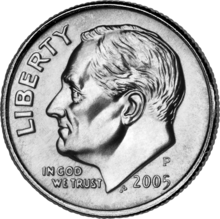
In the years following his disease, Roosevelt became an advocate of polio research and in 1938 founded the National Foundation for Infantile Paralysis, which became known as the March of Dimes and supported the development of Jonas Salk’s vaccine. As a sort of recognition of his association with that organization (in 1946, the “March of Dimes” was the group’s annual fundraiser), the disembodied head of FDR now graces the US dime:

See?

Regardless of what condition Roosevelt suffered, his name will always be closely associated with polio.

As best I can tell, a serious challenge has been raised to the diagnosis of
polio. Now, as historical questions go, this is not as pressing an issue as, say, “Did the Holocaust happen?” but it is an interesting question, the type of point that you could possibly argue on Jeopardy if the question they accept is, “What is polio?” Hey, that could be worth money.

Anyway, in 2003 the Journal of Medical Biography published an article by Goldman, Schmalstieg, Freeman, another Goldman and yet another Schmalstieg (apparently the University of Texas was suffering from an outbreak of Goldman-Schmalstieg in 2003). The article, “What was the cause of Franklin Delano Roosevelt’s paralytic illness?” The researchers looked at 11 features of the disease reported in FDR’s medical record. Then they did something called Bayesian Analysis, which as I understand it is a retrospective analysis of probability based on a subsequently established incidence rate (in this case of disease) in a population. So, they were asking questions like, “What is the relative probability that someone FDR’s age would have contracted polio versus GBS?” and “What is the relative probability that someone with polio would have fever versus someone with GBS?” (GBS, by the way, is a condition where the immune system, which has started fighting an infection, mistakenly starts to attack parts of the nervous system. Dr. House is always ruling it out.)

By comparing the features of FDR’s disease, the Goldman-Schmalstieg-infected Freeman makes a strong case that the GBS hypothesis is worth serious consideration (from Goldman):

Click to embiggen!

It really does seem as if most of FDR’s symptoms are most commonly associated with GBS. This is not, however, conclusive diagnostically. At the same time, it seems to me that a good Bayesian analysis would need to accurately determine the prevalence of the diseases and symptoms at the time, and I have no way of assessing that and still maintain a blog. The only way to do be sure of what Roosevelt had would be to tap his spine. Modern interventions gor GBS had not yet been developed, and the authors conclude that it is unlikely his treatment would have changed if FDR had a different diagnosis.

The nearly complete elimination of polio from the planet is a powerful testimony to the efficacy of vaccination, and one may wonder how the course of history might have been altered if Roosevelt’s intense interest in polio research had been redirected toward autoimmune disorder research. Whether he had it or not, FDR will always be closely associated with polio and the search for the cure.

RJB

References

Goldman, Armond, et al. “What Was the Cause of Franklin Delano Roosevelt’s Paralytic Illness?” Journal of Medical Biography 11.4 (2003): 232-240.

Grace, Pierce A. “With Reluctant Feet–The Story of FDR’s Struggle with Polio.” Journal of the Irish Colleges of Physicians and Surgeons 21.1 (1997): 58-61.


Antivaccine Rhetoric vs. History

January 17, 2011

Tonight, Mayer Eisenstein hosted a webinar (shudder) about vaccines. Ostensibly, the online event was to tell people how to write vaccine exemption letters. It was a Cirque du Soleil-sized extravaganza of clownishly sloppy logic and at-best-half-truths. I’ve watched some webinars before, and they are simply online Powerpoint presentations with audio. We see the speaker’s screen while they talk, and there is usually a chat room where the audience can interact. I have no idea how well attended Eisenstein’s event was, but it lasted for an hour and ended with about a 10-minute sales pitch for his miracle cure, Vitamin D, and his books.

The basic argument that Eisenstein was pushing was “use the religious protections provided by the First Amendment to justify vaccine exemption,” a cynical use of religion if I have ever seen one (and I’ve seen several). I thought that I would see how cynical he could possibly be, so in the chat room I asked, “Is there an option for atheists to claim religious objections?” Heehee.

His answer?

“I think all lawyers are atheists so [unintelligble] when they get in front of a jury they say, ‘I pray that the jury gives a verdict for me.’  Oh, or ‘I religiously believe that I believe this person is negligent or guilty.’ So I had a lawyer tell me that he felt the religious exemption had nothing to do with the belief in God, that a personal, specific religious belief–if you look up the word ‘religious,’ it’s very closely held position, uh, believing that there is some higher order or higher power, and you know, I think it’s close enough. If it’s not close enough for you, well, I’m not sure how you would go about it. Even if there’s a belief that there’s a natural order in the universe, that in itself is a religion. Don’t take the word religion to be so narrowly defined. Take a more, ah, expansive position.”

You could look at this answer in a couple of ways. The first way to see it as a string of loosely connected statements of a person on their way out, and while that is tempting, we do far more damage to the cause of public health when we underestimate our ideological adversaries. Even this guy.

But if you look at the underlying logical structure of that first part, he seems to be saying, “Well, atheist lawyers often pretend like they have religion to appeal to juries. Wink wink, nudge nudge.”

I am also bemused by the way he went straight to “negligent,” as his medical practice, according to the Chicago Tribune

“was on the losing side of one of the largest U.S. jury verdicts — $30 million — ever awarded to the family of a newborn in a wrongful-death suit.”

Anyway, then he tries on another fundamentally cockamamie argument, that “religion” doesn’t really mean “religion.” It really just means, “closely guarded belief.” This, of course, inflates the meaning of the word “religion” to almost complete uselessness: “Even if there’s a belief that there’s a natural order in the universe, that in itself is a religion.” Yeah, only if you are an intelligent design advocate, bucko. So sayeth the courts.

Despite his willingness to see the First Amendment misapplied, he did make some rather staggering comments that do fall directly under the purview of this new skeptical humanities site. He made a rather large claim when someone asked a question about diseases like polio:

“Well, that opens up a big can of worms. Because, I don’t want anyone to leave tonight saying Mayer Eisenstein isn’t worried about, uh, diseases. I’m more worried about…most doctors will scare you with the disease, I’m going to scare you with the side effects.”

Yeah, he actually said that. I know.

“We now know that we have had thousands and thousands of people die from contamination of the, of the, uh, polio vaccine. The polio vaccine, many of the doses were contaminated with SV40 virus, and I talk about it in my book, Making an Informed Vaccine Decision. […] Polio died out in Europe even in countries that didn’t give the polio vaccine, and the big push for the polio vaccine came with President Franklin Roosevelt who allegedly got polio as an adult. Allegedly. I’ve read some very credible reports that, um, he most probably had Guillain-Barré from the, um, Guillain-Barré from the flu vaccine, because, I don’t, I can’t remember, another adult who got polio. I’ve never seen it in almost 40 years in medicine. Now you know I came in a little bit after the adult era, but I should have seen, especially 35 and 40 years ago adults who contracted polio.”

Then he prattles on about what’s in vaccines, as if it helped his case.

Many of the assertions in this especially densely-packed drivel are historical questions. Take, for instance, his statement about the SV40 virus. According to the CDC, the Simian Virus was found in kidney cells of rhesus monkeys, which (I’m supposing) were used as a growth medium for attenuated polio virus in early polio vaccine. Quoth the CDC:

“More than 98 million Americans received one or more doses of polio vaccine during the period (1955–1963) when some of the vaccine was contaminated with SV40. SV40 has been found in certain types of human cancers, but it has not been determined that SV40 causes these cancers. The majority of evidence suggests there is no causal relationship between receipt of SV40-contaminated vaccine and cancer; however, some research results are conflicting and more studies are needed.”

Further, the contaminated strains have been yanked, and there has been no SV40 in polio vaccines since the early 1960s. I don’t know how he can say that deaths were caused by the presence of the virus in vaccines. Does he have access to research that the CDC doesn’t? Swing and a miss, Mayer.

The likelihood that a younger Mayer Eisenstein would likely have encountered a case of polio in the 1970s is also one that can be clarified by looking at history, again provided by the CDC:

There were usually about 13,000 to 20,000 cases of paralytic polio reported each year in the US before the introduction of Salk inactivated polio vaccine (IPV) in 1955. Polio peaked in 1952 when there were more than 21,000 reported cases. The number of cases of polio decreased dramatically following introduction of the vaccine and the development of a national vaccination program. In 1965, only 61 cases of paralytic polio were reported compared to 2,525 cases reported cases just five years earlier in 1960.

By the time Eisenstein graduated from short pants, the cases of paralytic polio were down to 61. The chances that he would have seen polio in the 1970s as a med student are vanishingly small. One interesting side note, Eisenstein mentioned over the course of the webinar that Amish kids don’t get autism, and he says it is because they don’t get vaccines. But they sure as hell got polio, as an Amish community hosted the last natural outbreak of polio in the US in 1979.  Strike two. No batter, no batter.

By far, my favorite assertion by Mayer was that FDR did not suffer from polio but Guillain-Barré syndrome brought on by flu vaccine.

I have access to a truly fantastic set of databases that I use in my research almost constantly. A source does exist that discusses the of FDR having Guilain-Barre, an article from 2003 in the Journal of Medical Biography by Armond Goldman, which according to the abstract:

“Posits that the conditions around the diagnosis of President Franklin Delano Roosevelt’s illness indicate that he likely suffered from Guillain-Barré syndrome, an autoimmune polyneuritis, rather than paralytic poliomyelitis.”

So, we have a retrospective study based on available historical documents at the Franklin D. Roosevelt Library and Museum, Hyde Park, New York, and the Francis A. Countway Library of Medicine. It’s possible, I imagine. However, I looked at 5 cross-disciplinary databases looking for “Roosevelt and Guillain-Barré” and found that all of the mentions of the hypothesis in the press were references to Goldman’s article. So, it’s nothing like the consensus view at this point. (I have ordered the article, however, and look forward to seeing it.)

We can, however, use history to completely demolish the boneheaded assertion that FDR got…whatever he had… from a flu vaccine, as he fell ill in August 1921. The first experimental influenza vaccine was developed in 1936, according to Stanley A. Plotkin, Walter A. Orenstein, and Paul A. Offit. Strike three, big guy. YEEEEEEEROUT!

History spanks cranky antivaxxers.

RJB

A note: I did subsequently find another reference to an article from the Journal of Medical Biography that suggests that Roosevelt may not have had polio (top of list), but diagnostically, I am told, we would need to see his spinal fluid to get a final answer about what caused his paralysis. Good luck with that.


Bug Girl reports on a different type of infestation…

January 12, 2011

If you visit Bug Girl’s Blog today, you’ll find a useful discussion about the Christian Identity movement, a peculiar racist subculture that holds the peculiar religious belief that the real Chosen People are America’s white males.

The Real Chosen People

The roots of this delusion can be traced back to beliefs that surfaced in England during the Empire, when believers saw their nation, as the colonial governor of Palestine, playing a special role in the fulfillment of divine revelation. This slightly patronizing view of Jews mutated in this country into the extremely racist theology that it is today. A great source on this uncanny evolution is Michael Barkun’s Religion and the Racist Right. I also recommend Chip Berlet’s extensive work on conspiracy and American politics.

RJB