WAR! Huh! Good god, y’all! What is it good for?

May 31, 2011

Growing your teaching portfolio, for one.

This semester, students in my 3 classes put together a website about World War II as experienced in Atlanta. They looked at Atlanta before, during and after the war, and we found that the war really shaped much of what Atlanta has become.

Behind the splash page, you’ll find that all of the groups have been named using the military alphabet of the day, because of my super cleverness. I need to work on that page, but other than that, it’s complete. I am immensely proud of so many students who worked very hard over the semester to produce a fantastic site.

http://wwii.lcc.gatech.edu

RJB


Cogito, ergo not ergotism: The Salem Witch Trials

May 19, 2011

After a grueling week of covering conspiracy theories, I thought that I would pick up a gauntlet not so much thrown down as dropped suggestively by Ryan F in the comments of Eve’s wildly successful berserker post a few weeks back:

I’d love to see a similar takedown of ergotism and the Salem Witch Trials; I always have a few students who latch on to that one. There really is an appeal to the mundane scientific explanation for a cultural phenomenon that doesn’t quite fit with modern sensibilities.

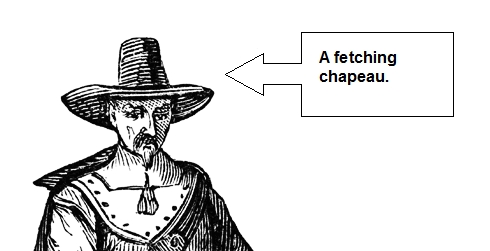
So, instead of conspiracy theories, today I’m going to talk about…a lot of people who thought there was a Satanic conspiracy afoot! But this is different because the characters in this story are wearing amusing headgear:
One of the perennial questions of American history is, “What the hell was wrong with the Puritans?” In my opinion, a lot. Let’s face it, the Netherlands didn’t want them, and you had to be a real jerk to make yourself unwelcome in the Netherlands in 1630, let me tell you.

Anyway, between September 1692 and May of 1693, 19 men and women were executed on charges of witchcraft in the towns surrounding Salem, MA, and one man was crushed to death as the court sought to force him into entering a plea. A variety of causes have been suggested for the witch mania that seized New England that year. In truth, it seems likely that a number of factors contributed to the Witch Trials; it is also apparent that the forces that initiated the craze were not the same ones that perpetuated it. Among factors that contributed in various degrees are gender and class (which were related), social and individual psychology, the social structure and beliefs of the townspeople, and, finally, the separation of church and state, which in Salem was about 2 blocks.

I have taught the Salem incident in past conspiracy theory courses. I tend to put a lot of weight on the theological background that made witchery seem like a plausible explanation. In really, truly unacceptably rough terms, the social order was thought to reflect a divine order. The maintenance of a system of covenants (women and children/father, head of household/government, government/God) was seen as ensuring the health of the relationship between the colony and the Lord. When that tranquility was disturbed, one might easily interpret that as someone having made a covenant with someone other than God, wink wink nudge nudge. It also makes a stunning lesson about standards of evidence.

But I digress.

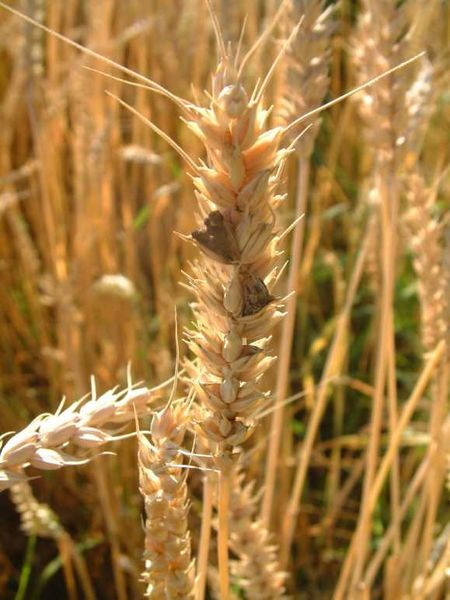
In the 1970s, Linnda R. Caporael, a psychology graduate student at UC, Santa Barbara, published a new hypothesis in Science. She posited that ergotism might account for the physical symptoms that were reported by those making accusations of witchcraft. Ergotism is caused by…wait for it…ergot poisoning. Ergot (Claviceps purpura) is a fungus that grows on various cereals and has a special hankering for rye:
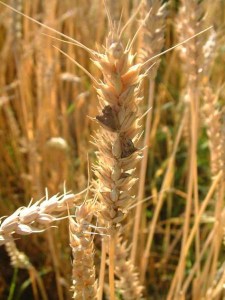
Ergot on wheat. Hold the mayo.

Caporael gives a cursory history of the madness outbreak (entire careers can be consumed by the scholarship around the Witch Trials), and considers three possible explanations 1) fraud on the part of the accusers, 2) psychological/ psychiatric issues, and 3) “physiological explanations.” Because Caporael finds that the possibility of physical ailments causing the outbreak have not been considered in depth before, the review of that literature is necessarily very brief, and she means to fill in the blank. She mentions that “A modern [1949] historian [Marion Lena Starkey] reports a journalist’s suggestion that Tituba had been dosing the girls with preparations of jimson weed, a poisonous plant brought to new England from the West Indies in the early 160o’s” (23), but the reference is not immediately available to me, so it is not clear when the journalist was writing or what evidence the journalist was citing.

Most of the studies of ergot that I have come across stress the effects of ergotism on cattle and livestock, which would be eating the affected grains. Ergot has medical uses, most notably as a vasoconstrictor, and most modern human cases of ergotism are the result of overdose on ergot-based medications. Ergot also contains alkaloid precursors to LSD, and so they share similar structures.

As you might expect given the pharmacology above, the types of symptoms associated with ergotism have to do with vasoconstriction resulting in dry gangrene and insults to the nervous system resulting in convulsions and hallucinations. It is the later suite of symptoms that lead Caporael to hypothesize convulsive ergotism as a possible culprit.

Caporael’s evidence falls into a couple of different categories. The first is “growing conditions.” There was ergot in the region, so it was a possible contaminant of rye stores. Also, she says that the crucial growing period, between April and Thanksgiving 1961, was warm and stormy, as evidenced in Puritan diaries, ideal growing conditions for the fungus. Her second line of evidence is “localization.” Three of the eight afflicted girls lived in the Putnam residence, and Putnam’s farm was large, as indicated by his will. Presumably, the agricultural yield from his substantial land holdings, if they were the source of the ergotism, would be dispersed more widely among the population. And this is how she explains the second group of afflicted girls:

The two afflicted girls, the daughter and niece of Samuel Parris, lived in the parsonage almost exactly in the center of the village. Their exposure to contaminated grain from western land [including Putnam’s] is also explicable. Two-thirds of Parris’s salary [as parson] was paid in provisions; the villagers were taxed proportionately to their landholding. Since Putnam was one of the largest landholders and an avid supporter of Parris in the minister’s community disagreement’s, an ample store of ergotized grain would be anticipated in Parris’s larder. (192)

Another sick girl was a servant in the household of the man who was presumably the town’s only doctor. Because Ann Putnam was often sick, he probably visited her a lot and got payments in ergotized grain. Another servant girl, this one on a farm near a river, may have been poisoned from her own Master’s fields, but Caporael says this case is questionable and possibly fraud (on the basis of the timing and nature of the accusation, as well as a second-hand report of the servant admitting to lying).

Another servant on an outlying farm is a bit of a puzzle. She alone was afflicted in the household (though pretty much everyone, including the kids was accused of witchcraft). There is a record of her once staying in town overnight, however. Because this girl had two bouts with the affliction, Caporael entertains the notion that she may have been poisoned the first time and then under psychological duress during the second episode.

I take these first two lines of evidence as an attempt to establish the plausibility of the ergotism hypothesis. The last line of evidence is the testimony of the trial, of which there is a staggering bunch. Caporael is looking for the symptoms of ergotism in the testimony.

After Caporael re-establishes that the outbreak of witches was an abnormal reaction, a strange paragraph follows:

The affected girls’ behavior seemed to be no secret in early spring. Apparently it was the great consternation that some villagers felt induced Mary Sibley to direct the making of the witch cake of rye meal and the urine of the afflicted. This concoction was fed to a dog, ostensibly in the belief that the dog’s subsequent behavior would indicate the action of any malefic magic. The fate of the dog is unknown; it is quite plausible that it did have convulsions, indicating to the observers that there was witchcraft involved in the girls’ afflictions. […]

The importance of the witch cake has incident has generally been overlooked. (25)

Hold on…I must have missed something. There is no contemporary record whatsoever of a dog having convulsions (or not)? If it did have any symptoms at all…surely it would have been mentioned somewhere? Where did the “importance of the incident” happen?

Regardless, lack of dog testimony aside, Caporael mentions the spectral evidence (images of the accused or of their familiars who appeared to the afflicted), and “epileptiform” convulsions which she believes are consistent with convulsive ergotism. She also notes that “[c]omplaints of vomiting and ‘bowels almost pulled out’ are common in the depositions of the accusers.” She also refers to pinches and burning sensations that might signify some sort of ergotic neuropathy.

She then points to what is slightly worse evidence than the dog:

“When examined in the light of a physiological hypothesis, the content of so called delusional testimony, previously dismissed as imaginary by historians, can be reinterpreted as evidence of ergotism. After being choked and strangled by the apparition of a witch sitting on his chest, John Londer testified that a black thing came through the window and stood before his face.”

It was a little monkey-man thing, but that’s almost completely unimportant because we already have enough to determine precisely what Londer was describing, sleep paralysis. The pressure on the chest that becomes someone sitting on you (probably because his body is still “asleep”), the sensation that there are people around you, this is classic sleep paralysis. And it’s very cool to see how confusing sensory data, even when they are fairly common, get interpreted through the filter of the experiencer’s culture. If Londer were alive now, he’d testify that little gray aliens with big dark eyes were standing around his bed. Throughout history, the specters have been variously represented as the recently deceased (as in reports of vampirism and the wacky cures that communities developed for that–exhumation, beheading, staking or cremation!); when the waking dream has a sexual element, the phantoms have become incubi and succubi, and so on. Now they’re “grays.”

Within about, oh, 20 minutes of the publication of Caporael’s paper, the thesis was completely demolished Nicholas P. Spanos and Jack Gottlieb. Their article, “Ergotism and the Salem Village Witch Trials,” appeared in the December 1976 edition of Science.

Spanos and Gottlieb raise a question that occurred to me while I was reading Caporael, “So, were there any cases of gangrene?” I mean, ergot causes both gangrene and neurological symptoms. If uncontrolled doses were being consumed by the public, surely someone would have contracted gangrene. Or maybe the animals? Most of the studies of ergotism that I found were veterinary, after all. But they take it one step further than my uninformed musings and deploy a full arsenal of reasons why ergotism is unlikely. For instance, convulsive ergotism has been seen in groups where “the inhabitants have suffered from severe vitamin A deficiency” (1390). They note that Salem was affluent enough and had enough fish to avoid such a disease. They note that children, really young children, are the most likely to succumb to ergotism, but in Salem that the ages of the girls trend well over 15 (only 3 of 11 were younger).
The fact that entire families, who you would think would be eating the same food, were not laid low casts further doubt on the hypothesis.

In the case of the gastrointestinal symptoms (vomiting and diarrhea) that Caporeal discovered in the depositions, Spanos and Gottlieb find much less than would be expected. One instance that Caporael cited as “bowels almost pulled out” in the original text reads like this: “Abigail hath been greviously vexed with the apparition of Eliz: Proctor the wife of John Proctor of Salem, by which apparition she has been greviously pinched, had also her bowels almost pulled out…”. It’s unclear that this is actually explosive at either end of the digestive tract, or whether it is a cramp or…even real. It seems to be a retelling, not an ongoing, verified complaint. Indeed, the three girls who mention what might be construed as gastrointestinal symptoms all had a single bout. There is no mention of vomiting. (Oh! Perhaps Regan in The Exorcist, which was released a few years before the paper, had ergotism! I sense a publication!)

They further notice that there is no record of ergotism being cured by the reading of particular Bible passages in the medical literature. There is no reason why someone who had ergot poisoning would appear to be fine (“hale and hearty”) outside of court, as was the case with these girls. The descriptions of hallucinations and apparitions are not consistent with the types that people report having when they are on LSD (remember, ergot and LSD share some characteristics), such as halos around objects, long-lasting afterimages, rainbow-like colors, etc. Seeing people who aren’t there while awake is reportedly a comparatively rare effect of LSD. The girls did not reportedly display the ravenous hungers that follow ergotic convulsions. The reports of burning sensations are clearly triggered by external suggestion. Lastly, nobody reported that the girls’ skin hues changed, as would be expected with ergotism. When the epidemic ended, it ended. There are no reports of the permanent neurological damage that people who had been ingesting ergot for months would have displayed. Ergotism is in almost in every way a bad match unless you are willing to cherry-pick symptoms.

Nonetheless, while Gottlieb and Spanos put a stake through the heart of the notion that ergotism caused witches, they did inadvertently prove that the reanimated corpse of a discredited theory can wander aimlessly through pop culture.

In 1982, historian Mary K. Matossian, who had been studying the effects of mold poisoning on history and culture, resurrected the theory. Her principal objection to the Gottlieb and Spanos is  that:

“The Salem court record does not mention certain symptoms often associated with mild or early ergotism, such as headache, nausea, diarrhea, dizziness, chills, sweating, livid or jaundiced skin, and the ravenous appetite likely to appear between firs. If these symptoms were present, they may not have been reported because they were not commonly associated with witchcraft.”

They didn’t note that the sufferers had changed color, eh? I’d like to refer you to a specialist in this area:


They also would have noticed bits of people falling off, I imagine.

Most of Matossian’s reply is, “Well, you can’t disprove ergotism.” But that’s not positive evidence of ergotism. Matossian does offer more circumstantial evidence of conditions that might have been conducive to ergot, like tree rings, but again, we get nothing that remotely looks like ergotism in the record. Of course, her hypothesis got picked up by the New York Times, and the rest, as they say, is the History Channel.

In a strange way, I feel that this issue could be settled using Baysian analysis. As you probably do not remember because nobody was reading Skeptical Humanities at the time, Baysian analysis appeared in our examination of whether FDR had polio or an autoimmune condition. By looking at the frequencies of different symptoms in known polio cases, researchers were able to assign a very, very low probability that FDR’s particular cluster of symptoms would have appeared in a genuine polio case.

I looked for descriptive surveys of known ergotism outbreaks in human populations, but did not find any. (Be fair, I’m way outside my area here.) If you took a couple of large studies of outbreaks (or lots of little studies), it seems to me that you might be able to assign a likelihood of seeing an outbreak that has the variety of symptoms like the one at Salem.

So, there. Now you have homework. Go do that.

RJB

Sources:

Caporael, Linnda R. “Ergotism: The Satan Loosed in Salem?” Science 192.4234 (2 Apr. 1976): 21-26.

Matossian, Mary K. “Ergot and the Salem Witchcraft Affair,” American Scientist 70 (1982): 355-357.

Spanos, Nicholas P. and Jack Gottlieb. Science 194.4272 (24 Dec. 1976): 1930-1934.


The History Channel Discovers the REAL Cause of the Black Death

May 16, 2011

I saw part of an episode of “Ancient Aliens” on the History Channel this weekend. There were far, far too many ridiculous assertions for me to deal with them in any depth. Suffice to say, they kicked a very large number of academic fields in the metaphorical goolies. There were a smattering of academics. I’m not sure if their comments were taken out of context or if they managed to get tenure before going completely insane. Hard to tell. Most of the talking heads, though, were the usual bunch of ancient astronaut proponents, including Erich von Däniken, Giorgio A. Tsoukalos and David Hatcher Childress.

I find it interesting that these guys can read the Bible as literally as any Young Earth Creationist but just think the authors got things wrong a bit. So, if the Bible says there was a flaming chariot, you can bet there really was a flaming chariot, except it wasn’t really a chariot, it was a flaming flying saucer. And that’s pretty much how they read everything: very literally and without skepticism, but they can change the story as necessary to fit their particular nutty theory. Well, that’s how scholarship works, right?

Speaking of scholarship, one of the academics was William J. Birnes, Ph.D. He was wearing a suit and looked quite scholarly. He does have a Ph.D. in medieval English literature from New York University (1974). His dissertation was called Patterns of Legality in Piers Plowman, and he published an article called “Christ as Advocate: The Legal Metaphor of Piers Plowman” in Annuale Mediaevale 16 (1975): 71-93. But he’s also Bill Birnes, UFO Hunter. He more commonly appears in a turtleneck, bomber jacket, aviator shades and a hat that advertises his UFO Magazine (see here).

In his role as tweedy academic, he talked about Gervase of Tilbury. In his work Otia imperialia, Gervase mentions the following incident:

There happened in the borough of Cloera, one Sunday, while the people were at Mass, a marvel. In this town is a church dedicated to St. Kinarus. It befell that an anchor was dropped from the sky, with a rope attached to it, and one of the flukes caught in the arch above the church door. The people rushed out of the church and saw in the sky a ship with men on board, floating before the anchor cable, and they saw a man leap overboard and jump down to the anchor, as if to release it. He looked as if he were swimming in water. The folk rushed up and tried to seize him; but the Bishop forbade the people to hold the man, for it might kill him, he said. The man was freed, and hurried up to the ship, where the crew cut the rope and the ship sailed out of sight. But the anchor is in the church, and has been there ever since, as a testimony. (Source I couldn’t find Otia Imperialia online)

That is totally a weird story. And it involves a ship in the sky. Of course, it’s an anecdote, and the fact that it comes from an educated medieval aristocrat who served an emperor doesn’t somehow make it more reliable than an anecdote from Cletus the slack-jawed yokel. Let us look a bit more closely at Gervase and his writings. According to Wikipedia, he claimed “kinship with Patrick, Earl of Salisbury, and relations allegedly descended from a fey serpent-woman recognizable as the Melusine.” That’s a promising start. He devotes a section of his work to mirabilia or marvels, about which he says, “what constitutes the marvel is our inability to fathom the cause of a particular phenomenon” (quoted in Andrew Joynes, Medieval Ghost Stories, p. 46). He made a distinction between mirabilia and miracula. As Jean-Claude Schmitt explains,

[T]he miracle invited one to rely on one’s faith, to accept the total power of God, who was upsetting the order that he himself had established… [while] the marvelous aroused the curiositas of the human mind, the search for hidden natural causes, ones that would someday be unveiled and understood. The development of the latter attitude at the turn of the twelfth century must be seen as an early form of the scientific spirit that valued inquiry…true accounts of the facts, and even experimentation. (Ghosts in the Middle Ages, pp. 79-80)

So, hey, score one for Gervase. So, what kind of marvels did he write about? Well, ghosts, lamia, fairy creatures “the phoenix arising from the flames,” “women with boars’ tusks and men with eight feet and eyes” (Joynes, p. 74). Hmmm, perhaps we should take Gervase’s marvels with a grain or two of salt.

But the show wasn’t done with the Middle Ages. No, far from it. At some point, they started wittering on about the Black Death. As someone, possibly Tsoukolas, pointed out, one theory about the Black Death is that it was carried by rats, but William Bramley has a theory that the Black Death was caused by aliens. Now at this point, I think my brain short-circuited and partially shut itself down to protect itself from damage. I liked the way the two theories were given equivalence: “well, there are two theories about the Black Death: one that it was an illness spread by rodent-borne fleas and another that it was caused by chemtrail-spraying little green men. It’s really kind of a toss up.” Now to be fair, some perfectly sensible people have questioned whether the Black Death was caused by the plague, specifically the Yersinia pestis bacterium. Some have suggested an Ebola-like hemorrhagic fever. But human-culling aliens?

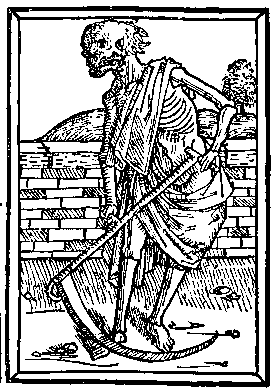
In the course of the segment, various talking heads managed to call Y. pestis a virus rather than a bacterium, and they placed all the blame on the rats, rather than on the fleas. Well, of course, they actually vindicated both the rats and the fleas, since now we know it was aliens. After all, it wasn’t the first time the aliens tried to wipe out most of humankind, cuz–hey–The Flood. And they’ve got evidence for their “theory:” reports of lights and shapes in the sky as well as mists and miasmas. In addition, a black figure was often seen outside a town about to be hit by the plague. This figuring wandered about and was seen carrying a scythe and possibly making crop circles. He looked a little like this:

Oh. My. God. Death’s a frikking alien! We’ve got to find the planet Death comes from, and kill all the bastards. Then there’ll be no more death! Of course, reports of the Grim Reaper appearing outside affected towns couldn’t possibly be interpreted allegorically, nor could the accounts be made up or simply mistaken. It’s definitely aliens. Someone alert Above Top Secret! Oh, wait, they already know, and, holy crap, many of them are skeptical: attention William Bramley, when ATS forum members think your theory is a bit far-fetched, it’s time to find another theory.

ES

Further Reading:

Gottfried, Robert S. The Black Death: Natural and Human Disaster in Medieval Europe. New York, Free Press, 1983.

Joynes, Andrew. Medieval Ghost Stories: An Anthology of Miracles, Marvels and Prodigies. Woodbridge, Suffolk, Boydell, 2001.

Kelly, John. The Great Mortality: An Intimate History of the Black Death, the Most Devastating Plague of All Time. New York: Harper-Perennial, 2005.

Schmitt, Jean-Claude. Ghosts in the Middle Ages: The Living and the dead in Medieval Society. Tr. Teresa Lavender Fagan. Univ. of Chicago Press, 1998.

Ziegler, Philip. The Black Death. Collins, 1969.


Pitch the Perfect History Channel Show

May 10, 2011

So, I’ve been thinking about the History Channel (or the “History” Channel or the Pseudo-History Channel) and wondering if I could come up with the perfect History Channel show. I suppose it would probably be a reality show featuring mostly unpleasant people doing dangerous and/or stupid things and arguing a lot. But I’m thinking about shows that involve actual history (or “history”). Among the shows listed on the website are such gems as:

I am only including shows listed on the website which have “about the show” information available. I’m not including History International.

A couple of other shows are listed which I hadn’t seen before. First is Brad Meltzer’s Decoded. I watched the episode on the Georgia Guidestones to see what it was about. Well, it’s awkward, with way too much time spent on shots of the investigators giving each other looks when they are interviewing someone. I haven’t quite figured out the relevance of the investigators’ qualifications: one’s a lawyer, one’s an engineer, and one is a journalist described as an “English professor.”  When they get to the guidestones and see all the languages, the English professor whips out his phone and Googles to see what the languages are. Really? Really? That’s your research? You wait until you get there and then start Googling? Not to mention he’s Googling information that is provided at the monument.

During the investigation, they interview various people and uncover various conspiracy theories: evil Rosicrucians planning genocide and using mind control and other occult gifts; good Rosicrucians warning us of global catastrophe. Occasionally Meltzer pops up in the studio like a deus ex machina and dismisses a particular theory (spoiler alert: Rosicrucians aren’t evil). And in the end, he puts the guidestones into the context of the Cold War, when they were built. His explanation is one of the least loopy; however, he does give a certain amount of credence to some of the theories (catastrophic solar flares! asteroids! 2012! Mayans!). Based on the one episode I’ve seen, it’s a conspiracy theory show for people who aren’t quite Jesse Ventura/Alex Jones crazy.

And then there’s MysteryQuest. Again, I was willing to sit through one episode. The episode I chose is called “Return of the Amityville Horror.”

I wasn’t encouraged by the opening, which summarized the story of the Amityville Horror without so much as mentioning the possibility that it was a hoax. Also, someone was bibbling about demons and vortices. But, while I was banging my head against the desk, I saw something out of the corner of my eye: did that bespectacled bald man have a Radfordian look to him? Why yes, that’s Ben Radford, well-known paranormal investigator and skeptic. It was at this moment that my often absent and frequently drunk spirit guide Sir Percival Piddlestew smacked me on the head and showed me a psychic vision: “Ben Radford’s point of view will get short-shrift.” If you don’t believe I made this prediction, ask Bob. (Spoiler alert 2–James Randi owes me a cool million).

So, is the Amityville house still (or again, or for the first time) haunted? Nope, it’s fine. Apparently the ghosts and demons and assorted paranormal whatnot have packed up and moved across the country to Wolfe Manor in Clovis, CA. What the supposed haunting at Amityville has to do with the supposed haunting at Wolfe Manor, I have no idea, unless it be the terrifying Ghost of Marketing come to call.

The investigative team includes a paranormal investigator and a demonologist joined by a medium and a scientist/engineer who makes ghost-hunting gadgets. No Ben Radford. The owner of Wolfe Manor shows them a picture of what could be a ghost or a demon:

Personally, I think it’s a velociraptor in ceremonial robes, possibly a reptilian mason. Or the Egyptian god Horus. Pareidolia‘s fun. As for the investigation, if you’ve ever seen Ghost Hunters, or Ghost Adventures, or Ghost Lab, you might as well have seen this investigation, except that Ghost Hunters are paragons of skepticism compared to these people.

Once the investigation is over, they take their data to analyze at the scientist’s lab–which is also haunted. This is where Radford comes in. There is security video of a desk chair rotating and a cubicle wall falling down on the same night six hours apart. Radford investigates that, and comes up with possible natural explanations. The scientist agrees that these explanations are plausible or would be, if both events hadn’t occurred during the same night. That’s it. Radford isn’t part of the main investigation, and he doesn’t get to comment on the practices used by the team. The team goes on to investigate the lab/warehouse. Upshot: at both locations there are “heat anomalies.” At Wolfe Manor, there is a possible vortex. They aren’t sure if the lab is haunted, but Wolfe Manor definitely is.

So, here’s your challenge: come up with the perfect idea for a History Channel show. Include title and description, if the spirit moves you. Try to incorporate as many of the following as possible:

  • Nostradamus
  • 2012
  • Mayans
  • DOOM!
  • Ancient aliens
  • Lost civilizations
  • Bigfoot
  • Freemasons
  • Reptilians
  • Illuminati

And anything else you can think of. Extra points if you can work in Hitler somewhere (nostalgia for the days when the History Channel was the Hitler Channel).

Grand prize: one shiny new Internets!


Science Gone Berserk

May 3, 2011

Not long ago, I wrote about how the History Channel dealt with the Norse warriors known as berserks (spoiler alert–they dealt with it badly). More recently, Brian Dunning mentioned berserks in an episode of Skeptoid on feats of superhuman strength:

Such drugs [as PCP] have also been suggested to explain groups such as the Norse berserkers, a subset of Viking shock troops who fought like enraged wild animals, impervious to pain, and contemptuous of injury. Some researchers have suggested that berserkers may have taken hallucinogenic mushrooms before going into battle, as did Zulu warriors. Another theory states that they may have simply gotten really drunk, but this likely would have resulted in poorer performance in battle. It’s also possible that berserkers simply worked themselves up into a frenzy, and combined with the fight or flight response to the impending battle, did indeed gain heightened physical ability.

Berserks aren’t the focus of the episode, but Dunning covers the all the bases briefly: berserks may have taken magic mushrooms; they may have used another substance, such as alcohol (but probably not); or they may have achieved the frenzy without any mind-altering substances. The idea that berserks may have taken something seems to be pervasive, and the history of the idea is traceable and interesting. To a large extent, it has been scientists who have explored the “magic mushroom” theory. It turns out, when science gets involved in the humanities, science is not always right.

In Dunning’s “References and Further Reading” section, he lists an article called “On Going Berserk: A Neurochemical Inquiry” by Howard D. Fabing. This article was published in both The Scientific Monthly and The American Journal of Psychiatry in 1956. It is based on a paper Fabing presented at the annual meeting of the American Psychiatric Association. According to the author biography included in the article, Fabing was at the time of writing “in private practice of neurology and psychiatry.” Previously,

[he had] taught physiology and neurology at the University of Cincinnati. During World War II he was director of the School of Military Neuropsychiatry in the European Theater of Operations. His research activities have been in the fields of parkinsonism, narcolepsy, epilepsy, wartime blast concussion syndrome, shock therapies, and the neuro-chemistry of mental disorders.

Clearly, Fabing was eminently qualified to discuss neurological and psychiatric disorders. He was perhaps less qualified to discuss medieval Scandinavian history. He doesn’t directly quote a single primary document related to the Viking age, and indeed, it seems clear that he was not immediately familiar with the primary documents (many of which were available in translation in 1956, although often in that “ye olde” variety of English that no one ever spoke). He begins by giving the supposed legendary background of the berserks:

Berserk was a mighty hero in Norse mythology. Legend states that he was the grandson of the mythical eight-handed Starkadder. He was renowned for his consummate bravery and for the fury of his attack in battle. He had twelve sons who were his equals in courage. He never fought in armor but in his ber sark, which means “bearskin” in the Nordic languages. Thus the term berserk became synonymous with reckless courage. (232)

I was not familiar with a hero named Berserk. I have still not found him in any primary text. I have, however, found references to this story in nineteenth- and early twentieth-century re-tellings of Norse legendary material. For instance, the 1910 edition of the Encyclopedia Britannica gives the following information under the entry for “berserker:”

[I]n Scandinavian mythology, the name of the twelve sons of the hero Berserk, grandson of the eight-handed Starkadder and Alfhilde. Berserk was famed for the reckless fury with which he fought, always going into battle without armour. By the daughter of of King Swafurlam, whom he had killed, he had twelve sons who were his equal in bravery. In Old Norse berserer thus became synonymous with reckless courage, and was later applied to the bodyguards of several of the Scandinavian heroes.

Starkaðr, usually Anglicized either as Starkad or Starkadder, does appear in various primary texts. There are actually two of Starkads. One or the other or both appear briefly in the Poetic Edda, the Prose Edda, Heimskringla and a number of sagas. Starkad the Old plays a larger role in chapters 6-8 of Saxo Grammaticus’s Gesta Danorum (translation available here) and the extremely strange Gautreks saga. Neither Starkad has a grandson named Berserk in any of these works. I suspect that the origin of this story comes from Hervarar saga ok Heiðreks (The Saga of Hervor and Heidrek, translation available here). In the versions of Hervarar saga that I have seen, there is no character named Berserk. The berserk father of the twelve berserk sons is named Arngrim, and in most versions Starkad does not seem to be his grandfather. There are, however, several variant texts of the saga. In this short, strange version* of Hervarar saga, called Saga Heiðreks konúngs ens vitra (The Saga of King Heidrek the Wise) Starkad does indeed seem to be Arngrim’s grandfather, and Arngrim is called “Arngrímr berserkr” (Arngrim the berserk).

So, without citing a source, Fabing recounts a garbled version of one variant of one saga. As I said, it is clear he is not familiar with the primary texts and accepts conflated and sometimes inaccurate accounts in secondary sources. Later, he gives a description of berserks that is third-hand (“A vivid description of the behavior of the Viking hoodlums is given by Schübeler, who relied on the renowned Norse historian, Munch” 234). While this description contains a lot of the usual information, it includes symptoms that are less common: “This condition is said to have begun with shivering, chattering of the teeth, and chill in the body, and then the face swelled and changed its color” (234). These sound like medical symptoms, and they fit rather well with some of the symptoms he and other doctors have observed in patients who have taken or been given hallucinogens, but they are not common in the sagas.

Fabing goes on to note that

There is a fascinating theory that Berserksgang…may not have been a psychogenically determined habit pattern, but may rather have been the result of eating toxic mushrooms. This idea, fantastic though it may appear at first glance, has won general acceptance among Scandinavian scholars, according to Larsen. (232)

According to the endnote, this information comes from a personal communication from “H. Larsen, provost, University of Illinois.” The next note identifies him as Henning Larsen. Larsen was a professor of English who is listed as a consultant in the front matter of the Middle English Dictionary. He was also the president of the Society for the Advancement of Scandinavian Study. Several articles he wrote are listed in the MLA Bibliography. Still, it would have been nice if Fabing had cited some actual articles or books to show this “general acceptance.” The theory does not seem to be generally accepted among Norse scholars any more.

The reasons it is not widely accepted are clear from Fabing’s article. He notes that the mushroom Amanita muscaria, or fly agaric, has been “used orgiastically” by Siberian tribes. The practice was first described in 1730 (232). Notice that Siberia is not Scandinavia, and the eighteenth-century is not the Viking age. He describes the effects in some detail. Some of these effects fit with the berserker rage: “Prodigious feats of physical strength are reported to have been accomplished under its influence” (232).  Other effects would seem to be detrimental in battle: “Suddenly his eyes dilate, he begins to gesticulate convulsively, converses with persons whom he imagines he sees, sings, and dances” (W. Jochelsen qtd. in Fabing 233). Berserks would not have been effective warriors if they raged about fighting imaginary people.

One man who accidentally poisoned himself with hallucinogenic mushrooms suffered

explosive onset of diarrhea, profuse sweating, excessive salivation and vertigo. He fell asleep and wakened…completely disoriented, irrational and violent…. He did not react to deep pain stimulation, but responded to pinprick. He was disoriented in all three spheres…. He thought that he was in hell and identified the interne, nurses, and attending physicians as Christ, Satan, God or angels (Arthur Drew qtd. in Fabing 233)

Violence and imperviousness to pain fit with descriptions of berserks. Diarrhea, vertigo, disorientation and hallucinations would seem to be drawbacks for a warrior.

As Fabing points out, the theory that berserks used some sort of mind-altering substance originated in 1784 with Samuel Lorenzo Ødman, a Swedish theologian, who read the sagas (or at least some of the fornaldarsögur) and concluded:

I am not of the opinion that these ecstasies can be explained as effects of a peculiar temperament or of autosuggestion because…they were not able to keep up their hated arrogance between paroxyms. (qtd. in Fabing 234. Ellipsis in Fabing)

Now his logic here seems flawed: because the frenzy isn’t essentially permanent, it can’t be auto-suggestion. Obviously, this is not true. One could think of berserker rages as big-boy temper tantrums: awful, but fortunately temporary. Ødman goes on to suggest that berserks used some substance from “the vegetable kingdom,” but that they “kept it secret so that their prestige would not be reduced by the general populace’s knowledge of the simplicity of the technique” (qtd. in Fabing 234). Ah, yes, they kept it secret. That’s convenient. Of course, what isn’t quite being said here is that there is NO EVIDENCE that berserks used any substance to achieve the berserker rage: NO REFERENCES to any ritual consumption of mushrooms or anything else. But if you have a cool theory, there’s no reason you should let a lack of evidence hold you back: you just have to come up with an excuse for why it doesn’t exist.

Lacking any reference to berserks consuming mushrooms, Ødman turns to accounts of the tribes of eastern Siberia and finds corroborating information:

What in particular seems to me to argue for flugswamp [the delightful Swedish name for fly agaric] is the fact that to partake of it is a custom from that part of Asia from which the pagan god Odin, with his pantheon, made their migration to our North. … The history of the Berserks in our North begins with Odin’s coming. (qtd. in Fabing 235)

While it was difficult to identify the source for the story of Berserk, son of Starkadder, this bit of misinformation is easy to identify. In both the Prose Edda and Heimskringla, Snorri Sturluson euhemerizes the Norse gods, explaining that they were great men who came to be regarded as gods. He suggests that they originally came from Troy. After Virgil invented a nice history for Rome, many European lands came up with foundation myths centered on Troy. Snorri’s has about as much validity as any of the others (none whatsoever). But Snorri tosses in some completely bogus etymology as well: the gods were called Æsir because they came from Asia. Hector becomes Tror, which becomes Thor. I could go on. These etymologies are false.

So, to summarize Ødman’s argument: it is based on false assumptions; it has to explain away the complete lack of evidence; it relies on “historical” accounts that no one accepts. It doesn’t really look good for the magic mushroom theory.

It didn’t go away though. A century later, it was taken up by a Norwegian physician and botanist, F. C. Schübeler. Schübeler agreed with Ødman about pretty much everything, including the likely secrecy that surrounded the mushroom-eating. He considered other substances, but dismissed them as less likely culprits than fly agaric.

Fabing concludes by discussing his own observations. He had studied bufotenine, the active ingredient in a number of hallucinogenic mushrooms and plants (and toads). He injected healthy, mentally stable prisoners with bufotenine and recorded the results. He concludes that the effects are very similar to the berserker rage, which is odd because rage is noticeably absent from his descriptions. The subjects had hallucinations and their faces became purple, but they also became “relaxed and languid” and “lay contentedly in bed, feeling pleasantly relaxed” (236). These prisoners would make disastrously bad berserks. In addition to being supremely relaxed, they suffered from severely impaired spacial perception, and other side-effects that would again be problematic for a warrior.

The whole magic-mushroom theory is based on cherry-picking certain side effects of hallucinogens (the effects of bufotenine can vary drastically) and certain descriptions of berserks and ignoring the bits that don’t fit. More importantly, it depends on a flawed justification (that it couldn’t be auto-suggestion because the state is temporary) and false history. Oh, and also there is no evidence the berserks used any mind-altering substance to achieve the berserker rage!


*I’m not sure where this version comes from. Very little information is provided. There’s no manuscript reference. Googling the title in Icelandic or English just turns up a lot of hits for Christopher Tolkien’s edition/translation of Hervarar saga. Although he uses the name that is given to this version, this is not the text he is editing and translating.

ES

References:

Fabing, Howard D. “On Going Berserk: A Neurochemical Inquiry.” The Scientific Monthly 83 (Nov. 1956): 232-237.

King Gautrek. Seven Viking Romances. Tr. Hermann Pálsson and Paul Edwards. London: Penguin, 1985.

Saxo Grammaticus. Gesta Danorum.

Snorri Sturluson. Edda. Tr. and ed. Anthony Faulkes. London: Everyman, 1987.

Snorri Sturluson. Heimskringla or The Lives of the Norse Kings. Ed. Erling Monsen. Tr. Monsen and A. H. Smith. 1932 New York: Dover, 1990.


The Palimpsest of History: WWII in Images

April 28, 2011

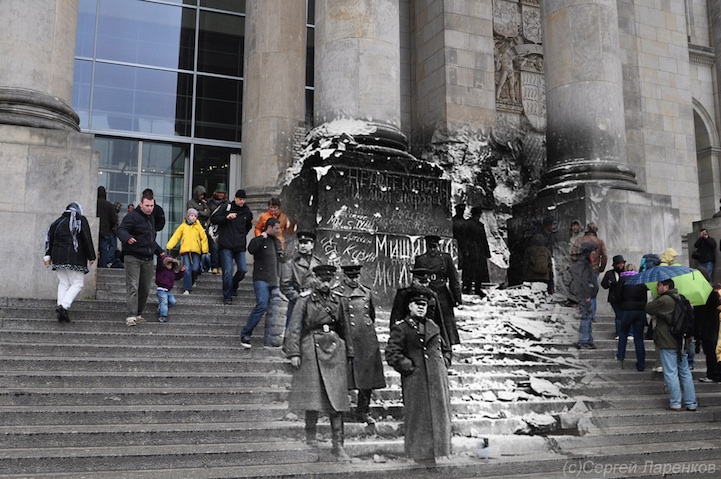
I wanted to share a link with you that hit the web big about a year ago, but is related to the course I am currently teaching on World War II. Photographer Sergey Larenkov’s stunning then-and-now-at-the-same-time photos conjure the ghosts of the past dramatically and make us the modern world in a new way.

It’s like cubist multiperspectivism on crack.  My Modern Metropolis also posted an interview with Larenkov, with more photos, including photos of Hitler in Paris.

RJB


Popeye the Sailor vs. the Japanese

April 26, 2011

Here’s a little find that a student researching his final paper on WWII sent to me. It comes fully stocked with all of the racist characterizations of the Japanese that one expects from the period. It may be the first cartoon that I have seen that addresses Japanese ritual suicide. (Warning: may be offensive to humans.)

As it so happens, I am reading David Livingston Smith’s  book on dehumanization, Less Than Human: Why We Demean, Enslave and Exterminate Others. It’s quite good and, I imagine, very accessible for a variety of audiences.

Sigh.

RJB


Going Berserk

April 19, 2011

Who hasn’t at one time or another gone berserk? And by “gone berserk,” of course I mean become enraged, howled like an animal and then killed indiscriminately. What, just me? Ha ha, just kidding. Really.

But what does it really mean “to go berserk”? Berserks (Old Norse berserkr, pl. berserkir) were fearsome Viking Age warriors. They appear frequently in sagas, but it is difficult to separate legend from reality in the sagas. Sometimes they had supernatural abilities and sometimes they were stock characters–bullies who served as a foil for the protagonist. Where can we find the truth?

Where else but the History Channel. A few years ago History International ran a program called Unconventional Warfare. The first segment deals with the Trojan Horse. According to the narrator, no one really knows whether the story of the Trojan Horse is true or not, so you know off the bat that this is going to be another serious, hard-hitting, scholarly look at history.

The segment on berserks begins well enough, with information provided by real, genuine experts (and General Wesley Clark for some reason). Okay, the fact that the History Channel manages to bollox up their credentials may be a bit of a concern. They properly credit Ruth Mazo Karras as “Historian, Univ. of Minnesota,” but they identify Anatoly Liberman (more here) as a “Scandinavian Historian” at the Univ. of Minnesota as well. In fact, Liberman teaches in the department of German, Scandinavian and Dutch, and much of his work focuses on linguistics and philology. Similarly, they identify Paul Acker* as a “Norse Historian” at Saint Louis University, and, to be fair, he does look a bit like a Viking who’s given up raiding for academia. However, he is a professor of English rather than a historian. They don’t bother to give John Lindow (more here) any academic qualifications at all, identifying him as “Author ‘Handbook on Norse Mythology.'”

Regardless, the misidentified academics give a good summary of the berserks: they were fierce fighters who whipped themselves into a frenzy and fought in the front lines. In legendary tales, they are described as wearing bear or wolf skins (berserkr means “bear shirt”). They supposedly fought without armor and could not be harmed by weapons or fire. In reality, of course, they could be harmed and killed, but for the duration of  the berserker rage, they may have seemed impervious.

But what, asks the narrator, caused the berserker rage? Acker says, “Through their training and initiations, they whipped themselves into frenzy: that’s part of their jobs.”  The narrator, of course, knows better: “Some theorize, however, that the berserkers had a little help–from mood-altering substances.” Karras notes that “If you read a lot of modern works that refer to berserks, they talk about how they may have used either alcoholic beverages or perhaps hallucinogenic mushrooms to bring on the rage.”

Now, at this point, you can sense the word “however” hurtling across the room, desperate to make it before the camera cuts away, but, alas, to no avail. Magic mushrooms is what the History Channel wanted, and once someone mentioned them, they stopped. The point of Unconventional Warfare is to compare strategies used in the past to ones used much more recently. The berserks and their magic mushrooms are compared to Somali warriors who use a narcotic weed to become more aggressive.

None of the academics were told that this was the point of the segment. They only knew that the History Channel was doing a segment on berserks. When asked about the magic mushrooms, Acker and presumably Karras (quite possibly the others as well) explained that while some have speculated that the berserks used hallucinogens, there is absolutely NO evidence. There is nothing in the literature to suggest that the berserks used anything but training, natural aggression and the gift of Odin to work themselves into a frenzy. They may well have had a bit of a tipple now and then, but that hardly separates them from anyone else in Viking society.

If this is how they do history, perhaps it’s just as well that they stick with monsters and doomsday.

But enough about historical berserks; let’s talk about the literary and legendary ones–they’re much more fun. First the stock characters. These guys wander around, acting like bullies and intimidating people until they get their comeuppance from the saga protagonist. In Grettis saga, Grettir fights and kills a mound-dweller (an undead guy who attacks Grettir when Grettir is robbing his grave), a draugr (an ueber-nasty undead guy), a she-troll, a giant, a bear and lots of people. LOTS of people, including a number of berserks. Grettir meets a group of twelve berserks, led by a couple of brothers named Thorir Paunch and Ogmund the Evil.

They came from Halogaland and were bigger and stronger than anybody else. They would go berserk and spare nothing when they flew into a rage. They used to take away men’s wives and daughters and keep them for a week or two, then return them. Wherever they went, they used to plunder and cause other trouble (Saga of Grettir the Strong, p. 42)

Grettir pretends to befriend them, then gets them drunk and fights them (the alcohol is of no benefit to them, by the way). When they realize what is happening, the berserks, of course, go “berserk and [begin] howling like dogs” (p. 46). While they’re howling, Grettir thrusts a spear through Thorir and Ogmund, who bumps into him. Then he takes out the other berserks.

Later, when Grettir is staying with a man named Einar, a group of berserks arrive, and the leader challenges Einar “either to hand over his daughter or defend her if he was man enough” (p. 95).  Einar consults with Grettir, and the berserk becomes impatient:

The berserk thought that Grettir and the farmer were stalling. He started to howl loudly and bite the edge of his shield. He put his shield in his mouth, spread his lips over the corner of it and acted like a savage. Grettir strode over to him and when he came alongside the berserk’s horse he kicked the bottom of the shield up into his mouth so hard that his face ripped open and his jaws fell down to his chest (p. 95)

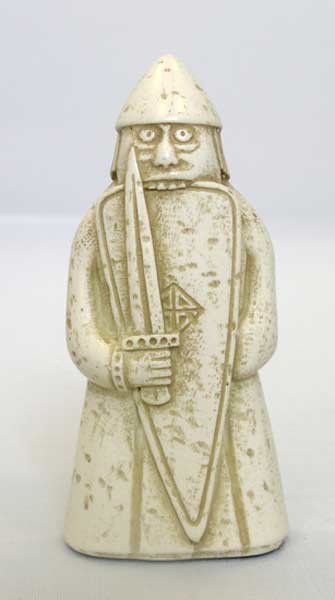
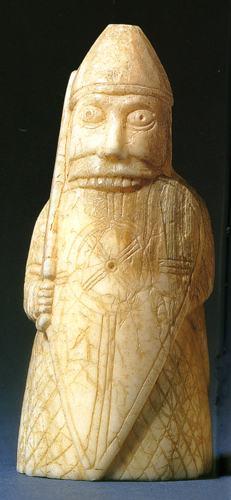
Then Grettir cuts off his head, and the other berserks decide to be on their way–rather quickly. Throughout the sagas, the beginning of the berserker rage is signaled by howling and shield-biting. Some of the Isle of Lewis chessman seem to depict shield-biting berserks:

As far as I know, Grettir is the only person who has the sense to kick the shield back into the berserk’s mouth. Not all berserks are slightly comic bullies, however. Some have supernatural powers. Examples may be found in Egils saga. Egil was a great warrior, an exceptional poet and a truly phenomenal drunk (again, though, his drunkenness is unrelated to his frenzies). Jesse L. Byock has argued that Egil may have suffered from Paget’s disease, which has a genetic component. Based on his saga, Egil may also have suffered from a genetic predisposition for berserkerism.

Egil’s grandfather is named Ulf. He is big and strong and a good farmer. As evening rolls around, however, he turns bad-tempered and is known as Kveldulf or Evening Wolf. You might as well wear a name tag that says, “Hi, I’m a werewolf. Ask me how.” He has two sons, Thorolf and Grim, known as Skallagrim (Bald Grim). Thorolf is tall, strong, brave, handsome, honorable (by saga standards) and an all-round swell guy. Grim is big, strong, ugly, troublesome and, like his father, has a tendency to shape-shift. Skallagrim has sons named Thorolf and Egil. Thorolf II is a carbon-copy of Thorolf I. Egil is big, strong, freakishly ugly and has the family tendency to shape-shift. The non-berserk Thorolfs both die young; the berserks all die of old age.

In one of Skallagrim’s rages, he seizes one of Egil’s friends and “[dashes] him to the ground so fiercely that he was crushed by the blow and died on the spot” (Egil’s Saga p. 63). He then seizes twelve-year-old Egil, who is rescued by his foster mother who is “as strong as a man and well versed in the magic arts” (p. 63). Skallagrim is described by an enemy as being “as vicious as a wolf” (p. 42), and Egil is mistaken for a bear on one occasion (p. 104). According to the narrator:

It is said that people who could take on the character of animals, or went berserk, became so strong in this state that no one was a match for them, but also that just after it wore off they were left weaker than usual (p. 46)

Kveldulf, Skallagrim and Egil also tend to befriend people with similar berserker characteristics. For instance, there is Egil’s friend, Onund Sjoni: “Not everyone agreed that he was not a shape-shifter” (p. 130).  Although Egil’s connection to berserker madness is less explicit than Kveldulf’s and Skallagrim’s, he performs one of the best killings in all the Icelandic family sagas. He is fighting a duel against a man named Atli, who is “strong and courageous, an experienced dueller, and skilled in the magic arts” (p. 128). Egil is able to hack Atli’s shield to bits and land blows, but the sword is unable to bite. His own shield is beginning to split, so

He threw down his sword and shield, ran for Atli and grabbed him with his hands. By his greater strength, Egil pushed Atli over backwards, then sprawled over him and bit through his throat. Atli died on the spot. Egil rushed to his feet and ran over to the sacrificial bull, took it by the nostrils with one hand and by the horns with the other, and swung it over on to its back, breaking its neck (p. 128)

Let this be a warning to you, History Channel: don’t mess with berserks.

ES

*Full disclosure: Professor Acker was my dissertation director. When the History Channel came a-filming, they collected several graduate students to sit listening in rapt attention while Prof. Acker delivered a faux lecture. We were cut.

References:

Byock, Jesse L. “Egil’s Bones.” Scientific American. Vol. 272. Jan. 1995, pp. 82-87

Egil’s Saga. Tr. Bernard Scudder. The Sagas of Icelanders: A Selection. New York: Viking, pp. 8-184.

The Saga of Grettir the Strong. Tr. Bernard Scudder. London: Penguin, 2005.


Fingerprints of the Norse Gods

April 14, 2011

I’ve been reading Graham Hancock’s unnecessarily lengthy tome Fingerprints of the Gods (hey Graham, if I wanted to read a travelogue, I’d’ve bought a travelogue: get to the point). It’s been slow going because every couple of sentences, my eyeballs roll into the back of my skull, and I have to wait for them to return to their normal position before continuing.

As I was reading, I began to get an idea for a blog post: I would write a parody in which I traced suspicious parallels between Mesopotamian, Mesoamerican and Old Norse mythology. Perhaps I’d begin with Hancock’s discussion of the Babylonian god Marduk‘s conquest of the chaos monster Tiamat:

…[A] great plan of world creation began to take shape in his mind. His first move was to split Tiamat’s skull and cut her arteries. Then he broke her into two parts “like a dried fish,” using one half to roof the heavens and the other to surface the earth. From her breasts he made mountains, from her spittle, clouds, and he directed the rivers Tigris and Euphrates to flow from her eyes. (Hancock p. 144. Hancock’s source is the New Larousse Encyclopedia of Mythology, pp. 60)

He compares Marduk to Quetzalcoatl, who

in his incarnation as the creator deity, took the role of Marduk while the part of Tiamat was played by Cipactli, the “Great Earth Monster.” Quetzalcoatl seized Cipactli’s limbs “as she swam in the primeval waters and wrenched her body in half, one part forming the sky and the other the earth.” From her hair and skin he created grass, flowers and herbs; “from her eyes, wells and springs; from her shoulders, mountains.” (Hancock p. 144. Hancock’s sources are Adela Fernandez, Pre-Hispanic Gods of Mexico, p. 59 and Inga Glendinnen, Aztecs, p. 177)

Well, one can hardly miss the parallels to Ymir, the primordial giant in Old Norse Mythology. Ymir was formed in the thawing ice of Ginnungagap, the great void that lay between the extreme heat of Muspelheim and the extreme cold of Niflheim.  A male and female were formed from the sweat of Ymir’s left armpit, and one of his legs sired a son on the other. These were the first frost giants (Snorri Sturluson, Poetic Edda, Gylfaginning, ch. 5). Odin and his brothers Vili and Ve killed Ymir:

When he fell, so much blood gushed from his wounds that with it they drowned all the race of the frost giants except for one who escaped with his household. The giants call that one Bergelmir. He, together with his wife, climbed up on to his wooden box, and there they kept themselves safe. From them come the races of the frost giants….” (Snorri, Gylfaginning, ch. 7)

ZOMG! A flood that destroyed an entire race, except for just enough individuals to replenish the race! Hancock goes on and on about flood stories. It doesn’t really matter how dissimilar they are. If they involve floods (and sometimes even if they don’t), they have to be related in some way.  But wait, there’s more! After killing Ymir, Odin and his brothers created the world using bits of his body:

They took Ymir and they moved him into the middle of Ginnungagap and made from him the world. From his blood they made the sea and the lakes. The earth was fashioned from the flesh, and mountain cliffs from the bones. They made stones and gravel from the teeth, the molars and those bones that were broken.

…With the blood that gushed freely from the wounds, they made the sea, and by fashioning that sea around, they belted and fastened the earth. Most men would think it impossible to cross over this water.

…They also took his skull and from it made the sky. They raised it over the earth and under each of the four corners they placed a dwarf.

…[The gods built a fortress wall to protect the world from the giants.] As material for the wall, they used the eyelashes of the giant Ymir and called this stronghold Midgard…. They took his brain, threw it up into the air, and from it they made the clouds. (Snorri, Gylfaginning, ch. 8 )

In my parody, I was going to ask a lot of rhetorical questions that began “Is it simply a coincidence that…?” and “Or is it perhaps possible that…?” Then I’d note the big fuss Hancock makes over Mesoamerican gods who are described as white and mention all the works of art that he identifies as “clearly” representing bearded Caucasians. Heck, you can’t get much whiter than Scandinavians and still have melanin, and their gods are generally depicted as bearded. Finally, I was going to mention the Mayan god Votan, whom Hancock describes as “pale-skinned, bearded and wearing a long robe” (p. 103). Hey, Wotan/Woden/Odin/Oðinn was pale-skinned and bearded and often wore a cloak. If only this Votan fella was one-eyed. Could this possibly be a coincidence? (yes, yes it could).

I was saddened–for many reasons–to learn that people have seriously made this argument (see here as well as Votan link above). So, I plowed on with my reading, when, lo, I came across the following in a chapter called “The Many Masks of the Apocalypse:”

There is one ancient culture that perhaps preserves more vivid memories in its myths than any other; that of the so-called Teutonic tribes of Germany and Scandinavia, a culture best remembered through the songs of the Norse scalds and sages. The stories those songs retell have their roots in a past which may be much older than scholars imagine and which combine familiar images with strange symbolic devices and allegorical language to recall a cataclysm of awesome magnitude. (Hancock, p. 204)

Yay! Hancock made the Norse connection! I’m not sure why he thinks that the roots of Old Norse mythology may be much older than scholars imagine, except that he thinks ALL old cultures are somehow much older than we imagine. In a lengthy indented quotation, Hancock describes a Norse apocalypse in which he sees similarities to Mesoamerican, and ancient Iranian stories, among many others. All these stories involve cold and dark. In the Norse version he recounts, a giantess gives birth to a brood of wolves sired by the giant wolf Fenrir, son of Loki. One of the wolves devours the sun. The disappearance of the sun brings about a period of intense cold and brutality (known as fimbulvetr, awful or great winter). Fenrir escapes from his bonds. The world tree Yggdrasil is shaken violently; mountains split. “Abandoned by the gods, men were driven from their hearths and the human race was swept from the surface of the earth. The earth itself was beginning to lose its shape. Already the stars were coming adrift from the sky and falling into the gaping void” (Larousse, p. 279 qtd. in Hancock, p. 205). The fire giant Surt sets the earth alight; then the seas and rivers overflow; however, an undisclosed number of people survive, enclosed within Yggdrasil. They are the progenitors of a new race of men.

Now, in reading Hancock, I’ve found some odd things about the way he uses and cites sources. Of course, many of his sources are of an extremely dubious nature (Velikovsky and Sitchin, to name two). But one thing that concerns me is that when he’s recounting mythology, he often does not cite primary sources (or translations of primary sources). In some cases, I suppose, the primary sources may not be accessible, or they may not have been translated into English. But in some cases, for one indented quote, he will name more than one source, at least one of which is not a primary source. This has led me to suspect that he is picking and choosing information that fits his ideas. His presentation of the Norse material confirmed my suspicions. Both the Poetic and Prose Eddas have been translated into English several times and are easily accessible. Hancock does not quote from a translation. He again quotes from the New Larousse Encyclopedia of Mythology. And I found the quotation odd in a number of ways. For one thing, there are some bits I don’t remember–for instance the dwarfs trying to find entrances to their underground dwellings–but perhaps I just missed or forgot those bits.

Larousse is available for free online. In consulting it, I noticed that Hancock has altered wordings here and there (or perhaps there is some variation in versions of Larousse: his page numbers don’t match mine, either). These alterations are trivial. A much bigger problem is that Hancock has omitted large chunks of the story without using ellipses. The story Hancock is recounting is that of Ragnarok, the doom of the gods. What Hancock has omitted from the story is…the doom of the gods. He doesn’t mention Odin, Thor, Frey, Tyr or Heimdall. He doesn’t even mention Loki who is the leader of the “bad guys” and the father or ancestor of some of the monsters (Fenrir and the other wolves and Hel, goddess of the underworld).

That’s a hell of an omission. Now, it could be argued that he left out those bits to save space, and it’s the other elements, the ones that relate to the fate of the sun and the earth, etc., that are most pertinent to the discussion. I don’t buy it. I think it allows him to skew the story. He follows the quotation with the comment, “The new world this Teutonic myth announces is our own” (p. 205). This statement is simply untrue. The events described haven’t happened yet. While Larousse recounts the story in the past tense, Snorri Sturluson uses the present tense in the Prose Edda. Vǫluspá (the Prophecy of the Seeress), from the Poetic Edda, tells the story partly in the present tense, but it is clear that it describes events that have not yet occurred, since the seeress is addressing Odin, who is still alive (his death is foretold in the poem). Hancock adds: “Needless to say, like the Fifth Sun of the Aztecs and the Maya, it was created long ago and is new no longer” (p. 205). Again, this is not true. Ragnarok doesn’t parallel the beginning of the Fifth Sun, the beginning of the present age. From Hancock’s point of view, it would fit with December 23, 2012, the catastrophic end of an age (again, according to Hancock’s view).

This is some impressive cherry-picking. The story of Ragnarok is not obscure. It always refers to a future apocalyptic event. Now, granted, since the stories were told or recorded by Christians, one could argue that the Teutonic gods had died, but not in some world-destroying cataclysm that somehow relates to a real event we don’t seem to know about. They were simply supplanted by a new religion. Most of the myths Hancock discusses do concern disasters that happened in the distant past, but not all myths can be forced to tell the same story.

ES

REFERENCES

Hancock, Graham. Fingerprints of the Gods. New York: Crown, 1995.

New Larousse Encyclopedia of Mythology. Tr. Richard Aldington and Delano Ames. New York: Crescent, 1987. http://www.scribd.com/doc/2176365/New-Larousse-Encyclopedia-of-Mythology.

Snorri Sturluson. The Prose Edda. Tr. Jesse L. Byock. Penguin Classics. London: Penguin, 2005.

Vǫluspá. Poetic Edda. Text with translation by Henry Adams Bellows available here.


Dowsing for King Arthur

March 31, 2011

A few weeks ago, Bob suggested I write a post on the “historical” King Arthur. My immediate reaction was “meh.” Arthur is, of course, quite important to medieval literature: the Matter of Britain is the subject of many important works of Middle English, including Laȝamon’s Brut, the Alliterative Morte Arthure, the Stanzaic Morte Arthure, The Awntyrs off ArthureSir Gawain and the Green Knight and many more. Finally, in the late Middle English period, Sir Thomas Malory produced Le Morte d’Arthur, in which he brought together disparate stories from French and English sources and attempted to tell the whole tale from beginning to end. As you might expect, Malory’s work has some organizational problems. For instance, I distinctly recall that Lancelot killed the same knight three times in thirty pages. Nonetheless, Malory’s compilation has become the story of Arthur that we all know.

I have from time to time read about the “historical Arthur,” but my main reaction is, “I don’t care” because even if (and it’s a big “if”) Arthur existed, he is so far removed from the Arthur we know as to be unrecognizable. A historical Arthur would have nothing in common with Malory’s king; he’d have precious little in common even with Geoffrey of Monmouth‘s.

Recently, though, I’ve been thinking a bit more about the historical Arthur. From time to time, I have watched the BBC series Merlin, which has absolutely nothing to do with anything remotely historical. However, the actors who play Merlin and Arthur in the series, Colin Morgan and Bradley James, also appear in a program in which they gallivant across Wales in search of “The Real Merlin and Arthur,” although Merlin gets pretty short shrift. They arrive late everywhere, but–hey–the scenery is pretty and so are the actors.

Their first stop is the Arthurian Collection in Mold, Flintshire, which houses over 2000 books related to Arthur. Unfortunately, they arrive after the library has closed. Regardless, author Scott Lloyd gamely tells the actors about the documentary evidence for Arthur’s existence. Here it is:

Want to see it again? It’s like this: Arthur is supposed to have fought the Germanic invaders of Britain, briefly halting the Anglo-Saxon advance. This would place him in the late 5th and early 6th centuries. Arthur is first mentioned in the 9th century.  The Old Welsh poem Y Gododdin mentions a warrior named Gwawrddur who, though mighty, was “no Arthur.” Unfortunately, Y Gododdin survives in a manuscript from the 13th century. Although there is scholarly debate over the date of composition, it may be as late as the 9th century. Even if the poem is much earlier, say 6th or 7th century, it has undergone extensive changes in its oral and written transmission. There is no way to know whether the almost throwaway reference to Arthur is original.

A more substantive account of Arthur appears in the Historia Brittonum, usually (though quite possibly erroneously) attributed to a Welsh monk named Nennius. The Historia Brittonum is a disorganized mish-mash of material written or compiled in the first half of the 9th century. Arthur is mentioned as a dux bellorum (leader of battles) who fought with the kings of Britain against the Germanic invaders. This would suggest that he was not himself a king, even if he existed. Nennius associates Arthur with a number of wonders or marvels and twelve battles. Of course, the wonders are of extremely dubious historicity, but the battles are questionable as well. Although people have tried to make connections, most of the battles cannot be identified. Furthermore, Nennius claims that Arthur personally killed 960 men in one battle, which seems a tad unlikely.

This battle, the battle of Mount Badon, is, however, almost certainly historical. It is mentioned by Gildas, a 6th-century British monk, in De Excidio et Conquestu de Britanniae. Gildas says that he was born in the year of the battle of Mount Badon, so he would have been a younger contemporary of Arthur’s if Arthur had existed. Guess who isn’t mentioned in Gildas. I’ll give you a hint: it’s the same guy who isn’t mentioned in any works by Anglo-Saxons, such as Bede‘s Chronica Maiora (725) and Historia Ecclesiastica Gentis Anglorum (731) or the Anglo-Saxon Chronicle (begun in the 9th century). They mention other characters from the “historical” Arthur’s story, such as the British king Vortigern, who invited the Germanic mercenaries to Britain. Indeed Bede was probably the first to mention Vortigern. Two manuscripts of Gildas name him, but these are from the 12th and 13th centuries. Bede and the Anglo-Saxon Chronicle also mention the twin brothers Hengest (stallion) and Horsa (horse). Both Beowulf and The Fight at Finnsburg also mention a fella named Hengest, who may or may not be the same guy.

The “historical” Arthur is largely the creation of Geoffrey of Monmouth in the Historia Regum Britanniae, but Geoffrey was writing in the 12th century, more than half a millennium after Arthur’s time. In addition, Geoffrey’s work is not considered historically accurate by any credible authority.

So, that is the documentary evidence: bupkis. Some people cite archeological evidence to support Arthur’s likely existence, and indeed settlements and earthworks have been uncovered from the right time period, including the South Cadbury hill fort in Somerset and Tintagel in Cornwall and several others. But, come on, we know the 5th and 6th centuries existed; we know the Britons fought the Germanic invaders. Evidence of hill forts is not evidence of Arthur.  A few objects have been found with direct, but questionable, links to Arthur. In 1191, the monks of Glastonbury discovered the bodies of a man and woman, along with a lead burial cross that identified them as Arthur and Guinivere. The bodies and the cross disappeared during the Reformation. Most believe this was a pious hoax. At the time, the monks were trying to raise funds to rebuild Glastonbury Abbey which had been gutted by fire. Occasionally, the cross allegedly makes a reappearance, but such glimpses are also the result of hoaxes.

Amateur historians Alan Wilson and Baram Blackett have found another grave of Arthur. They identify Arthur with Athrwys ap Meurig. This is the opening paragraph of their official website:

King Arthur I son of Magnus Maximus of the late 4th Century AD and King Arthur II of the late 6th Century AD, can both trace their family lines back to the British Emperor Constantine the Great, and continue on back to the Holy Family itself which entered Britain in AD 37. Both King Arthur’s continue tracing their bloodline all the way back to King Brutus, himself a great grandson of Aeneas of Troy.

Neither the Da Vinci Code-ish content nor the grammar fill me with confidence. Nor does the fact that they’ve also found the Ark of the Covenant. But let’s look at their findings objectively. In 1983, they discovered a burial stone that reads “Rex Artorius, Fili Mavricius,” which supposedly means “King Arthur, the son of Mauricius (Meurig).” In 1990, they discovered an electrum cross that reads “Pro Anima Artorius,” “for the soul of Arthur.” The problem is, as the Bad Archaeologist points out, that “Rex Artorius, Fili Mavricius” actually means “King Arthur Mauricius, of the son” and “Pro Anima Artorius” means “Arthur for the soul.” Oh dear. This is not terribly complicated Latin grammar, although one could imagine that it might fool people who put apostrophes in plurals.

There is one inscription that definitely seems not to be a hoax or a forgery: the Artognou stone found at Tintagel. Actually, there are parts of two inscriptions on this piece of slate. Only the letters “AXE” survive from the one inscription. The other reads “+ PATERN… COLIAVIFICIT… ARTOGNOV… COL… FICIT…” The Celtic Inscribed Stones Project translates the inscription as “Artognou descendant of Patern[us] made [this]. Colus made [this].” Artognou and its Old Breton and Old Welsh cognates Arthnou and Arthneu do look a bit like Arthur. This similarity was enough to get people excited, even such an august body as the Archeological Institute of America. The name Arthur may come from the Roman gens name Artorius or it may be a Celtic name which derives in part from arto/arth, meaning “bear.” If it is the latter, then it does share an element with Arthneu, but it is not the same name. Now I admit I know virtually nothing about the Celtic languages; however assuming that “Arthur” and “Arthneu” are close enough to be considered the same guy because both names contain the element “arth” seems to be like assuming that Thorbjorn and Arnbjorn are the same guy because both names contain the element “bjorn,” which means “bear.”

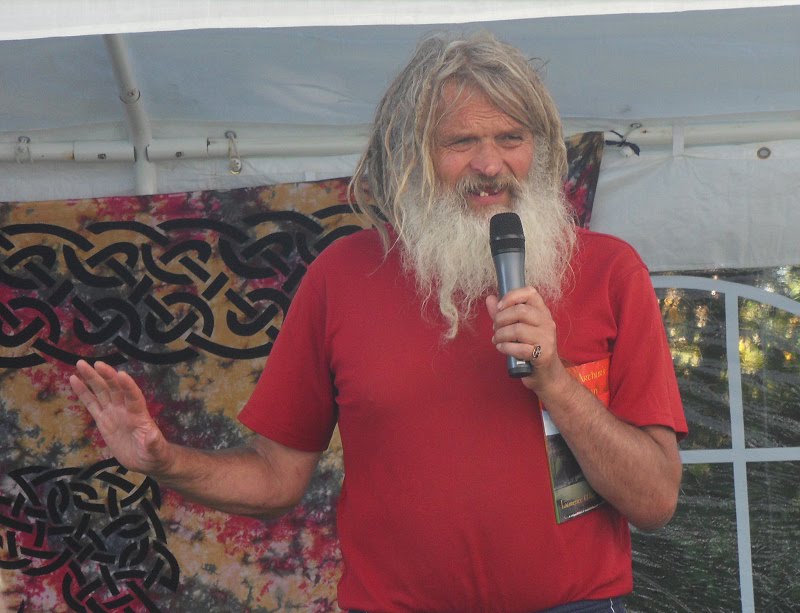
In short, the archeological evidence isn’t much stronger than the documentary evidence. Is there any other kind of evidence? Well, back in Wales, the actors may have found “spiritual” evidence.  On the second day of their trek, they arrive in Gwynedd at the supposed site of the Battle of Camlann, where Arthur was mortally wounded. There they meet Santa’s disreputable older brother, Laurence Main

http://thepaganfederation-midwestandwales.blogspot.com/

a Druid in a fetching miniskirt, who uses ley lines to dowse for Arthur’s burial site (another one). So, they’re walking around in the dark (they arrived late again), and their rods cross once they run into a tree. It is also possible that Main is unconsciously indicating to them where their rods should cross. At any rate, they hit one of the major ley lines and, Main explains, if it were day time and wintertime with no leaves on the tree, they could see the church where Arthur was buried. What more proof do you need?

The actors seem somewhat disappointed that they didn’t find definitive evidence of a historical Arthur, but at the end, Colin Morgan makes what I think is an excellent point:

Maybe it doesn’t matter because…the legends are always going to be there. They’re always going to be reinvented and reinterpreted, and maybe you don’t need a final answer because that’s what it’s all about: the stories are there to be enjoyed.

And that’s always been true. From very, very early on, the Arthurian legends have looked back nostalgically to a time that never really existed. Every age has reinterpreted the stories to fit the time and culture. A real Arthur probably never existed, and if he did, he had almost nothing to do with the king we know.

ES