The Green Knight Code

February 10, 2011

Well, I finished re-reading The Da Vinci Code. Then I drank some beer in an attempt to kill the brain cells where awareness of it is stored, but that failed. Then I read a well-written mystery novel and had a nap, and now I feel a little better.

From the moment of its publication, people have been writing refutations of the “facts” presented in the book, so, at least for the moment, I will confine my comments to the general category of “random stuff that irritated me.” Today’s topic is Sir Gawain and the Green Knight (SGGK), an Arthurian romance from the fourteenth century and one of the glories of the so-called Alliterative Revival (I say “so-called” because it was really more of a survival than a revival). Brown mentions SGGK twice. Both mentions are brief, but annoying.

I’ll deal with the second reference first. In the exciting and suspenseful database-search scene (chapter 95), a computer, having been fed the search terms “knight,” “London,” “Pope” and “tomb” within a 100-word proximity of the terms “grail,” “rose,” “sangreal” or “chalice” (p. 381), spits out the title, “Grail Allegory in Medieval Literature: A Treatise on Sir Gawain and the Green Knight.” As far as the plot is concerned, this result is irrelevant–“Not many mythological green giants buried in London,” as the librarian says (389)–so one has to assume it’s an attempt by the author to tie SGGK to the grail/bloodline of Jesus/sacred feminine fantasy he’s been weaving.

There’s something a bit odd about the title though. Certainly, the poem can be read as an allegory (of the Christian variety),and like many medieval grail stories, it is a quest romance. But it is not a grail romance. There’s no grail: the word isn’t even mentioned. Granted, it is one of the premises of The Da Vinci Code that references to Mary Magdalene and her descendants had to be hidden in allegory (or “symbology”), but it must be hidden very well indeed in SGGK. Not only is there no mention of Mary Magdalene or her bloodline, there is no reference to the grail which symbolizes the bloodline. If the grail exists in the poem at all, it is through allegory. So something (I have no idea what) represents the grail allegorically, and the grail allegorically represents Mary’s womb. The Gawain-poet was one sneaky, clever dude.

In the first reference to SGGK, Brown makes the connection between the poem and Mary Magdalene even more explicit.  Langdon tells Sophie,

“The Grail story is everywhere, but it is hidden. When the Church outlawed speaking of the shunned Mary Magdalene, her story and importance had to be passed on through more discreet channels…channels that supported metaphor and symbolism.” [ellipsis in original]

“Of course. The arts.”

“….Some of today’s most enduring art, literature, and music secretly tell the history of Mary Magdalene and Jesus.”

Langdon quickly told her about works by Da Vinci, Botticelli, Poussin, Bernini, Mozart, and Victor Hugo that all whispered of the quest to restore the banished sacred feminine. Enduring legends like Sir Gawain and the Green Knight, King Arthur, and Sleeping Beauty were Grail allegories….(p. 281)

So SGGK definitely has something to do with the grail, Mary and Jesus and the sacred feminine. It’s hard to see what, though. Let’s take a look at the sacred feminine’s representatives in the poem. There’s Morgan le Fay. In some modern Arthurian tales, such as Marion Zimmer Bradley’s The Mists of Avalon, Morgan is presented in a favorable light. SGGK, however, is not a modern tale. When she first appears, she is described as old and unattractive: her eyes are bleary, her skin wrinkled, her chin black, her body short and thick and her buttocks swollen and broad (ll. 947-969). When her identity is revealed, she is called a “goddess,” (l. 2452), but she seems more like a typical sorceress. She has transformed an ordinary knight into the Green Knight and sent him to Arthur’s court in order to frighten Guinevere, hopefully to death.

The other prominent woman in the poem is the wife of the Green Knight (or Sir Bertilak as he’s known when not enchanted). On her husband’s orders (and according to Morgan’s plans, presumably) she visits Gawain in his room on three successive mornings and attempts to seduce him. When the seduction fails, she tempts him to accept a green girdle which will supposedly protect him from harm. Gawain and Bertilak have agreed to exchange whatever they acquire during Gawain’s stay (Bertilak spends each day out hunting a different animal). Gawain fails to give the girdle to Bertilak. As a punishment for this minor failing, the Green Knight gives Gawain a slight nick with his axe (rather than beheading him or seriously injuring him as he would have done if Gawain had succumbed to the seduction).

It’s not really looking very good for the sacred feminine–one hag and one seductress. Gawain’s speech in which he gives examples of men who have been brought to sorrow through the wiles of women doesn’t help the case much either (he mentions Adam, Solomon, Samson and David). He concludes that men would be better off if they could love women well, but not believe them (ll. 2407-2428).

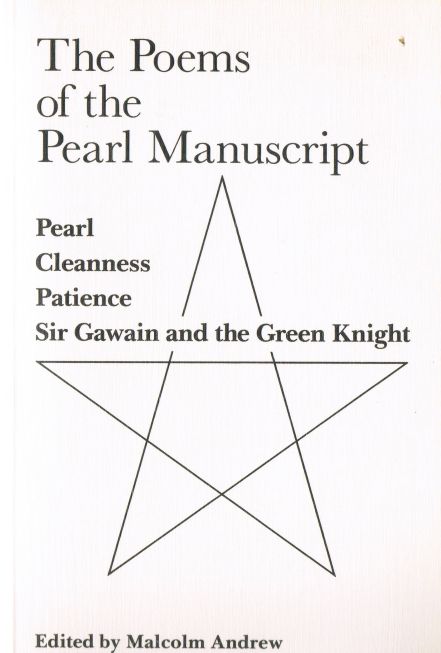
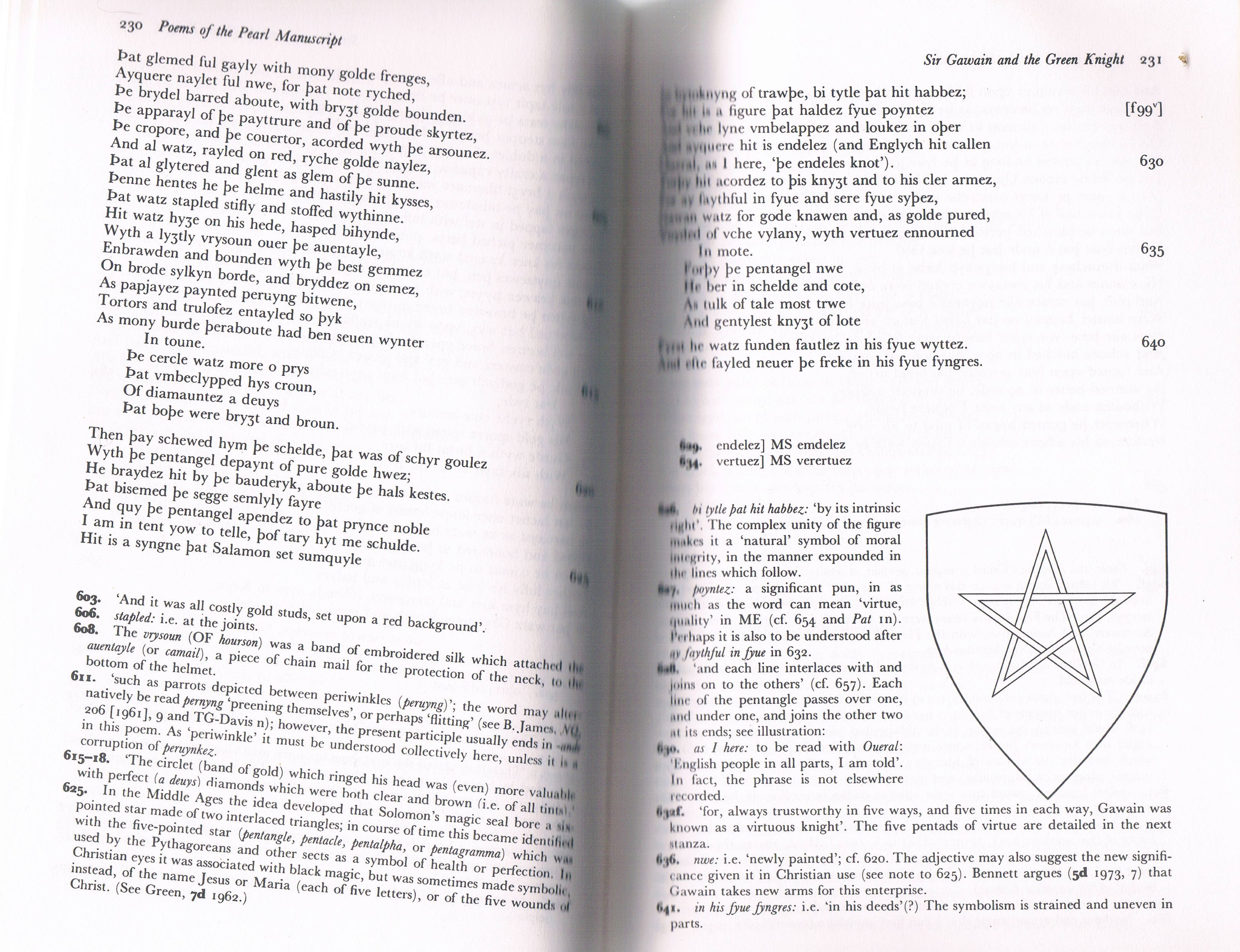
To be fair though, there is one unambiguously positive female in SGGK. And her name is Mary. And she is associated with the pentagram, which, as all readers of The Da Vinci Code know, represents Venus and the sacred feminine. Gawain bears a pentangle on his shield. He wears the pentangle because, as an endless knot, it represents the perfection he aspires to as a knight. The five points also have symbolic significance. Gawain is said to be faultless in his five senses; he never fails with his five fingers; he puts his trust in the five wounds of Christ; in battle, he receives strength from contemplating the five joys that the Virgin Mary had in her son; he has five virtues (generosity, fellowship, purity, courtesy and pity). He is so devoted to the Virgin Mary that he has her picture painted on the inside of his shield (ll. 619-670).

So, there you go: SGGK does encourage devotion to Mary. Wait, that’s the wrong Mary, isn’t it? As with his references to the Holy Grail and the bloodline of Jesus, the Gawain-poet kept his theological unorthodoxy very well hidden indeed.
ES

References:

Andrew, Malcom and Ronald Waldron, eds. The Poems of the Pearl Manuscript. Rev. ed. Exeter Medieval English Texts and Studies. Exeter: U of Exeter Press, 1987. My apologies to Ronald Waldron, whose name got cut off the scan above.

Brown, Dan. The Da Vinci Code. New York: Anchor-Random, 2003.


Favorite souvenir from the TruthCon

February 6, 2011

I can almost guarantee you that none of the other conferences I’ll attend this year will have as nifty a badge!

RJB


The Week in Conspiracy (3 Feb 2011)

February 3, 2011

This weekend, I will be attending TruthCon, which brings together all sorts of energy healers and people interested in UFO disclosure and 9/11 conspiracy theorists and…oh, everything. It’s like a paradise for me and will likely be the most interesting conference I attend this year (all love to NeMLA and NECSS, btw!). Regardless, since I am going to be really busy this weekend, I thought I would write up the week that was weak a little early.

Forget two weeks ago. And last week. And three weeks ago. THIS week, without a doubt is the most important week in the history of the human species, if conspiracy theorists are right.

Conspiracy theory of the week:

Honorary conspiracy theory of the week:

Not a real conspiracy theory, but my brother totally got me with a facebook post about the GIGANTIC STORM OF DOOM (which, in the end, never materialized in St. Louis):

“NEWS FLASH!! Area Man Convinced Blizzard The Work Of Muslim Extremists: “I don’t know how exactly, but these fellas have found a way to manipulate our weather patterns. They really will stop at nothing to disrupt our American way of life.”

Well played, sir. Well played.

And that’s it for now, friends. I’m off into the breach!

RJB


Creation “Science” in the Writing Classroom

February 1, 2011

Several years ago, one of my writing assignments was for students to find an op-ed they disagreed with and write a rebuttal. One student picked as her article a letter from the editor of Nature or Science entitled, “The Logical Fallacies Creationists Make.” It was a list of about 20 arguments commonly heard from creation advocates (or “intelligent design” advocates) followed by a critique of each one. In my student’s paper, she first named each fallacy and then made it. For instance, in response to the old equivocation that “evolution is only a theory” (a scientific theory is not a “guess” in the sense that we colloquially use the term “theory”), she offered as a rebuttal, “But evolution is only a theory.” I decided, as I read her paper in horror, that I would add evolution and creationism to my list of forbidden paper topics–like “abortion,” “gun control,” and “campus drinking policies.”

Last semester, however, given that I was teaching a writing class called “Writing About Science and Pseudoscience,” it seemed irresponsible for me to avoid what is perhaps the most controversial and socially relevant pseudoscience in the U.S., intelligent design.

I also made it clear that I in no way intended to offend or comment on anyone’s religious beliefs (teaching at a public university, I was acutely aware of my responsibilities to protect the religious rights of my students). At the same time, a guiding tenet of my class was that if you make claims about the observable world and represent what you do as science, your assertions are open to scrutiny and evaluation, as all science is open to challenge. Indeed, nothing purporting to be a science can justifiably claim to be protected religious speech. So, I made it clear to students that I did not intend to critique “creationism,” but that I was looking specifically at “creation science” a.k.a. “intelligent design.”

I had selected two movies for students to watch about Intelligent Design. The first was Ben Stein’s Expelled: No Intelligence Allowed. The second was Judgment Day: Intelligent Design on Trial, an episode of NOVA that told the story behind the First Amendment case in Dover, PA. I had students watch Expelled first and then watch the NOVA episode. (Many students opted to watch these online or in their dorms instead of at the optional evening movie viewing sessions). Soon students started sending me emails indignantly protesting the treatment of advocates of intelligent design at the hands of “Big Science” (a term that Stein uses). One student wrote to me to ask about why people were being kicked out of labs, especially when they had good evidence and can prove it.

As you can see, one of the risks that you run when you teach using extraordinary claims is that some students may find the claims of propagandists like Stein convincing. But this is precisely why well-produced but ill-evidenced works should be addressed in an environment where all evidence is interrogated and all claims are challenged.

During the next class period, I discussed Expelled. I don’t like to simply lecture in a writing class–I find that the give and take of discussion is usually more productive–but Expelled leaves out a lot of information relative to a full understanding of the issues, including the state of evolutionary theory (very, very robust), and the status of intelligent design as a pseudoscience. In a nutshell, Stein’s argument is that Big Science is suppressing Intelligent Design, a viable scientific theory being practiced by reputable scientists, by denying ID proponents tenure, research and publication opportunities, in favor of what it knows is a failing theory (evolution) for ideological, probably atheistic, reasons. Stein argues that this is dangerous because it could ultimately lead to social abuses of the type perpetrated by the Nazis. My students agreed that this was a fair statement of the essential argument of the movie. We find in this thesis a number of testable claims, and in my lecture I took each one in turn.

It’s hardly a fair fight to put the cumulative weight of the evidence from so many scientific disciplines that suggest all life descended from a common ancestor against the bald assertion that “this animal or structure could only have been put together by an intelligence.” I sketched out the robust evidence that we have that suggests the deep, interconnected history of life on the planet, not a jot of which was mentioned in the movie. Indeed, the best argument that Stein was able to muster in the movie was a story by some supposedly maligned victim of the Big Science cabal that, after a few beers, evolutionists admit that the theory is in trouble. As we had already discussed the value of anecdote, my students asked a number of relevant questions, for instance, “Who said that and did you talk to them?” (Answers: They don’t say and probably not.)

A useful resource for teaching material like Stein’s is, as always, the National Center for Science Education. Their site Expelled Exposed is an invaluable compilation of background information, putting Expelled‘s claims in context, and satisfied most of my students, I suspect, that the claims of persecution were likely exaggerated. Another useful source about the wealth of evidence for evolution is Richard Dawkins’ The Greatest Show on Earth.

Later in the section on evolution, I included perhaps the most eloquent argument on behalf of design, William Paley’s Natural Theology, in which he develops the famous watchmaker analogy. I included it because students deserve to be exposed to the best arguments, not merely lame and deceitful ones like Stein’s. (In class, I suspended judgment about whether or not Stein was deliberately deceitful in the movie. When students asked, I said I didn’t know. At any rate, Stein’s intent was not the point.)

The last reading I included was a chapter of Richard Dawkins’ The Blind Watchmaker. While flipping through Dawkins looking for something suitable for the class, I found myself rejecting potential readings because of his tone, which can be, how you say, condescending and occasionally bracingly so? I did not want to offend my students, but it occurred to me that censuring Dawkins’ readings on the off-chance they would offend a student would give my students an inaccurate and decidedly biased view of the debate over the teaching of evolution, so I picked a chapter at the end of The Blind Watchmaker and ran with it.

Now, I realized that it was entirely possible that despite my best efforts to limit the scope of my lectures to creation science, a student might take offense at what I said and complain to my superiors. For this reason, I made sure to record every class and alerted my students to the fact that I was recording my talk.

Because I was especially interested in what the students thought of the talk about Stein’s movie, the first of six classes over two weeks, I used the peer-review and final project writing groups to allow students to submit their feedback anonymously. I asked them to email a paragraph to each group manager (my principle contact during the semester as they did their group projects) who would compile the responses into a single email without identifying information. The response to the lecture was decidedly positive, and I got a sense that students fell all along the religious spectrum between young-earth creationist to atheist (I didn’t ask).

Most surprising and pleasing about these responses was my students’ take on my own religion. When they ventured to interpret the lecture in light of what they perceived my religion to be, they revealed that they had no idea what my religious position was. Everybody who ventured a guess guessed differently, and that made me very happy.

Another choice I made that had an unexpectedly pleasant pedagogical outcome came about by giving a lecture about a controversial topic without taking hardly any questions–there were severe time constraints. By the next class students were bursting with questions and dying to jump in. I can say that without a doubt the most lively conversations I have ever had in my teaching career came in the period after I discussed Stein and the evidence of evolution. I played traffic cop, more or less, and let the students duke it out.

I won’t shy away from teaching evolution/ID again. It was one of the most rewarding, productive and invigorating subjects I have ever worked into a syllabus.

RJB


Guess Where I’m Going?

January 25, 2011

I won’t be writing about it much here, because I’ve been invited to write about it for a real, live skeptical magazine. I still might do a podcast about it here, but we’ll see what my schedule allows:

I’ve already been to a preliminary meetup held by the organizer, and it was very interesting. Apparently, saying that you can electrify women’s naughty chakras is actually an effective pickup line in some social circles. Clearly my sparkling personality, humor and preternatural wisdom is only worth so much against saying that you have the ability to deliver psychic thrills directly into ladies’ pants. Oh, well.

RJB


Conspiracy in the News

January 22, 2011

If the conspiracy theorists are to be trusted, it has been the most momentous week in the entire of global history, just like last week. And the rest of the world didn’t even manage to even notice. Shame on you, entire world.

Onto the news that is news to the rest of us:


Conspiracy Theory of the Week

Though it is in the spirit of the aflockalypse two weeks ago, this headline has a sort of “Beowulf is an anonymous medieval poem written by Robert Cotton in the 18th century”-quality to it (that’s an actual opening line from a paper Eve once received):

Wow. I mean. Wow.

RJB


Conspiracy in the News (15 Jan 2011)

January 16, 2011

Tonight I resurrect, like a twisted necromancer, a feature from my old website in which I take a look at the conspiracies that make our wacky world go ’round. Honestly, the conspiracy flies so thick and fast on the web that it is impossible for any single mortal to keep up with. This week, a lot of it has related back to the Giffords’ shooting, and, let’s face it, the shooter is bizarre: he has left tracks all over AboveTopSecret.com and believed that grammar was being used by the government as a method of control. If you see that much agency where there cannot possibly be agency, you are flying over the cuckoo’s nest.

Gordon Duff found a Jewish angle to the attack, because he is such a delight.

Before It’s News found five sinister reasons for the attack. (Misery is like porn to these people.)

The other major conspiracy theory story this week has been about animals “dying off” all over the world, starting with the aflockalypse in Arkansas. This of course is bullocks as similar incidents happen all the time; the only thing different this time is an especially fatuous news cycle. So, here’s the obligatory link to that conspiracy, with a dash of apocalyptic Christianity thrown in for good measure.

Mnookin’s new book, The Panic Virus, discusses how conspiracy theories can have deadly real-world effects.

Are the floods in Australia the work of HAARP? Of course not, but here’s a video with snappy music (btw, the comments are worth reading):

Also, discredited anti-vaccine fraud Andrew Wakefield was recently interviewed on Anderson Cooper and resorted to conspiracy theories to defend himself. Super-weak:

According to the Canada Free Press (in my experience, appending “free press” to your website’s name indicates “otherwise unpublishable”), secular humanists are using evolution to dismantle American democracy. Check out the CrAzY CaPs that the author “USES”!!!!

Liberty News Online issues a crazed statement of belief or something. I like where they describe the TSA as Nazis. The Nazis were primarily known, of course, for especially vigorous pat-downs. The bastards.

Fluoridation is still a controversial topic in certain sections of the undeveloped world. Like Wyoming.

Conspiracy Theory of the Week

The Zionists are behind the “new” astrological zodiac. Somehow they are going to copyright Ophiuchus and make a killing. This one was on the JREF forums, where goofy ideas often collide. It’s like an LHC of hilarity.

RJB


Conspiracy and Violence in Tuscon

January 12, 2011

I’ve been following the shooting in Arizona for the last few days, and I’m as disgusted as everyone else is, I’m sure. I’m reading with special interest because of how elements of conventional political conspiracy theories appear in the assassin’s truly disjointed and incoherent worldview.

The elements of truly run-of-the-mill conspiracist thought–at least the stuff that appears in Loughner’s youtube videos–are usually encountered as elements of larger, more complete and fleshed-out narratives. These narratives are really quite well developed, often repeated and reprinted verbatim. Elements in Loughner’s ramblings suggest exposure to a certain type of conspiracist thinking, the gold standard conspiracy: “No! I won’t pay a debt with a currency that’s not backed by gold and silver!” In its most general form, this conspiracy theory posits that BAD GUY (pick your favorite demonic Other: the Fed/international bankers/Jews/Illuminati/Boy Scouts) has taken us off of the gold standard in order to impose an easily manipulated fiat currency. In the most popular conspiracy theories, the bad boy is the Federal Reserve, who controls the entire economy, printing money and deflating the value of the paper money in your pocket. (There is far more wrong about this than I can reasonably write about in a quick blog post, but suffice it to say that it is not even the Fed that prints money, rather the Bureau of Engraving and Printing. Mega-fail. The Fed can infuse banks’ reserves with cash, but it can also reduce liquidity and does so often.) It’s probably worth mentioning that his statement, “No! I won’t trust in God!” immediately follows his statement about precious metals and that it is at least as much a reference to what is printed on US currency as it is religious expression.

Loughner also has an abiding fear of mind control. Often, this is found on the (super-way-out-there) extremes of conspiratorial thought. Mind control, in conspiracist circles, can range from media control (or just influence) of popular opinion, the softening of the resistance to suggestion through fluoridation, chemtrails or the quality of popular entertainment, to the implantation of subliminal messages in corporate logos and advertisements, to the actual taking over of minds by remote, telepathic or technological means. It includes everything from “political spin” to the belief that one is not thinking one’s own thoughts.

Other signs that Loughner has been influenced by established conspiracy theories include the brief list of favorite reads that includes Animal Farm and Brave New World, Mein Kampf and The Republic, all of which have some authority and currency in white supremacist and far-right separatist circles. Of course, he also includes the Communist Manifesto, which decidedly does not. It occurs to me that if Animal Farm appears on his reading list, he may have picked up notions about how mind control can be achieved through the use of language in Orwell’s other works, including 1984 (consider Newspeak, which is an attempt to limit the types of thoughts it is possible to have) or his 1946 essay, “Politics and the English Language,” in which Orwell confronts and criticizes “language as an instrument […] for concealing or preventing thought.” At the same time, I have no confidence that someone with the writing skills like those displayed in his videos or someone whose logic is so jumbled could even be considered a nihilist, since I can’t even be sure that he understood what he had read.

If you look back at Richard Hoffstadter’s classic essay, “The Paranoid Style in American Politics,” you see that he attempted to distance the “paranoid style” from clinical paranoia, arguing that the clinically paranoid perceived illusory designs against them personally, while people who participate in paranoid politics perceive threats against a nation and entire way of life. Loughner’s rantings blur these lines. Some of it is especially local and relevant to his life, “The Pima Community College police are unconstitutionally working.” But he also talks about his understanding of the Constitution and other large issues like the currency. Hoffstadter’s essay does not help us much here. I suspect that what happened in Tuscon could be described as the deliberate political act of a disordered mind, but I am at a loss to discern to what degree politics determined his decisions.

In his essay, Hoffstadter tries to make it clear that he does not equate “paranoid” politics with clinical pathology, but the blunt fact remains that the word comes with connotations that may be profitable to explore, and I wonder if there is not some sense in which we could justifiably call conspiratorial political thought pathological. (Of course, that would entail defining “non-pathological” political thought. Yikes!)

FYI, I am going to be bringing back my weekly conspiracy round-up soon. (I tell you, though, I am getting sick of reading about Julian Assange and the damned birds dying off.)

A thoughtful, extended, and ongoing discussion about the role of mental illness is going on at PLoS, at Neuroanthroplogy. Daniel Lende makes excellent points about not presuming that mental illness is the most important issue here. It’s probably the best thing that I have seen on this issue so far.

RJB

UPDATE:

It seems that according to the Washington Post that Loughner was involved with the message boards at AboveTopSecret, and that the people there also saw that something was demonstrably abnormal, even for that site. My favorite comment at the end of the article was a reply to Loughner: “they faked the moon landing yes .. but the mars rover .. i dont think so.”

Also, for Ken–linking Assange to the bird die-offs: HAARP killed the birds using alien technology, the acquisition of which Assange will disclose in the next group of documents. All of these are real theories.

RJB


Bug Girl reports on a different type of infestation…

January 12, 2011

If you visit Bug Girl’s Blog today, you’ll find a useful discussion about the Christian Identity movement, a peculiar racist subculture that holds the peculiar religious belief that the real Chosen People are America’s white males.

The Real Chosen People

The roots of this delusion can be traced back to beliefs that surfaced in England during the Empire, when believers saw their nation, as the colonial governor of Palestine, playing a special role in the fulfillment of divine revelation. This slightly patronizing view of Jews mutated in this country into the extremely racist theology that it is today. A great source on this uncanny evolution is Michael Barkun’s Religion and the Racist Right. I also recommend Chip Berlet’s extensive work on conspiracy and American politics.

RJB