A moment for me…

March 22, 2013

I used to blog at another site under a pen name. It was a great way to keep a daily tally of my exploits, and if I did not get around to my nightly post, I would feel guilty.

Not so much these days.

I only sort of miss the frantic bursts of commentary that I used to produce. The best thing about becoming a blogger was how it helped me snap a longstanding bout of writers block so that I could finish my Ph.D. Establishing a routine was essential to that. Now that I work primarily on themed projects, doing similar things here and on Skepticality, the Burzynski stuff, and at CSI on conspiracy theory (new article on Jesuits coming soon!), education stuff at the JREF Swift blog, well, the Virtual Skeptics is the one place where I get to do a little bit of everything, a new short little essay every week about whatever catches my fancy. But I don’t get to go off on my Wagnerian rants like I used to. It’s probably for the best.

But I’m tired. At this point, I essentially have two full time jobs, and only one pays. The thought of turning away from either of them hasn’t occurred to me.

So, what’s next? Well, I have NECSS coming up in a few weeks. That’s going to be a great long weekend. I went to the conference two years ago, and had a great time. This time around, I’m going to be participating in a workshop about the joys of multidisciplinary skepticism.  The cool thing about speaking is casually bumping into your heroes in the green room. I am looking forward to seeing a couple of British skeptics who will be speaking who I have never met or seen. I have so many books to get signed.

After that, well, the next big thing that I’ll be doing is TAM. This year, I’m involved in two events, a workshop and a thingy on the main stage. That’s very, very exciting, of course. There was a point way back in the day when I sort of had TAM in my mind as a long-term career goal. This is my second one, so I’m pleased as punch.

Ah, well. It’s late. 2:00 AM. Lots to do tomorrow too.

RJB


Linguistics ‘Hall Of Shame’ 1

March 17, 2013

Hi again, everybody!

At Bob’s suggestion, I’m presenting a new series of blogs on specific ‘fringe’ writers (idiosyncratic individuals rather than members of ‘movements’) on language matters (in his words a ‘Hall Of Shame’, though some of these writers are more worthy of attention than this terminology might suggest!).

1 JOHN TROTTER

One example of a deep-thinking person who developed his own idiosyncratic linguistic theories (and issued attacks on the mainstream of linguistics) is the psychologist and amateur logician John Trotter. Trotter was a psychology lecturer in Australia, and in the 1970s-80s he developed radical views on the logical and structural nature of language, and incorporated these into papers offered for publication and into his teaching. His most central focus was on the philosophical aspects of these matters, and one of his main foci within linguistics involved the development of links between the formalism of Chomskyan grammars on the one hand and the ‘predicate calculus’ of logic on the other. If Trotter’s main ideas are valid, much of the basis of linguistic theory and indeed some important aspects of contemporary thought on logic must be mistaken.

Trotter’s papers were rejected by editors and reviewers whom he regarded as inadequately informed, and he was allegedly discouraged from presenting his views to students. After that time he operated as a private scholar. He & I interacted at some length in the late 1990s, but his dogmatic approach to many of his key points does not encourage scholarly attention. (In addition, some of his claims regarding e.g. possible improvements in automatic translation appear to be contradicted by familiar linguistic facts.)

Some of Trotter’s main points involve direct criticisms of mainstream concepts. For instance, he holds that some key mainstream linguistic concepts such as ‘allophone’ and ‘phoneme’ should NOT be used; new formulations of the matters in question should be adopted. This stance involves his rejection in its mainstream form of the ‘emic/etic’ contrast (as in phonemic versus phonetic), which he instead treats as essentially a type-token relationship; for example, each phoneme is seen as a type and each of its allophones as a token of this type. Trotter’s objection at this point is associated in turn with his opposition on philosophical (ontological) grounds to some types of linguistic expression used to express the relationship between types and tokens (for example, he objects to definite descriptions such as the dodo as used to refer to a type, as in the dodo is now extinct). However, whatever might be the merits of Trotter’s philosophical points, his reasons for rejecting the mainstream formulations of the linguistic concepts in question here (‘allophone’ etc.) appear to involve a) a degree of misreading of mainstream linguistics (an allophone of a phoneme is NOT in fact the same thing as a token of that phoneme; it is itself a type, more specific and at a less abstract linguistic ‘level’, and has its own tokens, namely the individual instances where it occurs) and b) an exaggerated ontologically-based preference for one linguistic formulation of such matters over another (not uncommon in philosophical work based on linguistic facts; see below).

Trotter also rejects (mainly covertly, and in some specific respects) the linguistic non-prescriptivist approach to language adopted by mainstream linguists. He argues that certain kinds of formulaic expression of philosophical interest (for instance the logician’s For all X, X is Y = ‘all Xs are Y’, as in ‘all men are mortal’) are to be deemed ungrammatical even though they are the normal forms used by the relevant native speakers (logicians) in such cases. For all X, X is Y is seen as ungrammatical because there is no determiner such as that or the before the second token of X, which would be required in more everyday styles of English if the sentence were to occur (suitably modified) and to be deemed grammatical. For instance, in any other context one would not say For all lions, lion has paws, or even For every/any lion, lion has paws; the noun lion in the second clause would always have a determiner, as in that lion or the lion. However, this does not imply that it must have a determiner in the style used in the technical philosophical/logical domain in which such sentences normally occur. These sentences are NOT ungrammatical in context in any normal sense of this term (prescriptivist or descriptivist).

Trotter goes on to argue that because these expressions are ungrammatical they are also logically invalid – and that, because the issue at hand is central in discussions of logic, the whole basis of logic is thereby impugned. Indeed, the philosophical under-pinnings of contemporary logic and linguistics are grossly inadequate. Both mainstream linguists and philosophers would deny this. First of all, the linguistic features in question are found in only some languages. Not all languages even require determiners modifying nouns; for instance, Chinese and Russian do not. In fact, there are serious problems (albeit not always adequately acknowledged by philosophers) associated with heavy reliance upon linguistic data in a philosophical context, because the details of the constructions involved vary so much from language to language. And, even if it were accepted that ENGLISH sentences such as those cited were ungrammatical, it would thus be difficult to argue that some formulations were logically invalid on the ground that there was an issue with the grammar of the versions of these formulations as expressed in English but not in all languages. English and similar languages have no special status in this respect.

Indeed, the grammatical and logical statuses of expressions in any given language are very largely independent of each other. Grammatical issues can normally bring the logical status of expressions into question only if they involve the meanings of these expressions, for example by rendering them ambiguous or self-contradictory. Most grammatical anomalies (whatever their origin or the status ascribed to them) generate no significant ambiguity and certainly have no logical consequences. A form such as Jo go home (grammatically non-standard) is normally semantically transparent, and its ‘ungrammaticality’ (in contrast with Jo goes home, etc.) has no logical consequences.

For reading, see John Trotter, System of Rational Discourse: Vols. 1 (A Calculus of Attributes), 2 (Aggregates, ‘Numbers’ and ‘Sets’), 3 (Applied Arithmetic and Probability), 4 (A Calculus of Predictions and Propositions), (Aranda (ACT), 1995-6, and other works; see
bibliography with links to online versions at http://isbndb. com/d/person/trotter_john. html (accessed 2 February 2011).

Mark


Response to the release of Burzynski 2, Havanna Nights

March 14, 2013

On this week’s episode of the Virtual Skeptics, I replied to what was learned at the premiere of the new Burzynski movie. The text of my segment follows the episode.

This week, the new Burzynski movie premiered in San Luis Obispo, California. We largely knew what was going to be in the movie since a couple of trailers had been released, the patients who appeared had talked about the filming, and there was a sort of credulous review had appeared a few days ahead of time and I believe the director may have mentioned it on a PBS fundraising specual a few days earlier. So we had a pretty good idea of what our proxies should be looking for. We really wanted to see if certain people who had been filmed, like Amelia Saunders or Hannah Bradley appeared and especially what was said about them. We wanted lists of people who appeared, to see if we might be able to put together who said what. Most of these people’s stories are well known, and we doubted there would be anything new. Also our people took down key quotes that struck them as important, like “skeptics are hiding behind their BS free speech.”

This is my takeaway, after talking to the people who I know were there. We are wiggly little scumbags who are hateful and slimy. We ridicule the desperate and dying. Some of us are paid by big pharma. Others are deluded and think that we are doing good but are being misled. But make no mistake–and this was hammered home to me by everyone I talked to–we are to them pure evil.

One of my big concerns going into the movie was how I was going to be portrayed and whether or not I was going to receive death threats. That my family was going to receive death threats or that I was going to be harassed at work. I feared this because of a letter that, as you know, was sent to my employer promising that I would be featuring prominently in the Burzynski movie. Nobody asked me for my opinion or to give a statement or to respond or clarify; they went straight to my boss. Fine. I’ve had wacky people contact my employers in the past. I fully expect it to happen in the future. Clips of this show, episode 13, were included in the movie. This is the episode that was quoted in the letter on my university chancellor.

As it turned out, our faces were blurred, our names obscured, and our voices were altered. No real identifying information. Which, you know, I’m OK with. However, there are some problems here. 1) What was served by contacting my employer other than to scare me? How dare the filmmakers say that we’re terrorizing people when they are doing just that. 2) Someone asked me about a quote, “we’re coming for you, you little polish sausage you.” The thing is, the quote is patently absurd if my name is shown, something that everyone here jumped on, like I hoped you would during the original episode. That joking was not conveyed to the skeptics in the theater audience. This might be due to the fact that not only were we given scary voices but also that apparently every time we appeared scary music played in the background.

It’s clear that the reason I’m in the movie in the capacity I am, as chief bad guy, is because I’m on video talking about the Burzynski Clinic. And this leads me to another thing that Brian mentioned. That when we kind of appeared on the screen, they put up a title card type thing that said, “skeptical teleconference” or something like that, and that a woman at the end of the show, wanted to know, “How did you get this footage of these scheming skeptics?” Um….we publicize our show constantly? If you can’t have real clandestine drama, you might as well make it up. My favorite bit was a tweet that I got around this time where a new account who followed like 10 people I do said, “It’s really interesting when you talk about Burzynski on the show. Could you do that more?” Really, Eric? Do you think I’m two years old?

I am interested in ultimately seeing it. I’m asking that the producer send a review copy to the James Randi Educational Foundation so a proper review can be done.

Or you could screen it in Minneapolis. Next week works for me, Eric, if you’re free.

Another thing. News broke on the 7th of January in skeptical circles that the FDA was conducting an audit of the clinic. A patient in the movie apparently said that she had been receiving a brain scan when she heard that the Clinic was being investigated again. This means that material was added to the movie after the 7th of January. The Burzynski Birthday Fundraiser was announced by PZ Myers on the 6th. So there was more than enough time for the filmmaker to clarify exactly what was meant in that episode when I said that there was going to be a little present on his birthday. Skeptics evilly, and with malice aforethought, raised $14.5K dollars for St. Jude’s. We then challenged the Clinic to match us, and it didn’t. That the director did not mention this fact seems to me inexcusable, making us look like we are big meanos who hate babies and morality. This demonization is unfair and at the expense of the truth–if you ever read theotherburzynskipatientgroup blog you know whose side I’m on. If he used the video clip of us that he cited in his letter to my employer, about us bringing a “present” to Burzynski and knowing what it actually was without clarifying it, well, that just speaks to his regard for completeness and accuracy. No messiah should need such fudging. It suggests to me that he’s forcing evidence into a pre-existing narrative of persecution.

References:

PZ Myer’s announcement of the Houston Cancer Quack
http://scienceblogs.com/pharyngula/2013/01/06/lets-make-houston-cancer-quack-burzynski-pay/

The Virtual Skeptics episode that appears in the movie:
http://www.youtube.com/watch?v=IK-yF8w6nLo

RJB


Sleep Paralysis or Folk-Tale Motif

March 10, 2013

Consider the following hypothetical situation: a young woman is asleep in bed. She awakes but cannot move. She senses a malevolent presence near her. The being comes closer, pressing on her chest with a great weight. Now consider the following “real” account:

…Sarah came every night and sat upon some portion of the body [of her sister], causing great pain and misery. (Sidney S. Rider, “The Belief in Vampires in Rhode Island,” qtd. in Bell)

What was happening to the nameless sister? Was Sarah really a vampire attacking her in the night? Or was the poor girl suffering from sleep paralysis, perhaps exacerbated by sadness over her sister’s death? Or was it something else?

Many skeptics would immediately say that it’s a case of sleep paralysis, perhaps accompanied by hypnagogic or hypnopompic hallucination. During sleep paralysis, the brain is conscious or on the verge of wakefulness, but the body remains locked down. In addition to the paralysis, the sufferer may experience vivid and frightening hallucinations. These frequently involve an impression of a presence, often hostile. The dreamer may also feel as if he or she is suffocating.

Sleep paralysis is extremely common. Many people will experience it at least once in their lives. Some people experience if with some regularity. The experience can be terrifying and the hallucinations can seem very real. Many people swear that they are awake, and, in a sense, they are–more or less.

The experience of sleep paralysis varies over time and according to cultural expectation. In medieval and Renaissance Europe, people experienced demon attacks as they slept. The word “incubus” comes from the Latin “incubare,” to lie upon. While this may suggest the sexual nature of incubi, it probably originally referred to the feeling of oppression. According to the Oxford English Dictionary, the earliest use of of “incubus” in English is from Laȝamon’s Brut: there is a very numerous race–

heo beoð ihaten ful iwis

incubii demones.

ne doð heo noht muchel scaðe:

but hokerieð þan folke.

monine mo on sueuene:

ofte heo swencheð. (Brut, Cotton Caligula A 9, ll. 15782-7. Ed. Frederick Madden, 1847)

They are known, indeed, as incubus demons. They don’t do much harm, but they deceive people. They often afflict men in dreams.

It goes on to say the incubi “know” women and lead children astray.
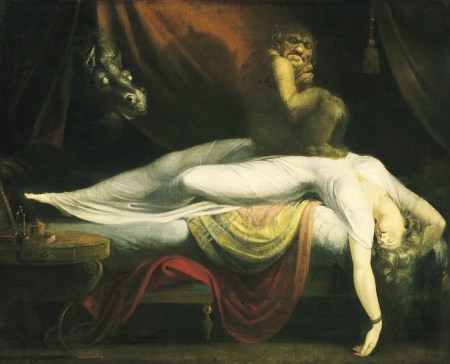
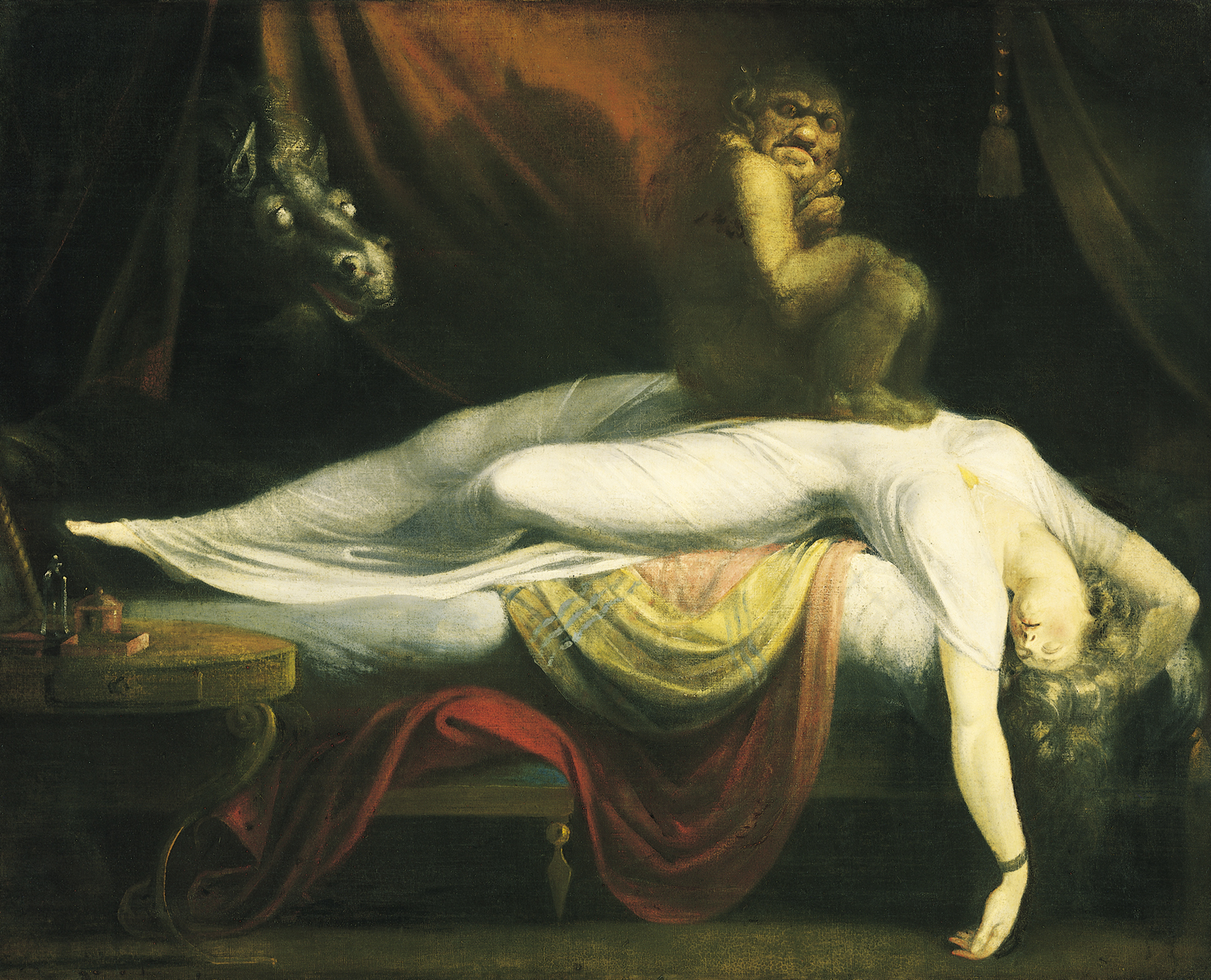
Fuseli, The Nightmare. Wikipedia

Fuseli, The Nightmare. Wikipedia

In eighteenth-century Serbia, vampires visited their victims at night:

In addition, the haiduk Jowiza reports that his stepdaughter, by name of Stanacka, lay down to sleep fifteen days ago, fresh and healthy, but at midnight she started up out of her sleep with a terrible cry, fearful and trembling, and complained that she had been throttled by the son of a haiduk by the name of Milloe, who had died nine weeks earlier, whereupon she had experienced a great pain in the chest and became worse hour by hour, until she finally died on the third day. (Visum et Repertum, tr. and qtd. in Barber 16)

Since the second half of the 20th century, the assailants have often been aliens, bent on abduction and examination.

About 18 years ago I had gone to bed just like any night. I do not take drugs or drink. I went to sleep and some time during the night I felt something crawling up on me. It started at my lower legs and was crawling up to my chest. I could not open my eyes. It felt like it was some kind of hoffed animal. I wanted to move but could not. I was thinking what the heck is this what is happening. It semed to last for a few minutes then the weight of this thing was gone. I then could open my eyes and there was nothing. (phenomenalog.com)

In some cases, sleep paralysis has been suggested to sufferers, but they reject the notion:

A woman named Ruth told me that the crucial event for her had been a nighttime episode in which she’d felt terror, been unable to breathe, and heard footsteps. I asked her if she thought the symptoms could have been related to sleep paralysis. “no–because, see, I wasn’t asleep when it happened. I was on the couch watching David Letterman.” (Clancy)

Are we, as skeptics, justified in dismissing all these stories as sleep paralysis? No doubt we often we are. Many instances almost certainly can be explained by sleep paralysis, and it seems likely that stories of night hags and night demons originated with the phenomenon of sleep paralysis, but the stories are so prevalent that they’ve moved from the world of physical phenomenon to the realm of folk tale motif.

A folk motif is a recurring and recognizable element in traditional narratives. For instance, a cruel stepmother is a motif that appears again and again in folk tales. Another is the supernatural being who helps the hero or heroine perform chores. In the 1930s, Stith Thompson published his monumental six volume Motif-Index of Folk Literature. Entry F471 deals with dream demons. F471.1 is the Nightmare or Alp which “presses person in dream.” There follows a long list of sources. F471.1.5 concerns

Persons who at night become nightmare. Those who are born on a Thursday and christened on a Sunday must at certain times (on Thursdays) press someone or something.

E281.2 tells of a “Ghostly horse [that] enters house and puts hoof on breast of sleeper.”

According to Carl Lindahl, John McNamara and John Lindow in Medieval Folklore, the assaults of the mara, nightmare or night hag

were always connected with a feeling of anxiety and suffocation. The mara was believed to oppress and weigh her victim down when tormenting and riding it. There is also an undercurrent of latent sexuality more or less manifest in the mara traditions.

Jan Louis Perkowski, professor of Slavic languages, has published extensively on Slavic folklore. He has collected numerous tales of suffocating demons. For instance, Canadian Kashubs speak of the mwəra or succuba. He describes it as “a night spirit which suffocates its sleeping victims” (34). Among the accounts he records:

The succuba chokes. They said that it was a child who was not baptized properly. This person walks at night and chokes others.

They said that when people went to sleep it choked them.

Succuba–They are unbaptized children who died before they were baptized. They come to a person and they choke a person in the night….

A succuba is that which chokes people. She could crawl through a keyhole. Someone said that, while a succuba was choking them and then they grabbed, sometimes it was like a ball of wool and then it disappeared.

My brother Frank also caught one. A succuba, nightmare, also choked him. He had to sit up and not go to sleep on the pillow, so that it would come to him. He said that a man all matted with hair came to him, and he caught it.

The succuba had to be a person. It would come and choke you at night. Sometimes it was a neighbor. (Perkowski 35-6)

Demons, night hags, witches, ghosts, vampires and now aliens. All have attacked and suffocated victims in the night. It seems odd that we label all of these cases “sleep paralysis.” The Wikipedia entry on sleep paralysis has a section on “Folklore,” listing folktales from all over the world. A New York Times article attributes all sorts of folklore to sleep paralysis, as does a Skeptical Inquirer article by Susan Blackmore. Were all the victims suffering from sleep paralysis? Probably not. I have no doubt that sleep paralysis served as the origin of the motif, but the motif has grown beyond the physical phenomenon. It’s become a part of the story of beings that attack in the night, and it’s been a part of the story for a very long time.

This is not to say that people who tell stories of a great weight on their chests are lying or adding that element to the story because they think they should; however, the experience has become an expected element. We know that cultural expectations shape perception and memory. For instance, it has been suggested that some of the elements of Betty and Barney Hill’s alien abduction accounts were subconsciously based on science fiction television programs and movies. Certainly, the Hills’ story has influenced other accounts of alien abduction.

The very fact that experiences that would have once been perceived as demon attacks are now interpreted as alien visitations suggests just how much cultural expectations influence perception.

To return to the case of Sarah the vampire and her sister: this story is one of the earliest of the New England vampire cases. It concerns Stukeley “Snuffy” Tillinghast and his fourteen children. His daughter Sarah died of consumption, followed by several other family members. The bodies were exhumed. Only Sarah’s was found to be undecayed. Her heart was removed and burned. The deaths ceased (after one more).

The story of the Tillinghast family was recorded nearly a hundred years after the events described, in Sidney S. Rider’s 1888 article, “The Belief in Vampires in Rhode Island.” Folklorist Michael Bell researched the stories and found some information that corroborated Rider’s story: Tillinghast did have fourteen children, and several, including Sarah, died of consumption in 1799. There were also discrepancies: Rider says half the Tillinghast children died, but, in fact, only four or five died. Rider also says Sarah was the oldest child; she was actually the tenth. Enough of the story was corroborated that it is plausible the bodies were exhumed and that Sarah’s heart was burned.

However, there are elements of Rider’s story that are pure folklore and cannot be true. Some of these folkloric elements involve dreams. At the beginning of the story, paterfamilias Snuffy dreams that he has an apple orchard (which he did) and that exactly half of it died. This dream is presented as an omen of the death of exactly half of his children. Aside from problems of interpreting a dream as an allegorical prediction–or postdiction–the dream simply isn’t accurate: Snuffy lost plenty of children, but not half.

And then there are the sleep paralysis dreams. We’ve seen that an unnamed sister dreamed of Sarah sitting on her body. This was a “continual complaint” that occurred every night until the sister died.

So it went on. One after another sickened and died until six were dead, and the seventh, a son, was taken ill. The mother also now complained of these nightly visits of Sarah. These same characteristics were present in every case after the first one. (Rider qtd. in Bell)

Seven people, six siblings and their mother, dreamed every single night that Sarah visited them and pressed on them. Each of them had these dreams until they died or, in the case of the mother, recovered. These dreams, though they sound like sleep paralysis, cannot be explained by any real physical phenomena. It is not plausible that the family could have shared so many hypnopompic hallucinations. Like the prophetic dream, these dreams belong to the realm of folklore, not neurology.

This case is extreme and was no doubt intentionally embellished by a professional writer. Nonetheless, we should keep in mind when we hear tales of alien abduction that folklore may be at play as well as sleep paralysis.

ES

REFERENCES:

Barber, Paul. Vampires, Burial, and Death: Folklore and Reality. New Haven: Yale UP, 1988.

Bell, Michael E. Food for the Dead: On the Trail of New England’s Vampires. Middletown, CT: Wesleyan UP, 2001. Kindle ed. N.p.

Blackmore, Susan. “Abduction by Aliens or Sleep Paralysis?” Skeptical Inquirer May/June 1998.

Clancy, Susan A. Abducted: How People Come to Believe They Were Kidnapped by Aliens. Cambridge: Harvard UP, 2005. Kindle ed. N.p.

Kristov, Nicholas D. “Alien Abduction? Science Calls It Sleep Paralysis.” New York Times 6 Jul. 1999.

Lindahl, Carl, John McNamara, and John Lindow. Medieval Folklore: A Guide to Myths, Legends, Tales, Beliefs and Customs. Oxford UP, 2002.

Perkowski, Jan Louis. Vampire Lore: From the Writings of Jan Louis Perkowski. Bloomington, IN: Slavica, 2006.

Thompson, Stith. Motif-Index of Folk-Literature: A Classification of Narrative Elements in Folktales, Ballads, Myths, Fables, Mediaeval Romances, Exempla, Fabliaux, Jest-Books, and Local Legends. Rev. ed. Bloomington: Indiana UP, 1955.


Virtual Skeptics (Show 29, 6 March 2012)

March 6, 2013

RJB


Burzynski Movie to Air on Public Television? Get a physician on during pledge breaks!

March 3, 2013

On March 7th, PBS station CBT12 in Colorado is going to air the hagiographic Burzynski: Cancer is Big Business. CBT12 is notorious for using conspiracy theories to raise money at pledge time. It’s a cheap tactic. Last year, they aired the AE911 Truth movie during pledge week. It’s lucrative. Most conspiracy theorists, while they openly distrust mainstream media outlets, seem to yearn for the respectability that comes from being broadcast on them. And when their stories appear on CPT12, and I say this because the station continues to push this garbage, it seems that the conspiracy theorists reward the station.

I have come to expect the exploitation of ignorance on the part of CPT12. When it’s a truther movie, well, it makes PBS look bad, but that’s about it. But this movie has led so many people into Burzynski’s clutches, gotten so many patients entangled in his unpublishable trials and quack “gene therapy”, that I can say with a high degree of confidence that CPT12 is BANKING ON ITS VIEWERS’ LIVES.

Worse, at the breaks in the film, Eric Merola, the guy who contacted my employer in December, will be appearing alongside a spokesperson for the clinic to talk to the station’s fundraising director. This is unacceptable. Nonetheless, CPT12 has taken down misleading alt med propaganda before, so it is worth taking a strong stand and lobbying that they follow precedent and take this down.

Most importantly, one should contact Colorado state legislators who are also cancer survivors and alert them to this upcoming travesty, including state senator and esophageal cancer survivor Rollie Heath (rollie.heath.senate@state.co.us(303) 866-4872, fax: (303) 866-4543) and state representative and breast cancer survivor Dianne Primavera (dianne.primavera.house@state.co.us(303)-866-4667).

You might also contact the station, and demand that they either change their schedule or have an independent physician appear with Burzynski’s toadies. You know, because it’s a medical issue and a movie director and PR guy can’t add anything meaningful to the discussion.

Shari Bernson (she’s the host between breaks)
Director of Development
sbernson@cpt12.org

Willard “Wick” D. Rowland, Jr
President & CEO
wrowland@cpt12.org

Station:  (303) 296-1212
Toll-Free:  1-800-727-8812
Fax:  (303) 296-6650

Also, please register a complaint with the PBS ombudsman about the movie being aired at all and this weird little station’s repeated tarnishing of the name of public broadcasting:

http://www.pbs.org/ombudsman/feedback.html

We are making only reasonable, responsible requests. PLEASE follow through and contact the station and the PBS ombudsman.


Robert Steven Thomas’s Intelligent Intervention

February 26, 2013

Here is a transcript of my segment on this week’s Skepticality:

A (Sort of) Review of Intelligent Intervention by Robert Steven Thomas

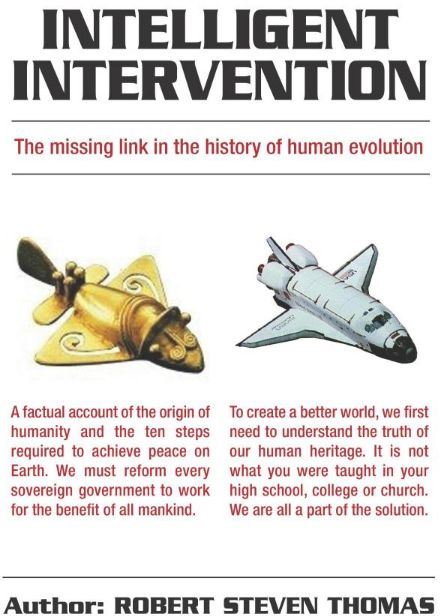
Several months ago, at the Paradigm Symposium, a conference in Minneapolis devoted to the ancient alien hypothesis, during a question and answer session following an especially credulous presentation about Velikovski, I identified myself in front of the crowd as a skeptic with a capital S. After the session, a gentleman came up to me and seemed very interested in talking. His name was Robert Steven Thomas, and he the author of the book Intelligent Intervention: The Missing Link in the History of Human Evolution. After a cordial conversation, he got up to leave. We shook hands and he left the conference hall. A few minutes later, one of conference organizers who had issued me a press pass, came over and handed me a copy of Robert’s book. On the inside cover, it read:

“To Bob. A pleasure to have met you. Please read and the “have at it”! I’d be honored to hear your response. Warm regards, RS Thomas.”

I appreciate the gesture though, to be honest, I’ve been very busy in the last few months, so it has taken me a while to get around to looking through the book. And even then, you know, I’ve done most of my public work examining conspiracy theories. An ancient alien book is a little outside of the scope of my expertise, though I do find the idea of ancient aliens fascinating, if vanishingly improbable.

The book is written around the premise that the mainstream and academic understanding of human history is hopelessly flawed. What Thomas calls the “history establishment” is governed by dogmatism, he argues, and that it “monitors and controls what is commonly taught as history” (15). He uses this, I believe, as an explanation of why one does not see the ancient alien hypothesis in reputable journals, as he launches into a condemnation of the peer-review process. He describes peer-review as a subjective process, based on cronyism, run by people with a vested interest in maintaining the status quo. “As a result,” he says:

there have been valuable discoveries made in the last half-century that profoundly change history which, regrettably, have not gotten the proper attention and focus they deserve or seen publication in scientific journals because of the inequities in the peer review process. In the majority cases, the personal interest and ambitions of a few select individuals stand in the way of the open scientific discourse and dialog with which they have been called upon to champion and foster. (16-17)

He holds out Heinrich Schliemann, who, the story goes, used a copy of Homer’s Iliad as a guide to find the location of Priam’s Troy in 1870, as an example of an outsider defying the establishment and making great finds on his own. But he seems unaware that there are some real problems with Schliemann’s account of the discovery of Troy. Not the least being that the site he eventually dug at was originally identified as a possible candidate for the location of Troy in 1822—nearly 50 years before Schliemann’s find, that an amateur dig specifically looking for evidence of Troy had been ongoing at the site for seven years by the time Schliemann arrived, that the amateur archaeologist leading those exploratory digs, Frank Calvert, suggested to Schliemann that he poke around in the Mound of Haslarik, that of the several layers of debris found at the site Schliemann misidentified the one that is now thought to be Agamemnon or Priam’s Troy, that in his enthusiasm, Schliemann destroyed much of Priam’s Troy, that the hoard of so-called “Priam’s Gold” that was uncovered did not date from the Early Bronze Age, or that Schliemann privately absconded with the gold artifacts that he found there. Even if Schliemann’s account of the discovery were true, that merely interpreting the Iliad literally led him to the site of Troy, it does not follow that anything else that happens in the Iliad literally happened. Heck, even if he read the Iliad like a treasure map and found Troy, it doesn’t even mean that the Iliad is a good treasure map. Schliemann may have simply gotten incredibly lucky.

Personally, I feel for alternative knowledge scholars, and I suspect that it is immensely frustrating to find their work unrecognized. So, in the spirit of reciprocity for Thomas’s thoughtful gift, I feel I should offer back some advice, three points, about how to adapt alternative messages and methods so that they are more likely to receive a hearing and consideration from academics.

1) First and above all, specialize. A characteristic of ancient alien theorizing is to draw on a vast numbers of disparate and far-flung cultures, finding a few apparent similarities, and positing a common context for those similarities. But in creating a new context for archeological and historical finds, their analyses often fail to benefit from the explanatory power of the immediate context of historical finds. For instance, take the image on Thomas’s cover, a space shuttle juxtaposed with a gold bit of jewelry from the Museo de Oro in Bogota:

Thomas

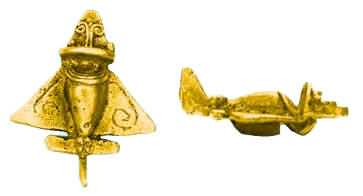
This juxtaposition suggests that objects with vastly different contexts share some sort of function. In fact, even the similarities are a matter of perspective. As you can see below, a profile shot of the jewelry shows that it is decidedly un-shuttle-like.

sar_7gl2

But when you understand that this bit of jewelry was found among a collection of stylized bugs, lizards and birds, none of which is out of keeping for jewelry of the time, suddenly the ancient alien explanation vanishes. It’s not actually an anomaly. A specialized understanding of local context of historical finds is crucial to generating credible hypothesis. As it stands, alternative scholars know a little bit about a lot, but not much about anything in particular.

2) Cite your sources in the text. When I teach research and writing classes, I describe footnotes and bibliographies as, in part, a courtesy to the interested reader. If someone, say a peer-reviewer, is genuinely interested in following up on a point that you have made, we need to know exactly where that came from, and it is your job as an author to at all points to show us all of your work. Depending on how you do it, it may be clunky and distracting, and god knows that it’s a huge pain in the neck to create a good bibliography or index if your research method does not anticipate it, but it is worth it to the reader.  When reading Intelligent Intervention, for instance, when Thomas says that an alternative understanding of history is “well-established” I want to know WHO SAID THAT so I can follow up on it. The bib at the back of each chapter is just not specific enough to be useful. When you say that the Indian Vedas say something about a spaceship, I want to know which line in which translation you are using, and I want to know now. Without citation, everything becomes as unhelpful as a bare assertion. Reverse engineering an author’s research is not a reader’s job.

3) Maintain civility. This should go without saying, but I’ve seen so many alternative knowledge authors display such vitriolic contempt for mainstream scholarship that perhaps it is no wonder that they have so little understanding of what it actually says and how they derived their conclusions. Scholarship is not a series of ex cathedra pronouncements about truth, which are, ironically, exactly what unsourced research is. Take, for instance, the opening of the fourth chapter of Intelligent Intervention, “Collective Memories,” which describes as “categorically incompetent” the dismissal of the Great Deluge when “almost every one of the world’s cultures, though scattered around the globe and separated by millennia and vast oceans, all share stories of these same ancient recollections.” Recollections of floods are to be expected all over the world because people all over the world need access to fresh water, which means rivers, which means floods, which means flood stories. An understanding about how orally transmitted stories tend to amplify memorable aspects of their stories at the expense of unremarkable content, easily explains how flood stories of global deluges are so common—the story itself is more memorable. But dismissing the vast amount of research about this process, indeed failing to display any awareness of this literature—is often why such assertions are dismissed. It’s not from ignorance, as alternative theorists suggest, it’s out of genuine expertise. Don’t ever suspect that the other side will ever take you seriously if you start out with “they are incompetent.” You might try, “I think that they are wrong,” then show you understand their argument, and then point out the flaws.

Like I said, I appreciated Thomas’s gift, and it’s an interesting look into alternative knowledge culture. But no matter how good their work is, alternative scholars will remain isolated from mainstream consideration if they don’t address these oversights.

RJB


animal languages 4 (non-historical ‘fringe’ linguistics 28)

February 24, 2013

Hi again, everybody! I’m concluding my section on alleged animal languages with some shorter sub-sections on specific topic areas.

BIRDS

The psychologist and zoologist Irene Pepperberg, who has collaborated with linguists, holds that the vocal behaviour of African grey parrots displays some of the characteristics of human language, and that they are capable of being taught to communicate using aspects of human language. One particular parrot (‘Alex’) reportedly acquired a 150-word vocabulary and used it in a sophisticated way, performing in a way similar to that of a two-year old child; he was also able to differentiate meaning and grasp features of syntax (and to count up to seven). Alex was learning the Roman alphabet and could indicate the names of fifty types of object when he died. Other parrots have demonstrated similar abilities. Pepperberg’s ideas have been reviewed in fairly positive terms. Against critics’ claims that Alex had been taught a ‘script’, she argues that the controls and tests which she used made it impossible for him simply to recite words when she asked questions.

Theodore Barber discusses bird communication mainly in terms of non-linguistic and paralinguistic systems, but endorses Pepperberg’s claims and argues that the general intelligence of birds is equal or even superior to that of humans (he likens it to that of cetaceans; see earlier). Robert Carroll recounts another case of an African grey parrot (‘N’kisi’) which can allegedly engage in conversation.

TEACHING HUMAN LANGUAGE TO NON-PRIMATES

Several studies have tested the ability of dogs to learn at least the vocabulary of human languages, especially nouns referring to specific, concrete items. Considerable success is claimed, but of course the more specifically ‘human’ aspects of language are not involved here. Another, linguistically more original proposal involves the Bliss Symbols. Of course, sheepdogs can be trained to respond to many distinct whistles, and indeed Robert Schusterman reportedly taught a sea-lion (related to the dogs) over 190 distinct gestures. (See also earlier on Fitch’s work on seals.) However, like the more modest passive repertoires of domestic pets, these abilities do not appear to be linguistic in a strict sense (see again earlier).

There is also, of course, a large corpus of wholly sober mainstream work on communication with such animals.

MORE EXTREME CLAIMS

There have been various papers in anomalist journals on the alleged apparently untutored use of human languages by cats, cows, goats, elephants, tortoises and fish; and on reports of humans using sponges for the recording and re-playing of human speech.

Others who have suggested that animals obtain information and communicate by ‘telepathic’ or other mystical means include figures as varied as Rupert Sheldrake, Ted Andrews, Henry Blake, Amelia Kinkade, Trisha McCagh, Arthur Myers, Ashleea Nielsen, Jim Nollman (on alleged wide-ranging inter-species communication though music), Joan Ranquet, E. Scott Rogo, Penelope Smith, etc. It has been suggested that dolphins in particular are strongly telepathic and can understand unspoken thoughts. Eris Andys presents an account of work with dolphins and whales inspired by that of Lilly (see earlier) but involving alleged psychic communication with these cetaceans and combining ideas adopted from Lilly with those of Peter Tompkins and Christopher Bird and of Stephan Schwartz and his ‘Mobius Group’; both of these groups of thinkers are advocates of the reality of psychic powers. Because of the nature of these claims, linguistic details are not normally discussed in the relevant texts; most of these claims are thus of only peripheral interest in this present context. However, Karen Stollznow offers a very useful skeptical review of claims regarding psychic pets.

There have been many sensationalistic reports on ‘the secret life of plants’ (see especially Tompkins as just mentioned), but understandably these seldom involve linguistic matters (though it is claimed by Tompkins that plants can be trained to count). There are also claims involving communication involving even stone and water.

Some reports of non-humans using language involve apparitions of entities interpreted as the spirits of deceased animals. One of the most striking cases involved the ghostly Manx mongoose known as ‘Gef’.

CRYPTIDS

According to some writers who accept their existence, some human-like mysterious animals (cryptids), notably the Himalayan yeti, the North American sasquatch, the Asian almas, etc. (which some writers equate to or liken with supposedly extinct human-like primates such as the pre-historic Gigantopithecus, or indeed Homo neanderthalensis), manifest linguistic or near-linguistic behaviour. If yeti, sasquatches and such exist, they would appear to be very closely related to humans, which renders the matter especially interesting.

Some reports attribute telepathic and associated linguistic powers to sasquatches. However, there are in addition more sober reports of what could be pre-linguistic behaviour involving these cryptids. Myra Shackley also summarizes reports of apparently pre-linguistic behaviour and/or attempts at communication with humans in rudimentary human language among the alleged humanoid almas of the Caucasus and Mongolia (but not among Himalayan yeti or the Chinese yeren). In Belizean folklore, the duende (unlike the other local humanoid cryptid, the sisimite) is explicitly described as able to speak. Until recently, there has not been sufficient data on any such cases which might be suitable for analysis; but I am now working on one such case.

Marius Boirayon reports (quasi-)linguistic behaviour among the supposed giant yeti-like creatures of Guadalcanal, Santa Isabella, Malaita and other islands in the Solomon Islands group; however, no concrete evidence is produced. Boirayon also expresses naïve
ideas about relationships between these creatures’ linguistic performances and the Fijian language (and has apparently naïve notions about language generally).

As ever, detailed references on request.

Are there any other general topic areas of skeptical linguistics which might be of especial interest? Let me know!

Mark


Bob and Eve appearing at TAM 2013

February 19, 2013

Yesterday, the James Randi Educational Foundation released the lineup for this year’s The Amaz!ng Meeting (theme: “Fighting the Fakers”) and Eve and I were honored to be announced as presenters. The speakers are truly spectacular, and I keep going back to remind myself how totally awesome it’s going to be. The keynote speaker will be Susan Jacoby, an excellent choice. It will be hosted again this year by George Hrab.

The current lineup includes:

  • Dan Ariely
  • Susan Blackmore
  • Russell Blackford
  • Elisabeth Cornwell
  • Jerry Coyne
  • Barbara Drescher
  • Reginald Finley
  • David Gorski
  • D. J. Grothe
  • Susan Haack
  • Harriet Hall
  • Sharon Hill
  • Marty Klein
  • Max Maven
  • Sara E. Mayhew
  • Steve Novella
  • Edwina Rogers
  • Massimo Pigliucci
  • Massimo Polidoro
  • Cara Santa Maria
  • Joe Schwarcz
  • Michael Shermer
  • Karen Stollznow
  • Jamy Ian Swiss
  • Banachek
  • Joshie Berger
  • Evan Bernstein
  • Bob Blaskiewicz
  • Bryan & Baxter
  • Chip Denman
  • Tim Farley
  • Shane Greenup
  • Miranda Celeste Hale
  • Kyle Hill
  • Daniel Loxton
  • Maria Myrback
  • Bob Novella
  • Jay Novella
  • Penn & Teller
  • Don Prothero
  • Stuart J. Robbins
  • Paul Provenza
  • Todd Robbins
  • Richard Saunders
  • Eve Siebert
  • Nakul Shenoy
  • Brian Thompson
  • Brent Weedman

The sheer number of books I’ll need to bring to get signed will take up most of my luggage space. And I’m FINALLY going to get to meet Daniel Loxton, fer crying out loud.

You will notice a number of the Virtual Skeptics on the program, because we are pretty much a year-round self-contained TAM party. As far as my contribution to the program, as I understand it, I will be participating in two events. The first will be a workshop for educators called “Skepticism Across the Curriculum” on Thursday morning (with Eve). The second will likely be a main stage event (possibly with David Gorski et al.) about fighting quacks, which is in keeping with the theme of the convention.

A lot of new faces and a lot of familiar ones. If you are attending, or just really wanting to experience it vicariously, get the Lanyard app, an excellent crowd sourced all-purpose multimedia virtual convention program.

I guess I should also mention that I will also be appearing at NECSS in just under two months. A lot of my superheroes are presenting there too. (How does this keep happening to me?) I’ll be doing an education workshop there with Marc David Barnhill. It promises to be an excellent weekend.

RJB


animal languages 3 (non-historical ‘fringe’ linguistics 27)

February 17, 2013

Hi again, everybody! Yet more on alleged animal languages: this time, non-primate mammals.

Some accounts of the use of ‘language’ or of ‘speaking’/‘talking’ on the part of non-primates, especially domestic pets such as cats and dogs, involve loose use of these terms, as discussed above. However, there are many reports, some more clearly non-mainstream than others, of animals other than primates displaying behaviour of a genuinely linguistic nature.

Of course, it is commonfor pet-lovers to over-interpret the quasi-linguistic performances of intelligent mammals such as cats. For example, my fiancée and I have a cat which often appears to call ‘Mam!’ [the Cumbrian word for Mum/Mom] ONLY when we are out of sight. Pre-theoretically, it would be easy to regard such enunciations as linguistic in nature. And indeed many writers have seriously advanced claims (mostly poorly supported) about the supposed quasi-linguistic abilities of domestic cats and dogs. See also later on the alleged teaching of human communication systems to dogs.

Much has been claimed about the communicative abilities of horses (communicating with each other or with humans) – and indeed about the therapeutic value of interaction with horses, especially for children who suffer from autism and similar conditions or have undergone trauma. It is suggested that, like autistic humans (by preference) and non-human primates (see earlier), horses think and communicate pictorially rather than linguistically.

Some of the ideas involved here relate to shamanism and other aspects of ‘New Age’ thinking, and the associated claims regarding horses are of varying degrees of plausibility.

Con Slobodchikoff’s study of prairie dog communication found both dialectal diversity (across three American states) and a sophisticated system of partly musical calls which differentiate even between human beings of different heights and in differently coloured clothing. Slobodchikoff proposes that prairie dogs can refer to other entities (including entities not present at the time of a call), abstract and generalize, and display innovatory usage; he even suggests that they may employ double articulation and syntax. This position appears seriously exaggerated.

Tecumseh Fitch discusses seals, which are able to imitate human speech sounds to a surprising degree. Fitch clearly knows linguistics to a high level, and it appears that his conceptualization and theorizing are sound; but even some of the more scholarly summaries of this work arguably do not adequately distinguish between phonation (the production of speech sounds) and spoken language (see above). Fitch does not claim that seal communication manifests all the key features of human language; for instance, he does not hold that it displays recursiveness, double articulation, syntax etc., and indeed he argues that such features are confined to human language.

There have been various claims regarding the linguistic and artistic behaviour of elephants, which (like some primates) can be induced to paint abstract pictures and may also have surprising mathematical abilities. One study regarding the linguistic or near-linguistic abilities of elephants was made in the context of a rather naïve acceptance of linguistic behaviour on the part of primates (see above) and cetaceans (see below); but given the apparent general intelligence of elephants such studies are not without interest in themselves. On the other hand, the claims for success in this case were modest. Some success was claimed in respect of signing and the use of Zener cards; but it is not in fact clear from the evidence presented that even these positive findings were genuinely valid.

Charlotte Uhlenbroek and other scientists acknowledge that elephants communicate among themselves using low-frequency sounds inaudible to unaided human ears; Katie Payne argues that these calls can be exchanged over great distances and often express personal relationships. Payne’s ideas are to a large extent grounded in personal emotions and in the acceptance of traditional African ideas regarding ‘telepathic’ communion between humans, elephants and other animals; as they stand, they appear too impressionistic and imprecise to permit rigorous testing.

There have been many claims, some fairly persuasive, regarding the linguistic and artistic behaviour of cetaceans, notably baleen whales and dolphins. These mammals’ main modes of communication are said to involve sounds at various frequencies, some of them inaudible to unaided human ears. It has also been argued that they can be successfully taught significant aspects of human language.

John Stuart Reid heads a multi-disciplinary team investigating dolphin communication (whistles and clicks) using a ‘CymaScope’. Dramatic results (allegedly proving that dolphins ‘have language’) are anticipated. An earlier Japanese study reported some success in inducing a beluga whale to develop its own vocabulary of high-pitched sounds to refer to specific, concrete items.

John Lilly (a supporter of the view that apes have been successfully taught significant aspects of human language) reports that bottle-nose dolphins in particular communicate among themselves by ‘painting sound pictures’ (compare the case of horses; autism in humans is again invoked here) and can be trained to communicate systematically using versions of human languages. Towards the end of his career, Lilly came to believe that some trained dolphins were actually communicating with him in English.

In addition to Lilly’s earlier, more sober account of the general intelligence and communicative potential of the small cetaceans, there is a body of early work in this area by Javis Bastian. There are various later writers who cite Lilly and develop his ideas or their own theories regarding dolphin communication. B.F. Sergeev focuses more especially upon the use of sonar by cetaceans in obtaining information, and also surveys material involving other non-human species. He is critical of Lilly’s excesses, and is among the few such authors who discuss the methodological issues involved in seeking to demonstrate the reality of complex and flexible communication systems among cetaceans and to determine their specific nature.

Theodore Barber (see later on birds) endorses rather stronger interpretations of the data in respect of the linguistic behaviour and capabilities of both larger and smaller cetaceans.

Ashleea Nielsen presents ‘New Age’ accounts of dolphin and whale mentality and communication in ‘telepathic’ terms. Heathcote Williams offers a highly personal and overtly partisan (anti-whaling) multi-disciplinary celebration of the great whales and their allegedly profound and spiritual intelligence and communicative abilities. Opposition to the whaling industry and an arguably sentimental identification with its victims are in fact salient features in the contemporary focus upon the supposed intelligence of these mammals. Wade Doak presents a somewhat more restrained but also very personal and committed account of the author’s interaction and communication with dolphins, including elements of ‘telepathy’ and such. Many other writers take similar sensationalist views of dolphins and other cetaceans.

As ever, detailed references on request. More next time!

Mark