Linguistics ‘Hall Of Shame’ 6

April 21, 2013

Hi again, everybody! ‘Hall Of Shame’ continues!

6 CHARLES BLISS

There are a number of interesting projects offering invented systems of written symbols (as opposed to invented spoken & written ‘auxiliary’ languages of the more usual kind), intended to be more systematic, more logical and more ‘in tune with reality’ than existing languages or scripts, and thus to improve thought and communication.

One such system is Charles Bliss’s ‘Bliss Symbols’, a philosophically-grounded, supposedly cross-linguistic ideographic writing system partly inspired by the Chinese logography (wrongly perceived by Bliss as itself ideographic and thus as more useful cross-linguistically than it in fact is). Bliss invented the system in the years following the Second World War; it is now controlled by Blissymbolics Communication International, based in Toronto. Bliss based his system on a supposedly universally valid philosophical analysis of human experience, rather after the manner of the inventors of a priori artificial auxiliary languages in medieval and early modern times.

For largely philosophical (ontological) reasons, the script focuses upon observables (‘photographables’), corresponding with ‘concrete’ nouns, and ‘filmables’, corresponding with actions and processes usually expressed with verbs; it avoids reference to abstract entities as far as possible. Not all critics would regard this limited ontology as adequately defended. (I will examine other aspects of this issue next time as they arise in the context of the work of other thinkers.)

Other philosophical issues also arise in the context of Bliss’s ideas. For example: in critiquing some English usage which he deems philosophically suspect, Bliss appears correct in distinguishing between two issues: that of the ‘copular’ use of the English verb be (as in be a boy), which he sees as mainly grammatical and thus as less dangerous, and the more specific and arguably more dangerous use of be with ‘evaluative’ adjectives such as bad (which remain ‘evaluative’ whatever the construction). But he goes on to contrast ‘evaluatives’ with adjectives or nouns importing objective (physical) qualities. This is not actually erroneous, but the boundary is not as obvious or as sharp as he may think. For example, whether ‘evaluatives’ do or do not themselves represent or relate to objective (non-physical) qualities depends on one’s theory of metaethics. Bliss is entitled to his own theory, but he cannot assume its truth. If he does, his formulations may exclude those who disagree. On the other side of this opposition, reference to physical characteristics, even though these are objective at a very detailed level, is subject to cross-linguistic and other variation, most obviously in terms of the classification of individuals into types and of more specific types into more general ones. Bliss makes his own assumptions here, some culture-/language-specific and some more personal. For example, he seems (though he does not make himself very clear) to exclude from his system the equivalent of Man is an animal, because he selects one sense of animal rather than others – and also focuses here on be meaning ‘be identical with’ rather than ‘be of this kind’ (which is surely the more relevant sense here in any case).

Bliss also appears rather scientistic in his apparent assumption that more scientific knowledge will provide agreed, clear definitions for all non-‘evaluative’ notions. In discussing mental events he adopts specific psychological notions (such as Id, Ego etc.) which are naturally contentious; this again seems to exclude those who have other views. It is also strange that he extends the symbol for ‘evaluative’ be to include cases where the attribute given does seem to be itself objective (such as male). It often remains unclear why Bliss believes that his particular decisions are the best or the correct ones, or, in some cases, even likely to be valid. (This is not to deny that some kinds of nonsensical or outrageous discourse – for instance, that of some dictators – can be defused by linguistic analysis. Scholars as different as Gilbert Ryle and C.S. Lewis have exemplified this, or at least have attempted it; but Bliss’ own formulations are not especially convincing.)

Bliss clearly knew more linguistics than some aspects of his approach suggest; but some of his comments on language are nevertheless linguistically naïve and/or confused. For example, he seems to assume that Subject-Verb-Object (the preferred word order in English and a common one in Chinese) is the ‘natural’ order, ignoring not only languages with other word orders (such as Welsh or indeed Latin) and ‘ergative’ languages such as Basque (where the categories Subject and Object are not really relevant) but even the commonly-used logical formulations which correspond with Verb + (Subject + Object).

More generally, in respect of inflectional morphology and basic syntax the system obviously has to select (in some respects) from among the systems found around the world). In addition, Bliss’ systematisation of derivational morphology would clearly involve major differences vis-a-vis most relevant languages, not merely in respect of the script. On the other hand, many of Bliss’ complaints about current language-specific usage do appear reasonable or at least arguable, and (if language reform on this scale were deemed genuinely desirable and feasible) a reformist might well seek to alter such things. Adjudicating on whether Bliss’ OWN solutions are the best available would require more detailed examination; but this is an especially arbitrary area of natural languages, and well-considered reform might conceivably be beneficial. More feasibly, such reforms might be introduced into novel spoken & written ‘auxiliary’ languages which might be linked with the Bliss Symbols.

Unfortunately, Bliss relies too much in places on particular, often idiosyncratic scholars, which misleads him; for instance, he accepts Otto Jespersen’s rather strange views on early language, possibly because of Jespersen’s own prominence in language reform movements.

Bliss’s intention was to develop a full international ‘auxiliary’ language, but, as noted, in the event he himself developed a script rather than a language per se. Later, his system was applied as an approach to communicating with disabled people, but he himself objected to this. Nevertheless, various groups have continued to apply the Bliss Symbols in this way. It has also been applied in the context of communication with animals.

There are many other such symbol systems, but most of them involve fewer specifically philosophical issues than the Bliss Symbols do.

On the Bliss Symbols, see the material issued by Blissymbolics Communications International, such as Blissymbol Reference Guide (Don Mills, ON, 1991); http://www. blissymbolics. us, http://www. blissymbolics. us/dictionary/ etc.; for the system, see http://www.google.co.uk/images?hl=en&source=hp&q=bliss+symbols&aq=f&aqi=g3g-v7&aql=&oq=&oi=image_result_group&sa=X. On applications to communicating with animals, see http://www. wikihow. com/Teach-a-Dog-to-%22Read-and-Write%22-Bliss-Symbols.

More next time!

Mark


False takedown claims filed against Burzynski critic…

April 18, 2013

Apparently, someone thinks that they are the only person allowed to have a public opinion about Burzynski in a moving picture, as false takedown order attributed by Google to Burzynski movie director Eric Merola’s production company has been issued against c0nc0rdance, who posted a very good video about the Clinic in February. Whoever did this, well, they done somethin’ ornery.

The thing is that c0nc0rdance didn’t use any footage from Merola’s stinky toilet movie, possibly because it makes all critical thinkers feel sticky and dirty.

This is intolerable. The video remains down on youtube, but a kind person has mirrored the video, and it is now spreading around the Internet. Well done! Here’s my part to fight bullying:

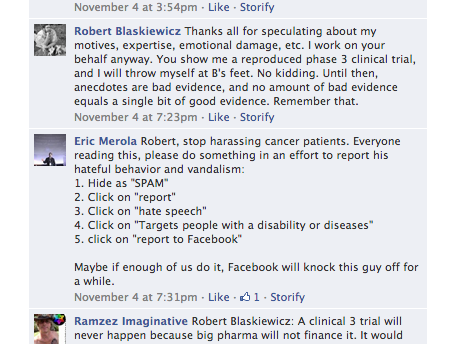
If it’s true, it is actually starting to become a thing with Merola. Merola once tried to have me kicked off of facebook by encouraging people to lie about me to admins, saying that I was directing hate speech against sick people. Really. He did that.

267110276850143232

You will remember that he is also the dude who contacted my employer about articles I had written and statements I had made, promised my employer that I would feature heavily in his shitty sequel, and then did not name me or show my face. It’s being a bully. It’s wrong. And every time he calls us slippery or dirty, I marvel at such a minimal level of self-awareness.

Lastly, he reportedly told an audience who had been subjected to his new flick that the reason people like me were not getting sued was because we’d make a big stink online and try to hide behind our “B.S. free speech.” This is perhaps the only thing he has been right about in public. Except for the BS part. That’s real, and you better realize it, kiddo.

RJB


Boston Marathon Conspiracy Theories

April 16, 2013

This is a preview of a report coming up on the live Google+ hangout webshow, The Virtual Skeptics, which will air in its entirety on Wednesday, 8PM Eastern at virtualskeptics.com. (It’s like Meet the Press with chupacabras.)

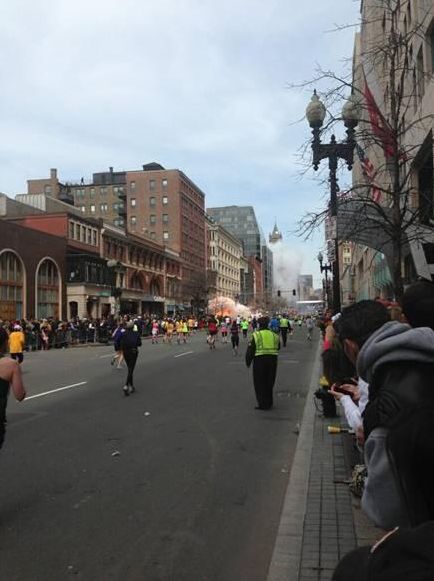
On Monday bombs went off at the finish line of the Boston Marathon. Of course, the police are keeping many details of the young investigation confidential, and that opens up a lot of airtime to speculate about who was responsible. This morning the news suggested that the investigation was trending toward domestic terrorism, so we’ll see if this line of evidence holds up.

But just because there is very little information available doesn’t mean that you won’t have wall to wall coverage, and this means that every little detail that was mentioned in front of a microphone will come under intense scrutiny and be tortured to the point of uselessness.

Actually, I see an opportunity here. Lately in the states, we’ve been getting weary of mass killings. I mean, it’s actually becoming dispiriting. And with that aggravation comes impatience with being fed crummy news, bogus analysis, and speculation. For me, it’s the false sense of confidence that the talking heads have that I find particularly irksome. And for that reason, I think, one group is finding itself increasingly despised, the group that is most sure of its boneheaded proclamations at times of genuine confusion and that regards human tragedy as a type of pornography: conspiracy theorists.

After Aurora and Sandy Hook many of us were plunged into a parallel twitterverse of conspiracy and paranoia. And you know what? The speculation is getting old. My first thought, was how is this going to be spun as an argument for gun control related false flag? Well, a false flag narrative seemed to arrive almost immediately, but Alex Jones and his cohort of sycophants and imbeciles, spun it in a surprising way, as a way of expanding the authority of the TSA into the streets. This is very odd. If you visit the TSA website you see that their mandate is to “protect the Nation’s transportation systems to ensure freedom of movement for people and commerce.” This means airport screening, baggage checking, bomb sniffing dogs, that sort of thing. They are not trained to execute martial law or patrol the streets; they couldn’t. The idea is as absurd as Alex Jones is loud. And absurd.

The first seed of a conspiracy theory came very shortly after the bomb went off just before 3PM. Within an hour and a half, a news outlet in Mobile mentioned that a local college cross country coach, Ali Stevenson who was participating in the Marathon had commented that there were bomb sniffing dogs on site before the explosion:

“They kept making announcements to the participants do not worry, it’s just a training exercise,” Coach Ali Stevenson told Local 15.

Stevenson said he saw law enforcement spotters on the roofs at the start of the race. He’s been in plenty of marathons in Chicago, D.C., Chicago, London and other major metropolitan areas but has never seen that level of security before.

“Evidently, I don’t believe they were just having a training exercise,” Stevenson said. “I think they must have had some sort of threat or suspicion called in.”

CNN reports a state government official said there were no credible threats before the race.

A major problem with his testimony, of course, is that he has never been in a race that exploded before. It seems only natural that salient measures of security are now receiving his attention after the Boston Marathon when they haven’t before. Basically, this is a post-9/11 world. There is security at all major events. The presence of bomb dogs is not surprising. Further I want to talk about “police spotters” on roofs. How does he know they were police spotters?

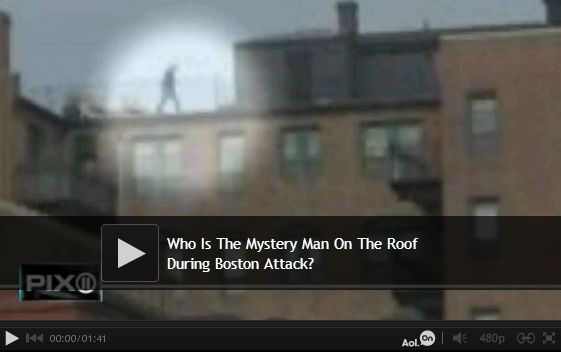
One person who actually was walking on a roof near the explosion has actually received a lot of attention on the Internet. Here he is:

ManOnRoof

What? You don’t see him? Here’s a close up of this sinister character.

Mysterymancloseup

I think it’s Bigfoot.

I understand that as much of the crime scene as possible needs to be documented, but that this guy was being circulated on twitter sort of befuddles me. There is nothing peculiar about someone being on the roofs along the Boston Marathon route. In fact, at the finish line, this is common. Actually the police had been enforcing rules against the gatherings after a young man fell through a skylight in 2011. So, it’s clearly not unexpected that there would be people on the roof.

One of Alex Jones’ defective correspondents, Dan Bidondi, managed to get into a couple of press briefings. First he asked what actually would have been a reasonable question. Had a threat been called in (referring to the Stevenson narrative of dogs and drills)? The answer? No. Security had been upped as a matter of course. At a later conference, the same guy asked the governor a question if it was a false flag operation to take away our civil liberties and let the TSA slip their hands down our pants. The governor said, “No, next question,” basically slam dunking the idiot back into irrelevancy.

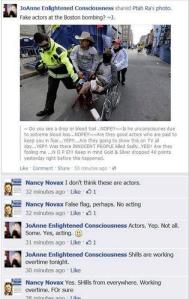
A trend being rehashed from the Sandy Hook conspiracy theories, and the idea of a “crisis actors,” which are supposed to be actors paid to act out drama. Take for instance this image, which comes from Peter Tierney’s collection of rather depressing facebook shots:

BombingHorrid

Crisis actors actually seem to me to be a manifestation of something that you often see in the conspiracy world, what Michael Barkun calls “fact-fiction reversals.” Conspiracy theorists see fiction as more real than reality, so they take the 1970s April fools “documentary” about elites secretly going to Mars (Alternative 3) as factual and think that aliens are putting story lines into the heads of Star Trek writers to prepare us for the alien invasions to come, while simultaneously believing that the news is being staged. For some reason, conspiracy theorists seem to be unable to believe in reality.

One last type of evidence that we see is searching for predictions of the event in popular culture. The only one I have seen so far is supremely cynical, in my opinion, which has to do with a recutting of a Family Guy episode so that it suggests Peter is detonating a bomb at the Boston Marathon. Seth MacFarlane has slammed the conspiracy theory, calling it “abhorrent.”

Actually, I’m hopeful that people are starting to pay attention to the horridness that is the conspiratorial mindset. One clever, civic-minded netizen grabbed up a number of likely conspiracy theory website domain names with the purpose of “keeping some conspiracy theory kook from owning it,” which gives me a small measure of hope.

RJB


Links:

The seeds of the Boston Marathon Conspiracy:

http://www.local15tv.com/mostpopular/story/UM-Coach-Bomb-Sniffing-Dogs-Spotters-on-Roofs/BrirjAzFPUKKN8z6eSDJEA.cspx

Alex Jones is horrid:

http://www.salon.com/2013/04/15/alex_jones_labels_boston_explosion_a_false_flag/

In the Infobunker with an Infochick. Also, Info.

http://www.youtube.com/watch?v=kQWH2epffQY&feature=youtu.be

“Hands in our pants” comment:

http://deadspin.com/the-first-question-for-the-governor-was-from-a-conspira-473064054

The man on the roof:

http://news.yahoo.com/blogs/lookout/boston-marathon-roof-man-mystery-012843805.html

Human toilet Mike Adams opines:

http://t.co/g9dzlrtprh

Family Guy predicted the bombing. Also, I hate Earth:

https://www.facebook.com/photo.php?fbid=328397323949106&set=a.220793581376148.48959.100003365224508&type=1&comment_id=739392&ref=notif&notif_t=comment_mention&theater

Seth MacFarlane replies to the Family Guy conspiracy:

http://tv.yahoo.com/news/seth-macfarlane-rips-edited-family-guy-clip-depicts-233737274.html


Linguistics ‘Hall Of Shame’ 5

April 13, 2013

Hi again, everybody! ‘Hall Of Shame’ continues!

5 VARIOUS WILD ANTIPODEANS!

Grahame Walsh, Ian Wilson and others have argued that the Bradshaw rock-paintings of the Kimberley in Western Australia, first seen by a European (Joseph Bradshaw) in 1891, can be attributed to a pre-Aboriginal Australian culture. The dating of these paintings has been heavily debated but they may be very early; and local Aboriginal people do not regard them as their ancestors’ work (or even as human in origin, though there are suggestions that their producers may have been the mysterious ‘Mimi’ people referred to in Northern Territory Aboriginal myths). Walsh argues that they represent the work of a pre-Aboriginal group who came to the area as long ago as 75,000 BP and developed the art-form during a sequence of cultures. He goes on to speculate as to where such a group might have originated, likening the art itself to certain African forms but more seriously suggesting that a negrito group such as those found on some Indian Ocean islands might have been involved. Such a group would later have been displaced or absorbed by Aboriginal populations. The movement of Aboriginal people into Australia appears to have been part of the earliest phase of Homo sapiens diffusion from Africa, and any suggestions that they were not alone in being the first inhabitants of Australia are obviously politically provocative (though they should, naturally, not be rejected on these grounds).

The controversial historian Keith Windschuttle (best known for his revisionist ideas about nineteenth-century Australia) argued, with Tim Gillin, in support of Walsh’s theory. Williamson and Gillin invoked some linguistic arguments; Colin Groves and Sean Ulm responded forcefully to Windschuttle and Gillin’s article from a mainstream anthropological standpoint; Gillin then responded in turn, denying the validity of some of Groves’ points and citing some more material by earlier authors (not linguists), including new linguistic arguments. However, these latter are partly based on Merritt Ruhlen’s ‘maverick’ ideas and are thus less persuasive than is suggested. In addition, the linguistic differences in the ethnically mixed area in question appear within normal variation limits for Aboriginal Australia. Of course, such mixing in historic times would be too recent for Walsh’s thesis, and probably too recent for Windschuttle as well.

In a very different vein, Rupert Gerritsen (of Dutch extraction) proposes that some groups of early Dutch sailors and passengers, marooned in Western Australia, had considerable influence on some of the coastal Aboriginal cultures. A fairly high proportion of the evidence offered is linguistic. This material has been informed by extensive reading in the discipline; but Gerritsen’s treatment nevertheless displays various naïveties and misconceptions. These include the usual popular but long outdated comparative linguistic methodology, use of minority/non-mainstream/outdated theories, very loose/inaccurate treatment of phonetics, phonology and spelling, implausible proposals on specific cases, some quite large factual errors, etc. The Aboriginal languages in question do seem to have some unusual features; but in most instances the case that these involve Dutch influence is not strong. (This is not to deny that Dutch and Dutch-speakers might have had some influence in the area.)

New Zealand was settled (by Eastern Polynesians, the Moriori and then the Maori) much more recently than Australia, to all appearances only in the last thousand years. The nineteenth-century writer Edward Tregear claimed to have proved that Maori, specifically, is related to Sanskrit and that the Maori and other Polynesians are really ‘Aryans’ who migrated to New Zealand from Europe via India. But Tregear’s linguistics was dated even in his own day; some of his claims appear ludicrous, notably his derivation of Maori verbs from the names of the associated animals, not themselves found in New Zealand: kauika ‘lie in a heap’ is said to be derived from Sanskrit gaus (‘cow’; cognate with the English word); the reference is to dung!

There is a body of markedly non-mainstream work regarding an ancient civilization and language known as Naacal, carried to Mesopotamia, Egypt and India in very remote ages by Mayan adepts, and a late-pre-historic world civilization centred on a Pacific continent known as ‘Mu’ (later submerged); Augustus le Plongeon and James Churchwood are the best-known exponents of these ideas, but many others have taken them up. Joan Leaf (recently deceased) was an amateur New Zealand historian and genealogist who accepted many of Tregear’s ideas and also accepted the reality of Mu, which supposedly gave rise to pre-Polynesian cultures in New Zealand and massive early diffusion more generally. In her self-published books, Leaf endorses Churchward’s ideas (including his claim that the Greek alphabet as recited is really a poem in Mayan!), and she regards Mayan as the language of Mu and the ultimate Ursprache. She uncritically treats orally transmitted stories and genealogies as very reliable, and her comparative linguistic and cultural methodology (shared with other current New Zealand diffusionists) is, as ever, far too imprecise and unsystematic; it reflects pre-scientific ideas.

Bryan Mitchell promotes the idea that there was Scots Gaelic settlement of New Zealand well before the eighteenth-century colonization. He upholds a diffusionist account of New Zealand history which minimizes the positive influence of the Maori, and accuses contemporary Maori of inconsistency in denying that some unearthed human remains and artefacts involve their own ancestors but still claiming control over them and thus preventing analysis. Mitchell believes that this involves a conspiracy involving politicians, academics and Maori activists, aimed at hindering the study of what they regard as strong evidence for pre-Maori settlement in New Zealand. This view is clearly exaggerated, although it is arguably true that it has become ‘politically incorrect’ to dispute the mainstream view that New Zealand was uninhabited until the Maori and other Polynesians began to arrive around 1000 CE. On the other hand, this is precisely what the evidence (reasonably interpreted) appears to suggest.

In respect of evidence which favours his own view specifically, Mitchell suggests that a number of Maori personal names and place-names used in Northland (the area north of Auckland) are in fact Gaelic-derived; he exemplifies with Gaelic Taine (ascribed to a Gaelic-speaking navigator who allegedly reached New Zealand) and Maori Tane (the name of a forest divinity), Gaelic Tara (used of high-set citadels) and Tara- as in the Maori region-name Taranaki, etc. He knows some linguistics, but his philology is of the usual amateur brand, and these examples are unsystematic and wholly unpersuasive.

References for specific writers on request! More next time!

Mark


Linguistics ‘Hall Of Shame’ 4

April 6, 2013

Hi again, everybody! ‘Hall Of Shame’ continues! I propose to include here some thinkers who for various reasons failed to ‘make it’ into my now-available book Strange Linguistics! There is always more ‘grist to the mill’!

4 ‘ALFERINK’

Like some authors discussed in Chapter 2 of my book, the Australian amateur author ‘Alferink’ proposes new etymologies for modern words which are held to be constructed out of basic, allegedly ancient individual sounds, syllables or other very short sequences; these have somehow retained fixed meanings (obscure to modern scholars and the general public) over long periods. I became aware of Alferink through a leaflet picked up at a ‘New Age’ street-emporium in Melbourne.

The main word of interest to Alferink is the very name Australia (for which alternative etymologies have also been proposed by authors such as Knapp; see Chapter 1 of my book). Alferink interprets Australis, the immediate source of the word Australia, as Au (‘gold’) + S (‘Sun’) + T (‘top’) + Ra (‘Sun’) + L (‘land’) + Is (‘is’). However, the form Australis clearly means ‘southern’ in Latin; and the form Australia (which first appears in English in 1625), has a clear associated meaning, ‘southern land’. Alferink does not offer any defence of his own interpretation against this very robust etymology.

Some of these very short morphemes appear to have been derived by Alferink from specific words or word-parts drawn from specific non-English languages. Thus, Ra is very close to the Egyptian name for the Sun-god, and Au is the international chemical symbol for ‘gold’, derived from Latin aurum. However, most of those consisting in orthographic form of only one letter are identified as each having the same meaning as a specific modern English word commencing with that letter. For example, S means ‘Sun’, T ‘top’, etc. It is not made clear why these specific words are selected rather than other words commencing with the same letters; but it appears that they may have been chosen in an attempt to explain the origin of the alphabetic letters used to write English, since the work is titled ‘Theory on Origin of Letters’. Alferink may have tried various different analyses of each longer word such as Australia until he came upon one in which he felt that meanings which he could ascribe to the individual letters together made up a suitable sense for the entire word.

Naturally, there are considerable problems with this theory. Firstly, Alferink offers multiple readings of some of the letters, inevitably if there are to be enough words of very short length to provide a vocabulary of adequate size (and compound words of manageable lengths). For instance, S may also be read as ‘swerve’. This obviously allows Alferink excessive freedom in proposing compound derivations for known, longer words. Secondly, it is not clear why, prior to the invention of the alphabet, the initial sound of a given word, or any other sound of the language in any context, should have suggested a particular letter-form. The forms of alphabetic letters are phonologically arbitrary; any motivation they have is semantic, by way of ‘acrophony’. (Acrophony involves the conversion of a logographic symbol to an alphabetic or abjadic letter representing the initial phoneme of the corresponding spoken word. For example, the form of the Hebrew/Phoenician abjadic letter beth (which later became Greek beta and Roman B) derives from a logographic (and pictographic) symbol resembling a house, which was used earlier to represent the Hebrew/Phoenician noun beth (‘house’), one very common word which has beth as its initial phoneme.) The idea that a letter-form can be explained in terms of the pronunciation of a word commencing with the relevant phoneme is wholly naive and confused. Overall, in fact, Alferink (like several other such writers) is naively folk-linguistic in treating letters rather than phonemes as primary.

Thirdly, the alphabet used to write English is of course much older than the English language; it developed initially out of regional versions of the Greek alphabet as a means of writing Latin, which is why it is called the ‘Roman alphabet’. Any explanations of the forms or pronunciations of the letter-names, or of the original pronunciations of the letters as used in words, must relate to Latin (or to Greek or the still earlier Phoenician), not to English, to which the letters were applied much later.

Fourthly, there are further unexplained complexities within Alferink’s system. He complicates the quasi-monophonemic morpheme-system (one letter per word-meaning) by introducing digraphs such as AB (‘original’; itself unexplained) and Au/Ra/Is (as cited above; the last of these is interpreted simply as the English word spelled in this way), and also other symbols, some established ones such as + (‘Christ’, etc.) and some novel ones such as a symbol for ‘woman’ representing a woman’s mammaries.

More next time!

Mark


Linguistics ‘Hall Of Shame’ 3

March 31, 2013

Hi again, everybody! ‘Hall Of Shame’ continues!

3 RONALD ENGLEFIELD (and others)

Ronald Englefield (1891-1975) was an English poet and philosopher. His major work,
Language and Thought, remains unpublished, though extracts appeared in the journal Trivium and this material is commented upon (often supportively) by other authors such as G. A. Wells and D. R. Oppenheimer. While Englefield’s specifically linguistic ideas have not met with wide acceptance, his criticism of religion and philosophy, published posthumously, was relatively well received.

Englefield was overtly critical of mainstream thought on language; he objected to the general pretentiousness and loose thinking which he found in much philosophical and linguistic work on the subject, and was especially critical of the effect on thinking of the use of words – in linguistics, literary criticism, religious studies and other philosophical domains – where they allegedly have no clear referent. Like Amorey Gethin (see my earlier comments), he went so far as to regard linguistics as a ‘bogus science’. However, Englefield’s skewed understanding of the writings of linguists (see below for an example) reduces the strength of his own claims.

On the origins of language, Englefield followed eighteenth-century Enlightenment thinkers such as Étienne Bonnot de Condillac, who argued that language evolved naturally from gestures. Englefield ‘explains’ how an animal little more intelligent than modern apes could ‘progress’ from a natural gesture language to invent a spoken and later a written language.

Some of Englefield’s views on these matters were opposed to those of other writers marginal to the mainstream such as Philip Ballard, who seem to believe (quite wrongly) that the grammar and other structural aspects of one’s first language are learned by explicit instruction (some of these writers, at least, appear to have been distracted by awareness of the teaching of STANDARD grammar to native speakers of non-standard dialects). In contrast, Englefield (though possibly confused in a broadly similar way; see below) argues that even modern humans can communicate WITHOUT the benefit of grammar.

Specifically, Englefield joined Wells and others in critiquing the linguistic ‘paradigms’ associated with Noam Chomsky. While Chomskyan thought does invite skeptical comment (again, see my earlier discussion), some of these critics of Chomsky are confused on some quite basic issues. For example: Englefield suggests (with Wells) that – if Chomsky’s view of the matter is correct – adult native speakers of a language who do not command the grammar of the relevant standard variety have either somehow FAILED to develop (pre-birth) the tendency to acquire grammar which Chomsky believes humans inherit, or HAVE acquired grammar but have then ‘lost’ or suppressed it. Wells and Englefield seem to have misunderstood what Chomsky means when he says that all normal human infants have access to a Universal Grammar (UG) enabling them to acquire the syntax and other aspects of their native languages very rapidly. The term grammar here (as elsewhere in linguistics) does NOT refer only to standard/formal grammar as taught in schools and socially endorsed as ‘good usage’ (etc.); it also includes the grammar of informal and indeed of non-standard usage as used naturally by many native speakers of each language. Native speakers who systematically produce non-standard forms have simply acquired a DIFFERENT grammar. The idea that non-standard or informal usage somehow LACKS grammar, while widespread among non-linguists, is folk-linguistic and does not stand up under careful examination; and Chomskyan linguists fully accept this.

The acquisition of the SPECIFIC grammars of individual languages (spoken or signed) clearly requires exposure to suitable data (as does the acquisition of their respective phonologies); not even a ‘hard-line’ Chomskyan would dispute this. However, some non-linguists (including some skeptics) assume that humans actually inherit some of the specifics of their parents’ or ancestors’ particular languages. Even a few scholars in relevant disciplines have adopted this stance, notably J.R.R. Tolkien, who was expert in philology (descriptive historical linguistics) but not in modern theoretical linguistics. Tolkien apparently believed, for instance, that he himself had acquired older varieties of English formerly used in his own home area (where his family had long resided) more readily than would students from other areas. No positive evidence of such effects exists, and, if they were genuine, they would in fact be difficult to explain in scientific terms. Children clearly inherit a language-learning propensity (specific, as asserted by Chomsky, or more general); but they obviously learn the individual languages, accents etc. used by their early carers and in their communities, and if they have no contact with their biological parents they know nothing of the languages used by them.

On Englefield specifically, see F.R.H. Englefield, Critique of Pure Verbiage: Essays on Abuses of Language in Literary, Religious and Philosophical Writings (G.A. Wells and D.R. Oppenheimer, eds) (La Salle, IL, 1990), and Language: Its Origin and Relation to Thought (Wilton, CT, 1977).

Mark


Hispter Demonologists and the Brotherhood of the Black T-shirt (Virtual Skeptics #32)

March 28, 2013

Now with extra Viking!

RJB (With thanks to Torkel for stepping up and filling in!)


A Letter to the PBS Ombudsman about CPT12’s Airing of “Burzynski”

March 26, 2013

On Friday, PBS Ombudsman Michael Getler responded to CPT12’s recent airing of the first Burzynski movie as part of a fundraiser. PBS has always been quite responsive to its critics, and this is something that I have not seen in many large broadcasters in the past. He contacted a lot of the interested parties at the station, the FDA, and CPT12. I have no doubt that Getler took this subject seriously, and I appreciate this very much.

Furthermore, Burzynski is not Getler’s fight. To understand the complexities and history involved takes a lot of work, far more than we could possibly expect of Mr. Getler. The station is not his responsibility, nor is it PBS’s role to censor a member station. This was clear from his first post in the run-up to the airing of the documentary.

That said, however, I do disagree with some of his conclusions. (You could see that coming a mile away, couldn’t you?)

Getler starts off:

[Burzynski] is a long program — two and a half hours, with about 45 minutes of that devoted to pledge drive discussions and promotions of the film. It is about the decades-long struggle of a Polish-born physician and biochemist, Stanislaw Burzynski, who set up a clinic in Texas in 1976, to achieve acceptance for a cancer-cure therapy based on a treatment he developed based on what he calls “Antineoplastons.” [ANP]

I submit this is already wrong. There is little evidence that Burzynski is at all serious about developing antineoplastons for wider marketing. If that were true, surely he would have managed to have completed and published a single advanced trial in 35 years. If you look at the trials he’s been required to register at clinicaltrials.gov, you see over 60 trials, 1 completed, and none published. NONE. This is important because he is restricted to giving his ANP in clinical trials. But he apparently abandons his trials, almost all of them. This is not normal. He charges patients out the nose to participate in the clinical trials. This is not normal. This is not the behavior of someone who intends to market the product widely later and expects a return on an investment. It sure looks like someone taking the money while he can.

I put the word “documentary” in quotes above because while the actual film does indeed document very well Burzynski’s seemingly endless battle to win acceptance and approval for his treatment against the FDA, National Cancer Institute, patent challenges and big pharmaceutical companies — and includes very powerful filmed interviews with cancer survivors who say his treatment (in Texas, where it was allowed) saved them — it doesn’t have the kind of critical other-side that one is used to in other documentaries.

That last part is true. the movie is one-sided. Of course, why this is might be more apparent if Mr. Getler had realized that Merola’s cousin was a patient of Burzynski (she later died, of course) and that Merola raised funds for his cousin’s treatments on his website. Merola is not impartial. He has skin in the game. He has sunk an enormous amount into Burzynski.

Mr. Getler mentions that Shari Bernson, the person responsible for the programming and who appeared in fundraising spots, described the movie as “controversial.” To someone on the outside, it may appear to be controversial. To someone who understands the science and process of publication and who has found endless descriptions of how patients end up making really, really bad choices out of desperation at that clinic, however, there is no controversy. The fact remains that after 35+ years, the Clinic has never produced a single reproducible result that would constitute the barest minimum for serious consideration among experts. It just hasn’t. Should that ever happen (I’m not holding my breath), then, hell, yes, we’ll be on board cheering the advance of science. But he has to play by the rules.

And this is important too, playing by the rules that all real researchers abide to. Part of the FDA’s job is to ensure that Burzynski’s people are doing this. And on February 7th, they were doing just that; they were in the facility inspecting to make sure that Burzynski’s team was playing by the rules.

In a FOIA release this week, the FDA revealed a number of things that had been found out and reported to the clinic by the time the movie aired. By law, the Clinic had 15 days to respond, so if they responded, it was before CPT12’s love-in. (The observational notes can be found here:  https://skepticalhumanities.com/wp-content/uploads/2013/03/burzynskiform483feb2013.pdf)

Two investigators observed:

  • “The IRB [Institutional Review Board] used an expedited review procedure for research which did not appear in an FDA list of categories eligible for expedited review, and which had not previously been approved by the IRB. Specifically, your IRB routinely provided expedited approvals for new subjects to enroll under Single Patient Protocols.” [2 adults and 3 pediatric patients are mentioned]
  • “The IRB approved the conduct of research, but did not determine that the risks to subjects were reasonable in relation to the anticipated benefits (if any) to subjects, and to the importance of the knowledge that might be expected to result. Specifically, your IRB gave Expedited Approval for several Single Patient Protocols (SPP) without all the information necessary to determine that the risk to subjects are minimized.” [4 examples follow]
  • “The IRB did not determine at the time of initial review that a study was in compliance with 21 CFR Part 50 Subpart D, ‘Additional Safeguards for Children in Clinical Investigations.’ Specifically, an IRB that reviews and approves research involving children is required to make a finding that the study is in compliance with 21 CFR Part 50 Subpart D, ‘Additional Safeguards for Children in Clinical Investigations.’ Your IRB approved research involving children without documentation of the IRBs finding that the clinical investigation satisfied the criteria under Subpart D.” [3 examples follow and there is a note that this is a repeat observation that had been found in an Oct 2010 Inspection.]
  • “The IRB did not follow its written procedure for conducting its initial review of research. Specifically, the IRB is required to follow its written procedures for conducting initial and continuing review. Your IRB did not follow your written procedures for conducting initial and continuing review because these subjects received IRB approval via an expedited review procedure not described in your Standard Operating Procedures. If your IRB would have followed your own SOP for initial and continuing review, the following subjects would have received review and approval from the full board rather than an expedited review.” [2 adults and 3 pediatric patients are listed.]
  • “The IRB has no written procedures for ensuring prompt reporting to the IRB, appropriate institutional officials, and the FDA of any unanticipated problems involving risks to human subjects or others. Specifically, your current SOP-2012 v2-draft doc does not describe the requirements on Investigators on how unanticipated problems are reported to the IRB, Institutional Official, and the FDA, such as time intervals and the mode of reporting, or otherwise address how the prompt reporting of such instances will be ensured.”
  • “The IRB has no written procedures [in the SOP-2012 v2-draft doc] for ensuring prompt reporting to the IRB, appropriate institutional officials, and the FDA of any instance of serious or continuing noncompliance with theses [sic] regulations or the requirements or determinations of the IRB.”
  • “A list of IRB members has not been prepared and maintained, identifying members by name, earned degrees, representative capacity, and any employment or other relationship between each member and the institution.”

You have to play by the rules. I’m not sure that this round of investigation is over yet, as the audience at the premier of the sequel was apparently told that the FDA was still on site. Researchers should not be playing fast and loose with the rules that protect children (a protected subject population, like prisoners and students–yeah, I’m IRB certified). There should be procedures in place to see that proper oversight and reporting of unexpected events is ensured. Hell, there was apparently no document even saying WHO was on the IRB!

This is not a report on a serious research institution. It’s more like the observations of the IRB of a clown school.

Back to Mr Getler’s letter:

On the other hand, Bernson’s sidekick on the in-studio, pledge-drive promotion who was interviewing the clinic spokesman, made me gag when she said, “I’m Rebecca Stevens and I’m proud to be a journalist who asks the hard questions.” There were no hard questions. [I believe the question that followed up this statement was, “What is peer-review?”–RJB]

And where Bernson may have gone too far, depending on who you believe, was in her statement that: “Antineoplaston therapy has had significant success rates with terminal brain cancer patients and especially in children.”

No, she went too far no matter who you believe, and his next paragraph demonstrates this:

The National Cancer Institute, reporting last month on Antineoplastons, said, among other things: “No randomized, controlled trials showing the effectiveness of antineoplastons have been published in peer-reviewed scientific journals” and that they are “not approved by the U.S. Food and Drug Administration for the prevention or treatment of any disease.”

Aaaand…how’s that controversial? In light of this, how could Sherri possibly be right?

My bottom line is that CPT12 obviously has a right to show this film.

Nobody questions that. What we wanted, and what was offered to the station, was the opportunity to have an independent oncologist in the studio at the time of the broadcast, you know, to stir up the kind of informed discussion the station says they want to have instead of settling for two True Believers talking to two CPT12 pitch people. When the station had that opportunity, they walked away from it. That’s indefensible. Especially when you consider that the people we are worried about, patients and their families, may NOT be as discerning as your average viewer, as CPT President Willard Rowland suggests in his response to the ombudsman:

“The program’s airing is grounded in the station’s mission, specifically those portions about respecting our viewers as inquisitive and discerning citizens, addressing social issues and public concerns not otherwise adequately covered in the community, and cultivating an environment of discovery and learning.”

Some of them haven’t had good news since their diagnosis. Then they hear that some lone genius with the cure for cancer is operating in Houston and they are on the next flight down. I’ve seen it dozens of times, and I have hundreds more patients on deck to write about. These are vulnerable, vulnerable people who deserve the best information from their public broadcasters.

I’m fairly disappointed by the tepid response, honestly. I have a hard time imagining that Mr. Getler, or Mr Willard Rowland for that matter, could possibly think that this program was anything but misleading if they spent a half hour at The OTHER Burzynski Patient Group, which chronicles, in patients’ own words, what goes on in that Clinic. All of the people told that getting worse is getting better (for decades being fed the same line!), the children having strokes (unrelated to their tumors) while on the medicine, the “terrifying” amounts of sodium that go into patients. The quasi-legalistic threats and phone calls to dissatisfied cancer patients. The untested chemo cocktails given to most of his patients. None of that was mentioned in the CPT12 fundraiser.

Of course, that’s not Mr. Getler’s fight.

RJB


Linguistics ‘Hall Of Shame’ 2

March 23, 2013

Hi again, everybody! ‘Hall Of Shame’ continues!

2 LAURA KNIGHT-JADCZYK

Laura Knight-Jadczyk (henceforth K-J) is a widely-read independent scholar with highly radical views on history and the nature of humanity. I encountered her work at a stall run by her supporters at the 2008 Unconvention in London, and approached her with information on her linguistic claims, which do not loom especially large but are important – and display some knowledge of the subject but a (temporarily?) incomplete grasp. For example, she accepts Iman Wilkens’ linguistically naïve equations of Greek and English river-names (in his revisionist book Where Troy Once Stood) as clearly valid, and wonders how linguists can justify ignoring his ‘obviously’ impressive success in correlating the two sets of names.

K-J was unwilling to be corrected here (pending further reading), whereas she was (surprisingly) more amenable to my exposition of mainstream reservations about the much less fringe but seriously (and increasingly) controversial theory that Indo-European and several other language families had a common ancestor (‘Nostratic’) spoken 10-12,000 years ago. This theory would fit in with her view (quite widely shared and not altogether unsupported) that there was a world catastrophe at that time caused by minor-planet impact.

More generally, K-J regards the more extreme revisionist/catastrophist histories proposed by Immanuel Velikovsky, Michael Cremo etc. as much more strongly supported by the evidence than mainstream scholars would allow. She holds, in fact, that all such seriously revisionist views are systematically suppressed by ‘the powers that be’.

By way of another specific (more philosophical) issue, K-J is strongly opposed to Judaic-Christian-Muslim monotheism, regarding it as balefully influential even on recent scientific & historical scholarship, and in fact as ‘psycho-pathological’. Saliently, she holds that it would be psycho-pathological even for a creator god to claim the right to allegiance and obedience. I myself agree that humans could legitimately resist such claims – partly because of the logical argument, best summarised by Bertrand Russell, that objective ethical truths (if any exist) cannot follow from religious truths (ditto). But, despite my own atheistic views, I suggest that a creator god, if (s)he existed, WOULD have a prima facie case here, unlike truly psycho-pathological human tyrants making similar claims.

On the other hand, K-J holds (obviously against skeptics and most scientists) that the evidence for spiritual and ‘paranormal’ entities of other kinds is overwhelming and should persuade even those who themselves have no awareness of divine or parapsychological forces in the world. But she also thinks it likely that some humans have a ‘soul’ which confers veridical awareness of these entities. Others (including skeptics) have no such awareness exactly because they have NO souls. (This idea is similar to the less dramatic claim that humans have a psychic/spiritual ‘sense’ but that some are ‘blind’ in this respect.) Souls probably arose by way of mutation in the process of evolution (her version of same!). But it is not clear how such entities as souls (if they can exist at all) could arise in this way (though see for example Stephen Goldberg’s view, expounded in his book Anatomy Of The Soul, that important aspects of a mind can exist after the demise of the brain from which it is generated). And the fact that even members of the same family may differ in respect of such awareness surely renders K-J’s specific position dubious.

K-J is also searching for a new form or aspect of linguistics which would relate to her ontology by way of being ‘hyper-dimensional’. She declined to attempt to explain this idea to me, seeing me as one of the soul-less and thus being permanently unable to grasp the concepts involved. (For her, humanity is doomed to remain divided on issues of this kind, where empirical evidence does NOT directly apply. The soul-less have an incorrigibly impoverished world-view.) She did suggest that semiotics might be identified with her ‘hyper-dimensional linguistics’, but this notion seems to reflect either confusion or a so-far unarticulated non-standard view of semiotics (it is normally taken to be the study of symbolism, with linguistics as one of its most major sub-fields, and thus to be wider in scope than linguistics but NOT at a ‘different level’).

K-J’s main work is her book The Secret History of the World (Grande Prairie, AB, 2008), her main web-site is http://cassiopaea.org/, and her publishing-house, Red Pill Press, is at http://www.redpillpress.com/, where other books by K-J and her associates can be ordered. The most recent issue of the Red Pill Press newsletter (available on enquiry) advertises a second volume of Secret History, Comets and the Horns of Moses. (K-J also had interesting views regarding the predictions of Zecharia Sitchin and others regarding the anticipated appearance in 2003 of the rogue planet Nibiru; see http://www.cassiopaea.org/cass/sitchin.htm.)

Mark


Virtual Skeptics, Episode 31 (20 March 2013)

March 22, 2013

This week on the Virtual Skeptics

  • Bob sacrifices Tim to the Illuminati for the success of the show;
  • Eve asks, “Got penis?”;
  • Sharon is mad Bob took her story so she is going to go watch television;
  • and Tim wants to see your papers – including your cash.

This Week’s Panel

  • Bob Blaskiewicz – CSI’s Conspiracy Guy web columnist, blogger for Skeptical Humanities and Swift Blog contributor
  • Eve Siebert – Editor and blogger at Skeptical Humanities and contributor to Skepticality
  • Sharon Hill – Editor of Doubtful News and author of the CSI’s Sounds Sciencey web column
  • Tim Farley – JREF fellow and creator of What’s the Harm.net and the Skeptical Software Tools blog and also contributor to Skepticality.

Bob’s links:

Eve’s links:

Other sources:

  • Ivan Crozier, “Making Up Koro: Multiplicity, Psychiatry, Culture, and Penis-Shrinking Anxieties,” Journal of the History of Medicine and Allied Sciences 67.1 (2012): 36-70.
  • Johan J. Mattelaer and Wolfgang Jilek, “Koro: The Psychological Disappearance of the Penis,” Journal of Sexual Medicine 4 (2007): 1509-1515.
  • Moira Smith. “The Flying Phallus and the Laughing Inquisitor: Penis Theft in Malleus Maleficarum,” Journal of Folklore Research 39.1 (2002): 85-117.

Sharon’s links:

Tim’s links:

Brian’s Robot links:

Announcements:

The Virtual Skeptics is an independent production of Doubtful News, WhatsTheHarm.net, Skeptical Humanities, and Brian Gregory. Our logo was designed by Sara Mayhew at SaraMayhew.com. Our theme music is by Tremor and is used with permission.