TAPS paraMagazine, Part 2: TAPS the Ripper

May 30, 2011

Yesterday, I began my review of TAPS paraMagazine. Today, I am going to discuss an article that has nothing to do with the paranormal but which illustrates why competent writing is so important.

The article on Jack the Ripper is credited to Rev. Jonathan Tapsell. The only information about the author is that he is from “London, England, Great Britain” (oh, that London, England). There is no other biographical information and no explanation of his title of “Rev.” My investigoogling turned up no more information, except that he is the author of Porn-Again Christian: One Englishman’s Startling Adventures in the UK Sex Trade! Having read the product description, I can’t figure out what the “Christian” part has to do with anything. Oh well.

The article’s description (which, to be fair, may not have been written by Tapsell) begins, “Jack the Ripper was the world’s first media serial killer.” Wow. Wait, what’s a “media serial killer”? Does he kill media? “Oh my God, stop stabbing that newspaper!” Is it media with a penchant for homicide? “Oh my God, that newspaper is stabbing prostitutes!” The blurb goes on to describe Jack the Ripper as a “shadowy figure whose scarlet tracings wreaked terror in Victorian London, and whose name conjures up dark, fear-filled foggy streets.” Nice alliteration. The phrase “scarlet tracings” may be borrowed from the book White Chappell, Scarlet Tracings by Iain Sinclair.

The article proper begins,

To this day experts on the Whitechapel murders (Ripperologists) disagree on the number of victims, but generally it is seen as five women, although according to some theories this figure could be higher. (p. 25)

This is a weak, awkwardly-worded opening that lacks context, but the problems with the writing are just beginning. When he begins considering suspects, Tapsell says,

From his official notes kept at the Public Records Office, Sir Melville Macnaughten [sic*] was quoted in the press during a later interview in 1894, stating that one suspect was a man called Cutbush….” (p. 26)

I’ve read and reread that sentence and still can’t make sense of it. Does the information come from Macnaghten’s notes or an interview? I assume it must have been from the report he wrote in 1894. According to Wikipedia, this report wasn’t publicly available until 1959; however, it seems that Frank Abberline, the detective who led the investigation, may have mentioned Macnaghten’s report in an interview. You’d never guess this from what Tapsell actually says. Tapsell then mentions that Macnaghten thought the most likely suspect was a man named Druitt:

Mr. M. J. Druitt, a doctor of about 41 years of age from a fairly good family, disappeared at the time of the Miller’s Court murder. His body was found floating in the Thames on 31st December….

Montague Druitt is one of the classic suspects. He was born in 1857, and would have been thirty-one at the time of the murders. Educated at Oxford, he soon went into teaching, and also practiced law as a barrister. (p. 26)

Are these two Druitts the same guy? On the one hand, their ages are different, they have different professions, and their names are not identical (M. J. versus Montague). On the other, could there have been two M. Druitt’s who were suspected of the murders and who both drowned in the Thames in 1888? The confusion over profession apparently came from Macnaghten, but Tapsell does nothing to clarify. The information he gives is very confusing.

He also mentions the work of “Laura Richards, a ‘pretty blonde’ who is the former Head of analysis for Scotland Yard’s Violent Crime Command.” I have no idea why “pretty blonde” is in quotation marks nor why her hair color and level of attractiveness are relevant to her position with Scotland yard or the validity of her work.

Tapsell’s own favored candidate is Francis Tumblety. After four whole paragraphs of discussion, Tapsell feels confident in concluding “Jack the Ripper died in St. Louis, Missouri in 1903 and is buried in Rochester, New York.” Case closed.

Or maybe not, as there is an “Editor’s Addendum,” five more paragraphs discussing another suspect. Presumably based on the Discovery Channel’s documentary “Jack the Ripper in America” (part 1 available here; critique of the show here), the addendum presents the investigative work of Ed Norris, radio host, former police officer and convicted felon, who believes that James Kelly was Jack the Ripper. The addendum doesn’t actually mention the Discovery program, but it seems fairly clear this where the information comes from. For instance, Roberts mentions that Kelly, after returning to Broadmore Asylum after a long absence, said he disliked “skanks.” According to the Oxford English Dictionary, “skank,” meaning “A person (esp. a woman) regarded as unattractive, sleazy,sexually promiscuous, or immoral,” is slang of American origin which first appeared in 1967. However, in the documentary, Norris does say the notes on Kelly mentioned “sqanks,” although he does not provide a full context. It seems that “skank” may come from “skag,” which first appeared in the 1920s (Kelly returned to Broadmore in 1927). While no credit is given to the documentary, readers are invited to “Learn more about James Kelly on the web: http//www.casebook.org/suspects/jameskelly.html.” That site (minus the “www”) gives an unsourced but detailed timeline of the events of Kelly’s life; however, it does not include some of the information mentioned in the TAPS article (such as the “skank” reference).

So, there you have it: a poorly-written, confusing, badly-sourced article that makes a bold claim which the editor undercuts in a poorly written, badly-sourced addendum.

*Tapsell mispells the names of Macnaghten, Frank Abberline (he adds an extra “b”) and Patricia Cornwell (he also calls Cornwell an “author and pathologist.” Although she worked as a technical writer and computer analyst with the Office of the Chief Medical Examiner of Virginia, she was never a pathologist: her degree is in English). The proofreading in the magazine is quite appalling. Aside from spelling, punctuation and grammar errors, some information is simply missing. When discussing the man he believes committed the murders, Tapsell says, “Tumblety was arrested for–what was then punishable as misdemeanor–and prosecuted.” He doesn’t actually say what crime it was (it was “gross indecency“). In another article, a “Demonology F.A.Q.,” a sentence begins at the bottom of one column, but never concludes: “My functions include…investigating claims of paranormal activity, speaking to” That’s it. The next column begins a new paragraph: “I am on a committee that put on a conference for clergy and laity….”


This week in conspiracy (29 May 2011)

May 29, 2011

Ahoy! It’s been another week of insidious insidiousness, sneaky sneakiness and false flaggy false flagitude here at Skeptical Humanities. I have been gathering fears all week and am ready to regurgitate the best of them up at you. So get your raincoats and shovels!

  • It’s official! Congress has been alerted to the uninstitutionalized mentally ill:
This week in September 11:

Conspiracy Theory of the Week:

From the very busy goofball Alex Jones: “AAAAAAAH MOUSE POX!!!!!!!!

That’s it for now. Stay afraid!

RJB


Review of TAPS paraMagazine

May 29, 2011

From time to time, Bob and I buy and sometimes even read fringe publications. We use them to illustrate logical fallacies and (occasionally) sound critical thinking (no really, it happens occasionally). I was looking through some of the notes I’ve made on a couple of these publications and thought I might share them with you, gentle reader, lest you be tempted to pick up one of the magazines for your own reading pleasure.

Up first, TAPS paraMagazine (March/April 2010). Everyone’s favorite Ghost Hunters, Jason Hawes and Grant Wilson, are pictured next to the magazine’s name, but, aside from a paragraph or two on the “Founders” page (5), they seem to have little direct involvement in the magazine, although they, along with Steve Gonsalves, are listed as “senior staff.” Gonsalves is also listed as the Art Director.

(For a tl;dr capsule review, scroll to the end.)

So, okay, The Name: paraMagazine: who came up with that? Is it beyond a magazine? beside a magazine? I suspect they didn’t think that one through very carefully.

Overall, the magazine is rather self-serving and self-promoting: there are ads for TAPS-related events and products as well as stories (and a cartoon) that promote TAPS. Fair enough: TAPS is part of the title, after all. On Ghost Hunters, however, the members of TAPS argue that their method of investigation is scientific and even skeptical (wow, I can hear you cringing), so what else do they advertise in a magazine to which they attach their corporate name, individual names and likenesses? Well, on the inside cover, there is an advertisement for DVDs from Reality Films. Any conspiracy you can think of, Reality Films has a video about it: Lies & Deception: UFO’s [sic] & the Secret Agenda (What They Don’t Want You to Know); UFOs and Close Encounters (The Most Amazing Encounters of Alien Abductions, UFO Visitations and Government Cover Ups in History!); The Truth Injection (more new world order exposed; Swine Flu Conspiracy, New World Order, Totalitarianism, Financial meltdown, and more…); The Conspiracy to Rule the World: From 911 to the Illuminati; Angels, Demons & Freeemasons: The True Conspiracy (666, New World Order); Inside the Freemasons: The Grand Lodge Uncovered (Freemasons on Freemasons [is anyone else imagining the world’s worst porn?]); Secret Societies and the Global Conspiracy: The Ultimate Conspiracy 3 DVD Set! (Discover the Secret Origins of the Knights Templar, Fremasonry, The Bilderbergers, Serpent Cults, the Illuminati and MORE!).

Not sure about conspiracies, but you’d like to cure all illness and live forever? Well, there’s an advertisement for Covenant of Silence: The Secret of Immortality Revealed by Nicholas D. Collette:

All throughout history, elite secret societies have guarded the knowledge of how to manufacture the true “Elixir of Life”, which restores youth, prolongs life, cures disease, and opens the gateway to extraordinary psychic power…. After 12 years of researching these texts and experimenting in the lab, correct methods have been discovered which don’t involve the use of corrosive chemicals or dangerous acids…. Experience the power of the true Elixir of Life for yourself, and open the gateway to the paranormal!

So it turns out alchemy is true. Yay. I suppose this is mostly silly, but it is also potentially dangerous as it claims the Elixir can cure illness (though it apparently can’t cure dangling modifiers).

Perhaps it’s not fair to judge the magazine by its advertisers. So, let us look at the magazine itself.

The magazine is edited by Scotty Roberts, and his “From the Editor” is the reader’s first introduction to the prose one can expect from this periodical. If Scotty Moore ever took a creative writing class, he should sue his teacher. Heck, he should sue all his English teachers:

The Mag you now hold in your hands is the product of an evolution. It started as a big dream of its founders and went on to reality, coursing it’s way through the Pillars of Hercules of the business and creative process–the good, bad and ugly (p. 4, emphasis added).

He goes on to say that their goal is to become “the finest paranormal magazine on the market,[sic]  today.” They will accomplish this, in part, “[b]y offering a more journalistic approach.” You will note the apostrophe error I have bolded above, as well as the unnecessary comma. I feel a bit petty pointing these errors out, but the poor quality of the writing, punctuation and grammar are quite distracting. Glancing through my notes, I see that I have recorded at least 14 apostrophe errors. Every possible mistake you can make with apostrophe has been made: possessive “its” has been given an apostrophe; the contraction “it’s” lacks an apostrophe; non-possessive plurals have apostrophes; possessives lack them. Then there are the awkward attempts at rhetorical flourishes, as when Roberts imagines his magazine traveling through the Strait of Gibraltar for some reason.

One of the magazine’s more serious articles is called “The Resonance Factor: The Role of Vibration and Consciousness in The Infrastructure of Reality” by Larry Flaxman and Marie D. Jones. A better title might be, “She Blinded Me with SCHMIENCE!”  To be honest, I’m not quite sure what the authors are trying to say. They are taking real science that I suspect that they don’t really understand and trying to apply it to everything: ghosts, UFOs, The Secret, Bigfoot–everything. And it all has to do with resonance and vibrations and sound. Somehow resonance connects “Let there be light” and the Big Bang theory:

The term resonance really is much more encompassing than one might initially realize…. Judeo-Christian tradition refers to the Word as the first utterance of the Creator, from which all of creation sprang forth. Science points to the Big Bang as the explosive moment of the birth of our universe. (p. 9)

See? The article starts vague, and uses many weasel words and the weaselly passive: “some believe,” “is generally believed,” “studies have shown,” “may indeed be,” “may also work,” “research has shown.” You get the idea. Eventually, they discuss some real scholarly-sounding articles, but I’m not sure the quotes, which are probably taken out of context, actually have anything to do with what the authors of this article are saying. One of the experts they cite is Amit Goswami, who appeared in the film What the Bleep Do We Know!? In general, the article doesn’t make much sense; it is hard to understand, but it sounds all sciencey. Since most normal people can’t understand scholarly scientific articles (I include myself), the fact that it doesn’t make sense may actually lend it credibility to some readers (I do not include myself): they expect science to not make sense, so stuff that doesn’t make sense must be science.

An article about orbs (16-17) starts out more promisingly. For starters, the author, Rosemary Ellen Guiley, is actually a professional writer. The content of her works may be questionable, but she is a more competent writer than some of the other contributors. Secondly, she briefly gives rational explanations for the appearance of most orbs; however, eventually she says, “even the hardest skeptics acknowledge that at least a tiny percentage of orb photos cannot be explained” (17). I suppose this is technically true, but the implication seems to be that if these orbs haven’t been explained they are therefore inexplicable. Of course, this is not true: while we may not have sufficient information to formulate a firm explanation, we don’t have to assume that the explanation must therefore be ghosts or aliens or quantum energy farts. Naturally, Guiley isn’t content to say, “huh, we don’t know what that is. The video just isn’t clear enough.” No, she, citing Miceal Ledwith and Klaus Heinemann, authors of The Orb Project, suggests they might be “images of spirit manifestations, or emanations of spirits” (17). She also cites physicist William A. Tiller, another alumnus of What the Bleep, who suggests that orbs may indicate an “unfolding of ‘communications manifestation,'” whatever that may mean. In the end, Guiley concludes that “Orbs should not be dismissed outright. There may be much more behind them than we realize.” Or, you know, maybe there isn’t.

Stay tuned for “Review of TAPS paraMagazine, Part the Second,” in which we will encounter a new Jack the Ripper, who eviscerates the English language and dumps her entrails over her shoulder. We will also discover how a Ph.D. in medieval English literature makes one a qualified paranormal researcher.

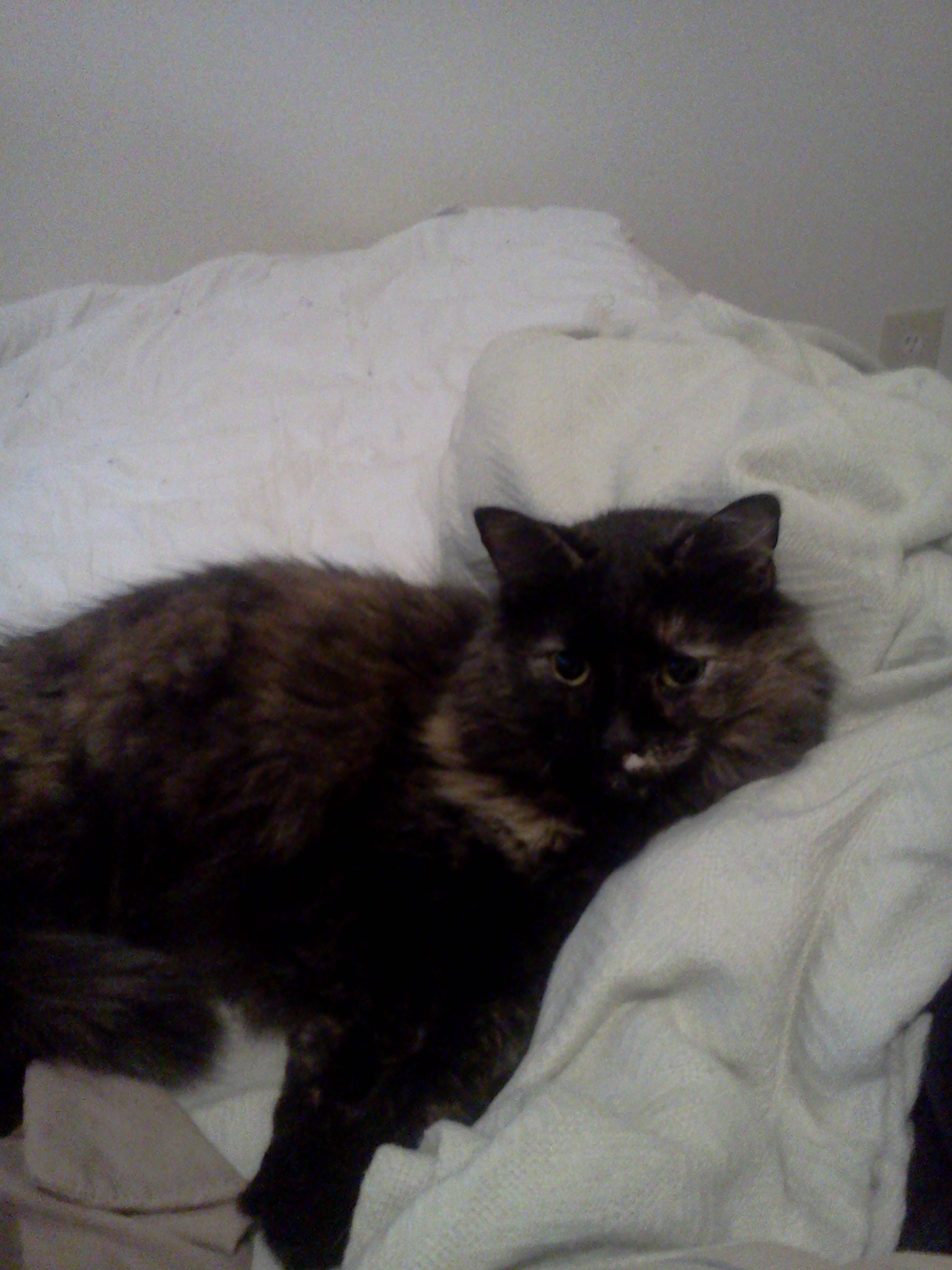
tl;dr capsule review: One of the cats barfed on the magazine. A harsh assessment, but fair.

ES, with assistance from Mina the Cat (pictured below)


The Language of Pseudoscience

May 28, 2011

On April 20th, I was a guest on Inside the Black Box, a science-themed radio show produced at Georgia Tech. Well, they have archived the show, which makes me very happy, because now I get to hear myself speak, which as you can imagine is something I enjoy immensely! Also, I am dying to know if they kept in a calculus joke I made that they thought might be too dirty for the archives. I know! I can make calculus positively obscene!

The topic is “The Language of Pseudoscience” (mp3 file) and it draws on a course that I taught in the Fall of 2010.

RJB


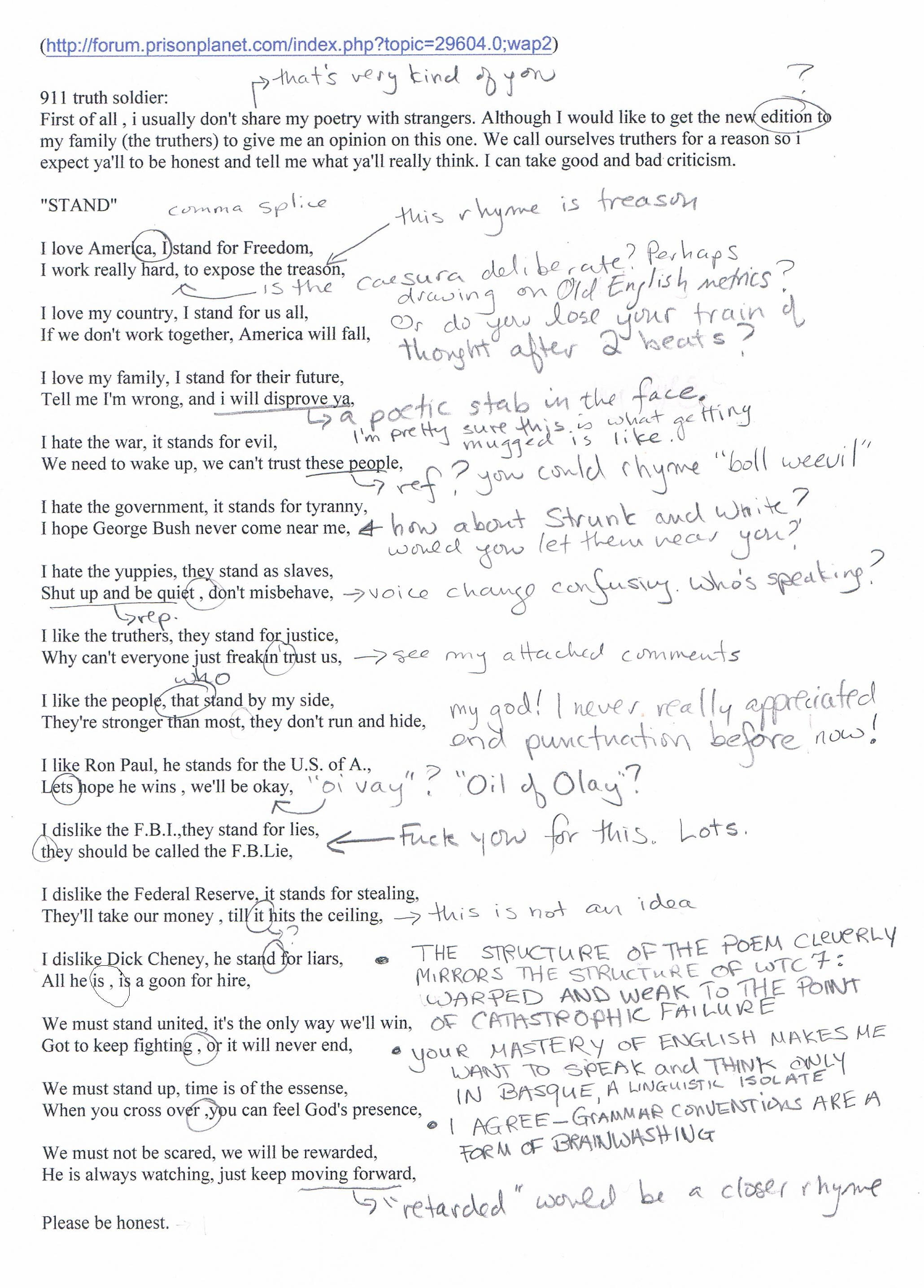
A poetry slam of a different kind

May 27, 2011

I was recently accused of having never done anything for my country. This may be true. As an English teacher, it’s often difficult to take my peculiar skill set out into the real world, what with the decadent lifestyle of a professor at a Research 1 institution like mine.  When you are a member of power-elite like me, dropping nuggets of wisdom like so many water balloons from the pinnacle of my ivory tower, you wonder, “How can I make a difference? I mean a real difference in the lives of the little, unimportant people? One that they’ll have a chance of understanding?” It’s tough, let me tell you.

Then it hit me. The Internet is a vast repository of unreadable prose and poetry.  Surely I could ply my trade to make the Internet just a little bit more pleasant. With that in mind, I knew exactly where I could make the most difference–the public forums of Alex Jones’ Prison Planet. And there it was, a whole world just begging for me to improve it. My first effort is for a poem called “Stand.”

Click to embiggen!

RJB


This Week in Conspiracy (23 May 2011)

May 23, 2011

It’s been a helluva weekend for me, which you will all probably read about in Skeptical Inquirer one day. This episode of TWIC is a day late because I needed a little time to recover.

With that in mind, the improbable was par for the course in the world of conspiracy this week:

  • It’s always cool when you are doing this and you find yourself as part of the story. Here’s the Georgia Guidestones video from CBS Atlanta.
  • First off, We Are Change Atlanta and Architects and Engineers for 9/11 Truth co-hosted an event here in Atlanta, which is where I was this weekend. Here’s the promotional trailer:

This week in Osama bin Laden

Conspiracy Theory of the Week (+bonus extra conspiracy theory!)

Well, that’s it. I’ve had all I can bear this week. I’ll see you guys on the flip-flop.

RJB


On Being the Only Treasonous Cockroach in the Room

May 22, 2011

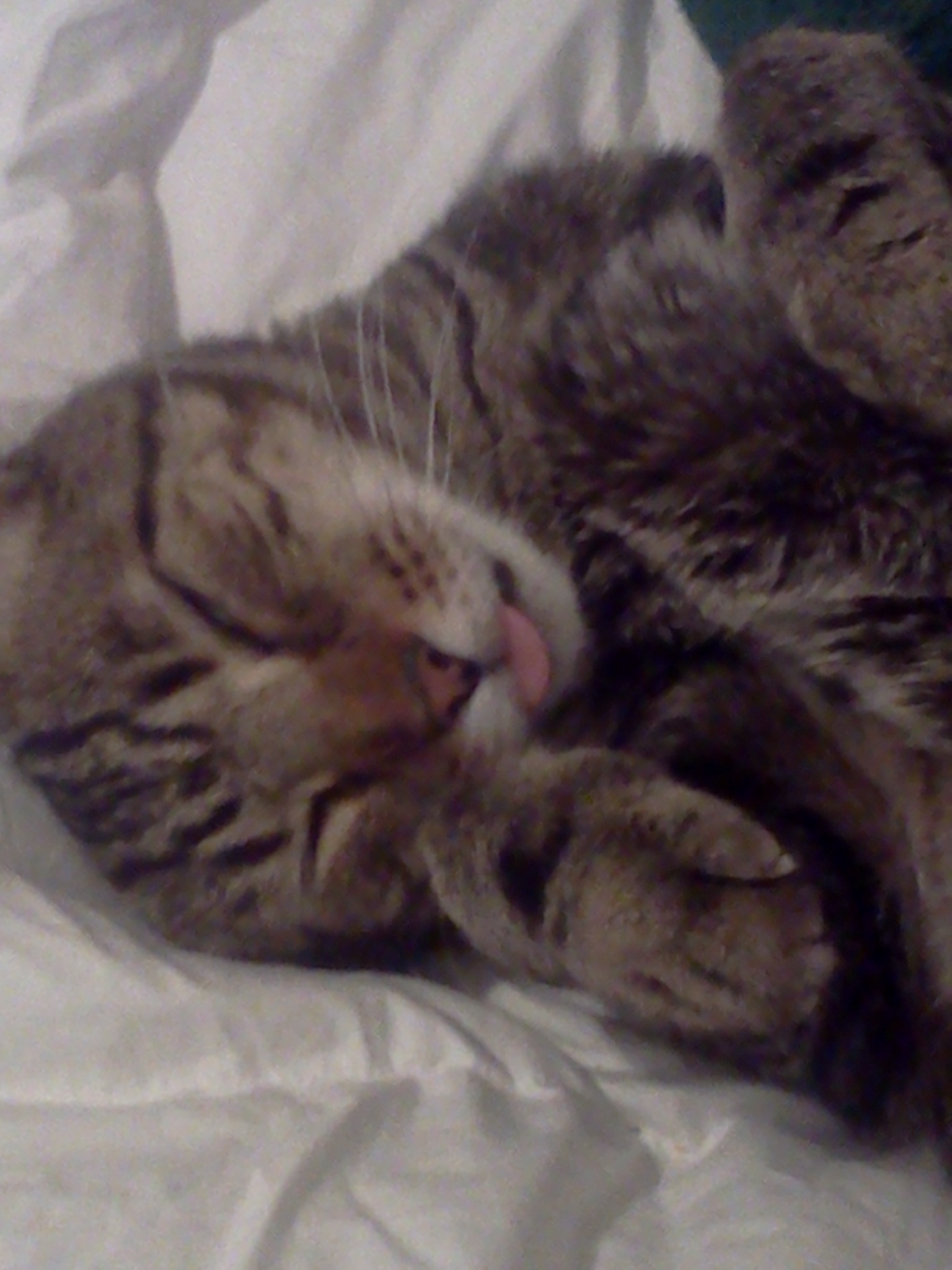
The 9/11 Truth event with Richard Gage last night was exhausting. I was literally the only one who was skeptical, as evidenced by a show of hands at the end of his talk. (The title of this post comes from something I heard an audience member shout, nothing that you heard from anyone on the stage.) I’m spent, I think, right now. So instead of posting This Week in Conspiracy tonight, here’s a picture of my cat, Gavin, asleep this afternoon:

RJB


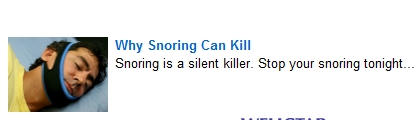
What’s wrong with this advertisement?

May 21, 2011

RJB


I was on the TV! Kind of!

May 20, 2011

“Andy Warhol said that everyone gets 15 minutes of fame. Well, with the coming of high speed processors and fiber optics, we’ve gotten that down to .15 millisecond…”

“I dawned upon Atlanta today. Unfortunately, Atlanta is on the arctic circle, and it’s the winter solstice…”

“Wait, was that me? I couldn’t tell. I didn’t get a good enough look…”

Just some of the possible ways I could have started this post. Yep, I was on the TV for like 6 seconds. (Shakes my head.) I am actually glad that I pause and stutter when I speak because because it, like, doubled my face time. It was an interview about the Georgia Guidestones. The interview was about 20 minutes or so.

Here’s the online link. And whatever you do…don’t blink:

RJB


Cogito, ergo not ergotism: The Salem Witch Trials

May 19, 2011

After a grueling week of covering conspiracy theories, I thought that I would pick up a gauntlet not so much thrown down as dropped suggestively by Ryan F in the comments of Eve’s wildly successful berserker post a few weeks back:

I’d love to see a similar takedown of ergotism and the Salem Witch Trials; I always have a few students who latch on to that one. There really is an appeal to the mundane scientific explanation for a cultural phenomenon that doesn’t quite fit with modern sensibilities.

So, instead of conspiracy theories, today I’m going to talk about…a lot of people who thought there was a Satanic conspiracy afoot! But this is different because the characters in this story are wearing amusing headgear:
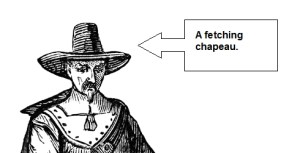
One of the perennial questions of American history is, “What the hell was wrong with the Puritans?” In my opinion, a lot. Let’s face it, the Netherlands didn’t want them, and you had to be a real jerk to make yourself unwelcome in the Netherlands in 1630, let me tell you.

Anyway, between September 1692 and May of 1693, 19 men and women were executed on charges of witchcraft in the towns surrounding Salem, MA, and one man was crushed to death as the court sought to force him into entering a plea. A variety of causes have been suggested for the witch mania that seized New England that year. In truth, it seems likely that a number of factors contributed to the Witch Trials; it is also apparent that the forces that initiated the craze were not the same ones that perpetuated it. Among factors that contributed in various degrees are gender and class (which were related), social and individual psychology, the social structure and beliefs of the townspeople, and, finally, the separation of church and state, which in Salem was about 2 blocks.

I have taught the Salem incident in past conspiracy theory courses. I tend to put a lot of weight on the theological background that made witchery seem like a plausible explanation. In really, truly unacceptably rough terms, the social order was thought to reflect a divine order. The maintenance of a system of covenants (women and children/father, head of household/government, government/God) was seen as ensuring the health of the relationship between the colony and the Lord. When that tranquility was disturbed, one might easily interpret that as someone having made a covenant with someone other than God, wink wink nudge nudge. It also makes a stunning lesson about standards of evidence.

But I digress.

In the 1970s, Linnda R. Caporael, a psychology graduate student at UC, Santa Barbara, published a new hypothesis in Science. She posited that ergotism might account for the physical symptoms that were reported by those making accusations of witchcraft. Ergotism is caused by…wait for it…ergot poisoning. Ergot (Claviceps purpura) is a fungus that grows on various cereals and has a special hankering for rye:

Ergot on wheat. Hold the mayo.

Caporael gives a cursory history of the madness outbreak (entire careers can be consumed by the scholarship around the Witch Trials), and considers three possible explanations 1) fraud on the part of the accusers, 2) psychological/ psychiatric issues, and 3) “physiological explanations.” Because Caporael finds that the possibility of physical ailments causing the outbreak have not been considered in depth before, the review of that literature is necessarily very brief, and she means to fill in the blank. She mentions that “A modern [1949] historian [Marion Lena Starkey] reports a journalist’s suggestion that Tituba had been dosing the girls with preparations of jimson weed, a poisonous plant brought to new England from the West Indies in the early 160o’s” (23), but the reference is not immediately available to me, so it is not clear when the journalist was writing or what evidence the journalist was citing.

Most of the studies of ergot that I have come across stress the effects of ergotism on cattle and livestock, which would be eating the affected grains. Ergot has medical uses, most notably as a vasoconstrictor, and most modern human cases of ergotism are the result of overdose on ergot-based medications. Ergot also contains alkaloid precursors to LSD, and so they share similar structures.

As you might expect given the pharmacology above, the types of symptoms associated with ergotism have to do with vasoconstriction resulting in dry gangrene and insults to the nervous system resulting in convulsions and hallucinations. It is the later suite of symptoms that lead Caporael to hypothesize convulsive ergotism as a possible culprit.

Caporael’s evidence falls into a couple of different categories. The first is “growing conditions.” There was ergot in the region, so it was a possible contaminant of rye stores. Also, she says that the crucial growing period, between April and Thanksgiving 1961, was warm and stormy, as evidenced in Puritan diaries, ideal growing conditions for the fungus. Her second line of evidence is “localization.” Three of the eight afflicted girls lived in the Putnam residence, and Putnam’s farm was large, as indicated by his will. Presumably, the agricultural yield from his substantial land holdings, if they were the source of the ergotism, would be dispersed more widely among the population. And this is how she explains the second group of afflicted girls:

The two afflicted girls, the daughter and niece of Samuel Parris, lived in the parsonage almost exactly in the center of the village. Their exposure to contaminated grain from western land [including Putnam’s] is also explicable. Two-thirds of Parris’s salary [as parson] was paid in provisions; the villagers were taxed proportionately to their landholding. Since Putnam was one of the largest landholders and an avid supporter of Parris in the minister’s community disagreement’s, an ample store of ergotized grain would be anticipated in Parris’s larder. (192)

Another sick girl was a servant in the household of the man who was presumably the town’s only doctor. Because Ann Putnam was often sick, he probably visited her a lot and got payments in ergotized grain. Another servant girl, this one on a farm near a river, may have been poisoned from her own Master’s fields, but Caporael says this case is questionable and possibly fraud (on the basis of the timing and nature of the accusation, as well as a second-hand report of the servant admitting to lying).

Another servant on an outlying farm is a bit of a puzzle. She alone was afflicted in the household (though pretty much everyone, including the kids was accused of witchcraft). There is a record of her once staying in town overnight, however. Because this girl had two bouts with the affliction, Caporael entertains the notion that she may have been poisoned the first time and then under psychological duress during the second episode.

I take these first two lines of evidence as an attempt to establish the plausibility of the ergotism hypothesis. The last line of evidence is the testimony of the trial, of which there is a staggering bunch. Caporael is looking for the symptoms of ergotism in the testimony.

After Caporael re-establishes that the outbreak of witches was an abnormal reaction, a strange paragraph follows:

The affected girls’ behavior seemed to be no secret in early spring. Apparently it was the great consternation that some villagers felt induced Mary Sibley to direct the making of the witch cake of rye meal and the urine of the afflicted. This concoction was fed to a dog, ostensibly in the belief that the dog’s subsequent behavior would indicate the action of any malefic magic. The fate of the dog is unknown; it is quite plausible that it did have convulsions, indicating to the observers that there was witchcraft involved in the girls’ afflictions. […]

The importance of the witch cake has incident has generally been overlooked. (25)

Hold on…I must have missed something. There is no contemporary record whatsoever of a dog having convulsions (or not)? If it did have any symptoms at all…surely it would have been mentioned somewhere? Where did the “importance of the incident” happen?

Regardless, lack of dog testimony aside, Caporael mentions the spectral evidence (images of the accused or of their familiars who appeared to the afflicted), and “epileptiform” convulsions which she believes are consistent with convulsive ergotism. She also notes that “[c]omplaints of vomiting and ‘bowels almost pulled out’ are common in the depositions of the accusers.” She also refers to pinches and burning sensations that might signify some sort of ergotic neuropathy.

She then points to what is slightly worse evidence than the dog:

“When examined in the light of a physiological hypothesis, the content of so called delusional testimony, previously dismissed as imaginary by historians, can be reinterpreted as evidence of ergotism. After being choked and strangled by the apparition of a witch sitting on his chest, John Londer testified that a black thing came through the window and stood before his face.”

It was a little monkey-man thing, but that’s almost completely unimportant because we already have enough to determine precisely what Londer was describing, sleep paralysis. The pressure on the chest that becomes someone sitting on you (probably because his body is still “asleep”), the sensation that there are people around you, this is classic sleep paralysis. And it’s very cool to see how confusing sensory data, even when they are fairly common, get interpreted through the filter of the experiencer’s culture. If Londer were alive now, he’d testify that little gray aliens with big dark eyes were standing around his bed. Throughout history, the specters have been variously represented as the recently deceased (as in reports of vampirism and the wacky cures that communities developed for that–exhumation, beheading, staking or cremation!); when the waking dream has a sexual element, the phantoms have become incubi and succubi, and so on. Now they’re “grays.”

Within about, oh, 20 minutes of the publication of Caporael’s paper, the thesis was completely demolished Nicholas P. Spanos and Jack Gottlieb. Their article, “Ergotism and the Salem Village Witch Trials,” appeared in the December 1976 edition of Science.

Spanos and Gottlieb raise a question that occurred to me while I was reading Caporael, “So, were there any cases of gangrene?” I mean, ergot causes both gangrene and neurological symptoms. If uncontrolled doses were being consumed by the public, surely someone would have contracted gangrene. Or maybe the animals? Most of the studies of ergotism that I found were veterinary, after all. But they take it one step further than my uninformed musings and deploy a full arsenal of reasons why ergotism is unlikely. For instance, convulsive ergotism has been seen in groups where “the inhabitants have suffered from severe vitamin A deficiency” (1390). They note that Salem was affluent enough and had enough fish to avoid such a disease. They note that children, really young children, are the most likely to succumb to ergotism, but in Salem that the ages of the girls trend well over 15 (only 3 of 11 were younger).
The fact that entire families, who you would think would be eating the same food, were not laid low casts further doubt on the hypothesis.

In the case of the gastrointestinal symptoms (vomiting and diarrhea) that Caporeal discovered in the depositions, Spanos and Gottlieb find much less than would be expected. One instance that Caporael cited as “bowels almost pulled out” in the original text reads like this: “Abigail hath been greviously vexed with the apparition of Eliz: Proctor the wife of John Proctor of Salem, by which apparition she has been greviously pinched, had also her bowels almost pulled out…”. It’s unclear that this is actually explosive at either end of the digestive tract, or whether it is a cramp or…even real. It seems to be a retelling, not an ongoing, verified complaint. Indeed, the three girls who mention what might be construed as gastrointestinal symptoms all had a single bout. There is no mention of vomiting. (Oh! Perhaps Regan in The Exorcist, which was released a few years before the paper, had ergotism! I sense a publication!)

They further notice that there is no record of ergotism being cured by the reading of particular Bible passages in the medical literature. There is no reason why someone who had ergot poisoning would appear to be fine (“hale and hearty”) outside of court, as was the case with these girls. The descriptions of hallucinations and apparitions are not consistent with the types that people report having when they are on LSD (remember, ergot and LSD share some characteristics), such as halos around objects, long-lasting afterimages, rainbow-like colors, etc. Seeing people who aren’t there while awake is reportedly a comparatively rare effect of LSD. The girls did not reportedly display the ravenous hungers that follow ergotic convulsions. The reports of burning sensations are clearly triggered by external suggestion. Lastly, nobody reported that the girls’ skin hues changed, as would be expected with ergotism. When the epidemic ended, it ended. There are no reports of the permanent neurological damage that people who had been ingesting ergot for months would have displayed. Ergotism is in almost in every way a bad match unless you are willing to cherry-pick symptoms.

Nonetheless, while Gottlieb and Spanos put a stake through the heart of the notion that ergotism caused witches, they did inadvertently prove that the reanimated corpse of a discredited theory can wander aimlessly through pop culture.

In 1982, historian Mary K. Matossian, who had been studying the effects of mold poisoning on history and culture, resurrected the theory. Her principal objection to the Gottlieb and Spanos is  that:

“The Salem court record does not mention certain symptoms often associated with mild or early ergotism, such as headache, nausea, diarrhea, dizziness, chills, sweating, livid or jaundiced skin, and the ravenous appetite likely to appear between firs. If these symptoms were present, they may not have been reported because they were not commonly associated with witchcraft.”

They didn’t note that the sufferers had changed color, eh? I’d like to refer you to a specialist in this area:


They also would have noticed bits of people falling off, I imagine.

Most of Matossian’s reply is, “Well, you can’t disprove ergotism.” But that’s not positive evidence of ergotism. Matossian does offer more circumstantial evidence of conditions that might have been conducive to ergot, like tree rings, but again, we get nothing that remotely looks like ergotism in the record. Of course, her hypothesis got picked up by the New York Times, and the rest, as they say, is the History Channel.

In a strange way, I feel that this issue could be settled using Baysian analysis. As you probably do not remember because nobody was reading Skeptical Humanities at the time, Baysian analysis appeared in our examination of whether FDR had polio or an autoimmune condition. By looking at the frequencies of different symptoms in known polio cases, researchers were able to assign a very, very low probability that FDR’s particular cluster of symptoms would have appeared in a genuine polio case.

I looked for descriptive surveys of known ergotism outbreaks in human populations, but did not find any. (Be fair, I’m way outside my area here.) If you took a couple of large studies of outbreaks (or lots of little studies), it seems to me that you might be able to assign a likelihood of seeing an outbreak that has the variety of symptoms like the one at Salem.

So, there. Now you have homework. Go do that.

RJB

Sources:

Caporael, Linnda R. “Ergotism: The Satan Loosed in Salem?” Science 192.4234 (2 Apr. 1976): 21-26.

Matossian, Mary K. “Ergot and the Salem Witchcraft Affair,” American Scientist 70 (1982): 355-357.

Spanos, Nicholas P. and Jack Gottlieb. Science 194.4272 (24 Dec. 1976): 1930-1934.