A Letter to the PBS Ombudsman about CPT12’s Airing of “Burzynski”

March 26, 2013

On Friday, PBS Ombudsman Michael Getler responded to CPT12’s recent airing of the first Burzynski movie as part of a fundraiser. PBS has always been quite responsive to its critics, and this is something that I have not seen in many large broadcasters in the past. He contacted a lot of the interested parties at the station, the FDA, and CPT12. I have no doubt that Getler took this subject seriously, and I appreciate this very much.

Furthermore, Burzynski is not Getler’s fight. To understand the complexities and history involved takes a lot of work, far more than we could possibly expect of Mr. Getler. The station is not his responsibility, nor is it PBS’s role to censor a member station. This was clear from his first post in the run-up to the airing of the documentary.

That said, however, I do disagree with some of his conclusions. (You could see that coming a mile away, couldn’t you?)

Getler starts off:

[Burzynski] is a long program — two and a half hours, with about 45 minutes of that devoted to pledge drive discussions and promotions of the film. It is about the decades-long struggle of a Polish-born physician and biochemist, Stanislaw Burzynski, who set up a clinic in Texas in 1976, to achieve acceptance for a cancer-cure therapy based on a treatment he developed based on what he calls “Antineoplastons.” [ANP]

I submit this is already wrong. There is little evidence that Burzynski is at all serious about developing antineoplastons for wider marketing. If that were true, surely he would have managed to have completed and published a single advanced trial in 35 years. If you look at the trials he’s been required to register at clinicaltrials.gov, you see over 60 trials, 1 completed, and none published. NONE. This is important because he is restricted to giving his ANP in clinical trials. But he apparently abandons his trials, almost all of them. This is not normal. He charges patients out the nose to participate in the clinical trials. This is not normal. This is not the behavior of someone who intends to market the product widely later and expects a return on an investment. It sure looks like someone taking the money while he can.

I put the word “documentary” in quotes above because while the actual film does indeed document very well Burzynski’s seemingly endless battle to win acceptance and approval for his treatment against the FDA, National Cancer Institute, patent challenges and big pharmaceutical companies — and includes very powerful filmed interviews with cancer survivors who say his treatment (in Texas, where it was allowed) saved them — it doesn’t have the kind of critical other-side that one is used to in other documentaries.

That last part is true. the movie is one-sided. Of course, why this is might be more apparent if Mr. Getler had realized that Merola’s cousin was a patient of Burzynski (she later died, of course) and that Merola raised funds for his cousin’s treatments on his website. Merola is not impartial. He has skin in the game. He has sunk an enormous amount into Burzynski.

Mr. Getler mentions that Shari Bernson, the person responsible for the programming and who appeared in fundraising spots, described the movie as “controversial.” To someone on the outside, it may appear to be controversial. To someone who understands the science and process of publication and who has found endless descriptions of how patients end up making really, really bad choices out of desperation at that clinic, however, there is no controversy. The fact remains that after 35+ years, the Clinic has never produced a single reproducible result that would constitute the barest minimum for serious consideration among experts. It just hasn’t. Should that ever happen (I’m not holding my breath), then, hell, yes, we’ll be on board cheering the advance of science. But he has to play by the rules.

And this is important too, playing by the rules that all real researchers abide to. Part of the FDA’s job is to ensure that Burzynski’s people are doing this. And on February 7th, they were doing just that; they were in the facility inspecting to make sure that Burzynski’s team was playing by the rules.

In a FOIA release this week, the FDA revealed a number of things that had been found out and reported to the clinic by the time the movie aired. By law, the Clinic had 15 days to respond, so if they responded, it was before CPT12’s love-in. (The observational notes can be found here:  https://skepticalhumanities.com/wp-content/uploads/2013/03/burzynskiform483feb2013.pdf)

Two investigators observed:

  • “The IRB [Institutional Review Board] used an expedited review procedure for research which did not appear in an FDA list of categories eligible for expedited review, and which had not previously been approved by the IRB. Specifically, your IRB routinely provided expedited approvals for new subjects to enroll under Single Patient Protocols.” [2 adults and 3 pediatric patients are mentioned]
  • “The IRB approved the conduct of research, but did not determine that the risks to subjects were reasonable in relation to the anticipated benefits (if any) to subjects, and to the importance of the knowledge that might be expected to result. Specifically, your IRB gave Expedited Approval for several Single Patient Protocols (SPP) without all the information necessary to determine that the risk to subjects are minimized.” [4 examples follow]
  • “The IRB did not determine at the time of initial review that a study was in compliance with 21 CFR Part 50 Subpart D, ‘Additional Safeguards for Children in Clinical Investigations.’ Specifically, an IRB that reviews and approves research involving children is required to make a finding that the study is in compliance with 21 CFR Part 50 Subpart D, ‘Additional Safeguards for Children in Clinical Investigations.’ Your IRB approved research involving children without documentation of the IRBs finding that the clinical investigation satisfied the criteria under Subpart D.” [3 examples follow and there is a note that this is a repeat observation that had been found in an Oct 2010 Inspection.]
  • “The IRB did not follow its written procedure for conducting its initial review of research. Specifically, the IRB is required to follow its written procedures for conducting initial and continuing review. Your IRB did not follow your written procedures for conducting initial and continuing review because these subjects received IRB approval via an expedited review procedure not described in your Standard Operating Procedures. If your IRB would have followed your own SOP for initial and continuing review, the following subjects would have received review and approval from the full board rather than an expedited review.” [2 adults and 3 pediatric patients are listed.]
  • “The IRB has no written procedures for ensuring prompt reporting to the IRB, appropriate institutional officials, and the FDA of any unanticipated problems involving risks to human subjects or others. Specifically, your current SOP-2012 v2-draft doc does not describe the requirements on Investigators on how unanticipated problems are reported to the IRB, Institutional Official, and the FDA, such as time intervals and the mode of reporting, or otherwise address how the prompt reporting of such instances will be ensured.”
  • “The IRB has no written procedures [in the SOP-2012 v2-draft doc] for ensuring prompt reporting to the IRB, appropriate institutional officials, and the FDA of any instance of serious or continuing noncompliance with theses [sic] regulations or the requirements or determinations of the IRB.”
  • “A list of IRB members has not been prepared and maintained, identifying members by name, earned degrees, representative capacity, and any employment or other relationship between each member and the institution.”

You have to play by the rules. I’m not sure that this round of investigation is over yet, as the audience at the premier of the sequel was apparently told that the FDA was still on site. Researchers should not be playing fast and loose with the rules that protect children (a protected subject population, like prisoners and students–yeah, I’m IRB certified). There should be procedures in place to see that proper oversight and reporting of unexpected events is ensured. Hell, there was apparently no document even saying WHO was on the IRB!

This is not a report on a serious research institution. It’s more like the observations of the IRB of a clown school.

Back to Mr Getler’s letter:

On the other hand, Bernson’s sidekick on the in-studio, pledge-drive promotion who was interviewing the clinic spokesman, made me gag when she said, “I’m Rebecca Stevens and I’m proud to be a journalist who asks the hard questions.” There were no hard questions. [I believe the question that followed up this statement was, “What is peer-review?”–RJB]

And where Bernson may have gone too far, depending on who you believe, was in her statement that: “Antineoplaston therapy has had significant success rates with terminal brain cancer patients and especially in children.”

No, she went too far no matter who you believe, and his next paragraph demonstrates this:

The National Cancer Institute, reporting last month on Antineoplastons, said, among other things: “No randomized, controlled trials showing the effectiveness of antineoplastons have been published in peer-reviewed scientific journals” and that they are “not approved by the U.S. Food and Drug Administration for the prevention or treatment of any disease.”

Aaaand…how’s that controversial? In light of this, how could Sherri possibly be right?

My bottom line is that CPT12 obviously has a right to show this film.

Nobody questions that. What we wanted, and what was offered to the station, was the opportunity to have an independent oncologist in the studio at the time of the broadcast, you know, to stir up the kind of informed discussion the station says they want to have instead of settling for two True Believers talking to two CPT12 pitch people. When the station had that opportunity, they walked away from it. That’s indefensible. Especially when you consider that the people we are worried about, patients and their families, may NOT be as discerning as your average viewer, as CPT President Willard Rowland suggests in his response to the ombudsman:

“The program’s airing is grounded in the station’s mission, specifically those portions about respecting our viewers as inquisitive and discerning citizens, addressing social issues and public concerns not otherwise adequately covered in the community, and cultivating an environment of discovery and learning.”

Some of them haven’t had good news since their diagnosis. Then they hear that some lone genius with the cure for cancer is operating in Houston and they are on the next flight down. I’ve seen it dozens of times, and I have hundreds more patients on deck to write about. These are vulnerable, vulnerable people who deserve the best information from their public broadcasters.

I’m fairly disappointed by the tepid response, honestly. I have a hard time imagining that Mr. Getler, or Mr Willard Rowland for that matter, could possibly think that this program was anything but misleading if they spent a half hour at The OTHER Burzynski Patient Group, which chronicles, in patients’ own words, what goes on in that Clinic. All of the people told that getting worse is getting better (for decades being fed the same line!), the children having strokes (unrelated to their tumors) while on the medicine, the “terrifying” amounts of sodium that go into patients. The quasi-legalistic threats and phone calls to dissatisfied cancer patients. The untested chemo cocktails given to most of his patients. None of that was mentioned in the CPT12 fundraiser.

Of course, that’s not Mr. Getler’s fight.

RJB


Linguistics ‘Hall Of Shame’ 2

March 23, 2013

Hi again, everybody! ‘Hall Of Shame’ continues!

2 LAURA KNIGHT-JADCZYK

Laura Knight-Jadczyk (henceforth K-J) is a widely-read independent scholar with highly radical views on history and the nature of humanity. I encountered her work at a stall run by her supporters at the 2008 Unconvention in London, and approached her with information on her linguistic claims, which do not loom especially large but are important – and display some knowledge of the subject but a (temporarily?) incomplete grasp. For example, she accepts Iman Wilkens’ linguistically naïve equations of Greek and English river-names (in his revisionist book Where Troy Once Stood) as clearly valid, and wonders how linguists can justify ignoring his ‘obviously’ impressive success in correlating the two sets of names.

K-J was unwilling to be corrected here (pending further reading), whereas she was (surprisingly) more amenable to my exposition of mainstream reservations about the much less fringe but seriously (and increasingly) controversial theory that Indo-European and several other language families had a common ancestor (‘Nostratic’) spoken 10-12,000 years ago. This theory would fit in with her view (quite widely shared and not altogether unsupported) that there was a world catastrophe at that time caused by minor-planet impact.

More generally, K-J regards the more extreme revisionist/catastrophist histories proposed by Immanuel Velikovsky, Michael Cremo etc. as much more strongly supported by the evidence than mainstream scholars would allow. She holds, in fact, that all such seriously revisionist views are systematically suppressed by ‘the powers that be’.

By way of another specific (more philosophical) issue, K-J is strongly opposed to Judaic-Christian-Muslim monotheism, regarding it as balefully influential even on recent scientific & historical scholarship, and in fact as ‘psycho-pathological’. Saliently, she holds that it would be psycho-pathological even for a creator god to claim the right to allegiance and obedience. I myself agree that humans could legitimately resist such claims – partly because of the logical argument, best summarised by Bertrand Russell, that objective ethical truths (if any exist) cannot follow from religious truths (ditto). But, despite my own atheistic views, I suggest that a creator god, if (s)he existed, WOULD have a prima facie case here, unlike truly psycho-pathological human tyrants making similar claims.

On the other hand, K-J holds (obviously against skeptics and most scientists) that the evidence for spiritual and ‘paranormal’ entities of other kinds is overwhelming and should persuade even those who themselves have no awareness of divine or parapsychological forces in the world. But she also thinks it likely that some humans have a ‘soul’ which confers veridical awareness of these entities. Others (including skeptics) have no such awareness exactly because they have NO souls. (This idea is similar to the less dramatic claim that humans have a psychic/spiritual ‘sense’ but that some are ‘blind’ in this respect.) Souls probably arose by way of mutation in the process of evolution (her version of same!). But it is not clear how such entities as souls (if they can exist at all) could arise in this way (though see for example Stephen Goldberg’s view, expounded in his book Anatomy Of The Soul, that important aspects of a mind can exist after the demise of the brain from which it is generated). And the fact that even members of the same family may differ in respect of such awareness surely renders K-J’s specific position dubious.

K-J is also searching for a new form or aspect of linguistics which would relate to her ontology by way of being ‘hyper-dimensional’. She declined to attempt to explain this idea to me, seeing me as one of the soul-less and thus being permanently unable to grasp the concepts involved. (For her, humanity is doomed to remain divided on issues of this kind, where empirical evidence does NOT directly apply. The soul-less have an incorrigibly impoverished world-view.) She did suggest that semiotics might be identified with her ‘hyper-dimensional linguistics’, but this notion seems to reflect either confusion or a so-far unarticulated non-standard view of semiotics (it is normally taken to be the study of symbolism, with linguistics as one of its most major sub-fields, and thus to be wider in scope than linguistics but NOT at a ‘different level’).

K-J’s main work is her book The Secret History of the World (Grande Prairie, AB, 2008), her main web-site is http://cassiopaea.org/, and her publishing-house, Red Pill Press, is at http://www.redpillpress.com/, where other books by K-J and her associates can be ordered. The most recent issue of the Red Pill Press newsletter (available on enquiry) advertises a second volume of Secret History, Comets and the Horns of Moses. (K-J also had interesting views regarding the predictions of Zecharia Sitchin and others regarding the anticipated appearance in 2003 of the rogue planet Nibiru; see http://www.cassiopaea.org/cass/sitchin.htm.)

Mark


Virtual Skeptics, Episode 31 (20 March 2013)

March 22, 2013

This week on the Virtual Skeptics

  • Bob sacrifices Tim to the Illuminati for the success of the show;
  • Eve asks, “Got penis?”;
  • Sharon is mad Bob took her story so she is going to go watch television;
  • and Tim wants to see your papers – including your cash.

This Week’s Panel

  • Bob Blaskiewicz – CSI’s Conspiracy Guy web columnist, blogger for Skeptical Humanities and Swift Blog contributor
  • Eve Siebert – Editor and blogger at Skeptical Humanities and contributor to Skepticality
  • Sharon Hill – Editor of Doubtful News and author of the CSI’s Sounds Sciencey web column
  • Tim Farley – JREF fellow and creator of What’s the Harm.net and the Skeptical Software Tools blog and also contributor to Skepticality.

Bob’s links:

Eve’s links:

Other sources:

  • Ivan Crozier, “Making Up Koro: Multiplicity, Psychiatry, Culture, and Penis-Shrinking Anxieties,” Journal of the History of Medicine and Allied Sciences 67.1 (2012): 36-70.
  • Johan J. Mattelaer and Wolfgang Jilek, “Koro: The Psychological Disappearance of the Penis,” Journal of Sexual Medicine 4 (2007): 1509-1515.
  • Moira Smith. “The Flying Phallus and the Laughing Inquisitor: Penis Theft in Malleus Maleficarum,” Journal of Folklore Research 39.1 (2002): 85-117.

Sharon’s links:

Tim’s links:

Brian’s Robot links:

Announcements:

The Virtual Skeptics is an independent production of Doubtful News, WhatsTheHarm.net, Skeptical Humanities, and Brian Gregory. Our logo was designed by Sara Mayhew at SaraMayhew.com. Our theme music is by Tremor and is used with permission.


A moment for me…

March 22, 2013

I used to blog at another site under a pen name. It was a great way to keep a daily tally of my exploits, and if I did not get around to my nightly post, I would feel guilty.

Not so much these days.

I only sort of miss the frantic bursts of commentary that I used to produce. The best thing about becoming a blogger was how it helped me snap a longstanding bout of writers block so that I could finish my Ph.D. Establishing a routine was essential to that. Now that I work primarily on themed projects, doing similar things here and on Skepticality, the Burzynski stuff, and at CSI on conspiracy theory (new article on Jesuits coming soon!), education stuff at the JREF Swift blog, well, the Virtual Skeptics is the one place where I get to do a little bit of everything, a new short little essay every week about whatever catches my fancy. But I don’t get to go off on my Wagnerian rants like I used to. It’s probably for the best.

But I’m tired. At this point, I essentially have two full time jobs, and only one pays. The thought of turning away from either of them hasn’t occurred to me.

So, what’s next? Well, I have NECSS coming up in a few weeks. That’s going to be a great long weekend. I went to the conference two years ago, and had a great time. This time around, I’m going to be participating in a workshop about the joys of multidisciplinary skepticism.  The cool thing about speaking is casually bumping into your heroes in the green room. I am looking forward to seeing a couple of British skeptics who will be speaking who I have never met or seen. I have so many books to get signed.

After that, well, the next big thing that I’ll be doing is TAM. This year, I’m involved in two events, a workshop and a thingy on the main stage. That’s very, very exciting, of course. There was a point way back in the day when I sort of had TAM in my mind as a long-term career goal. This is my second one, so I’m pleased as punch.

Ah, well. It’s late. 2:00 AM. Lots to do tomorrow too.

RJB


Linguistics ‘Hall Of Shame’ 1

March 17, 2013

Hi again, everybody!

At Bob’s suggestion, I’m presenting a new series of blogs on specific ‘fringe’ writers (idiosyncratic individuals rather than members of ‘movements’) on language matters (in his words a ‘Hall Of Shame’, though some of these writers are more worthy of attention than this terminology might suggest!).

1 JOHN TROTTER

One example of a deep-thinking person who developed his own idiosyncratic linguistic theories (and issued attacks on the mainstream of linguistics) is the psychologist and amateur logician John Trotter. Trotter was a psychology lecturer in Australia, and in the 1970s-80s he developed radical views on the logical and structural nature of language, and incorporated these into papers offered for publication and into his teaching. His most central focus was on the philosophical aspects of these matters, and one of his main foci within linguistics involved the development of links between the formalism of Chomskyan grammars on the one hand and the ‘predicate calculus’ of logic on the other. If Trotter’s main ideas are valid, much of the basis of linguistic theory and indeed some important aspects of contemporary thought on logic must be mistaken.

Trotter’s papers were rejected by editors and reviewers whom he regarded as inadequately informed, and he was allegedly discouraged from presenting his views to students. After that time he operated as a private scholar. He & I interacted at some length in the late 1990s, but his dogmatic approach to many of his key points does not encourage scholarly attention. (In addition, some of his claims regarding e.g. possible improvements in automatic translation appear to be contradicted by familiar linguistic facts.)

Some of Trotter’s main points involve direct criticisms of mainstream concepts. For instance, he holds that some key mainstream linguistic concepts such as ‘allophone’ and ‘phoneme’ should NOT be used; new formulations of the matters in question should be adopted. This stance involves his rejection in its mainstream form of the ‘emic/etic’ contrast (as in phonemic versus phonetic), which he instead treats as essentially a type-token relationship; for example, each phoneme is seen as a type and each of its allophones as a token of this type. Trotter’s objection at this point is associated in turn with his opposition on philosophical (ontological) grounds to some types of linguistic expression used to express the relationship between types and tokens (for example, he objects to definite descriptions such as the dodo as used to refer to a type, as in the dodo is now extinct). However, whatever might be the merits of Trotter’s philosophical points, his reasons for rejecting the mainstream formulations of the linguistic concepts in question here (‘allophone’ etc.) appear to involve a) a degree of misreading of mainstream linguistics (an allophone of a phoneme is NOT in fact the same thing as a token of that phoneme; it is itself a type, more specific and at a less abstract linguistic ‘level’, and has its own tokens, namely the individual instances where it occurs) and b) an exaggerated ontologically-based preference for one linguistic formulation of such matters over another (not uncommon in philosophical work based on linguistic facts; see below).

Trotter also rejects (mainly covertly, and in some specific respects) the linguistic non-prescriptivist approach to language adopted by mainstream linguists. He argues that certain kinds of formulaic expression of philosophical interest (for instance the logician’s For all X, X is Y = ‘all Xs are Y’, as in ‘all men are mortal’) are to be deemed ungrammatical even though they are the normal forms used by the relevant native speakers (logicians) in such cases. For all X, X is Y is seen as ungrammatical because there is no determiner such as that or the before the second token of X, which would be required in more everyday styles of English if the sentence were to occur (suitably modified) and to be deemed grammatical. For instance, in any other context one would not say For all lions, lion has paws, or even For every/any lion, lion has paws; the noun lion in the second clause would always have a determiner, as in that lion or the lion. However, this does not imply that it must have a determiner in the style used in the technical philosophical/logical domain in which such sentences normally occur. These sentences are NOT ungrammatical in context in any normal sense of this term (prescriptivist or descriptivist).

Trotter goes on to argue that because these expressions are ungrammatical they are also logically invalid – and that, because the issue at hand is central in discussions of logic, the whole basis of logic is thereby impugned. Indeed, the philosophical under-pinnings of contemporary logic and linguistics are grossly inadequate. Both mainstream linguists and philosophers would deny this. First of all, the linguistic features in question are found in only some languages. Not all languages even require determiners modifying nouns; for instance, Chinese and Russian do not. In fact, there are serious problems (albeit not always adequately acknowledged by philosophers) associated with heavy reliance upon linguistic data in a philosophical context, because the details of the constructions involved vary so much from language to language. And, even if it were accepted that ENGLISH sentences such as those cited were ungrammatical, it would thus be difficult to argue that some formulations were logically invalid on the ground that there was an issue with the grammar of the versions of these formulations as expressed in English but not in all languages. English and similar languages have no special status in this respect.

Indeed, the grammatical and logical statuses of expressions in any given language are very largely independent of each other. Grammatical issues can normally bring the logical status of expressions into question only if they involve the meanings of these expressions, for example by rendering them ambiguous or self-contradictory. Most grammatical anomalies (whatever their origin or the status ascribed to them) generate no significant ambiguity and certainly have no logical consequences. A form such as Jo go home (grammatically non-standard) is normally semantically transparent, and its ‘ungrammaticality’ (in contrast with Jo goes home, etc.) has no logical consequences.

For reading, see John Trotter, System of Rational Discourse: Vols. 1 (A Calculus of Attributes), 2 (Aggregates, ‘Numbers’ and ‘Sets’), 3 (Applied Arithmetic and Probability), 4 (A Calculus of Predictions and Propositions), (Aranda (ACT), 1995-6, and other works; see
bibliography with links to online versions at http://isbndb. com/d/person/trotter_john. html (accessed 2 February 2011).

Mark


Response to the release of Burzynski 2, Havanna Nights

March 14, 2013

On this week’s episode of the Virtual Skeptics, I replied to what was learned at the premiere of the new Burzynski movie. The text of my segment follows the episode.

This week, the new Burzynski movie premiered in San Luis Obispo, California. We largely knew what was going to be in the movie since a couple of trailers had been released, the patients who appeared had talked about the filming, and there was a sort of credulous review had appeared a few days ahead of time and I believe the director may have mentioned it on a PBS fundraising specual a few days earlier. So we had a pretty good idea of what our proxies should be looking for. We really wanted to see if certain people who had been filmed, like Amelia Saunders or Hannah Bradley appeared and especially what was said about them. We wanted lists of people who appeared, to see if we might be able to put together who said what. Most of these people’s stories are well known, and we doubted there would be anything new. Also our people took down key quotes that struck them as important, like “skeptics are hiding behind their BS free speech.”

This is my takeaway, after talking to the people who I know were there. We are wiggly little scumbags who are hateful and slimy. We ridicule the desperate and dying. Some of us are paid by big pharma. Others are deluded and think that we are doing good but are being misled. But make no mistake–and this was hammered home to me by everyone I talked to–we are to them pure evil.

One of my big concerns going into the movie was how I was going to be portrayed and whether or not I was going to receive death threats. That my family was going to receive death threats or that I was going to be harassed at work. I feared this because of a letter that, as you know, was sent to my employer promising that I would be featuring prominently in the Burzynski movie. Nobody asked me for my opinion or to give a statement or to respond or clarify; they went straight to my boss. Fine. I’ve had wacky people contact my employers in the past. I fully expect it to happen in the future. Clips of this show, episode 13, were included in the movie. This is the episode that was quoted in the letter on my university chancellor.

As it turned out, our faces were blurred, our names obscured, and our voices were altered. No real identifying information. Which, you know, I’m OK with. However, there are some problems here. 1) What was served by contacting my employer other than to scare me? How dare the filmmakers say that we’re terrorizing people when they are doing just that. 2) Someone asked me about a quote, “we’re coming for you, you little polish sausage you.” The thing is, the quote is patently absurd if my name is shown, something that everyone here jumped on, like I hoped you would during the original episode. That joking was not conveyed to the skeptics in the theater audience. This might be due to the fact that not only were we given scary voices but also that apparently every time we appeared scary music played in the background.

It’s clear that the reason I’m in the movie in the capacity I am, as chief bad guy, is because I’m on video talking about the Burzynski Clinic. And this leads me to another thing that Brian mentioned. That when we kind of appeared on the screen, they put up a title card type thing that said, “skeptical teleconference” or something like that, and that a woman at the end of the show, wanted to know, “How did you get this footage of these scheming skeptics?” Um….we publicize our show constantly? If you can’t have real clandestine drama, you might as well make it up. My favorite bit was a tweet that I got around this time where a new account who followed like 10 people I do said, “It’s really interesting when you talk about Burzynski on the show. Could you do that more?” Really, Eric? Do you think I’m two years old?

I am interested in ultimately seeing it. I’m asking that the producer send a review copy to the James Randi Educational Foundation so a proper review can be done.

Or you could screen it in Minneapolis. Next week works for me, Eric, if you’re free.

Another thing. News broke on the 7th of January in skeptical circles that the FDA was conducting an audit of the clinic. A patient in the movie apparently said that she had been receiving a brain scan when she heard that the Clinic was being investigated again. This means that material was added to the movie after the 7th of January. The Burzynski Birthday Fundraiser was announced by PZ Myers on the 6th. So there was more than enough time for the filmmaker to clarify exactly what was meant in that episode when I said that there was going to be a little present on his birthday. Skeptics evilly, and with malice aforethought, raised $14.5K dollars for St. Jude’s. We then challenged the Clinic to match us, and it didn’t. That the director did not mention this fact seems to me inexcusable, making us look like we are big meanos who hate babies and morality. This demonization is unfair and at the expense of the truth–if you ever read theotherburzynskipatientgroup blog you know whose side I’m on. If he used the video clip of us that he cited in his letter to my employer, about us bringing a “present” to Burzynski and knowing what it actually was without clarifying it, well, that just speaks to his regard for completeness and accuracy. No messiah should need such fudging. It suggests to me that he’s forcing evidence into a pre-existing narrative of persecution.

References:

PZ Myer’s announcement of the Houston Cancer Quack
http://scienceblogs.com/pharyngula/2013/01/06/lets-make-houston-cancer-quack-burzynski-pay/

The Virtual Skeptics episode that appears in the movie:
http://www.youtube.com/watch?v=IK-yF8w6nLo

RJB


Virtual Skeptics (Show 29, 6 March 2012)

March 6, 2013

RJB


Burzynski Movie to Air on Public Television? Get a physician on during pledge breaks!

March 3, 2013

On March 7th, PBS station CBT12 in Colorado is going to air the hagiographic Burzynski: Cancer is Big Business. CBT12 is notorious for using conspiracy theories to raise money at pledge time. It’s a cheap tactic. Last year, they aired the AE911 Truth movie during pledge week. It’s lucrative. Most conspiracy theorists, while they openly distrust mainstream media outlets, seem to yearn for the respectability that comes from being broadcast on them. And when their stories appear on CPT12, and I say this because the station continues to push this garbage, it seems that the conspiracy theorists reward the station.

I have come to expect the exploitation of ignorance on the part of CPT12. When it’s a truther movie, well, it makes PBS look bad, but that’s about it. But this movie has led so many people into Burzynski’s clutches, gotten so many patients entangled in his unpublishable trials and quack “gene therapy”, that I can say with a high degree of confidence that CPT12 is BANKING ON ITS VIEWERS’ LIVES.

Worse, at the breaks in the film, Eric Merola, the guy who contacted my employer in December, will be appearing alongside a spokesperson for the clinic to talk to the station’s fundraising director. This is unacceptable. Nonetheless, CPT12 has taken down misleading alt med propaganda before, so it is worth taking a strong stand and lobbying that they follow precedent and take this down.

Most importantly, one should contact Colorado state legislators who are also cancer survivors and alert them to this upcoming travesty, including state senator and esophageal cancer survivor Rollie Heath (rollie.heath.senate@state.co.us(303) 866-4872, fax: (303) 866-4543) and state representative and breast cancer survivor Dianne Primavera (dianne.primavera.house@state.co.us(303)-866-4667).

You might also contact the station, and demand that they either change their schedule or have an independent physician appear with Burzynski’s toadies. You know, because it’s a medical issue and a movie director and PR guy can’t add anything meaningful to the discussion.

Shari Bernson (she’s the host between breaks)
Director of Development
sbernson@cpt12.org

Willard “Wick” D. Rowland, Jr
President & CEO
wrowland@cpt12.org

Station:  (303) 296-1212
Toll-Free:  1-800-727-8812
Fax:  (303) 296-6650

Also, please register a complaint with the PBS ombudsman about the movie being aired at all and this weird little station’s repeated tarnishing of the name of public broadcasting:

http://www.pbs.org/ombudsman/feedback.html

We are making only reasonable, responsible requests. PLEASE follow through and contact the station and the PBS ombudsman.


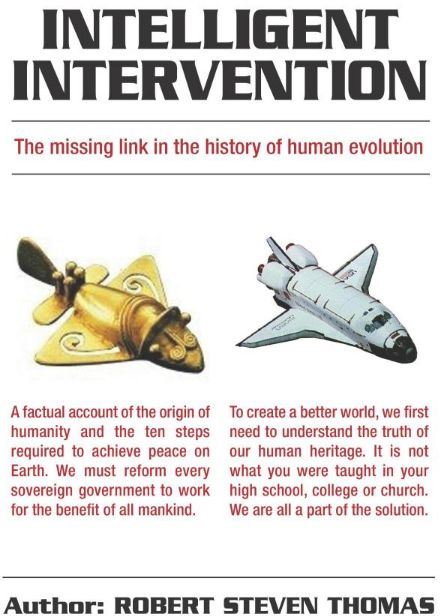
Robert Steven Thomas’s Intelligent Intervention

February 26, 2013

Here is a transcript of my segment on this week’s Skepticality:

A (Sort of) Review of Intelligent Intervention by Robert Steven Thomas

Several months ago, at the Paradigm Symposium, a conference in Minneapolis devoted to the ancient alien hypothesis, during a question and answer session following an especially credulous presentation about Velikovski, I identified myself in front of the crowd as a skeptic with a capital S. After the session, a gentleman came up to me and seemed very interested in talking. His name was Robert Steven Thomas, and he the author of the book Intelligent Intervention: The Missing Link in the History of Human Evolution. After a cordial conversation, he got up to leave. We shook hands and he left the conference hall. A few minutes later, one of conference organizers who had issued me a press pass, came over and handed me a copy of Robert’s book. On the inside cover, it read:

“To Bob. A pleasure to have met you. Please read and the “have at it”! I’d be honored to hear your response. Warm regards, RS Thomas.”

I appreciate the gesture though, to be honest, I’ve been very busy in the last few months, so it has taken me a while to get around to looking through the book. And even then, you know, I’ve done most of my public work examining conspiracy theories. An ancient alien book is a little outside of the scope of my expertise, though I do find the idea of ancient aliens fascinating, if vanishingly improbable.

The book is written around the premise that the mainstream and academic understanding of human history is hopelessly flawed. What Thomas calls the “history establishment” is governed by dogmatism, he argues, and that it “monitors and controls what is commonly taught as history” (15). He uses this, I believe, as an explanation of why one does not see the ancient alien hypothesis in reputable journals, as he launches into a condemnation of the peer-review process. He describes peer-review as a subjective process, based on cronyism, run by people with a vested interest in maintaining the status quo. “As a result,” he says:

there have been valuable discoveries made in the last half-century that profoundly change history which, regrettably, have not gotten the proper attention and focus they deserve or seen publication in scientific journals because of the inequities in the peer review process. In the majority cases, the personal interest and ambitions of a few select individuals stand in the way of the open scientific discourse and dialog with which they have been called upon to champion and foster. (16-17)

He holds out Heinrich Schliemann, who, the story goes, used a copy of Homer’s Iliad as a guide to find the location of Priam’s Troy in 1870, as an example of an outsider defying the establishment and making great finds on his own. But he seems unaware that there are some real problems with Schliemann’s account of the discovery of Troy. Not the least being that the site he eventually dug at was originally identified as a possible candidate for the location of Troy in 1822—nearly 50 years before Schliemann’s find, that an amateur dig specifically looking for evidence of Troy had been ongoing at the site for seven years by the time Schliemann arrived, that the amateur archaeologist leading those exploratory digs, Frank Calvert, suggested to Schliemann that he poke around in the Mound of Haslarik, that of the several layers of debris found at the site Schliemann misidentified the one that is now thought to be Agamemnon or Priam’s Troy, that in his enthusiasm, Schliemann destroyed much of Priam’s Troy, that the hoard of so-called “Priam’s Gold” that was uncovered did not date from the Early Bronze Age, or that Schliemann privately absconded with the gold artifacts that he found there. Even if Schliemann’s account of the discovery were true, that merely interpreting the Iliad literally led him to the site of Troy, it does not follow that anything else that happens in the Iliad literally happened. Heck, even if he read the Iliad like a treasure map and found Troy, it doesn’t even mean that the Iliad is a good treasure map. Schliemann may have simply gotten incredibly lucky.

Personally, I feel for alternative knowledge scholars, and I suspect that it is immensely frustrating to find their work unrecognized. So, in the spirit of reciprocity for Thomas’s thoughtful gift, I feel I should offer back some advice, three points, about how to adapt alternative messages and methods so that they are more likely to receive a hearing and consideration from academics.

1) First and above all, specialize. A characteristic of ancient alien theorizing is to draw on a vast numbers of disparate and far-flung cultures, finding a few apparent similarities, and positing a common context for those similarities. But in creating a new context for archeological and historical finds, their analyses often fail to benefit from the explanatory power of the immediate context of historical finds. For instance, take the image on Thomas’s cover, a space shuttle juxtaposed with a gold bit of jewelry from the Museo de Oro in Bogota:

Thomas

This juxtaposition suggests that objects with vastly different contexts share some sort of function. In fact, even the similarities are a matter of perspective. As you can see below, a profile shot of the jewelry shows that it is decidedly un-shuttle-like.

sar_7gl2

But when you understand that this bit of jewelry was found among a collection of stylized bugs, lizards and birds, none of which is out of keeping for jewelry of the time, suddenly the ancient alien explanation vanishes. It’s not actually an anomaly. A specialized understanding of local context of historical finds is crucial to generating credible hypothesis. As it stands, alternative scholars know a little bit about a lot, but not much about anything in particular.

2) Cite your sources in the text. When I teach research and writing classes, I describe footnotes and bibliographies as, in part, a courtesy to the interested reader. If someone, say a peer-reviewer, is genuinely interested in following up on a point that you have made, we need to know exactly where that came from, and it is your job as an author to at all points to show us all of your work. Depending on how you do it, it may be clunky and distracting, and god knows that it’s a huge pain in the neck to create a good bibliography or index if your research method does not anticipate it, but it is worth it to the reader.  When reading Intelligent Intervention, for instance, when Thomas says that an alternative understanding of history is “well-established” I want to know WHO SAID THAT so I can follow up on it. The bib at the back of each chapter is just not specific enough to be useful. When you say that the Indian Vedas say something about a spaceship, I want to know which line in which translation you are using, and I want to know now. Without citation, everything becomes as unhelpful as a bare assertion. Reverse engineering an author’s research is not a reader’s job.

3) Maintain civility. This should go without saying, but I’ve seen so many alternative knowledge authors display such vitriolic contempt for mainstream scholarship that perhaps it is no wonder that they have so little understanding of what it actually says and how they derived their conclusions. Scholarship is not a series of ex cathedra pronouncements about truth, which are, ironically, exactly what unsourced research is. Take, for instance, the opening of the fourth chapter of Intelligent Intervention, “Collective Memories,” which describes as “categorically incompetent” the dismissal of the Great Deluge when “almost every one of the world’s cultures, though scattered around the globe and separated by millennia and vast oceans, all share stories of these same ancient recollections.” Recollections of floods are to be expected all over the world because people all over the world need access to fresh water, which means rivers, which means floods, which means flood stories. An understanding about how orally transmitted stories tend to amplify memorable aspects of their stories at the expense of unremarkable content, easily explains how flood stories of global deluges are so common—the story itself is more memorable. But dismissing the vast amount of research about this process, indeed failing to display any awareness of this literature—is often why such assertions are dismissed. It’s not from ignorance, as alternative theorists suggest, it’s out of genuine expertise. Don’t ever suspect that the other side will ever take you seriously if you start out with “they are incompetent.” You might try, “I think that they are wrong,” then show you understand their argument, and then point out the flaws.

Like I said, I appreciated Thomas’s gift, and it’s an interesting look into alternative knowledge culture. But no matter how good their work is, alternative scholars will remain isolated from mainstream consideration if they don’t address these oversights.

RJB


animal languages 4 (non-historical ‘fringe’ linguistics 28)

February 24, 2013

Hi again, everybody! I’m concluding my section on alleged animal languages with some shorter sub-sections on specific topic areas.

BIRDS

The psychologist and zoologist Irene Pepperberg, who has collaborated with linguists, holds that the vocal behaviour of African grey parrots displays some of the characteristics of human language, and that they are capable of being taught to communicate using aspects of human language. One particular parrot (‘Alex’) reportedly acquired a 150-word vocabulary and used it in a sophisticated way, performing in a way similar to that of a two-year old child; he was also able to differentiate meaning and grasp features of syntax (and to count up to seven). Alex was learning the Roman alphabet and could indicate the names of fifty types of object when he died. Other parrots have demonstrated similar abilities. Pepperberg’s ideas have been reviewed in fairly positive terms. Against critics’ claims that Alex had been taught a ‘script’, she argues that the controls and tests which she used made it impossible for him simply to recite words when she asked questions.

Theodore Barber discusses bird communication mainly in terms of non-linguistic and paralinguistic systems, but endorses Pepperberg’s claims and argues that the general intelligence of birds is equal or even superior to that of humans (he likens it to that of cetaceans; see earlier). Robert Carroll recounts another case of an African grey parrot (‘N’kisi’) which can allegedly engage in conversation.

TEACHING HUMAN LANGUAGE TO NON-PRIMATES

Several studies have tested the ability of dogs to learn at least the vocabulary of human languages, especially nouns referring to specific, concrete items. Considerable success is claimed, but of course the more specifically ‘human’ aspects of language are not involved here. Another, linguistically more original proposal involves the Bliss Symbols. Of course, sheepdogs can be trained to respond to many distinct whistles, and indeed Robert Schusterman reportedly taught a sea-lion (related to the dogs) over 190 distinct gestures. (See also earlier on Fitch’s work on seals.) However, like the more modest passive repertoires of domestic pets, these abilities do not appear to be linguistic in a strict sense (see again earlier).

There is also, of course, a large corpus of wholly sober mainstream work on communication with such animals.

MORE EXTREME CLAIMS

There have been various papers in anomalist journals on the alleged apparently untutored use of human languages by cats, cows, goats, elephants, tortoises and fish; and on reports of humans using sponges for the recording and re-playing of human speech.

Others who have suggested that animals obtain information and communicate by ‘telepathic’ or other mystical means include figures as varied as Rupert Sheldrake, Ted Andrews, Henry Blake, Amelia Kinkade, Trisha McCagh, Arthur Myers, Ashleea Nielsen, Jim Nollman (on alleged wide-ranging inter-species communication though music), Joan Ranquet, E. Scott Rogo, Penelope Smith, etc. It has been suggested that dolphins in particular are strongly telepathic and can understand unspoken thoughts. Eris Andys presents an account of work with dolphins and whales inspired by that of Lilly (see earlier) but involving alleged psychic communication with these cetaceans and combining ideas adopted from Lilly with those of Peter Tompkins and Christopher Bird and of Stephan Schwartz and his ‘Mobius Group’; both of these groups of thinkers are advocates of the reality of psychic powers. Because of the nature of these claims, linguistic details are not normally discussed in the relevant texts; most of these claims are thus of only peripheral interest in this present context. However, Karen Stollznow offers a very useful skeptical review of claims regarding psychic pets.

There have been many sensationalistic reports on ‘the secret life of plants’ (see especially Tompkins as just mentioned), but understandably these seldom involve linguistic matters (though it is claimed by Tompkins that plants can be trained to count). There are also claims involving communication involving even stone and water.

Some reports of non-humans using language involve apparitions of entities interpreted as the spirits of deceased animals. One of the most striking cases involved the ghostly Manx mongoose known as ‘Gef’.

CRYPTIDS

According to some writers who accept their existence, some human-like mysterious animals (cryptids), notably the Himalayan yeti, the North American sasquatch, the Asian almas, etc. (which some writers equate to or liken with supposedly extinct human-like primates such as the pre-historic Gigantopithecus, or indeed Homo neanderthalensis), manifest linguistic or near-linguistic behaviour. If yeti, sasquatches and such exist, they would appear to be very closely related to humans, which renders the matter especially interesting.

Some reports attribute telepathic and associated linguistic powers to sasquatches. However, there are in addition more sober reports of what could be pre-linguistic behaviour involving these cryptids. Myra Shackley also summarizes reports of apparently pre-linguistic behaviour and/or attempts at communication with humans in rudimentary human language among the alleged humanoid almas of the Caucasus and Mongolia (but not among Himalayan yeti or the Chinese yeren). In Belizean folklore, the duende (unlike the other local humanoid cryptid, the sisimite) is explicitly described as able to speak. Until recently, there has not been sufficient data on any such cases which might be suitable for analysis; but I am now working on one such case.

Marius Boirayon reports (quasi-)linguistic behaviour among the supposed giant yeti-like creatures of Guadalcanal, Santa Isabella, Malaita and other islands in the Solomon Islands group; however, no concrete evidence is produced. Boirayon also expresses naïve
ideas about relationships between these creatures’ linguistic performances and the Fijian language (and has apparently naïve notions about language generally).

As ever, detailed references on request.

Are there any other general topic areas of skeptical linguistics which might be of especial interest? Let me know!

Mark