Back from #TAM2012

July 15, 2012

An amaz!ng weekend to be sure. One night, I joined about 10 people from IIG West to go and protest in front of where Sylvia Browne was appearing, the Imperial Palace, perhaps the dumpiest hole in all of Vegas. We were there for about an hour or so, and Susan Gerbic and Ross Blocher made a video, which was shown after Lawrence Krauss spoke and before Penn and Teller appeared.

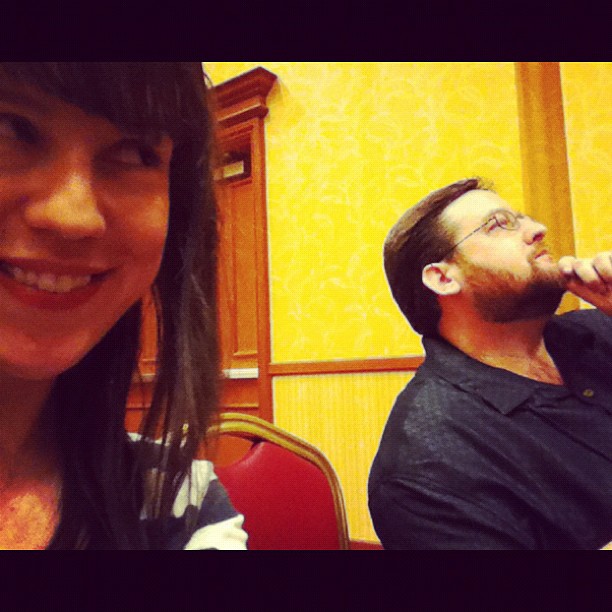
Also, I want to share with you my favorite photo from the trip, taken by Miranda Celeste Hale during one of the workshops:

I had a great time and will surely share more of the more memorable moments with you in the next couple of weeks. During the after-hours meetings in the Del Mar lounge, we had some pretty great conversations which may lead to some remarkable collaborations.

Stay tuned!

RJB


Ken Ham’s World of Wonder and Bollocks (written on the way to #TAM2012)

July 11, 2012

Recently Ken Ham, the founder of Answers in Genesis, published an article where he wagged his finger at the “secular world” following the widely publicized revelation that a Christian “science” textbook suggesting that plesiosaurs might be alive in Loch Ness. As I have spent the last couple of days working with my students on logical fallacies, the deep logical errors in his argument popped out like…big…popping things.

Part of the problem that Ham has with coverage this goofy not-a-science-book has garnered, I suspect, is that he sees that his claims are not so very different, and that creationism has always been allied with cryptozoology. If you visit the Creation Museum, it quickly becomes clear that its directors believe almost exactly what the Louisiana textbook claims, that humans coexisted with dinosaurs in the recent past. So fervent is their belief that the Creation Museum actually presents medieval dragon stories like Beowulf as evidence of recent dinosaurs.

Mess with the Bible all you want, Ken, but when you start messing with Beowulf, you have English majors to contend with.

According to Ham:

As I wrote on Facebook last week, there is no textbook, whether Christian or secular, that is perfect! But what’s more is that the secular world has often put forth numerous scientifically untenable theories.

This is damned close to the tu quoque fallacy, which says, “Yeah, well, you’re wrong too!” This of course does not make the original proposition any more true or acceptable, but he seems not to realize the depth of the ridiculousness of even his medieval “dragons.” Pointing out problems with “secular” theories, does not give any credibility to your monumentally bizarre assertions. I like how he says that putting the Loch Ness Monster in a biology text makes it merely “not perfect,” not “completely laughable and misguided from its ill-conceived botch of a conception. Let’s take his examples of “secular theories” one by one:

1) Aliens seeded life on earth (known as directed panspermia). Francis Crick, a codiscoverer of the structure of DNA, promoted this idea.

Indeed, this assertion strikes me as unlikely as it is so unnecessary. Everything that we need for life is found in abundance throughout the universe. But the funny thing is how closely it mirrors the creationist argument: some mighty person from elsewhere shows up and seeds the planet with life. By your own logic, Ken, the only thing different between what you’re saying is feeble and what you preach is the fact that you believe it! And the other thing is that I suspect directed panspermia is more likely than the God hypothesis because you don’t need to invoke a deity to get that process started.

2) Birds are essentially modern, short-tailed feathered dinosaurs.

How is this scientifically untenable? This is actually pretty close to the standard model of evolution. Without evidence that it is merely fanciful thought, the claim that birds are little dino descendants is a bald assertion.  Life arose from non-life. (This goes against what biologists call the Law of Biogenesis, which says that living things can only come from other living things.)

Life arose from non-life. (This goes against what biologists call the Law of Biogenesis, which says that living things can only come from other living things.)

Alright. Let’s go back to Louis Pasteur. Pasteur’s formulation certainly still applies to complex life like bacteria, which was the original model. We’ll never see a bacterium spontaneously jump together out of atoms. However, we’ve learned things since the 19th century about the origin and nature of life. Science has moved well beyond the 19th century, Bucko. By suggesting that the Law of Biogenesis applies to the most simple chemical replicators out of which life evolved, Ken has created a straw man and demolished a weakened form of the argument that actual scientists make.

Humans evolved from an ape-like ancestor (which really means humans are just apes).

Yes. We’re apes. Apes with iPads and mortgages, but apes. The problem with this is that this is another bald assertion. It’s a lot like an argument from personal incredulity. “It’s untenable because I don’t accept it.” Wrong, kiddo. The universe is utterly indifferent to your malformed opinion of it.

Aliens from outer space built the pyramids.

Oh, that’s hardly mainstream evolutionary theory! This is not a bad argument because of its being secular. It’s a bad argument because it flies in the face of all available evidence. If the intended argument is: “Secularists produced ancient astronaut theories, therefore secularism is bad and somehow evolution is false…” Yeah, this is just a non sequitor. I’m not even sure that it counts as a thought.

Secularists can often say outlandish or wrong things—and get away with it. For instance, noted evolutionist Richard Dawkins admitted in an interview with Ben Stein that life could have been “seeded” on earth by aliens. And yet Christians are highly scrutinized in this very secular world.

Of course it “could” have happened, but what do you think the chances are that he thinks it is “likely”? I mean, we could have left some sort of hardy critter on the moon when we visited there. Such a development is completely plausible within living memory, and in the eyes of the descendants of the bacteria that we left there, we would have been aliens that seeded life there. So, what you are mocking might actually have already happened in recent human history!
Furthermore, Dawkins is scrutinized. He is a peer-reviewed professional. He doesn’t have to rely on an in-house vanity press like the Answers Research Journal. What makes you sad, it is clear, is that your religious beliefs are at all subjected to critical examination, and that when they are held up to the light of serious (or even casual) scrutiny, they are invariably rejected.
RJB
around the world in ‘mysterious’ scripts & texts (7) (‘fringe’ historical linguistics 18)

June 25, 2012

Hi again, everybody! Thanks for comments as ever! I turn now to the final set of cases of this kind. Some of these involve East Asia.

Dubious claims have been made regarding artefacts and written texts from a sunken civilization off the coast of Taiwan associated with the aboriginal Ketagalan group. Also in the Chinese world, Nu Shu (or Nü Shu) is a script and supposedly a language confined to women in one specific area within China. Unlike the standard logographic Chinese script, Nu Shu is syllabic (and hence phonological); each of its characters represents a syllable in the local ‘dialect’. It possesses considerably too small an inventory to represent all the syllables, including tonal distinctions; digraphs are used for the remainder. Zhou Shuoyi, reportedly the only male to have mastered the language, compiled a dictionary listing 1,800 characters, many of which are variant forms of Chinese characters. The origin of Nu Shu is unknown, but it has been suggested that it may date back as far as the third century CE.

Bruria Bergman claims in connection with her theory that a Japanese temple chant is in distorted Hebrew (mentioned earlier) that in 1935 one Kiyomaro Takeuchi discovered an actual document in the area in question (Herai) which dates from around 100 CE and is written in the kana syllabary (several hundred years before kana are known to have been used); this text allegedly shows that Jesus is buried in Herai, and contains his will. However, the document is probably a nineteenth-twentieth-century forgery.

Some cases of this general type are not closely associated with a particular region, because they involve portable manuscripts rather than inscriptions and are not linked with any identifiable language. The best known of these is the Voynich Manuscript, a genuinely mysterious medieval book-length work in an unfamiliar script, including illustrations; the topic may be botanical. Many decipherments have been advanced (some of them themselves book-length). The case arguably involves cryptography rather than linguistics, but either way the issue is my no means settled. Another such case involves the Rohonc Codex, which is of unknown date and may well be a hoax; there have been various attempts at translations (into Hungarian, an unidentified form of early Romance, Hindi etc.), mostly transparently non-mainstream in character.

A few non-mainstream theories involve written numerals. One such proposal, by Jason King, deals with the origins of the shapes of the ‘Arabic’ (apparently ultimately Indian) characters used to represent numbers (integers). Some such number-symbols, notably ‘Arabic’ 1, appear motivated: the symbol 1 is a single stroke. Most of the ‘Arabic’ symbols, however, appear arbitrary: for example, the character 9 does not obviously express the meaning ‘nine’. However, King holds that the ‘Arabic’ numerals 1-9 and also the zero sign (0) are not in fact arbitrary. The basic claim is that each symbol was invented so as to have angles corresponding in number with the meaning of the symbol. Thus, 0 has no angles, 1 (written as now usually printed) has one, 2 (written here as Z) has two, etc. King has to make various dubious assumptions in arriving at this view. For instance, he assumes that 1 was originally written as now printed; but in older versions it is typically a single vertical stroke with no angles. King does not offer any actual evidence that his forms are original ones; and he claims that they were invented by the Phoenicians rather than in India (although the usual Phoenician number-symbols were not in fact similar to the ‘Arabic’ symbols). In sum, it does not appear that King is correct here. The best that can be said is that he has drawn attention to a somewhat neglected matter.

I have now completed this summary survey of non-mainstream historical-linguistic and epigraphic claims. On request I will comment on claims regarding any particular language not so far discussed (especially linguistic rather than epigraphic claims). Apart from this, I now propose to look at non-historical aspects of ‘fringe’ linguistics. I may take a short break from blogging before embarking upon this. But thanks again for your support, and see you soon!

Mark


Eve’s Swift Blog article is totally…warranted

June 22, 2012

Oh, I’m such a delight!

Eve has a new post up at the Swift blog, where we are collecting writings by educators who use extraordinary claims in their classes to teach critical thinking. This one is about warrants.

RJB


This Week in Conspiracy (12 June 2012)

June 22, 2012

I’ve been sitting around Atlanta for weeks waiting for classes to start. To keep myself occupied, I’ve been combing through the conspiracy literature, reading for my upcoming class on the Cold War, and generally puttering about contentedly. I also watched a disturbing amount of Deadliest Catch (which is “any Deadliest Catch,” by the way).

Currently, I am up in Minnesota, where I failed to find a house for the next semester. I met members of my new department in Eau Claire, WI, which was delightful, and I have a jump on how to think about my upcoming class. So that was productive. I also hit n00b night at the Minnesota Skeptics and met some of the people who live in my electronic friend box. But not all the squeaky cheese in the world would keep me from bringing you up to speed on the weak that was weak! Perhaps delay me for a week or two, but that’s it.

Or how about Mark Dice’s reaction?

Mark Dice (@MarkDice)
6/8/12 1:27 AM
And Rand Paul announced it on #SeanHannity‘s show!!#ScrewRandPaul.

“So if there was weird stuff going on,” he said, “I actually think it was happening back in his college days because I think he has spent $1.5 or $2 million through attorneys to have all of the college records and all of that stuff sealed. So if you’re spending money to seal something, that’s probably where the hanky panky was going on.”

Twits of the Week

This has become a favorite feature-within-a-feature for me. I get a lot of joy/agony out of the twitterverse. Here’s agony:

#DefineObamaInOneWord Satanist — Kn0Wledge[!] (@An0nKn0wledge)

Here’s joy:

In KENYAN. // RT @UberFacts “Barack Obama has read every Harry Potter book to his daughters.” — BillCorbett (@BillCorbett)

Here’s some unintentional irony, in tweet form:

Dear Occupiers who hate me, just remember I was at the #BilderbergProtest aka #OccupyBilderberg for four straight days. Were you? — Mark Dice (@MarkDice)

Anyway, Eve and I are both going to be appearing at TAM in a few weeks, and my classes have started up again. I will do my best to keep the conspiracy coming!

RJB


around the world in ‘mysterious’ scripts & texts (6) (‘fringe’ historical linguistics 17)

June 18, 2012

Hi again, everybody! Thanks for comments as ever! I turn now to issues of this kind involving Pacific territories.

The mainstream view of Pacific linguistic history is that the Polynesian languages as they spread eastwards from East Asia across the ocean, and the other Pacific languages, were unwritten until the beginning of European colonization. The only exception is the now small corpus written in the Rongorongo script of outlying Easter Island (Rapa Nui). Rongorongo lacks an accepted decipherment but is generally presumed (in the absence of other candidate languages) to encode an earlier stage of Rapa Nui, the contemporary Polynesian language of the island (settled around 400 CE); it is possible that it represents an independent invention of writing.

Hundreds of tablets written in Rongorongo existed as late as 1864, but most were lost or destroyed in that period and only twenty-six remain today; almost all of these are inscribed in wood. Each text has between two and over two thousand simple glyphs (some feature what appear to be compound glyphs). The longest surviving text is that on the ‘Santiago Staff’: around 2,500 glyphs, depending upon how the characters are divided. The glyph-types are a mixture of geometric figures and standardized representations of living organisms; each glyph is around one centimetre in height. Thomas Barthel provides a standard list.

Only Tablet Q has been carbon-dated, but the results limit the date only to after 1680 (in any event, some carbon-dates for Rongorongo are demonstrably inaccurate). Texts A, P, and V can be dated to the eighteenth or nineteenth centuries by virtue of being inscribed on European oars.

Some ‘decipherers’ themselves regard Rongorongo as local in origin. Sergei Rjabchikov (unusually ‘mainstream’ in this case) interprets the texts as in an early form of Rapa Nui. Barry Fell (see earlier) ‘deciphers’ the script with the aid of cave ‘inscriptions’ and other texts from New Zealand (see below); he treats the language as an artificial (priestly) Polynesian language closely related to Maori.

On the other hand, various non-mainstream writers have linked Rongorongo with scripts and languages from remote areas. A common choice is Indus Valley Script, itself currently undeciphered (see earlier); some Rongorongo characters superficially resemble those of IVS.
.
Stephen Fischer (one of the ‘decipherers’ of the Phaistos Disk) has argued that Rongorongo is in fact a modern invention and is logographic and ‘semasiographic’ in character (and thus, in part, not strictly linguistic). He reads the text on the Santiago Staff as a series of creation chants. Konstantin Pozdniakov notes that the Staff shares short phrases with a very few other texts but nothing with the rest of the Rongorongo corpus; and Jacques Guy argues that Fischer’s reading is untenable (and that if it were correct the text on the Staff would consist almost entirely of personal names). Paul Bahn and John Flenley support the Fischer ‘decipherment’, but without displaying linguistic expertise.

The prevailing mainstream opinion is that Rongorongo is not true writing but ‘proto-writing’, or even a limited system of mnemonics. This view was foreshadowed by some earlier writers, notably Katherine Routledge, who interpreted Rongorongo as an idiosyncratic mnemonic system in which the meanings of the glyphs varied from scribe to scribe

Another regional focus of non-mainstream theorizing involving scripts in the Pacific proper is New Zealand, which was settled from Eastern Polynesia around 1000 CE. The mainstream position is that here too the languages (Moriori and Maori) were unwritten until the colonial period. However, some non-mainstream authors offer hyper-diffusionist theories (similar to those applied to the Americas) involving unrecognized early visits to New Zealand on the part of voyagers from Asia, Europe, Africa etc. – some involving unrecognized early contact with the New Zealand Polynesians, who are themselves sometimes held to have settled the islands earlier than the given date (see for instance the works of Barry Brailsford).

Barry Fell claimed to have identified Libyan and Numidian script in New Zealand, and also found Polynesian elements on the Phaistos Disk. Ross Wiseman and others believe that they have found Egyptian and Phoenician inscriptions around New Zealand, confirming their hyper-diffusionist views of history. However, some of these are natural markings on rocks, which they are over-interpreting; others are indeed written language but contain errors and are surely fakes. With some other amateurs, Martin Doutré argues for an alternative hyper-diffusionist view of early New Zealand history involving early voyages by ‘Celts’ and members of other Eurasian groups. Doutré’s linguistics is of the usual non-mainstream type. Like Wiseman, he identifies ancient inscriptions in Eurasian languages in New Zealand and endorses the ideas of the ‘Viewzone’ group (who also link the Panaramitee Aboriginal rock-art tradition of Australia with their claims regarding a common world script in very early times).

I turn now to Australia, on the fringe of the Pacific. Many non-mainstream authors have offered and continue to offer hyper-diffusionist theories involving unrecognized early visits to Australia by long-distance voyagers. Some of these theories involve the supposed presence in Australia of inscriptions in Egyptian or Phoenician script, found on rock faces or associated with ruins (typically, in fact, of nineteenth-century origin) and ruin-like rock formations. (For cultural reasons, there are far fewer genuine pre-colonial ‘indigenous’ buildings in Australia than in New Zealand.) Some of these alleged inscriptions again contain errors and are surely fakes; others are over-interpreted natural markings.

One author who has proclaimed the presence in Australia of Egyptian hieroglyphic texts is Paul White, who endorses as genuine a set of rock carvings found in the National Park forest in the Hunter Valley, New South Wales. White (claiming support from an Egyptologist) argues that the inscriptions feature early forms of hieroglyphs which ‘correlate’ with archaic Phoenician and Sumerian sources, but this view of early Egyptian script is simply mistaken, and the text in question is now acknowledged as a fake.

Val Osborn claims to have found a Phoenician port in Sarina, Queensland, and other authors report Phoenician or Egyptian inscriptions from that state and from New South Wales, notably the prominent ‘anomalist’ Rex Gilroy. Gilroy and Brett Green have identified ‘texts’ linked with the ‘Gympie Pyramid’ in Queensland (which probably represents ruined nineteenth-century vineyard terracing) as Egyptian or Indian in origin.

More next time on a few additional cases (some of them involving East Asia).

Mark


around the world in ‘mysterious’ scripts & texts (5) (‘fringe’ historical linguistics 16)

June 12, 2012

Hi again, everybody! I turn here to claims regarding Indian scripts.

Many of these claims involve the interpretation of the Indus Valley Script (IVS). IVS has been found on tablets in the ruins of Mohenjodaro and Harappa and dated around 4,500-4,000 years BP. The Indus Valley Civilization, if IVS is genuinely a script (see below), is one of the oldest literate civilizations known, and the issues extend well beyond linguistics.

IVS is the subject of a vast scholarly literature but has no accepted decipherment or interpretation. The two most plausible candidates for the unidentified language represented are Indo-European (probably early Sanskrit/pre-Sanskrit) and Dravidian, the main language ‘family’ of Southern India; the best known language in this ‘family’ is Tamil. On the ‘Dravidian IVS’ theory, the later arrival in India of the IE-speakers might have contributed to the fall of the Indus Valley Civilization, or might alternatively have post-dated it altogether. The old mainstream notion of an ‘Aryan Invasion’ of India by users of IE around 3,500 years BP has long been modified; but if IE arose much further west, as is still accepted in the mainstream, the language ‘family’ must have entered India at some date.

Many of those who believe that IVS represents Dravidian invoke Brahui, the isolated Dravidian language of the Indus region, which they interpret as a survivor of early Dravidian domination in the region (but there are other, mainstream accounts of the situation of Brahui suggesting that the language was transplanted to the region at a much later date).

If IVS instead represents very early Sanskrit or the like, IE was in India much earlier than orthodox scholarship maintains, too early to permit any Aryan incursion in the second millennium BCE. The arrival of IE in India might, indeed, have been the event which triggered the development of the Indus Valley Civilization. Edwin Bryant has proposed a moderate version of the view that IE entered India at an early date, but (as I noted earlier) there are also stronger, clearly non-mainstream views, proposed by K. D. Sethna and others, according to which IE actually had its origins in India. An authoritative and generally accepted decipherment of IVS would be a very important factor in the solution to this historical problem.

There have been over 100 ‘decipherments’ of IVS, many by non-mainstream writers and those with political, cultural and linguistic biases. Predictably, most ‘decipherers’ favour either IE or Dravidian (or languages which may be related to Dravidian, such as Elamite), depending upon their own linguistic background or interests. IE interpretations of IVS include those of Barry Fell (see earlier), who believed that he had deciphered the script as representing early Sanskrit/pre-Sanskrit, George Feuerstein and his associates, David Frawley, Daniel Salas, Rama Sarker, etc. Dravidian interpretations include those of Tariq Rahman and Anand Sharan, who believes that IVS is still in use in Bihar State, India (not close to the IVS sites). Sharan therefore accepts a version of the ‘Aryan Invasion’, but (as a ‘Dravidian supporter’) he also denies that the Dravidian-speakers were culturally and technologically inferior to these invaders. His account of how in that case Dravidian came to be ‘pushed’ south is not entirely convincing. Of course, it is not agreed by mainstream Indologists that IVS is indeed still in use, in Bihar or anywhere else.

Clyde Winters and other Afrocentrists ‘decipher’ the script as Dravidian; they go on to link Dravidian generally, Sumerian and even Chinese with African languages held to have been widely diffused by an early African diaspora. Ivan van Sertima and his associates present a range of other Afrocentrist views. Most of the material in this work is non-linguistic in character, involving artefacts, ‘racial’ characteristics and such; but Walter A. Fairservis claimed that the language represented by the Indus Valley Script was Dravidian – which is hardly supported by his editor’s claim that the IVS-users were black Africans rather than Dravidians akin to dark-skinned contemporary Southern Indians (endorsed by Wayne B. Chandler, who believes that Dravidians later ‘inherited’ what was originally an African civilization).

Indologists Steve Farmer, Richard Sproat and Michael Witzel have proposed that IVS is in fact a non-linguistic symbolic system (see above) which was used by an elite in a multilingual situation and does not encode any particular language. They support this view with many arguments, including the total absence of long texts in IVS (the longest known text has only seventeen characters, and very few have more than ten); this would make IVS unique as a true script, if it were a script. Richard Sproat has also commented on some academic approaches to such issues which in the view of these three authors have not led in the direction of what they hold to be reliable solutions. Michael Witzel offers extended critiques of non-mainstream proposals in this area. William Bright also concludes that none of the ‘decipherments’ offered to date can be substantiated and that the methods adopted are often dubious).

There are also claims regarding mysterious artefacts, some of them bearing markings interpreted by some as short inscriptions in an otherwise unknown script, found submerged in Indian waters off Cambay.

There is a body of markedly non-mainstream work regarding an ancient civilization and language known as Naacal, allegedly carried to Mesopotamia, Egypt, India etc. in very remote ages by Mayan adepts. The first recorded use of the term is by the maverick archaeologist Augustus le Plongeon. Le Plongeon believed in a late-pre-historic world civilization centred on a Pacific continent known as ‘Mu’ or ‘Lemuria’ (later submerged, giving rise to pre-Polynesian cultures in places such as New Zealand) and massive early diffusion more generally. His ideas were linked with those of H.P. Blavatsky and were developed further by James Churchward , Wishar Cervé and others. Churchward claimed to have learned from a priest in India to read the Naacal language, written on ancient tablets which are said to represent fragments of a larger text. He also claimed to have verified the material from the records of other ancient peoples, although his references to ancient sources are typically ludicrously vague. (Le Plongeon also asserted that Jesus spoke Mayan on the Cross, and Churchward further claimed that the Greek alphabet, as normally recited, is really a poem in Mayan.)

More next time, heading still further east!

Mark


around the world in ‘mysterious’ scripts & texts (4) (‘fringe’ historical linguistics 15)

June 5, 2012

Hi again, everybody!  More on European scripts and ‘scripts’!

The feminist archaeologist Marija Gimbutas (who made major contributions to the study of the cultures regarded as the early speakers of Indo-European), and her followers such as Richard Rudgley, identify an ‘Old European Script’ in the Vinča symbols (Balkans), which they associate with a ‘lost’ Stone Age civilization, possibly a matriarchy.  In fact, it is not even clear that these markings really represent a script as such; and the discussions of ‘meta-language’, ‘alphabets of the metaphysical’, ‘feminine’ versus ‘masculine’ scripts, etc. appear obscure and tendentious.  Much of Rudgley’s specific ‘evidence’ is linguistic (or at least involves what are claimed to be early manifestations of written language), but this is discussed only within the framework of these highly controversial ideas.  Rudgley devotes much space to his interpretation of the rather scanty and equivocal evidence surrounding a) the nature of ‘pre-writing’ (often apparently overinterpreted; he refers to controversial writers such as Alexander Marschack) and the origins of written language and b) linguistic pre-history and the ‘deep-time’ relationships between language families.  He cites Gimbutas, Harald Haarmann and others on the supposedly apparent parallelisms between the various syllabic scripts of the Mediterranean and ‘Old European Script’.  Rudgley also engages in loose philology of the usual type.

More markedly non-mainstream analyses of the Vinča symbols include Toby Griffen’s claim to have deciphered three of the symbols as logographs, and the theory of a historical link with Etruscan script (see above) proposed by Radivoje Pešić.  Vasil Ilyov argues (tendentiously and implausibly) that carved symbols found in the territory which now constitutes (Slavic) Macedonia represent a pre-historic Macedonian ‘phonetic alphabet’ which is to be regarded as the ancestor of early Indian scripts and as one of the earliest written languages.  Those with other loyalties cite other pre-historic texts such as the Tartaria Tablets, found in Romania, or the Dispilio Tablet, found in Greece.

The runic alphabets are a set of related alphabets using letters known as runes to write various Germanic languages prior to the adoption of the Roman alphabet and for specialized purposes thereafter.  The variants of the system displayed different numbers of runes: Teutonic (24 letters), Anglo-Saxon (32), and Scandinavian (sixteen).  The Scandinavian variant is known as futhark (a term derived from the first six letters of the system: F, U, Þ, A, R and K).  The earliest runic inscriptions date from around 150 CE.  Most adherents of ‘rune lore’ identify the runes as of Germanic origin, while differing as to the precise area of origin.  However, many runes resemble characters from the Roman alphabet, often featuring straight lines in place of curves; other possible direct sources include the related Northern Italic alphabets.  As Germanic developed and diversified, the words assigned to the runes and the sounds represented by the runes themselves diverged somewhat; new runes were created and existing runes and groups of runes were renamed or rearranged, or even abandoned, to accommodate these changes.  The characters were generally replaced by the Roman alphabet as the cultures which had used runes underwent Christianization.  There has been and still is a great deal of non-mainstream thought associated with runes, involving theories to the effect that they are very ancient indeed and/or possess magical powers.

Various writers argue that runic writing in Hungarian pre-dates Germanic use of the system, in some cases dating from as long ago as 6,500 years BP, (although the earliest clear attestations actually date from the seventh century CE).  They accordingly suggest that Hungarian is the oldest written language and was spoken in the territory which now constitutes Hungary much earlier than mainstream historians would hold. Some link the Hungarian runes with cuneiform as used to write Sumerian (and later Akkadian).  Turgay Kurum instead finds a Turkish source for runes. There are many other non-mainstream theories regarding Hungarian and its written forms.  (See earlier on runic or allegedly runic inscriptions in the Americas.  I will turn later to the ideas of the occultist Von List and other occultists regarding runes. )

Nigel Pennick and others develop mystical notions around scripts formerly used to write Celtic languages, notably Irish Ogam (which I discussed last time) and the quasi-runic Welsh system known as Coelbren or Coelbren y Beirdd (‘the Bardic Alphabet’), which they regard as one of a set of genuinely ancient alphabets and which they believe was employed by bards to communicate secret messages (using a wooden frame with sticks representing letter-strokes) in medieval times when writing in Welsh was suppressed.  Other authors such as Alan Wilson and Baram Blackett also regard Coelbren as authentic and as linked with widely dispersed scripts around the world.  Jim Michael finds links between Coelbren and American ‘inscriptions’ as discussed above, suggesting for example that that the inscription on one stone tablet found in the USA is in Coelbren.  In fact, Coelbren was devised – as were many ‘traditional’ features of contemporary Welsh culture – by the eighteenth-nineteenth-century Welsh antiquarian and mystic Edward Williams (‘Iolo Morganwg’) as the supposed alphabetic system of the ancient Druids (parallel with the genuinely ancient Ogam in Ireland) and promoted after 1840 by his son Taliesin Williams.  It consists of twenty main letters and twenty others used to represent long vowels and the mutated consonants characteristic of Welsh (and of Celtic generally).

Moving further east … the early Mesoptamian culture of Sumer (Sumeria) arises repeatedly in this kind of context, because it is the earliest known genuine ‘civilization’.  In addition, Mesopotamia is a centre of what may well be an immediate pre-script phase of written semiotics; and the full-blown written Sumerian language – which can now be read – is the oldest known written language (and, moreover, is, as far as is known, ‘genetically’ isolated).  The Sumerian ‘cuneiform’ script was later adapted to write other, unrelated Mesopotamian languages such as the Semitic language Akkadian.

Zecharia Sitchin (an advocate of early extraterrestrial contact), John Allegro, David Rohl and others advance novel interpretations of the Sumerian language to suit their theses, but these do not in general involve other than piecemeal reinterpretations of the script per se.  More relevantly here, the early twentieth-century non-mainstream historian L.A. Waddell argues (tendentiously and unconvincingly) that the common ancestor of the Middle-Eastern and European abjads and alphabets – and indeed of Egyptian script – was in fact Sumerian cuneiform.

A very different non-standard interpretation of Sumerian script has been proposed by Peter Linaker.  Linaker proclaims the exaggerated view that twentieth-century synchronic structuralist linguistics requires that all linguistic structures be interpreted as systematic.  In fact, because of prior linguistic changes, any language at any given time is liable to display a varying proportion of unsystematic features.  These may be exemplified by synchronically irregular verb morphology, as manifested for instance in English past tense forms such as rose, for what would be the regular form *rised.  Forms such as rose exemplify older, now superseded morphological systems, often quite systematic in their day, which are no longer productive; no such new forms now develop in English.

Because of Linaker’s general stance on this point, he seeks covert systems which would explain apparently unsystematic features of language in synchronic ways.  He unreasonably regards the (in fact not uncommon) mixture of logographs and phonological spelling which characterizes the Sumerian cuneiform script as unsystematic and therefore mysterious, and goes on to argue that some features of the Sumerian script which are generally interpreted as phonological can be interpreted only by ignoring Sumerian phonology and focusing instead upon hitherto unrecognized semantic properties of the characters.  Linaker thus develops a theory involving the existence of covert, highly coherent systems of cuneiform characters.  Many of these involve alleged ‘double-entendres’, often with references to sexual matters, which Linaker (bizarrely) appears to believe would naturally not be overtly expressed in any culture.  In most cases, no persuasive empirical evidence is adduced in support of these novel readings.

More next time, starting with the Indus Valley Script!

Mark


This Week in Conspiracy (3 June 2012)

June 4, 2012

Eve and I are back from a whirlwind tour of Savannah, GA, and the whole time I was there I kept thinking how screwed I would be if a tsunami hit. We did ghost tours (ouch), we kicked around tide pools, and I got my first mild sunburn in years. Meanwhile, the Bilderbergers were meeting in Virginia, attracting every damned nut with a enough coin, or enough chutzpah to beg enough coin, to go and protest. This week in conspiracy was a week in Bilderberg conspiracy theories.

Alex serenades the NWO with “In Your Eyes.”

  • Some of the biggest fake news was that the Bilderbergers were discussing ways to off Ron Paul. (The number of Ron Paul signs in front of that hotel was significant.) The source for this is an “unnamed insider” working for Big Jim Tucker, who is still not dead from heart failure somehow and has been following the Bilderbergers since I was knee-high to a horny-toad:

The one that struck me as the second-dumbest allegation was made by a guy who was arrested and then said that he was forcibly to be vaccinated under penalty of being denied bail. When I first got the tweet, I replied:

@kr3at That was funniest thing I’ve read all day. Ha!
I got a response:
@rjblaskiewicz Actually happened, his arrest is up on YouTube. They told him take a TB vaccine or be held until your trial
My analysis? Well, usually this might be the type of thing that we could verify. We could look at the arrest record. We could draw blood from the guy (who is a veteran) and see if his TB antibody count goes up over the next few weeks. TB vaccine is not routinely given in the US and is not a part of the standard military vaccine schedule. Of course, when you look at the video, the arrest is not there, and the “forced vaccination” is not shown. The guy is being interviewed by Luke Rudkowski, who will believe almost anything.
One of the places that TB thrives is in prisons–Russian jails, for instance, are rife with TB, and the bacteria jumps between all those people in close contact with one another. In fact, some police departments give a Mantoux TB skin test to every single prisoner. This means that they give you a scratch with a protein associated with TB, and if your body reacts, you may have TB. This is completely different from being injected with the vaccine, as that is a live, though attenuated, bacterium. I can’t find anything that says that this is standard operating procedure at the Fairfax police station, but it may well be. The scratch test is administered far more often than the vaccine; the scratch test seems far more likely than the vaccine. So, you know, shut up, Luke.

This Week in Plain Old Conspiracy

A Philadelphia witness reports that he or she saw a UFO on 22 May 2012 according to testimony supplied from UFO Sightings Daily.

The kind of UFO which the witness showed is consistent with the “lights” described in the “Book of Revelation” which the ancient Pagan Gnostics linked to an alien orchestrated “false flag” scenario designed to lead into the New World Order.

Headline of the Week

It comes from The Guardian, and is more of a subtitle:

“Protesters at Bilderberg up their game: ‘What do they want? Hegelian dialectics! When do they want it? Now!'”

It was closely followed by a headline from the Weekly World News:

“Zombies vs. Cannibals: The War is On!”

Twit of the week:

A lot of goofy things were flying this week. Very quotable. Take Steve Martin’s comment:

When you see a White Supremacist interviewed, you are immediately impressed at how they are so…so…supreme. — Steve Martin (@SteveMartinToGo)

Jon Ronson (who was on the DisinfoCast this week) tweeted about a conversation he had with a cab driver:

3m jonronson ‏@jonronson Taxi driver last night. Used to be a whale hunter in the Antarctic…now he writes about “the history nobody knows about”…

3m jonronson ‏@jonronson …like how “Bilderberg and the Trilateral commission are the secret world government” I said, “EVERYONE has heard of that.”

2m jonronson ‏@jonronson He looked annoyed that I’d heard of the thing nobody has heard about. He said “in 100 years the Jews will rise up and take over. Yes? YES?”

jonronson ‏@jonronson I shrugged and said, “well I suppose we’ll have to wait and see.”

There was this nugget from Bilderberg, which is so true, since Luke Rudkowski is not a reporter:

Truth Excavator ‏@TruthExcavator FAIL: Mediaite calls @Lukewearechange “a reporter working for Alex Jones” http://bit.ly/KlBS6k #OccupyBilderberg #MSM #Media #Bilderberg

The Center for Inquiry had a good one this week too:

CFI On Campus (@CFIOnCampus)
6/3/12 1:05 PM
“Skeptics Censor Skepticism of Paul Offit’s Book” Apparently, we at CFI are puppets of big pharma. @center4inquiryow.ly/bj9h0

The Truth Excavator needs a derivative hashtag timeout, I think:

9/11 Truth Spring And Bilderberg Spring http://t.co/06zVwXw1 #OccupyBilderberg #Bilderberg #BilderbergSpring #TruthSpring #September11 — Truth Excavator(@TruthExcavator)

Sean Carroll found something unpleasant in his hotel:

The hotel I’m staying at is hosting an Oath Keepers meeting. The gun-toting wing of Ron Paul Nation. http://t.co/njQSzyTO — Sean Carroll (@seanmcarroll)

This one made me happy:

Illinois rep EXPLODES on the House floor! IT’s ALL FALLING… http://t.co/sxmvEQAb — 911truth (@911Truth)

But legislators aren’t the only things exploding this week:

B4IN Featured (@B4INFeatured)
5/30/12 4:03 PM
2012 Firearms & Ammunition Sales Exploding bit.ly/M8r0JE

Conspiracy Theory of the Week

I like this one because I’m a U2 nut. Bono is the frontman for global genocide:

That’s it, people. More is coming. More is always coming.

RJB


It was a dark and stormy night…

May 31, 2012

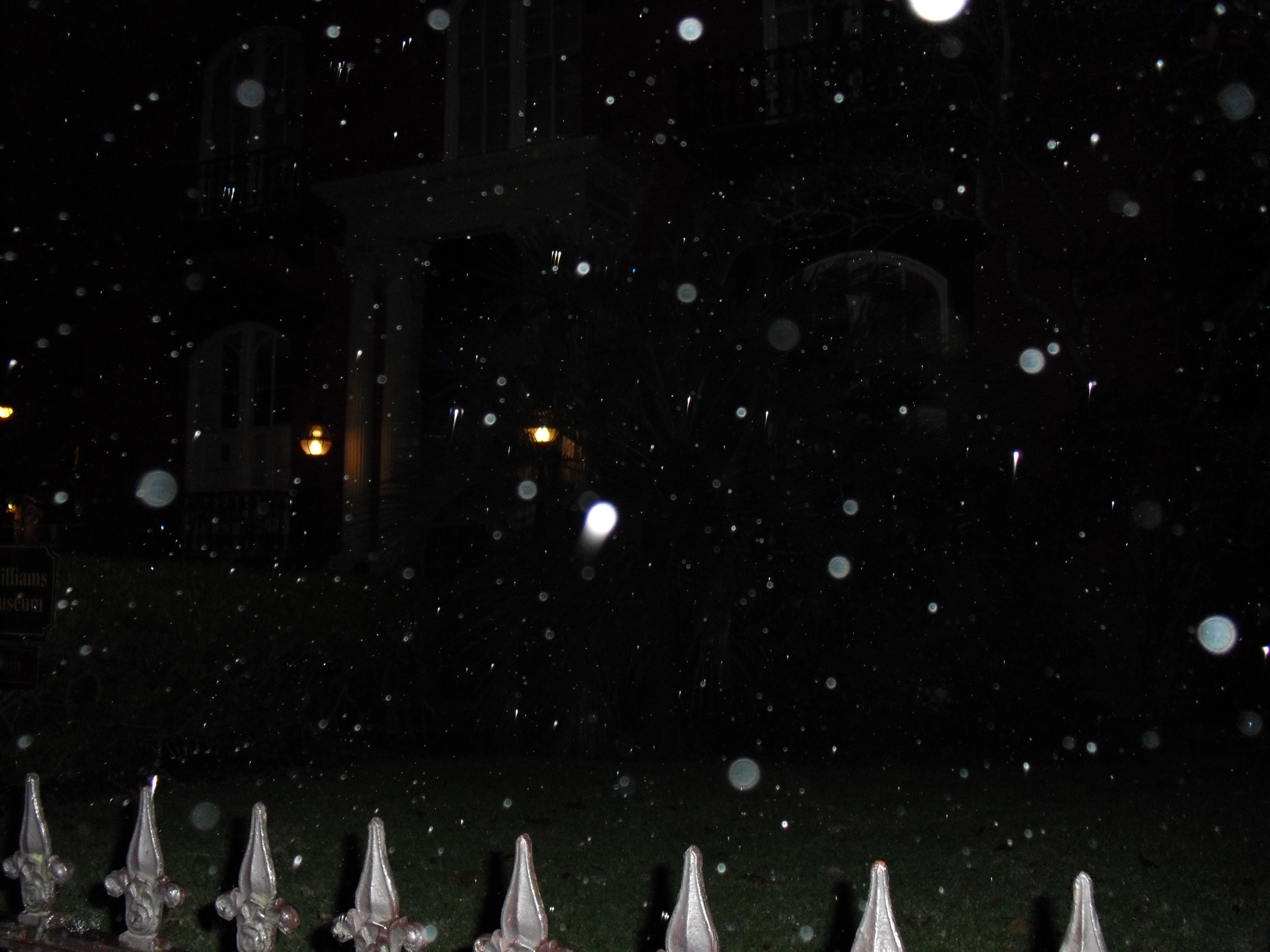
When Bob and I went on a ghost tour in Savannah, Georgia. Well, it was certainly dark, what with it being night and all, and there were occasional flashes of lightning. At the end of the tour, the heavens let loose and soaked us. Coincidentally, there were orbs all over the place outside the Mercer-Williams House.

Spoooooky.

Also, dolphins:


ES