The Last Couple of Weeks in Conspiracy (11 Oct 2012)

October 16, 2012

Been away. Very busy. Grading. Job hunt. I apologize. Still really busy. But also feeling guilty.

But you know I’ve been on the prowl for the latest and greatest in conspiracy, right? Because I have some sort of masochistic compulsive disorder!

@GoAngelo Truth. RT @KuraFire: @emokidsloveme @AriMelber @GoAngelo What a tremendous waste of taxpayer dollars.

Twit of the Week:

Jonathan Kay @jonkay
WND is now combining islamophobic paranoia with something resembling Aspergers wnd.com/2012/10/were-o… Ring collage = unintentionally hilarious.

The American Muslim site does a little debunkery of this claim.

Bill Corbett, however, made me laugh:

@BillCorbett
Rabid anti-Semites are gonna have a hard time explaining the bacon shortage.

That’s all. I’m trying to keep up, folks! This week, I am going to be attending the Paradigm Conference on behalf of Skeptical Inquirer. Follow me as live tweet on #paradigm!


channelled languages and similar phenomena 2 (non-historical ‘fringe’ linguistics 11)

October 15, 2012

Hi again, everybody! More on linguistic aspects of (allegedly) channelled communications and similar cases: first, oral ‘channelling’ and written ‘channelling’ or ‘automatic writing’. (I will provide (a) reference(s) to/for any specific source on request.)

Oral channelling is regarded by ‘believers’ as generated by spirits or other paraphysical entities rather than by the physical channeller or medium, who is often in a trance-like state at the time of production. These phenomena may involve languages known to the channeller (not of especial relevance here; the main point of skeptical interest in such cases involves information to which the channeller supposedly had no other access), identifiable languages (modern or other) not known to the channeller (again, very interesting, if genuine) or unidentified languages or ‘languages’ (as in glossolalia). Channellers often claim no understanding of the material produced where it is not in a language with which they themselves are familiar. For example, I met an Australian man who channelled large amounts of material in a ‘language’ which he himself could not interpret (and which – following information supposedly obtained from a ‘spirit guide’ – he wrongly identified as Seneca). In a few cases (see later on Flournoy for an example), unknown scripts are provided to accompany the oral material (see also below on written channelling and automatic writing).

Many cases of channelling are interpreted by believers as communication with deceased persons, including long-dead individuals as well as now-dead acquaintances. Examples include the works of Arthur Guirdham (reporting the channelling of a thirteenth-century French-speaker) and Margaret and Maurine Moon (reporting the channelling of ‘Wedge’, a seventeenth-century English-speaker).

In some cases involving deceased individuals from remote time-periods, and indeed in most cases involving languages not known to the channeller (contemporary or ancient), appropriate usage is not attempted. The channeller uses a contemporary form of her own first language; this is arguably both anomalous and ‘convenient’ (for channellers unschooled in language matters), but some such channellers adduce arguably specious reasons for this, such as the spirit’s desire to assist current listeners. One such case is that of the ‘Starseed Transmissions’; the channeller Ken Carey reports that these messages were transmitted in non-verbal form as ‘waves’ linking his ‘biogravitational field’ and neurology with those of the extraterrestrial/angelic communicators. Approximately synonymous English expressions were then ‘assigned’ to these ‘waves’ (apparently by the communicators).

However, such cases are obviously more convincing if linguistic forms appropriate to the period can be used. Unfortunately, where this is attempted the usage itself is seldom at all convincing to linguists. There are frequently errors and/or anomalies, for instance the mixing of usage from different periods. This suggests that the material has been fraudulently hoaxed and that the unconvincing features are errors which have intruded because the faker lacks the specialization required if utterances containing accurate forms in pre-modern usage are to be invented. One case which appears slightly less dubious is one in which a young Londoner allegedly lost his local accent when channelling.

The skeptical linguist Sarah Thomason reviewed some such cases and specifically investigated the cases of Marjorie Turcott (American, channelling ‘Matthew’, a seventeenth-century Scot), Jack Purcel (channelling ‘Lazaris’) and Julie Winter (channelling a ‘high-energy being’ called ‘Mika’). None appear convincing, especially where the supposed language variety is actually known; for example, Matthew’s dialect is mixed and often inaccurate for the period. Mika’s voice too displays an unconvincingly inconsistent ‘foreign’ accent. (The channellers/entities also make factual errors; for example, Turcott/Matthew makes various factual errors about Scotland.) Other such studies have been carried out by anthropological linguists, with similar results. In some other such cases there is a mixture of contemporary usage and an attempt at archaic forms, usually in the same language (that of the channeller); see for instance the case of Pearl Curran, who gained notoriety in 1913 for allegedly channelling a seventeenth-century character named Patience Worth, through an Ouija board; she and the spirit supposedly developed a powerful ‘mental linkage’. Skeptics such as Karen Stollznow and Joe Nickell hold that Curran herself was behind the creations.

An unusual older case involves a medium who supposedly channelled a speaker of Ancient Egyptian despite being untutored in the language. Her performances allegedly impressed some scholars of the language, though the vowels of Egyptian are poorly known (thus the channeller’s own ‘Egyptian’ vowels cannot be reliably checked) and there were in fact sundry errors, which the authors attempted to explain away. The case remains somewhat mysterious, but because of the date of the study it is no longer possible to investigate it thoroughly.

In cases involving languages altogether unknown to mainstream scholarship, such as ‘Atlantean’, it is of course impossible to demonstrate whether or not the usage presented is accurate. However, it is more difficult than most non-linguists imagine to invent a language (as opposed to an unstructured set of vocabulary items) in such a way that a linguist will be convinced, and even unknown ‘languages’ can be assessed for plausibility (this also applies to alleged extraterrestrial languages).

Other cases involve exotic phenomena such as the claimed channelling of a deceased person now living on Mars (as a spirit being) by the medium Hélène Smith, as reported by Théodore Flournoy. The spirit communications were in an unknown ‘Martian’ language, with an accompanying exotic script. This unidentifiable ‘language’ is in fact modelled (consciously or unconsciously) on a language familiar to the channeller, French. The grammatical and phonological structures of ‘Martian’ are clearly based on those of French, and the script is alphabetic and corresponds with the Roman alphabet as used to write French. Only the vocabulary is novel, although even this is partly derived by cipher from French, Hungarian and other languages known to Smith’s polyglot father.

As intimated, some cases of channelling involve ‘Atlantean’ (or ‘Lemurian’) languages emanating from spirit realms, etc. One such case involves some 3,000 ‘Atlantean’ words supposedly channelled to a medium. An Australian group called ‘Liquid Crystals’ claims that it is in touch with survivors of Atlantis (in space/other ‘dimensions’) and has access to ‘11 [Atlantean] languages spoken and written’.

Ramtha, channelled by J.Z. Knight, is said to be a ‘Lemurian’ warrior who lived over 35,000 years ago. His name is supposedly derived from the word Ram and means ‘the God’ in his own language, but the communications are in contemporary English and in a pseudo-British accent. So too are those of Mafu, who is channelled by Penny Torres and claims to be of a similar age and to know Latin. This account was critiqued by Thomason (see above).

More next time!

Mark


channelled languages and similar phenomena 1 (non-historical ‘fringe’ linguistics 10)

October 8, 2012

Hi again, everybody! I’m moving on here to linguistic aspects of (allegedly) channelled communications and similar cases. This series of blogs deals with one sub-set of a larger set of claims and theories about the mysterious emergence or appearance of linguistic material: either otherwise ‘normal’ language, or what appear to be manifestations of unknown (sometimes very unusual) languages.

The best known phenomenon of this kind is glossolalia, that is, speaking, or occasionally writing, in what appear to be unexpected and usually unfamiliar languages, mainly but not solely in the context of fervent Pentecostal Christian worship; it is especially associated with the feast of Pentecost itself. At the first Pentecost, after the death of Christ, the Apostles reportedly found themselves speaking in identified languages which they did not personally know. In modern cases of Christian glossolalia, the ‘languages’ used are generally not identified. In some cases, however, speakers and/or some listeners within the communities in question do claim to understand the material (although they cannot usually provide any structural breakdown). And in a few cases it is alleged that, as in the New Testament account, known languages with which the speaker is unfamiliar are produced (as also in xenoglossia, to be discussed later); such cases would obviously be of very great interest if verified. There is considerable overlap between glossolalia and the channelling of speech said to emanate from spirits (more on this later).

In contrast with the situation prevailing with respect to most general topics of skeptical linguistic interest, there is a very substantial literature on glossolalia, including a critical literature, some of it unusually well informed by linguistic expertise (even though many speakers are reluctant to cooperate with researchers, perceiving their performances as sacred). Here I obviously can’t attempt to discuss all the points made in this large literature, but I’ll summarise.

Some writers on this issue are associated with the relevant churches and/or unschooled in linguistics – although some of these are qualified in other scholarly disciplines (notably, and unsurprisingly, theology) and are far from injudicious. Most of these authors argue, with varying degrees of sophistication and persuasiveness, that the phenomenon genuinely involves divine possession and linguistic performances which cannot be explained in mundane terms. Many different ‘other’ languages have been reported in this context. However, linguistic details are seldom given in this branch of the literature, and ‘hard’ evidence that genuine languages not known to the speaker are involved is seldom offered. Some cases allegedly involving a specific ‘other’ language are actively disputed; one notable case of this kind involves Italian.

Morton Kelsey in particular is concerned to treat glossolalia as of divine origin and not merely a type of xenoglossia (see below), even though the latter is of course itself controversial and, if genuine, mysterious. In contrast, the consensus of linguists who have examined the phenomenon is that most if not all glossolalia is phonetic but not linguistic. The utterances are typically analysed as consisting of haphazard sequences of sounds, syllables and other sound-sequences which occur or at least are phonologically possible in languages known to the speaker, with more repetition of syllables and of some individual sounds than is usual in genuinely linguistic material, with very little evidence of morphological structure and often with no specific meanings; at most, there is a general interpretation supporting the relevant community’s belief system. For example, Felicitas Goodman studied events in Pentecostal communities in the USA, the Caribbean and Mexico (including English-, Spanish- and Mayan-speaking groups) and in non-Christian groups from Africa, Borneo, Indonesia and Japan. Her conclusion was that there was no essential distinction between the various sets of practices. Carlyle May came to similar conclusions.

Obviously, some Christian thinkers who accept the divine origin of glossolalia might find these conclusions somewhat unsettling. On the other hand, other Christian thinkers are suspicious (to say the least) of any focus upon special phenomena such as glossolalia at the expense of ‘core’ Christian beliefs and practices.

Some neurological studies have determined that during glossolalic performances activity in the language centres of the brain decreases, while activity in the emotional centres increases.

Watson Mills and William J. Samarin provide linguistically informed discussions of glossolalia. Samarin analyzes allegedly xenoglossic cases sympathetically but comes to the view that none of them can be regarded as demonstrated. As noted, there are some overtly skeptical accounts of glossolalia. Jean-Jacques Courtine provides a useful compilation of work in French on glossolalia.

More next time, when I’ll turn to oral ‘channelling’, written ‘channelling’, ‘automatic writing’ etc. in non-glossolalic contexts.

Mark


Virtual Skeptics, Episode 8 (3 Oct 2012)

October 3, 2012


texts and scripts 4 (non-historical ‘fringe’ linguistics 9)

September 27, 2012

Hi again, everybody! I’m getting my next blog in early, as I’m going to be REALLY busy next week! This present blog is the last instalment of this section.

Joscelyn Godwin is a musicology lecturer who has also written prolifically and positively (though not altogether uncritically) on various ‘fringe’ topics such as theosophy and the ‘Hollow Earth’. Godwin presents a strange mixture of amateur linguistics and occultism. He seems largely unaware of mainstream phonetics and phonology, relying mainly on earlier amateurs such as Richard Paget for background. His own contribution to phonetics predictably involves matters of pitch, tone and frequency, and – though he makes some errors – he has genuinely interesting notions to contribute in this area. However, he then moves into mysticism, and in the later sections of his book even his ‘facts’ are often mistaken. For instance, Ancient Greek did not have only seven distinct simple vowel phonemes (those of Godwin’s title). Only the imperfectly systematic alphabet suggests this, and the real figure (for most dialects) was at least ten. It must be acknowledged, however, that the ancient thinkers involved in this discussion may have focused on orthography rather than phonology so much that they too ignored the evidence of the spoken usage or judged it irrelevant. This was common before linguistics began and was especially the case where Ancient Greek was in question, for various reasons including dialectal diversity and the high status of the written word. Godwin may thus be simply following earlier thought in erring in these ways.

Some writers, usually of a conservative bent, argue that the established scripts used to write various culturally important languages are imbued with special status or significance and must not be replaced or seriously altered. This view is held by some who resist proposals for the reform of alphabetic spelling but is especially salient in respect of scripts such as the Chinese logography, which bears an unusually close relationship with the Chinese language and is particularly well-suited to it, at least in some respects: it distinguishes effectively between homophones, which are numerous, and it allows for seriously divergent pronunciations of the same morpheme in different fangyan (‘dialects’). Alphabetized spellings of Chinese, such as the modern Hanyu Pinyin system used to write Mandarin, are inevitably fangyan-specific and unable to distinguish between homophones.

Some authors, however, perceive the established script as so highly valued that it is almost ‘sacred’ in character and must not be altered even to small degrees. Tienzen Gong goes so far as to identify Chinese (with its script) as ‘Pre-Babel: the true Universal Language’, claiming to be setting up a ‘new paradigm of linguistics’. He cites F.S.C. Northrop as stating that ‘the Easterner … uses bits of linguistic symbolism, largely denotative, and often purely ideographic in character, to point toward a component in the nature of things which only immediate experience and continued contemplation can convey. This shows itself especially in the symbols of the Chinese language, where each solitary, immediately experienced local particular tends to have its own symbol, this symbol also often having a directly observed form like that of the immediately seen item of direct experience which it denotes … As a consequence, there was no alphabet. This automatically eliminates the logical whole-part relation between one symbol and another that occurs in the linguistic symbolism of the West in which all words are produced by merely putting together in different permutations the small number of symbols constituting the alphabet’ (emphasis in original). These comments about alphabetic writing are essentially uncontroversial; however, the use of the terms denotative and especially ideographic suggest a mistaken, quasi-cross-linguistic interpretation of Chinese script, which is naturally language-specific and thus logographic rather than ideographic. Gong accepts Northrop’s general analysis but obviously rejects his rather negative verdict on the philosophical consequences of the use of Chinese script.

Leonard Shlain argues that the development of literacy and in particular the adoption of alphabetic scripts in ancient times (at the expense of logographic scripts such as Chinese script) reinforced the brain’s ‘masculine’ left hemisphere at the expense of the ‘feminine’ right, upset the socio-psychological balance between the sexes and triggered massive, unwelcome changes in apparently unconnected areas of human thought and society. These chiefly involved shifts in the direction of ‘linear’, non-holistic thinking, an excessive concern with logic and science, and the growth of patriarchal systems in which women and their ideas have been suppressed and undervalued. Many of the major cultural patterns and changes of the last few thousand years are, Shlain maintains, to be explained in these terms. Naturally, he would like to see this imbalance corrected. In developing his case, he ranges widely outside his own field of expertise.

Much of Shlain’s discussion of language and writing is badly confused, and some is simply wrong. Given that linguistics is central to his thesis, the major problems which he has in this area are crucial. He does not systematically distinguish adequately between languages (in their spoken forms or considered generally) and the writing systems used to represent them (a common problem for non-linguists). One very obvious instance of this is provided by his very strange discussion of the mutual non-intelligibility of pairs of modern European languages; Shlain blames alphabetic writing for this, but such languages are, naturally, mutually unintelligible in speech and equally naturally remain so in writing (in any language-specific script). In addition, Shlain does not distinguish adequately between alphabets and writing systems more generally; some of the negative consequences which he sees as arising from the use of alphabets would, if he were correct, come about even if non-alphabetic writing systems were used. He largely ignores the important phonological but non-alphabetic category of syllabary; and he mistakenly describes Chinese characters as ideograms (they are, of course, language-specific logograms) and Chinese itself as lacking in the grammatical category ‘word’. At an even more basic level, Shlain confuses the notions of phoneme and phone (‘speech-sound’) and his definition of the very word alphabet is utterly wrong; he naïvely defines an alphabet as ‘any form of writing that contains fewer than thirty signs’.

Furthermore, Shlain’s accounts of the origin and early development of language and society are highly speculative, inadequately referenced and at times overtly partisan, relying excessively on traditional beliefs and endorsing (rather uncritically) the currently popular but ideologically-charged theories of early matriarchal paradises which were later overthrown by literate males. His claims about links between writing systems (or other aspects of language) and cultural patterns are often implausible and/or inadequately defended. For instance, he suggests that the Phoenicians’ use of their abjad – the ancestor of the Greek and the Roman alphabets – was somehow associated with the alleged barbarity and uncultured character of their civilization. Overall, Shlain cannot be taken seriously.

Some other authors also attribute major cultural developments to the development of literacy or (typically less plausibly) to the adoption of certain types of script; for instance, of alphabets where vowels are shown, which, according to Rostam Keyan, contributes vastly to clarity and thus to the development of science.

More next time (in about 11 days’ time)! I’ll be moving on to linguistic aspects of (allegedly) channelled communications.

Mark


texts and scripts 3 (non-historical ‘fringe’ linguistics 8)

September 24, 2012

Hi again, everybody! First, more applications of gematria!

Jerry Lucas and Del Washburn follow Kurt Fetteschoss in re-applying gematria, especially to the New Testament (‘Theomatics’). They claim that an analysis of the Bible reveals numerical patterns which are in no way explicable by chance and which a numerological analysis then converts into information about the meanings intended by God in inspiring the text of the Bible. In turn, this is used to attack atheism and other viewpoints which deny the existence of a creator entity behind the observed universe.

The linguistics invoked here is less than competent. For instance, Lucas & Washburn – misinterpreting a standard reference work– claim that there are no grammatical rules at all determining the use or non-use of the Greek definite article, the equivalent of English the. They therefore claim that God was free to include the article or not in each New Testament phrase, without thereby generating grammatical anomalies, in order to make the numbers add up. This is simply not the case; there are familiar, fairly precise principles determining whether or not the definite article is used in Greek.

In addition, Lucas & Washburn treat the various inflectional forms of Greek nouns such as theos (‘God’) – for instance, theou (genitive; ‘of God’), theon (accusative; ‘God’ as clause object, etc.) – as mere spelling variants, which they claim add to the flexibility of the language, again for the convenience of God. In fact, the decision to use theon or theou rather than theos would necessitate a complete re-structuring of the clause in question and would thus not assist at all in slightly modifying the numerological ‘score’ of the overall expression, as Lucas & Washburn suggest.

Other critiques of Lucas & Washburn include attacks on the statistical significance attributed to their ‘findings’.

Other relevant phenomena (not in general involving the Bible) include the linguistic aspects of ‘Western’ numerology as understood more generally. Numerology has a long history, and essentially involves the notion that integers or numerical digits possess inherent relationships with alphabetic letters and with linguistic or other meanings. This facilitates both a) prediction of future situations (including personalities) and events from the spellings of relevant names or other words and b) the selection of names for babies, religious converts, those adopting new languages, etc. in such a way as to maximize their future prospects. Numerology is related conceptually and/or historically to gematria and to systems such as ‘Chinese numerology’ where the words for numbers and the characters which represent them are said to have associations with specific non-numerical concepts – positive, negative, or other. However, where the direction of interpretation is from numbers to words/concepts, there are no universally agreed definitions for the numerological meanings of specific digits.

Most relevant in this context are versions of numerology where the direction of interpretation is from letters of the alphabet to numbers (single- or double-digit) and where the numbers are then combined and re-combined by way of repeated addition of digits so as to yield a single-digit number for each name or other word; these numbers are then linked with meanings. Thus, if the letters of the Roman alphabet as used to write English are paired with the integers 1-26, the name Eve obtains a ‘score’ of 5 + 22 + 5 = 32 = 3+2 = 5. It is then held that people with the name Eve will be likely to display whatever characteristics are ascribed to the number 5. This particular calculation assumes, of course, that the figures for the several letters are to be summed across the entire word before the digits are added together. Obviously, other procedures are possible; without any kind of rational argument for one procedure over another, the adoption of any one procedure appears arbitrary (although in fact most alternative procedures systematically yield the same results as the above, because of inherent properties of the integer series). Helyn Hitchcock, for instance, uses a different procedure from most other contemporary numerologists, although the reasons for this difference are not clear.

In addition, all familiar numerological systems employ Base-10. This may possibly be defended in terms of the fact that in most societies which employ alphabetic writing Base-10 is the norm; but this point threatens any attempt to claim universal status for numerology.

However, the most major issue arising here for skeptical linguists is the significance – often ignored or unconvincingly handled by numerologists – of the varied and changing membership and ordering of the alphabetic letters forming names. For example, the Greek alphabet has no letter C; its third letter (gamma) is the equivalent of G. Greek words and names were borrowed into Latin, which is written with a modified Greek alphabet, the Roman alphabet (now, of course, also used for English and many other languages). In this new alphabet, G was replaced by C (which largely replaced kappa/K) in third position and was itself reinserted in seventh position. Presumably, the numerical values associated with the various letters should differ according to whether the name or word in question was used before or after this and other such changes; thus G should have the value 3 for words used before the change and 7 for words used after the change; and the values for all letters following G should be different after the change. However, many words were used in both periods, resulting in the generation of rival scores for the same words.

A further issue arises with names which are common to various languages spelled with different versions of the alphabet with different total numbers and/or different orderings of letters. This applies especially to languages where fewer letters are used than in English, potentially affecting the numbers assigned to all letters conventionally listed after the first ‘missing’ letter. For example, native Italian words (including names) cannot feature J, K, W, X or Y. A further, similar issue arises where different alphabets are in use. Many names are shared between languages usually written in different scripts, for instance between English and Russian (Cyrillic alphabet), and are used by bilinguals. Names such as Ivan will naturally be associated with different numbers in the two languages; for instance, the Cyrillic letter B, corresponding with V, appears in third position. Some Cyrillic letters have no direct Roman equivalent and vice versa, complicating matters further: digraphs such as Roman ts are used outside numerology in transliterating these letters, and rival transliteration systems often exist.

A standard general-skeptical response to numerology as a whole is the position that, since numbers possess no genuine occult meanings and since by themselves they can have no significant influence on life, numerology is essentially superstition masquerading as science.

There are also various more specific non-standard theories of this nature. One of these is ‘acrophonology’ (variously spelled in its own literature), dealing with the alleged astrological and mystical significance of names. The name of the theory suggests that it relates especially to names as pronounced rather than written, but in fact the discussion is entirely of spelling; the title is thus misleading. As the morpheme acro-suggests, there is a strong focus here upon initial letters. For example, Laurie Baum treats people whose names begin with A as likely to be initiators and builders. Baum (an American) assumes the first-middle-last name structure for personal names as a given; and she does not discuss the issue of the changing and varying membership and ordering of alphabets, as introduced above.

Mary Scott ‘found’ a code hidden in the letters of the Roman alphabet as used to write English. Each letter allegedly has a spiritually significant meaning, and the spiritual meanings of entire words are composed of the meanings of the individual letters. These meanings apply whether a text was originally composed in English or in another language; Scott’s leading examples are Biblical texts translated from the Hebrew psalms. She pays little attention to other languages, even those written in essentially the same alphabet, and urges that the forms used in older English Bibles be preserved, since these communicate essential spiritual meanings which are lost if the spelling is altered.

More next time!

Mark


This Week in Conspiracy (23 Sept 2012)

September 23, 2012

A very brief conspiracy theory roundup this week. Man, between grading and procrastinating about grading, I have no time left!

Twit of the Week:

The week’s best tweet came from Kyle Hill:

‏@Sci_Phile
Is Big Pharma paying me to say that they don’t pay me? Don’t be a shill for Big Conspiracy @vigroco

Conspiracy Theory of the Week:

There you go. As promised. One round-up. Sorry I couldn’t go into more detail, but next week, I’m sure, will be a regular edition.

RJB


Sara Mayhew’s First Manga Doodle Hangout

September 22, 2012

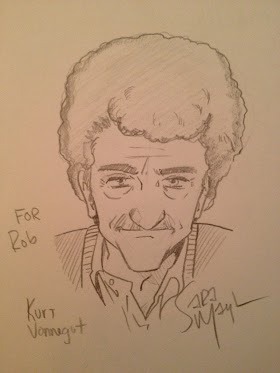
I just got offline from a fun online hangout with Sara Mayhew, Astrid Johannsen and Kyle Hill. Sara was taking fandom doodle requests and did a drawing of uber-humanist Kurt Vonnegut for me:

How awesome is that?! (The correct answer is “very.”)

Within 12 seconds of the end of the event, Kylie Sturgess had a review up.

Visit SaraMayhew.com and DEMAND MOAR MANGA HANGOUTS!

RJB


September 19, 2012

Go visit our our little web show at Virtual Skeptics! We were hilarious.

virtualskeptics's avatarThe Virtual Skeptics

This week on the “Virtual Skeptics”…

– Bob avoids taking sides in a cripple fight;
– Eve warns against taking medical advice from doctors who aren’t toilet trained;
– Sharon reminds us that animals don’t want to help, they mostly just want to eat
– and Tim is currently fixing technical problems… Dog bless ‘im.

View original post 262 more words


This Week in Conspiracy (16 Sept 2012)

September 17, 2012

Howdy ho! Wuz out of town this weekend–nipped off to be in the wedding of my bestest bud from grade school. A great time was had by all.

Meanwhile, the Internet burned.

  • Truer words were never spoken by The Onion: “9/11 Truther Convinced Government Destroyed Past 11 Years of His Life.” Yup! THE ONION IS IN ON THE CONSPIRACY!
  • Everyone knew that the repeal of Don’t Ask Don’t Tell would lead to this: “National Guard Partnering With Foreign Troops?
  • This week, Dirk Vander Ploeg came up with conclusive evidence that motherships not only fart orbs, but they also orbit in perfect synch with the ISS. Either that or that the glass is reflecting something on the inside of the space station. This is followed  by a change.org petition to–and it’s hard to say– to keep us from nuking the aliens, I think.
  • I say we declare war on Kansas. HEAR THAT, KANSAS?! “Kansas panel delays ballot decision on Obama: Kobach seeks Democrat’s birth records from Hawaii.”
  • Speaking of 9/11 and OBL conspiracy theories, here’s one that comes from the lofty heights of Pakistani academia.
  • The trailer for The Innocence of Muslims was an excuse for riots and attacks on American diplomats around the Muslim world this week. It’s been out for months and only blew up now and the attacks seems to have been organized. Not the first time that people have been killed by rage-on-delay in that part of the planet. But that didn’t stop conspiracy theorists from INSTANTLY claiming that the movie was “a contrived fraud.”
  • According to Veterans Today, the movie the trailer was supposed to promote never existed. As evidence, the author cites discrepancies in location, actors, time of action, and apparent plot. Of course, someone as steeped in Mystery Science Theater as I am and who just watched all of the Left Behind movies back to back will know that these conventions are often entirely absent in low-budget movies.
  • Is Obama The Prophesied Warrior Coming To Help Islam Conquer The World?” The author of this piece asserts that our embassies were not warned of attacks known to be pending. Unfortunately, they only read the headline of the story they cited. In it, it seems that the embassy in Bangladesh was warned ahead of time, and some of the embassies even underwent preparedness evaluations ahead of the 9/11 anniversary. How a warning in Bangladesh was related to an embassy in Libya, I don’t know.
  • Also, what’s the legal requirement for putting Michelle Bachmann in the nuthouse? I mean, really?
  • So, the conspiracy-theory motivated band HAARP Machine has signed on with, uh, Sumerian Records to release their album, Disclosure, with the single “Pleiadian Keys,” which is incomprehensible. Also, there are some…I think they’re autotuned burps:

Twit of the week:

Luke Rudkowski (@Lukewearechange)
9/13/12 12:57 PM
I recently confronted Henry Kissinger AGAIN he got really pissed, told me to go to hell and called me a sick person lol

You should totally confront Buzz Aldrin, Luke.

Conspiracy Theory of the Week:

If you thought the Illiad was epic, you should see Xavier Remington’s story about Mr. Rogers and his supernatural vampire slaying powers:

Once he acquired his PBS kid’s show, and became famous he saw the world in far different light.  He realized the forces of supernatural evil were very real, and actually physical rather than just metaphysical.  He first encountered such evil when a vampire working for the Illuminati approached him on the PBS set, and tried to recruit him for the indoctrination of kids into the New World Order.  He flatly refused, and the vampire attacked him later that night.  Unfortunately the vampire had no idea who he was dealing with.  Fred dispatched him with extreme prejudice.  However he did not actually kill him for Fred’s powers were so extensive that he didn’t have to resort to death.  He sent the vampire off greatly weakened with a message to his masters to back off.  The Illuminati never bothered Mr.Roger’s again after that.

I mean, holy crap! Mr Rogers had angel DNA.

On that happy note, I leave you to stew in the goof that is conspiracy.