I believe I may have mentioned this before, but my students in the WWII class put together a website about WWII in Atlanta. The site is up and running, and I hope that you take the opportunity to look through it. It was a great experience for me, and I hope that my students got a sense of the history behind their city, state, and school.
Mark Ditsler of Abrupt Media has taken my Skepticamp talk and turned it into a video. It’s about my visit to the TruthCon way back in February. This is a mega-file, hundreds of meg in .m4v format. Also, did I mention it’s really large? I may rip the audio later to have something more downloadable for you.
Glenn Beck awaits silent Tristero’s empire: “Post Office might be used as a sort of secret police.” If you got that reference, you are awesome and may put it on your resume.
Heehee. There’s a New World Order Party in New Zealand. I don’t know, but “New World Order Party” sounds like a Prince tribute band or something to me.
This week’s Gilded Trouser Nugget goes to Mike “Health Danger” Adams’ report on how Fairbanks, Alaska voted to remove fluoride, frikin’ fluoride, from their water. Now men’s precious bodily fluids will be safe from Grizzly Moms. They are always trying to steal our essence.
Oh, I’m getting rusty, people. I almost let this one slip past me. About a month ago I was listening to On the Media, one of my favorite podcasts. Paul Waldman and Peter Gourevitch were debating whether or not we needed to see an image of Osama bin Laden’s corpse. (I happen to think not, but whatever.) This exchange took place:
PAUL WALDMAN: We didn’t need the photograph of the Marines raising the flag at Iwo Jima to make us understand that we had won World War II, but it communicated a great deal about what we understood about that event, what it was supposed to represent, what it was supposed to tell us about us.
PHILIP GOUREVITCH: The image of Iwo Jima is exactly the opposite. It happens also to be a staged reenactment, as we now know, but it’s an image of American soldiers triumphing over intense adversity at the end of a grueling battle, hoisting their flag in pride over their nation. What you’re talking about is a headshot of Hitler with his brains blown out and showing. We don’t have that. And I don’t think there’s been a failure to achieve closure on World War II in the absence of it.
I groaned when I heard this because I teach classes about WWII, but I let it slide. A better blogger would have dropped everything, said good-bye to the wife, and set out to the library to put this sucker in the ground. I am unfortunately not that blogger.
I drag out this photo in almost every class I teach at some point. It’s the classic Joe Rosenthal photo of Marines erecting a flag at the summit of Mt. Suribachi, perhaps one of the most widely reprinted images of all time, and it’s not hard to see why:
The photo was taken after three days of fighting on Iwo Jima. Iwo Jima, I think you will find, sucked. It was a Japanese home island, and it was a fortress of the most formidable type. The Japanese had been preparing it for years, digging caves and tunnels in the volcanic rock and covering every inch of the island with artillery and machine guns, so that there was nowhere safe on the island for an invader. It was a perfect nightmare to attack. A US team could seal one spider hole with explosives, and the Japanese soldier who had been in there would pop up behind you and shoot you from there. All of the artillery and mortars would have been pre-sighted, that is, the Japanese would have placed targets of known size and distance to help them aim quickly, accurately and effectively. Look at this map, which shows the artillery and defensive positions on the island, and then consider that every one of those little dots housed either a machine gun, mortar or high explosive artillery. Iwo Jima was a calculated, engineered hell.
Contrary to what Gourevich says, the flag was not raised at the end of the battle, but at the beginning of a month-long struggle on the island. Indeed, only three of the men in the image survived the battle. Nonetheless, Iwo Jima was late in the war (Feb-March 1945), when Japan’s defeat was no longer a question. The only question was at what cost would Japan be defeated. As US troops were finally stepping on and taking over a home island, it represented the beginning of a new, final chapter.
The only feature to speak of on the entire island was Mt. Suribachi, itself riddled with man-made caves and bunkers. It loomed over the soldiers the entire time, and it must have been discouraging to know that the enemy was spotting you from the heights he commanded.
Symbolically, the mountain came to represent something other than a strategic position on an island. Indeed, it represented, on the eve of American victory in the Pacific, a long struggle that started at Pearl Harbor. (Perhaps this is is the “grueling battle” Gourevich was talking about.)
On the Media‘s listeners, God bless ’em, did not let Gourevich’s comment slide, as Bob Garfield reported in the next week’s listener mailbag segment:
Many of you responded to Gourevitch’s point that the photo of Iwo Jima was staged. Listener Brian Vargo writes, quote, “It is irresponsible to let someone say that on air. I cannot fathom how a program titled On the Media would allow something like that to go unchallenged.”
And listener Ben Bradley concurred. “My grandfather is in that picture,” he wrote. “I would like you to know that the flag-raising picture was not staged.”
Tim Zinnen brought the facts to bear on the issue when he wrote, quote, “Please correct for your listeners the statement your guest from The New Yorker made that the photo of the flag-raising at Iwo Jima was staged. It was not. It was a snapshot of the raising of a second larger flag. To say the photo was staged gives the wrong impression that the photographer directed the placement and positioning of the Marines and Corpsmen. There’s a difference between a staged photo and a photo of a staged event. All flag-raisings are staged events.”
The issue has sparked years of controversy, and we’ve addressed it on the show before. To say the photograph was staged is wrong. However, it was also not of the original triumphal moment. As listener Tim Zinnen wrote, the photo captured the raising of a second flag. Photographer Joe Rosenthal, who took the image, has never disputed that fact.
The sequence of events that led to the raising of the flag are fairly well-known, so I am always slightly flummoxed, if flummoxing is what I am getting at, about how this story that the image was posed continues to circulate. I suspect that part of it is that the picture is so damned good–I think it may be one of the most perfect combat photos ever taken. The figures have exquisite triangular composition; the path your eye follows from the flag, down the pole and to the men is as natural as any composition I’ve ever seen. Their task is instantly identifiable, but the men, in a manner consistent with so many combat and military photographs, are almost indistinguishable from one another. They could have been anyone’s brother, father or husband. The image exudes the message of collective, anonymous effort toward a single goal on the verge of completion.
The event of the raising itself is thoroughly documented. The first patrol to reach the top of Suribachi raised a small flag at the summit:
So, not all that majestic or anything, but seeing the Americans claim the mountain set off cheers as well as a blaring of horns in the harbor.
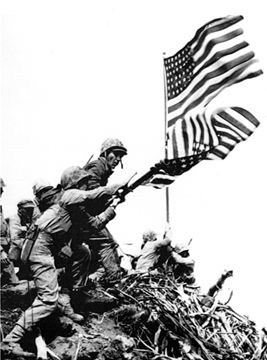
Secretary of the Navy James Forrestal was offshore and wanted the flag as a souvenir (and so did the battalion that raised and owned the flag, by the way), so soon a second flag was erected. The officer in command at the summit, a Lt. Schrier, coordinated the raising of a second larger flag with the simultaneous lowering of the smaller flag. This moment was captured too:
This second raising was still being carried out under combat conditions not conducive for posing a photograph.
Joe Rosenthal, the AP photographer whose photograph would become famous, had missed the initial flag raising and was on the summit shooting photos of the harbor when he saw the men preparing the second raising. The second raising was a planned event, to be sure, and Rosenthal snapped several photos.
The raising was filmed from almost the same angle as Rosenthal’s photograph:
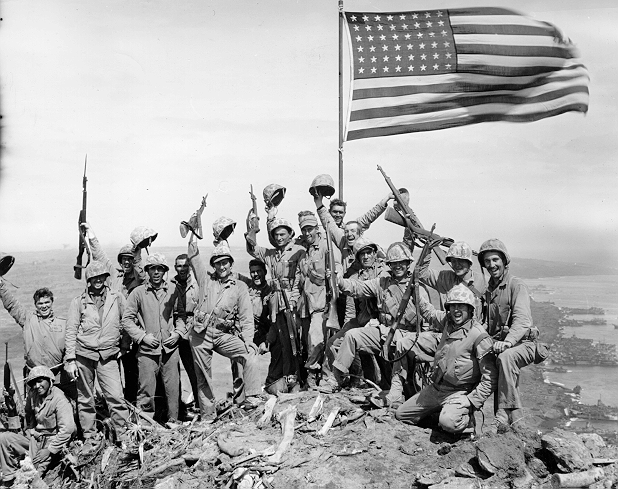
What is interesting about the photograph is that Rosenthal had no idea that he had taken perhaps the most iconic photograph of the war. He did not have access to his images while he was on the island, and he did not develop the film–it was developed days later, on Guam. The person responsible for seeing that the image got widespread release was actually an AP editor, John Bodkin. Indeed, when someone told Rosenthal that his photo was on the cover of every newspaper on the planet, he asked, “The posed one?” You see, he had taken a posed photograph of the men under the flag:
Rosenthal hadn’t seen his iconic photo (and he in fact may have thought that he missed the shot–he wasn’t even looking through the view finder when he took it). But his reaction to hearing of his photo’s fame, his misapprehension of which photo had been selected, slipped into history and became the foundation of the alternative, unsinkable rumor that remains today.
RJB
For more about the image, I recommend:
Bradley, James. Flags of Our Fathers. New York: Bantam, 2001.
Casaregola, Vincent. Theaters of War: America’s Perceptions of World War II. New York: Palgrave-Macmillan, 2009. See especially, pgs 106-109.
This is brilliant and simple, and I think that it applies for mere passing knowledge of any highly technical field. Take that last sentence home. Think about it.
You thought that you could slip by while I was at Skepticamp, didn’t you, you little conspiracy theories? Well, it’s not that easy. I’m ever vigilant and on the case. This week brought more grotesque news analysis from the goof-o-sphere. Let’s get into it.
The release date of the movie that I suspect will make everyone just a little bit dumber, Anonymous, which is about Shakespeare authorship (hint: it was Shakespeare), has been pushed back. It now opens on October 28. You bet your pants we’re going to review it when it comes out.
The Bilderbergers met over the last week. Here’s TIME’s article, which will give you a sense of what happens there.
Richard got onto Irish television while he was in Europe. But he should still be focusing on engineers if he wants to convince me.
I love this remark in the comments of this video. The irony is deep and hilarious, even if the person who penned it is defective: “JEWS ARE THE MOST RACIST, HATEFUL PEOPLE ON THE PLANET.” Touche.
Is the e coli outbreak in Germany is actually an excuse to irradiate food. No, it’s a reason to. When you apply cui bono thinking to this situation, you get a rotten conspiracy.
For me, it was hands down “Palin birtherism.” It’s the idea that Sarah Palin pretended to have a child…for some reason. It made it into Skepticamp Atlanta, and I’m still irritated with annoyance and irritation. So, the Palin emails were released in the last few days, and they talk about this issue. And her office was clearly befuddled by the allegations. And I resent having to defend Sarah Palin on any point, but you have to be fair. As Eve just said over my shoulder, because she did a long series of stupid things while leaking (radiator?) fluid, that does not mean that she was never pregnant.
Tomorrow, Atlanta Skeptics are leaving the bar (for once) to put on a two-day online extravaganza: Skepticamp 2011: This Time It’s Personal. We will be streaming live on the Internet, so you may be able to see my talk or Eve’s talk. I’ll be doing a bit about my visit to the TruthCon at 1:00PM Eastern, while Eve will go at 1:30 and will be talking about the history of profanity.
I am embedding a widget linky doodad below, but in case that does not work, you can click on this link to get to the live web stream. Remember to ask questions in the chat and to introduce yourselves?


 Posted by Bob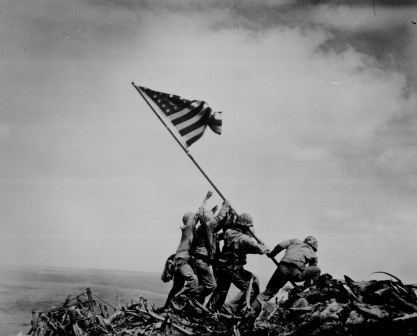

 Skeptical Humanities
