Conspiracy in the News

January 22, 2011

If the conspiracy theorists are to be trusted, it has been the most momentous week in the entire of global history, just like last week. And the rest of the world didn’t even manage to even notice. Shame on you, entire world.

Onto the news that is news to the rest of us:


Conspiracy Theory of the Week

Though it is in the spirit of the aflockalypse two weeks ago, this headline has a sort of “Beowulf is an anonymous medieval poem written by Robert Cotton in the 18th century”-quality to it (that’s an actual opening line from a paper Eve once received):

Wow. I mean. Wow.

RJB


FDR’s Paralysis: A Fortuitious Misdiagnosis?

January 21, 2011

A few days ago, an antivaxxer by the name Mayer Eisenstein made a comment that FDR may have gotten Guillain-Barre Syndrome (GBS) from a reaction to a flu shot. This, I found, is simply not possible because the first influenza vaccines were not available for far more than a decade after Roosevelt fell ill. So, big fake facts out of the big fake health guru.

Nonetheless, an interesting story lies behind Eisenstein’s painfully inaccurate mutterings. Roosevelt’s diagnosis of polio was made in 1921, after a string of misdiagnoses (the first doc said it was a bad cold, the second doc first diagnosed a blood clot in spine and then a lesion). The diagnosis that ultimately stuck is polio.

Several reasons appear responsible for the original diagnosis and why it remains a popular diagnosis today. First, Roosevelt fell ill in an era when polio was rampant, and several outbreaks had occurred in previous summers, mostly in cities. It’s a virus spread by interpersonal contact, either oral-oral or oral-fecal. Children are especially vulnerable. At the time FDR fell ill, polio was one of a fairly limited number of known diseases that caused flaccid paralysis, muscular weakening with no immediately obvious cause (like traumatic nerve damage).

After bouncing, metaphorically, from physician to physician, Roosevelt was diagnosed by Boston doctor Robert W. Lovett, who Pierce A. Grace describes “the leading American authority on polio.” He immediately diagnosed polio. It was a fairly late stage in the disease by this point, and he shortly thereafter began his slow recovery. I suspect that once his initial crisis had passed, the urgency of coming up with a diagnosis may have abated, but that’s speculation on my part.

Another factor that seems to have contributed to the story found in the biographies is the fact that on July 28, 13 days before he fell ill, Roosevelt had toured and visited a Boy Scout camp for disadvantaged city youth, something that Roosevelt delighted in. Historians have speculated, and this is the story that I was familiar with, that he contracted the disease while he was at the scouting event. I haven’t seen anything to suggest that there had been polio at the camp, but someone who is infected but not yet showing symptoms can be contagious. Regardless, it’s plausible that Roosevelt contracted polio at the camp, because the incubation period of the disease is between 3 and 35 days.

Other people have looked to the immense stress that Roosevelt had recently been under. He was in the middle of an especially saucy sex and vice scandal, in which a Senate Naval Affairs committee alleged that members of a vice-squad at a naval training facility under his command (and not necessarily AT his order) were reported to have engaged in sodomy while attempting to entrap homosexuals among recruits. Stress may leave people susceptible to infection, and perhaps there was a perfect storm of stress and filthy children that led to his contracting the disease, which was, after all fairly rare in adults.

And let’s not overlook FDR’s symptoms, the major one being progressive paralysis, which at its worst extended from his chest down and was ultimately permanent in his legs, accompanied by a fever (102 degrees). Marooned in a wheelchair for much of the rest of his life, Roosevelt certainly looked like a polio survivor (though remarkably few photos of the man in his wheelchair exist).

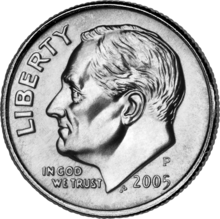
In the years following his disease, Roosevelt became an advocate of polio research and in 1938 founded the National Foundation for Infantile Paralysis, which became known as the March of Dimes and supported the development of Jonas Salk’s vaccine. As a sort of recognition of his association with that organization (in 1946, the “March of Dimes” was the group’s annual fundraiser), the disembodied head of FDR now graces the US dime:

See?

Regardless of what condition Roosevelt suffered, his name will always be closely associated with polio.

As best I can tell, a serious challenge has been raised to the diagnosis of
polio. Now, as historical questions go, this is not as pressing an issue as, say, “Did the Holocaust happen?” but it is an interesting question, the type of point that you could possibly argue on Jeopardy if the question they accept is, “What is polio?” Hey, that could be worth money.

Anyway, in 2003 the Journal of Medical Biography published an article by Goldman, Schmalstieg, Freeman, another Goldman and yet another Schmalstieg (apparently the University of Texas was suffering from an outbreak of Goldman-Schmalstieg in 2003). The article, “What was the cause of Franklin Delano Roosevelt’s paralytic illness?” The researchers looked at 11 features of the disease reported in FDR’s medical record. Then they did something called Bayesian Analysis, which as I understand it is a retrospective analysis of probability based on a subsequently established incidence rate (in this case of disease) in a population. So, they were asking questions like, “What is the relative probability that someone FDR’s age would have contracted polio versus GBS?” and “What is the relative probability that someone with polio would have fever versus someone with GBS?” (GBS, by the way, is a condition where the immune system, which has started fighting an infection, mistakenly starts to attack parts of the nervous system. Dr. House is always ruling it out.)

By comparing the features of FDR’s disease, the Goldman-Schmalstieg-infected Freeman makes a strong case that the GBS hypothesis is worth serious consideration (from Goldman):

Click to embiggen!

It really does seem as if most of FDR’s symptoms are most commonly associated with GBS. This is not, however, conclusive diagnostically. At the same time, it seems to me that a good Bayesian analysis would need to accurately determine the prevalence of the diseases and symptoms at the time, and I have no way of assessing that and still maintain a blog. The only way to do be sure of what Roosevelt had would be to tap his spine. Modern interventions gor GBS had not yet been developed, and the authors conclude that it is unlikely his treatment would have changed if FDR had a different diagnosis.

The nearly complete elimination of polio from the planet is a powerful testimony to the efficacy of vaccination, and one may wonder how the course of history might have been altered if Roosevelt’s intense interest in polio research had been redirected toward autoimmune disorder research. Whether he had it or not, FDR will always be closely associated with polio and the search for the cure.

RJB

References

Goldman, Armond, et al. “What Was the Cause of Franklin Delano Roosevelt’s Paralytic Illness?” Journal of Medical Biography 11.4 (2003): 232-240.

Grace, Pierce A. “With Reluctant Feet–The Story of FDR’s Struggle with Polio.” Journal of the Irish Colleges of Physicians and Surgeons 21.1 (1997): 58-61.


Cool Spellings

January 20, 2011

Currently, Yahoo has a story on its front page about Theodore Roosevelt High School in Washington D.C. The school’s sports teams are nicknamed “Rough Riders,” and for the past several years, the basketball team has had the single word “Riders” on the front of its jerseys. Not this year, though. This year the players are sporting jerseys that say “Ryders,” as in The Ryder Cup or Ryder Trucks or perhaps Ruff Ryders, none of which is traditionally associated with Teddy Roosevelt or the 1st United States Volunteer Cavalry. The best part of the story is the explanation/excuse that the jersey vendor gave the basketball coach: Ryders is the “cool” way to spell it.

Look, okay, we all know that English spelling is a bit wonky. Granted, traditional spelling gives us an idea of the history and etymology of a word, but it’s kind of a pain. So why not get rid of traditional spelling and give up on the dream of a simplified and phonetically consistent system of spelling. Instead, let’s adopt “cool spellings.” Oh sure, that means that spellings will become faddish and ephemeral. Presumably, language designers will bring out new spelling lines at least twice a year. I think it’s worth it, though. We don’t want other languages to make fun of our frumpy spellings.

ES at Skeptycle Hoomanatees


Letters in the Eyes of the Mona Lisa?

January 20, 2011

The recent accounts in the media that an Italian researcher had uncovered tiny letters in the eyes of the Mona Lisa seemed suspicious, especially since in no account that I have seen has anyone bothered to print a picture of the supposed micro-signature. Well, Joe Nickell has seen this sort of claim before, and he has some background on the people who are making this extraordinary claim.  (Spoiler: They harbor  all manner of  improbable beliefs.)

RJB


Chaucer’s Cunt

January 18, 2011

Now that I have your attention, I regret to inform you that he didn’t have one. On several occasions recently, sometimes in conversations about censorship, I have heard people say that Chaucer used the word “cunt.” Indeed, Wikipedia says, “The word appears several times in Chaucer’s The Canterbury Tales (c. 1390) in bawdy contexts, but it does not appear to be considered obscene at this point, since it is used openly.” Similarly, RationalWiki proclaims that “Chaucer used the word unblushingly in his Canterbury Tales.”

Oddly, these statements are followed by quotes from The Canterbury Tales that belie them, for the word that Chaucer uses is not “cunt,” but “queynte.” “Queint,” as a noun, literally means “a clever or curious device or ornament” (Middle English Dictionary) or an “elegant, pleasing thing” (Riverside Chaucer). When used to refer to a woman’s genitalia, it is both a euphemism and a pun.

Chaucer uses “queint” several times in his earthier tales. The Miller’s Tale is a fabliau about a carpenter, his much younger wife, a young Oxford clerk who is lodging with them and another clerk, who is somewhat squeamish about farting. Both clerks have naughty feelings toward the young wife, and she reciprocates the lodger’s lust. The tale involves adultery, farting, pissing, a badly misplaced kiss, a burning poker in a very sensitive area and a fake deluge. One day, when the carpenter is away, the lodger, Nicholas, begins “to rage and pleye” with Alison, the young wife, and…

As clerkes ben ful subtile and ful queynte,
And prively he caughte hire by the queynte,
And seyde, “Ywis, but if ich have my wille,
For deerne love of thee, lemman, I spille.” (MT I (A) 3275-3278)

(As clerks are very ingenious and clever, and discreetly he caught her by the pleasing thing and said, “Indeed, unless I have my will, I will spill (die) for secret love of you, my dear.”)

Chaucer also uses “queint” in The Wife of Bath’s Prologue. In lecturing one of her husbands, she says that, as long as he has enough of what he wants, he shouldn’t care what other folks get:

For, certeyn, olde dotard, by youre leve,
Ye shul have quente right ynogh at eve (WBP III (D) 332-333)

(For indeed, old dotard, by your leave, you shall have plenty of the precious thing (or, more generally, sexual gratification) in the evening.)

Later she asks,

What eyleth yow to grucche thus and grone?
Is it for ye wolde have my queynte allone? (WBP III (D) 444-445)

(What ails you to complain and groan so? Is it because you alone would have my precious thing? NB One of the manuscripts, Cambridge, University Library II.3.26, does read “cunte” in this passage)

A few lines later, she refers to her favorite body part as her “bele chose” (Fr. belle chose, lovely thing).

“Cunt,” like many naughty words for body parts and bodily functions, probably has its origins in Old English. It certainly has cognates in other medieval Germanic languages, such as Old Norse kunta and Old Frisian, Middle Low German and Middle Dutch kunte (Oxford English Dictionary). There are no known instances of it in Old English, however. James McDonald, in The Wordsworth Dictionary of Obscenity and Taboo, suggests that it may be related to Old English cynd, which means “origin, generation, birth, kind, offspring” and can also mean “genitalia” (Concise Anglo-Saxon Dictionary).

According to The Oxford English Dictionary, the earliest use of “cunt” is in the street name “Gropecuntelane” (c. 1230). The earliest instance of “cunt” used to refer to the vagina comes from around 1325 (OED, MED). McDonald also cites several personal names that incorporate “cunt” (a number of these are earlier than “Gropecuntlane”). He lists the women’s names Gunoka Cuntles (1219) and Bele Wydecynthe (1328) and men’s names Godwin Clawecuncte (1066), Simon Sitbithecunte (1167), John Fillecunt (1246) and Robert Clevecunt (1302). Ladies, if you ever meet a man named Godwin Clawcunt or Robert Cleavecunt, run!

According to McDonald, “cunt” was used to refer to the vagina without any suggestion of vulgarity until roughly the end of the fourteenth century. Chaucer, who died in 1400, was therefore writing The Canterbury Tales at a time when cunts were disappearing from polite society; consequently, he hinted at the word without actually using it.

ES

References:

Chaucer, Geoffrey. The Riverside Chaucer. 3rd ed. Gen. ed. Larry D. Benson. Boston: Houghton, 1987.

Clark Hall, J. R. A Concise Anglo-Saxon Dictionary. Suppl. by Herbert D. Merritt. 4th ed. Medieval Academy Reprints for Teaching 14. U of Toronto P, 1960.

McDonald, James. The Wordsworth Dictionary of Obscenity and Taboo. Ward, Herts.: Wordsworth, 1996.

Middle English Dictionary Online. University of Michigan. http://quod.lib.umich.edu/m/med/

Oxford English Dictionary: OED Online. Oxford UP, 2010. Subscription only.


Antivaccine Rhetoric vs. History

January 17, 2011

Tonight, Mayer Eisenstein hosted a webinar (shudder) about vaccines. Ostensibly, the online event was to tell people how to write vaccine exemption letters. It was a Cirque du Soleil-sized extravaganza of clownishly sloppy logic and at-best-half-truths. I’ve watched some webinars before, and they are simply online Powerpoint presentations with audio. We see the speaker’s screen while they talk, and there is usually a chat room where the audience can interact. I have no idea how well attended Eisenstein’s event was, but it lasted for an hour and ended with about a 10-minute sales pitch for his miracle cure, Vitamin D, and his books.

The basic argument that Eisenstein was pushing was “use the religious protections provided by the First Amendment to justify vaccine exemption,” a cynical use of religion if I have ever seen one (and I’ve seen several). I thought that I would see how cynical he could possibly be, so in the chat room I asked, “Is there an option for atheists to claim religious objections?” Heehee.

His answer?

“I think all lawyers are atheists so [unintelligble] when they get in front of a jury they say, ‘I pray that the jury gives a verdict for me.’  Oh, or ‘I religiously believe that I believe this person is negligent or guilty.’ So I had a lawyer tell me that he felt the religious exemption had nothing to do with the belief in God, that a personal, specific religious belief–if you look up the word ‘religious,’ it’s very closely held position, uh, believing that there is some higher order or higher power, and you know, I think it’s close enough. If it’s not close enough for you, well, I’m not sure how you would go about it. Even if there’s a belief that there’s a natural order in the universe, that in itself is a religion. Don’t take the word religion to be so narrowly defined. Take a more, ah, expansive position.”

You could look at this answer in a couple of ways. The first way to see it as a string of loosely connected statements of a person on their way out, and while that is tempting, we do far more damage to the cause of public health when we underestimate our ideological adversaries. Even this guy.

But if you look at the underlying logical structure of that first part, he seems to be saying, “Well, atheist lawyers often pretend like they have religion to appeal to juries. Wink wink, nudge nudge.”

I am also bemused by the way he went straight to “negligent,” as his medical practice, according to the Chicago Tribune

“was on the losing side of one of the largest U.S. jury verdicts — $30 million — ever awarded to the family of a newborn in a wrongful-death suit.”

Anyway, then he tries on another fundamentally cockamamie argument, that “religion” doesn’t really mean “religion.” It really just means, “closely guarded belief.” This, of course, inflates the meaning of the word “religion” to almost complete uselessness: “Even if there’s a belief that there’s a natural order in the universe, that in itself is a religion.” Yeah, only if you are an intelligent design advocate, bucko. So sayeth the courts.

Despite his willingness to see the First Amendment misapplied, he did make some rather staggering comments that do fall directly under the purview of this new skeptical humanities site. He made a rather large claim when someone asked a question about diseases like polio:

“Well, that opens up a big can of worms. Because, I don’t want anyone to leave tonight saying Mayer Eisenstein isn’t worried about, uh, diseases. I’m more worried about…most doctors will scare you with the disease, I’m going to scare you with the side effects.”

Yeah, he actually said that. I know.

“We now know that we have had thousands and thousands of people die from contamination of the, of the, uh, polio vaccine. The polio vaccine, many of the doses were contaminated with SV40 virus, and I talk about it in my book, Making an Informed Vaccine Decision. […] Polio died out in Europe even in countries that didn’t give the polio vaccine, and the big push for the polio vaccine came with President Franklin Roosevelt who allegedly got polio as an adult. Allegedly. I’ve read some very credible reports that, um, he most probably had Guillain-Barré from the, um, Guillain-Barré from the flu vaccine, because, I don’t, I can’t remember, another adult who got polio. I’ve never seen it in almost 40 years in medicine. Now you know I came in a little bit after the adult era, but I should have seen, especially 35 and 40 years ago adults who contracted polio.”

Then he prattles on about what’s in vaccines, as if it helped his case.

Many of the assertions in this especially densely-packed drivel are historical questions. Take, for instance, his statement about the SV40 virus. According to the CDC, the Simian Virus was found in kidney cells of rhesus monkeys, which (I’m supposing) were used as a growth medium for attenuated polio virus in early polio vaccine. Quoth the CDC:

“More than 98 million Americans received one or more doses of polio vaccine during the period (1955–1963) when some of the vaccine was contaminated with SV40. SV40 has been found in certain types of human cancers, but it has not been determined that SV40 causes these cancers. The majority of evidence suggests there is no causal relationship between receipt of SV40-contaminated vaccine and cancer; however, some research results are conflicting and more studies are needed.”

Further, the contaminated strains have been yanked, and there has been no SV40 in polio vaccines since the early 1960s. I don’t know how he can say that deaths were caused by the presence of the virus in vaccines. Does he have access to research that the CDC doesn’t? Swing and a miss, Mayer.

The likelihood that a younger Mayer Eisenstein would likely have encountered a case of polio in the 1970s is also one that can be clarified by looking at history, again provided by the CDC:

There were usually about 13,000 to 20,000 cases of paralytic polio reported each year in the US before the introduction of Salk inactivated polio vaccine (IPV) in 1955. Polio peaked in 1952 when there were more than 21,000 reported cases. The number of cases of polio decreased dramatically following introduction of the vaccine and the development of a national vaccination program. In 1965, only 61 cases of paralytic polio were reported compared to 2,525 cases reported cases just five years earlier in 1960.

By the time Eisenstein graduated from short pants, the cases of paralytic polio were down to 61. The chances that he would have seen polio in the 1970s as a med student are vanishingly small. One interesting side note, Eisenstein mentioned over the course of the webinar that Amish kids don’t get autism, and he says it is because they don’t get vaccines. But they sure as hell got polio, as an Amish community hosted the last natural outbreak of polio in the US in 1979.  Strike two. No batter, no batter.

By far, my favorite assertion by Mayer was that FDR did not suffer from polio but Guillain-Barré syndrome brought on by flu vaccine.

I have access to a truly fantastic set of databases that I use in my research almost constantly. A source does exist that discusses the of FDR having Guilain-Barre, an article from 2003 in the Journal of Medical Biography by Armond Goldman, which according to the abstract:

“Posits that the conditions around the diagnosis of President Franklin Delano Roosevelt’s illness indicate that he likely suffered from Guillain-Barré syndrome, an autoimmune polyneuritis, rather than paralytic poliomyelitis.”

So, we have a retrospective study based on available historical documents at the Franklin D. Roosevelt Library and Museum, Hyde Park, New York, and the Francis A. Countway Library of Medicine. It’s possible, I imagine. However, I looked at 5 cross-disciplinary databases looking for “Roosevelt and Guillain-Barré” and found that all of the mentions of the hypothesis in the press were references to Goldman’s article. So, it’s nothing like the consensus view at this point. (I have ordered the article, however, and look forward to seeing it.)

We can, however, use history to completely demolish the boneheaded assertion that FDR got…whatever he had… from a flu vaccine, as he fell ill in August 1921. The first experimental influenza vaccine was developed in 1936, according to Stanley A. Plotkin, Walter A. Orenstein, and Paul A. Offit. Strike three, big guy. YEEEEEEEROUT!

History spanks cranky antivaxxers.

RJB

A note: I did subsequently find another reference to an article from the Journal of Medical Biography that suggests that Roosevelt may not have had polio (top of list), but diagnostically, I am told, we would need to see his spinal fluid to get a final answer about what caused his paralysis. Good luck with that.


Conspiracy in the News (15 Jan 2011)

January 16, 2011

Tonight I resurrect, like a twisted necromancer, a feature from my old website in which I take a look at the conspiracies that make our wacky world go ’round. Honestly, the conspiracy flies so thick and fast on the web that it is impossible for any single mortal to keep up with. This week, a lot of it has related back to the Giffords’ shooting, and, let’s face it, the shooter is bizarre: he has left tracks all over AboveTopSecret.com and believed that grammar was being used by the government as a method of control. If you see that much agency where there cannot possibly be agency, you are flying over the cuckoo’s nest.

Gordon Duff found a Jewish angle to the attack, because he is such a delight.

Before It’s News found five sinister reasons for the attack. (Misery is like porn to these people.)

The other major conspiracy theory story this week has been about animals “dying off” all over the world, starting with the aflockalypse in Arkansas. This of course is bullocks as similar incidents happen all the time; the only thing different this time is an especially fatuous news cycle. So, here’s the obligatory link to that conspiracy, with a dash of apocalyptic Christianity thrown in for good measure.

Mnookin’s new book, The Panic Virus, discusses how conspiracy theories can have deadly real-world effects.

Are the floods in Australia the work of HAARP? Of course not, but here’s a video with snappy music (btw, the comments are worth reading):

Also, discredited anti-vaccine fraud Andrew Wakefield was recently interviewed on Anderson Cooper and resorted to conspiracy theories to defend himself. Super-weak:

According to the Canada Free Press (in my experience, appending “free press” to your website’s name indicates “otherwise unpublishable”), secular humanists are using evolution to dismantle American democracy. Check out the CrAzY CaPs that the author “USES”!!!!

Liberty News Online issues a crazed statement of belief or something. I like where they describe the TSA as Nazis. The Nazis were primarily known, of course, for especially vigorous pat-downs. The bastards.

Fluoridation is still a controversial topic in certain sections of the undeveloped world. Like Wyoming.

Conspiracy Theory of the Week

The Zionists are behind the “new” astrological zodiac. Somehow they are going to copyright Ophiuchus and make a killing. This one was on the JREF forums, where goofy ideas often collide. It’s like an LHC of hilarity.

RJB


The Panic Virus

January 13, 2011

On the Media, one of my favorite podcasts, interviewed Seth Mnookin about his new book, The Panic Virus, which is about the vaccine scare brought on by Andrew Wakefield, who remains happily complicit in unprecedented child suffering and death.

I am excited about this in particular because host Bob Garfield uses the phrase “false balance” to describe the disproportional representation of vaccine fears in the media despite vaccines’ statistically insignificant risks.

We included On the Media in the podcast section of the website because Bob Garfield, Brooke Gladstone and their producers and contributors do a fantastic job of showing how often-unseen forces affect the news and media consumed by the public. I’ve been hooked ever since 2004, when they explained exactly how everyone on NPR sounds so damned good. The report is a classic, and I still recommend it.

Oh, this week they also mention Allen Gribben’s shamefully bowdlerized new edition of Huckleberry Finn, which substitutes the word “nigger” with the word “slave.” They are not the same thing, Allen. I was going to hurl a pithy Twain quote at him (“Censorship is telling a man he can’t have a steak just because a baby can’t chew it”), but I can’t verify that it is actually Twain’s. Oh well.

RJB


Conspiracy and Violence in Tuscon

January 12, 2011

I’ve been following the shooting in Arizona for the last few days, and I’m as disgusted as everyone else is, I’m sure. I’m reading with special interest because of how elements of conventional political conspiracy theories appear in the assassin’s truly disjointed and incoherent worldview.

The elements of truly run-of-the-mill conspiracist thought–at least the stuff that appears in Loughner’s youtube videos–are usually encountered as elements of larger, more complete and fleshed-out narratives. These narratives are really quite well developed, often repeated and reprinted verbatim. Elements in Loughner’s ramblings suggest exposure to a certain type of conspiracist thinking, the gold standard conspiracy: “No! I won’t pay a debt with a currency that’s not backed by gold and silver!” In its most general form, this conspiracy theory posits that BAD GUY (pick your favorite demonic Other: the Fed/international bankers/Jews/Illuminati/Boy Scouts) has taken us off of the gold standard in order to impose an easily manipulated fiat currency. In the most popular conspiracy theories, the bad boy is the Federal Reserve, who controls the entire economy, printing money and deflating the value of the paper money in your pocket. (There is far more wrong about this than I can reasonably write about in a quick blog post, but suffice it to say that it is not even the Fed that prints money, rather the Bureau of Engraving and Printing. Mega-fail. The Fed can infuse banks’ reserves with cash, but it can also reduce liquidity and does so often.) It’s probably worth mentioning that his statement, “No! I won’t trust in God!” immediately follows his statement about precious metals and that it is at least as much a reference to what is printed on US currency as it is religious expression.

Loughner also has an abiding fear of mind control. Often, this is found on the (super-way-out-there) extremes of conspiratorial thought. Mind control, in conspiracist circles, can range from media control (or just influence) of popular opinion, the softening of the resistance to suggestion through fluoridation, chemtrails or the quality of popular entertainment, to the implantation of subliminal messages in corporate logos and advertisements, to the actual taking over of minds by remote, telepathic or technological means. It includes everything from “political spin” to the belief that one is not thinking one’s own thoughts.

Other signs that Loughner has been influenced by established conspiracy theories include the brief list of favorite reads that includes Animal Farm and Brave New World, Mein Kampf and The Republic, all of which have some authority and currency in white supremacist and far-right separatist circles. Of course, he also includes the Communist Manifesto, which decidedly does not. It occurs to me that if Animal Farm appears on his reading list, he may have picked up notions about how mind control can be achieved through the use of language in Orwell’s other works, including 1984 (consider Newspeak, which is an attempt to limit the types of thoughts it is possible to have) or his 1946 essay, “Politics and the English Language,” in which Orwell confronts and criticizes “language as an instrument […] for concealing or preventing thought.” At the same time, I have no confidence that someone with the writing skills like those displayed in his videos or someone whose logic is so jumbled could even be considered a nihilist, since I can’t even be sure that he understood what he had read.

If you look back at Richard Hoffstadter’s classic essay, “The Paranoid Style in American Politics,” you see that he attempted to distance the “paranoid style” from clinical paranoia, arguing that the clinically paranoid perceived illusory designs against them personally, while people who participate in paranoid politics perceive threats against a nation and entire way of life. Loughner’s rantings blur these lines. Some of it is especially local and relevant to his life, “The Pima Community College police are unconstitutionally working.” But he also talks about his understanding of the Constitution and other large issues like the currency. Hoffstadter’s essay does not help us much here. I suspect that what happened in Tuscon could be described as the deliberate political act of a disordered mind, but I am at a loss to discern to what degree politics determined his decisions.

In his essay, Hoffstadter tries to make it clear that he does not equate “paranoid” politics with clinical pathology, but the blunt fact remains that the word comes with connotations that may be profitable to explore, and I wonder if there is not some sense in which we could justifiably call conspiratorial political thought pathological. (Of course, that would entail defining “non-pathological” political thought. Yikes!)

FYI, I am going to be bringing back my weekly conspiracy round-up soon. (I tell you, though, I am getting sick of reading about Julian Assange and the damned birds dying off.)

A thoughtful, extended, and ongoing discussion about the role of mental illness is going on at PLoS, at Neuroanthroplogy. Daniel Lende makes excellent points about not presuming that mental illness is the most important issue here. It’s probably the best thing that I have seen on this issue so far.

RJB

UPDATE:

It seems that according to the Washington Post that Loughner was involved with the message boards at AboveTopSecret, and that the people there also saw that something was demonstrably abnormal, even for that site. My favorite comment at the end of the article was a reply to Loughner: “they faked the moon landing yes .. but the mars rover .. i dont think so.”

Also, for Ken–linking Assange to the bird die-offs: HAARP killed the birds using alien technology, the acquisition of which Assange will disclose in the next group of documents. All of these are real theories.

RJB


Last Post on Shakespeare (for now)

January 12, 2011

I don’t harbor any illusions that any post or comment I make will quell dissent from the Oxfordians. Nor do I believe that I will be able to answer every question or point raised. As I said in my first post on the topic, fringe theorists in general nitpick: they present a barrage of questions, counterarguments and niggles (and repeat ones already made). I look forward to hearing from them a coherent explanation of how the Oxford-as-Shakespeare conspiracy actually worked, why it was put into place and who was involved in it. I also eagerly await evidence for the conspiracy and Oxford’s authorship.

Until then, I will attempt to explain why William Shakespeare (with help from John Fletcher, George Peele, Thomas Middleton and George Wilkins) is likely to be the author of the works attributed to William Shakespeare. In the first place, the simplest answer to the question, “Who wrote the plays and poems of ‘William Shakespeare’?” is William Shakespeare, son of a Stratford glover, actor and shareholder in the Lord Chamberlain’s/King’s Men. We know such a person existed. Plenty of official records survive that refer to him. He is named as the author on the title pages of Venus and Adonis, The Rape of Lucrece, many quartos of plays published during his lifetime and the First Folio of his plays, published seven years after his death by colleagues in his company. There were also many references to him and his works in his lifetime and within a decade after his death. Occam’s Razor would suggest that this man was exactly who the evidence says he was: a middle class man who wrote a bunch of really impressive stuff. If someone wishes to argue otherwise, that person must present very compelling evidence that explains not only “who,” but also “how” and “why.”

Oxfordians such as Charlton Ogburn often say that there is no documentary evidence to tie Shakespeare to his works. The proper response to this contention is a befuddled look and the words, “Yes there is—lots of it.” The Oxfordians then explain that somehow that evidence doesn’t count: those are merely references to a name on a title page. Even assuming this were true, so what? References on title pages are very strong evidence indeed. Again, where is the compelling evidence that someone else was using the name “William Shakespeare,” a name that belonged to an actual living human, as a pseudonym? In addition, this argument is simply not true. There are a number of contemporary references to plays that had not been published yet. The best, but not only, example of this is Francis Meres’s Palladis Tamia, which mentions, among other works, Shakespeare’s sonnets and the (probably) lost play Love’s Labor’s Won.

There is also Robert Greene’s indictment of Shakespeare as an “upstart Crow,” who thinks himself “the only Shake-scene in a country.” It is hard to imagine how this could refer to anyone but the actor Shakespeare, who was also the author of 3 Henry VI, which is parodied. Yet Stratfordians maintain that this statement is ambiguous. In his comments on an earlier post, Howard Schumann has quoted a “skeptic’s [presumably Diana Price’s] paraphrase of the ‘Upstart Crow’ diatribe:”

Beware of one untrustworthy actor, the “Upstart Crow”. We make him look good in the roles we write, but this player is callous, duplicitous, and arrogant. ; he fancies himself able to extemporize lines in blank verse that are as good as any of yours (the three playwrights Peele, Marlowe, and Nashe). He even passes off some of your material as his own. And this know-it-all thinks he’s the most important actor around…So while you still have a chance to escape my fate, find some playmasters with more compassion and integrity. Stay away from actor-paymasters and usurers (like Johannes Factotum) because you three are too talented to be exploited by such contemptible knaves.

This is not a paraphrase: it’s a wildly speculative interpretation. It does not represent what the passage actually says. Mr. Schumann also cites Stephanie Hopkins Hughes who argues that the Upstart Crow passage refers to Edward Alleyn, the lead actor of the rival Lord Admiral’s Men. There is absolutely no evidence for this and no reason to think it might be true.

Oxfordians also make a great deal of fuss about the six Shakespeare signatures. These signatures prove, say the Oxfordians, that Shakespeare was barely literate: he spelled his name several different ways, and the writing is almost illegible. This argument is frankly ludicrous. Spelling is irrelevant. Since spelling was not standardized, people spelled according to preference or whim or space requirements. Bob noted in the comments that Sir Walter Ralegh at one time spelled his name “Rawley.” In Christopher Marlowe’s only known signature, he spelled his name “Marley,” though his baptismal record reads “Marlow.” Contemporaries sometimes spelled his name “Morley.”

As to handwriting, Shakespeare, like many of his contemporaries, wrote in secretary hand, which is very difficult to read because we no longer use it. It is also possible that Shakespeare was ill at the time he signed his will (which contains 3 of the 6 signatures). This is speculative, but he died within a month of signing it, and there is evidence that it was revised hastily. More importantly, however, since when has handwriting, especially in signatures, been an indicator of literacy or intelligence? I know squirrels with neurological impairments that would be ashamed of my handwriting.

A major premise of all anti-Shakespearean theories is that the author of the plays must have had great knowledge of/first-hand experience in [fill in the blank], and semi-literate, business-obsessed, middle class Shakespeare couldn’t possibly have had that knowledge/experience. This premise is based in part on our friend the argument from ignorance: the author of the plays must have traveled widely, especially in Italy; we have no record of Shakespeare traveling abroad; therefore, Shakespeare never traveled abroad and couldn’t have written the plays. Well, we actually don’t know if Shakespeare ever traveled outside England–maybe he did; maybe he didn’t–we just don’t know, so we can’t really say that he didn’t travel abroad. On top of that, sometimes he was wrong. In The Taming of the Shrew, he gave Padua a harbor, and Ben Jonson complained that “Shakespeare in a play [The Winter’s Tale] brought in a number of men saying they had suffered shipwreck in Bohemia, where there is no sea by some 100 miles” (qtd. in Stanley Wells, Shakespeare & Co., p. 159). The thing is, Shakespeare didn’t need to be a world traveler to avoid these mistakes: they had these things…they were kind of like Google Earth but without the Google part. Granted, there were bits of these maps that were a bit sketchy, but Italy and Bohemia had been fairly thoroughly explored by then. Did he not realize his mistake? I don’t know, but it’s possible that he just didn’t care that much. If it served his dramatic purpose for Padua to have a harbor, then Padua got a harbor.

It is, of course, a mistake to assume that the author must have had personal experience of all the things he wrote about. Shakespeare presumably used the tools modern authors use: personal experience and observation, study, reading and discussions with people who did have personal experience. Shakespeare did not have to be an expert in falconry to be able to write accurately about falconry. Also, rumor has it that many creative writers are known for their imaginations.

Anti-Shakespeareans also point out that some of Shakespeare’s sources were not available in English translation and assume that he was not sufficiently fluent in Latin, French and Italian to read those sources. Again, this is an argument from ignorance. We can’t assume Shakespeare couldn’t read Italian just because we don’t have a receipt from an Italian tutor. As we’ve said previously, it is very likely that Shakespeare attended a grammar school and got a good Latin education. If you know Latin, figuring out Italian and French isn’t that hard. I have personally wrestled with languages that I have not studied formally, and, while I won’t claim that I won every bout, I at least managed a draw.

Oxfordians–and others, frankly–just aren’t very happy with what we know about Shakespeare. We have a fair amount of information about him, but most of it comes from legal and business documents. This is hardly surprising: those are the sorts of official documents that one would expect to survive, while more personal items may be lost or destroyed. Would it be nice if there were a treasure-trove of personal letters? Well, heck yeah. Such a discovery would make Shakespeare scholars absolutely giddy. Sadly, we have to deal with what we do have. The odd thing is that anti-Shakespeareans sometimes assume that business and money were all Shakespeare was interested in. Again this strikes me as patently ridiculous. Who among us is defined by the contracts we’ve signed? Most people care about finances and business, and most people care about other things as well. Why should we assume Shakespeare was so different from the rest of us?

ES