Linguistics ‘Hall of Shame’ 12

May 31, 2013

Hi again, everybody! ‘Hall Of Shame’ continues!

12 DAVID OGILVY AND OTHERS ON MYSTERIOUS CHILD LANGUAGE

Claims regarding the actual production of language by children in their first few months of life have always emerged as suspect or worse on analysis (this includes David Oates’ special claims regarding ‘Reverse Speech’ as allegedly produced by infants). In contrast, some self-proclaimed psychics sidestep the evidence involving actual speech and assert that they can communicate TELEPATHICALLY with babies. The skeptical psychologists Chris French and Krissy Wilson tested the ‘powers’ of one such person, David Ogilvy, the ‘baby-whisperer’, in 2007. Ogilvy also took on the James Randi Challenge. In both cases he failed to demonstrate any abilities in this area.

There are other claims regarding mysterious linguistic material involving older children. One such case involved triplets who abbreviated and modified English words when communicating with each other and at one stage intoned their utterances as if using a language with phonemic tone such as Chinese.

Cases are also reported of teenaged and older couples developing ‘secret languages’ – although– like other ‘languages’ invented/concocted by non-linguists – these often consist very largely of novel vocabulary items and are unremarkable in phonological and grammatical terms. One such case involved a teenaged lesbian couple in Melbourne, Australia in the 1990s; one of the women instructed the other in satanic ideas and an accompanying private vocabulary.

There are cases of groups of deaf children apparently inventing new (but wholly orthodox) signed languages.

For introductory (but of course largely unrefereed comments) on special linguistic behaviour of twins or other very small groups, see http://en.wikipedia.org/wiki/Cryptophasia; on the (often generally similar) idiosyncratic linguistic behaviour of individual speakers, see
http://en.wikipedia.org/wiki/Idioglossia.

More next time!

Mark

For my new book Strange Linguistics, see:
http://linguistlist.org/pubs/books/get-book.cfm?BookID=64212

Copies are available through me at the author’s 50% discount, for EU 26.40 including postage to anywhere outside Germany. Please let me know if you’d like one, suggest means of payment (Paypal is possible) and provide your preferred postal address.


Non-Mainstream Methodology

May 30, 2013

NON-MAINSTREAM METHODOLOGY

Hi again, everybody!

Non-mainstream writers and others who accept the veracity of highly controversial claims are often quick to condemn skeptics and the mainstream more generally for assuming (or proclaiming without adequate argumentation) that mainstream methods of investigation and assessment are superior to (more reliable than) non-mainstream. However, there are many cases in which it is instead the non-mainstream methods that blatantly invite criticism along these lines. Two examples, from opposite ends of the ‘respectability’ spectrum:

The maverick amateur Liam Jones (discussed last time) deflects critical questions by likening himself to the 20th-century English philosopher and populariser C.E.M. Joad, who used to commence his analysis of amateur proposals and queries (e.g. on radio shows) by asking for the background assumptions behind the discourse – and hence the key aspects of its meaning – to be made explicit. Jones asks professional linguists and philosophers to apply this approach to their own questions regarding his obscure statements; he declines to respond to these questions unless this is done first. But these questions are, typically, already as ‘paradigm-free’ as possible, making the minimum of assumptions. And Jones’ own material is largely unintelligible in the absence of answers to these questions. This is special pleading on a grand scale.

Even more judicious and astute authors who endorse non-mainstream claims sometimes seem to assume that positive reports on the outcomes of experiments or other studies (for example, reports made by the investigators themselves) are veridical. For instance: in his tribute to the polymath and parapsychologist Archie Roy (Seriously Strange [Association For The Scientific Study Of Anomalous Phenomena] 142 (2013), pp. 14-15), Hugh Pincott says that Trish Robertson and Roy demonstrated beyond reasonable doubt that the ‘messages’ from alleged deceased persons in question in their studies were more relevant to intended recipients than others. Now Pincott is fully entitled to his own assessment of what R&R demonstrated – but surely his wording should have acknowledged that skeptical commentators on R&R do not accept their own very positive interpretations of their results. Even if he believes that he could overturn the skeptical objections, or indeed that they have already been overturned, it would be reasonable to mention that they have been raised. (Of course, no-one is saying here that R&R MANIPULATED their data.) One would hope that writers of all views on such matters would acknowledge thoughtful disagreement.

For samples of skeptical comment on R&R, see:

Modern Mediumship Research: Robertson & Roy


http://www.rationalinquiry.org.uk/forum/showthread.php/3266-Patricia-Robertson
http://www.skepdic.com/news/newsletter103.html
http://www.skepticreport.com/sr/?p=574
http://forums.randi.org/showthread.php?t=102863

More ‘Hall Of Shame’ at the weekend!

Mark

For my new book Strange Linguistics, see:
http://linguistlist.org/pubs/books/get-book.cfm?BookID=64212

Copies are available through me at the author’s 50% discount, for EU 26.40 including postage to anywhere outside Germany. Please let me know if you’d like one, suggest means of payment (Paypal is possible) and provide your preferred postal address.


Linguistics ‘Hall of Shame’ 11

May 25, 2013

Hi again, everybody! ‘Hall Of Shame’ continues!

11 SOME UNPUBLISHED/BARELY-PUBLISHED ECCENTRICS

LIAM JONES

Melbourne-based Jones sent his treatises on language to various linguists including me; I was the only one who was game enough to respond at any length! Jones’ ideas involve proposed novel, large-scale theories about the nature of language, strikingly different from generally-held mainstream ideas and developed on the basis of a very limited knowledge of the discipline. In Jones’ case this involved some acquaintance with Chomsky’s thought, which he had however seriously misunderstood. His structural and sociolinguistic terminology is very different from mainstream terminology and does not seem to relate closely to the latter; it is mostly left unexplained, as if it is supposed to be already familiar or readily grasped on first exposure (some amateur philosophers in Australia proceed in similar ways). This also applies to many of Jones’ proposed non-mainstream analyses and theoretical claims, which imply many unannounced and unexplained assumptions. He declines to explain his terminology, apparently believing that he needs to avoid mainstream terms in order to make novel points and that the onus is upon his critics to determine his meaning as best they may.

CHICO

One ‘Chico’ appeared on an atheist bulletin-board, saying: ‘Nothing fails like prayer? As a linguist with a strong faith in the delusional linguistic common, as a positive phenomenon, (which actually works as an illusion), but fails miserably as a tool for value, this statement as to the failure of prayer, disturbed me deeply. As usual when confronted with linguistic phenomenon, I began a lengthy search into formulation of my conceptualization. I am happy to report, I found this statement to be absolutely truth, and have found the truth to be a linguistic positive, due to the fact, language is a delusional, illusion. It is not real, and therefore, requires failure to eliminate most all positives, and nearly all the negatives as well. It prevents sensory overload, and prevents drowning in linguistic immersion’. A request for clarification proved fruitless; ‘Chico’ responded: ‘The concept of illusion is greeted in the same manner as music, the concept of delusion is greeted the same as language. All four are illusion! This is a constant known as the four basics’. He ignored a further enquiry.

FORRESTER

‘Forrester’, a contributor to skeptical bulletin-boards based in the USA, has adopted a peculiarly mixed stance in respect of Chomskyan linguistics. He rejects Chomskyan theories concerning Universal Grammar as not fully supported by the evidence, but he does accept certain features of UG (as he understands it) as applying to all human languages (and indeed, quite contrarily to Chomskyan views, to the communication systems of higher non-human primates also). He also argues (loosely) for a close link between the acquisition of these features and that of accurate perception and hence successful manipulation of the physical world, on the ground that UG reflects the relationships between entities in the world. This view seems to be at least overstated. One of the features of UG which Forrester accepts is the Subject-Verb-Object system of functional units in clauses. Interestingly, Chomskyans do not actually use these terms in their own versions of UG; instead of identifying some Noun Phrases as Subjects, they define the relevant NPs as the NPs involved in the basic clause construction NP+VP (= Subject-Predicate) and describe what other linguists call Objects as the NPs involved in the secondary construction V+NP within the VP. There are, of course, linguists (non-Chomskyan) who do talk in terms of Subjects and Objects (as basic functional units of clauses); but these linguists are often typologists and generally do not accept UG as genuine. Forrester himself clearly holds that ALL human languages actually have Subjects, Verbs and Objects; but this does not seem to be the case (‘ergative’ languages such as Basque resist analysis in these terms).

‘TOM HARDWYCK’

The proposed spelling reforms of ‘Tom Hardwyck’ (not his real name) have been featured in The Australian newspaper and elsewhere. His system is basically phonemic, with all the usual issues (of which he is apparently unaware; he writes as if he were the first to consider these matters). Hardwyck’s attitude to scholarship is one of determined ignorance and belligerence. One critic of Hardwyck, Nick Wade, is himself utterly naive in sociolinguistic terms and apparently wants to ‘reform and unify’ pronunciation so that spelling reform will then be ‘easy’.

More next time!

Mark

For my new book Strange Linguistics, see:
http://linguistlist.org/pubs/books/get-book.cfm?BookID=64212

Copies are available through me at the author’s 50% discount, for EU 26.40 including postage to anywhere outside Germany. Please let me know if you’d like one, suggest means of payment (Paypal is possible) and provide your preferred postal address.


rejoinder to ‘Kids Rule’ on my ‘Hall of Shame’ 10

May 20, 2013

I am struggling to relate this intemperate comment to what I said in ‘Hall Of Shame’ 10. Unless someone can persuade me that any of my statements there are out of order in any way, I don’t see any need to modify or withdraw my comments or to refrain from further comments on these issues. As I hope is clear, I am wholly respectful and sympathetic with respect to deaf people or anyone else with any kind of disability (naturally, I have my own shortcomings and hope that others will treat me too with respect and sympathy), and I am positive about any efforts made by deaf people to improve their situation. But this does not imply that I must accept EVERY proposal along these lines as helpful.

In any case, the one point of criticism of Ladd which I included was, as stated , originally advanced by Dale Mellor (himself deaf), not by me; I merely cited and endorsed it. But I DO endorse it. Young children (deaf or not) are not well equipped to make life-changing decisions, and it is by no means obvious that the desire of some deaf parents to impose avoidable deafness upon their children should be respected, still less applauded. (If an ADULT who has a choice wishes to remain deaf, that is of course their decision; they must live with the consequences.)

The most unfortunate deaf and non-speaking person referred to by ‘Kids Rule’ represents an extreme case, and people who need or wish to interact with such a person do probably need to become proficient at signing. But the fact remains that the non-deaf public at large are unlikely to learn signing, and such a person will need interpreters (who should be made as widely available as possible) in many situations. (If a cochlear implant would not work or help in such a case, naturally there would be no point in insisting on the operation in that specific case.)

Addendum: there is of course now a very welcome option to view signing (in various languages) on many TV shows.

Mark


Linguistics ‘Hall of Shame’ 10

May 18, 2013

Hi again, everybody! ‘Hall Of Shame’ continues!

10 PADDY LADD

Some minority groups generally regarded as ‘disabled’ have of late begun asserting their right not to be ‘cured’ but rather to be accepted as they are. One such group is the deaf; the term is now often capitalized as Deaf. Many deaf people have long embraced without compunction the internal use and fostering of their various signed languages, which differ from group to group as much as other languages do and are not based on the spoken languages of the countries in which they live; they have rejected the policy of ‘oralism’, under which they were pressurised into shifting as far as possible to the wholesale adoption of speech. (In extreme cases, deaf people were discouraged from forming couples, in the hope of eventually ‘breeding out’ the condition.)

The aim of many deaf people is now to use spoken language only with the non-deaf who cannot sign. Taking this idea further, some Deaf community leaders have begun to urge that their group should be regarded as ‘differently abled’, do not need to be given full hearing even if this becomes easy and inexpensive, and must be treated analogously with minority spoken-language communities. In academic circles, this is already common: interpretation into the British and American Sign Languages, in particular, is often provided at conferences. (This is especially the case within linguistics, where signed languages have become a major focus of scholarly attention.)

One of the Deaf leaders is Paddy Ladd, who was a fellow linguistics student of mine at Reading some 30 years ago. In 2008 Ladd expounded his views in the book Understanding Deaf Culture: In Search of Deafhood, based on his PhD thesis and reviewed online by Dale Mellor; for further summary comments, see Margaret Macmillan’s 2010 book The Uses And Abuses Of History (pp. 60-61). While Ladd is very informative and has much to say that makes excellent sense, he does seem at times to adopt an exaggerated stance on this issue. Mellor is himself effectively deaf and found himself adversely affected during his early life by the older ‘oralistic’ attitudes; but, as he says, Ladd treats the Deaf community rather as a ‘law unto itself’, going so far as to argue that parents are wrong to have their deaf children fitted with cochlear implants (rather than hearing aids) so as to facilitate their life in the wider community. There is a (presumably unintended) echo of the ‘glad to be disabled’ syndrome here. Deaf people do need to live in a largely non-deaf world; and it is unlikely that very many hearing people will learn signed languages to fluency for the purpose of interacting with others who mostly know the relevant spoken language well and can nowadays be given adequate hearing (without abandoning the asset of an additional, signed community language). And isolation from the hearing world – even if with international links to other Deaf cultures – is neither feasible nor, surely, desirable (although this notion has been explored, notably in some science-fiction).

Mellor suggests that nobody has ever tried seriously to invent written forms of signed languages. However, this is not the case; see http://www.signwriting.org/index.html, etc. These systems seem not to be as prominent as they arguably ought to be, and their further development and promotion would benefit those who prefer to function in signed languages where possible.

Ladd has also argued that autistic people, similarly, should not be seen as disabled; the validity of this view seems to depend on the degree to which their autism affects their ability to interact with the community at large.

More next time!

Mark

For my new book Strange Linguistics, see:
http://linguistlist.org/pubs/books/get-book.cfm?BookID=64212

Copies are available through me at the author’s 50% discount, for EU 26.40 including postage to anywhere outside Germany. Please let me know if you’d like one, suggest means of payment (Paypal is possible) and provide your preferred postal a


Linguistics ‘Hall Of Shame’ 9

May 12, 2013

Hi again, everybody! ‘Hall Of Shame’ continues (a short one this time)!

9 SCOTT ALAN ROBERTS

Scott Alan Roberts’ work is in most respects typical of ‘pseudo-historical’ treatises dealing with the ancient world and incorporating some linguistic considerations. His book The Rise And Fall Of The Nephilim (2012) commences with a fairly typical much-overstated broadside against skeptics and unsurprisingly deals mostly with Roberts’ non-mainstream ideas concerning the ‘Nephilim’ (the mysterious ‘giants’ referred to in Genesis).

However, Roberts’ work also features an unusual linguistic quirk: he presents the relevant Hebrew data in a VERY strange manner! Hebrew is written from right to left, and usually with the ‘vowel-points’ introduced around 700 CE; when quoting from earlier sources, Roberts cites it in this form. But when citing Hebrew on his own account, he reverses the letter-order. Thus the words read from left to right, making them appear utterly bizarre to those who know Hebrew (as if the English word giants were spelled stnaig). And Roberts does not transliterate his cited Hebrew into Roman letters for the benefit of his non-Hebraicist readers (surely the vast majority); one therefore wonders why he thought that (inconsistently) adopting a left-to-right ‘ductus’ would be useful. He also omits the vowel-points, AND (by way of sheer error?) some of the letters themselves.

More next time!

Mark

For my new book Strange Linguistics, see:
http://linguistlist.org/pubs/books/get-book.cfm?BookID=64212.
Copies are available through me at the author’s 50% discount, for EU 26.40 including postage to anywhere outside Germany. Please let me know if you’d like one, suggest means of payment (Paypal is possible) and provide your preferred postal address.


Phrenology in American Culture

May 6, 2013
Phrenology-journal

(Source: Wikipedia)

At any one time, I am working on a couple of skeptical projects, most of which involve some sort of writing component, so I am always on the lookout for new material. Last month, in the class I am teaching about researching and writing about extraordinary claims, a student decided that he was going to look into medical quackery, and we brainstormed about topics that he could look into at the library.

As we sat in the computer lab, I started entering some terms into the university databases, looking for a source that might give my student a head start on the research. When I entered “phrenology” into the search box, I was surprised not only by how much came back, but especially by how much of it came back from journals in the humanities, especially in literature and history. I honestly knew next to nothing about phrenology, so I saved about 20 full-text articles with phrenology in their titles on the off chance that I would have time to look at them in depth later.

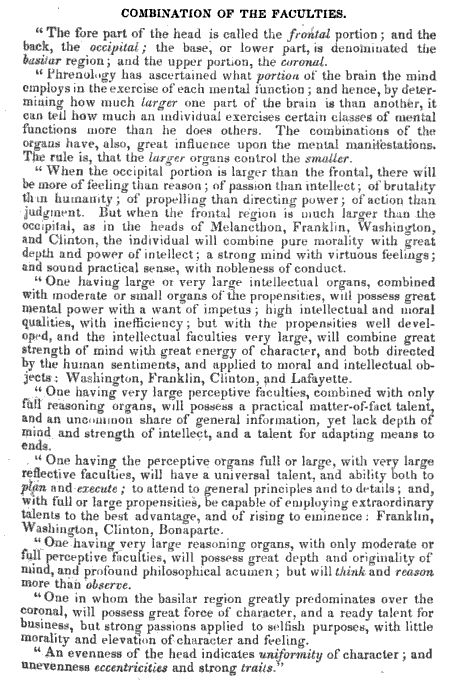
Sifting through these articles, I was struck by the impact that phrenology managed to have on American culture. Phrenology came out of the work of German doctor Franz Joseph Gall in the first two decades of the 19th century, and was popularized in the United States in the 1830s by a well-known physician named Charles Cardwell. I was surprised to learn from Robert E. Reigel, writing in the 1930s, that the earliest phrenologists were respectable physicians who had derived their theories by employing the empirical tools of observation and measurement to the psyche, even if the conclusions were uniformly unrevealing. The thought behind phrenology seems to have followed as such: that the brain consisted of modular faculties that were generally independent and localized, an observation that would have been supported through observations of traumatic injuries like the one received by Phineas Gage in 1848, whose personality changed radically when his left frontal lobe was largely destroyed by a railroad spike. It seemed not implausible that if mind and brain were deeply intertwined that the size of these various organs in the skull might determine one’s personality. And if the shape of the brain determined the shape of the skull, well, could one not possibly infer the personality traits of the individual from an examination of the contours of the head? Sure there are a lot of speculative leaps in there, but it’s not impossible. It could have been right. It just happened to not be, and quite quickly the interpretive flaws that doomed phrenology were recognized.

Phrenology, while in some ways reflecting a materialist sensibility about the origin of character, was also a very convenient tool by which to confirm racial and social stereotypes and beliefs that one’s true inner nature would be written on one’s body, like Dorian Gray’s portrait. As such, it was an especially useful pseudoscience for reconfirming the inferiority of darker races and confirming the inherently criminal nature of the lower classes.

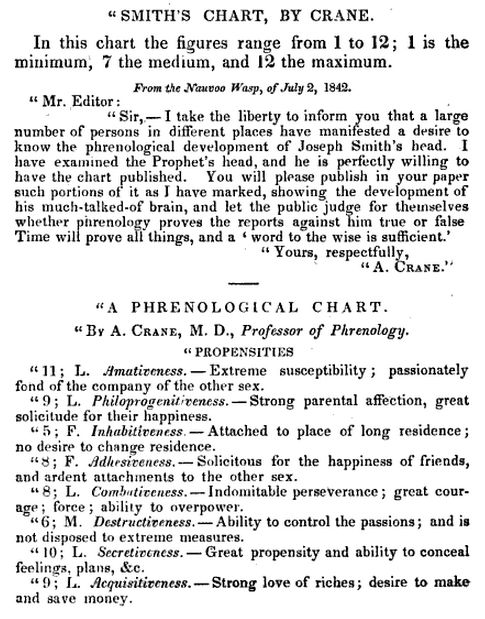
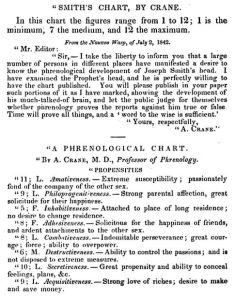
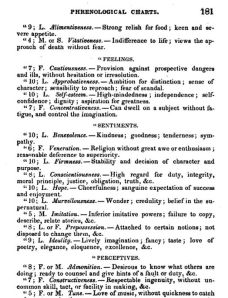
What I am most surprised by as I go through these articles is the number and variety of prominent historical characters who underwent phrenological analysis. These include Herman Melville, Edgar Allan Poe, Clara Barton, most of the Northern generals in the Civil War, and the exhumed skull of Jonathan Swift. When these personages were not available for direct examination, phrenologists would base their analyses on paintings and busts of the figures. One of the most intriguing was a phrenological analysis of Joseph Smith, the founder of Mormonism. The Nauvoo Wasp on 2 July 1842 printed a letter from Smith’s phrenologist, Dr. A. Crane. which he prefaces with:

“Sir, I take the liberty to inform you that a large number of persons in different places have manifested a desire to know the phrenological development of Joseph Smith’s head. I have examined the Prophet’s head, and he is perfectly willing to have the chart published. You will please publish in your paper such portions of it as I have marked, showing the development of his much-talked-of brain, and let the public judge for themselves whether phrenology proves the reports against him true or false[.] Time will prove all things, and word to the wise is sufficient.”
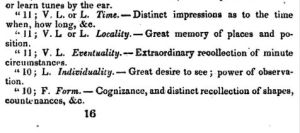
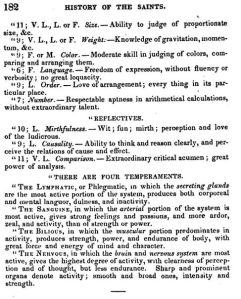
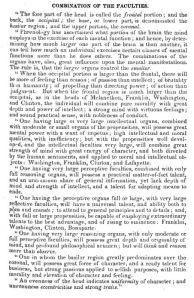
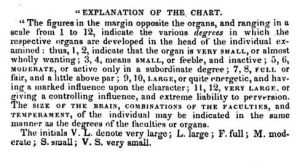
Smith1

Smith2

Smith3

Smith4

Smith6

smith5

(source: Bennet, The History of the Saints)

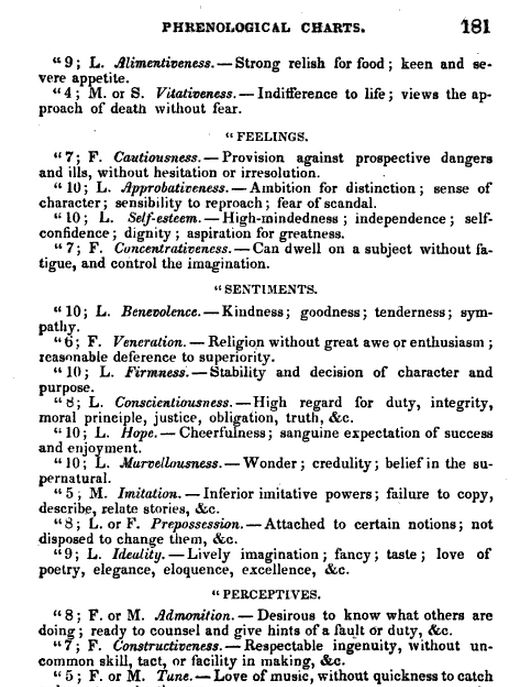
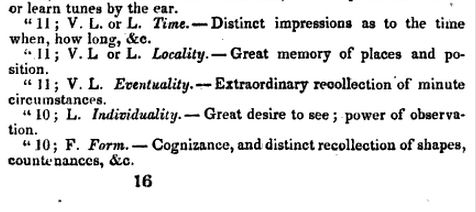
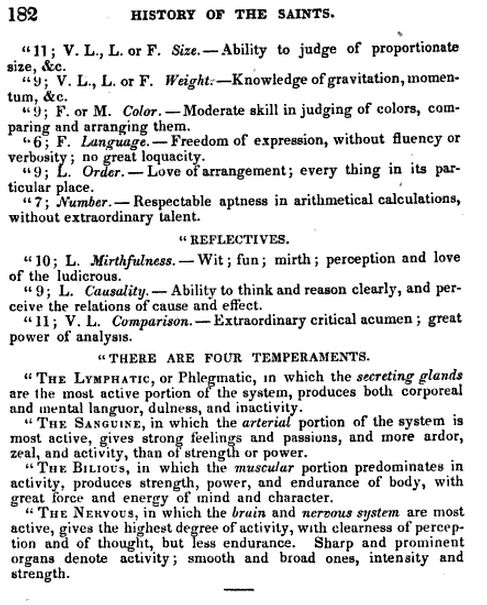
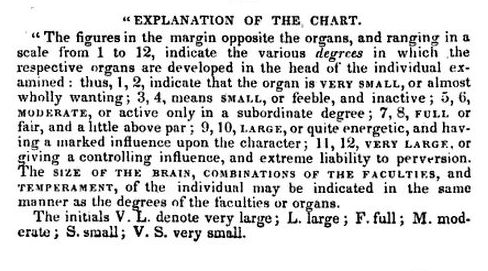
The scores range from 1-12, twelve meaning that the part of the brain in question is very large. It turns out, according to Dr. Crane, Smith was extremely susceptible to and desirous of the opposite sex. A lot. Like 11 out of 12 a lot.  Also, he was judged to have an enlarged region of critical acumen. He scored low on “attachment to places of long residence,” musical aptitude, destructiveness, indifference to life, and, interestingly, the sentiment of “veneration,” which is described as “religion without great awe or enthusiasm” and “reasonable deference to superiority.”

Mark Twain also had his head examined. In a series of articles published in the 1970s, literary scholars debated to what degree Twain was a believer in phrenology. Certainly he was familiar with phrenology and other forms of bunkum. It’s low hanging fruit, and he often deployed his satirical skills against popularly discredited practices. The exchange that these scholars were having, however, seem to miss the point that whenever Twain was writing for a large popular audience, he was uniformly damning of phrenology, which suggests to me that was likely his attitude toward the topic. In Huck Finn, the King and the Duke, two traveling confidence men included phrenology among their skills. Wandering phrenologists would come to his hometown of Hannibal, MO and give readings for a quarter. In his Autobiography, he recounted:

The phrenologist took great delight in mouthing [the] great names [of cranial features]; they gurgled from his lips in an easy and unembarrassed stream, and this exhibition of cultivated facility compelled the envy and admiration of everybody. By and by the people became familiar with these strange names and addicted to the use of them and they batted them back and forth in conversation with deep satisfaction– a satisfaction which could hardly have been more contenting if they had known for certain what the words meant.

“It is not at all likely, I think, that the traveling expert ever got any villager’s character quite right, but it is a safe guess that he was always wise enough to furnish his clients character-charts that would compare favorably with George Washington’s. It was a long time ago and yet I think I still remember that no phrenologist ever came across a skull in our town that fell much short of the Washington standard.

Twain also recounts a visit to a London phrenologist, once under a fake identity, and then again several months later under his own nomme de plume. He found that the two readings in no way matched, and that the second one was clearly far more specifically tailored to his public persona. I will include a detailed phrenological reading of Mark Twain that found–surprise, surprise–that he was very funny indeed.

I would be remiss if I did not add one final literary figure who received a phrenological analysis. Walt Whitman employed the language of phrenology in his Leaves of Grass. For instance, when he praises “the noble character of mechanics and farmers, especially the young men, he lauds:

The freshness and candor of their physiognomy, the copiousness and decision of their phrenology,

The picturesque looseness of their carriage, their fierceness when wrong’d,

The fluency of their speech, their delight in music, their curiosity, good temper, and open-handedness—the whole composite make,

The prevailing ardor and enterprise, the large amativeness[…]

And later in the poem, he questions himself:

Who are you, indeed, who would talk or sing to America?

Have you studied out the land, its idioms and men?

Have you learn’d the physiology, phrenology, politics, geography, pride, freedom, friendship, of the land? its substratums and objects?

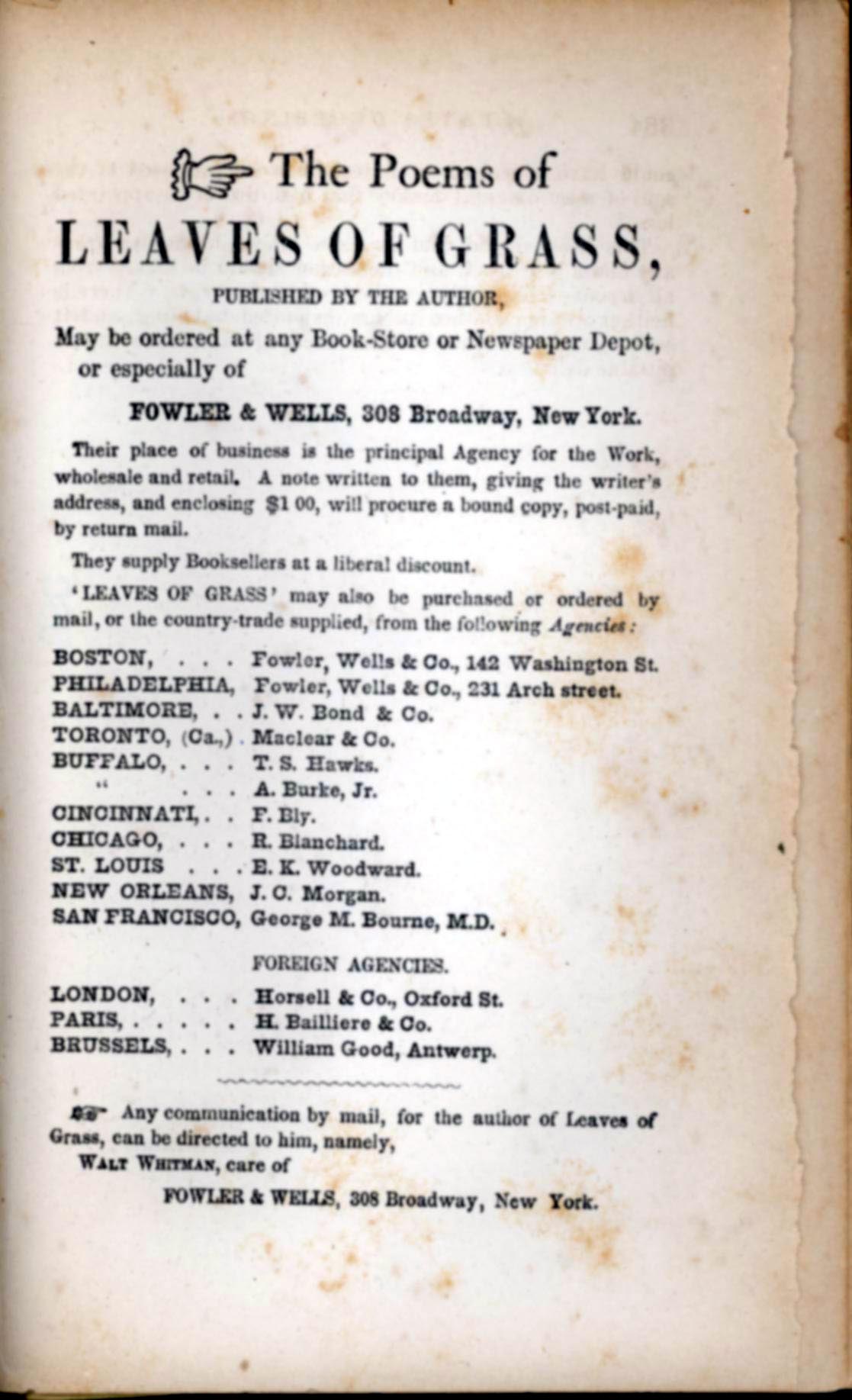
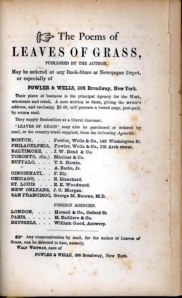
But Whitman didn’t just use the language of phrenology in terms like “amativeness” (a phrenological feature suggesting sexual desire) and as a metaphor for understanding the deeper truths of American character; he also praised phrenologists alongside geologists, chemists, mathematicians, and oddly, spiritualists, as the “lawgivers of poets,” those who reliably illuminated the objective reality that poets use to fashion their verses. Furthermore, early printings of Leaves of Grass were initially distributed by Fowler and Wells, the New York publishers of the long-lived Phrenology Journal. Their office actually received Whitman’s professional correspondence for a time:
whitman1856b

(Source: http://bit.ly/15rjSRN)

Further, Whitman published his phrenological readings by Lorenzo Fowler in several editions of Leaves of Grass.

For all its misuses and silliness, phrenology seems to have nonetheless left its mark on American culture. Indeed, at least a basic understanding of the pseudoscience is essential to understanding one of America’s most important literary works.

RJB

Works Consulted:

  • Bennett, John C. The History of the Saints: Or, An Exposure of Joe Smith and Mormonism. New York: Leland and Whiting, 1842.
  • Claggett, Shalyn. “Putting Character First: The Narrative Construction of Innate Identity in Phrenological Texts.” Victorians Institute Journal 38 (Jan 2010): 103-162.
  • Gribben, Alan. “Mark Twain, Phrenology and the “Temperaments”: A Study of Pseudoscientific Influence” American Quarterly 24.1 (Mar., 1972): 45-68.
  • Hungerford, Edward. “Walt Whitman and His Chart of Bumps.” American Literature 2.4 (Jan., 1931): 350-384.
  • Mackey, Nathanial. “Phrenological Whitman.” Conjunctions 29 (Fall 1997).  http://www.conjunctions.com/archives/c29-nm.htm
  • Riegal, Robert E. “The Introduction of Phrenology to the United States.” The American Historical Review 39.1 (Oct 1933): 73-78.
  • Stern, Madeline B. “Mark Twain Had His Head Examined.” American Literature 41.2 (May, 1969): 207-218.
  • Wrobel, Arthur.  “Corroborating His Phrenology”: The American Phrenological Journal, The Great American Crisis, and U. S. Grant. Journal of American & Comparative Cultures (24.3-4): 161-169.

Linguistics ‘Hall Of Shame’ 8

May 5, 2013

Hi again, everybody! ‘Hall Of Shame’ continues!

8 EMMA COCKER

Like many ‘fringe’ authors, some artists and commentators on the arts apparently believe that scholars – including linguists – hold (or can reasonably be read as holding) that their theories and observations as published in books and articles are definitely correct, not admitting of any challenges, alternative stances or modifications. One such writer is Emma Cocker, an ally of John Latham (discussed briefly last time), who finds this supposed viewpoint unwelcome because of her own focus on the ‘margins’ between entities and the uncertainty of analyses (a popular theme among artists).

Although those of us who are active skeptics do of course find SOME alternative ideas ill-founded, this very ‘strong’ interpretation of what we say reflects a serious (and surprising) error in respect of our intent. Most academics – while confident enough to subject their ideas to scrutiny through publication – are well aware of the provisional nature of academic ‘conclusions’ and of the large amounts of uncertainty which obtain (perhaps especially but not exclusively in the humanities and social sciences). (However, we ARE also – naturally – much more interested than are artists in the RESOLUTION of uncertainties wherever possible, by synthesis or by the identification of some analyses as preferable to others.)

Some writers of this kind also advance more specific ideas (not necessarily non-mainstream) about language – though not always very explicitly or clearly; they are accustomed to using vivid metaphors rather than precise ‘academic’ wording. Cocker herself suggests that ‘seams become audible in the spoken language of certain districts’ (which, she explains in correspondence, refers to interference between dialects/accents in contact situations), and that speech can be ‘twisted and reversed’ (this refers to usage such as Cockney ‘backslang’, as in rofe meaning ‘four’). She discusses these two phenomena in the context of her more general notions about language and the mind, chiefly with respect to her ‘margins’ (these notions are only to a limited extent empirically grounded).

However, both phenomena are already rather well understood: the former is much more widespread in language generally than Cocker seems to imagine and normally requires no special explanation, and the latter is (obviously) typically involved in the encryption of information. Novel perspectives are always of interest; however, they need to be explicitly expressed and exemplified if linguists are to assess their validity and/or significance, and they are more likely to be genuinely useful if they are informed by knowledge of existing ideas within the discipline (even if their proponents reject these ideas).

More next time!

Mark

PS: For my new book Strange Linguistics, see:
http://linguistlist.org/pubs/books/get-book.cfm?BookID=64212

Copies are available through me at the author’s 50% discount, for EU 26.40 including postage to anywhere outside Germany. Please let me know if you’d like one, suggest means of payment (Paypal is possible) and provide your preferred postal address.


Linguistics ‘Hall Of Shame’ 7

April 28, 2013

Hi again, everybody! ‘Hall Of Shame’ continues!

7 WYNN-MILLER, CROFT, MYRLAND & LATHAM

Some extremely strange thinkers, notably David Wynn-Miller and Mary Croft, are concerned with what they take to be the inadequate basis for most current laws in most countries (including the UK) and with what Croft in particular identifies as the religious basis for legal principles: truly valid laws allegedly arise out of the will of God. This material is taken seriously by some advocates of radical meta-legal reform. These authors present linguistic analyses and theories which allegedly (not always at all obviously!) would support their critiques of current laws. However, these analyses are themselves inaccurate, and the associated linguistic conceptualisation is seriously confused.

Wynn-Miller in particular focuses upon English grammar as it is manifested in texts such as those of laws and of justificatory preambles to laws. On his web-site, he describes English grammar as providing ‘a set of rules for the construction of the English Language so that human-beings can communicate with each other and understand that communication correctly’. (Presumably he would say the same about the grammars of other languages.) He continues: ‘If the rules of grammar were not defined, then it would be impossible to know what is meant by any words or statements. Dictionaries provide definitions for words and the rules of grammar define the construction of sentences in order to convey meaning and ideas unambiguously’.

The tone here is more ‘prescriptivist’/‘normative’ than a mainstream linguist would prefer (it suggests that grammars should lay down rules for usage, even for native speakers); but Wynn-Miller’s ideas are in other respects relatively uncontroversial up to this point. However, he then makes the bizarre claim that it is important to retain as many nouns in the language as possible, because they refer to things or places and therefore ‘are’ real, tangible items. In fact, Wynn-Miller’s ontology is badly astray here. Many nouns (not all) REFER to tangible items (sometimes called ‘photographables’, for instance by Charles Bliss as discussed last time), but they are not themselves those items (like the well-known picture of a pipe by Rene Magritte, the word pipe is not itself a pipe). On the other hand, Wynn-Miller says, verbs describe actions and motions, cannot describe real, tangible items, and are thus harmful to thought. This too is confused: many verbs (not all) describe dynamic assemblies of wholly tangible entities, collectively forming physical events: ‘filmables’. (Some nouns, such as stampede, also refer to filmables rather than photographables.)

Wynn-Miller refers to his novel version of English grammar as ‘Truth Language’ because it (supposedly) retains all nouns as nouns. He offers examples of the operation of ‘Truth Language’ involving various English sentences; one example is For the text of this web-site is with the absence of the legal-advice. (This sentence is, obviously, in very strange English, to say the least; Wynn-Miller does not identify the author.) Wynn-Miller badly misanalyses the grammar of the sentence, and then proposes a new, supposedly preferable version: For the absence of the legal-advice is with the text of this web-site. He describes this version as ‘unambiguous’. In fact, no AMBIGUITY is present in the original sentence; the term ambiguity is apparently being used idiosyncratically here. In addition, the new formulation is not palpably clearer than the original, and it itself might in fact be ‘ambiguous’ if the original were ambiguous; it is also, again, bizarrely phrased. It is indeed far from clear why this new formulation is deemed preferable to the original; this may be because it is held to express (subtly) a political ‘truth’ adhered to by Wynn-Miller (and Croft), whereas the original expresses (subtly) an uncongenial political notion. Furthermore, Wynn-Miller’s new formulation STILL includes non-nouns.

Some of Wynn-Miller’s sentences are cited by his ally David Myrland (if indeed Myrland is not in fact Wynn-Miller himself in another guise!), who openly rejects the authority of the United States government and legal system (rather after the manner of the ‘Freemen of Montana’ and other such groups), threatens to enforce his own principles by sending armed gangs to ‘arrest’ officials, and is currently serving a sentence for non-compliance with various laws. Myrland too suggests that grammatical problems in the English of legal texts render them invalid; in his lawsuits against the American authorities, he presents extensive (often inaccurate) grammatical analyses of such texts, along similar lines.

One is reminded here of thinkers such as John Trotter, whom I discussed in the first instalment in this series: Trotter argues that certain kinds of formulaic expression of philosophical interest – for instance the logician’s For all X, X is Y = ‘all Xs are Y’, as in ‘all men are mortal’ – are to be deemed ungrammatical even though they are the normal forms used by the relevant native speakers (logicians) in such cases, and goes on to claim (bizarrely) that these expressions are not only ungrammatical but are therefore also logically invalid – and that, because the issue at hand is central in discussions of logic, the whole basis of logic is thereby impugned. But Myrland’s grasp of grammar (and of language matters more generally) is far inferior to Trotter’s. Indeed, Wynn-Miller, Myrland and Croft simply do not understand the grammar of English – or linguistics – well enough to make any valid comments on language, or to draw any theoretical conclusions.

The art-theoretician John Latham, in his works promoting his ‘Time-Base Theorem’, takes such ideas even further in arguing (unconvincingly) that language as a whole (supposedly ‘object-based’) cannot adequately describe reality (which is itself ‘event-based’). See John Latham, Time-Base and the Universe (London, 2006); also online discussions and projects such as http://www.arts-humanities.net/projects/reanimating_john_latham_through_archive_event.

For Wynn-Miller, see http://www. natural-person.ca/; for Croft, see
http://spiritualeconomicsnow. net/, from which Croft’s e-book How I
Clobbered Every Bureaucratic Cash-Confiscatory Agency Known To Man
(http://www. spiritualeconomicsnow. net/solutions/How_I_08. pdf) can be downloaded;
for Myrland, see
http://spiritualpolitician.blogspot.co.uk/2007/06/david-myrland-man-who-cures-fear-of.html

More next time!

Mark


And That’s Why They’re Going to Hell: Teaching Literature in Bobby Jindal’s Louisana

April 21, 2013

In an interview with NBC’s Hoda Kotb on April 12, Louisiana governor Bobby Jindal defended two anti-education elements of Louisiana’s education system: the Louisiana Science Education Act and the Louisiana voucher program. Asked if he thought it was acceptable to teach creationism in public schools, Jindal responded:

We have what’s called the Science Education Act that says that if a teacher wants to supplement those materials, if the school board is okay with that, if the state school board is okay with that, they can supplement those materials. … Let’s teach them — I’ve got no problem if a school board, a local school board, says we want to teach our kids about creationism, that people, some people, have these beliefs as well, let’s teach them about “intelligent design”…. What are we scared of?”

The Louisiana Science Education Act allows teachers to bring in supplemental reading materials to critique controversial scientific theories, such as evolution, the origins of life and global warming. In practice, this act allows teachers in public schools to counter approved science textbooks with anti-science and to present creationism as a viable alternative to evolution by natural selection.

The voucher program allows funds set aside for public education to pay for students to attend private, religiously-based schools. In November a state judge ruled the voucher program unconstitutional, but did not end or suspend the program. This issue is now before the state Supreme Court.

Last year, Mother Jones compiled a list of “facts” included in textbooks that are used by some of the schools receiving public funds from the voucher program. Among those facts: dinosaurs and humans co-existed; fire-breathing dragons may have been real; slavery and the KKK weren’t that bad.

I purchased copies of two of the books Mother Jones listed: Life Science 3rd ed. by Brad R. Batdorf and Thomas E. Porch, published by Bob Jones University Press, and the teacher’s edition of Elements of Literature for Christian Schools by Ronald A Horton, Ph.D., Donnalynn Hess, M.A. and Steven N. Skaggs, also published by BJU Press.

The life science textbook is as horrible as you would expect, but I am going to focus on the literature textbook. It is intended for high school freshmen and sophomores, and it isn’t really about literature: it’s about the bible. Oh, other literary works are included, but they’re really only there to shed light on the Bible.

In the “To the Teacher” section, the authors state:

The serious study of imaginative literature opens the door to a vast new realm of reading comprehension and pleasure. All artful writing takes on greater richness and breadth of significance. Improved Bible study will be an inevitable benefit of developing these skills. Students will be sensitive and responsive to meanings in the Scriptures…that were beyond them before. Students will be aware of the beauty and power of Biblical expression and understand how artistry clarifies and reinforces meaning. For sheer variety and magnificence of artistic effects and structural finesse, the Bible is incomparable. It supernaturally excels in artistry of form as well in truth of content.

Every section begins with a selection from the Bible which exemplifies whatever literary device is being discussed. Then other selections are introduced. In this way, say the authors, “the students are learning that they may take the Bible as their standard in every area of their experience–that it should, in fact, be the center of their entire mental and emotional world.”

Of course, in juxtaposing the Bible with other works of literature, there is a danger that students might come to see the Bible as being simply literature: a collections of stories using metaphor, allegory, symbolism and other literary devices, little different from the works of Shakespeare or Edgar Allan Poe.

No fear. As the authors explain:

[T]his book is careful to maintain the distinction between the Bible and other literature. The Christian teacher of literature cannot afford to leave any doubt about his belief in the uniqueness of the divinely inspired writings of Scripture. The study of Biblical metaphors, allegory, irony, allusions, and themes can otherwise be construed to imply that the Bible is only a work of man and differs from other human writings only in degree. Secular courses in “the Bible as literature” raise doubt about the supernatural nature of Scripture simply by ignoring it. If the artistry of Scripture and its divine origin are disregarded, literary analysis can promote unbelief.  Just as it degrades the character of Christ to speak of Him simply as a great man (although He was that), so it degrades the nature of the scriptures to speak of them as simply great literature (although they are that). For this reason, [this book] continually points out the supportiveness of Biblical artistry to the Biblical message and to its intentions concerning the reader or hearer. It also makes frequent reference to the supernatural origin and character of the Scriptures.

Much of this is repeated verbatim in the introduction to the student edition.

The teacher’s edition includes suggestions for class activities and warnings of “potential problems.” These warnings sometimes involve terms or ideas that students may find confusing, but often they are warnings about moral dangers. For instance, in discussion of a passage from Mark Twain’s Tom Sawyer, the authors warn teachers, “You may wish to caution your students about indiscriminate reading of Twain’s works….Several of Twain’s works would be considered inappropriate for recreational reading.” Because, you know, you wouldn’t want to encourage indiscriminate reading in a literature course.

The text itself included biographies of many of the authors whose works appear in the book. These bios always end with a moral and religious assessment of the author. I find it helps to mentally add the words “and that’s why the author is going to hell” to the end of these bios.

John Ruskin:

“Ruskin’s personal religion emphasized a love for beauty and goodness and a thorough knowledge of the English Bible. However, his writings also show that he espoused empiricism, a philosophy which teaches that knowledge stems directly from man’s experience. According to this dangerous doctrine, we can only trust what is felt or seen.” And that’s why he’s going to hell.

James Joyce:

“Although a comprehensive knowledge of Joyce’s writing is not a necessary or even a healthy goal, a general awareness of his literary impact helps us better understand contemporary trends in literature…. [M]ost of [his] works hold little ideological value. Joyce’s use of cryptic allusions and veiled obscenities as well as his inflated sense of self-importance…preview both the style and attitude of many twentieth-century writers.” And that’s why he’s going to hell.

John Updike:

[A recurring theme in Updike’s work] “concedes that man must possess the hope of immortality and a cosmic design. Unfortunately, his observations…fail to acknowledge God’s provision of salvation through Christ and man’s individual responsibility to accept what God has graciously provided through His Son.” And that’s why he’s going to hell.

Walt Whitman:

“Although we can appreciate the literary quality of many Whitman poems, we must, of course, be careful to evaluate their message in light of Scriptural standards. Unlike Whitman, we as Christians recognize that ‘there is a way which seemeth right unto man, but the end thereof are the ways of death’ (Proverbs 14:12).” And that’s why he’s going to hell.

Emily Dickinson:

“Dickinson’s year at Mount Holyoke Female Seminary further shaped her ‘religious’ views. During her stay at the school, she learned of Christ but wrote of her inability to make a decision for Him. She could not settle ‘the one thing needful.’ A thorough study of Dickinson’s works indicates that she never did make that needful decision. Several of her poems show a presumptuous attitude concerning her eternal destiny and a veiled disrespect for authority in general. Throughout her life she viewed salvation as a gamble, not a certainty. Although she did view the Bible as a source of poetic inspiration, she never accepted it as an inerrant guide to life.” And that’s why she’s going to hell.

The condemnation of Twain is too lengthy to quote in full, but it concludes:

“Twain’s outlook was both self-centered and ultimately hopeless. Denying that he was created in the image of God, Twain was able to rid himself of feeling any responsibility to his Creator. At the same time, however, he defiantly cut himself off from God’s love. Twain’s skepticism was clearly not the honest questioning of a seeker of truth but the deliberate defiance of a confessed rebel.” And that’s why he’s going to hell.

To be fair, some authors, such as poet John Greenleaf Whittier, squeak by without condemnation, but all authors and their works must be assessed according to moral and religious worth, and the primary purpose of literature is to better understand the Bible.

The pedagogic material in the book and in the teacher’s section is designed to guide students to a particular interpretation of individual works of literature. It is overtly intended to further inculcate a narrow religious view of the world. This approach is antithetical to what a good literature course should do. There are many valid interpretations of any literary work: students should be encouraged to think for themselves, to provide an interpretation supported by evidence from the text. They should also be encouraged to read great literature as indiscriminately as they wish, not merely those bits that are deemed biblically inoffensive according to a very narrow definition.

ES