Linguistics ‘Hall of Shame’ 23

August 25, 2013

Hi again, everybody! ‘Hall Of Shame’ continues.

23 WRITERS ON CREE, CHEROKEE AND LENAPE

Jean-Louis Pagé (see my ‘Around The World In Mysterious Scripts & Texts’ 3, this site, 28 May 2012) claims that the Algonkian language Cree and its script are related to his version of ‘Atlantean’ (which very probably never existed) and thus to ancient languages of the Old World. The Cree writing system (a syllabary-cum-alphabet) was demonstrably invented by James Evans in 1840-46 on the basis of shorthand, the syllabic Cherokee script (itself held by some, such as ‘Traveler Bird’, to be much older than it appears to be; this system too was in fact, as it seems, invented, around 1821, by a member of the Cherokee nation named Sequoya) and other scripts known to him; it cannot be related to ancient scripts. In addition, Pagé’s conceptualization of the system as logographic or even ideographic is confused and inaccurate.

Cyclone Covey’s associate Ethel Stewart offers another non-mainstream account of Cree and its writing system.

Another interesting case is that of the ‘Walam Olum’, a document allegedly obtained by Constantine Rafinesque from the nomadic Lenape Amerindians but in fact probably forged. This text, written in Lenape in an otherwise unknown ‘ideographic’ (logographic) script, supposedly recounts the wanderings of the tribe over many thousands of years, starting from their ultimate origins in Asia. Others have endorsed and developed this analysis.

References to all these sources on request!

More next time (which will be delayed until midweek or maybe even 8 September; my beloved & I will be away, in Iceland)!

Mark

For my book Strange Linguistics, see:
http://linguistlist.org/pubs/books/get-book.cfm?BookID=64212

Copies are available through me at the author’s 50% discount, for EU 26.40 including postage to anywhere outside Germany. Please let me know if you’d like one, suggest means of payment (Paypal is possible) and provide your preferred postal address.


Linguistics ‘Hall of Shame’ 22

August 18, 2013

Hi again, everybody! ‘Hall Of Shame’ continues.

22 MILAN ELESIN

There are numerous nationalistic myths concerning the various Balkan Slavic languages, notably Serbian. Milan Elesin, a Serbian writer, apparently believes that the Lord’s Prayer was mistranslated into Serbian and other modern Slavic languages, preferring his own reading of the version in Old Church Slavonic (OCS) – the classical language of Eastern European Orthodox Christianity – supposedly written by St Cyril. Elesin seems reluctant to acknowledge the status of the New Testament Greek text as the original formulation of the prayer. For instance, he regards the Serbian equivalent of the word daily in the prayer – and, it seems, the English word itself and equivalent words in other languages – as a confusing mistranslation. Elesin does not seem to be denying that the Greek sentence in question has the meaning ‘Give us today our daily bread’, or claiming that the English, Serbian etc. are mistranslations of the Greek. Instead, he ascribes higher status to the OCS wording, which he repeatedly translates quite differently from the Greek (differing in this respect from mainstream OCS scholars, though without overt acknowledgment of this divergence). In the case of the key word epiousion (‘daily’) as cited here, he treats the OCS as importing ideas from an Egyptian hymn beseeching divine relief from a drought. His view seems to be that Cyril had access – directly or indirectly – to these pre-first-century formulations, and that the OCS thus preserves these better than does the Greek. But these versions are not themselves known; and – like all scholars between post-dynastic times and the nineteenth-century decipherment – Cyril himself was surely unable to read Egyptian.

In other places Elison’s own interpretations are truly bizarre; for example, he translates one section of the OCS as referring to the gas ozone. And his ‘understanding’ of the ideas and covert motivations of contemporary linguists and biblical scholars is also bizarre.

It may be possible to purchase Milan Elesin’s e-book on this subject by writing to him at
elesinmilan@gmail.com. It should be borne in mind that his English is often very strange and difficult to understand (some of it is machine-translated)

I found one source where Elesin’s surname was transliterated Elisin; maybe this spelling should be included in web-searches.

More next time!

Mark

For my book Strange Linguistics, see:
http://linguistlist.org/pubs/books/get-book.cfm?BookID=64212

Copies are available through me at the author’s 50% discount, for EU 26.40 including postage to anywhere outside Germany. Please let me know if you’d like one, suggest means of payment (Paypal is possible) and provide your preferred postal address.


What’s Right with Skepticism?

August 17, 2013

The last two weeks have been difficult for members of organized skepticism, a community that I have been increasingly involved in over the last five years. In that time, I’ve made a lot of good friends, but recently many of them have forgotten they can disagree without hating one another. This animosity threatens a lot of progress that has been made over the past decade, during which time groups of overwhelmingly like-minded people have found each other in order to promote evidence-based thinking and to celebrate curiosity and progress.

Yesterday, Newsweek published a piece by Michael Moynihan called, “James Randi, the Amazing Meeting, and the Bullshit Police.” I think it’s safe to say that most of it was probably written before the most recent flare up of “The Troubles,” because in some ways the portrait of skepticism represented in that article–with the veneer of a united movement–reminds me of someone with whom I am intimately familiar, but who is impossibly distant. It’s hard to believe that just a month ago, I was in the company of 1,500 friends from around the world, any one of whom I could easily plonk down next to and have a beer with.

For all the dysfunction we’ve seen, though, skeptics are doing a number of things right, and I think that if ever were a time that we needed to appreciate the best of skepticism, it’s now. You may not agree with every item on the following list, and there is a very good chance that you strongly disagree with someone whose work appears on it. But it’s not a list of people or personalities, but of work that has been done. Regardless of how you feel about the people who are performing the work these projects deserve your attention and support.

SkeptiCamp–Since the first SkeptiCamp was organized by Reed Esau in Denver in 2007, skeptics in cities around the world have sponsored these gatherings where the only requirement is that you participate. Over 70 SkeptiCamps have been held to date and have given hundreds of people the opportunity to participate in skepticism, refine their research and presentation skills, and become more effective advocates of sound reasoning in the public sphere. These are powerful incubators of skeptical talent. If you think that skepticism is too centralized or that there are too many skeptical superstars or not enough variety at major conferences, then you should be participating in SkeptiCamp. You’ll get variety and you’ll be encouraging diversity at future national conferences. I was pulled into the screaming vortex of organized skepticism by Reed when Eve and I sat next to him at the food court at Dragon*Con and asked him about his “SkeptiCamp” t-shirt. Since then, I’ve presented at three SkeptiCamps and hope to attend more.

Science-Based MedicineThe Science-Based Medicine blog is one of the workhorses of skepticism, where experts discuss one of the perennial skeptical topics (alternative medicine) and guide readers through medical research that makes it into the news. The editorial board and author pool is a who’s-who of skeptical heavy hitters, and they deliver the goods. Week after week, you get the sense that this is the front line of the war on medical charlatanry. I think that SBM has managed to do what it does so well not just because of its talented contributors, but because it has stayed so close to its public mission throughout its run. Skeptics would do well to find ways to promote this valuable resource so that the SBM crew spends more time shaping public opinion than stomping out fires. And if there is someone you don’t like on there, there are a dozen other people you can get behind.

Doubtful News–This site has been going like gangbusters in the two years it’s been up, primarily, I think, because of the work of its founder, Sharon Hill. Doubtful News breaks more weird news before 9AM than most news organizations do all day, and she’s usually a day or two ahead of the news cycle. She and her co-editor are usually the first skeptical voices to chime in on the weird news of the day. And they are ALWAYS AT IT. This is another resource that we should be putting in front of the media. Skeptics should have a seat at the table when the news is somberly reporting bullshit. Further, Sharon has developed a useful Media Guide to Skepticism, a boilerplate introduction to what we do when we are at our best.

SiTP, Meetups, Virtual Drinking Skeptically–Skeptics in the Pub events are fantastic “gateway” social events, and when people report that they found a community of like-minded people in skepticism, SiTP is what they are usually talking about. But let’s say you don’t like bars or that you have kids that need constant attention/entertainment. Most local groups have occasional low-key and family days out, like Skeptics in the Park/at the Pool/at the Zoo. Lastly, Virtual Drinking Skeptically, an online project begun by Brian Gregory, is a way to enjoy all the benefits of drinking with skeptics without the hassle of leaving your most comfy chair. Actually, this is an attractive option for people like me, who live outside of the town outside of the town outside of the city.

Guerilla Skepticism–This little group has been kicking down doors and has made its presence known this year. Headed by the indefatigable Susan Gerbic, this international group is putting reliable information on Wikipedia, the universal go-to source for information. If there were ever a place skeptics should be devoting their attention and contributing heavily, it’s Wikipedia. My god, think if all the energy expended over the last few years on infighting between people (who really see almost everything else the same way) had been devoted to developing the skeptical presence on Wikipedia! Susan is working with other activist leaders on bringing more skeptical projects to fruition, so pay attention to her.

The Amazing Meeting–You’re goddamned right The Amazing Meeting deserves to be on this list. Ask almost anyone who was there this year. It’s an opportunity to meet the people you have been corresponding with online and whose work you admire. The sheer number of projects, ideas, and collaborations (not the mention the friendships) that begin at the South Point make TAM pretty much the best possible outcome of getting 1,500 humans together. SkeptiCamp came about in part because of TAM 2007. The Virtual Skeptics (full disclosure: we’re awesome) was born over drinks at TAM 2012. Susan Gerbic recruits SkeptiGuerrillas (is that a thing?) and holds meetings with her team there. Podcasters are brought into contact with high-profile interviewees, and some podcast teams have their only face-to-face interaction while in Vegas. I’ve heard many people say that TAM is what recharges them and prepares them emotionally for another year of often frustrating herculean (if not sisyphean) acts in the service of critical thinking; an important reason I got serious about taking on the Burzynski Clinic was because of Pamela Gay’s talk in 2012 about getting out there and doing something awesome. The regional conferences like SkeptiCal and NECSS are excellent too. So is CSICon (and what it is regenerating into), and so are international events like QED, Skeptics on the Fringe, and the European Skeptics Conference, but TAM has the greatest reach, and if I remember correctly, about half of the attendees were first TAMmers this year. It is clearly a unique opportunity to get new people involved in activism and outreach.

Podcasting and webcasting–In some ways, this is what makes skepticism an international community. There is no shortage of well-produced, thoughtful and intelligent digital content online. It began with Derek and Swoopy’s pioneering Skepticality, which was followed by innumerable other podcasts. Skeptoid, The Skeptics Guide to the Universe, Monster Talk, The Geologic Podcast, The Token Skeptic, Skeptics with a K, The Skeptic Zone, Oh No Ross and Carrie and dozens of other podcasts (I apologize if I missed your fave).

Independent Investigations GroupThe IIG, based in LA, is nuts and bolts skepticism, actively training people to test extraordinary claims, investigate reports of the paranormal, expose charlatanry, and take the hurt to fakers. They have conducted a couple dozen investigations of paranormal and other extraordinary claims. Perhaps my favorite was their investigation (and pranking) of the California Board of Registered Nursing, in which they were able to get workshops on preposterous (and entirely made up) alternative medicine regimens approved to be given for continuing education credit in the state of California. They have also welcomed claimants to test their paranormal abilities under scientifically controlled conditions for a shot at $50,000. The franchises that have popped up in a few cities across the country are expanding the mission of the IIG, and I am delighted to hear that the IIG-Atlanta group will be testing their first claimant for the prize in the near future.

Dragon*Con SkepTrackDragon*Con’s SkepTrack, a labor of love put on by Derek Colanduno, always brings an impressive number of excellent speakers and allows the Atlanta Skeptics to show their stuff.  It’s also a major first point of contact between skeptic nerds and pop culture nerds. There’s often very little difference between the two; it’s just that the pop culture nerds don’t realize that they are skeptics yet. This year’s SkepTrack is going to bring a lot of people together who have been at each others’ throats lately, and I’ve even heard rumblings that attendees should be disruptive to people they don’t like. If you do that during such a major outreach event, you are simply shitting in everyone’s macaroni. Don’t make me get all Jamy Ian Swiss on your ass. There’s a lot of other stuff to do at Dragon*Con while your nemesis is on stage, like visiting the celebrity petting zoo. The attendance at Atlanta Skeptics in the Pub surges every year following Dragon*Con because SkepTrack is an awesome and welcoming event. Keep it awesome. While you are there, go over to the Paranormal Track and see what the other side is up to. It’s illuminating.

Also, the Atlanta Skeptics get the party started early. Go to the Atlanta Star Party the night before Dragon*Con kicks off. This year, the proceeds are going to CosmoQuest, which had its budget disappeared by the sequestration. Noms, entertainment, science, bigass telescope on the roof. You want to be there. It’s like…the prom of skepticism.

I would be remiss if I did not mention another Dragon*Con related initiative, Women Thinking, Inc.’s vaccine clinics, which have had a presence at recent events and have distributed free pertussis shots. Free vaccines at high-profile public events are nothing but win.

Australia and the UK–Yeah, Australia seems to be doing something right. I kind of envision it as sort of skeptical paradise. Success after success comes out of Australia, whether they are stopping the AVN, seeing to it that PowerBalance bands officially don’t work on their continent, or crusading against woo in medical schools. So, yeah. Be like Australia. At the same time, the skeptics in the UK have forced libel law reform and have seen homeopaths wonder openly whether or not they should happily market their bogus wares as confectionary. This makes me happy.

Camp InquiryJunior Skeptic, the Mystery Investigators, Camp Quest, and the JREF education modules–These groups are doing a lot of work directed toward perhaps the most important demographic for skepticism’s long-term success. Skeptics who are interested in the growth of critical thinking should be working very hard to find ways of harnessing kids’ curiosity and empowering them to investigate the world.

What’sTheHarm.net?/Skeptools–These sites are the product of one of the hardest working, most organized skeptics in the business, Tim Farley. Whether it it taking down the infamous Mabus, compiling all of skeptic history, or monitoring new technologies and finding ways to apply them to the larger skeptical project, Farley is constantly working. He’s introduced skeptics to Web of Trust, rbutr, SEO strategies for combatting woo online, turning FourSquare into a skeptical tool, donotlink.com, Lanyard, the FOIA Machine, and dozens of other applications that can help us do skeptical work. Further, he has created WhatsTheHarm.net, a huge and growing searchable database that chronicles the consequences of superstitious and otherwise sloppy thinking. Like Snopes.com, it should be a standard reference work of skepticism. I’m seriously considering making little wristbands that ask, “What Would Tim Farley Do?”

Last words. I ask people to review Phil Plait’s “Don’t Be a Dick” speech. Go back and read Ray Hyman’s wonderful “Proper Criticism,” which outlines principles of productive argument. Steal a copy of Mistakes Were Made (But Not By Me), if necessary. And the next time you engage with a skeptic you strongly disagree with online, for the love of god imagine that Eugenie Scott is sitting right next to you. Our opponents, our REAL opponents, are not going to call a time-out so that skeptics can sort out their quarrels. If you are letting purveyors of woo advance their arguments unchallenged, whatever else it is you are doing, it’s not skepticism.

RJB


Linguistics ‘Hall of Shame’ 21

August 10, 2013

Hi again, everybody! ‘Hall Of Shame’ continues.

21 ANOTHER SERIES OF ECCENTRICS

Around 1890, Significs, intended to be a ‘theory of signs’, was developed by Victoria, Lady Welby, in close connection with the work of Charles Peirce, her correspondent. Some followers of Significs, particularly in France, developed the theory into an account of human language based heavily upon meaning and in particular on the international (originally Latin) root sign- as in English signify, etc. Significs constitutes, in effect, a ‘proactive’ version of what is more usually called ‘semiotics’, the overall study of meaning including linguistic meaning (semantics) but also the meanings of non-linguistic symbols of various kinds. As far as language per se is concerned, Significs is a doctrine of etymology and historical word-meaning, with a close focus on the study and classification of semantic terms themselves. It is argued, in fact, that reform of the use of semiotics in education and public policy is needed in response to the changing circumstances of humanity, but that linguistic reform alone, while necessary, is insufficient for this enterprise. Many of the specifics of the proposals are, however, rather abstract and philosophical in character.

In addition, some followers of Significs seem to have seen Ancient Greek and Latin as models for semiotic and linguistic reform, without giving an adequate explanation of this view; this aspect of the proposal appears rather traditionalist.

Stuart Chase was especially concerned with communication issues and the interface between language and other domains of human activity. Chase was troubled by miscommunication arising from the use of words with varied, shifting and largely emotive meanings and the political and social upshots of this effect. He argues (among many other things) that most people in developed societies have lost the ability to ‘translate’ words into ‘verifiable’ meanings and are thus liable to be defrauded. Much argument which is ostensibly about facts is in fact, he claims, about definitions. While there is an element of truth in this view, Chase’s specific version appears exaggerated. He summarizes, for the most part positively, the work of Alfred Korzybski, the founder of General Semantics.

Eli Abir claims to have arrived at an algorithmic means of determining and expressing linguistic context in such a way that machine translation can be completely reliable. His method as described is essentially a numerical expansion of existing methods, but if it were technically feasible it would indeed increase levels of reliability (though perhaps not as much as is suggested). Abir does apparently go too far in claiming that this work will revolutionize linguistic theory itself. He also seems to adhere to extreme and quasi-mystical worldviews.

The small book by an unidentified writer styling himself ‘Basilegist’, apparently a solipsist, begins: ‘Difficulties of language abound in the Retection. The simplicity of that, the opening section of the Retection does not mean that the language of Retection introduces linguistic tangles, but is a statement that as clouded thought is inseparable from language, then its apparent appearance even in Retected Thought using language as its medium is inevitable…’. What ‘Basilegist’ calls Retection involves an attempt to free the human mind from confusion allegedly generated by the universal expression of thoughts by means of language and to enable it to access the ‘morphic’ state in which language is no longer thought of as necessary. He dismisses all notions about the past which are ‘known’ through language, including notions about the origin of language itself. Some of his own usage is highly idiosyncratic.

More next time!

Mark

For my book Strange Linguistics, see:
http://linguistlist.org/pubs/books/get-book.cfm?BookID=64212

Copies are available through me at the author’s 50% discount, for EU 26.40 including postage to anywhere outside Germany. Please let me know if you’d like one, suggest means of payment (Paypal is possible) and provide your preferred postal address.


Linguistics ‘Hall of Shame’ 20

August 3, 2013

Hi again, everybody! ‘Hall Of Shame’ continues.

20 ZOLTÁN SIMON

As some readers may recall, Zoltán Simon (ZS) argues for a historical Atlantis in Western Atlantic waters, and for a catastrophist and otherwise revisionist account of early human history; he believes that the cases for (a) catastrophist interpretations of early history, (b) the early discovery (and subsequent loss) of advanced technology, and (c) extraterrestrial intervention in that period are much more persuasive than they are. He exaggerates the influence of his native Hungarian and its early speakers on linguistic differentiation and world history, finding pseudo-cognates and grammatical parallels between Hungarian and English and reading the arguably mysterious runic Yarmouth Stone (Nova Scotia) as Hungarian.

ZS’s linguistic ‘evidence’ is of the usual amateur kind, but his approach is somewhat more overt than is often the case. For example, he believes that a good way of establishing whether or not any two languages are related is to compare their vocabularies for matching pairs (similar forms, similar meanings). In fact, he imagines that this is how mainstream historical linguists operate, and berates them for engaging in this enterprise in a disorganised way and for not following up apparent connections which they find unpalatable. ZS appears unaware of linguists’ focus on SYSTEMATIC similarities in this context. He also pays no attention to a) the degrees of phonological and semantic similarity between words which might be required if they were to be regarded, pre-theoretically and prima facie, as probably shared (he talks as if pairs of forms are either obviously connected or obviously not, and his own judgments on this front appear arbitrary), b) the phonological systems of the relevant languages (which affect how similar forms can be and which phonemes are likely to correspond with which if forms are connected), c) the lengths of the words (for example, if two languages not known to be connected share a very short word-form such as [sa] with the same meaning, this could very well be accidental, whereas if they share the form [tolpesveblig], again with the same meaning, or with transparently related meanings, this is less likely), d) the cross-linguistic frequency of the sounds and sound-sequences in question (very widely-shared sounds such as [e], [s], etc. or common sound-sequences such as [til] or [po] are more likely to be shared by chance than sounds and sequences found in relatively few languages). And e) he openly disregards matters of grammar, maintaining indeed that until recently many languages did not even have grammar (a most gross error!).

In addition, ZS has an interest in dialectology and has worked on a dialect atlas of Hungary. He has also done some work on the results of the 1950s Survey of English Dialects (UK), comparing the vocabularies of different English dialects with a view to assessing the relative closeness of relationship between each pair of dialects (as he does with languages, as described above). It is more unusual in this context for factors a)-d) above to be an issue (it is normally clear enough whether or not forms with the same meaning in different dialects of the same language are ‘the same word’); but ZS still ignores the systematicity requirement, the phonological structures of the various dialects, and matters of grammar. His approach (which he himself regards as altogether pioneering) is at best a rough-&-ready initial method of assessing the overall patterning of such data. (The same applies to his work on Hungarian.)

ZS criticises the SED for poor and incomplete presentation of their data (‘cartographically a disaster’), but this seems to involve the fact that he has seen only their maps themselves, not the background and interpretive materials.

ZS has a range of other non-mainstream opinions. For example, he holds that Daniel Defoe’s novel Robinson Crusoe is in fact autobiographical.

More next time!

Mark

For my book Strange Linguistics, see:
http://linguistlist.org/pubs/books/get-book.cfm?BookID=64212

Copies are available through me at the author’s 50% discount, for EU 26.40 including postage to anywhere outside Germany. Please let me know if you’d like one, suggest means of payment (Paypal is possible) and provide your preferred postal address.


“Is It Possible?” No. The Vikings Meet Ancient Aliens

July 28, 2013

On April 12, 2013, just a little bit too late for April Fool’s Day, Ancient Aliens aired “The Viking Gods” as episode 11 of season 5. It was a sober and compelling examination of the evidence.

Just kidding. It’s nonsense.

The show features a smattering of real Norse scholars. I don’t know why they are willing to appear on such a show; perhaps they’ve never seen it. I suspect, though, that Timothy R. Tangherlini, Professor and Chair of the Scandinavian Section at UCLA, and Kirsten Wolf, Professor and Chair of Scandinavian Studies at the University of Wisconsin-Madison, wanted to dispel certain misconceptions about the Viking-Age Norse. Wolf says that, contrary to popular opinion, the Norse “were enormously sophisticated in terms of technology: ship-building, bridge-building, fortress-building….”

Her point is completely valid, of course, but it’s not one you want to make on Ancient Aliens because they are going to seize on any such statements and snatch those accomplishments from the hands of whatever group of humans is being discussed and place them in the freaky, attenuated fingers of little green men. And sure enough, the narrator jumps in to say,

But many researchers remain baffled at how the Vikings became so socially, politically and technologically advanced, especially while living in the cold, harsh environment of the North.

Ancient Aliens has taught me that researchers and scholars exist in a permanent state of bafflement. Still, I suppose it’s better than a state of permanent but unfounded certainty.

Just how were the Norse Vikings able to manage such technological and geographical feats? Are their fortresses and journeys to unknown continents evidence that the Vikings had access to extraterrestrial knowledge? Ancient astronaut theorists say yes, and believe the proof can be found by examining the religious beliefs of this mysterious people.

I’d like to pause briefly to discuss nomenclature: Norse Vikings? As opposed to what? Chinese Vikings? I also noticed that, although the program mentions some dates, the terms “medieval” and “Middle Ages” are never used. The Vikings are at times referred to as “ancient.” I realize the show is called Ancient Aliens, but do they think we don’t know the difference between ancient and medieval?

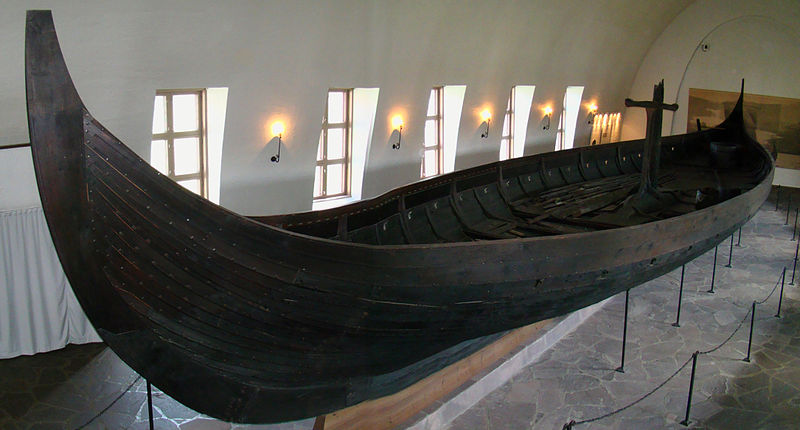
Regardless, while I would never diminish the accomplishments of medieval Scandinavians, there’s nothing completely baffling or inexplicable about their technological advancements. Consider their ships: they were superb, but, basically, they were boats. Humans have been building boats since someone first said, “you know, it would be quicker to cross that body of water than to go around it.” Viking ships were built by skilled craftsmen without any input from aliens. Why would aliens need ocean-going ships anyway?
Gokstad ship: built by humans. From Wikipedia

Gokstad ship: built by humans. Source: Wikipedia

But wait, there’s more proof of alien intervention:

An account of the attack on Lindisfarne says the assault coincided with extraordinary whirlwinds, lightning, and fiery dragons crisscrossing the skies. Could these strange events be coincidence?

Well, not the dragons. I imagine they were made up, misinterpreted and/or were exaggerations of some natural phenomenon. The rest of it? That’s just weather. Sometimes weather happens. But you never know. After all, the Vikings were a mysterious people.

The Vikings…flourished from the late 8th century to the 11th century in what is today Norway, Sweden and Denmark, but unlike other ancient civilizations, like Greece, Rome or Egypt, relatively little is known about this mysterious people, as few written records or hieroglyphs have survived.

Okay, there aren’t many hieroglyphs, since the Norse didn’t use hieroglyphs (runes are not hieroglyphs), but as the narrator is saying this, we see on the screen a picture from Flateyjarbók, which, as its name implies, is a book–a huge book, filled with letters and words and even sentences. So important and precious is this book that it was one of the first two manuscripts (along with the main manuscript of the so-called Poetic Edda) that Denmark repatriated to Iceland. A significant proportion of the population went to the shore to greet the ship bearing the two books.

The corpus of Old Norse literature is vast. The Icelanders took to literacy with wild abandon. Admittedly, this material was written down later than the events described–in some cases much later–but quite a lot is known about Viking-Age Norse culture, from their own writings and from the writings of others. They really aren’t that mysterious.

It is true that there are questions when it comes to the mythology. We have limited sources. Some of those sources are difficult, confusing and contradictory. Some of the sources (especially Snorri Sturluson’s Prose Edda and Saxo Grammaticus’s Gesta Danorum) were written by Christians long after Norse mythology had ceased to be an active religion. They euhemerized, synthesized, interpreted and probably misinterpreted. Consequently, we have limited knowledge about how the religion was actually practiced, and we are probably mistaken in trying to force consistency and coherency onto Norse mythology: beliefs change over time and differ regionally. Ancient Aliens recognizes this problem:

Because little information has survived related to the origin of Norse or Viking gods, modern scholars depend on a pair of Icelandic books written several hundred years after the Viking Age, called the Eddas.

Well, the Poetic Edda isn’t really a book. It is a collection of poems written by different poets at different times. It is called Edda for convenience and in association with the Prose Edda, which quotes Eddic poems extensively. The Poetic Edda was written down after the Viking Age, but probably contains much earlier material.

What’s weird is that, although what they say about the Eddas isn’t entirely accurate, they are correct in their assumption that the Eddas are not a completely reliable source for Viking Age belief. Having sort of acknowledged this, what do they do? They take these stories as absolutely true and accurate accounts of real events because Odin, Thor, Frey and the gang were all aliens. Duh.

Odin, you see, had two ravens named Huginn and Muninn (thought and mind). Every day they flew through the world and then returned and reported to Odin. Or were they ravens? Let’s ask David Hatcher Childress:

Whenever he wanted to observe other worlds, find out what they were doing, he would send these two ravens out, and they would be…like…spy drones or something, and they would go to to these other countries and come back to Odin and report to him what was going on, and it would seem like what Odin had was some kind of spy planes or spy drones that he was sending out, much as we do today.

Or they could be magic birds. Actually, ravens are very intelligent and can be taught to speak. Can they do what Huginn and Muninn were supposed to do? Well, no. They’re special, a god’s magic birds. There is nothing to suggest that there is anything non-organic about them, that they are mechanical or technological.

Given their names, it is also possible to consider them as Odin’s thought and mind (or memory) externalized, perhaps as part of a magical or shamanistic ritual. There is some precedence for this. In the Prose Edda, Snorri tells the story of Thor and Loki’s visit to a giant called Utgarda-Loki. Thor and his retinue face several challenges which they fail miserably. For instance Utgarda-Loki asks Thor to lift a cat. Thor can only get one paw off the ground. Eventually, though, Utgarda-Loki reveals that it was only through magic and tricks of perception that he was able to best Thor. The cat was actually the World Serpent, which circles the world at the bottom of the ocean. Thor had managed to pull it part of the way out.

Thor and the others also directly compete with some apparently humanoid opponents whose names reveal their true natures. Thor wrestles an old woman named Elli, who brings him to one knee. She is actually old age personified. Loki loses an eating match against Logi, who eats the wooden trenchers as well as the meat. Logi means “flame,” which consumes everything in its path. Thor’s servant Thialfi loses a footrace to Hugi. Hugi, like Huginn, means “thought.” As Utgarda-Loki says, “And when Thialfi competed at running with the one called Hugi, that was my thought, and Thialfi was not likely to be able to compete with its speed” (Edda, tr. Anthony Faulkes, Everyman ed.).

But imaginary spy drones aren’t Odin’s only spy technology. He also has his high seat (hliðskjálf) from which he can observe what is going on in the world. According to Jason Martell, author of Knowledge Apocalypse: Ancient Astronauts and the Search for Planet X,

It sounds to me as if Odin was sitting in some type of a captain’s chair in a space ship above the earth, which allowed him to have this view.

To have a captain’s chair in a spaceship, don’t you need to have a spaceship? When the high seat is mentioned, there is nothing remotely spaceship-like associated with it, and again, it isn’t described in a way that makes it sound like anything technological.

But Odin isn’t the only god with pretend alien tech. Thor has a belt of strength. Or is it a bionic exoskeleton? You see, the Norse would have no way to describe a bionic exoskeleton, so the best they could come up with was “magic belt.” If they’d seen the damned thing, and the show suggests that they did, surely they could have come closer than “belt.”

Frey has a magical, foldable ship, Skíðblaðnir. Or is it a spaceship? Well, perhaps, if the Vikings couldn’t tell the difference between something that sails on the ocean and something that flies. It’s not as if they were a sea-going people or anything. Well, perhaps they had no verbs that mean “fly.” Oh wait, they totally did. For instance, they were not forced to say that the ravens (spy drones) sailed on the ocean.

Odin’s spear, Gungnir, is so well-balanced that it will always hit its target. Or as Childress raves,

Gungnir was some kind of high-tech weapon. No matter who he threw it at, it would hit it, like some laser-guided missile or something like that, that just simply could not miss its mark once it had been sent to its target.

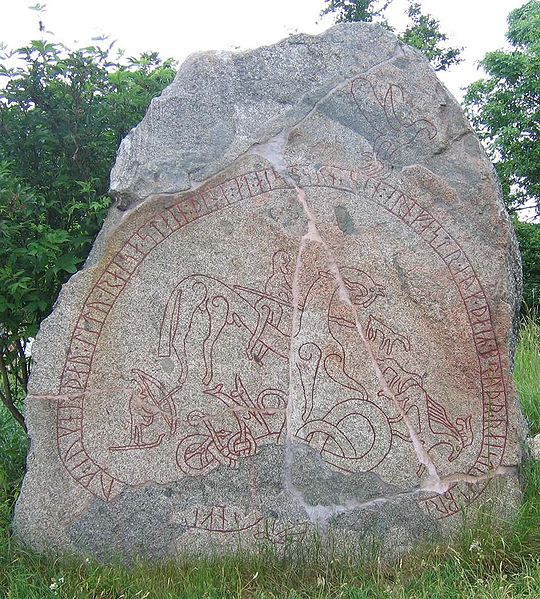
This time they have evidence of such amazing high-tech weaponry: the Böksta Runestone, which shows a spear-wielding man on a horse, accompanied by two dogs and two birds. The man might be Odin. And he has a spear. Okay, it doesn’t look like a missile, and you can’t tell that it’s laser-guided, and it looks a lot like a spear. Also, he’s hunting an elk or a moose. I suppose it could be some sort of space-ungulate.
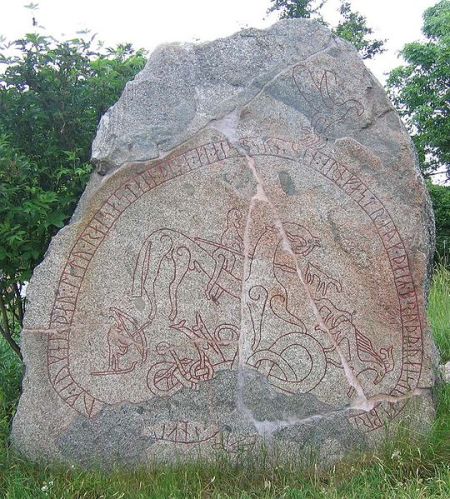
Odin hunts a Space-Moose. Source: Wikipedia

Odin hunts a Space-Moose. Source: Wikipedia

The late Philip Coppens explains the true nature of Thor’s hammer:

It is actually said that this weapon is able to crush mountains. Now imagine a weapon which is able to destroy an entire mountain–the hammer does not cause explosions; it is really the physical force which destroys the object. That is something that today we describe as kinetic weapons.

The scene shifts to NASA Ames where Dr. Peter Schultz of Brown University is working on the Ames Vertical Gun Range. Schultz explains that if it’s really ramped up, “you’ll start melting, vaporizing material. In a sense, this is a kinetic weapon, except we’re not pointing at anything except a target inside the tank.” According to the narrator “the destructive power of this gun displays uncanny similarities to Thor’s Hammer.” Well, they are both powerful, and they both destroy things. So do puppies, but that doesn’t make them extraterrestrial technology.

If kinetic energy weapons and laser-guided missiles (or possibly smart bombs) aren’t enough, Bifröst, the Rainbow Bridge, is a wormhole.

Where did the alien Norse gods get their fabulous stuff? In many cases, from dwarfs. Coppens asks,

[A]re they real dwarfs, or…[are they] somehow more mythical, or whether the label “dwarf” actually stuck to them because they were somehow smaller. And of course today, we often describe the gray alien archetype as dwarfish as well, simply because they are smaller.

Childress also suggests that the Norse dwarfs got their name from their (lack of) height, as if mythological dwarfs were named for dwarfism, rather than the other way around. Aside from being small, dwarfs don’t have that much in common with Grays. According to John Lindow’s Norse Mythology: A Guide to the Gods, Heroes, Rituals, and Beliefs, dwarfs are “associated with the dead, with battle, with wisdom, with craftsmanship, with the supernatural, and even to some extent with the elves” (100). They are also said to live in the earth, rocks or mountains. Snorri says they were created from the maggots in the flesh of the primordial giant Ymir. They are creatures of the earth, not of the sky. Oh and while the English word “dwarf” has been associated with shortness for a long time, Norse mythological dwarfs don’t necessarily seem to be that small. Or gray. Or large-headed. Or small-bodied.

So where did the Norse gods/aliens go? Well, one might find it suspicious that they seem to have taken their spaceships, spy drones, laser-guided missiles, kinetic weapons, bionic exoskeletons and wormholes and buggered off right around the time the Scandinavians converted to Christianity. Surely there must be another explanation. Let’s look at ship burials. The Oseberg ship burial “revealed for the first time some of the Viking’s burial rituals.” Well, Oseberg was discovered 25 years after Gokstad, but okay.

Is it possible that the Vikings…buried their dead in boats in an effort to help their deceased on their journey to the afterlife?

Yes! Oh my god, YES, that IS possible! They actually asked an “Is it possible” question whose answer is “yes.” Yes, that’s how mythology works.

But wait, there’s more. Martell says “Now this seems very similar to some type of conveyance possibly going into space.” Well, yes, it does seem like that, except that it’s a sea-going ship buried in the ground.

They then describe Valhalla. Like Snorri, they conflate probably separate ideas regarding Valhalla, but they really seize on the description of it as being golden. Giorgio Tsoukalos says,

Valhalla was not a figment of our ancestors’ imaginations, but it might have been some type of an orbiting space station. The reason why I’m saying this is because we have a description of Valhalla: it is an incredible description of a place that has weird attributes.

And Martell just goes ahead and describes it as a “large metallic ship.” How the hell do you go from a “gold-bright” hall of the slain to a “large metallic ship”? It’s not a ship, and it’s not metallic.

Ship burials (and ship cremations), they claim, are supposed to replicate the gods’/aliens’ return to their home world or to the space station Valhalla. But Oseberg also contains sledges. Did the aliens’ return home also involve traversing space-snow? One other thing about Oseberg: its occupants were female. This is never mentioned on Ancient Aliens. In fact, you’d never know that there were Norse goddesses or Norse women based on the program. Anyway, except in unusual circumstances, women didn’t go to Valhalla, so Oseberg doesn’t really fit the weird scenario they’ve created.

Watching this episode, I found myself wondering if these people really believe what they’re saying, or if, in the fifth season, they’ve run out of things to talk about and will just say anything to keep the show going. However, when Bob and I went to the Paradigm Symposium, we both got the idea that these people are true believers, and Coppens did write about a Viking/ancient alien connection.

It’s just so hard to imagine the thought processes that could lead to such beliefs. First, they seem to conclude that human imagination is a comparatively recent invention, and that no one in the past could describe anything they hadn’t seen with their own eyes. Second, they make logical leaps of truly spectacular proportions. And finally, there is the ability to seize on some details, blow them up, and then ignore other details as if they weren’t there. This is particularly noticeable when they discuss the Böksta stone as an example of Odin’s spear. How on earth can they use this to support the laser-guided missile argument? He’s riding a horse (with only four legs; Odin’s steed Sleipnir usually has eight); he’s hunting an elk; he has hunting hounds; one of his birds (spy drones) is attacking the eyes of the elk. He is also accompanied by a human figure on skies, carrying a bow and arrows, possibly Ullr. It’s all sorts of terrestrial. Stunningly ordinary. If the stone does show Odin, it shows him behaving very much like a medieval Scandinavian hunter.
notaliens


apologies

July 28, 2013

Sorry, there will be no blog this week; I have been unwell. Normal service should resume soon! Mark


TAM 2013 Recap…

July 20, 2013

Well, TAM 2013 was a hell of a thing.

Eve and I arrived on Wednesday, the night before our workshop. Outside of the security area, we met our driver who we identified by his sign, which read “Blaskiewicz/Siebert/Blackmore.” Excuse me? Susan Blackmore will be sharing our ride to the South Point? Oh, well, if she must! We chatted with her on the way to the venue, and I brought up her work on memes, which you may have heard of. I took an interest in memes a couple of years ago, but was coming at it at a different way than Susan was, from the point of view of a lit/rhetoric guy, not a psychologist. I encouraged her to read Walter Ong’s Orality and Literacy and indicated that she might find useful his discussion of the forms of memorable thoughts (which are valued in oral cultures).

And that was just the ride to the hotel.

As we checked in, Eve and I bumped into Sharon Hill, our friend and fellow virtual skeptic. She had come through the desert on a horse with no name with a viking. She was pooped. I went to my room, dropped off my stuff, and picked up my badge. I loitered in the Del Mar for a while and was going to go upstairs to drop off my program and “fighting the fakers” t-shirt when, holy crap, Sanal Sedamaruku steps out of the elevator and asks me where he can get his credentials. When someone is basically in exile because he demonstrated that a weeping statue was actually exuding toilet water and the Archbishop is a petty bully without a shred of dignity, well, you help the guy get his badge so he can point at it and justifiably brag about how awesome he is.

I met the rest of my morning panel (“Skepticism Across the Curriculum”) at the Del Mar that night. The panel in the morning went pretty well. We had a chance to include a number of the audience members in the discussion at the end, though through a series of (my) miscalculations we did not have as much time as I had hoped we would. (At the same time we were presenting, one group of skeptics decided to bungee jump off of the Stratosphere on the Strip, or as Eve put it, “would rather jump off of a building than see our panel.”) I made it to a couple of other panels during the day, including the “Preserving Skeptical History” panel and the “Skepticism Around the World” panel. I was, however, a right twit because I missed Tim Farley’s talk about skeptics’ conferences; I know how much work went into that presentation, and I will have to catch it when it comes up on youtube. And you will too….

Much of what happened over the next few days is a blur. I saw Sharon’s talk about being an honest broker of doubtful news, which was pretty kickass. I caught the beginning and end of Karen Stollznow’s talk, but when you come into the end of the talk and she shows the video of Pastor Jack casting out demons to the tunes of Tom Jones…you just want to know about the theology that suggested that should be in the exorcism ritual! (I fell over possessed—WITH LAUGHTER!)

Yes, it is unusual. It’s very unusual.

After Karen’s talk, I watched a bit of Marty Klein’s presentation and then bopped out for a bit. I was back for the Honest Liar presentation, which featured Jamy Ian Swiss, Randi and the folks putting together the biopic about Randi. That night, the Skepticality crowd gathered for dinner with people from IIG, and then the Skepticality crowd went upstairs to try to record an episode. We don’t know if Derek is going to be able to get anything this week because the recording was fairly chaotic. I skipped Penn’s Bacon and Doughnut Party (but dropped the requested funds in the till) and partied in the Del Mar instead.

Saturday morning was spent in silent contemplation. I had my talk coming up at 2:20. I missed a number of really remarkable speakers, but to be fair, I was getting in the zone and focusing on the job. I heard that the Skepticism and Philosophy panel was out of sight–it was an all-star cast–and Michael Mann knocked ’em dead. David Gorski and I had planned to give two parts of a larger talk. David prepared a talk about the history and schmience of the Burzynski Clinic. I talked about the patients. We split 40 minutes evenly, which was enough to give people a taste of the larger project we’ve been working on for the last several months. I was pleased with how our presentations went. Next I was on the Science-Based Medicine panel with Harriet Hall and Mark Crislip, David Gorski and Steve Novella. I like to think that I represented “the common man” on that panel.

That evening was the speakers’ reception with Randi, which was swell. The man has the patience of a zen master, posing for dozens of photos and giving the benediction–I’M KIDDING! It was a great opportunity to meet with the luminaries you had not yet bumped into in the lounge, at the Del Mar, or in the hall.

The evening entertainment, Magic, Mayhem, and Mentalism, was produced by Jamy, and I finally got to see Jonny Zavant and Caroline Gayle’s act. I met them in the elevator the night before and psychically predicted while floor they were getting off on completely by coincidence. Also, I was pleased to see Todd Robbins again, who makes the Sideshow look…really uncomfortable if I’m honest, but his delivery is very polished and smooth and you get the sense that he is curating a tradition of entertainment that is fading. (I saw him as the host of NECSS 2+ years ago, and he was superb.)

Then there was a lot of drinking.

In the morning, I managed to get downstairs for the Sunday morning papers. I missed only the first one, and they were all of exceptional quality. Standouts were Andrew Hansford’s talk about the Marblehead UFO, an old fashioned debunking, Shane Greenup’s vision for the rbutr tool, and Jo Benhamu’s closer about the (other) FSM. Eve gave a talk about how creationists ruin all areas of human thought, in this case literary studies. I really liked the variety and pace of these talks, and think that they might do really well as a bunch in the middle of Saturday to change up the pace a little bit when people are getting tired.

The Bigfoot Skepticism panel was totally misleading. There was no bigfoot at all, only Blake moderating, and he didn’t even have his bigfoot costume this year! Sara Mayhew gave her talk next, which I had to be there for since I missed it last year. (“Beta blockers, Bob…They are sooo great.”) I also witnessed the blow up on the Magicians vs. Psychics panel between, well, the other magicians and Mark Edward. I think there was a lot going on in the background there, I think, ahead of time, and I watched as the panel took the ethical stances that they had elaborated during the panel and applied them to Mark’s case. Mark has long been a liminal case, it seems, and I’m not sure what the full backstory is there. It was a great discussion and as the accusations flew; I know at one point I realized my mouth was agape. It was one of those confrontations you want to munch popcorn while watching.

Harriet Hall followed next and thoroughly complicated my feelings about my prostate in her talk about screening tests.

In the evening was the Million Dollar Challenge. This year, a remote viewer failed to describe the contents of a sealed room in Las Vegas from his home in Algeria. Apparently Ramadan threw off his mojo. The JREF has invited the applicant to revisit the test after the holy month has ended so that he may be tested under optimal conditions.

After the MDC, the Virtual Skeptics recorded a show from room 1942, where we did a wrap up of TAM with a select few chums, including Susan Gerbic, who won the Randi prize for promoting skepticism in the public sphere. It was well deserved. You will see that we had a great time:

TAM ended in the Del Mar, as we said goodbye to everyone and George Hrab struck up an acoustic sing-along. A great end to an invigorating extended weekend surrounded by clever people being goofy and clever. It was great to see so many friends who had only been internet buddies live and for real. Many thanks to DJ and Thomas for the opportunity to come out. You guys should totally have another one next year.

RJB


Linguistics ‘Hall of Shame’ 19

July 18, 2013

Hi again, everybody! ‘Hall Of Shame’ continues (early this week since my beloved & I are going away until next Tuesday).

19 OWEN BARFIELD

Owen Barfield was a member of the mid-twentieth-century group of Oxford writers, literature scholars and philologists centred on J.R.R. Tolkien and C.S. Lewis. Tolkien himself espoused some implausible ideas about language grounded in literary and philological notions rather than in the then current work of linguists. He apparently believed, for instance, that he himself had acquired older varieties of English formerly used in his own home area near Birmingham (where his family had long resided) more readily than would students from other areas. No positive evidence of such effects exists, and, if they were genuine, they would in fact be difficult to explain in scientific terms (such characteristics are acquired, not genetically transmitted). For his part, Barfield developed a more articulated and wide-ranging non-mainstream approach to language. He lived to a very advanced age and long survived all the other ‘Inklings’.

Barfield’s most relevant works (Saving the Appearances (London, 1957); Worlds Apart (Hanover, NH, 1963); Poetic Diction: A Study in Meaning, 3rd edn (Hanover, NH, and London, 1973)) deals mainly with poetic language, seeking ‘objective’ standards of criticism involving philosophical considerations on the relation between language and thought (although it is far from clear that he succeeds in this enterprise). Like Tolkien, he was less aware of twentieth-century mainstream scientific linguistics than of philology (also scientific, albeit in a weaker, partly pre-theoretical sense) and linguistic philosophy. He offers little concrete empirical evidence for his general claims, and his comments about non-Indo-European languages (for example, on Chinese word order) are oversimplified.

Barfield claims that poetry genuinely is the ‘best’ language, and that in early times all language had a poetic character, before ‘logic’ came to dominate both usage itself and most strands of thought about the subject. This poetic character, he holds, is still found in ‘primitive’ languages such as pidgins (in fact, no truly ‘primitive’ languages are known, although some linguists do hold that some features of pidgins may reflect earlier stages of language). Barfield objects to the notion that a language becomes richer and more poetic as it ‘ages’ historically. He judges that the poet Percy Shelley and others were profoundly mistaken in holding that a spiritual, creative awakening, accompanied by a strengthening of the relevant aspects of language, occurred in their own time, arguing that if language were indeed becoming more poetic all people would have been accomplished poets by his own time.

Barfield’s focus on the past leads him to interpret the semantics of words in a heavily etymological manner, with a focus on metaphor as a vehicle of meaning-shift. He also accepts Otto Jespersen’s view that there is very generally a movement during the ‘lifetime’ of a language from inflectional morphology with relatively free word order (as in Sanskrit or Latin), which he prefers, to isolating morphology and a fixed word order (as in contemporary English); in fact, this is at most an Indo-European tendency.

Barfield’s ideas are interesting, but from the point of view of a scientific linguist they are too heavily grounded in partly subjective judgments and insufficiently justified in empirical terms.

For my book Strange Linguistics, see:
http://linguistlist.org/pubs/books/get-book.cfm?BookID=64212

Copies are available through me at the author’s 50% discount, for EU 26.40 including postage to anywhere outside Germany. Please let me know if you’d like one, suggest means of payment (Paypal is possible) and provide your preferred postal address.


Linguistics ‘Hall of Shame’ 18

July 14, 2013

Hi again, everybody! ‘Hall Of Shame’ continues.

18 JEAN PERDRIZET

Jean Perdrizet (French; 1907-75) is one of the many eccentric thinkers featured in the very interesting current exhibition at the Hayward Gallery in London on non-mainstream ideas about many subjects (http://www.culture24.org.uk/art/painting%20&%20drawing/art439636). An excellent book is available to purchase if you can’t make the show itself; the article on Perdrizet (pp. 116-120) is by Eimear Martin.

Perdrizet was an inventor of speculative machines; many of his diagrams but none of his prototypes survive. He was interested in linguistics (among many other subjects), and more specfifucally he was very concerned with communication, especially by/with spirits, ‘robots on the moon’, Martians, etc. (Compare artificial languages such as aUI and Lincos aimed in part at communicating with extraterrestrials. Perdrizet was aware of some such proposals, notably Flournoy’s ‘Martian’ and Loglan.)

Whatever the arguable merits of some of his specific proposals, it has to be said at the outset that Perdrizet’s thinking about language appears conceptually confused. Notably, his ‘language’ Sidereal Esperanto is said to be modelled not only on Esperanto (the well-known alphabetically-written invented LANGUAGE) but also on Initial Teaching Alphabet, a 1960s alphabetic SCRIPT specifically intended by its author James Pitman to represent [certain accents of] British English.

However, Sidereal Esperanto is itself written logographically (one symbol per word or morpheme, as in Chinese) or ideographically, NOT alphabetically, and indeed (by intention) pictographically, with 92 symbols. These symbols are drawn as far as possible from those available on French typewriters, but they are not used alphabetically or indeed phonologically (it is not clear how they would be pronounced). They are chosen to represent specific ‘thoughts’, because the letter-forms supposedly suggest those thoughts and because Perdrizet believed that thinking is predominantly visual. For example, the ampersand (&) signifies the notion ‘knot’; M denotes ‘walking’ (it resembles legs in motion); C represents ‘hook’; etc. In some cases the link between form and meaning is rather abstract, as in the choice of lower case J to represent ‘date in time’ (it supposedly represents a point on a time-line), or is simply obscure. And some of the symbols used are, predictably, mainly used in French, such as the cedilla which ‘softens’ a C in order for it to represent /s/ rather than /k/ before a back vowel.

Perdrizet’s ideas are often intriguing but would benefit from collaboration with linguists.

For my own book Strange Linguistics, see:
http://linguistlist.org/pubs/books/get-book.cfm?BookID=64212

Copies are available through me at the author’s 50% discount, for EU 26.40 including postage to anywhere outside Germany. Please let me know if you’d like one, suggest means of payment (Paypal is possible) and provide your preferred postal address.