The Last Couple of Weeks in Conspiracy (11 Oct 2012)

October 16, 2012

Been away. Very busy. Grading. Job hunt. I apologize. Still really busy. But also feeling guilty.

But you know I’ve been on the prowl for the latest and greatest in conspiracy, right? Because I have some sort of masochistic compulsive disorder!

@GoAngelo Truth. RT @KuraFire: @emokidsloveme @AriMelber @GoAngelo What a tremendous waste of taxpayer dollars.

Twit of the Week:

Jonathan Kay @jonkay
WND is now combining islamophobic paranoia with something resembling Aspergers wnd.com/2012/10/were-o… Ring collage = unintentionally hilarious.

The American Muslim site does a little debunkery of this claim.

Bill Corbett, however, made me laugh:

@BillCorbett
Rabid anti-Semites are gonna have a hard time explaining the bacon shortage.

That’s all. I’m trying to keep up, folks! This week, I am going to be attending the Paradigm Conference on behalf of Skeptical Inquirer. Follow me as live tweet on #paradigm!


channelled languages and similar phenomena 2 (non-historical ‘fringe’ linguistics 11)

October 15, 2012

Hi again, everybody! More on linguistic aspects of (allegedly) channelled communications and similar cases: first, oral ‘channelling’ and written ‘channelling’ or ‘automatic writing’. (I will provide (a) reference(s) to/for any specific source on request.)

Oral channelling is regarded by ‘believers’ as generated by spirits or other paraphysical entities rather than by the physical channeller or medium, who is often in a trance-like state at the time of production. These phenomena may involve languages known to the channeller (not of especial relevance here; the main point of skeptical interest in such cases involves information to which the channeller supposedly had no other access), identifiable languages (modern or other) not known to the channeller (again, very interesting, if genuine) or unidentified languages or ‘languages’ (as in glossolalia). Channellers often claim no understanding of the material produced where it is not in a language with which they themselves are familiar. For example, I met an Australian man who channelled large amounts of material in a ‘language’ which he himself could not interpret (and which – following information supposedly obtained from a ‘spirit guide’ – he wrongly identified as Seneca). In a few cases (see later on Flournoy for an example), unknown scripts are provided to accompany the oral material (see also below on written channelling and automatic writing).

Many cases of channelling are interpreted by believers as communication with deceased persons, including long-dead individuals as well as now-dead acquaintances. Examples include the works of Arthur Guirdham (reporting the channelling of a thirteenth-century French-speaker) and Margaret and Maurine Moon (reporting the channelling of ‘Wedge’, a seventeenth-century English-speaker).

In some cases involving deceased individuals from remote time-periods, and indeed in most cases involving languages not known to the channeller (contemporary or ancient), appropriate usage is not attempted. The channeller uses a contemporary form of her own first language; this is arguably both anomalous and ‘convenient’ (for channellers unschooled in language matters), but some such channellers adduce arguably specious reasons for this, such as the spirit’s desire to assist current listeners. One such case is that of the ‘Starseed Transmissions’; the channeller Ken Carey reports that these messages were transmitted in non-verbal form as ‘waves’ linking his ‘biogravitational field’ and neurology with those of the extraterrestrial/angelic communicators. Approximately synonymous English expressions were then ‘assigned’ to these ‘waves’ (apparently by the communicators).

However, such cases are obviously more convincing if linguistic forms appropriate to the period can be used. Unfortunately, where this is attempted the usage itself is seldom at all convincing to linguists. There are frequently errors and/or anomalies, for instance the mixing of usage from different periods. This suggests that the material has been fraudulently hoaxed and that the unconvincing features are errors which have intruded because the faker lacks the specialization required if utterances containing accurate forms in pre-modern usage are to be invented. One case which appears slightly less dubious is one in which a young Londoner allegedly lost his local accent when channelling.

The skeptical linguist Sarah Thomason reviewed some such cases and specifically investigated the cases of Marjorie Turcott (American, channelling ‘Matthew’, a seventeenth-century Scot), Jack Purcel (channelling ‘Lazaris’) and Julie Winter (channelling a ‘high-energy being’ called ‘Mika’). None appear convincing, especially where the supposed language variety is actually known; for example, Matthew’s dialect is mixed and often inaccurate for the period. Mika’s voice too displays an unconvincingly inconsistent ‘foreign’ accent. (The channellers/entities also make factual errors; for example, Turcott/Matthew makes various factual errors about Scotland.) Other such studies have been carried out by anthropological linguists, with similar results. In some other such cases there is a mixture of contemporary usage and an attempt at archaic forms, usually in the same language (that of the channeller); see for instance the case of Pearl Curran, who gained notoriety in 1913 for allegedly channelling a seventeenth-century character named Patience Worth, through an Ouija board; she and the spirit supposedly developed a powerful ‘mental linkage’. Skeptics such as Karen Stollznow and Joe Nickell hold that Curran herself was behind the creations.

An unusual older case involves a medium who supposedly channelled a speaker of Ancient Egyptian despite being untutored in the language. Her performances allegedly impressed some scholars of the language, though the vowels of Egyptian are poorly known (thus the channeller’s own ‘Egyptian’ vowels cannot be reliably checked) and there were in fact sundry errors, which the authors attempted to explain away. The case remains somewhat mysterious, but because of the date of the study it is no longer possible to investigate it thoroughly.

In cases involving languages altogether unknown to mainstream scholarship, such as ‘Atlantean’, it is of course impossible to demonstrate whether or not the usage presented is accurate. However, it is more difficult than most non-linguists imagine to invent a language (as opposed to an unstructured set of vocabulary items) in such a way that a linguist will be convinced, and even unknown ‘languages’ can be assessed for plausibility (this also applies to alleged extraterrestrial languages).

Other cases involve exotic phenomena such as the claimed channelling of a deceased person now living on Mars (as a spirit being) by the medium Hélène Smith, as reported by Théodore Flournoy. The spirit communications were in an unknown ‘Martian’ language, with an accompanying exotic script. This unidentifiable ‘language’ is in fact modelled (consciously or unconsciously) on a language familiar to the channeller, French. The grammatical and phonological structures of ‘Martian’ are clearly based on those of French, and the script is alphabetic and corresponds with the Roman alphabet as used to write French. Only the vocabulary is novel, although even this is partly derived by cipher from French, Hungarian and other languages known to Smith’s polyglot father.

As intimated, some cases of channelling involve ‘Atlantean’ (or ‘Lemurian’) languages emanating from spirit realms, etc. One such case involves some 3,000 ‘Atlantean’ words supposedly channelled to a medium. An Australian group called ‘Liquid Crystals’ claims that it is in touch with survivors of Atlantis (in space/other ‘dimensions’) and has access to ‘11 [Atlantean] languages spoken and written’.

Ramtha, channelled by J.Z. Knight, is said to be a ‘Lemurian’ warrior who lived over 35,000 years ago. His name is supposedly derived from the word Ram and means ‘the God’ in his own language, but the communications are in contemporary English and in a pseudo-British accent. So too are those of Mafu, who is channelled by Penny Torres and claims to be of a similar age and to know Latin. This account was critiqued by Thomason (see above).

More next time!

Mark


For the Love of Yeti, Bigfooters, Read a Primary Source!

October 13, 2012

Earlier this year, I wrote (twice) about an outrage to sense, science, history, folklore, grammar, punctuation and all that is good in the world, called Claws, Jaws and Dinosaurs by “Dr.” Kent Hovind and William J. Gibson. From this book, I learned that Leif Ericson and his men

encountered hairy, ugly giants that uttered harsh cries. This is the earliest recorded encounter with Bigfoot, or Sasquatch….

Since then, I’ve wondered if this is a common argument among Bigfoot enthusiasts. After some investigating, I have discovered that it is not an uncommon argument. This account from the show “Ancient Mysteries: Bigfoot” is typical:

The oldest account of Bigfoot was recorded in 986 AD by Leif Ericson and his men. During their first landing in the New World, the Norsemen wrote about monsters that were horribly ugly, hairy, swarthy and with great black eyes.

It’s almost always Leif Ericson who is credited with discovering not only North America, but also Bigfoot. It’s never one of the later Norse explorers. The year 986 also recurs, as does the description. There are also often references to Leif writing about or recording his encounter. Almost all these details are impossible.

Two sagas deal with the Norse discovery of America: Greenlanders’ Saga (Grænlendinga saga) and the Saga of Eric the Red (Eiríks saga rauða). In both sagas, Leif’s single voyage to the New World is described rather briefly. In both, the most significant things he finds are the grapes and vines which provide Vinland with its name. In Eric’s Saga, Leif sees no animals at all. In Greenlanders’ Saga, he sees salmon (lax) larger than any he had seen before. While large, the fish are not said to be hairy; there is no mention of feet.

The date 986 is very specific, and I haven’t figured out where it comes from. No one knows exactly when the Norse discovered Vinland, but, based on information from the sagas, the initial sighting seems to have taken place around 1000. Leif hadn’t been born in 986, and his father had not yet settled in Greenland. This is important: there is a logical progression from Iceland to Greenland to Vinland.

If the discovery occurred around 1000, it was more or less contemporary with the Christian conversion of Iceland and Greenland. Eric’s Saga claims that Leif accidentally discovered Vinland when he got blown off course traveling from Norway to Greenland on a mission from God King Olaf Tryggvason to convert the Greenlanders. This story is generally agreed to be untrue, but the general time period is probably right. One of the perks of conversion was a shiny new alphabet. Well, okay, a slightly used alphabet. But not even the Icelanders (who took to writing with wild abandon) started writing within a week or two. The stories weren’t written down for centuries after the events described. It is true, of course, that the Norse had the Runic alphabet, but it seems unlikely that Leif schlepped around a supply of big rocks so that he could record a journal or captain’s log.

Absurd as they are, these details appear over and over, sometimes with extra absurdities added on. Rick Emmer, in his book Bigfoot: Fact or Fiction, says:

Vikings led by Leif Ericson made their way to the East Coast of North America in 986 CE. It was there that they reported seeing an “horribly ugly, hairy, swarthy and with big black eyes” (Ericson, Leif. 986 CE) creature. They called the creature “Skellring”. People believe that the creature “Skellring” is what we know today as Bigfoot. But it is possible that the Aboriginals were playing a prank on the vikings by wearing large animal hides. This Bigfoot sighting was the first to be recorded in North America.

I love the way he cites Leif parenthetically as his source, in (almost) proper APA style. One website suggests that Bigfoot were an aboriginal tribe:

[Leif described] encounters with huge hairy men, with a horrible odor and  piercing shrieks. L’Anse aux Meadows…is the only known village settlement by the Vikings in this area around 1000 AD. That region was inhabited by Native people from back to 6000 BP. Native people who surely had dealt with the local Bigfoot. Is it possible that the Vikings landed on a continent that had two tribes? One Native American and one being Bigfoot? If and [sic] upright human-like being can manage to stay well hidden from man, showing a good degree of intelligence, then when we refer to Bigfoot, are we not referring to the “other” tribe of the Americas?

A similar account was recorded by the Gulf Coast Bigfoot Research Organization:

It is a little known historical fact that the first Sasquatch encounter was perhaps observed by the vikings who settled on the island of Newfoundland in Eastern Canada….Leif kept a record of his journey across the Atlantic, from Iceland to Greenland, and of his experiences whilst in Newfoundland, the last point of land on his voyage. Among his accounts, Leif told of seeing huge hairy men who towered over him and his Berzerker crew (and the vikings are known to have been large men). The “huge hairy men”, according to Leif, lived in the Woods and had a rank odour and a deafening shriek. Apparently, Leif had several sightings of the “huge hairy men” before departing the island.

DESCRIPTION OF CREATURE:  Towering height, hairy, man-like, rank smell, deafening verbal tones., The natives of Newfoundland, the Beothuck (now extinct), most likely had similar relations to the Sasquatch like other native bands, especially those of Western Canada (ie Bella Coola). Leif’s accounts spoke of his meeting of a race of men (seperate [sic] from the “huge hairy men”), which were almost certainly the Beothuck.

It should be noted that neither Leif nor the later Norse explorers of Vinland were Vikings: properly speaking, “Viking” refers specifically to raiders. They certainly weren’t Berserkers. While the Norse explorers have become insane, frothing warriors in this account, Bigfoot has become huge, loud, foul-smelling and clearly distinct from native peoples.

So where does the story of Leif and Bigfoot come from? I believe it comes from Peter Byrne’s The Search for Big Foot: Monster, Myth or Man? and he drew on Samuel Eliot Morison’s The European Discovery of America: The Northern Voyages, A.D. 500-1600, though Morison did not mention Bigfoot. Byrne, who appears on the “Ancient Mysteries” program, refers to Morison’s account of the Norse discoveries, particularly:

an encounter by Leif Erikson and his men, during their first landing in the New World, with creatures that were pictured as “horribly ugly, hairy, swarthy and with great black eyes. (Byrne 7)

While Byrne admits that this case is “borderline” and that the “creatures” were probably “simply Indians,” he still thinks it may have been Bigfoot. Why? Because they were hairy:

The Norse word “skellring” is a term of contempt. It means, roughly, a “babarian.” But what caught my eye . . . was the word “hairy.” The Norse were a hairy people themselves, big men with matted hair and beards. Why did they remark on the “skellring” being hairy? Was it because they were very much hairier than the Norsemen, even covered with hair, perhaps? If the encounter had been between, say, Tibetans, who are not a hirsute people, and the “skellring,” one could understand the reference to hairiness. But why the Norse mention? (7)

And what of Samuel Eliot Morison? Morison held a Ph.D. from Harvard University and taught history there for forty years. In his account of the Vinland voyages, Morison essentially retells the two sagas, sometimes conflating them. Although he lists the manuscripts and some editions and translations in his bibliography, it is not clear what translation he is using when he quotes, or if he is using his own translation. It is not always clear what saga he’s quoting from. He includes some information that is definitely false. He says, for instance, that Eric the Red “left Norway for Iceland to escape punishment for manslaughter” (39). Eric’s Saga does say that Eric and his father left Norway “because of some killings,” but in reality Eric would have been a child when his family moved to Iceland, too young to have been involved in the killings. Morison also interprets and embellishes some parts of the sagas. He says that Leif considered Helluland (Flat-Rock Land, here identified as Baffin Island) worthless “after finding no gold in the rocks” (41). As far as I know, neither saga in any manuscript mentions gold or the lack of it in Helluland.

So Morison’s account is eccentric or at least dated. Is there any justification for thinking Leif might have met Bigfoot based on Morison’s book? No. First, Morison mentions no encounters between Leif and any sort of animal or native person. Second, the often-quoted description of what Morison calls the Skrellings (not Skellrings, as Byrne calls them) as “horribly ugly, hairy, swarthy, with great black eyes” (55) is not actually in quotation marks. More importantly, he applies this description to “the natives.” It would take a huge amount of determination and delusion to find Bigfoot in Morison’s account. The Skrælings (the word actually used in the sagas) speak, use weapons (arrows and some sort of catapult), row and presumably build boats made out of animal skin. They also bring a variety of animal pelts to trade. All this is clear from Morison’s account.

As for the description of the Skrælings which inspired Byrne to think of Bigfoot, it’s a pretty close paraphrase of a description in Eric’s Saga:

Þeir váru svartir menn ok illiligir ok höfðu illt hár á höfði. Þeir váru mjök eygðir ok breiðir í kinnum. (chap. 10)

This can be translated as, “They were dark men and ill-looking and had bad hair on their heads. They were large-eyed and broad-cheeked” (my translation). “Illt,” used to describe the Skrælings’ hair, can mean “ill, evil, bad; hard, difficult; close, mean, stingy.” Magnus Magnusson and Herman Pálsson translate it as “coarse.” So the excessive hairiness that so fascinated Byrne is just hair that the Norse considered ugly. And it’s not body hair: the description says they had bad hair on their heads. This description comes from the manuscript Hauksbók. The other manuscript, Skálholtsbók, describes the Skrælings as smáir, small, rather than svartir, black or dark. So the huge, hairy, bigfooty Skrælings were neither large nor particularly hairy.

So how did humans become Bigfoot? Well, first Morison retold the sagas in a slightly odd way. Byrne seized on one word and ignored everything else Morison said, while making several mistakes. Others have dismissed Byrne’s reservations but repeated his mistakes, while adding their own (anyone who uses the word “Skellring” has clearly gotten their information from Byrne, either directly or indirectly). The same mistakes get repeated religiously until they become established fact. And no one, not even Byrne, bothers to look at the actual sagas.

Well, almost no one. One poster at Bigfoot Forums has almost restored my faith in humans. In a thread called “Best Bigfoot Documentaries,” spasticskeptic warns,

[“Ancient Mysteries”] repeats the arguably mistaken claim that the earliest known alleged sightings of hairy manlike beasts in the New World go back to 900-something A.D., with “Leif Erickson and his men.” The textual evidence that they quote is just one English translation, and it differs markedly from nearly all other English translations of this material with respect to the issue at hand. Consult the myriad English translations of the early Norse explorations/settlements of North America and this notion that the Norse encountered “hair-covered manlike beasts” pretty much disappears. I looked into to this at length some years ago because to my mind the quotes in the A&E special were especially promising in terms of establishing a historical record of alleged sightings. Thus, I learned the hard way (through old school research) that the translation quoted by A&E is aberrant.

See, Bigfooters, there are books that aren’t about Bigfoot. Some of them are instructive and entertaining. It is possible to read primary sources and, you know, learn stuff.

ES

References:

“Ancient Mysteries: Bigfoot.” A&E. Originally aired as season 1, episode 1 on 7 Jan. 1994, narrated by John Swanson. Version narrated by Leonard Nimoy aired as season 4, episode 18 on 15 May 1997. http://www.youtube.com/watch?v=UCfF-JLpo4I

Byrne, Peter. The Search for Big Foot: Monster, Myth or Man? New York: Pocket, 1975.

Eiríks saga rauða. Ed. Guðni Jónsson. http://www.heimskringla.no/wiki/Eir%C3%ADks_saga_rau%C3%B0a (Hauksbók); http://www.snerpa.is/net/isl/eirik.htm (Skálholtsbók)

Emmer, Rick. Bigfoot: Fact or Fiction. Infobase Publishing, 2010. Qtd. in http://elo11g05a.blogspot.com/2011/11/bigfoot-leif-ericsons-sighting.html

Grænlendinga saga. Ed. Guðni Jónsson. http://www.heimskringla.no/wiki/Gr%C3%A6nlendinga_saga

Morison, Samuel Eliot. The European Discovery of America: The Northern Voyages, A.D. 500-1600. New York: Oxford UP, 1971.

The Vinland Sagas: The Norse Discovery of America. Tr. Magnus Magnusson and Hermann Pálsson. London: Penguin, 1965.


channelled languages and similar phenomena 1 (non-historical ‘fringe’ linguistics 10)

October 8, 2012

Hi again, everybody! I’m moving on here to linguistic aspects of (allegedly) channelled communications and similar cases. This series of blogs deals with one sub-set of a larger set of claims and theories about the mysterious emergence or appearance of linguistic material: either otherwise ‘normal’ language, or what appear to be manifestations of unknown (sometimes very unusual) languages.

The best known phenomenon of this kind is glossolalia, that is, speaking, or occasionally writing, in what appear to be unexpected and usually unfamiliar languages, mainly but not solely in the context of fervent Pentecostal Christian worship; it is especially associated with the feast of Pentecost itself. At the first Pentecost, after the death of Christ, the Apostles reportedly found themselves speaking in identified languages which they did not personally know. In modern cases of Christian glossolalia, the ‘languages’ used are generally not identified. In some cases, however, speakers and/or some listeners within the communities in question do claim to understand the material (although they cannot usually provide any structural breakdown). And in a few cases it is alleged that, as in the New Testament account, known languages with which the speaker is unfamiliar are produced (as also in xenoglossia, to be discussed later); such cases would obviously be of very great interest if verified. There is considerable overlap between glossolalia and the channelling of speech said to emanate from spirits (more on this later).

In contrast with the situation prevailing with respect to most general topics of skeptical linguistic interest, there is a very substantial literature on glossolalia, including a critical literature, some of it unusually well informed by linguistic expertise (even though many speakers are reluctant to cooperate with researchers, perceiving their performances as sacred). Here I obviously can’t attempt to discuss all the points made in this large literature, but I’ll summarise.

Some writers on this issue are associated with the relevant churches and/or unschooled in linguistics – although some of these are qualified in other scholarly disciplines (notably, and unsurprisingly, theology) and are far from injudicious. Most of these authors argue, with varying degrees of sophistication and persuasiveness, that the phenomenon genuinely involves divine possession and linguistic performances which cannot be explained in mundane terms. Many different ‘other’ languages have been reported in this context. However, linguistic details are seldom given in this branch of the literature, and ‘hard’ evidence that genuine languages not known to the speaker are involved is seldom offered. Some cases allegedly involving a specific ‘other’ language are actively disputed; one notable case of this kind involves Italian.

Morton Kelsey in particular is concerned to treat glossolalia as of divine origin and not merely a type of xenoglossia (see below), even though the latter is of course itself controversial and, if genuine, mysterious. In contrast, the consensus of linguists who have examined the phenomenon is that most if not all glossolalia is phonetic but not linguistic. The utterances are typically analysed as consisting of haphazard sequences of sounds, syllables and other sound-sequences which occur or at least are phonologically possible in languages known to the speaker, with more repetition of syllables and of some individual sounds than is usual in genuinely linguistic material, with very little evidence of morphological structure and often with no specific meanings; at most, there is a general interpretation supporting the relevant community’s belief system. For example, Felicitas Goodman studied events in Pentecostal communities in the USA, the Caribbean and Mexico (including English-, Spanish- and Mayan-speaking groups) and in non-Christian groups from Africa, Borneo, Indonesia and Japan. Her conclusion was that there was no essential distinction between the various sets of practices. Carlyle May came to similar conclusions.

Obviously, some Christian thinkers who accept the divine origin of glossolalia might find these conclusions somewhat unsettling. On the other hand, other Christian thinkers are suspicious (to say the least) of any focus upon special phenomena such as glossolalia at the expense of ‘core’ Christian beliefs and practices.

Some neurological studies have determined that during glossolalic performances activity in the language centres of the brain decreases, while activity in the emotional centres increases.

Watson Mills and William J. Samarin provide linguistically informed discussions of glossolalia. Samarin analyzes allegedly xenoglossic cases sympathetically but comes to the view that none of them can be regarded as demonstrated. As noted, there are some overtly skeptical accounts of glossolalia. Jean-Jacques Courtine provides a useful compilation of work in French on glossolalia.

More next time, when I’ll turn to oral ‘channelling’, written ‘channelling’, ‘automatic writing’ etc. in non-glossolalic contexts.

Mark


Virtual Skeptics, Episode 8 (3 Oct 2012)

October 3, 2012


Video Proof of Our TAM Panel!

September 27, 2012

For those of you who were skeptical that the James Randi Educational Foundation would allow Bob and me to appear on a panel at The Amazing Meeting 2012, we have evidence!


Jesus H. Christ (Mrs.)

September 27, 2012

Adapted from my segment on Virtual Skeptics. That’s Virtual Skeptics, available now for all your skeptical needs on YouTube or virtualskeptics.com.

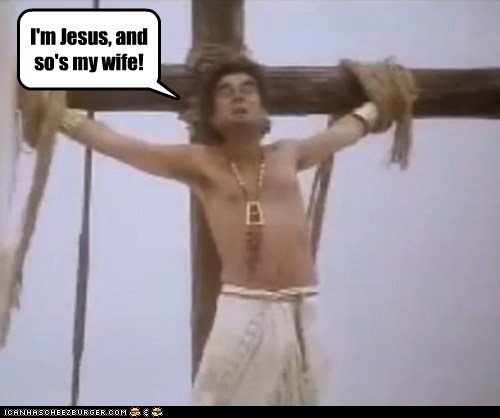
Last week, Karen L. King, the Hollis Professor of Divinity at Harvard Divinity School, dropped a bombshell at the tenth annual International Congress of Coptic Studies in Rome: she had found Mrs Jesus.

Specifically, she had studied a small, roughly rectangular scrap of papyrus that contains a Sahidic Coptic text. The fragment is torn on the top, bottom, left and right, so it is difficult if not impossible to get a good idea of the entire context of the passage. The one thing that got people’s attention, though, is the phrase, “Jesus said to them, ‘My wife…'” Jesus also says that a woman, possibly the wife, will be able to be his disciple. He also mentions his mother and a woman named Mary, although it is not entirely clear if “Mary” refers to the wife, his mother or another woman. Although it is common in Christian texts to refer to the Church as Jesus’ wife, the personal context of the passage makes a literal interpretation of “my wife” more likely.  According to King, “The meaning…’my wife’ is unequivocal; the word can only have this meaning. Given that Jesus is the speaker, the possessive article indicates that he is speaking of his wife” (King 18).*

Oh. My. Married. God! The Da Vinci Code was right!

Hang on a sec. First, The Da Vinci Code was not right. Not in any world. Jesus and Mrs. Jesus, YHWH and Asherah, Buddha and Buddhessa, the Vishnus,  Zeus and Hera, Odin and Frigg could all come down from on high and proclaim in a variety of languages that The Da Vinci Code was right, but that still wouldn’t make it right: it would just prove that those gods are fallible and unworthy of worship. Such a declaration would immediately remove a god from the God Stakes.

More importantly, while King, who is not herself a papyrologist or Coptic linguist,** admits that “Coptic paleography is notoriously difficult to date” (8), she places the handwriting of the papyrus in the second half of the fourth century and suggests that the original (in Greek, presumably) was probably written in the second half of the second century (based on similarities to the Gospel of Thomas, the Gospel of Mary and the Gospel of the Egyptians. So, assuming the fragment is authentic and assuming these dates are correct, the fragment is relatively late, and there is no particular reason to assume that it represents The Truth.™

King calls the fragment The Gospel of Jesus’s Wife, even though she admits that there is no clear evidence that the work is a gospel (not enough text survives to determine genre); there is no indication that Mrs. Jesus is the putative or pseudonymous author; and there is no evidence that she is even the primary subject of the work. King also uses the words “recto” and “verso” in a way that strikes me as nonstandard. Usually those terms  indicate (respecitively) the front and back of a leaf from a codex. Here it is not even clear that the work comes from a codex, and even if it does, the paucity of text and the damage to one side makes it impossible to determine which side comes first. For King, “recto” means “along the fibers” and “verso” means “against the fibers.”

The provenance of the fragment is murky at best. The owner has chosen to remain anonymous, although he or she apparently also owns a 2nd- to 4th-century fragment of the Gospel of John in Coptic. This fragment came from the same batch of Coptic and Greek papyri as the “Take my wife” fragment (King 2). Where these fragments came from originally, no one knows. The anonymity of the owner and the murkiness of the provenance raise concerns that the fragment could have come from the illicit antiquities trade.

King makes several arguments in favor of the fragment’s authenticity. She notes that the papyrus seems to be genuinely old but admits that it is possible to acquire blank scraps of ancient papyrus. However, she believes that the condition of the ink argues for authenticity: it is badly worn and in some places illegible. The “verso” is particularly badly damaged, with only a few recoverable words. There are also minute traces of ink at the edges of the fragment, suggesting that the text was cut off from a larger original. Where the papyrus is damaged, the ink has faded or disappeared. King argues that if the fragment were a modern forgery on old papyrus, we would expect to see the damaged areas filled with ink.

The ink will be subjected to non-destructive tests. These will not provide a definitive date but should show if the ink is consistent with that of other ancient papyri. A more definitive test, such as Carbon 14, cannot be used because that would destroy too much of the tiny fragment.

On the other hand, the references to “my wife,” “Mary” and a female apostle seem almost too good to be true. It’s not just Da Vinci Code fans who are hungry for this kind of evidence. Perfectly normal, literate people have become interested in the gnostic gospels that suggest the crucial role women played in some sects of the early church. References to an intimate if not necessarily sexual relationship between Jesus and Mary have sparked a great deal of interest among feminist bible scholars and Christian women. And, boy howdy! this tiny, tiny fragment hits all the sweet spots, without containing a single complete sentence.*** Several other religious artifacts that seemed to good to be true, such as the James ossuary and the Jordan lead codices, were rather quickly declared likely forgeries.

The Gosple of Jesus’s Old Lady appears to be headed in the same direction. In the peer review of King’s article, two of the three readers questioned the fragment’s authenticity, and King’s article shows that there are anomalies, such as non-standard grammatical forms. King defends these by reference to the Gospel of Thomas, but its similarity to that text may be problematic. Within days of the momentous announcement, New Testament scholar Francis B. Watson of Durham University argued that the Gospel of Jesus’s Main Squeeze was cobbled together from bits and pieces of the Coptic Gospel of Thomas. While he makes a compelling case, it is difficult to judge, without knowing Coptic, whether the similarities result from a modern forger lifting scraps from Thomas, or whether, perhaps, the two works merely share verbal parallels.

Many of the scholars at the Coptic conference where King revealed the fragment have also questioned its authenticity, suggesting that neither the handwriting nor the grammar looks right. Indeed, the backlash has been so immediate and so widespread that the Harvard Theological Review has walked back its commitment to publish the article in the January edition.  On Friday, one of the co-editors said that they had only “provisionally” accepted the article for publication, pending the results of scientific tests and “further reports from Coptic papyrologists and grammarians.”

So, it seems King’s announcement may have been premature, but she notes that she was looking for comment and criticism. In the draft of her article, she freely mentions the reservations of her readers. The media reaction to her announcement, however, has been predictable. Headlines scream that there is new evidence that Jesus had a wife or that King claims Jesus was married. Neither of these statements is true. It is well-known that early Christians held widely diverse views, even about Jesus’s nature (was he fully divine, fully human, or both?). The fragment doesn’t provide evidence that Jesus had a wife; if it is authentic, it merely provides evidence that some early Christians thought he had a wife, a view that doesn’t come as much of a surprise to scholars who study the early church.

A minority of Christians has reacted predictably as well, declaring the fragment inauthentic simply because they don’t like what it says. A commenter on a post called “Christian Scholars Not Fazed by ‘Gospel of Jesus’ Wife ‘” somewhat ironically declares:

This fragment is little more than another attempt to discredit Jesus and hence Christianity. Any impeachment upon Jesus’ character would be fuel to the devil which if this parchment were true would have been evident by now the devil would not have let an opportunity like that go begging. You [another commenter] blaspheme when you say that He was “kissing on Mary all the time” not  only is that not scriptural but it defames His character. For Jesus to have a  wife is to suggest that there was a passion within His nature which His Deity  could not overcome thus diminishing His ability to overcome for the world. He  would not have had the desires of a human in this regard because He came to do  the will of the Father which was to live a pure and sinless life and die as  God’s sacrifice for sin to atone for the sins of the world.

This is for you, “An Evangelist”:

References:

King, Karen L., with AnneMarie Luijendiik. “‘Jesus said to them, ‘My wife…”‘: A New Coptic Gospel Papyrus.” Draft. http://news.hds.harvard.edu/files/King_JesusSaidToThem_draft_0917.pdf

Watson, Francis. The Gospel of Jesus’ Wife: How a fake gospel fragment was composed.” Revised. http://markgoodacre.org/Watson.pdf

*The Coptic word can mean either “woman” or “wife;” the use of the possessive suggests that “wife” is the more appropriate reading.

**Stop laughing, Brian and Bob. You’re adult men with beards–it’s not that funny.

***This isn’t entirely fair. There are a couple of complete independent clauses (e.g., “Mary is [or is not] worthy of it”). They may or may not be complete sentences, but they aren’t complete thoughts.


texts and scripts 4 (non-historical ‘fringe’ linguistics 9)

September 27, 2012

Hi again, everybody! I’m getting my next blog in early, as I’m going to be REALLY busy next week! This present blog is the last instalment of this section.

Joscelyn Godwin is a musicology lecturer who has also written prolifically and positively (though not altogether uncritically) on various ‘fringe’ topics such as theosophy and the ‘Hollow Earth’. Godwin presents a strange mixture of amateur linguistics and occultism. He seems largely unaware of mainstream phonetics and phonology, relying mainly on earlier amateurs such as Richard Paget for background. His own contribution to phonetics predictably involves matters of pitch, tone and frequency, and – though he makes some errors – he has genuinely interesting notions to contribute in this area. However, he then moves into mysticism, and in the later sections of his book even his ‘facts’ are often mistaken. For instance, Ancient Greek did not have only seven distinct simple vowel phonemes (those of Godwin’s title). Only the imperfectly systematic alphabet suggests this, and the real figure (for most dialects) was at least ten. It must be acknowledged, however, that the ancient thinkers involved in this discussion may have focused on orthography rather than phonology so much that they too ignored the evidence of the spoken usage or judged it irrelevant. This was common before linguistics began and was especially the case where Ancient Greek was in question, for various reasons including dialectal diversity and the high status of the written word. Godwin may thus be simply following earlier thought in erring in these ways.

Some writers, usually of a conservative bent, argue that the established scripts used to write various culturally important languages are imbued with special status or significance and must not be replaced or seriously altered. This view is held by some who resist proposals for the reform of alphabetic spelling but is especially salient in respect of scripts such as the Chinese logography, which bears an unusually close relationship with the Chinese language and is particularly well-suited to it, at least in some respects: it distinguishes effectively between homophones, which are numerous, and it allows for seriously divergent pronunciations of the same morpheme in different fangyan (‘dialects’). Alphabetized spellings of Chinese, such as the modern Hanyu Pinyin system used to write Mandarin, are inevitably fangyan-specific and unable to distinguish between homophones.

Some authors, however, perceive the established script as so highly valued that it is almost ‘sacred’ in character and must not be altered even to small degrees. Tienzen Gong goes so far as to identify Chinese (with its script) as ‘Pre-Babel: the true Universal Language’, claiming to be setting up a ‘new paradigm of linguistics’. He cites F.S.C. Northrop as stating that ‘the Easterner … uses bits of linguistic symbolism, largely denotative, and often purely ideographic in character, to point toward a component in the nature of things which only immediate experience and continued contemplation can convey. This shows itself especially in the symbols of the Chinese language, where each solitary, immediately experienced local particular tends to have its own symbol, this symbol also often having a directly observed form like that of the immediately seen item of direct experience which it denotes … As a consequence, there was no alphabet. This automatically eliminates the logical whole-part relation between one symbol and another that occurs in the linguistic symbolism of the West in which all words are produced by merely putting together in different permutations the small number of symbols constituting the alphabet’ (emphasis in original). These comments about alphabetic writing are essentially uncontroversial; however, the use of the terms denotative and especially ideographic suggest a mistaken, quasi-cross-linguistic interpretation of Chinese script, which is naturally language-specific and thus logographic rather than ideographic. Gong accepts Northrop’s general analysis but obviously rejects his rather negative verdict on the philosophical consequences of the use of Chinese script.

Leonard Shlain argues that the development of literacy and in particular the adoption of alphabetic scripts in ancient times (at the expense of logographic scripts such as Chinese script) reinforced the brain’s ‘masculine’ left hemisphere at the expense of the ‘feminine’ right, upset the socio-psychological balance between the sexes and triggered massive, unwelcome changes in apparently unconnected areas of human thought and society. These chiefly involved shifts in the direction of ‘linear’, non-holistic thinking, an excessive concern with logic and science, and the growth of patriarchal systems in which women and their ideas have been suppressed and undervalued. Many of the major cultural patterns and changes of the last few thousand years are, Shlain maintains, to be explained in these terms. Naturally, he would like to see this imbalance corrected. In developing his case, he ranges widely outside his own field of expertise.

Much of Shlain’s discussion of language and writing is badly confused, and some is simply wrong. Given that linguistics is central to his thesis, the major problems which he has in this area are crucial. He does not systematically distinguish adequately between languages (in their spoken forms or considered generally) and the writing systems used to represent them (a common problem for non-linguists). One very obvious instance of this is provided by his very strange discussion of the mutual non-intelligibility of pairs of modern European languages; Shlain blames alphabetic writing for this, but such languages are, naturally, mutually unintelligible in speech and equally naturally remain so in writing (in any language-specific script). In addition, Shlain does not distinguish adequately between alphabets and writing systems more generally; some of the negative consequences which he sees as arising from the use of alphabets would, if he were correct, come about even if non-alphabetic writing systems were used. He largely ignores the important phonological but non-alphabetic category of syllabary; and he mistakenly describes Chinese characters as ideograms (they are, of course, language-specific logograms) and Chinese itself as lacking in the grammatical category ‘word’. At an even more basic level, Shlain confuses the notions of phoneme and phone (‘speech-sound’) and his definition of the very word alphabet is utterly wrong; he naïvely defines an alphabet as ‘any form of writing that contains fewer than thirty signs’.

Furthermore, Shlain’s accounts of the origin and early development of language and society are highly speculative, inadequately referenced and at times overtly partisan, relying excessively on traditional beliefs and endorsing (rather uncritically) the currently popular but ideologically-charged theories of early matriarchal paradises which were later overthrown by literate males. His claims about links between writing systems (or other aspects of language) and cultural patterns are often implausible and/or inadequately defended. For instance, he suggests that the Phoenicians’ use of their abjad – the ancestor of the Greek and the Roman alphabets – was somehow associated with the alleged barbarity and uncultured character of their civilization. Overall, Shlain cannot be taken seriously.

Some other authors also attribute major cultural developments to the development of literacy or (typically less plausibly) to the adoption of certain types of script; for instance, of alphabets where vowels are shown, which, according to Rostam Keyan, contributes vastly to clarity and thus to the development of science.

More next time (in about 11 days’ time)! I’ll be moving on to linguistic aspects of (allegedly) channelled communications.

Mark


Virtual Skeptics, Episode 7 (26 Sept 2012)

September 27, 2012

Looky-looky! A new episode of Virtual Skeptics is up! Hooray!

Virtual Skeptics, Episode 7 (26 Sept 2012)

This week on the “Virtual Skeptics”…

  • Bob brings us a pretty corny story;
  • Eve channels Mrs Jesus;
  • Sharon wonders, “What IS it with Siberia?”
  • and Tim…well, we love Tim.

RJB


texts and scripts 3 (non-historical ‘fringe’ linguistics 8)

September 24, 2012

Hi again, everybody! First, more applications of gematria!

Jerry Lucas and Del Washburn follow Kurt Fetteschoss in re-applying gematria, especially to the New Testament (‘Theomatics’). They claim that an analysis of the Bible reveals numerical patterns which are in no way explicable by chance and which a numerological analysis then converts into information about the meanings intended by God in inspiring the text of the Bible. In turn, this is used to attack atheism and other viewpoints which deny the existence of a creator entity behind the observed universe.

The linguistics invoked here is less than competent. For instance, Lucas & Washburn – misinterpreting a standard reference work– claim that there are no grammatical rules at all determining the use or non-use of the Greek definite article, the equivalent of English the. They therefore claim that God was free to include the article or not in each New Testament phrase, without thereby generating grammatical anomalies, in order to make the numbers add up. This is simply not the case; there are familiar, fairly precise principles determining whether or not the definite article is used in Greek.

In addition, Lucas & Washburn treat the various inflectional forms of Greek nouns such as theos (‘God’) – for instance, theou (genitive; ‘of God’), theon (accusative; ‘God’ as clause object, etc.) – as mere spelling variants, which they claim add to the flexibility of the language, again for the convenience of God. In fact, the decision to use theon or theou rather than theos would necessitate a complete re-structuring of the clause in question and would thus not assist at all in slightly modifying the numerological ‘score’ of the overall expression, as Lucas & Washburn suggest.

Other critiques of Lucas & Washburn include attacks on the statistical significance attributed to their ‘findings’.

Other relevant phenomena (not in general involving the Bible) include the linguistic aspects of ‘Western’ numerology as understood more generally. Numerology has a long history, and essentially involves the notion that integers or numerical digits possess inherent relationships with alphabetic letters and with linguistic or other meanings. This facilitates both a) prediction of future situations (including personalities) and events from the spellings of relevant names or other words and b) the selection of names for babies, religious converts, those adopting new languages, etc. in such a way as to maximize their future prospects. Numerology is related conceptually and/or historically to gematria and to systems such as ‘Chinese numerology’ where the words for numbers and the characters which represent them are said to have associations with specific non-numerical concepts – positive, negative, or other. However, where the direction of interpretation is from numbers to words/concepts, there are no universally agreed definitions for the numerological meanings of specific digits.

Most relevant in this context are versions of numerology where the direction of interpretation is from letters of the alphabet to numbers (single- or double-digit) and where the numbers are then combined and re-combined by way of repeated addition of digits so as to yield a single-digit number for each name or other word; these numbers are then linked with meanings. Thus, if the letters of the Roman alphabet as used to write English are paired with the integers 1-26, the name Eve obtains a ‘score’ of 5 + 22 + 5 = 32 = 3+2 = 5. It is then held that people with the name Eve will be likely to display whatever characteristics are ascribed to the number 5. This particular calculation assumes, of course, that the figures for the several letters are to be summed across the entire word before the digits are added together. Obviously, other procedures are possible; without any kind of rational argument for one procedure over another, the adoption of any one procedure appears arbitrary (although in fact most alternative procedures systematically yield the same results as the above, because of inherent properties of the integer series). Helyn Hitchcock, for instance, uses a different procedure from most other contemporary numerologists, although the reasons for this difference are not clear.

In addition, all familiar numerological systems employ Base-10. This may possibly be defended in terms of the fact that in most societies which employ alphabetic writing Base-10 is the norm; but this point threatens any attempt to claim universal status for numerology.

However, the most major issue arising here for skeptical linguists is the significance – often ignored or unconvincingly handled by numerologists – of the varied and changing membership and ordering of the alphabetic letters forming names. For example, the Greek alphabet has no letter C; its third letter (gamma) is the equivalent of G. Greek words and names were borrowed into Latin, which is written with a modified Greek alphabet, the Roman alphabet (now, of course, also used for English and many other languages). In this new alphabet, G was replaced by C (which largely replaced kappa/K) in third position and was itself reinserted in seventh position. Presumably, the numerical values associated with the various letters should differ according to whether the name or word in question was used before or after this and other such changes; thus G should have the value 3 for words used before the change and 7 for words used after the change; and the values for all letters following G should be different after the change. However, many words were used in both periods, resulting in the generation of rival scores for the same words.

A further issue arises with names which are common to various languages spelled with different versions of the alphabet with different total numbers and/or different orderings of letters. This applies especially to languages where fewer letters are used than in English, potentially affecting the numbers assigned to all letters conventionally listed after the first ‘missing’ letter. For example, native Italian words (including names) cannot feature J, K, W, X or Y. A further, similar issue arises where different alphabets are in use. Many names are shared between languages usually written in different scripts, for instance between English and Russian (Cyrillic alphabet), and are used by bilinguals. Names such as Ivan will naturally be associated with different numbers in the two languages; for instance, the Cyrillic letter B, corresponding with V, appears in third position. Some Cyrillic letters have no direct Roman equivalent and vice versa, complicating matters further: digraphs such as Roman ts are used outside numerology in transliterating these letters, and rival transliteration systems often exist.

A standard general-skeptical response to numerology as a whole is the position that, since numbers possess no genuine occult meanings and since by themselves they can have no significant influence on life, numerology is essentially superstition masquerading as science.

There are also various more specific non-standard theories of this nature. One of these is ‘acrophonology’ (variously spelled in its own literature), dealing with the alleged astrological and mystical significance of names. The name of the theory suggests that it relates especially to names as pronounced rather than written, but in fact the discussion is entirely of spelling; the title is thus misleading. As the morpheme acro-suggests, there is a strong focus here upon initial letters. For example, Laurie Baum treats people whose names begin with A as likely to be initiators and builders. Baum (an American) assumes the first-middle-last name structure for personal names as a given; and she does not discuss the issue of the changing and varying membership and ordering of alphabets, as introduced above.

Mary Scott ‘found’ a code hidden in the letters of the Roman alphabet as used to write English. Each letter allegedly has a spiritually significant meaning, and the spiritual meanings of entire words are composed of the meanings of the individual letters. These meanings apply whether a text was originally composed in English or in another language; Scott’s leading examples are Biblical texts translated from the Hebrew psalms. She pays little attention to other languages, even those written in essentially the same alphabet, and urges that the forms used in older English Bibles be preserved, since these communicate essential spiritual meanings which are lost if the spelling is altered.

More next time!

Mark