animal languages 2 (non-historical ‘fringe’ linguistics 26)

February 10, 2013

Hi again, everybody! More on alleged animal languages, starting with non-human primates.

Opinions vary greatly among linguists and other researchers as to the degree to which human-like primates (chimpanzees, bonobos, gorillas, orang-utans, other apes, monkeys), sharing as they do large percentages of the human genome, display the capacity for language or indeed display genuinely linguistic thought and behaviour involving systems of complexity and flexibility similar to those of human languages – featuring, for instance, double articulation and syntax.

Some rather impressive cases, adduced by supporters of the view that genuinely linguistic features do occur among non-human primates, involve monkeys. Wild putty-nosed monkeys apparently combine tokens of their three basic calls to generate novel messages, as it were syntactically, or vary their individual calls by adding what appear to be morphological suffixes, in some cases apparently distinguishing between predators which they have observed directly and those which they know others have observed. These features appear quasi-linguistic, near-linguistic or associated with roughly equivalent features in human language, although none of them seems to be strictly syntactic in nature.

Even where spontaneous linguistic thought and behaviour is not claimed, it is often claimed that primates do possess the capability of being taught key aspects of human language, again involving, for instance, double articulation and syntax – even if they have not developed these characteristics themselves, and even if they are incapable of phonation and require to be trained in other modes of expression (notably signed languages such as are used especially by deaf humans). For instance, some chimpanzees which have been raised largely among humans have reportedly become capable of acquiring and manipulating large vocabularies (150 words or more) and other significant aspects of human language, and on this basis it is argued that they demonstrate genuinely linguistic thought and behaviour. On this basis, a New York Times reporter competent in sign language, Boyce Rensberger, was able to conduct what he regarded as the first newspaper interview with a member of another species when in 1974 he ‘conversed’ with Lucy, a chimpanzee who had been instructed in signing (see below).

Scholars critical of such claims argue that even the ‘higher’ primates are unable to link symbolic sounds together in sentences or produce other key features characteristic of language, either after or without attempts at instruction, and that attempts to teach animals human language are doomed to failure. Scholars with such views include Noam Chomsky and his followers such as Stephen Budiansky and Steven Pinker, who adopt such positions largely on theoretical grounds (involving the alleged ‘hard-wiring’ of the language faculty in humans specifically) but who also present empirical evidence supposedly upholding their views. Some active empiricist researchers also reject or at least challenge claims regarding primate language use or language acquisition. Yet other researchers adopt intermediate views on the issue, regarding the empirical evidence as mixed or equivocal, or hold that some primate communication systems should be considered not strictly linguistic but pre-linguistic in character. The debate continues.

R.M. Seyfarth and D.L. Cheney (with Klaus Zuberbühler, whose own wording is linguistically naïve) suggest that non-human primates have not developed their pre-linguistic behaviour further predominantly because, unlike Homo sapiens, they lack a ‘theory of mind’: the recognition that others have thoughts. At some point in human evolution, on the other hand, humans developed the desire to share thoughts, and natural selection led to the development of language as a means of achieving this. This suggests that non-human primates might be regarded as quasi-autistic; the notion is that both non-human primates and (by preference) autistic humans (and maybe also horses, cetaceans and birds; see below) think and communicate pictorially rather than linguistically. Ideas similar to those proposed by Seyfarth are proclaimed by Temple Grandin (who has close personal experience of autism as well as relevant professional expertise), and there seems to be much to commend them, although the specifics are open to debate.

Another group of authors, of a clearly non-mainstream kind, who uphold the view that language is specific to the human species are Christian fundamentalist writers such as the psycholinguist Clifford Wilson. Wilson supports a Chomskyan species-specific model of language as part of an anti-evolutionist program. He analyses the communication systems of various species in terms of distinct ‘types’ of animal, as is usual among creationist thinkers, with the different types each possessing their own, unrelated and in fact specially created systems.

One increasingly important aspect of this debate involves genetics. Since mid-2002 evidence has accumulated regarding the appearance of the supposedly crucial FOXP2 chromosome-code at the relatively recent date of 200,000 BP – around the time when Homo sapiens may actually have begun to speak or at least sign; some of the physiology needed for speech seems to have appeared later. On this ground, many scholars have argued that it is unlikely that non-human primates have the capacity for genuine linguistic behaviour (or indeed that pre-sapiens hominids had such capacities). Even the closely related chimpanzees display possibly crucially different forms of the relevant gene.

It must be noted, however, that not all linguists agree as to the significance of FOXP2 in respect of the human language faculty. Very different interpretations of some of the key findings have been advanced by non-nativist linguists such as Geoffrey Sampson. In addition, it is conceivable that non-human species might possess very different systems of similar complexity and flexibility which are based otherwise than in any given genetic feature such as FOXP2. Indeed, members of Homo erectus (to all appearances) must have built boats to reach insular Flores around 840,000 years BP and it is suggested by some that they must have been able to speak or sign in order to organize such a complex enterprise.

Manipulation of the relevant genes is reported to have altered the mental and behavioural capabilities of mammals such as mice; and a more ‘positive’ interpretation of the situation with respect to non-human primates could involve the suggestion that chimpanzees and bonobos could now be readily induced to develop language, or at least to learn human languages more effectively, by manipulation of the relevant gene.

I will say a little later on the alleged (near-)linguistic capabilities of supposed human-like cryptids (sasquatch, etc.).

As ever, detailed references on request. More next time!

Mark


plug for my skeptical linguistics book (coming out in 2-3 weeks)!

February 10, 2013

Hi! See link below! If anyone is interested, copies are available through me at the author’s 50% discount, for EU 22.40, plus postage (to be determined when I have a copy in hand). Please let me know if you’d like one, suggest means of payment (Paypal is possible) and provide your preferred postal address. Cheers! Mark Newbrook

http://linguistlist.org/pubs/books/get-book.cfm?BookID=64212


Something is going down at the Burzynski Clinic

February 7, 2013

Non-humanities post here.

One of my vast network of informants has fed me the following CaringBridge update from a Burzynski patient that she is monitoring:

The Burzynski Clinic is going through some issues right now. They are in the process of getting audited for the past month by the FDA. The FDA has also gotten approved to continue their audit for another month. I believe it was August, the FDA stopped new pediatric patients because a child had went into a tumor related coma and did not get enough water during treatment, thus spiking the sodium level to a fatal level. Now, in January, for reasons unknown to me, the FDA has suspended new adult patients from the ANP as well. I do not know when the new patients will be allowed again or if any restrictions on current patients will also follow. Friday, the Burzynski Clinic shipped us 3 months of ANP, where they normally only ship 2 weeks. They are being proactive and making sure we have the meds she needs just in case any medicine production is stopped. Apparently, a person who monitors the medicine production had a serious medical emergency. This, along with the FDA auditing has us a little on edge waiting to see how it all plays out. Even though this is bad news for the clinic, there is silver lining because when this is finished, the clinic should be moving into Phase 3 of the clinical trail and hospitals and doctors should be able to start prescribing the ANP and doing clinical trials of their own. To my knowledge, Dr. Burzynski has the only medicine not sponsored or picked up by a pharma company. I think that’s why things don’t work like they do for normal drug approval.

In the last month, the clinic removed all mention of ANP from their website, and we did not know why. This might explain it. I am nauseated at the thought that their drug out-and-out killed a patient.

Also, it sure looks like they are shipping ANP across state lines, doesn’t it? Looks like the FDA had a birthday present for ol’ Stan too.

RJB


animal languages 1 (non-historical ‘fringe’ linguistics 25)

February 3, 2013

Hi again, everybody!

This is the first instalment of the last ‘non-historical’ section requested by readers, dealing with the alleged ‘languages’ of non-human animals (and in passing with their ‘pre-linguistic’/quasi-linguistic behaviour, which is sometimes regarded, contrary to most scholarly opinion, as of similar complexity to human language; see below); and with the alleged ability of some animals to learn human languages (especially the key feature of syntax) under training by humans.

As usual, I deal chiefly with non-mainstream material presented by those without linguistic expertise. I refer only in passing to the much larger volume of mainstream (or near-mainstream) work carried out in recent years by linguists (in conjunction with primatologists, etc.) on features of human language as allegedly used by or taught to non-human animals – even where this work is controversial.

The mainstream consensus is that only Homo sapiens of all known animals CERTAINLY uses language or any system of comparable complexity and flexibility. Claims in the popular press and in popular books regarding animal communication are thus rendered more dramatic in prima facie appearance by the use in titles etc. of the term language. However, in many such cases the term language is in fact clearly being used in a looser sense; the idea is merely that more has been learned about the NON-linguistic communication system of some species. On the other hand, where the reference to language in such a report DOES involve the strict sense of the term, the claims are very serious and dramatic indeed and require close examination.

The two most salient distinguishing features of human language are ‘double articulation’ (phonemes/morphemes) and secondly grammar and especially syntax. Together these features enable each human language to express a potentially infinite number of sentence-length meanings with finite inventories of phonemes on the one hand and of words and morphemes on the other. There are, of course, other important features than these which also seem to distinguish human language from other communication systems. For instance, philosophical and psychological questions may be raised regarding the ability of animals to refer to other specific entities (especially entities not present at the time of an utterance), to abstract and generalize, and to display innovatory usage. However, the leading strictly linguistic issue involving the contrast between human language and animal communication involves the fact that no animal communication system displaying the two main features of double articulation and syntax has been discovered so far, however intelligent the animal species in question might be in other respects. Non-human communication systems, no matter how sophisticated they may be in other ways, all appear to lack both of these key features. Some species of monkey have as many as thirty distinct calls; but it is generally held that these cannot be further divided in analysis either into phonemes (as if they were doubly-articulated words or morphemes) or into words or morphemes (as if they were syntactic structures). Each call appears to have a unitary sense such as ‘predator!’, ‘food source’ or ‘go away!’. (See later, however, for contrary claims regarding such species.) Bees can modify their messages so as to express numerical factors such as the distance to a food source, but they do not appear to have the ability to modify a message in DISCRETE ways as occurs in human language (for example, in switching between verb tenses or singular/plural nouns).

It is possible that some animals have communication systems which ARE (approximately) as complex and flexible as human language (or even MORE complex and/or MORE flexible), but have radically different natures. In such cases, it is conceivable that the issues of double articulation and syntax might not arise. Even if they did, the actual physical systems and modes involved might be very different indeed from human physical systems. Some such systems, or their most relevant and impressive features, may have escaped notice to date because of differences in physical mode of communication, etc. For instance, dolphins and whales inevitably avail themselves of different modes of communication because of their aquatic environment (see below). (Compare my earlier comments on possible extraterrestrial languages.)

It is important to note that points specifically concerning the nature of the SOUNDS made by non-human animals do not have any direct implications for linguistic structures at other ‘levels’ such as grammar. It is quite probable that when human language itself first developed it was signed rather than spoken; but this might have affected its grammatical structure only marginally. The capacity for phonation is a necessary but by no means a sufficient condition for spoken language, and it is not a prerequisite for language per se. A creature which cannot produce human speech-sounds at all readily or accurately (such as some non-human primates) may still have language or the capacity for language, which would have to be expressed through modes other than speech. In turn, a creature such as a parrot or a mynah which CAN (perhaps by way of mimicking) produce human-like speech sounds may prove NOT to have language or indeed any capacity for language. This consideration is often ignored or underplayed by non-linguists working or writing in this area; but it obviously affects the significance of findings on animal vocal tracts, etc.

I have focused here upon the question of how far non-human animals might spontaneously possess communication systems displaying complexity and flexibility similar to those of human language. The question of how far some animals can be TAUGHT human language systems displaying the relevant features (double articulation, syntax, etc.), to the point where they display passive or even active command of language, is a separate issue; see later.

Some scientists deal on a broad front with the alleged senses, thoughts , ‘feelings’ and non-linguistic communication systems of a wide range of species from mammals to invertebrates and even microbes. Some of these discuss animal communication systems without seriously attending to the above issues or to linguistics generally; others include some serious discussion of the linguistics involved. The maverick linguist Morris Swadesh presents a fascinating and well-informed (if often rather speculative) account of possible scenarios for the evolution of human language out of earlier communication systems.

As ever, detailed references on request. More next time!

Mark


clicks

January 27, 2013

Hi again, everybody!

I comment briefly here about some claims regarding ‘clicks’, the consonants technically described as ‘velaric ingressives’ (produced with airstreams drawn INTO the mouth and by movement of the velum aka the soft palate rather than by the lungs). These consonants are especially associated with the Khoisan or ‘Bushman’ languages of Namibia and neighbouring areas of southern Africa, as famously portrayed in the movie The Gods Must Be Crazy. Some of them resemble the sound stereotypically used to ‘gee up’ horses.

The mainstream palaeoanthropologist (etc.) Alice Roberts comments upon the long early period when pre-literate humans probably already had language (for the details of which little concrete evidence survives, naturally); she includes an interesting discussion of ‘click’ consonants in a range of African languages, comparing their distribution with genetic data and suggesting (with others, and not unpersuasively) that the development of these phones may well have pre-dated sapiens expansion from Africa.

There are also some more specific, less mainstream (and less persuasively argued) book-length works along broadly similar lines, such as that of Roman Stopa on alleged links between Indo-European and Khoisan.

Dan Willmore and Nicholas Wade are advocates of the view that some aspects of the phonology of Proto-World can be reconstructed; both Willmore (apparently familiar with the relevant aspects of human genetics and with palaeo-anthropology) and Wade argue that Proto-World featured ‘clicks’. At present the only non-Khoisan languages which extensively feature clicks are the languages of the Hadzabe and Sandawe of Tanzania. The two groups of languages are not otherwise similar, and their speakers are hardly close relatives: mitochondrial DNA evidence suggests that the two peoples have been separate from each other for more than 50,000 years. Willmore holds that modern humans began to leave Africa around 50,000 years BP, which itself would imply that any ancestral features which Khoisan and Hadzabe/Sandawe now have in common must have been shared at that date (compare Roberts as cited above). Australian evidence suggests that the beginning of homo sapiens movement out of Africa must be dated earlier than this, perhaps around 70,000 years BP; but the data are still striking. (In addition, Willmore holds that the overall evidence shows that there was just one Proto-World and that it can be reconstructed in part. He is also ‘certain’ that Neanderthals could speak; and he seems to believe (very oddly) that ‘imagination’ is somehow involved even in PHONOLOGICAL change.)

A manifestly non-mainstream article by T. Kluge argues that the human capacity for speech results from features of the brain, notably the ‘language centre’, which have become strengthened through the use of the arms, which in turn arose from the overall arrangement of human limbs (two arms, no wings). Kluge also associates many phonetic features with physiological characteristics; he claims, for instance, that clicks are associated with certain ‘racially’ determined mouth structures. (He further holds that variations in auditory perceptions of phonetic pitch in speech correlate with air-density and thus with the altitude at which a language is used; this is an extreme version of the commonly-expressed folk-linguistic view that differences in prevailing atmospheric conditions generate accent differences, for instance the ‘adenoidal’ quality of the speech of once fog-bound Liverpool).

As ever, detailed references on request. Another new topic area next time!

Mark


reversals & such 5 (non-historical ‘fringe’ linguistics 24)

January 20, 2013

Hi again, everybody!

I now turn, in concluding this section, to Backward Masking and related phenomena.

Backward masking, ‘backmasking’ or ‘backtracking’ is a phenomenon in which hidden messages are inserted into or created in music lyrics. These can be heard consciously only when the track is played in reverse, but like RS they can allegedly be heard unconsciously or subconsciously when one listens to the track in normal forward mode, and can thus affect the listener’s thinking (after the manner of ‘subliminal’ messages). Backward messages of this kind may be inserted deliberately by the lyricist, or may (supposedly) occur without any intent of the writer, indicating deep unconscious ideas on her part. (The deliberate introduction of accurate reversals is difficult in the absence of linguistic expertise but may be feasible to a degree.)

Reversals have been reported in the lyrics of AC-DC, the Beatles, Black Sabbath/Ozzy Osbourne, the Eagles, Electric Light Orchestra, Michael Jackson, KISS, Led Zeppelin, Madonna, Motley Crue, Pink Floyd, Prince, Queen, Styx, Frank Zappa, the Los Angeles metal bands the Plasmatics and W.A.S.P, and many other groups and individual performers. In many cases the force of the hidden messages is sinister, involving references to death, suicide, Satan, etc. Some cases of this kind have led to alarm on the part of Christian organizations, and indeed to legal proceedings, notably in connection with a suicide allegedly stimulated by backward masking in the lyrics of a song by the band Judas Priest.

Interestingly, listeners (including skeptics) generally find that they cannot hear the reversals in such cases until they are prompted with the alleged wording, but that after this has happened they cannot avoid hearing them.

Chris French and I are currently planning work on one such case involving the Led Zeppelin song ‘Stairway To Heaven’, which allegedly contains a reversal (very much audible after prompting) interpreted as conveying Satanic messages.

Another phenomenon which arises in music lyrics and in other contexts involving repetition – notably ‘mantras’ as chanted by followers of some religions, etc. – is the distortion of words which are repeatedly heard.

As ever, detailed references on request. New topic area next time!

Mark


reversals & such 4 (non-historical ‘fringe’ linguistics 23)

January 13, 2013

Hi again, everybody!

Jane Curtain & I investigated the Reverse Speech theory in 1997. We found ourselves unable to hear more than a few very short reversals in Oates’ material; even these were short accidental approximate reversals of unconnected FS sequences (as in it’s an honour). In other cases, any resemblance between FS and alleged RS was minimal; for instance, Neil Armstrong’s … small step for man (said on the Moon in 1969) does not reverse to Man will space-walk, as is claimed; the consonants, especially, do not match. However, we found that we were being distracted by Oates’ continual prompting on his video and audio tapes, which induce listeners to hear the alleged RS sequences. Because of this effect and the requirement to subject the RS theory to empirically sounder testing, we turned to experimentation.

Oates’ description of his own experimental methodology is repeatedly obscure and ambiguous, and he is generally reluctant to answer questions seeking clarification (or else repeatedly fails to understand exactly what information is required). The replication of his experiments is thus somewhat uncertain. Nevertheless, we replicated the experiments as best we could; additional variants were introduced where this was thought potentially useful. Forty subjects, divided into four groups of ten, participated in the preliminary experiment. Six short recordings of alleged RS sequences were taken from Oates’ audio tapes and were reproduced in written form. Each group of subjects experienced a different set of procedures:

Group A: The Group A response sheets listed the six written sequences, without any identification of the speakers.

Group B: The Group B response sheets listed six written sequences, which were entirely different from the RS sequences alleged by Oates, but which displayed a) the same number of syllables and b) similar or the same vowel phonemes, within each sequence.

Group C: Group C subjects were not provided with a written list of the alleged RS sequences. They were, however, told that an intelligible sentence was present in each of the six recordings.

Group D: Group D subjects were not provided with a written list of the alleged RS sequences, and they were told NOT told that there WAS an intelligible sentence in each of the six recordings but that there MIGHT be such a sentence.

Groups A and B subjects were asked to tick those sentences which they could clearly hear in the extracts played to them, or to circle any syllables, words or sequences of syllables or words, shorter than the sentences, which they could hear. Groups C and D subjects were asked to record (in normal orthography) any clearly intelligible sequences in English which they could hear, whether these formed the whole of a given extract or only a part of it.

The Group A subjects provided a significantly greater number of ‘correct’ responses than did the other three groups, and the Group B subjects provided a greater number of ‘correct’ sentences than did Groups C and D. In respect of words and syllables, the Group D subjects provided a greater number of ‘correct’ responses than the Group C subjects. It is clear from these results that suggestion (prompting) is a major factor in the hearing of alleged RS sequences. Where the vowel phonemes were the same as those proposed by Oates, 32% of the relevant syllables were ‘correctly’ identified; while, for the same participants, where the vowel phonemes were different from those proposed by Oates, only 18% of the syllables were ‘correctly’ identified. A possible explanation for the fact that the Group D subjects had more success than the Group C subjects involves the idea that they concentrated very hard to hear such sequences, whereas the Group C participants initially believed that the sequences would be obvious and gave up attempting to hear such sequences when they proved difficult to hear.

Further, potentially decisive tests of Oates’ claims suggest themselves, notably tests aimed at determining whether information which (as it seems) could not otherwise be known can be obtained from listening to RS sequences. However, Oates has not been willing to co-operate with linguists and psychologists in arranging such tests.

In summary, it appears (as is agreed by most of the linguists and psychologists who have examined Oates’ theories) that RS is an artefact of the listening process, often encouraged by advance prompting in the material (written and oral) provided by Oates.

There are various other skeptical discussions of RS, from various standpoints. Oates and some RS supporters have attempted rebuttal of some of these criticisms, but very few of these responses manifest anything resembling the level of specifically LINGUISTIC expertise required for dealing with the data, and their authors often misinterpret the criticisms and/or fail to understand what further information is required.

As ever, detailed references on request. Next time, I’ll say a little about Backward Masking and related phenomena.

Mark


Burzynski Filmmaker Contacts My EMPLOYER?!?!

January 7, 2013

You might remember last year how people who thought they were acting in the interests of the Burzynski Clinic issued quasi-legal threats to bloggers who took issue with his unproven “antineoplaston” treatments. I am specifically thinking of Marc Stephens, who contacted Andy Lewis, Peter Bowditch, and Rhys Morgan. As I understand it, Burzynski had hired Stephens to do web-optimization work, cleaning up B’s reputation (no small feat considering who was signing the checks!). Stephens apparently interpreted this as a green light to send a high school student a picture of his house, the unmistakable threat: “We know where you live.” This was when I first wrote about Burzynski, I believe.

Another Burzynski supporter (one at the same IP address as the Burzynski Patient Group) put up a website–albeit very briefly–which painted prominent skeptics…and somehow me… as pedophiles. (That’s my name in between those of two of my heroes, Simon Singh and Stephen Fry! Squee! Best. Defamation. Ever.) When it was discovered, the site was instantly taken down, but The 21st Floor has the goods.

Well, people who seem to somehow think that they represent Burzynski are at it again; this time it is his propagandist Eric Merola (@BurzynskiMovie), the guy behind the straight-to-Internet stinker Burzynski. He is currently putting together a sequel (working title: Burzynski II: This Time It’s Peer-Reviewed).

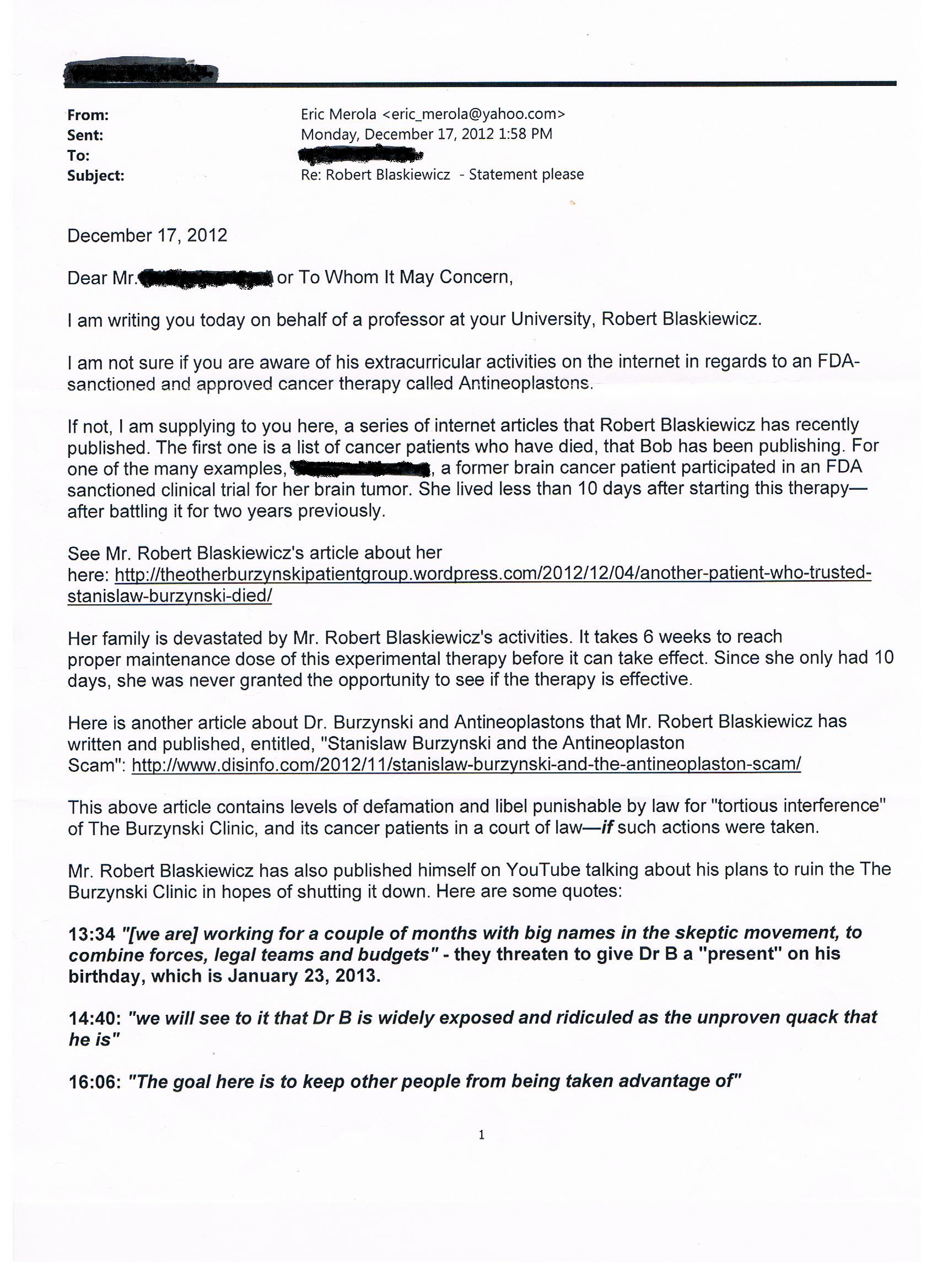
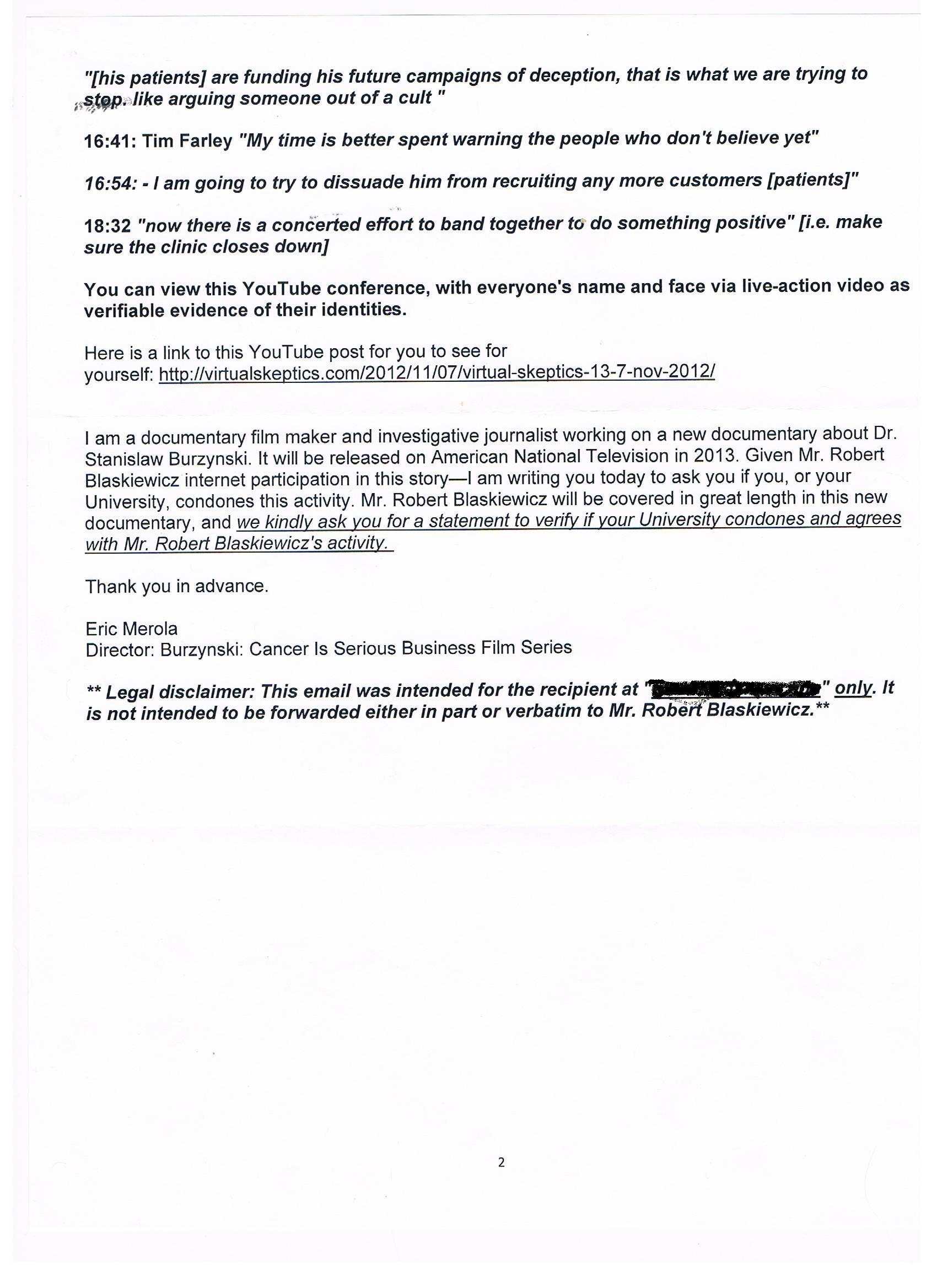
Not long ago, I received a call from one of the lawyers at my university. When I went over to see her, she handed me a letter that had been sent to the office of my university’s Chancellor. Honestly, from her description on the phone of how strange it was, I thought it was going to be something from Mabus, who had contacted my coworkers in the past. I was surprised to read that it was from the guy making the Burzynski movies. And now I share it with you:

Page1

Page2

How about that?

Let’s clarify a few things here, Eric. My “extracurricular” interest in Burzynski has nothing to do with my research and everything to do with my interest in science. My letters, articles, and blog posts that discuss Burzynski do not appear on my CV. The things I do in my spare time are no business of my employer and they respect that.

Your legal disclaimer is a joke; you are as competent a lawyer as you are a filmmaker.

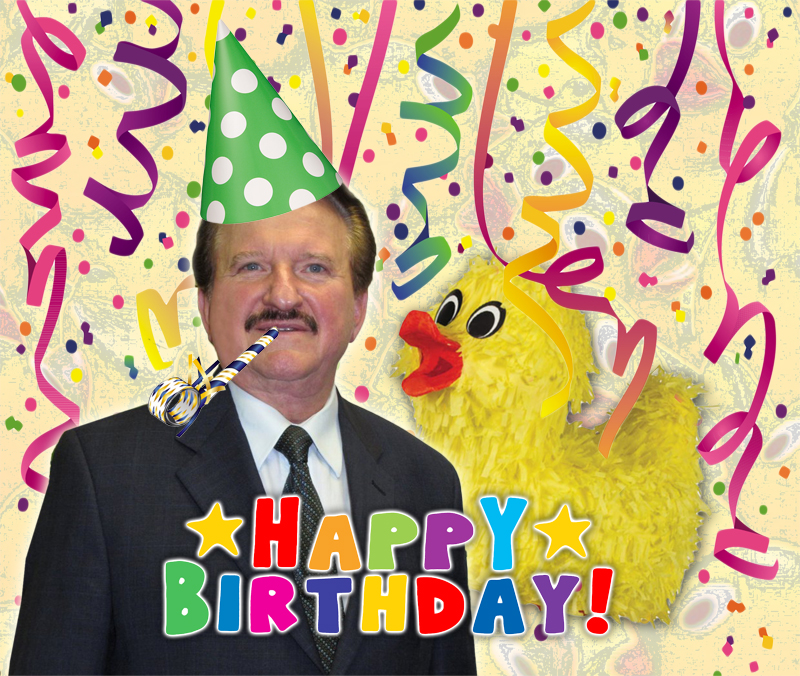
The “present” we are going to give Burzynski on his birthday is a challenge to the Clinic to match the funds raised by skeptics for St. Jude Children’s Research Hospital. The “something positive” you fear is what I have publicly called “Operation Cuddly Puppy,” a campaign designed to put reliable information about clinical trials and cancer treatments into the hands of cancer patients. I can see why a Burzynski supporter would be afraid of that.

Regarding theOTHERburzynskipatientgroup.wordpress.com, I will be delighted for you to discuss my (and others’) work there in your movie. What we offer there is an honest look at the patients who have not made it, patients whose stories are just as important as the ones you believe Burzynski gave a happy ending. I’m not prying either; the patients and their families have already shared this information with the world. Also, it has about 30 total views (well, until today!). What you seem to be opposed to is open inquiry into what goes on at the clinic.

I’ve yet to hear from the family of the patient you singled out in your email. I would, of course, give them my standard answer for patients of Burzynski: “I’m very, very sorry for your loss, and I don’t take down content. Your stories are too important.” All of which is true. In about a month, three of us working in our spare time have been able to accumulate as many (more, actually) examples of failed treatment as there are “successes” at the Burzynski Patient Group site, which actually opens up patient records to promote Burzynski. (Though I don’t hear you howling about the ethics of that!)

In a way, I guess I’m not surprised that you went to my employer. I have gotten threats from other wackdoodles before who were going to “expose me to my employer.” This is more of the same.

Eric, the interpretation of my actions that you put forward in your laughable letter are so far from the mark that I should warn you against replicating them in your movie–and now  you have been notified of that. Furthermore, should you make any attempt to link my family or my employer to my online science advocacy, I will not hesitate to hire an actual lawyer and pursue you until you cry. The fact that you actively tried to hide it from me, to spread half-truths about me to my employer behind my back, is stunning evidence of your malicious motives. It’s like the type of thing trial lawyers dream of.

If you are appalled by this behavior, I encourage skeptics to contribute to the St. Jude fundraiser. We will be donating everything raised to the hospital in Burzynski’s name and then challenge the Clinic to match those funds. If he doesn’t participate, we will still be able to say it’s probably the best thing ever done for cancer research in his name!

birthday-quack

RJB


reversals & such 3 (non-historical ‘fringe’ linguistics 22)

January 6, 2013

Hi again, everybody! Yet more on Reverse Speech!

Further implausible, incoherent and/or suspect aspects of the RS theory and Oates’ material include the following:

1) RS should only occasionally yield phonologically/phonetically possible sequences, even in the same language. There will be even fewer cases where the reversed sequence is not only possible but corresponds with a meaningful sequence of morphemes. One example is a reversal of any word terminating in /-r/ followed by the word honesty; in an American accent, this yields a close approximation to the phrase it’s an honour. However, this reversal will, obviously, occur on all occasions when the FS sequence is produced; it does not depend upon the feelings, knowledge etc. of the speaker. The shorter elements commonly reported in alleged reversals are simply the reversed forms of common words or word-parts, although in fact the resemblance is often much weaker than in the above case. For instance, one of Oates’ favourite RS metaphors is that of the ‘wolf’; but the RS word wolf is in fact an inaccurate reformulation of the reversed forms of four, for, etc.

2) Oates lists six ‘guidelines’ or ‘criteria’ on which he claims to rely in determining whether or not a given sequence in reversed speech actually counts as a case of genuine RS. However, most of his leading examples do not meet these six criteria successfully. Indeed, some of the criteria are based on errors as to linguistic facts, and are thus most unlikely to be met:

a) The syllable counts for FS and RS should be identical. This criterion is frequently not met.

b) There should be audible spaces between words in RS. This criterion is invalid: there are not usually any spaces of this kind between words in FS, only potential pauses. Furthermore, such spaces appear to be rare in alleged RS sequences also.

c) The beginnings and ends of the words in RS should be clearly defined. The same objection may be made here as under b).

d) The vowel sounds in RS should be clear and precise. The precise sense of this criterion is unclear.

e) The reversal should be distinct from surrounding ‘gibberish’. The same objection may be made here as under b) (above); but, to the extent that this kind of judgment is possible, the criterion is frequently not met, because the reversal itself is often unclear.

f) The RS phrase should have a ‘continuous, melodious tonal flow’. The sense of this criterion is unclear.

When apprised of these criticisms, Oates argued that RS is so different from FS that objections based on the workings of FS are irrelevant. This idea raises serious methodological issues, but it would allow Oates to claim that criteria b) and c) apply to RS even though they do not apply to FS. However, he at no point makes this explicit; and, given that most non-linguists, relying (as Oates himself does) largely upon spelling, would probably imagine that FS displays these features, it appears likely that Oates originally attributed them to RS because he too believes (or believed) that they apply to FS.

3) Oates claims that very young children begin to produce coherent RS, and, indeed, that they acquire RS well before they acquire FS, in fact as early as the ‘babbling’ stage, in the middle of their first year of life. These claims appear utterly implausible in view of what is known about child language acquisition.

4) Oates’ treatment of phonetics and phonology, including intonation, is superficial, vague, folk-linguistic and inaccurate. He also adopts a naïvely folk-linguistic, prescriptivist approach to the issue of grammaticality and accepts some other folk-linguistic ideas, apparently believing for instance that Sanskrit was the Ursprache (see my 2012 blogs here on ‘fringe’ historical linguistics).

5) In his print and video material, Oates repeatedly prompts listeners with full versions of what he claims they should expect to hear. As work with ‘backward masking’ and replications of Oates’ experiments (see later) demonstrate, this practice is highly suspect. See also earlier on Oates’ inconsistency on this issue.

6) Oates pays little attention to the findings of mainstream psychology, but develops complex, poorly-supported psychological theories, notably on the role of the metaphors he ‘finds’ in RS. Many of the concepts which he associates with RS are in fact of a ‘New Age’ or ‘fringe’ nature.

Along with Jane Curtain, I myself investigated the RS theory in 1997. Details next time!

As ever, detailed references on request.

Mark


Happy Birthday, Dr. Burzynski!

January 4, 2013

Happy Birthday, Dr. Burzynski!.

Skeptics for the Protection of Cancer Patients are kicking off a project to celebrate the life’s work of Stanislaw Burzynski by giving immense amounts of money to…anyone else. Well, not just anyone, but St. Jude Children’s Hospital. Follow the link and find out how you can help get money and GOOD INFORMATION into the hands of potential Burzynski patients.

RJB