Phrenology in American Culture

May 6, 2013
Phrenology-journal

(Source: Wikipedia)

At any one time, I am working on a couple of skeptical projects, most of which involve some sort of writing component, so I am always on the lookout for new material. Last month, in the class I am teaching about researching and writing about extraordinary claims, a student decided that he was going to look into medical quackery, and we brainstormed about topics that he could look into at the library.

As we sat in the computer lab, I started entering some terms into the university databases, looking for a source that might give my student a head start on the research. When I entered “phrenology” into the search box, I was surprised not only by how much came back, but especially by how much of it came back from journals in the humanities, especially in literature and history. I honestly knew next to nothing about phrenology, so I saved about 20 full-text articles with phrenology in their titles on the off chance that I would have time to look at them in depth later.

Sifting through these articles, I was struck by the impact that phrenology managed to have on American culture. Phrenology came out of the work of German doctor Franz Joseph Gall in the first two decades of the 19th century, and was popularized in the United States in the 1830s by a well-known physician named Charles Cardwell. I was surprised to learn from Robert E. Reigel, writing in the 1930s, that the earliest phrenologists were respectable physicians who had derived their theories by employing the empirical tools of observation and measurement to the psyche, even if the conclusions were uniformly unrevealing. The thought behind phrenology seems to have followed as such: that the brain consisted of modular faculties that were generally independent and localized, an observation that would have been supported through observations of traumatic injuries like the one received by Phineas Gage in 1848, whose personality changed radically when his left frontal lobe was largely destroyed by a railroad spike. It seemed not implausible that if mind and brain were deeply intertwined that the size of these various organs in the skull might determine one’s personality. And if the shape of the brain determined the shape of the skull, well, could one not possibly infer the personality traits of the individual from an examination of the contours of the head? Sure there are a lot of speculative leaps in there, but it’s not impossible. It could have been right. It just happened to not be, and quite quickly the interpretive flaws that doomed phrenology were recognized.

Phrenology, while in some ways reflecting a materialist sensibility about the origin of character, was also a very convenient tool by which to confirm racial and social stereotypes and beliefs that one’s true inner nature would be written on one’s body, like Dorian Gray’s portrait. As such, it was an especially useful pseudoscience for reconfirming the inferiority of darker races and confirming the inherently criminal nature of the lower classes.

What I am most surprised by as I go through these articles is the number and variety of prominent historical characters who underwent phrenological analysis. These include Herman Melville, Edgar Allan Poe, Clara Barton, most of the Northern generals in the Civil War, and the exhumed skull of Jonathan Swift. When these personages were not available for direct examination, phrenologists would base their analyses on paintings and busts of the figures. One of the most intriguing was a phrenological analysis of Joseph Smith, the founder of Mormonism. The Nauvoo Wasp on 2 July 1842 printed a letter from Smith’s phrenologist, Dr. A. Crane. which he prefaces with:

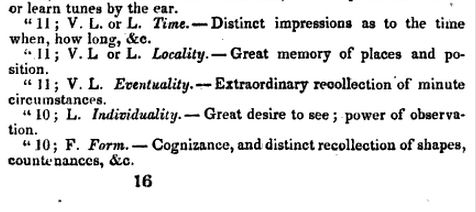
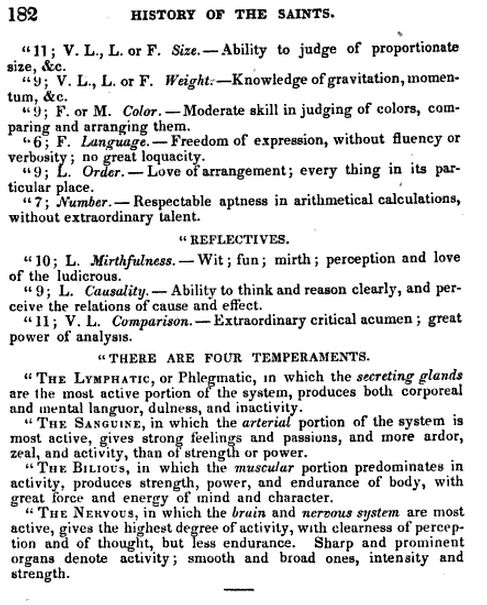
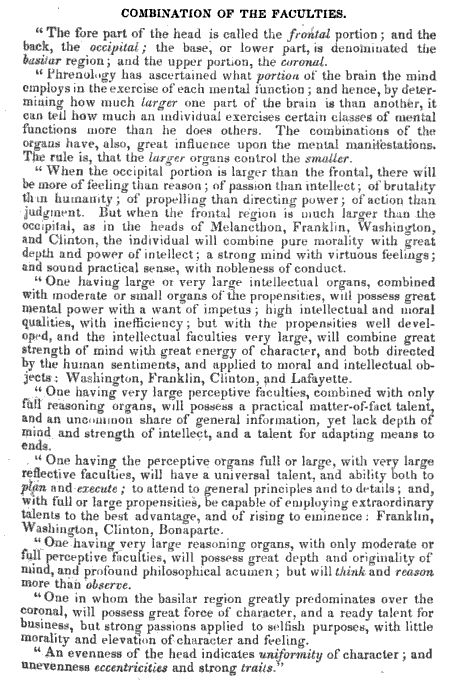
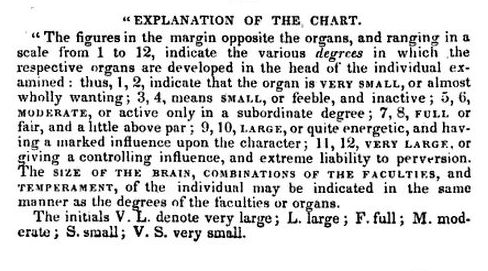
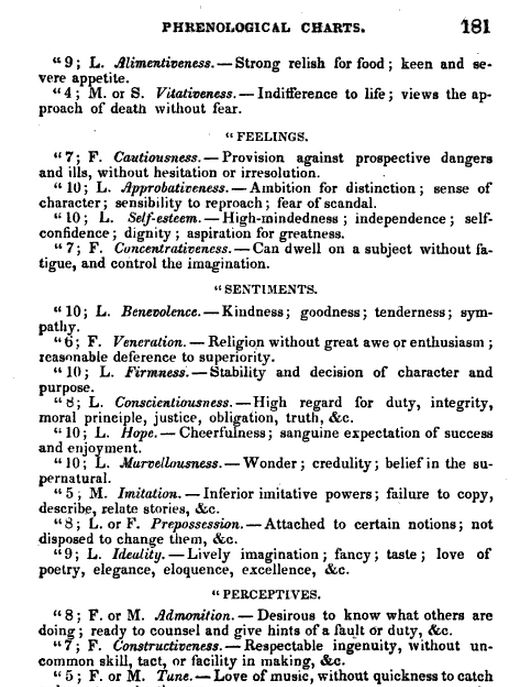
“Sir, I take the liberty to inform you that a large number of persons in different places have manifested a desire to know the phrenological development of Joseph Smith’s head. I have examined the Prophet’s head, and he is perfectly willing to have the chart published. You will please publish in your paper such portions of it as I have marked, showing the development of his much-talked-of brain, and let the public judge for themselves whether phrenology proves the reports against him true or false[.] Time will prove all things, and word to the wise is sufficient.”
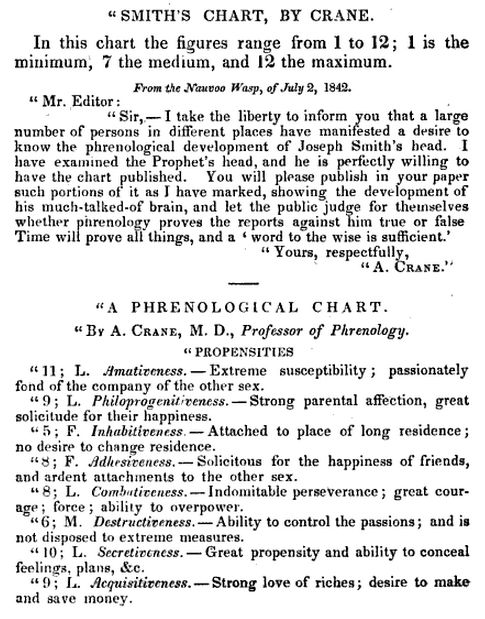
Smith1

Smith2

Smith3

Smith4

Smith6

smith5

(source: Bennet, The History of the Saints)

The scores range from 1-12, twelve meaning that the part of the brain in question is very large. It turns out, according to Dr. Crane, Smith was extremely susceptible to and desirous of the opposite sex. A lot. Like 11 out of 12 a lot.  Also, he was judged to have an enlarged region of critical acumen. He scored low on “attachment to places of long residence,” musical aptitude, destructiveness, indifference to life, and, interestingly, the sentiment of “veneration,” which is described as “religion without great awe or enthusiasm” and “reasonable deference to superiority.”

Mark Twain also had his head examined. In a series of articles published in the 1970s, literary scholars debated to what degree Twain was a believer in phrenology. Certainly he was familiar with phrenology and other forms of bunkum. It’s low hanging fruit, and he often deployed his satirical skills against popularly discredited practices. The exchange that these scholars were having, however, seem to miss the point that whenever Twain was writing for a large popular audience, he was uniformly damning of phrenology, which suggests to me that was likely his attitude toward the topic. In Huck Finn, the King and the Duke, two traveling confidence men included phrenology among their skills. Wandering phrenologists would come to his hometown of Hannibal, MO and give readings for a quarter. In his Autobiography, he recounted:

The phrenologist took great delight in mouthing [the] great names [of cranial features]; they gurgled from his lips in an easy and unembarrassed stream, and this exhibition of cultivated facility compelled the envy and admiration of everybody. By and by the people became familiar with these strange names and addicted to the use of them and they batted them back and forth in conversation with deep satisfaction– a satisfaction which could hardly have been more contenting if they had known for certain what the words meant.

“It is not at all likely, I think, that the traveling expert ever got any villager’s character quite right, but it is a safe guess that he was always wise enough to furnish his clients character-charts that would compare favorably with George Washington’s. It was a long time ago and yet I think I still remember that no phrenologist ever came across a skull in our town that fell much short of the Washington standard.

Twain also recounts a visit to a London phrenologist, once under a fake identity, and then again several months later under his own nomme de plume. He found that the two readings in no way matched, and that the second one was clearly far more specifically tailored to his public persona. I will include a detailed phrenological reading of Mark Twain that found–surprise, surprise–that he was very funny indeed.

I would be remiss if I did not add one final literary figure who received a phrenological analysis. Walt Whitman employed the language of phrenology in his Leaves of Grass. For instance, when he praises “the noble character of mechanics and farmers, especially the young men, he lauds:

The freshness and candor of their physiognomy, the copiousness and decision of their phrenology,

The picturesque looseness of their carriage, their fierceness when wrong’d,

The fluency of their speech, their delight in music, their curiosity, good temper, and open-handedness—the whole composite make,

The prevailing ardor and enterprise, the large amativeness[…]

And later in the poem, he questions himself:

Who are you, indeed, who would talk or sing to America?

Have you studied out the land, its idioms and men?

Have you learn’d the physiology, phrenology, politics, geography, pride, freedom, friendship, of the land? its substratums and objects?

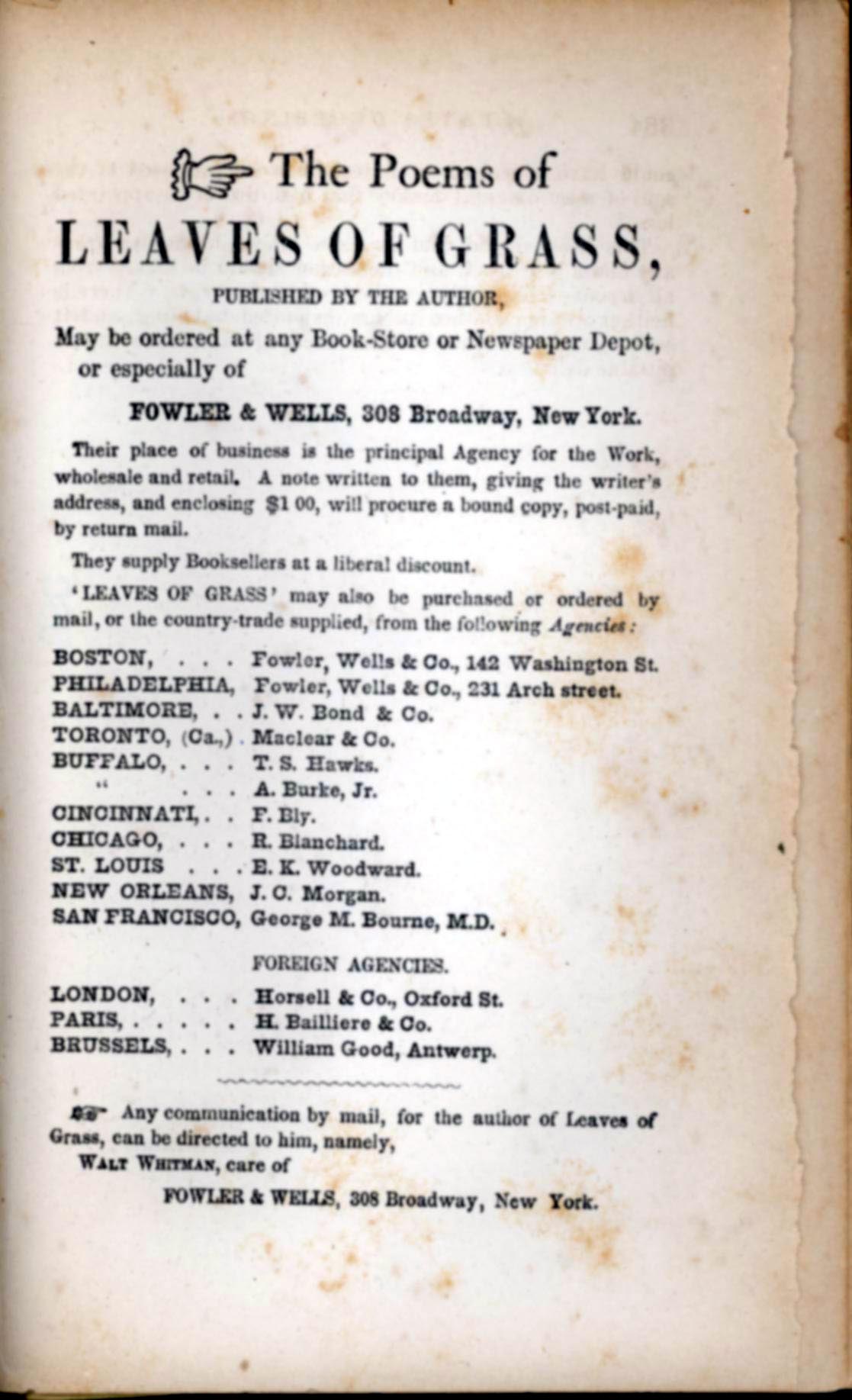
But Whitman didn’t just use the language of phrenology in terms like “amativeness” (a phrenological feature suggesting sexual desire) and as a metaphor for understanding the deeper truths of American character; he also praised phrenologists alongside geologists, chemists, mathematicians, and oddly, spiritualists, as the “lawgivers of poets,” those who reliably illuminated the objective reality that poets use to fashion their verses. Furthermore, early printings of Leaves of Grass were initially distributed by Fowler and Wells, the New York publishers of the long-lived Phrenology Journal. Their office actually received Whitman’s professional correspondence for a time:
whitman1856b

(Source: http://bit.ly/15rjSRN)

Further, Whitman published his phrenological readings by Lorenzo Fowler in several editions of Leaves of Grass.

For all its misuses and silliness, phrenology seems to have nonetheless left its mark on American culture. Indeed, at least a basic understanding of the pseudoscience is essential to understanding one of America’s most important literary works.

RJB

Works Consulted:

  • Bennett, John C. The History of the Saints: Or, An Exposure of Joe Smith and Mormonism. New York: Leland and Whiting, 1842.
  • Claggett, Shalyn. “Putting Character First: The Narrative Construction of Innate Identity in Phrenological Texts.” Victorians Institute Journal 38 (Jan 2010): 103-162.
  • Gribben, Alan. “Mark Twain, Phrenology and the “Temperaments”: A Study of Pseudoscientific Influence” American Quarterly 24.1 (Mar., 1972): 45-68.
  • Hungerford, Edward. “Walt Whitman and His Chart of Bumps.” American Literature 2.4 (Jan., 1931): 350-384.
  • Mackey, Nathanial. “Phrenological Whitman.” Conjunctions 29 (Fall 1997).  http://www.conjunctions.com/archives/c29-nm.htm
  • Riegal, Robert E. “The Introduction of Phrenology to the United States.” The American Historical Review 39.1 (Oct 1933): 73-78.
  • Stern, Madeline B. “Mark Twain Had His Head Examined.” American Literature 41.2 (May, 1969): 207-218.
  • Wrobel, Arthur.  “Corroborating His Phrenology”: The American Phrenological Journal, The Great American Crisis, and U. S. Grant. Journal of American & Comparative Cultures (24.3-4): 161-169.

Linguistics ‘Hall Of Shame’ 8

May 5, 2013

Hi again, everybody! ‘Hall Of Shame’ continues!

8 EMMA COCKER

Like many ‘fringe’ authors, some artists and commentators on the arts apparently believe that scholars – including linguists – hold (or can reasonably be read as holding) that their theories and observations as published in books and articles are definitely correct, not admitting of any challenges, alternative stances or modifications. One such writer is Emma Cocker, an ally of John Latham (discussed briefly last time), who finds this supposed viewpoint unwelcome because of her own focus on the ‘margins’ between entities and the uncertainty of analyses (a popular theme among artists).

Although those of us who are active skeptics do of course find SOME alternative ideas ill-founded, this very ‘strong’ interpretation of what we say reflects a serious (and surprising) error in respect of our intent. Most academics – while confident enough to subject their ideas to scrutiny through publication – are well aware of the provisional nature of academic ‘conclusions’ and of the large amounts of uncertainty which obtain (perhaps especially but not exclusively in the humanities and social sciences). (However, we ARE also – naturally – much more interested than are artists in the RESOLUTION of uncertainties wherever possible, by synthesis or by the identification of some analyses as preferable to others.)

Some writers of this kind also advance more specific ideas (not necessarily non-mainstream) about language – though not always very explicitly or clearly; they are accustomed to using vivid metaphors rather than precise ‘academic’ wording. Cocker herself suggests that ‘seams become audible in the spoken language of certain districts’ (which, she explains in correspondence, refers to interference between dialects/accents in contact situations), and that speech can be ‘twisted and reversed’ (this refers to usage such as Cockney ‘backslang’, as in rofe meaning ‘four’). She discusses these two phenomena in the context of her more general notions about language and the mind, chiefly with respect to her ‘margins’ (these notions are only to a limited extent empirically grounded).

However, both phenomena are already rather well understood: the former is much more widespread in language generally than Cocker seems to imagine and normally requires no special explanation, and the latter is (obviously) typically involved in the encryption of information. Novel perspectives are always of interest; however, they need to be explicitly expressed and exemplified if linguists are to assess their validity and/or significance, and they are more likely to be genuinely useful if they are informed by knowledge of existing ideas within the discipline (even if their proponents reject these ideas).

More next time!

Mark

PS: For my new book Strange Linguistics, see:
http://linguistlist.org/pubs/books/get-book.cfm?BookID=64212

Copies are available through me at the author’s 50% discount, for EU 26.40 including postage to anywhere outside Germany. Please let me know if you’d like one, suggest means of payment (Paypal is possible) and provide your preferred postal address.


Linguistics ‘Hall Of Shame’ 7

April 28, 2013

Hi again, everybody! ‘Hall Of Shame’ continues!

7 WYNN-MILLER, CROFT, MYRLAND & LATHAM

Some extremely strange thinkers, notably David Wynn-Miller and Mary Croft, are concerned with what they take to be the inadequate basis for most current laws in most countries (including the UK) and with what Croft in particular identifies as the religious basis for legal principles: truly valid laws allegedly arise out of the will of God. This material is taken seriously by some advocates of radical meta-legal reform. These authors present linguistic analyses and theories which allegedly (not always at all obviously!) would support their critiques of current laws. However, these analyses are themselves inaccurate, and the associated linguistic conceptualisation is seriously confused.

Wynn-Miller in particular focuses upon English grammar as it is manifested in texts such as those of laws and of justificatory preambles to laws. On his web-site, he describes English grammar as providing ‘a set of rules for the construction of the English Language so that human-beings can communicate with each other and understand that communication correctly’. (Presumably he would say the same about the grammars of other languages.) He continues: ‘If the rules of grammar were not defined, then it would be impossible to know what is meant by any words or statements. Dictionaries provide definitions for words and the rules of grammar define the construction of sentences in order to convey meaning and ideas unambiguously’.

The tone here is more ‘prescriptivist’/‘normative’ than a mainstream linguist would prefer (it suggests that grammars should lay down rules for usage, even for native speakers); but Wynn-Miller’s ideas are in other respects relatively uncontroversial up to this point. However, he then makes the bizarre claim that it is important to retain as many nouns in the language as possible, because they refer to things or places and therefore ‘are’ real, tangible items. In fact, Wynn-Miller’s ontology is badly astray here. Many nouns (not all) REFER to tangible items (sometimes called ‘photographables’, for instance by Charles Bliss as discussed last time), but they are not themselves those items (like the well-known picture of a pipe by Rene Magritte, the word pipe is not itself a pipe). On the other hand, Wynn-Miller says, verbs describe actions and motions, cannot describe real, tangible items, and are thus harmful to thought. This too is confused: many verbs (not all) describe dynamic assemblies of wholly tangible entities, collectively forming physical events: ‘filmables’. (Some nouns, such as stampede, also refer to filmables rather than photographables.)

Wynn-Miller refers to his novel version of English grammar as ‘Truth Language’ because it (supposedly) retains all nouns as nouns. He offers examples of the operation of ‘Truth Language’ involving various English sentences; one example is For the text of this web-site is with the absence of the legal-advice. (This sentence is, obviously, in very strange English, to say the least; Wynn-Miller does not identify the author.) Wynn-Miller badly misanalyses the grammar of the sentence, and then proposes a new, supposedly preferable version: For the absence of the legal-advice is with the text of this web-site. He describes this version as ‘unambiguous’. In fact, no AMBIGUITY is present in the original sentence; the term ambiguity is apparently being used idiosyncratically here. In addition, the new formulation is not palpably clearer than the original, and it itself might in fact be ‘ambiguous’ if the original were ambiguous; it is also, again, bizarrely phrased. It is indeed far from clear why this new formulation is deemed preferable to the original; this may be because it is held to express (subtly) a political ‘truth’ adhered to by Wynn-Miller (and Croft), whereas the original expresses (subtly) an uncongenial political notion. Furthermore, Wynn-Miller’s new formulation STILL includes non-nouns.

Some of Wynn-Miller’s sentences are cited by his ally David Myrland (if indeed Myrland is not in fact Wynn-Miller himself in another guise!), who openly rejects the authority of the United States government and legal system (rather after the manner of the ‘Freemen of Montana’ and other such groups), threatens to enforce his own principles by sending armed gangs to ‘arrest’ officials, and is currently serving a sentence for non-compliance with various laws. Myrland too suggests that grammatical problems in the English of legal texts render them invalid; in his lawsuits against the American authorities, he presents extensive (often inaccurate) grammatical analyses of such texts, along similar lines.

One is reminded here of thinkers such as John Trotter, whom I discussed in the first instalment in this series: Trotter argues that certain kinds of formulaic expression of philosophical interest – for instance the logician’s For all X, X is Y = ‘all Xs are Y’, as in ‘all men are mortal’ – are to be deemed ungrammatical even though they are the normal forms used by the relevant native speakers (logicians) in such cases, and goes on to claim (bizarrely) that these expressions are not only ungrammatical but are therefore also logically invalid – and that, because the issue at hand is central in discussions of logic, the whole basis of logic is thereby impugned. But Myrland’s grasp of grammar (and of language matters more generally) is far inferior to Trotter’s. Indeed, Wynn-Miller, Myrland and Croft simply do not understand the grammar of English – or linguistics – well enough to make any valid comments on language, or to draw any theoretical conclusions.

The art-theoretician John Latham, in his works promoting his ‘Time-Base Theorem’, takes such ideas even further in arguing (unconvincingly) that language as a whole (supposedly ‘object-based’) cannot adequately describe reality (which is itself ‘event-based’). See John Latham, Time-Base and the Universe (London, 2006); also online discussions and projects such as http://www.arts-humanities.net/projects/reanimating_john_latham_through_archive_event.

For Wynn-Miller, see http://www. natural-person.ca/; for Croft, see
http://spiritualeconomicsnow. net/, from which Croft’s e-book How I
Clobbered Every Bureaucratic Cash-Confiscatory Agency Known To Man
(http://www. spiritualeconomicsnow. net/solutions/How_I_08. pdf) can be downloaded;
for Myrland, see
http://spiritualpolitician.blogspot.co.uk/2007/06/david-myrland-man-who-cures-fear-of.html

More next time!

Mark


Linguistics ‘Hall Of Shame’ 6

April 21, 2013

Hi again, everybody! ‘Hall Of Shame’ continues!

6 CHARLES BLISS

There are a number of interesting projects offering invented systems of written symbols (as opposed to invented spoken & written ‘auxiliary’ languages of the more usual kind), intended to be more systematic, more logical and more ‘in tune with reality’ than existing languages or scripts, and thus to improve thought and communication.

One such system is Charles Bliss’s ‘Bliss Symbols’, a philosophically-grounded, supposedly cross-linguistic ideographic writing system partly inspired by the Chinese logography (wrongly perceived by Bliss as itself ideographic and thus as more useful cross-linguistically than it in fact is). Bliss invented the system in the years following the Second World War; it is now controlled by Blissymbolics Communication International, based in Toronto. Bliss based his system on a supposedly universally valid philosophical analysis of human experience, rather after the manner of the inventors of a priori artificial auxiliary languages in medieval and early modern times.

For largely philosophical (ontological) reasons, the script focuses upon observables (‘photographables’), corresponding with ‘concrete’ nouns, and ‘filmables’, corresponding with actions and processes usually expressed with verbs; it avoids reference to abstract entities as far as possible. Not all critics would regard this limited ontology as adequately defended. (I will examine other aspects of this issue next time as they arise in the context of the work of other thinkers.)

Other philosophical issues also arise in the context of Bliss’s ideas. For example: in critiquing some English usage which he deems philosophically suspect, Bliss appears correct in distinguishing between two issues: that of the ‘copular’ use of the English verb be (as in be a boy), which he sees as mainly grammatical and thus as less dangerous, and the more specific and arguably more dangerous use of be with ‘evaluative’ adjectives such as bad (which remain ‘evaluative’ whatever the construction). But he goes on to contrast ‘evaluatives’ with adjectives or nouns importing objective (physical) qualities. This is not actually erroneous, but the boundary is not as obvious or as sharp as he may think. For example, whether ‘evaluatives’ do or do not themselves represent or relate to objective (non-physical) qualities depends on one’s theory of metaethics. Bliss is entitled to his own theory, but he cannot assume its truth. If he does, his formulations may exclude those who disagree. On the other side of this opposition, reference to physical characteristics, even though these are objective at a very detailed level, is subject to cross-linguistic and other variation, most obviously in terms of the classification of individuals into types and of more specific types into more general ones. Bliss makes his own assumptions here, some culture-/language-specific and some more personal. For example, he seems (though he does not make himself very clear) to exclude from his system the equivalent of Man is an animal, because he selects one sense of animal rather than others – and also focuses here on be meaning ‘be identical with’ rather than ‘be of this kind’ (which is surely the more relevant sense here in any case).

Bliss also appears rather scientistic in his apparent assumption that more scientific knowledge will provide agreed, clear definitions for all non-‘evaluative’ notions. In discussing mental events he adopts specific psychological notions (such as Id, Ego etc.) which are naturally contentious; this again seems to exclude those who have other views. It is also strange that he extends the symbol for ‘evaluative’ be to include cases where the attribute given does seem to be itself objective (such as male). It often remains unclear why Bliss believes that his particular decisions are the best or the correct ones, or, in some cases, even likely to be valid. (This is not to deny that some kinds of nonsensical or outrageous discourse – for instance, that of some dictators – can be defused by linguistic analysis. Scholars as different as Gilbert Ryle and C.S. Lewis have exemplified this, or at least have attempted it; but Bliss’ own formulations are not especially convincing.)

Bliss clearly knew more linguistics than some aspects of his approach suggest; but some of his comments on language are nevertheless linguistically naïve and/or confused. For example, he seems to assume that Subject-Verb-Object (the preferred word order in English and a common one in Chinese) is the ‘natural’ order, ignoring not only languages with other word orders (such as Welsh or indeed Latin) and ‘ergative’ languages such as Basque (where the categories Subject and Object are not really relevant) but even the commonly-used logical formulations which correspond with Verb + (Subject + Object).

More generally, in respect of inflectional morphology and basic syntax the system obviously has to select (in some respects) from among the systems found around the world). In addition, Bliss’ systematisation of derivational morphology would clearly involve major differences vis-a-vis most relevant languages, not merely in respect of the script. On the other hand, many of Bliss’ complaints about current language-specific usage do appear reasonable or at least arguable, and (if language reform on this scale were deemed genuinely desirable and feasible) a reformist might well seek to alter such things. Adjudicating on whether Bliss’ OWN solutions are the best available would require more detailed examination; but this is an especially arbitrary area of natural languages, and well-considered reform might conceivably be beneficial. More feasibly, such reforms might be introduced into novel spoken & written ‘auxiliary’ languages which might be linked with the Bliss Symbols.

Unfortunately, Bliss relies too much in places on particular, often idiosyncratic scholars, which misleads him; for instance, he accepts Otto Jespersen’s rather strange views on early language, possibly because of Jespersen’s own prominence in language reform movements.

Bliss’s intention was to develop a full international ‘auxiliary’ language, but, as noted, in the event he himself developed a script rather than a language per se. Later, his system was applied as an approach to communicating with disabled people, but he himself objected to this. Nevertheless, various groups have continued to apply the Bliss Symbols in this way. It has also been applied in the context of communication with animals.

There are many other such symbol systems, but most of them involve fewer specifically philosophical issues than the Bliss Symbols do.

On the Bliss Symbols, see the material issued by Blissymbolics Communications International, such as Blissymbol Reference Guide (Don Mills, ON, 1991); http://www. blissymbolics. us, http://www. blissymbolics. us/dictionary/ etc.; for the system, see http://www.google.co.uk/images?hl=en&source=hp&q=bliss+symbols&aq=f&aqi=g3g-v7&aql=&oq=&oi=image_result_group&sa=X. On applications to communicating with animals, see http://www. wikihow. com/Teach-a-Dog-to-%22Read-and-Write%22-Bliss-Symbols.

More next time!

Mark


False takedown claims filed against Burzynski critic…

April 18, 2013

Apparently, someone thinks that they are the only person allowed to have a public opinion about Burzynski in a moving picture, as false takedown order attributed by Google to Burzynski movie director Eric Merola’s production company has been issued against c0nc0rdance, who posted a very good video about the Clinic in February. Whoever did this, well, they done somethin’ ornery.

The thing is that c0nc0rdance didn’t use any footage from Merola’s stinky toilet movie, possibly because it makes all critical thinkers feel sticky and dirty.

This is intolerable. The video remains down on youtube, but a kind person has mirrored the video, and it is now spreading around the Internet. Well done! Here’s my part to fight bullying:

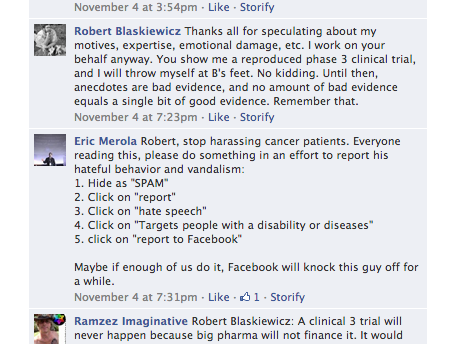
If it’s true, it is actually starting to become a thing with Merola. Merola once tried to have me kicked off of facebook by encouraging people to lie about me to admins, saying that I was directing hate speech against sick people. Really. He did that.

267110276850143232

You will remember that he is also the dude who contacted my employer about articles I had written and statements I had made, promised my employer that I would feature heavily in his shitty sequel, and then did not name me or show my face. It’s being a bully. It’s wrong. And every time he calls us slippery or dirty, I marvel at such a minimal level of self-awareness.

Lastly, he reportedly told an audience who had been subjected to his new flick that the reason people like me were not getting sued was because we’d make a big stink online and try to hide behind our “B.S. free speech.” This is perhaps the only thing he has been right about in public. Except for the BS part. That’s real, and you better realize it, kiddo.

RJB


Boston Marathon Conspiracy Theories

April 16, 2013

This is a preview of a report coming up on the live Google+ hangout webshow, The Virtual Skeptics, which will air in its entirety on Wednesday, 8PM Eastern at virtualskeptics.com. (It’s like Meet the Press with chupacabras.)

On Monday bombs went off at the finish line of the Boston Marathon. Of course, the police are keeping many details of the young investigation confidential, and that opens up a lot of airtime to speculate about who was responsible. This morning the news suggested that the investigation was trending toward domestic terrorism, so we’ll see if this line of evidence holds up.

But just because there is very little information available doesn’t mean that you won’t have wall to wall coverage, and this means that every little detail that was mentioned in front of a microphone will come under intense scrutiny and be tortured to the point of uselessness.

Actually, I see an opportunity here. Lately in the states, we’ve been getting weary of mass killings. I mean, it’s actually becoming dispiriting. And with that aggravation comes impatience with being fed crummy news, bogus analysis, and speculation. For me, it’s the false sense of confidence that the talking heads have that I find particularly irksome. And for that reason, I think, one group is finding itself increasingly despised, the group that is most sure of its boneheaded proclamations at times of genuine confusion and that regards human tragedy as a type of pornography: conspiracy theorists.

After Aurora and Sandy Hook many of us were plunged into a parallel twitterverse of conspiracy and paranoia. And you know what? The speculation is getting old. My first thought, was how is this going to be spun as an argument for gun control related false flag? Well, a false flag narrative seemed to arrive almost immediately, but Alex Jones and his cohort of sycophants and imbeciles, spun it in a surprising way, as a way of expanding the authority of the TSA into the streets. This is very odd. If you visit the TSA website you see that their mandate is to “protect the Nation’s transportation systems to ensure freedom of movement for people and commerce.” This means airport screening, baggage checking, bomb sniffing dogs, that sort of thing. They are not trained to execute martial law or patrol the streets; they couldn’t. The idea is as absurd as Alex Jones is loud. And absurd.

The first seed of a conspiracy theory came very shortly after the bomb went off just before 3PM. Within an hour and a half, a news outlet in Mobile mentioned that a local college cross country coach, Ali Stevenson who was participating in the Marathon had commented that there were bomb sniffing dogs on site before the explosion:

“They kept making announcements to the participants do not worry, it’s just a training exercise,” Coach Ali Stevenson told Local 15.

Stevenson said he saw law enforcement spotters on the roofs at the start of the race. He’s been in plenty of marathons in Chicago, D.C., Chicago, London and other major metropolitan areas but has never seen that level of security before.

“Evidently, I don’t believe they were just having a training exercise,” Stevenson said. “I think they must have had some sort of threat or suspicion called in.”

CNN reports a state government official said there were no credible threats before the race.

A major problem with his testimony, of course, is that he has never been in a race that exploded before. It seems only natural that salient measures of security are now receiving his attention after the Boston Marathon when they haven’t before. Basically, this is a post-9/11 world. There is security at all major events. The presence of bomb dogs is not surprising. Further I want to talk about “police spotters” on roofs. How does he know they were police spotters?

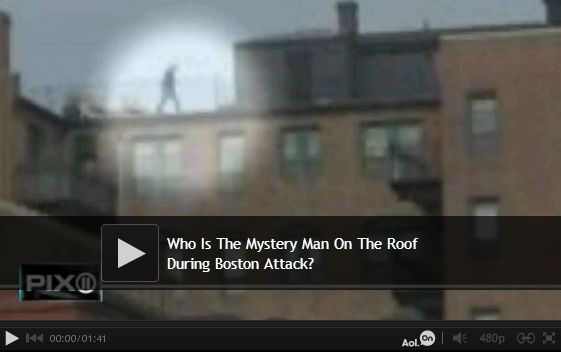
One person who actually was walking on a roof near the explosion has actually received a lot of attention on the Internet. Here he is:

ManOnRoof

What? You don’t see him? Here’s a close up of this sinister character.

Mysterymancloseup

I think it’s Bigfoot.

I understand that as much of the crime scene as possible needs to be documented, but that this guy was being circulated on twitter sort of befuddles me. There is nothing peculiar about someone being on the roofs along the Boston Marathon route. In fact, at the finish line, this is common. Actually the police had been enforcing rules against the gatherings after a young man fell through a skylight in 2011. So, it’s clearly not unexpected that there would be people on the roof.

One of Alex Jones’ defective correspondents, Dan Bidondi, managed to get into a couple of press briefings. First he asked what actually would have been a reasonable question. Had a threat been called in (referring to the Stevenson narrative of dogs and drills)? The answer? No. Security had been upped as a matter of course. At a later conference, the same guy asked the governor a question if it was a false flag operation to take away our civil liberties and let the TSA slip their hands down our pants. The governor said, “No, next question,” basically slam dunking the idiot back into irrelevancy.

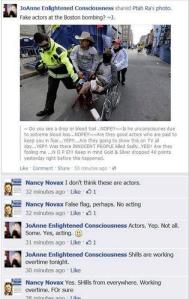
A trend being rehashed from the Sandy Hook conspiracy theories, and the idea of a “crisis actors,” which are supposed to be actors paid to act out drama. Take for instance this image, which comes from Peter Tierney’s collection of rather depressing facebook shots:

BombingHorrid

Crisis actors actually seem to me to be a manifestation of something that you often see in the conspiracy world, what Michael Barkun calls “fact-fiction reversals.” Conspiracy theorists see fiction as more real than reality, so they take the 1970s April fools “documentary” about elites secretly going to Mars (Alternative 3) as factual and think that aliens are putting story lines into the heads of Star Trek writers to prepare us for the alien invasions to come, while simultaneously believing that the news is being staged. For some reason, conspiracy theorists seem to be unable to believe in reality.

One last type of evidence that we see is searching for predictions of the event in popular culture. The only one I have seen so far is supremely cynical, in my opinion, which has to do with a recutting of a Family Guy episode so that it suggests Peter is detonating a bomb at the Boston Marathon. Seth MacFarlane has slammed the conspiracy theory, calling it “abhorrent.”

Actually, I’m hopeful that people are starting to pay attention to the horridness that is the conspiratorial mindset. One clever, civic-minded netizen grabbed up a number of likely conspiracy theory website domain names with the purpose of “keeping some conspiracy theory kook from owning it,” which gives me a small measure of hope.

RJB


Links:

The seeds of the Boston Marathon Conspiracy:

http://www.local15tv.com/mostpopular/story/UM-Coach-Bomb-Sniffing-Dogs-Spotters-on-Roofs/BrirjAzFPUKKN8z6eSDJEA.cspx

Alex Jones is horrid:

http://www.salon.com/2013/04/15/alex_jones_labels_boston_explosion_a_false_flag/

In the Infobunker with an Infochick. Also, Info.

http://www.youtube.com/watch?v=kQWH2epffQY&feature=youtu.be

“Hands in our pants” comment:

http://deadspin.com/the-first-question-for-the-governor-was-from-a-conspira-473064054

The man on the roof:

http://news.yahoo.com/blogs/lookout/boston-marathon-roof-man-mystery-012843805.html

Human toilet Mike Adams opines:

http://t.co/g9dzlrtprh

Family Guy predicted the bombing. Also, I hate Earth:

https://www.facebook.com/photo.php?fbid=328397323949106&set=a.220793581376148.48959.100003365224508&type=1&comment_id=739392&ref=notif&notif_t=comment_mention&theater

Seth MacFarlane replies to the Family Guy conspiracy:

http://tv.yahoo.com/news/seth-macfarlane-rips-edited-family-guy-clip-depicts-233737274.html


Linguistics ‘Hall Of Shame’ 5

April 13, 2013

Hi again, everybody! ‘Hall Of Shame’ continues!

5 VARIOUS WILD ANTIPODEANS!

Grahame Walsh, Ian Wilson and others have argued that the Bradshaw rock-paintings of the Kimberley in Western Australia, first seen by a European (Joseph Bradshaw) in 1891, can be attributed to a pre-Aboriginal Australian culture. The dating of these paintings has been heavily debated but they may be very early; and local Aboriginal people do not regard them as their ancestors’ work (or even as human in origin, though there are suggestions that their producers may have been the mysterious ‘Mimi’ people referred to in Northern Territory Aboriginal myths). Walsh argues that they represent the work of a pre-Aboriginal group who came to the area as long ago as 75,000 BP and developed the art-form during a sequence of cultures. He goes on to speculate as to where such a group might have originated, likening the art itself to certain African forms but more seriously suggesting that a negrito group such as those found on some Indian Ocean islands might have been involved. Such a group would later have been displaced or absorbed by Aboriginal populations. The movement of Aboriginal people into Australia appears to have been part of the earliest phase of Homo sapiens diffusion from Africa, and any suggestions that they were not alone in being the first inhabitants of Australia are obviously politically provocative (though they should, naturally, not be rejected on these grounds).

The controversial historian Keith Windschuttle (best known for his revisionist ideas about nineteenth-century Australia) argued, with Tim Gillin, in support of Walsh’s theory. Williamson and Gillin invoked some linguistic arguments; Colin Groves and Sean Ulm responded forcefully to Windschuttle and Gillin’s article from a mainstream anthropological standpoint; Gillin then responded in turn, denying the validity of some of Groves’ points and citing some more material by earlier authors (not linguists), including new linguistic arguments. However, these latter are partly based on Merritt Ruhlen’s ‘maverick’ ideas and are thus less persuasive than is suggested. In addition, the linguistic differences in the ethnically mixed area in question appear within normal variation limits for Aboriginal Australia. Of course, such mixing in historic times would be too recent for Walsh’s thesis, and probably too recent for Windschuttle as well.

In a very different vein, Rupert Gerritsen (of Dutch extraction) proposes that some groups of early Dutch sailors and passengers, marooned in Western Australia, had considerable influence on some of the coastal Aboriginal cultures. A fairly high proportion of the evidence offered is linguistic. This material has been informed by extensive reading in the discipline; but Gerritsen’s treatment nevertheless displays various naïveties and misconceptions. These include the usual popular but long outdated comparative linguistic methodology, use of minority/non-mainstream/outdated theories, very loose/inaccurate treatment of phonetics, phonology and spelling, implausible proposals on specific cases, some quite large factual errors, etc. The Aboriginal languages in question do seem to have some unusual features; but in most instances the case that these involve Dutch influence is not strong. (This is not to deny that Dutch and Dutch-speakers might have had some influence in the area.)

New Zealand was settled (by Eastern Polynesians, the Moriori and then the Maori) much more recently than Australia, to all appearances only in the last thousand years. The nineteenth-century writer Edward Tregear claimed to have proved that Maori, specifically, is related to Sanskrit and that the Maori and other Polynesians are really ‘Aryans’ who migrated to New Zealand from Europe via India. But Tregear’s linguistics was dated even in his own day; some of his claims appear ludicrous, notably his derivation of Maori verbs from the names of the associated animals, not themselves found in New Zealand: kauika ‘lie in a heap’ is said to be derived from Sanskrit gaus (‘cow’; cognate with the English word); the reference is to dung!

There is a body of markedly non-mainstream work regarding an ancient civilization and language known as Naacal, carried to Mesopotamia, Egypt and India in very remote ages by Mayan adepts, and a late-pre-historic world civilization centred on a Pacific continent known as ‘Mu’ (later submerged); Augustus le Plongeon and James Churchwood are the best-known exponents of these ideas, but many others have taken them up. Joan Leaf (recently deceased) was an amateur New Zealand historian and genealogist who accepted many of Tregear’s ideas and also accepted the reality of Mu, which supposedly gave rise to pre-Polynesian cultures in New Zealand and massive early diffusion more generally. In her self-published books, Leaf endorses Churchward’s ideas (including his claim that the Greek alphabet as recited is really a poem in Mayan!), and she regards Mayan as the language of Mu and the ultimate Ursprache. She uncritically treats orally transmitted stories and genealogies as very reliable, and her comparative linguistic and cultural methodology (shared with other current New Zealand diffusionists) is, as ever, far too imprecise and unsystematic; it reflects pre-scientific ideas.

Bryan Mitchell promotes the idea that there was Scots Gaelic settlement of New Zealand well before the eighteenth-century colonization. He upholds a diffusionist account of New Zealand history which minimizes the positive influence of the Maori, and accuses contemporary Maori of inconsistency in denying that some unearthed human remains and artefacts involve their own ancestors but still claiming control over them and thus preventing analysis. Mitchell believes that this involves a conspiracy involving politicians, academics and Maori activists, aimed at hindering the study of what they regard as strong evidence for pre-Maori settlement in New Zealand. This view is clearly exaggerated, although it is arguably true that it has become ‘politically incorrect’ to dispute the mainstream view that New Zealand was uninhabited until the Maori and other Polynesians began to arrive around 1000 CE. On the other hand, this is precisely what the evidence (reasonably interpreted) appears to suggest.

In respect of evidence which favours his own view specifically, Mitchell suggests that a number of Maori personal names and place-names used in Northland (the area north of Auckland) are in fact Gaelic-derived; he exemplifies with Gaelic Taine (ascribed to a Gaelic-speaking navigator who allegedly reached New Zealand) and Maori Tane (the name of a forest divinity), Gaelic Tara (used of high-set citadels) and Tara- as in the Maori region-name Taranaki, etc. He knows some linguistics, but his philology is of the usual amateur brand, and these examples are unsystematic and wholly unpersuasive.

References for specific writers on request! More next time!

Mark


Linguistics ‘Hall Of Shame’ 4

April 6, 2013

Hi again, everybody! ‘Hall Of Shame’ continues! I propose to include here some thinkers who for various reasons failed to ‘make it’ into my now-available book Strange Linguistics! There is always more ‘grist to the mill’!

4 ‘ALFERINK’

Like some authors discussed in Chapter 2 of my book, the Australian amateur author ‘Alferink’ proposes new etymologies for modern words which are held to be constructed out of basic, allegedly ancient individual sounds, syllables or other very short sequences; these have somehow retained fixed meanings (obscure to modern scholars and the general public) over long periods. I became aware of Alferink through a leaflet picked up at a ‘New Age’ street-emporium in Melbourne.

The main word of interest to Alferink is the very name Australia (for which alternative etymologies have also been proposed by authors such as Knapp; see Chapter 1 of my book). Alferink interprets Australis, the immediate source of the word Australia, as Au (‘gold’) + S (‘Sun’) + T (‘top’) + Ra (‘Sun’) + L (‘land’) + Is (‘is’). However, the form Australis clearly means ‘southern’ in Latin; and the form Australia (which first appears in English in 1625), has a clear associated meaning, ‘southern land’. Alferink does not offer any defence of his own interpretation against this very robust etymology.

Some of these very short morphemes appear to have been derived by Alferink from specific words or word-parts drawn from specific non-English languages. Thus, Ra is very close to the Egyptian name for the Sun-god, and Au is the international chemical symbol for ‘gold’, derived from Latin aurum. However, most of those consisting in orthographic form of only one letter are identified as each having the same meaning as a specific modern English word commencing with that letter. For example, S means ‘Sun’, T ‘top’, etc. It is not made clear why these specific words are selected rather than other words commencing with the same letters; but it appears that they may have been chosen in an attempt to explain the origin of the alphabetic letters used to write English, since the work is titled ‘Theory on Origin of Letters’. Alferink may have tried various different analyses of each longer word such as Australia until he came upon one in which he felt that meanings which he could ascribe to the individual letters together made up a suitable sense for the entire word.

Naturally, there are considerable problems with this theory. Firstly, Alferink offers multiple readings of some of the letters, inevitably if there are to be enough words of very short length to provide a vocabulary of adequate size (and compound words of manageable lengths). For instance, S may also be read as ‘swerve’. This obviously allows Alferink excessive freedom in proposing compound derivations for known, longer words. Secondly, it is not clear why, prior to the invention of the alphabet, the initial sound of a given word, or any other sound of the language in any context, should have suggested a particular letter-form. The forms of alphabetic letters are phonologically arbitrary; any motivation they have is semantic, by way of ‘acrophony’. (Acrophony involves the conversion of a logographic symbol to an alphabetic or abjadic letter representing the initial phoneme of the corresponding spoken word. For example, the form of the Hebrew/Phoenician abjadic letter beth (which later became Greek beta and Roman B) derives from a logographic (and pictographic) symbol resembling a house, which was used earlier to represent the Hebrew/Phoenician noun beth (‘house’), one very common word which has beth as its initial phoneme.) The idea that a letter-form can be explained in terms of the pronunciation of a word commencing with the relevant phoneme is wholly naive and confused. Overall, in fact, Alferink (like several other such writers) is naively folk-linguistic in treating letters rather than phonemes as primary.

Thirdly, the alphabet used to write English is of course much older than the English language; it developed initially out of regional versions of the Greek alphabet as a means of writing Latin, which is why it is called the ‘Roman alphabet’. Any explanations of the forms or pronunciations of the letter-names, or of the original pronunciations of the letters as used in words, must relate to Latin (or to Greek or the still earlier Phoenician), not to English, to which the letters were applied much later.

Fourthly, there are further unexplained complexities within Alferink’s system. He complicates the quasi-monophonemic morpheme-system (one letter per word-meaning) by introducing digraphs such as AB (‘original’; itself unexplained) and Au/Ra/Is (as cited above; the last of these is interpreted simply as the English word spelled in this way), and also other symbols, some established ones such as + (‘Christ’, etc.) and some novel ones such as a symbol for ‘woman’ representing a woman’s mammaries.

More next time!

Mark


Linguistics ‘Hall Of Shame’ 3

March 31, 2013

Hi again, everybody! ‘Hall Of Shame’ continues!

3 RONALD ENGLEFIELD (and others)

Ronald Englefield (1891-1975) was an English poet and philosopher. His major work,
Language and Thought, remains unpublished, though extracts appeared in the journal Trivium and this material is commented upon (often supportively) by other authors such as G. A. Wells and D. R. Oppenheimer. While Englefield’s specifically linguistic ideas have not met with wide acceptance, his criticism of religion and philosophy, published posthumously, was relatively well received.

Englefield was overtly critical of mainstream thought on language; he objected to the general pretentiousness and loose thinking which he found in much philosophical and linguistic work on the subject, and was especially critical of the effect on thinking of the use of words – in linguistics, literary criticism, religious studies and other philosophical domains – where they allegedly have no clear referent. Like Amorey Gethin (see my earlier comments), he went so far as to regard linguistics as a ‘bogus science’. However, Englefield’s skewed understanding of the writings of linguists (see below for an example) reduces the strength of his own claims.

On the origins of language, Englefield followed eighteenth-century Enlightenment thinkers such as Étienne Bonnot de Condillac, who argued that language evolved naturally from gestures. Englefield ‘explains’ how an animal little more intelligent than modern apes could ‘progress’ from a natural gesture language to invent a spoken and later a written language.

Some of Englefield’s views on these matters were opposed to those of other writers marginal to the mainstream such as Philip Ballard, who seem to believe (quite wrongly) that the grammar and other structural aspects of one’s first language are learned by explicit instruction (some of these writers, at least, appear to have been distracted by awareness of the teaching of STANDARD grammar to native speakers of non-standard dialects). In contrast, Englefield (though possibly confused in a broadly similar way; see below) argues that even modern humans can communicate WITHOUT the benefit of grammar.

Specifically, Englefield joined Wells and others in critiquing the linguistic ‘paradigms’ associated with Noam Chomsky. While Chomskyan thought does invite skeptical comment (again, see my earlier discussion), some of these critics of Chomsky are confused on some quite basic issues. For example: Englefield suggests (with Wells) that – if Chomsky’s view of the matter is correct – adult native speakers of a language who do not command the grammar of the relevant standard variety have either somehow FAILED to develop (pre-birth) the tendency to acquire grammar which Chomsky believes humans inherit, or HAVE acquired grammar but have then ‘lost’ or suppressed it. Wells and Englefield seem to have misunderstood what Chomsky means when he says that all normal human infants have access to a Universal Grammar (UG) enabling them to acquire the syntax and other aspects of their native languages very rapidly. The term grammar here (as elsewhere in linguistics) does NOT refer only to standard/formal grammar as taught in schools and socially endorsed as ‘good usage’ (etc.); it also includes the grammar of informal and indeed of non-standard usage as used naturally by many native speakers of each language. Native speakers who systematically produce non-standard forms have simply acquired a DIFFERENT grammar. The idea that non-standard or informal usage somehow LACKS grammar, while widespread among non-linguists, is folk-linguistic and does not stand up under careful examination; and Chomskyan linguists fully accept this.

The acquisition of the SPECIFIC grammars of individual languages (spoken or signed) clearly requires exposure to suitable data (as does the acquisition of their respective phonologies); not even a ‘hard-line’ Chomskyan would dispute this. However, some non-linguists (including some skeptics) assume that humans actually inherit some of the specifics of their parents’ or ancestors’ particular languages. Even a few scholars in relevant disciplines have adopted this stance, notably J.R.R. Tolkien, who was expert in philology (descriptive historical linguistics) but not in modern theoretical linguistics. Tolkien apparently believed, for instance, that he himself had acquired older varieties of English formerly used in his own home area (where his family had long resided) more readily than would students from other areas. No positive evidence of such effects exists, and, if they were genuine, they would in fact be difficult to explain in scientific terms. Children clearly inherit a language-learning propensity (specific, as asserted by Chomsky, or more general); but they obviously learn the individual languages, accents etc. used by their early carers and in their communities, and if they have no contact with their biological parents they know nothing of the languages used by them.

On Englefield specifically, see F.R.H. Englefield, Critique of Pure Verbiage: Essays on Abuses of Language in Literary, Religious and Philosophical Writings (G.A. Wells and D.R. Oppenheimer, eds) (La Salle, IL, 1990), and Language: Its Origin and Relation to Thought (Wilton, CT, 1977).

Mark


Hispter Demonologists and the Brotherhood of the Black T-shirt (Virtual Skeptics #32)

March 28, 2013

Now with extra Viking!

RJB (With thanks to Torkel for stepping up and filling in!)