FDR’s Paralysis: A Fortuitious Misdiagnosis?

January 21, 2011

A few days ago, an antivaxxer by the name Mayer Eisenstein made a comment that FDR may have gotten Guillain-Barre Syndrome (GBS) from a reaction to a flu shot. This, I found, is simply not possible because the first influenza vaccines were not available for far more than a decade after Roosevelt fell ill. So, big fake facts out of the big fake health guru.

Nonetheless, an interesting story lies behind Eisenstein’s painfully inaccurate mutterings. Roosevelt’s diagnosis of polio was made in 1921, after a string of misdiagnoses (the first doc said it was a bad cold, the second doc first diagnosed a blood clot in spine and then a lesion). The diagnosis that ultimately stuck is polio.

Several reasons appear responsible for the original diagnosis and why it remains a popular diagnosis today. First, Roosevelt fell ill in an era when polio was rampant, and several outbreaks had occurred in previous summers, mostly in cities. It’s a virus spread by interpersonal contact, either oral-oral or oral-fecal. Children are especially vulnerable. At the time FDR fell ill, polio was one of a fairly limited number of known diseases that caused flaccid paralysis, muscular weakening with no immediately obvious cause (like traumatic nerve damage).

After bouncing, metaphorically, from physician to physician, Roosevelt was diagnosed by Boston doctor Robert W. Lovett, who Pierce A. Grace describes “the leading American authority on polio.” He immediately diagnosed polio. It was a fairly late stage in the disease by this point, and he shortly thereafter began his slow recovery. I suspect that once his initial crisis had passed, the urgency of coming up with a diagnosis may have abated, but that’s speculation on my part.

Another factor that seems to have contributed to the story found in the biographies is the fact that on July 28, 13 days before he fell ill, Roosevelt had toured and visited a Boy Scout camp for disadvantaged city youth, something that Roosevelt delighted in. Historians have speculated, and this is the story that I was familiar with, that he contracted the disease while he was at the scouting event. I haven’t seen anything to suggest that there had been polio at the camp, but someone who is infected but not yet showing symptoms can be contagious. Regardless, it’s plausible that Roosevelt contracted polio at the camp, because the incubation period of the disease is between 3 and 35 days.

Other people have looked to the immense stress that Roosevelt had recently been under. He was in the middle of an especially saucy sex and vice scandal, in which a Senate Naval Affairs committee alleged that members of a vice-squad at a naval training facility under his command (and not necessarily AT his order) were reported to have engaged in sodomy while attempting to entrap homosexuals among recruits. Stress may leave people susceptible to infection, and perhaps there was a perfect storm of stress and filthy children that led to his contracting the disease, which was, after all fairly rare in adults.

And let’s not overlook FDR’s symptoms, the major one being progressive paralysis, which at its worst extended from his chest down and was ultimately permanent in his legs, accompanied by a fever (102 degrees). Marooned in a wheelchair for much of the rest of his life, Roosevelt certainly looked like a polio survivor (though remarkably few photos of the man in his wheelchair exist).

In the years following his disease, Roosevelt became an advocate of polio research and in 1938 founded the National Foundation for Infantile Paralysis, which became known as the March of Dimes and supported the development of Jonas Salk’s vaccine. As a sort of recognition of his association with that organization (in 1946, the “March of Dimes” was the group’s annual fundraiser), the disembodied head of FDR now graces the US dime:
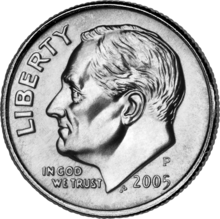
See?

Regardless of what condition Roosevelt suffered, his name will always be closely associated with polio.

As best I can tell, a serious challenge has been raised to the diagnosis of
polio. Now, as historical questions go, this is not as pressing an issue as, say, “Did the Holocaust happen?” but it is an interesting question, the type of point that you could possibly argue on Jeopardy if the question they accept is, “What is polio?” Hey, that could be worth money.

Anyway, in 2003 the Journal of Medical Biography published an article by Goldman, Schmalstieg, Freeman, another Goldman and yet another Schmalstieg (apparently the University of Texas was suffering from an outbreak of Goldman-Schmalstieg in 2003). The article, “What was the cause of Franklin Delano Roosevelt’s paralytic illness?” The researchers looked at 11 features of the disease reported in FDR’s medical record. Then they did something called Bayesian Analysis, which as I understand it is a retrospective analysis of probability based on a subsequently established incidence rate (in this case of disease) in a population. So, they were asking questions like, “What is the relative probability that someone FDR’s age would have contracted polio versus GBS?” and “What is the relative probability that someone with polio would have fever versus someone with GBS?” (GBS, by the way, is a condition where the immune system, which has started fighting an infection, mistakenly starts to attack parts of the nervous system. Dr. House is always ruling it out.)

By comparing the features of FDR’s disease, the Goldman-Schmalstieg-infected Freeman makes a strong case that the GBS hypothesis is worth serious consideration (from Goldman):
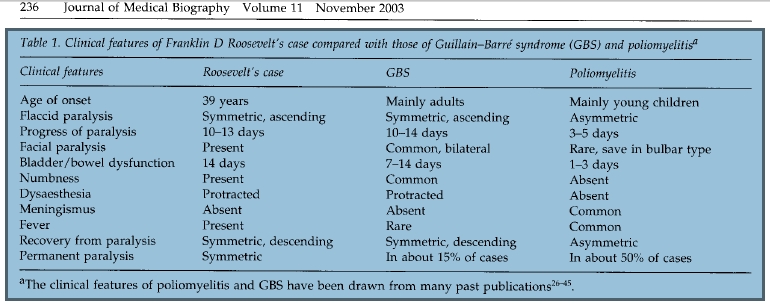
Click to embiggen!

It really does seem as if most of FDR’s symptoms are most commonly associated with GBS. This is not, however, conclusive diagnostically. At the same time, it seems to me that a good Bayesian analysis would need to accurately determine the prevalence of the diseases and symptoms at the time, and I have no way of assessing that and still maintain a blog. The only way to do be sure of what Roosevelt had would be to tap his spine. Modern interventions gor GBS had not yet been developed, and the authors conclude that it is unlikely his treatment would have changed if FDR had a different diagnosis.

The nearly complete elimination of polio from the planet is a powerful testimony to the efficacy of vaccination, and one may wonder how the course of history might have been altered if Roosevelt’s intense interest in polio research had been redirected toward autoimmune disorder research. Whether he had it or not, FDR will always be closely associated with polio and the search for the cure.

RJB

References

Goldman, Armond, et al. “What Was the Cause of Franklin Delano Roosevelt’s Paralytic Illness?” Journal of Medical Biography 11.4 (2003): 232-240.

Grace, Pierce A. “With Reluctant Feet–The Story of FDR’s Struggle with Polio.” Journal of the Irish Colleges of Physicians and Surgeons 21.1 (1997): 58-61.


Letters in the Eyes of the Mona Lisa?

January 20, 2011

The recent accounts in the media that an Italian researcher had uncovered tiny letters in the eyes of the Mona Lisa seemed suspicious, especially since in no account that I have seen has anyone bothered to print a picture of the supposed micro-signature. Well, Joe Nickell has seen this sort of claim before, and he has some background on the people who are making this extraordinary claim.  (Spoiler: They harbor  all manner of  improbable beliefs.)

RJB


That new music the kids are listening to

January 8, 2011

I swear I don’t understand the kids’ hippity-hop and their wicked crazy doggerel. You can’t hardly understand what they’re saying even, but I presume that they are angry youth rapping about life on the hard streets. Between London and Canterbury.

RJB


Skepticism and the Humanities

January 7, 2011

Over the last five years, I have become increasingly involved in a community intensely interested in the popularization of science and critical thinking, the skeptic movement. Innumerable skeptically-oriented meetup groups have appeared in cities all over the world, and they are coordinating with one another. If you survey the skeptical movement, you will see that we cluster around (or at least frequently walk past) many of the same online water coolers–Phil Plait’s Bad Astronomy blog, the JREF site, the National Center for Science Education, the Skeptics’ Guide podcast, Brian Dunning’s Skeptoid, the Skeptic Zone Podcast, Skepticality and any number of other podcasts. We attend The Amazing Meeting Las Vegas, The Amazing Meeting London, The Amazing Meeting Australia, Dragon*Con, NECSS, and numerous other regional, national, and international conferences on science, skepticism and critical thinking. We have collectively taken up a number of political causes that are opportunities to reintroduce science and critical thinking into the daily lives of our fellow citizens, including combating antivaccine wackloonery, debunking the bizarrely popular holographic wristband phenomenon, and checking the often dangerous claims of self-proclaimed natural health gurus.

A major part of what binds all of these people together is a deep appreciation of the importance of evidence and reason, to which I subscribe without reservation. However, something that is often missing from the discussion is an appreciation of the critical thinking that goes on in the humanities. In fact, I occasionally even encounter outright hostility to the humanities (often, I think, in association with the hilarious Sokal Hoax). And don’t get me wrong, there is some woo in the humanities (you will hear a lot about that on this site in the months to come), but most academics in the humanities strive to come to a better understanding of the human experience through examining evidence. Critical thinking, that is, is not the exclusive domain of the sciences, and we want to gently remind fellow skeptics of that.

Another reason to recognize the close relationship of skepticism and humanistic inquiry is that much of the formal training that high school and college students receive in critical thinking and argument is in English classes. Through the nineteenth century, the skills associated with argument (on most topics) were folded into a topic known as “rhetoric” and were geared at creating men (yes, just men) who would participate in public life. The humanities have since fractured and specialized (perhaps as a reaction to the simultaneous specialization of disciplines in the sciences), and courses in rhetoric and argument have become increasingly focused on producing and reacting to written texts. This is why students receive so much of their formal training in argument in English classes, communication departments and writing programs. After freshman English, students practice producing extended syllogistic arguments, finding and citing reliable sources, and developing style and a sense of audience in term papers for their history, theology, philosophy, cultural studies, and literature classes. We must cultivate an appreciation of these skills across the disciplines, and instructors should keep these goals in mind as they train students to become capable, independent learners.

Another reason that the apparent exclusion of the humanities from skeptical circles seems forced and artificial to me is because the most skilled communicators in the movement, including James Randi, Pamela Gay, Phil Plait, the Mythbusters, and innumerable podcasters, authors, bloggers and educators are all participating in the production of culture–they are immersed in and generating the stuff that researchers in the humanities groove on! In many cases, they actually are professional artists, like George Hrab and “Surly” Amy Davis Roth. And the easy fit of a Skeptical track into the cultural carnival that is Dragon*Con suggests to me that the producers and consumers of pop culture (and so-called “high” culture, if you care to make the distinction) and the people who are interested in critical thinking overlap substantially. And I can even think of a couple of high profile skeptics who have advanced academic degrees in the humanities, including Karen Stollznow (linguistics) and Joe Nickell (a Ph.D. in English).

My interest in developing this site is both professional and personal. Professionally, I look forward to forging relationships with other scholars across the disciplines and benefiting from their expertise and enthusiasm. Personally, I derive immense satisfaction from my research into fringe and unorthodox areas of study and find the urge to share what I learn with others almost impossible to resist.

If you are a researcher in the humanities or artist who would be interested in joining or contributing to this project, contact us through this website or via my gmail address, rjblaskiewicz. A sample of the sorts of the topics that we plan to cover include:

  • Freud and the Academy
  • Are memes real things?
  • Postmodernism and science.
  • Academic fetishes
  • So, which writers and artists were actually gay, and how much does it matter?
  • Conspiracy theory and pseudoscholarship
  • Biblical authorship (David’s Psalms, Moses and the Torah, Gospel writers)
  • The rhetoric of science.
  • Was Shakespeare Catholic? Jewish? Shakespeare?
  • Did Dan Brown get anything right?
  • Creationists and the abuse of non-Christian mythology
  • Monsters in history, art, and literature
  • Psychology and literature
  • Isn’t oral history just anecdotal evidence?
  • Enemies foreign, domestic, and imagined
  • Persuasion and propaganda

And lots more, including book reviews and commentary on the depiction of the humanities in popular culture. Additionally, if you have a topic that would like to see added to these, we’ll be happy to add it to the queue.

RJB


Spear Shaking!

January 5, 2011

In the first post of this brand-spanking new website, Eve Siebert addressed some of the problems that have dogged the arguments of people who do not think that the William Shakespeare who everyone at the time referred to was really “THAT” William Shakespeare. And we are immensely gratified to see people visiting and commenting on the site. We want to reply to one commenter in particular, Howard Schumann, who left a long list of questions for us to answer.

It is important to remember, of course, that ours is not the extraordinary claim. We know this because it is in accord with the best evidence that we have. Not questions about things we don’t know, but documents that point to a particular guy named named William Shakespeare, the broad strokes of whose life we can sketch out using business and legal documents, contemporary commentary, and an understanding of the history and culture of London and England during the period in question. Howard has asked us to answer a number of questions that he harbors, and that’s fine. But I do this as a courtesy, not because it is an obligation. It is always the responsibility of the person making the extraordinary claim to demonstrate the truth of their proposition with positive evidence for the claim. I’m still waiting for that. Regardless, Schumann says:

Thanks but please don’t try to force an answer where the thing is simply shrouded in mystery. Some of these questions may never be answered.

It’s true, some things won’t be answered, but that’s true about all sorts of historical events and literary creations and…everything. But in case, I would contend that there is a lot less mystery than Oxfordians seem to think there is.

So, on to the commentary and questions.

My point is that we have so much documentation for lesser writers, do not you think it a bit odd that we have none for the greatest writer in the English language?

You are factually wrong here. Factually. Wrong. I have in front of me 30 pages of documents from the time. Did you look at the appendices of the Norton Shakespeare? What about the line from William Basse’s elegy, “Mr. Wm. Shakespeare/he dyed in Aprill 1616”? He says: “Sleep, rare Tragaedian Shakespeare, sleep alone.” Actually says the guy was a tragedian and attaches a name and a date of death. Why does that not count as evidence? This is what I meant by “positive evidence for the claim.” The will and testament that we have is dated 25 March 1616. We have the royal Letter Patent that names Shakespeare at the adoption of the Chamberlain’s Men as the King’s Men. And there are pages of the stuff in the back of Norton edition (and that’s not even the good edition!). Look at it. Heck, even Greene famous snitty “upstart Crow, beautified with our feathers” comment is complaining in 1692 about how this guy without a formal education is doing so dang well–and he makes an allusion to Henry the Sixth, 1.2.138. He’s linking the guy (whose name he puns in “the only Shake-scene in a country”), his rise (despite his lower social status) and the plays–he also calls him a Johnannes fac totum a “jack of all trades”! This suggests the broad expertise that you say he can’t have. 30 pages worth of the primary documents you say do not exist can be found in Appendix B of the Riverside Shakespeare.

I’m not sure what the puns on the name Will are about but they are certainly not strong evidence that the author was William of Stratford. De Vere was also called Will.

Do you know who was also called Will? Will Shakespeare. And in Sonnet 136, he distinctly says his name is Will:

Make but my name thy love, and love that still,
And then thou lovest me, for my name is Will.

I would agree, however, that based on the content of the poems, you can glean almost no actual biographical material (for reasons I will discuss below), but it’s not nearly as clever unless his name is actually Will.

Perhaps you could address the following questions:

Sure. I’ll take a swing at ‘em.

1. The Sonnets were published in 1609 bearing the most personal and intimate details of a man’s life. At a time when the author was allegedly still alive, he offered no dedication, took no part in its publication nor did he attempt to stop publication. How is that possible?

OK, publishing was different then, but, the Norton Shakespeare makes a good argument that he may have been involved (p 1921). Basically, they make the case that they came out through a respectable publisher who had a good relationship with the acting company, it was registered officially at the Stationers’ Register: “Unauthorized publication would have jeopardized those connections. Moreover, a publisher did not have a right to include the author’s name without the author’s permission, and hardly any texts of the time that were registered for copyright violated this regulation. If Thorpe had done so, he would have risked a significant financial penalty that he could ill afford.” Now, there are some assumptions here, but only that “Thorpe was a good enough business man to not get sued poor.”

2. The dedication to the Sonnets is written to our “ever-living author”, a tribute almost always reserved for someone who is no longer alive. Please explain?

The dedication on the sonnets is as follows:

TO. THE. ONLY. BEGETTER. OF.
THESE. ENSUING. SONNETS.
MR. W.H. ALL. HAPPINESS.
AND. THAT. ETERNITY.
PROMISED.
BY.
OUR. EVER-LIVING. POET.
WISHETH.
THE. WELL-WISHING.
ADVENTURER. IN.
SETTING.
FORTH.

T.T.

So, to the “begetter”, the publisher is wishing eternal happiness, and who grants that? Oh, yeah, that’s God. The “ever-living poet,” or immortal creator.

3. In Sonnet #125, the author claims to have “borne the canopy”. This refers to carrying the canopy over royalty during a procession. Oxford was known to have done this on several occasions. A commoner such as Shaksper would not have been allowed within 1000 feet of the monarchs. Please explain.

This is an example of cherry picking. Even quote-mining, actually. If you read the whole sentence you’ll find that it actually confirms the opposite of what you think it means:

“Were’t ought to me I bore the canopy,
With my extern the outward honouring,
Or laid great bases for eternity,
Which prove more short than waste or ruining?”

This is saying, in essence, “Would it matter to me if I had the status to carry the canopy”? You see, it’s in the conditional, doesn’t say that he has carried the canopy, and even if it did, it’s not an autobiography.

4. The first 100 or so verses of the sonnets entreats a fair young man to marry. Scholars agree that the fair young man refers to Henry Wriotheseley, the 3rd Earl of Southhampton. No commoner such as Shaksper of Stratford would be allowed to address an Earl in such a manner. Please explain.

Scholars, in fact, do not agree on this. Now, some may jump the gun and accept that it was Southampton, but we don’t have any real evidence linking Southampton to the sonnets (now, to the narrative poems, yes, but only as dedicatee, not necessarily as patron). And, again, not autobiography.

5. Shakespeare without question was one of the greatest if not the greatest writer in the English language, yet his daughters were illiterate. How is this possible? I know the rate of literacy of women in that time was very low, but this is not a logical explanation.

Why is that not a logical explanation? It would be more extraordinary if they had been literate. Also, my father is an obstetrician, yet I rarely perform surgery. Furthermore, we don’t have any reason to think…almost anything about his home life. But for most of his professional career he was in London and the daughters were in Stratford. End of story, really.

6. None of Shaksper’s relatives from Stratford ever claimed that their relative was the famous author. Explain.

We don’t know that. How can you say that they never claimed that? All you can say is that we don’t have documentation. That’s a different matter all together. This is what we call the argument from ignorance, a logical fallacy that runs: “I don’t have evidence that X is true; therefore X is not true.” This is the opposite of having what I called “positive evidence.”

7. Dr. Hall was the husband of Susan Shaksper, daughter of William. In his journals he refers to famous men he knew and treated, yet never once mentions his wife’s illustrious father. Please explain.

People were generally not interested in biographies of Shakespeare at the time any of his immediate relatives were alive. James Shapiro (p 49 of Contested Will) mentions that a vicar (presumably in the Statford area, my source says “local”) who had an interest in Shakespeare intended to contact Judith, the younger daughter, about her father, but she died in 1662 before any meeting took place, it seems. Only one of Hall’s notebooks survived, and maybe he was in there. Maybe he never treated Shakespeare–these were, after all, medical journals and not literary journals. This is another argument from ignorance.

8. The sonnets are widely accepted to have been written in the early 1590s at a time when the man from Stratford would have been in his late twenties, yet his sonnets tell us that the poet was in his declining years when writing them. He was “Beated and chopped with tanned antiquity,” “With Time’s injurious hand crushed and o’er worn”, in the “twilight of life”. He is lamenting “all those friends” who have died, “my lovers gone”. His is “That time of year/When yellow leaves, or none, or few, do hang/Upon those boughs that shake against the cold.” Please explain.

Poems. Not autobiography. They may have been written in character, you know.

9. The sonnets that most contradict Will of Stratford’s life story are those about shame and disgrace to name and reputation. Here Shakespeare’s biographers have nothing to go on. The sonnets talk about a man who was in disgrace from fortune and men’s eyes. What biographical connection is there to the life of the man from Stratford that would have disgraced him and please don’t tell me that the Sonnets were merely literary exercises? It is not credible.

Are you saying that his poems have to be autobiographical? Because they don’t. I mean, how do you tell what’s real and what’s not? Why would the “greatest writer in English” be forced to only write autobiographically? I suspect that you need it to be true. Why not commit to this method of analysis and say that the author of A Midsummer Night’s Dream was a fairy because there are fairies in it?

10. Thomas Nashe and Gabriel Harvey were literary pamphleteers who wrote about the most prominent literary figures of the day and have many references to the Earl of Oxford, yet are strangely silent on any writer named Shakespeare. Why?

I see that Nashe wrote about 1 Henry IV, and Harvey wrote about that Hamlet, Venus and Adonis and Lucrece. You can find these reprinted in the Norton Shakespeare.

11. After two successful poems were published under the name of Shakespeare (Venus and Adonis and The Rape of Lucrece), all the plays were published anonymously for five years until 1598 when William Cecil died. Is there some cause and effect going on?

No.

(In voice of Monty Python’s Bruces) THERE IS NO COMMENT NUMBER TWELVE!!!

13. Many of the known sources for the plays were books in Italian, French, and Spanish that were untranslated at the time. There is no evidence that Shakspere could read any language other than English and there is even some question whether or not he was literate since nothing of his writing remains. There is no literary paper trail of any sort. While Oxford was fluent in those languages, what is there in the known background of the man from Stratford that could explain this knowledge?

Yeah, another argument from ignorance. I don’t have my high school Spanish vocab quizzes, but I still speak Spanish. He would have had Latin (probably) and you are talking about latinate languages. I mean, it’s not that hard for someone who is actually a genius to teach himself a language. And literate? Really? That’s like saying because my grandmother didn’t leave any letters, she was probably illiterate. Or that because someone doesn’t know who their dad is is a reason to believe that they had no father. No. No.

Now, you could persuade me, but you’d need really good evidence. Like, any of Shakespeare’s poetry in Oxford’s hand. Or a single instance of a contemporary discussing the big funny authorship hoax. Or evidence that the Zombie of Oxford was producing smash hits almost a decade after he had died. A note by Francis Meres explaining why he mentions both Shakespeare and Oxford as the best poets for comedy in his Palladis Tamia, or Wit’s Treasury. Then we can talk. But first look at those sources I mentioned, otherwise, you will labor under the misapprehension that there is no documentary evidence for Shakespeare. That’s not fair to you and leads to dubious conclusions.

RJB/ES