Creation “Science” in the Writing Classroom

February 1, 2011

Several years ago, one of my writing assignments was for students to find an op-ed they disagreed with and write a rebuttal. One student picked as her article a letter from the editor of Nature or Science entitled, “The Logical Fallacies Creationists Make.” It was a list of about 20 arguments commonly heard from creation advocates (or “intelligent design” advocates) followed by a critique of each one. In my student’s paper, she first named each fallacy and then made it. For instance, in response to the old equivocation that “evolution is only a theory” (a scientific theory is not a “guess” in the sense that we colloquially use the term “theory”), she offered as a rebuttal, “But evolution is only a theory.” I decided, as I read her paper in horror, that I would add evolution and creationism to my list of forbidden paper topics–like “abortion,” “gun control,” and “campus drinking policies.”

Last semester, however, given that I was teaching a writing class called “Writing About Science and Pseudoscience,” it seemed irresponsible for me to avoid what is perhaps the most controversial and socially relevant pseudoscience in the U.S., intelligent design.

I also made it clear that I in no way intended to offend or comment on anyone’s religious beliefs (teaching at a public university, I was acutely aware of my responsibilities to protect the religious rights of my students). At the same time, a guiding tenet of my class was that if you make claims about the observable world and represent what you do as science, your assertions are open to scrutiny and evaluation, as all science is open to challenge. Indeed, nothing purporting to be a science can justifiably claim to be protected religious speech. So, I made it clear to students that I did not intend to critique “creationism,” but that I was looking specifically at “creation science” a.k.a. “intelligent design.”

I had selected two movies for students to watch about Intelligent Design. The first was Ben Stein’s Expelled: No Intelligence Allowed. The second was Judgment Day: Intelligent Design on Trial, an episode of NOVA that told the story behind the First Amendment case in Dover, PA. I had students watch Expelled first and then watch the NOVA episode. (Many students opted to watch these online or in their dorms instead of at the optional evening movie viewing sessions). Soon students started sending me emails indignantly protesting the treatment of advocates of intelligent design at the hands of “Big Science” (a term that Stein uses). One student wrote to me to ask about why people were being kicked out of labs, especially when they had good evidence and can prove it.

As you can see, one of the risks that you run when you teach using extraordinary claims is that some students may find the claims of propagandists like Stein convincing. But this is precisely why well-produced but ill-evidenced works should be addressed in an environment where all evidence is interrogated and all claims are challenged.

During the next class period, I discussed Expelled. I don’t like to simply lecture in a writing class–I find that the give and take of discussion is usually more productive–but Expelled leaves out a lot of information relative to a full understanding of the issues, including the state of evolutionary theory (very, very robust), and the status of intelligent design as a pseudoscience. In a nutshell, Stein’s argument is that Big Science is suppressing Intelligent Design, a viable scientific theory being practiced by reputable scientists, by denying ID proponents tenure, research and publication opportunities, in favor of what it knows is a failing theory (evolution) for ideological, probably atheistic, reasons. Stein argues that this is dangerous because it could ultimately lead to social abuses of the type perpetrated by the Nazis. My students agreed that this was a fair statement of the essential argument of the movie. We find in this thesis a number of testable claims, and in my lecture I took each one in turn.

It’s hardly a fair fight to put the cumulative weight of the evidence from so many scientific disciplines that suggest all life descended from a common ancestor against the bald assertion that “this animal or structure could only have been put together by an intelligence.” I sketched out the robust evidence that we have that suggests the deep, interconnected history of life on the planet, not a jot of which was mentioned in the movie. Indeed, the best argument that Stein was able to muster in the movie was a story by some supposedly maligned victim of the Big Science cabal that, after a few beers, evolutionists admit that the theory is in trouble. As we had already discussed the value of anecdote, my students asked a number of relevant questions, for instance, “Who said that and did you talk to them?” (Answers: They don’t say and probably not.)

A useful resource for teaching material like Stein’s is, as always, the National Center for Science Education. Their site Expelled Exposed is an invaluable compilation of background information, putting Expelled‘s claims in context, and satisfied most of my students, I suspect, that the claims of persecution were likely exaggerated. Another useful source about the wealth of evidence for evolution is Richard Dawkins’ The Greatest Show on Earth.

Later in the section on evolution, I included perhaps the most eloquent argument on behalf of design, William Paley’s Natural Theology, in which he develops the famous watchmaker analogy. I included it because students deserve to be exposed to the best arguments, not merely lame and deceitful ones like Stein’s. (In class, I suspended judgment about whether or not Stein was deliberately deceitful in the movie. When students asked, I said I didn’t know. At any rate, Stein’s intent was not the point.)

The last reading I included was a chapter of Richard Dawkins’ The Blind Watchmaker. While flipping through Dawkins looking for something suitable for the class, I found myself rejecting potential readings because of his tone, which can be, how you say, condescending and occasionally bracingly so? I did not want to offend my students, but it occurred to me that censuring Dawkins’ readings on the off-chance they would offend a student would give my students an inaccurate and decidedly biased view of the debate over the teaching of evolution, so I picked a chapter at the end of The Blind Watchmaker and ran with it.

Now, I realized that it was entirely possible that despite my best efforts to limit the scope of my lectures to creation science, a student might take offense at what I said and complain to my superiors. For this reason, I made sure to record every class and alerted my students to the fact that I was recording my talk.

Because I was especially interested in what the students thought of the talk about Stein’s movie, the first of six classes over two weeks, I used the peer-review and final project writing groups to allow students to submit their feedback anonymously. I asked them to email a paragraph to each group manager (my principle contact during the semester as they did their group projects) who would compile the responses into a single email without identifying information. The response to the lecture was decidedly positive, and I got a sense that students fell all along the religious spectrum between young-earth creationist to atheist (I didn’t ask).

Most surprising and pleasing about these responses was my students’ take on my own religion. When they ventured to interpret the lecture in light of what they perceived my religion to be, they revealed that they had no idea what my religious position was. Everybody who ventured a guess guessed differently, and that made me very happy.

Another choice I made that had an unexpectedly pleasant pedagogical outcome came about by giving a lecture about a controversial topic without taking hardly any questions–there were severe time constraints. By the next class students were bursting with questions and dying to jump in. I can say that without a doubt the most lively conversations I have ever had in my teaching career came in the period after I discussed Stein and the evidence of evolution. I played traffic cop, more or less, and let the students duke it out.

I won’t shy away from teaching evolution/ID again. It was one of the most rewarding, productive and invigorating subjects I have ever worked into a syllabus.

RJB


FDR’s Paralysis: A Fortuitious Misdiagnosis?

January 21, 2011

A few days ago, an antivaxxer by the name Mayer Eisenstein made a comment that FDR may have gotten Guillain-Barre Syndrome (GBS) from a reaction to a flu shot. This, I found, is simply not possible because the first influenza vaccines were not available for far more than a decade after Roosevelt fell ill. So, big fake facts out of the big fake health guru.

Nonetheless, an interesting story lies behind Eisenstein’s painfully inaccurate mutterings. Roosevelt’s diagnosis of polio was made in 1921, after a string of misdiagnoses (the first doc said it was a bad cold, the second doc first diagnosed a blood clot in spine and then a lesion). The diagnosis that ultimately stuck is polio.

Several reasons appear responsible for the original diagnosis and why it remains a popular diagnosis today. First, Roosevelt fell ill in an era when polio was rampant, and several outbreaks had occurred in previous summers, mostly in cities. It’s a virus spread by interpersonal contact, either oral-oral or oral-fecal. Children are especially vulnerable. At the time FDR fell ill, polio was one of a fairly limited number of known diseases that caused flaccid paralysis, muscular weakening with no immediately obvious cause (like traumatic nerve damage).

After bouncing, metaphorically, from physician to physician, Roosevelt was diagnosed by Boston doctor Robert W. Lovett, who Pierce A. Grace describes “the leading American authority on polio.” He immediately diagnosed polio. It was a fairly late stage in the disease by this point, and he shortly thereafter began his slow recovery. I suspect that once his initial crisis had passed, the urgency of coming up with a diagnosis may have abated, but that’s speculation on my part.

Another factor that seems to have contributed to the story found in the biographies is the fact that on July 28, 13 days before he fell ill, Roosevelt had toured and visited a Boy Scout camp for disadvantaged city youth, something that Roosevelt delighted in. Historians have speculated, and this is the story that I was familiar with, that he contracted the disease while he was at the scouting event. I haven’t seen anything to suggest that there had been polio at the camp, but someone who is infected but not yet showing symptoms can be contagious. Regardless, it’s plausible that Roosevelt contracted polio at the camp, because the incubation period of the disease is between 3 and 35 days.

Other people have looked to the immense stress that Roosevelt had recently been under. He was in the middle of an especially saucy sex and vice scandal, in which a Senate Naval Affairs committee alleged that members of a vice-squad at a naval training facility under his command (and not necessarily AT his order) were reported to have engaged in sodomy while attempting to entrap homosexuals among recruits. Stress may leave people susceptible to infection, and perhaps there was a perfect storm of stress and filthy children that led to his contracting the disease, which was, after all fairly rare in adults.

And let’s not overlook FDR’s symptoms, the major one being progressive paralysis, which at its worst extended from his chest down and was ultimately permanent in his legs, accompanied by a fever (102 degrees). Marooned in a wheelchair for much of the rest of his life, Roosevelt certainly looked like a polio survivor (though remarkably few photos of the man in his wheelchair exist).

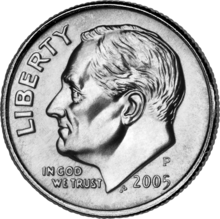
In the years following his disease, Roosevelt became an advocate of polio research and in 1938 founded the National Foundation for Infantile Paralysis, which became known as the March of Dimes and supported the development of Jonas Salk’s vaccine. As a sort of recognition of his association with that organization (in 1946, the “March of Dimes” was the group’s annual fundraiser), the disembodied head of FDR now graces the US dime:

See?

Regardless of what condition Roosevelt suffered, his name will always be closely associated with polio.

As best I can tell, a serious challenge has been raised to the diagnosis of
polio. Now, as historical questions go, this is not as pressing an issue as, say, “Did the Holocaust happen?” but it is an interesting question, the type of point that you could possibly argue on Jeopardy if the question they accept is, “What is polio?” Hey, that could be worth money.

Anyway, in 2003 the Journal of Medical Biography published an article by Goldman, Schmalstieg, Freeman, another Goldman and yet another Schmalstieg (apparently the University of Texas was suffering from an outbreak of Goldman-Schmalstieg in 2003). The article, “What was the cause of Franklin Delano Roosevelt’s paralytic illness?” The researchers looked at 11 features of the disease reported in FDR’s medical record. Then they did something called Bayesian Analysis, which as I understand it is a retrospective analysis of probability based on a subsequently established incidence rate (in this case of disease) in a population. So, they were asking questions like, “What is the relative probability that someone FDR’s age would have contracted polio versus GBS?” and “What is the relative probability that someone with polio would have fever versus someone with GBS?” (GBS, by the way, is a condition where the immune system, which has started fighting an infection, mistakenly starts to attack parts of the nervous system. Dr. House is always ruling it out.)

By comparing the features of FDR’s disease, the Goldman-Schmalstieg-infected Freeman makes a strong case that the GBS hypothesis is worth serious consideration (from Goldman):

Click to embiggen!

It really does seem as if most of FDR’s symptoms are most commonly associated with GBS. This is not, however, conclusive diagnostically. At the same time, it seems to me that a good Bayesian analysis would need to accurately determine the prevalence of the diseases and symptoms at the time, and I have no way of assessing that and still maintain a blog. The only way to do be sure of what Roosevelt had would be to tap his spine. Modern interventions gor GBS had not yet been developed, and the authors conclude that it is unlikely his treatment would have changed if FDR had a different diagnosis.

The nearly complete elimination of polio from the planet is a powerful testimony to the efficacy of vaccination, and one may wonder how the course of history might have been altered if Roosevelt’s intense interest in polio research had been redirected toward autoimmune disorder research. Whether he had it or not, FDR will always be closely associated with polio and the search for the cure.

RJB

References

Goldman, Armond, et al. “What Was the Cause of Franklin Delano Roosevelt’s Paralytic Illness?” Journal of Medical Biography 11.4 (2003): 232-240.

Grace, Pierce A. “With Reluctant Feet–The Story of FDR’s Struggle with Polio.” Journal of the Irish Colleges of Physicians and Surgeons 21.1 (1997): 58-61.


Antivaccine Rhetoric vs. History

January 17, 2011

Tonight, Mayer Eisenstein hosted a webinar (shudder) about vaccines. Ostensibly, the online event was to tell people how to write vaccine exemption letters. It was a Cirque du Soleil-sized extravaganza of clownishly sloppy logic and at-best-half-truths. I’ve watched some webinars before, and they are simply online Powerpoint presentations with audio. We see the speaker’s screen while they talk, and there is usually a chat room where the audience can interact. I have no idea how well attended Eisenstein’s event was, but it lasted for an hour and ended with about a 10-minute sales pitch for his miracle cure, Vitamin D, and his books.

The basic argument that Eisenstein was pushing was “use the religious protections provided by the First Amendment to justify vaccine exemption,” a cynical use of religion if I have ever seen one (and I’ve seen several). I thought that I would see how cynical he could possibly be, so in the chat room I asked, “Is there an option for atheists to claim religious objections?” Heehee.

His answer?

“I think all lawyers are atheists so [unintelligble] when they get in front of a jury they say, ‘I pray that the jury gives a verdict for me.’  Oh, or ‘I religiously believe that I believe this person is negligent or guilty.’ So I had a lawyer tell me that he felt the religious exemption had nothing to do with the belief in God, that a personal, specific religious belief–if you look up the word ‘religious,’ it’s very closely held position, uh, believing that there is some higher order or higher power, and you know, I think it’s close enough. If it’s not close enough for you, well, I’m not sure how you would go about it. Even if there’s a belief that there’s a natural order in the universe, that in itself is a religion. Don’t take the word religion to be so narrowly defined. Take a more, ah, expansive position.”

You could look at this answer in a couple of ways. The first way to see it as a string of loosely connected statements of a person on their way out, and while that is tempting, we do far more damage to the cause of public health when we underestimate our ideological adversaries. Even this guy.

But if you look at the underlying logical structure of that first part, he seems to be saying, “Well, atheist lawyers often pretend like they have religion to appeal to juries. Wink wink, nudge nudge.”

I am also bemused by the way he went straight to “negligent,” as his medical practice, according to the Chicago Tribune

“was on the losing side of one of the largest U.S. jury verdicts — $30 million — ever awarded to the family of a newborn in a wrongful-death suit.”

Anyway, then he tries on another fundamentally cockamamie argument, that “religion” doesn’t really mean “religion.” It really just means, “closely guarded belief.” This, of course, inflates the meaning of the word “religion” to almost complete uselessness: “Even if there’s a belief that there’s a natural order in the universe, that in itself is a religion.” Yeah, only if you are an intelligent design advocate, bucko. So sayeth the courts.

Despite his willingness to see the First Amendment misapplied, he did make some rather staggering comments that do fall directly under the purview of this new skeptical humanities site. He made a rather large claim when someone asked a question about diseases like polio:

“Well, that opens up a big can of worms. Because, I don’t want anyone to leave tonight saying Mayer Eisenstein isn’t worried about, uh, diseases. I’m more worried about…most doctors will scare you with the disease, I’m going to scare you with the side effects.”

Yeah, he actually said that. I know.

“We now know that we have had thousands and thousands of people die from contamination of the, of the, uh, polio vaccine. The polio vaccine, many of the doses were contaminated with SV40 virus, and I talk about it in my book, Making an Informed Vaccine Decision. […] Polio died out in Europe even in countries that didn’t give the polio vaccine, and the big push for the polio vaccine came with President Franklin Roosevelt who allegedly got polio as an adult. Allegedly. I’ve read some very credible reports that, um, he most probably had Guillain-Barré from the, um, Guillain-Barré from the flu vaccine, because, I don’t, I can’t remember, another adult who got polio. I’ve never seen it in almost 40 years in medicine. Now you know I came in a little bit after the adult era, but I should have seen, especially 35 and 40 years ago adults who contracted polio.”

Then he prattles on about what’s in vaccines, as if it helped his case.

Many of the assertions in this especially densely-packed drivel are historical questions. Take, for instance, his statement about the SV40 virus. According to the CDC, the Simian Virus was found in kidney cells of rhesus monkeys, which (I’m supposing) were used as a growth medium for attenuated polio virus in early polio vaccine. Quoth the CDC:

“More than 98 million Americans received one or more doses of polio vaccine during the period (1955–1963) when some of the vaccine was contaminated with SV40. SV40 has been found in certain types of human cancers, but it has not been determined that SV40 causes these cancers. The majority of evidence suggests there is no causal relationship between receipt of SV40-contaminated vaccine and cancer; however, some research results are conflicting and more studies are needed.”

Further, the contaminated strains have been yanked, and there has been no SV40 in polio vaccines since the early 1960s. I don’t know how he can say that deaths were caused by the presence of the virus in vaccines. Does he have access to research that the CDC doesn’t? Swing and a miss, Mayer.

The likelihood that a younger Mayer Eisenstein would likely have encountered a case of polio in the 1970s is also one that can be clarified by looking at history, again provided by the CDC:

There were usually about 13,000 to 20,000 cases of paralytic polio reported each year in the US before the introduction of Salk inactivated polio vaccine (IPV) in 1955. Polio peaked in 1952 when there were more than 21,000 reported cases. The number of cases of polio decreased dramatically following introduction of the vaccine and the development of a national vaccination program. In 1965, only 61 cases of paralytic polio were reported compared to 2,525 cases reported cases just five years earlier in 1960.

By the time Eisenstein graduated from short pants, the cases of paralytic polio were down to 61. The chances that he would have seen polio in the 1970s as a med student are vanishingly small. One interesting side note, Eisenstein mentioned over the course of the webinar that Amish kids don’t get autism, and he says it is because they don’t get vaccines. But they sure as hell got polio, as an Amish community hosted the last natural outbreak of polio in the US in 1979.  Strike two. No batter, no batter.

By far, my favorite assertion by Mayer was that FDR did not suffer from polio but Guillain-Barré syndrome brought on by flu vaccine.

I have access to a truly fantastic set of databases that I use in my research almost constantly. A source does exist that discusses the of FDR having Guilain-Barre, an article from 2003 in the Journal of Medical Biography by Armond Goldman, which according to the abstract:

“Posits that the conditions around the diagnosis of President Franklin Delano Roosevelt’s illness indicate that he likely suffered from Guillain-Barré syndrome, an autoimmune polyneuritis, rather than paralytic poliomyelitis.”

So, we have a retrospective study based on available historical documents at the Franklin D. Roosevelt Library and Museum, Hyde Park, New York, and the Francis A. Countway Library of Medicine. It’s possible, I imagine. However, I looked at 5 cross-disciplinary databases looking for “Roosevelt and Guillain-Barré” and found that all of the mentions of the hypothesis in the press were references to Goldman’s article. So, it’s nothing like the consensus view at this point. (I have ordered the article, however, and look forward to seeing it.)

We can, however, use history to completely demolish the boneheaded assertion that FDR got…whatever he had… from a flu vaccine, as he fell ill in August 1921. The first experimental influenza vaccine was developed in 1936, according to Stanley A. Plotkin, Walter A. Orenstein, and Paul A. Offit. Strike three, big guy. YEEEEEEEROUT!

History spanks cranky antivaxxers.

RJB

A note: I did subsequently find another reference to an article from the Journal of Medical Biography that suggests that Roosevelt may not have had polio (top of list), but diagnostically, I am told, we would need to see his spinal fluid to get a final answer about what caused his paralysis. Good luck with that.


The Panic Virus

January 13, 2011

On the Media, one of my favorite podcasts, interviewed Seth Mnookin about his new book, The Panic Virus, which is about the vaccine scare brought on by Andrew Wakefield, who remains happily complicit in unprecedented child suffering and death.

I am excited about this in particular because host Bob Garfield uses the phrase “false balance” to describe the disproportional representation of vaccine fears in the media despite vaccines’ statistically insignificant risks.

We included On the Media in the podcast section of the website because Bob Garfield, Brooke Gladstone and their producers and contributors do a fantastic job of showing how often-unseen forces affect the news and media consumed by the public. I’ve been hooked ever since 2004, when they explained exactly how everyone on NPR sounds so damned good. The report is a classic, and I still recommend it.

Oh, this week they also mention Allen Gribben’s shamefully bowdlerized new edition of Huckleberry Finn, which substitutes the word “nigger” with the word “slave.” They are not the same thing, Allen. I was going to hurl a pithy Twain quote at him (“Censorship is telling a man he can’t have a steak just because a baby can’t chew it”), but I can’t verify that it is actually Twain’s. Oh well.

RJB