Things that Went Bump in the Middle Ages (Part 1)

March 14, 2011

A few years ago, I used to frequent the Ghost Hunters discussion forum on Syfy.com. Many of the regular members were highly skeptical of TAPS and extremely good at analyzing questionable evidence from the program. As one might expect, however, most of the members believed in ghosts or at least believed that it was plausible that ghosts could exist. One of the reasons given for this belief was the ubiquity of ghost stories. Even noted skeptic Alison Smith at one time thought the commonness of ghost stories was the most compelling evidence for ghosts:

To me, the best evidence for the existence of ghosts was the way they permeated every culture. They crept across the globe. If they didn’t exist, then why would so many vastly different cultures believe in them?

Or, as a believer puts it (warning: website is very colorful):

Ghost stories, whether modern or of old, all seem to tell similar stories about ghosts’ tragedies, unfinished business, unrest, visitations, and hopeless roamings among the living.  Ghost stories also sometimes share common ghostly messages of warning to aid those still alive, or tell of spirits with ill intentions, seeking revenge from those who wronged them in life.  Some ghost stories truly enlighten, while other ghost stories paint a picture of hell to frighten!

I understand this point of view to an extent, but I have always found that the history of ghost stories argues against the reality of ghosts because the ghosts tend to fit the culture from which they come. Ghosts and ghost stories change radically over time and from culture to culture.

To begin with, what is a ghost? If you ask the guys from Ghost Hunters, Ghost Adventures, Ghost Lab, Ghost Wranglers, Ghost Snatchers, World’s Deadliest Ghost Catches, Martha Stewart’s UnLiving, etc., they would probably say something vague about “energy.” This isn’t entirely surprising, since the culture modern ghost stories come from combines New Age and schmience, which vaguely resembles science, but not that much. Wikipedia offers a more traditional definition: “the soul or spirit of a deceased person or animal that can appear, in visible form or other manifestation, to the living.” Probably most people would agree that ghosts are insubstantial.

Now, there are already problems with this description. Often ghosts are visible, sometimes as shadows and sometimes as “full-body apparitions.” Sometimes they appear solid; sometimes they are transparent. Ghosts can often be heard speaking, whispering, laughing or breathing with non-existent vocal cords and lungs, although some of them only make themselves heard by imprinting their disembodied voices on recorders. Sometimes ghosts can interact with physical objects: they touch/brush against/push/attack people; they make knocking sounds; they throw things; they play with equipment. They can disappear and walk through walls, but they don’t generally sink through floors or the ground (unless they do so dramatically at a place of burial, for instance). Do they have mass or not? Are they bound by gravity or not? As far as I can tell, ghosts are bound by the laws of physics, sort of, except when they aren’t.

And that’s modern ghosts. What are we to make of medieval ghosts such as this one?

[In Berwick-upon-Tweed] a certain wealthy man who…had been given over to sinful behaviour, died  and was buried. However, with Satan’s help he kept emerging at night from his tomb and wandering here and there to the sound of loudly barking dogs. Every night he was the cause of great terror to townspeople before his return at daybreak to the tomb…. The simpler folk of the town feared that they might accidentally run into the lifeless creature and be physically attacked; the more thoughtful were afraid that, unless something were done quickly, the air circulating around the town would become infected by the corpse and so lead to general sickness and death in the town. It was apparent to all that something had to be done, and so they brought together ten sturdy young men who dug up the offending corpse, dismembered it and burnt the pieces in a fire. Once this had been done, the nightly perturbations ceased… (William of Newburgh, Historia Rerum Anglicarum, Joynes 98-99).

William tells several similar tales. One dead man “entered the bedchamber of his sleeping wife…[and] attempted to lie upon her in the marital bed” (Joynes 97). After his wife employed watchmen, he attempted to attack his brothers and “took to prancing among the animals in the byre” (Joynes 97).  In another case, “the doors of every house were bolted, and nobody dared go out to attend to any business from sunset to sunrise for fear of being attacked by the wandering monster. But even such a precaution…was useless, since, by the circulation of air poisoned and infected by the corpse, the neighbourhood became filled with the sick and the dying who had inhaled the pestilence” (Joynes 101). In three of the four cases, the haunting stops when the body is dismembered/beheaded and/or burned. In the fourth case, such treatment is suggested, but Bishop Hugh of Lincoln instead has a letter of absolution placed on the corpse’s chest.

Now you may be thinking, “That isn’t a ghost–that’s a vampire or something.” But how do we decide on the taxonomy of the undead? How do we decide who’s a ghost, who’s a vampire, who’s a zombie, who’s a revenant? Most of our ideas about these classifications are fairly modern and to some extent derived from literature and film. In earlier time periods, it’s more difficult to say who’s what among the undead. William of Malmesbury and Walter Map also mention walking corpses, and Old Norse sagas are full of them. Though in Norse there are several words for such creatures, the words are generally translated as “ghost.” These “ghosts” spread illness, but they also attack and kill animals and humans directly. Somewhat oddly, on the blurb on the back cover of Denton Fox and Hermann Pálsson’s  translation of Grettir’s Saga, the undead fought by the hero are called “wraiths,” which is an almost perfectly inaccurate description.

A writer known as the “Monk of Byland” lived in the same area as William of Newburgh around 200 years later. He tells a number of tales that resemble William’s. One concerns

James Tankerlay, the one-time Rector of Kereby….His spirit began to wander at night as far as Kereby, and one evening he gouged out the eye of his concubine who still lived there. It is said that the abbot and chapter had his body in its coffin dug out of the grave and that they ordered Roger Wayneman to convey it to Gormyre. When he was about to throw the coffin into the water, the oxen drawing his wagon panicked and were almost drowned with fear (Joynes 123).

Some of the “spirits” shape-shift into animal form, but it is clear that they are corporeal. While they sometimes jump on a living person, they are generally less dangerous than William’s ghosts. Most want to right a wrong and/or to receive absolution. By the time the Monk of Byland was active (end of the fourteenth century), the doctrine of Purgatory was widely known and accepted, and this helps to explain the differences between his tales and those of William, who was writing when the doctrine was still developing.

Indeed, Purgatory was a great boon for the medieval ghost story. According to Jean-Claude Schmitt,

[the Church’s influence] enabled an inculcation of the faithful with a religious morality centered on the notions of sin, penance, and salvation, culminating at the end of the twelfth century in the “birth of Purgatory.”  Henceforth all Christians could hope to be saved, but only under the condition that after death, they would undergo salutary punishments–the duration and the intensity of which depended…[in part] on the suffrages (masses, prayers, and almsgiving) undertaken by relatives and friends….Otherwise the dead person might appear to a relative or close friend to demand the suffrages needed…. Eager to support and organize the unity of the living and the dead, the church gladly repeated tales of ghosts (4).

Jaques Le Goff points out that

Purgatory would become the prison in which ghosts were normally incarcerated, though they might be allowed to escape now and then to briefly haunt those of the living whose zeal in their behalf was insufficient (82).

He further notes that Purgatory was popularized in part by ghost stories (177). The ghosts might warn loved ones to mend their ways or announce an imminent death. They might want their heirs to return stolen property. Increasingly, though, they asked/demanded that relatives pay for masses or prayers to be said for their souls. Coincidentally, many of these ghost stories came out of monasteries that had become, since the introduction of Purgatory, factories that manufactured masses and prayers for the dead. While these ghosts were generally a bit tamer than those described by William and the Byland monk, they sometimes still appeared corporeal, and sometimes they retained pagan aspects, as when they appeared in a Wild Hunt (Schmitt 115).

While modern ghosts may warn loved ones or attempt to right wrongs, they rarely ask for suffrages anymore. Another thing that sets medieval ghosts apart from modern ones is their lack of ambiguity. Whether they were corporeal or incorporeal, whether they wanted to beg forgiveness or kill loved ones, they didn’t seem to have difficulty making themselves known. They were visible; usually they were able to communicate clearly. People saw them, heard them and sometimes felt them. The reporters hardly ever say, “What was that? Did you hear that?” When the only way to record ghostly phenomena was with quill, ink and parchment, the ghosts were bold and clear. Now that plumbers are armed with a dazzling variety of video and audio recorders, as well as other magical ghost hunting devices, the ghosts have gotten much more shy.  Odd that.

ES

References:

Le Goff, Jaques. The Birth of Purgatory. Trans. Arthur Goldhammer. Univ. of Chicago Press, 1984.

Joynes, Andrew, comp. and ed. Medieval Ghost Stories: An Anthology of Miracles, Marvels and Prodigies. Woodbridge, Suffolk: Boydell, 2001.

Schmitt, Jean-Claude. Ghosts in the Middle Ages: The Living and the Dead in Medieval Society. Trans. Teresa Lavender Fagan. Univ. of Chicago Press, 1998.

Simpson, Jacqueline. “Repentant Soul or Walking Corpse? Debatable Apparitions in Medieval England.” Folklore 114 (2003): 389-402.


Is the Voynich Manuscript the Product of an Alien Intelligence?

February 19, 2011

Of course the hell not, but by sticking to the evidence, I find myself regrettably unable to run out into the quad and shout: “IT’S A COOKBOOK! THE VOYNICH MANUSCRIPT IS A COOKBOOK!” Sticking to evidence, however, has never been the strength of the writers at Above Top Secret, which delivered a rather soggy excuse for a story entitled: “Voynich Manuscript–Diary of an Alien or a Mad Man? 100 Years Older than First Thought.”

Already wrong, but I’ll get there.

The Voynich Manuscript is a genuine mystery. Currently housed in Yale’s Beineke Library, the Voynich MS totally skipped my mind when I went up there to do research for my dissertation. Nonetheless, it is there, which has until recently been just about the only thing we’ve known for sure about it.

According to Curt A. Zimansky, writing in Philological Quarterly (before it went all corporate–haha), says that the manuscript was originally found in the library of Rudolph II and that it was in the possession of Father Athanasius Kircher in 1666. It then dropped out of sight for centuries, until it was acquired by a Polish bookseller named Voynich in 1912 during one of his book buying tours of Europe. The provenance of the manuscript is only certain, as far as I can tell, once it is in Voynich’s hands. He found it in a trunk at Villa Mondragone, in Frascatti. Upon Voynich’s death, it passed into the hands of Hans Kraus and eventually ended up at Yale.

It’s a beautiful book–nearly 250 vellum pages–an example of fine craftsmanship, beautiful and elegant and nobody has the faintest idea what the crap it says. You see, it is written in an unknown script in a language that does not seem to exist outside of the manuscript. Based on the illustrations that accompany the text, scholars have divided up the book into parts, including the herbal section, astrological section,  biological section, cosmological section, pharmaceutical section, and “recipes,” but really, we have no idea how closely the text corresponds to the images. But even with the, say, “herbal” sections, the plants that appear are unknown. As Voynich is reported to have asked, “WTF?”

A lot of people have stepped forward to offer their interpretations of the MS. The first person to attempt to answer the question was an otherwise reputable scholar at Penn by the name of Newbold.

In April 1921, Newbold announced that he had deciphered the Voynich MS. Hurrah! He said that it was a monograph written in a secret hand by Roger Bacon. Bacon was a 13th-century English monk and one of the first Europeans to embrace empiricism and experiment; and such he is considered a founding father of modern science. Hurrah!

Among the fantastic revelations that Newbold, uh, revealed, was that the manuscript was written in two codes. The first was a surface code, a Latin-text cipher. This cipher was so rife with arbitrary rules of substitution and anagrams that it could yield basically anything. The second cipher was a more subtle, much more interesting cipher, the shorthand cipher. The premise of this cipher was that tiny, literally microscopic strokes appeared on each character, and that a complete reading of this second, more secret text depended on deciphering these marks.

He revealed that the Voynich MS revealed the invention of the telescope in the 13th century! Doctor mirabilis!

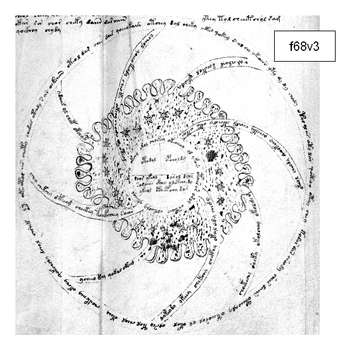
As evidence of this exceptional assertion, Newbold produced the Latin text which  he said was associated with a peculiar image in the manuscript:

The Latin decipherment Newbold associates with this diagram partially reads:

Vidi stellas in speculo concavo, in cochleae forma agglomeratas…

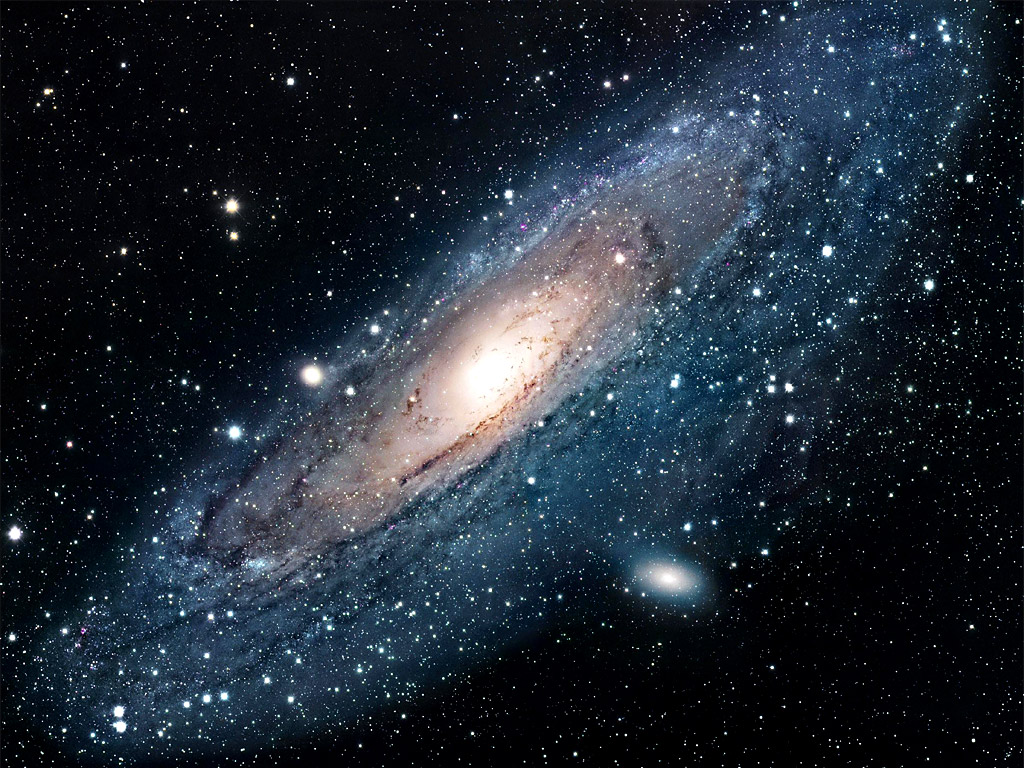
If my eyeballing of this snippet is correct, it reads: “In a concave mirror, I saw stars formed into the shape of a snail.” (That is, a spiral.) The rest of the passage makes this clear he is talking the Andromeda Galaxy:

Well, Holy Haleakala, Batman! Newbold pushed the history of the telescope back hundreds of years.

But, wait, there’s more! Bacon also invented the compound microscope, as evidenced by the images of what Newbold interpreted as ova and spermatozoa. (Not to mention the shorthand cipher itself, which could only be seen through a microscope.) The Voynich MS was the most important discovery in the history of science, and scholars generally accepted Newbold’s interpretation. Probably because nobody could understand his process of deciphering the manuscript.

In 1931, following Newbold’s death, John Matthews Manly wrote what should stand as one of the most thorough debunkings in the history of debunking, a spectacular and thorough treatment of Newbold’s assertions. He showed that the encryption that Newbold could not reliably generate text for the recipient. He illustrated that the cipher could achieve and had achieved “results” when applied to texts known not to be written by Bacon, to texts written long before the Voynich MS, and to mistranscriptions of the Voynich manuscript that Newbold used. In Newbold’s decipherments, sometimes the same passage revealed different messages. Manly demolished the content of the messages that Newbold had found to show that they could not square with what was known with the period. Newbold’s assertion defied even the laws of physics. Newbold apparently had simply shrugged off the objection that the Andromeda galaxy could not possibly have changed so radically in the time between the manuscript’s production and the 20th century. Also, he seemed not to worry that the spirals could not be seen by the naked eye even in a modern telescope–our images come from long exposures. It was in every way a thorough and complete trashing of the Newbold interpretation, and it left Newbold’s legacy in tatters. One may consider it a professional courtesy that Manly waited until Newbold had died before publishing his rebuttal.

It also meant that we had not progressed a single jot toward understanding what the heck this manuscript was.

As far as I can tell, the most interesting fabrication of Newbold’s mind was the secondary shorthand cipher. The little tails and swoops and signs that Newbold had found under a microscope were either clearly examples of ink bleeding into the cracks on the surface of the vellum and therefore meaningless, or they disappeared entirely when others looked at them. This strikes me as a close corollary to Lowell’s “discovery” of canals on Mars a few decades earlier, when the astronomer declared that he could see artificial channels on the surface of the Red Planet and spun a rather fanciful story to explain them. Turns out they weren’t there at all, but were artifacts of Lowell’s imagination.

By the way, I strongly recommend the conclusion of the Manly article as perhaps the epitome of the “don’t be a dick” school of skeptical criticism.

In the intervening years, a number of hypotheses have been floated about the content and meaning of the manuscript.In 1943, a bloke named O’Neill announced that he had deciphered the manuscript. In 1944, a botanist, James Feeley, have claimed that New World pepper plants and sunflowers appeared in the manuscript, which would place the manuscript after 1492. But even these botanical identifications are dubious, especially in the light of the vellum’s carbon-dating.

Without a doubt, my favorite “translation” appeared in Science in 1945, and it underlines why specialists in the humanities should be given their due respect. It came from Leonell C. Strong, who said that he had finally, really, actually cracked the code, but because of the current state of war, thought it was an inopportune time to reveal how he had uncovered its cryptological secrets (ahem, yeah). Voynich, Strong claimed, was written by 16th-century astrologer Anthony Askham. Most of the manuscript, he reported, discussed “the effects of plants on physiological processes in health and disease, especially, the diseases of women, and a conception of pre-Harveian generation and parturition” (608).

The cipher translated into something called “Medieval English,” which reads like: “When skuge uf tun’c-bag rip, seo oogon kum sli of se mosure-issue ped-stans sku-bent, stokked kimbo-elbow crawknot.” This passage, he says, is about the birth of a baby: “when the contents of the womb rip, the child comes slyly from the mother-issuing with the leg stance scewed and bent, while the arms, are knotted (above the head) like the legs of a crawfish.” I can’t imagine that anyone with a postgraduate degree in English at the time (Old English and history of English were still generally required graduate courses) did not howl with laughter when they read the “Medieval English.” It looks like it wants to be “Old English”: for instance, the “seo” is a feminine form for “that” and there are some…compound-y words. Unfortunately, it has the letter “k,” not found in Old English (you’d see it Old Norse), and words like “issue” that seem to be from a romance language. And it’s nothing like Middle English either. And what the hell’s up with that apostrophe? Strong further claimed that Ascham knew about antibiotics!

A group of cryptographers waiting to be released from the military after the Second World War spent their free time trying to decipher the sucker. I even found a reference to a report produced by the NSA on the shelves at Emory, but when I went to pull it, the report had mysteriously disappeared. Others have seen it, however, and report that the NSA was unable to crack the cipher. Take that, NSA! (Please don’t hurt me.)

A 2007 analysis of the characters by theoretical physicist Andreas Schinner suggests that the manuscript has been “generated by a stochastic (random) process rather than by encoding of encryption of language.” Damn it.

Nonetheless, crafty science types at the University of Arizona have at least pinned down the age of the vellum (which is slightly different from pinning down the age of the manuscript). The critters that died to make the MS snuffed it in the early 15th century. In the release at physorg.com, the author says that the writing doesn’t “resemble anything written–or read–by human beings.” This statement seems to have lead the imaginative author at ATS to a new hypothesis–aliens wrote it!

On vellum.

In the 15th century.

The poor guy writes, referring to the “galaxy” image above: “I will start with the picture that shocked me the most. To me, this is on par with the Sumerians knowing things they should not have been able to.”

Sigh. Me too, my friend. Me too.

RJB

References:

Kennedy, Gerry and Rob Churchill. The Voynich Manuscript: The Unsolved Riddle of an Extraordinary Book Which Has Defied Interpretation for Centuries. London: Orion, 2005.

Manly, John Matthews. “Roger Bacon and the Voynich MS.” Speculum 6.3 (1931): 345-391.

Schinner, Andreas. “The Voynich Manuscript: Evidence of the Hoax Hypothesis.” Cryptologia 31 (2007): 95-107.

Strong, Leonell C. “Anthony Askham, the Author of the Voynich Manuscript.” Science 101.2633 (15 June 1945): 608-609.

Zimansky, Curt A. “William F. Friedman and the Voynich Manuscript.” Philological Quarterly 49.4 (Oct 1970): 433-443.


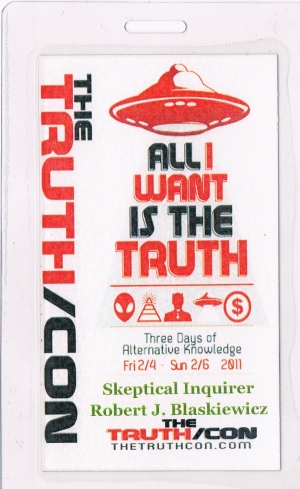
Favorite souvenir from the TruthCon

February 6, 2011

I can almost guarantee you that none of the other conferences I’ll attend this year will have as nifty a badge!

RJB


Guess Where I’m Going?

January 25, 2011

I won’t be writing about it much here, because I’ve been invited to write about it for a real, live skeptical magazine. I still might do a podcast about it here, but we’ll see what my schedule allows:

I’ve already been to a preliminary meetup held by the organizer, and it was very interesting. Apparently, saying that you can electrify women’s naughty chakras is actually an effective pickup line in some social circles. Clearly my sparkling personality, humor and preternatural wisdom is only worth so much against saying that you have the ability to deliver psychic thrills directly into ladies’ pants. Oh, well.

RJB