The Green Knight Code

February 10, 2011

Well, I finished re-reading The Da Vinci Code. Then I drank some beer in an attempt to kill the brain cells where awareness of it is stored, but that failed. Then I read a well-written mystery novel and had a nap, and now I feel a little better.

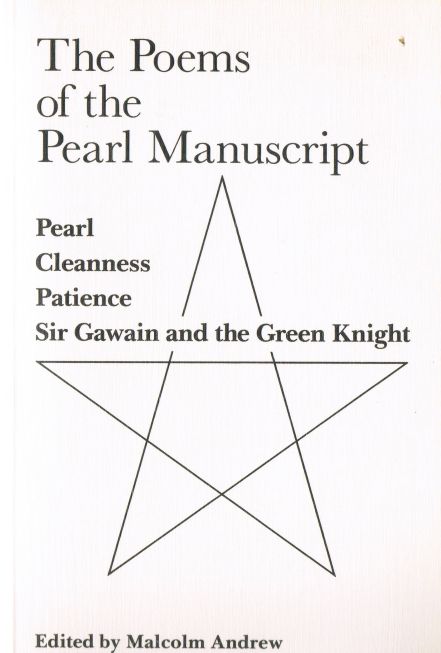
From the moment of its publication, people have been writing refutations of the “facts” presented in the book, so, at least for the moment, I will confine my comments to the general category of “random stuff that irritated me.” Today’s topic is Sir Gawain and the Green Knight (SGGK), an Arthurian romance from the fourteenth century and one of the glories of the so-called Alliterative Revival (I say “so-called” because it was really more of a survival than a revival). Brown mentions SGGK twice. Both mentions are brief, but annoying.

I’ll deal with the second reference first. In the exciting and suspenseful database-search scene (chapter 95), a computer, having been fed the search terms “knight,” “London,” “Pope” and “tomb” within a 100-word proximity of the terms “grail,” “rose,” “sangreal” or “chalice” (p. 381), spits out the title, “Grail Allegory in Medieval Literature: A Treatise on Sir Gawain and the Green Knight.” As far as the plot is concerned, this result is irrelevant–“Not many mythological green giants buried in London,” as the librarian says (389)–so one has to assume it’s an attempt by the author to tie SGGK to the grail/bloodline of Jesus/sacred feminine fantasy he’s been weaving.

There’s something a bit odd about the title though. Certainly, the poem can be read as an allegory (of the Christian variety),and like many medieval grail stories, it is a quest romance. But it is not a grail romance. There’s no grail: the word isn’t even mentioned. Granted, it is one of the premises of The Da Vinci Code that references to Mary Magdalene and her descendants had to be hidden in allegory (or “symbology”), but it must be hidden very well indeed in SGGK. Not only is there no mention of Mary Magdalene or her bloodline, there is no reference to the grail which symbolizes the bloodline. If the grail exists in the poem at all, it is through allegory. So something (I have no idea what) represents the grail allegorically, and the grail allegorically represents Mary’s womb. The Gawain-poet was one sneaky, clever dude.

In the first reference to SGGK, Brown makes the connection between the poem and Mary Magdalene even more explicit.  Langdon tells Sophie,

“The Grail story is everywhere, but it is hidden. When the Church outlawed speaking of the shunned Mary Magdalene, her story and importance had to be passed on through more discreet channels…channels that supported metaphor and symbolism.” [ellipsis in original]

“Of course. The arts.”

“….Some of today’s most enduring art, literature, and music secretly tell the history of Mary Magdalene and Jesus.”

Langdon quickly told her about works by Da Vinci, Botticelli, Poussin, Bernini, Mozart, and Victor Hugo that all whispered of the quest to restore the banished sacred feminine. Enduring legends like Sir Gawain and the Green Knight, King Arthur, and Sleeping Beauty were Grail allegories….(p. 281)

So SGGK definitely has something to do with the grail, Mary and Jesus and the sacred feminine. It’s hard to see what, though. Let’s take a look at the sacred feminine’s representatives in the poem. There’s Morgan le Fay. In some modern Arthurian tales, such as Marion Zimmer Bradley’s The Mists of Avalon, Morgan is presented in a favorable light. SGGK, however, is not a modern tale. When she first appears, she is described as old and unattractive: her eyes are bleary, her skin wrinkled, her chin black, her body short and thick and her buttocks swollen and broad (ll. 947-969). When her identity is revealed, she is called a “goddess,” (l. 2452), but she seems more like a typical sorceress. She has transformed an ordinary knight into the Green Knight and sent him to Arthur’s court in order to frighten Guinevere, hopefully to death.

The other prominent woman in the poem is the wife of the Green Knight (or Sir Bertilak as he’s known when not enchanted). On her husband’s orders (and according to Morgan’s plans, presumably) she visits Gawain in his room on three successive mornings and attempts to seduce him. When the seduction fails, she tempts him to accept a green girdle which will supposedly protect him from harm. Gawain and Bertilak have agreed to exchange whatever they acquire during Gawain’s stay (Bertilak spends each day out hunting a different animal). Gawain fails to give the girdle to Bertilak. As a punishment for this minor failing, the Green Knight gives Gawain a slight nick with his axe (rather than beheading him or seriously injuring him as he would have done if Gawain had succumbed to the seduction).

It’s not really looking very good for the sacred feminine–one hag and one seductress. Gawain’s speech in which he gives examples of men who have been brought to sorrow through the wiles of women doesn’t help the case much either (he mentions Adam, Solomon, Samson and David). He concludes that men would be better off if they could love women well, but not believe them (ll. 2407-2428).

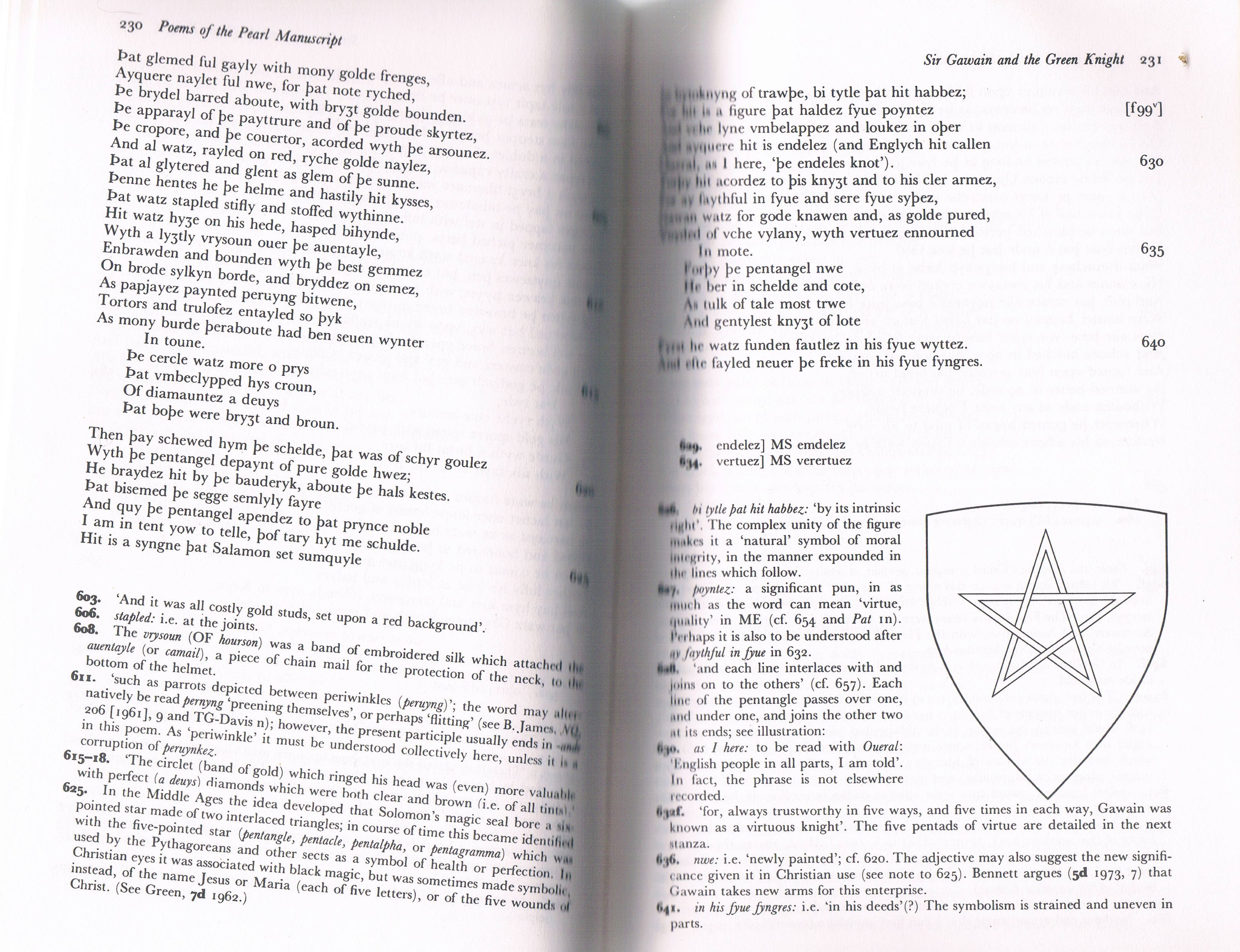
To be fair though, there is one unambiguously positive female in SGGK. And her name is Mary. And she is associated with the pentagram, which, as all readers of The Da Vinci Code know, represents Venus and the sacred feminine. Gawain bears a pentangle on his shield. He wears the pentangle because, as an endless knot, it represents the perfection he aspires to as a knight. The five points also have symbolic significance. Gawain is said to be faultless in his five senses; he never fails with his five fingers; he puts his trust in the five wounds of Christ; in battle, he receives strength from contemplating the five joys that the Virgin Mary had in her son; he has five virtues (generosity, fellowship, purity, courtesy and pity). He is so devoted to the Virgin Mary that he has her picture painted on the inside of his shield (ll. 619-670).

So, there you go: SGGK does encourage devotion to Mary. Wait, that’s the wrong Mary, isn’t it? As with his references to the Holy Grail and the bloodline of Jesus, the Gawain-poet kept his theological unorthodoxy very well hidden indeed.

ES

References:

Andrew, Malcom and Ronald Waldron, eds. The Poems of the Pearl Manuscript. Rev. ed. Exeter Medieval English Texts and Studies. Exeter: U of Exeter Press, 1987. My apologies to Ronald Waldron, whose name got cut off the scan above.

Brown, Dan. The Da Vinci Code. New York: Anchor-Random, 2003.


Shakespeare and Skeptoid

February 8, 2011

In a recent episode of Skeptoid, Brian Dunning answered questions from students around the world. One student, Stephen from California, asked Dunning’s opinion about the Shakespeare authorship question. Briefly, Dunning concludes that “all available evidence supports Shakespeare as a real living author, and the only support for the opposing viewpoint is supposition.” He also notes that the authorship question “may be worthy of its own complete Skeptoid episode.”

I agree with Dunning’s conclusions, and think Shakespeare does warrant an episode to himself. If Dunning does choose to devote an episode to the authorship question, however, I hope he does better research and uses better sources than he did in this episode. The two sources he cites in this episode are from those two great literary heavyweights, Scientific American and physorg.com*. Why must skeptics appeal to science even when discussing the humanities? The Scientific American article was written by Michael Shermer, who has a Bachelor’s degree in Psychology/Biology, a Master’s in Experimental Psychology and a Ph.D. in the History of Science. He also seems to want to make history into a science: “But reasonable doubt should not cost an author his claim, at least not if we treat history as a science instead of as a legal debate.” He was responding to former Supreme Court Justice John Paul Stevens’ use of legalese in making his argument for the Earl of Oxford. But history is neither of these: it is its own field with its own methods and standards for scholarship. It may be messier than science and more open to interpretation, but that is largely unavoidable. It can’t be fixed by trying to make it into a science.

In introducing the physorg.com article, Dunning says:

Perhaps the most compelling reason to accept Shakespeare as the real author is his unique and recognizable writing style, which does not match that of the authors to which his works have been attributed by doubters. And this is not merely an unreliable, subjective opinion: It’s backed by hard science.

Again there is a suggestion that the humanities are only trustworthy when science is involved. Of course science can be a useful tool in literary studies. In this case, literary scholars used computational stylistics to detect Shakespeare’s hand in various works. That is to say, they used a computer program to compare Shakespeare’s diction, syntax, etc. to other writers from the period. For instance, a scholar would look at a work whose authorship is disputed and use the computer program to compare it to works by many different authors. The frequency with which certain typical features of a certain author appear in the disputed work suggests a likely attribution.

Obviously, a computer can sift through a huge amount of data at great speed. Still, it builds on work done for years by literary scholars who have painstakingly studied the language and usage of Shakespeare and his contemporaries. In addition, it is wildly optimistic to assume that such computer analyses will actually settle many questions. Someone else is bound to say, “Oh yeah, well my computer program said Shakespeare wrote this unattributed play.” Indeed, some of the conclusions drawn by the group headed by Arthur F. Kinney, director of the Massachusetts Center for Renaissance Studies at UMass Amherst, have already been questioned.  Kinney, for example, claims in the article cited by Dunning: “I have now proven that Shakespeare is part-author of Arden of Faversham. They guessed that in the 19th century but no one would believe it in the 20th century. Now we know.” He makes this argument at greater length in Shakespeare, Computers and the Mystery of Authorship. Sir Brian Vickers, however, has argued, based on his own computer analysis of the play, that Thomas Kyd is the sole author.**

Based on the thumbnail descriptions of studies in the physorg.com article, some of the conclusions just seem…odd. For instance, in regard to the play Sir Thomas More, we learn that

Timothy Watt at last proved that Hand D in the manuscript of a play called The Book of Sir Thomas More is Shakespeare’s own handwriting and so extends examples of his writing past the seven signatures which alone have been attributed to him.

In the first place, there are only six signatures that are more or less universally regarded as genuinely Shakespearean (I assume the seventh refers to a copy of William Lambarde’s Archaionomia. If that signature were considered genuine, it would prove that Shakespeare did indeed own at least one book. Although a number of eminent scholars have accepted the signature as likely genuine, the attribution is still in question). Moreover, how could a computer program that evaluates authors’ styles conclude that the passage was in Shakespeare’s handwriting? It seems, based on the article in Computers, Shakespeare and the Mystery of Authorship, that Watt concluded that Shakespeare was the author of the Hand D passage. At the end of the article, Watt argues that “[s]ince the nature of the manuscript indicates an author at work–correcting and amending along the way–rather than a scribe making a fair copy,” if Shakespeare is the author of the passage, it logically must be in his hand. In other words, the handwriting isn’t being used as evidence of Shakespeare’s authorship; Shakespeare’s authorship is used as evidence of his handwriting. At any rate, the study has not quelled questions about Sir Thomas More.

Another assertion in the physorg.com article concerns one of Shakespeare’s putative sources:

Kevin Petersen noted that although people think Shakespeare was influenced by Montaigne’s skepticism in his work from Richard II through Hamlet to The Tempest, and was the source of his skepticism in parts of many of his plays, in fact there is no indication of any Montaigne – in French or in the popular English translation.

This article did not make it into the book, so it is hard to judge. It is possible that the brief description misrepresents the argument, but, as stated, it just doesn’t make sense. In the first place, while many of Montaigne’s essays have been suggested as sources for Shakespeare, very few of them are widely accepted. Many of the most compelling arguments for Montaigne’s influence on Shakespeare concern The Tempest. In 1781, Edward Cappel suggested that Gonzalo’s “commonwealth” speech in Act 2, scene 1 of The Tempest very closely resembles a passage in John Florio’s 1603 translation of Montaigne’s “Of the Cannibals:”

I’ th’ commonwealth I would, by contraries,
Execute all things, for no kind of traffic
Would I admit; no name of magistrate;
Letters should not be known; riches, poverty,
And use of service, none; contract, succession,
Bourn, bound of land, tilth, vineyard, none;
No use of metal, corn or wine, or oil;
No occupation, all men idle, all;
And women too, but innocent and pure;
No sovereignty–
Seb.                                       Yet he would be king on’t.
Ant.  The latter end of his commonwealth forgets the beginning.
Gon.  All things in common nature should produce
Without sweat or endeavour. Treason, felony,
Sword, pike, knife, gun, or need of any engine
Would I not have; but nature should bring forth
Of it own kind all foison, all abundance,
To feed my innocent people.
Seb.  No marrying ‘mong his subjects?
Ant.  None, man, all idle–whores and knaves.
Gon.  I would with such perfection govern, sir,
T’ excel the golden age.  (2.1.145-66)

Here is Montaigne’s description of life among the Brazilian cannibals:

It is a nation…that hath no kind of traffic, no knowledge of letters, no intelligence of numbers, no name of magistrate nor of politic superiority, no use of service, of riches or of poverty, no contracts, no successions, no dividences, no occupation but idle, no respect of kindred but common, no apparel but natural, no manuring of lands, no use of wine, corn or metal. The very words that import lying, falsehood, treason, dissimulation, covetousness, envy, detraction, and pardon were never heard of amongst them. (“Of the Cannibals,” Bk 1, ch. 30 of The Essays by Michel de Montaigne, tr. by John Florio. Included in Orgel’s ed. of The Tempest, pp. 230-31)

No one claims that Shakespeare got his ideas for Gonzalo’s commonwealth from Montaigne–they were not original to Montaigne. It is the way those ideas are expressed: primarily in negatives. Neither Montaigne nor Shakespeare describes his Utopia in terms of what it is or what it has, but rather of what it is not and what it doesn’t have. In addition, many of the details are the same. And you do not need a computer program to point out the verbal parallels. Indeed, if a computer were to tell me that the verbal parallels did not exist, I’m afraid I would have to disbelieve it.

Computational stylistics is a useful tool, but it is naive to think that science can definitively answer questions that literary studies have failed to answer.  It can lend credence to arguments that Shakespeare had a hand in a particular work (or that a collaborator had a hand in a work generally attributed to Shakespeare alone), and it can question other attributions. It is less useful in the argument that Shakespeare wrote the works attributed to him. A particular disputed work, such as Arden of Faversham or Sir Thomas More, can be compared to Shakespeare’s acknowledged works, but when the entire corpus is disputed, to what can we compare it? One of the anti-Shakespeareans’ main arguments is that we have no works that can be definitively attributed to Shakespeare (this is not true, of course, but that’s the argument). Admittedly, we can compare “Shakespeare’s” works to those by Oxford, Bacon and Marlowe, but, with the exception of Marlowe, none of the main candidates wrote in the genres for which Shakespeare is known, which makes comparison more difficult. Not impossible, of course. Many idiosyncrasies are likely to be the same, regardless if the poet is writing drama or lyric poetry, but it’s certainly not going to be good enough to satisfy Oxfordians (not that anything is).

ES

*This article is taken word for word from a press release from the University of Massachusetts at Amherst.

**I have not yet read this article (I have ordered it from Inter-Library Loan), so I am basing my interpretation of it on second-hand accounts.

Further Reading:

Craig, Hugh and Arthur F. Kinney, eds. Shakespeare, Computers and the Mystery of Authorship. Cambridge UP, 2009.

Hodgen, Margaret. “Montaigne and Shakespeare Again,” Huntington Library Quarterly 16 (1952-53): 23-42.

Montaigne, Michel de. “Of the Cannibals.” The Essays. Tr. John Florio. 1603. Included in Orgel’s ed. of The Tempest, pp. 227-238).

Paster, Gail Kern. “Montaigne, Dido, and The Tempest: ‘How Came that Widow in?’” Shakespeare Quarterly 35 (1984): 91-94.

Prosser, Elaine. “Shakespeare, Montaigne, and the Rarer Action,” Shakespeare Studies 1 (1965): 261-64.

Shakespeare, William. The Tempest. Ed. Stephen Orgel. Oxford World’s Classics. Oxford UP, 1987.

Vickers, Brian. “Thomas Kyd, Secret Sharer.” Times Literary Supplement 18 Apr. 2008: 13-15.


Psychoanalytic Literary Theory: Where Freud Ended Up

January 27, 2011

I’m suspicious of literary theory, and, as you might imagine, this is a problem for someone in my profession. A lot of criticism is grounded in philosophical positions that seem to me unproven and possibly unprovable. This, of course, is not their problem, but mine. Nonetheless, I would very much like to single out one school of literary theory and beat it savagely as a warning to other schools of theory. I am talking about psychoanalytic literary theory.

The purpose of psychoanalytic theory has always eluded me. I mean, as far as I can tell, even what constitutes the object of psychoanalytic critique is in doubt. I have seen psychoanalytic literary criticism directed at authors, works, characters in the works, even entire cultures. Once, and I swear I’m not making this up, I saw an author claim (and publish, fer cryin’ out loud) that Much Ado About Nothing had analyzed him.* I mean, what does that even mean? Professional psychiatry, with the exception of a dwindling cult of hardcore Freudians, has long recognized that Freud’s understanding of the mind was fundamentally flawed. Why is it so hard for literary theory to jettison Freud?

My personal objections to Freud stem from his misunderstanding of memory, which was very important to my dissertation on the memoirs and fiction of WWII combat veterans. The model of memory that Freud employs is pretty much at odds with everything that we know about how memory works from empirical studies. Central to psychoanalysis is the idea of repression, that traumatic events get displaced, forgotten from the conscious mind, but can still exert influence on the conscious life. Memory is, to Freud, similar an object that gets tucked away in the attic of memory, one which the analyst and patient must dislodge and bring to light. The memory is whole and essentially unchanging.

Most laboratory findings, however, refute this model of the mind. Memories are not mental objects; they are representations of events reconstructed anew with each remembering, subject to decay and alteration over time. Most importantly for any discussion of Freud, the more traumatic an experience is, the more likely we are to remember it, a process that seems to be governed by stress hormones. Indeed, there is no good evidence for “memory repression” in the Freudian sense. So-called “recovered” memories don’t count, because it is entirely possible to plant memories that are indistinguishable from regular memories–we can’t even in principle distinguish the two. Yikes!

If you think about it, psychoanalysis and literary interpretation have a lot in common, and depending on how far you are willing on how far you are willing to go, they may ultimately be variations of the same process. At a basic level, psychoanalytic criticism allows you to say that “A” equals “B.” That is, it is an exploration of metaphor, an examination of something expressed in terms of something else.  This also underlies an important (and true) assumption of literary criticism, that the “texts” we are examining often mean something more than what they literally say.

Often, however, I think that people run too far with the comparison and mistake the metaphor for the real thing. This is perhaps most prominent in the area of psychoanalytic theory that purports to look at “cultural or social memory,” the shared narratives that knit together large groups of people. A claim that might come out of this area of study would be, for instance, “America has expunged from its national memory the one of the greatest holocausts ever perpetrated by humanity, the displacement of Native Americans.” Academics, in this case, take an inadequate model of the human mind and use it for a metaphor for how societies remember, then they mistake the metaphor for the actual historical process of building up a national narrative. In its more flamboyant forms, what is being repressed, because it is naturally hidden, turns out to be…whatever the academic’s kink is. If it’s imperial conquest, they find imperial conquest. If it’s patriarchy, they’ll find patriarchy. If it’s pandas, they’ll find pandas. When A (the text) is defined and B is perfectly hidden, waiting to be “discovered” or “uncovered” by the theorist, well, you get widely divergent and often silly interpretations. When you are allowed to substitute any word or idea for any another word or idea, hell, you can make anything mean anything that you want! Postmodern criticism that finds the meaning “outside” of the text is especially vulnerable to this type of goof, and when you fuse the two in Lacan, you get unfettered bollocks.

I’m not saying that this might not be a useful exercise in some cases–I glean a lot from the historical research that informs much of this type of literary criticism. I think that the way in which that context is applied does not add much to the actual knowledge about the text the critic is analyzing. I suspect, and this has been said of Freud, that you learn more about the critic than you do about the object of criticism at this point. This in itself, however, has the potential to be a useful poetic, creative, and artistic project in its own right, and I wonder if that is not the one saving grace of psychoanalytic criticism– that it is the artistic synthesis of a creative mind.

But who’d want to read it?

So, what’s the “proper” use of Freud? I think that question is up for debate, but I would use Freud sparingly. Freud transformed all he touched, and I think that it is an important area of scholarship to show the influence that Freud’s ideas had on culture. So, you need to have his ideas in the back of your head (heheh) when surveying the art of the twentieth century, for instance. It would be nonsensical to look at the work of Salvador Dali and not consider the influence of psychoanalysis on his work and the work of other surrealists. Once we mistake his theories for useful models of how the mind actually works (say authors’ minds), however, that’s when we start to misuse him.

RJB

——-

*Krims, Marvin Bennett.  The Mind According to Shakespeare: Psychoanalysis in the Bard’s Writing. Westport: Praeger, 2006. Introduction, xv.


Chaucer’s Cunt

January 18, 2011

Now that I have your attention, I regret to inform you that he didn’t have one. On several occasions recently, sometimes in conversations about censorship, I have heard people say that Chaucer used the word “cunt.” Indeed, Wikipedia says, “The word appears several times in Chaucer’s The Canterbury Tales (c. 1390) in bawdy contexts, but it does not appear to be considered obscene at this point, since it is used openly.” Similarly, RationalWiki proclaims that “Chaucer used the word unblushingly in his Canterbury Tales.”

Oddly, these statements are followed by quotes from The Canterbury Tales that belie them, for the word that Chaucer uses is not “cunt,” but “queynte.” “Queint,” as a noun, literally means “a clever or curious device or ornament” (Middle English Dictionary) or an “elegant, pleasing thing” (Riverside Chaucer). When used to refer to a woman’s genitalia, it is both a euphemism and a pun.

Chaucer uses “queint” several times in his earthier tales. The Miller’s Tale is a fabliau about a carpenter, his much younger wife, a young Oxford clerk who is lodging with them and another clerk, who is somewhat squeamish about farting. Both clerks have naughty feelings toward the young wife, and she reciprocates the lodger’s lust. The tale involves adultery, farting, pissing, a badly misplaced kiss, a burning poker in a very sensitive area and a fake deluge. One day, when the carpenter is away, the lodger, Nicholas, begins “to rage and pleye” with Alison, the young wife, and…

As clerkes ben ful subtile and ful queynte,
And prively he caughte hire by the queynte,
And seyde, “Ywis, but if ich have my wille,
For deerne love of thee, lemman, I spille.” (MT I (A) 3275-3278)

(As clerks are very ingenious and clever, and discreetly he caught her by the pleasing thing and said, “Indeed, unless I have my will, I will spill (die) for secret love of you, my dear.”)

Chaucer also uses “queint” in The Wife of Bath’s Prologue. In lecturing one of her husbands, she says that, as long as he has enough of what he wants, he shouldn’t care what other folks get:

For, certeyn, olde dotard, by youre leve,
Ye shul have quente right ynogh at eve (WBP III (D) 332-333)

(For indeed, old dotard, by your leave, you shall have plenty of the precious thing (or, more generally, sexual gratification) in the evening.)

Later she asks,

What eyleth yow to grucche thus and grone?
Is it for ye wolde have my queynte allone? (WBP III (D) 444-445)

(What ails you to complain and groan so? Is it because you alone would have my precious thing? NB One of the manuscripts, Cambridge, University Library II.3.26, does read “cunte” in this passage)

A few lines later, she refers to her favorite body part as her “bele chose” (Fr. belle chose, lovely thing).

“Cunt,” like many naughty words for body parts and bodily functions, probably has its origins in Old English. It certainly has cognates in other medieval Germanic languages, such as Old Norse kunta and Old Frisian, Middle Low German and Middle Dutch kunte (Oxford English Dictionary). There are no known instances of it in Old English, however. James McDonald, in The Wordsworth Dictionary of Obscenity and Taboo, suggests that it may be related to Old English cynd, which means “origin, generation, birth, kind, offspring” and can also mean “genitalia” (Concise Anglo-Saxon Dictionary).

According to The Oxford English Dictionary, the earliest use of “cunt” is in the street name “Gropecuntelane” (c. 1230). The earliest instance of “cunt” used to refer to the vagina comes from around 1325 (OED, MED). McDonald also cites several personal names that incorporate “cunt” (a number of these are earlier than “Gropecuntlane”). He lists the women’s names Gunoka Cuntles (1219) and Bele Wydecynthe (1328) and men’s names Godwin Clawecuncte (1066), Simon Sitbithecunte (1167), John Fillecunt (1246) and Robert Clevecunt (1302). Ladies, if you ever meet a man named Godwin Clawcunt or Robert Cleavecunt, run!

According to McDonald, “cunt” was used to refer to the vagina without any suggestion of vulgarity until roughly the end of the fourteenth century. Chaucer, who died in 1400, was therefore writing The Canterbury Tales at a time when cunts were disappearing from polite society; consequently, he hinted at the word without actually using it.

ES

References:

Chaucer, Geoffrey. The Riverside Chaucer. 3rd ed. Gen. ed. Larry D. Benson. Boston: Houghton, 1987.

Clark Hall, J. R. A Concise Anglo-Saxon Dictionary. Suppl. by Herbert D. Merritt. 4th ed. Medieval Academy Reprints for Teaching 14. U of Toronto P, 1960.

McDonald, James. The Wordsworth Dictionary of Obscenity and Taboo. Ward, Herts.: Wordsworth, 1996.

Middle English Dictionary Online. University of Michigan. http://quod.lib.umich.edu/m/med/

Oxford English Dictionary: OED Online. Oxford UP, 2010. Subscription only.


The Panic Virus

January 13, 2011

On the Media, one of my favorite podcasts, interviewed Seth Mnookin about his new book, The Panic Virus, which is about the vaccine scare brought on by Andrew Wakefield, who remains happily complicit in unprecedented child suffering and death.

I am excited about this in particular because host Bob Garfield uses the phrase “false balance” to describe the disproportional representation of vaccine fears in the media despite vaccines’ statistically insignificant risks.

We included On the Media in the podcast section of the website because Bob Garfield, Brooke Gladstone and their producers and contributors do a fantastic job of showing how often-unseen forces affect the news and media consumed by the public. I’ve been hooked ever since 2004, when they explained exactly how everyone on NPR sounds so damned good. The report is a classic, and I still recommend it.

Oh, this week they also mention Allen Gribben’s shamefully bowdlerized new edition of Huckleberry Finn, which substitutes the word “nigger” with the word “slave.” They are not the same thing, Allen. I was going to hurl a pithy Twain quote at him (“Censorship is telling a man he can’t have a steak just because a baby can’t chew it”), but I can’t verify that it is actually Twain’s. Oh well.

RJB


Last Post on Shakespeare (for now)

January 12, 2011

I don’t harbor any illusions that any post or comment I make will quell dissent from the Oxfordians. Nor do I believe that I will be able to answer every question or point raised. As I said in my first post on the topic, fringe theorists in general nitpick: they present a barrage of questions, counterarguments and niggles (and repeat ones already made). I look forward to hearing from them a coherent explanation of how the Oxford-as-Shakespeare conspiracy actually worked, why it was put into place and who was involved in it. I also eagerly await evidence for the conspiracy and Oxford’s authorship.

Until then, I will attempt to explain why William Shakespeare (with help from John Fletcher, George Peele, Thomas Middleton and George Wilkins) is likely to be the author of the works attributed to William Shakespeare. In the first place, the simplest answer to the question, “Who wrote the plays and poems of ‘William Shakespeare’?” is William Shakespeare, son of a Stratford glover, actor and shareholder in the Lord Chamberlain’s/King’s Men. We know such a person existed. Plenty of official records survive that refer to him. He is named as the author on the title pages of Venus and Adonis, The Rape of Lucrece, many quartos of plays published during his lifetime and the First Folio of his plays, published seven years after his death by colleagues in his company. There were also many references to him and his works in his lifetime and within a decade after his death. Occam’s Razor would suggest that this man was exactly who the evidence says he was: a middle class man who wrote a bunch of really impressive stuff. If someone wishes to argue otherwise, that person must present very compelling evidence that explains not only “who,” but also “how” and “why.”

Oxfordians such as Charlton Ogburn often say that there is no documentary evidence to tie Shakespeare to his works. The proper response to this contention is a befuddled look and the words, “Yes there is—lots of it.” The Oxfordians then explain that somehow that evidence doesn’t count: those are merely references to a name on a title page. Even assuming this were true, so what? References on title pages are very strong evidence indeed. Again, where is the compelling evidence that someone else was using the name “William Shakespeare,” a name that belonged to an actual living human, as a pseudonym? In addition, this argument is simply not true. There are a number of contemporary references to plays that had not been published yet. The best, but not only, example of this is Francis Meres’s Palladis Tamia, which mentions, among other works, Shakespeare’s sonnets and the (probably) lost play Love’s Labor’s Won.

There is also Robert Greene’s indictment of Shakespeare as an “upstart Crow,” who thinks himself “the only Shake-scene in a country.” It is hard to imagine how this could refer to anyone but the actor Shakespeare, who was also the author of 3 Henry VI, which is parodied. Yet Stratfordians maintain that this statement is ambiguous. In his comments on an earlier post, Howard Schumann has quoted a “skeptic’s [presumably Diana Price’s] paraphrase of the ‘Upstart Crow’ diatribe:”

Beware of one untrustworthy actor, the “Upstart Crow”. We make him look good in the roles we write, but this player is callous, duplicitous, and arrogant. ; he fancies himself able to extemporize lines in blank verse that are as good as any of yours (the three playwrights Peele, Marlowe, and Nashe). He even passes off some of your material as his own. And this know-it-all thinks he’s the most important actor around…So while you still have a chance to escape my fate, find some playmasters with more compassion and integrity. Stay away from actor-paymasters and usurers (like Johannes Factotum) because you three are too talented to be exploited by such contemptible knaves.

This is not a paraphrase: it’s a wildly speculative interpretation. It does not represent what the passage actually says. Mr. Schumann also cites Stephanie Hopkins Hughes who argues that the Upstart Crow passage refers to Edward Alleyn, the lead actor of the rival Lord Admiral’s Men. There is absolutely no evidence for this and no reason to think it might be true.

Oxfordians also make a great deal of fuss about the six Shakespeare signatures. These signatures prove, say the Oxfordians, that Shakespeare was barely literate: he spelled his name several different ways, and the writing is almost illegible. This argument is frankly ludicrous. Spelling is irrelevant. Since spelling was not standardized, people spelled according to preference or whim or space requirements. Bob noted in the comments that Sir Walter Ralegh at one time spelled his name “Rawley.” In Christopher Marlowe’s only known signature, he spelled his name “Marley,” though his baptismal record reads “Marlow.” Contemporaries sometimes spelled his name “Morley.”

As to handwriting, Shakespeare, like many of his contemporaries, wrote in secretary hand, which is very difficult to read because we no longer use it. It is also possible that Shakespeare was ill at the time he signed his will (which contains 3 of the 6 signatures). This is speculative, but he died within a month of signing it, and there is evidence that it was revised hastily. More importantly, however, since when has handwriting, especially in signatures, been an indicator of literacy or intelligence? I know squirrels with neurological impairments that would be ashamed of my handwriting.

A major premise of all anti-Shakespearean theories is that the author of the plays must have had great knowledge of/first-hand experience in [fill in the blank], and semi-literate, business-obsessed, middle class Shakespeare couldn’t possibly have had that knowledge/experience. This premise is based in part on our friend the argument from ignorance: the author of the plays must have traveled widely, especially in Italy; we have no record of Shakespeare traveling abroad; therefore, Shakespeare never traveled abroad and couldn’t have written the plays. Well, we actually don’t know if Shakespeare ever traveled outside England–maybe he did; maybe he didn’t–we just don’t know, so we can’t really say that he didn’t travel abroad. On top of that, sometimes he was wrong. In The Taming of the Shrew, he gave Padua a harbor, and Ben Jonson complained that “Shakespeare in a play [The Winter’s Tale] brought in a number of men saying they had suffered shipwreck in Bohemia, where there is no sea by some 100 miles” (qtd. in Stanley Wells, Shakespeare & Co., p. 159). The thing is, Shakespeare didn’t need to be a world traveler to avoid these mistakes: they had these things…they were kind of like Google Earth but without the Google part. Granted, there were bits of these maps that were a bit sketchy, but Italy and Bohemia had been fairly thoroughly explored by then. Did he not realize his mistake? I don’t know, but it’s possible that he just didn’t care that much. If it served his dramatic purpose for Padua to have a harbor, then Padua got a harbor.

It is, of course, a mistake to assume that the author must have had personal experience of all the things he wrote about. Shakespeare presumably used the tools modern authors use: personal experience and observation, study, reading and discussions with people who did have personal experience. Shakespeare did not have to be an expert in falconry to be able to write accurately about falconry. Also, rumor has it that many creative writers are known for their imaginations.

Anti-Shakespeareans also point out that some of Shakespeare’s sources were not available in English translation and assume that he was not sufficiently fluent in Latin, French and Italian to read those sources. Again, this is an argument from ignorance. We can’t assume Shakespeare couldn’t read Italian just because we don’t have a receipt from an Italian tutor. As we’ve said previously, it is very likely that Shakespeare attended a grammar school and got a good Latin education. If you know Latin, figuring out Italian and French isn’t that hard. I have personally wrestled with languages that I have not studied formally, and, while I won’t claim that I won every bout, I at least managed a draw.

Oxfordians–and others, frankly–just aren’t very happy with what we know about Shakespeare. We have a fair amount of information about him, but most of it comes from legal and business documents. This is hardly surprising: those are the sorts of official documents that one would expect to survive, while more personal items may be lost or destroyed. Would it be nice if there were a treasure-trove of personal letters? Well, heck yeah. Such a discovery would make Shakespeare scholars absolutely giddy. Sadly, we have to deal with what we do have. The odd thing is that anti-Shakespeareans sometimes assume that business and money were all Shakespeare was interested in. Again this strikes me as patently ridiculous. Who among us is defined by the contracts we’ve signed? Most people care about finances and business, and most people care about other things as well. Why should we assume Shakespeare was so different from the rest of us?

ES


“Little English and No Sense”: The Shakespeare Authorship Controversy

January 5, 2011

Coming soon to a theater near you: Anonymous, another blockbuster from Roland Emmerich, who brought you 2012, 10,000 B.C., The Day after Tomorrow, The Patriot, Independence Day, Eight-Legged Freaks and many other fine examples of historical drama.  Anonymous promises political intrigue, conspiracy, a Not-Even-Close-to-Virgin Queen, incest and exciting, explosive quill action. Yes, that’s right, it focuses on the guy who really wrote Shakespeare.  Well, no not really: it actually focuses on Edward de Vere, the 17th earl of Oxford.

It’s interesting (or do I mean disheartening?) that the “authorship question” could have attained such acceptance that it has achieved Hollywood blockbuster funding, although it would be even more surprising to see advertisements for “Not Anonymous, the gripping story of how a competent actor and businessman who never killed anyone wrote the works attributed to him!”  While it’s possible, even likely, that Emmerich’s film will convince some viewers, what’s more disturbing is the sympathetic platform the Oxfordians have been given by such prestigious media outlets as PBS’s Frontline, which aired “The Shakespeare Mystery” in 1989 (transcript here); NPR’s Morning Edition, which ran a story called “The Real Shakespeare? Evidence Points to Earl,” (host Renée Montagne was later presented with the Distinguished Achievement in the Arts Award at the 13th Annual Shakespeare Authorship Studies Conference); and the New York Times, which has run a series of Oxford-leaning “teach-the-controversy” articles by William S. Niederkorn.

I remember watching the Frontline episode when it was re-run and discussing it later with other English lit types.  We were all terribly worried about Frontline.  Was the quality of all their shows this bad?  Did we simply not recognize it because it wasn’t our field?  Would next week’s NOVA give a friendly ear to moon landing deniers?

I was also concerned because, while I was yelling at the screen about dubious assertions, part of me recognized that some of the arguments could sound convincing.  An educated person, familiar with Shakespeare’s works but not an expert, might be swayed by some of the claims, not because the person was stupid or ignorant, but because the program was slanted.  For instance, two scholars speak on behalf of Shakespeare in the show.  Samuel Schoenbaum appears twice to say, basically, “well, Shakespeare was a genius.”  I may be trivializing Schoenbaum’s contributions somewhat, but he doesn’t provide much of a counterargument to the Oxfordians, and he certainly doesn’t offer evidence in favor of Shakespeare’s authorship, which he was certainly capable of doing.  I suspect that this failing may have something to do with editing.  Both times he appears (briefly) on screen, he is followed by Charlton Ogburn, whose work inspired the episode, offering an impassioned rebuttal.  The other scholar, A. L. Rowse, actually manages to make a few reasonable points, but these are grossly overshadowed by his apparent arrogance, egocentricity and homophobia (he uses the word “homo” twice, once modified by “roaring”–no, really, I’m not kidding).  The points he makes are largely ignored in the program and probably would be by most viewers as well.  In 1992, Frontline aired “Uncovering Shakespeare: An Update,” a three-hour video conference moderated by William F. Buckley.  This program was more even-handed, featuring, among others, eminent Shakespeare scholars Gary Taylor and David Bevington.  Still, as the transcript linked above shows, the program ended with an “ANIMATION: of the Stratford statue breaking apart and revealing the 17th Earl of Oxford.”

In his book, Contested Will: Who Wrote Shakespeare? James Shapiro, the Larry Miller Professor of English and Comparative Literature at Columbia University, traces the history of the authorship question.  He notes that by the early 1980s the Oxfordian theory was largely moribund.  It was revived partly through the ceaseless efforts of Charlton Ogburn, and it received a great deal of media exposure through two mock trials, one before American Supreme Court Justices William Brennan, Harry Blackmun and John Paul Stevens and one before three British judges, Lord Oliver of Aylmerton, Lord Templeman and Lord Ackner.  Oxford lost both cases, but the trials gave the theory media attention and legitimacy, especially since both Blackmun and Stevens showed some sympathy for the Oxfordian cause, although, since the burden of proof was on the Oxfordians, they did not feel enough evidence for his authorship had been presented.  Stevens has subsequently  decided that Oxford did indeed write the plays.

Certain elements of the Oxford theory are unlikely to be generally compelling except to those who are fond of conspiracy theories, but these elements tend to be missing or downplayed when the theory is mooted in such venues as the New York Times or on PBS or NPR.  According to the Prince Tudor Theory, Oxford and Elizabeth I were lovers, and Henry Wriothesley, the 3rd earl of Southampton, was their illegitimate child.  This theory allows Oxfordians to sidestep the homoerotic elements of the sonnets addressed to a young man: the speaker is addressing his son, not the object of his romantic or sexual affections.  Of course, there is a tiny problem: some of the poems are homoerotic, no matter how hard you try to get around it.  Here, for instance, is Sonnet 20:

A woman’s face with nature’s own hand painted
Hast thou, the master-mistress of my passion;
A woman’s gentle heart, but not acquainted
With shifting change as is false women’s fashion;
An eye more bright than theirs, less false in rolling,
Gilding the object whereupon it gazeth;
A man in hue, all hues in his controlling,
Which steals men’s eyes and women’s souls amazeth.
And for a woman wert thou first created,
Till nature as she wrought thee fell a-doting,
And by addition me of thee defeated
By adding one thing to my purpose nothing.
But since she pricked thee out for women’s pleasure,
Mine be thy love and thy love’s use their treasure.

Imagining that the speaker is a father addressing his son just adds a world of ickiness.

Speaking of ickiness, there is also the Prince Tudor Theory II (Attack of the Killer Prince Tudor Theory).  According to this theory, Oxford was himself an illegitimate son of Elizabeth I (there were several others as well), making him both brother and father to Southampton (and, based on the sonnets, possibly his suitor).  Who else wants a shower?  Good news! Both theories will feature in Emmerich’s film.  Ogburn was a proponent of at least the first part of the theory and Charles de Vere Beauclerk, earl of Buford, a descendant of Oxford’s who appeared in the Frontline episode as “Charles Vere,” supports both parts of the theory.  Yet, oddly, these soap opera elements did not make it into the Frontline episode.

Ciphers and codes don’t get a great deal of mainstream attention either.  Ciphers were particularly associated with the theory that Francis Bacon wrote Shakespeare, since Bacon did devise a cipher, but proponents of many candidates (and there are scores of candidates) have found coded messages “proving” that [fill-in-the-blank] wrote Shakespeare.  Therein, of course, lies the problem: codes and ciphers have definitively proven that Bacon, Marlowe, Oxford and many others wrote Shakespeare.  If you tried hard enough, you could probably even find evidence that Shakespeare wrote Shakespeare.  Personally, I find it distressing that great works of art–Shakespeare’s plays or Leonardo da Vinci’s paintings–are regarded merely as coded messages.  The artistry and beauty of the work become lost in the secret message, as if they were a simple coincidence or accident of transmission.

So which bits of the Oxford theory are compelling?  Well, the fallacies, mainly.  Sometimes fallacious arguments can be presented in a way that seems quite convincing.  Oxfordians often cherry pick evidence that seems to support their point of view while ignoring other evidence or the general context.  In particular, they try to find correspondences between incidences in Oxford’s life and details of Shakespeare’s plays and poems.  Individually, many of these correspondences seem weak or coincidental: King Lear had three daughters; Oxford had three (legitimate) daughters; Hamlet was on a ship overtaken by pirates; Oxford was on a ship overtaken by pirates.  Put all these correspondences together, though, and you’ve got…well, strictly speaking, you have a bunch of mostly weak or coincidental apparent correspondences, but it seems as if they have greater cumulative weight, even if you can dismiss some of the claims (for instance, some of the details in the works actually appear in Shakespeare’s known sources).

Cherries are not the only things Oxfordians pick: they also pick nits.  While not strictly a fallacy, nitpicking is beloved of many fringe theorists, such as creationists, 9/11 truthers and those convinced that the moon landings were a hoax.  They attempt to pick as many holes as possible in the conventional viewpoint.  When one point is dismissed, they move on to the next (often without acknowledging that the first point has been disproved): “Well, what about this?  Okay, but what about this?”.  This tactic puts proponents of the conventional view on the defensive.  As with cherry picking, the sheer number of nitpicks gives the impression of weight, however flimsy the individual points may be.  This tactic also helps to hide the fringe theorists’ lack of a single, coherent explanation of an alternative view.  This lack is particularly noticeable amongst anti-Shakespeareans: the vast number of people who have been brought forward as the “real” Shakespeare shows that there is no single coherent counter-theory.  Even among Oxfordians, there are those who accept the Prince Tudor Theory and those who reject it; those who accept Prince Tudor Theory I but not II and those who accept both.

Anti-Shakespeareans, again like many fringe theorists, also employ a combination of argumentum ad populum (AKA the appeal to popularity or the appeal to numbers) and the argument from false authority.  In other words, they compile lists of people who support their point of view, particularly people who are thought to have great credibility in some area or another.  This list-making tendency has led to The Declaration of Reasonable Doubt, vigorously promoted by actors Derek Jacobi and Mark Rylance, who both appear in Anonymous.  The Declaration not only lists “verified signatories,” but “notable signatories” and “academic signatories,” as well as “past doubters.”  The numbers and some of the names seem impressive, but again, there is no consensus.  Among the past doubters and some of the present signatories, there are Baconians and Marlovians as well as Oxfordians.  Some of the past doubters expressed more of a vague discomfort with what they saw as the disconnect between the known facts of Shakespeare’s life and the grandeur of the plays than a firm conviction that someone else was the author.  The same likely holds true of some of the signatories: the document’s name expresses doubt rather than conviction.

It may also be noted that there are very few prominent scholars of Early Modern drama and poetry among the academic signatories.  This is unsurprising as there is a strong democratic and anti-intellectual element to the anti-Shakespearean movement (although it is not democratic when it comes to the actual author: he must have been aristocratic or at least university-educated).  Conventional scholars are portrayed as stodgy and hidebound, and, indeed, both Schoenbaum and Rowse came off as stodgy in the Frontline episode.  Such scholars may even be in on it.  As Shapiro says,

I’ve spent the past twenty-five years researching and teaching Shakespeare’s works at Columbia University.  For some, that automatically disqualifies me from writing fairly about the controversy on the grounds that my professional investments are so great that I cannot be objective.  There are a few who have gone so far as to hint at a conspiracy at work among Shakespeare professors and institutions, with scholars paid off to suppress information that would undermine Shakespeare’s claims.  If so, somebody forgot to put my name on the list.  (Contested Will, pp. 4-5)

While some Shakespearean scholars may indeed be stodgy or hidebound, they have also intensely studied the era, the works, the texts, theatrical history, printing history, and the typical and comparative vocabulary, grammar, spelling, punctuation and metrical tendencies of various Early Modern poets.  In other words, they are the best qualified people to make judgments about the authorship of Elizabethan and Jacobean works.  It is because of the work of such scholars that we now understand to what degree Shakespeare collaborated with other writers (less than many other playwrights of his day, but much more than was previously admitted).

Another fallacy often employed by anti-Shakespeareans is the argumentum ad ignoratiam or appeal to ignorance.  They make positive assumptions based on lack of evidence.  We have no documentary evidence that Shakespeare ever attended a school or university; therefore, he must not have had any formal education.  We have no books that we know belonged to Shakespeare, so he must not have owned many books.  He didn’t mention his books in his will, so he must not have owned many books.  We have no plays in his hand, and he did not mention his plays or poems in his will; therefore, he must not have written those works.

Of course the fact that we lack this information means…that we lack this information, nothing more.  Is it terribly surprising that 400 year old school records don’t survive?  Not really.  There’s certainly nothing suspicious about it.  No, there are no copies of Shakespeare’s plays in Shakespeare’s hands (with the possible exception of Sir Thomas More, which is in several hands, one of which may be Shakespeare’s).  Of course, there are no copies of Shakespeare’s plays in Oxford’s hand either, but then that’s all part of the plot.  No really, anti-Shakespeareans have a history of wanting to open tombs and monuments (and dredge rivers) looking for the lost manuscripts.  The possibility that they are hidden behind Shakespeare’s monument is even mentioned in the Frontline episode.  In reality, very few plays from the Elizabethan and Jacobean eras survive in manuscript copies written by the author.

As for the will…well, Oxfordians get very excited about the will.  Shakespeare doesn’t mention his library, his books or his plays.  True, but he didn’t personally own the plays: they belonged to the acting company.  Those that were published became the property of the publisher.  He doesn’t mention books, but nor does he mention many specific items: the bulk of his estate was entailed.  Shapiro, citing  James Orchard Halliwell-Phillipps, notes that when Shakespeare’s son-in-law John Hall went to prove Shakespeare’s will, he apparently had with him “an inventory of the testator’s household effects” (qtd. in Shapiro, p. 50).  Shapiro continues:

Whatever valuable books, manuscripts, or letters Shakespeare owned and was bequeathing to his heirs would have been listed in this inventory rather than in the will itself (which explains, as Jonathan Bate has observed, why the surviving wills of such Elizabethan notables as the leading theologian Richard Hooker and the poet Samuel Daniel fail, like Shakespeare’s, to list any books at all).  (p. 50)

It is also true that Shakespeare probably did not go to Oxford or Cambridge, but then, neither did a number of other playwrights of the time, including some, like Ben Jonson, who were more classically-inclined than Shakespeare.  We have no documentary evidence that Shakespeare attended grammar school, but that is because enrollment records from the King’s New School in Stratford do not survive.  Because Shakespeare’s father John was an alderman and later High Bailiff, his son would have been eligible to attend the school for free.  According to Shapiro, “Scholars have exhaustively reconstructed the curriculum in Elizabethan grammar schools and have shown that what Shakespeare…would have learned there…was roughly equivalent to a university degree today, with a better facility in Latin than that of a typical classics major” (p. 276).

At this point I can sense someone thinking, “Aha!  But Ben Jonson said Shakespeare had ‘small Latin and less Greek.’  What about that?  Huh?  Gotcha!”  Sometimes people take poetry way too seriously.  In the first place, it is fairly common, when an artistic person is being memorialized, to suggest that his or her genius was innate.  You’re unlikely to read a poem praising Beethoven for the scales he played as a child or memorializing Michelangelo’s time as an apprentice to Domenico Ghirlandaio.  It’s also entirely possible that Shakespeare’s knowledge of Latin was less impressive than Jonson’s, but to most of us, it would seem more than sufficient.  At any rate, Jonson followed up his comment on Shakespeare’s deficiencies in classical languages by comparing him favorably with classical poets.

Finally, it’s important to have an understanding of Jonson personality.  He was a talented writer and ferociously well-educated, although, like Shakespeare, he attended only grammar school, not university.  He and Shakespeare were friends and rivals.  Shakespeare is listed as a principal actor in Jonson’s comedy Every Man in His Humour and his tragedy Sejanus (the printed edition of this play gives an idea of just how proud of his Latin Jonson was.  He included footnotes indicating his classical sources.  See Stanley Wells, Shakespeare & Co., pp. 141-2).  He also had an ego the size of all outdoors.  In 1616, he produced an expensive folio edition of nine of his plays and many of his other poems.  He called the folio Works.  To include plays, which were considered pop culture ephemera, in such a format elicited some mockery.  An epigram appeared addressed “To Mr Ben Jonson, demanding the reason why he called his plays works.”  The epigram reads, “Pray tell me, Ben, where doth the mystery lurk; / What others call a play you call a work.”  Another epigram answered the question: “Thus answered by a friend in Mr Jonson’s defence: / Ben’s plays are works, when others’ works are plays” (qtd. in Wells, p. 158).  Had Jonson not produced his folio, however, it’s possible that Shakespeare’s colleagues John Hemmings and Henry Condell might not have produced the First Folio of Shakespeare’s works in 1623, in which case, roughly half the plays we know would have been lost.  Fortunately, Hemmings and Condell had the sense not to call the Folio “Works.”

Jonson said a lot of things about Shakespeare, not all of them complimentary.  He told Scottish poet William Drummond that “Shakespeare wanted art;” he also made disparaging comments about Pericles and The Winter’s Tale.  He said derogatory things about many other poets as well.  It’s possible that, even when praising Shakespeare, he couldn’t quite resist a tiny criticism.  Still, in the same poem he calls Shakespeare “Sweet swan of Avon” and declares that “He was not of an age, but for all time!”

Jonson’s tendency to both criticize and compliment Shakespeare can also be seen in a more intimate setting.  Many years after Shakespeare’s death, Jonson wrote in his diary,

I remember, the Players have often mentioned it as an honour to Shakespeare, that in his writing, (whatsoever he penn’d) hee never blotted out line.  My answer hath beene, would he had blotted a thousand.  Which they thought a malevolent speech.  I had not told posterity this, but for their ignorance, who choose that circumstance to commend their friend by, wherein he most faulted.  And to justifie mine owne candor, (for I lov’d the man, and doe honour his memory (on this side Idolatry) as much as any.)  Hee was (indeed) honest, and of an open, and free nature: had an excellent Phantsie; brave notions, and gentle expressions: wherein hee flow’d with that facility, that sometime it was necessary he should be stop’d…. His wit was in his owne power; would the rule of it had beene so too.  Many times hee fell into those things, could not escape laughter…. But he redeemed his vices, with his vertues.  There was ever more in him to be praysed, then to be pardoned.”  (Jonson, Timber: or, Discoveries; Made upon Men and Matter, included in Appendix B of The Riverside Shakespeare)

Jonson knew Shakespeare well.  They had worked together frequently, since Shakespeare was a shareholder in and chief playwright for London’s pre-eminent acting company, a company that paid for and staged several of Jonson’s plays.  It’s inconceivable that Jonson would not have noticed that his friend and rival was a semi-literate dolt (and, yes, Oxfordians do characterize Shakespeare as barely literate) who had no concept of playwriting or stagecraft.  Given Jonson’s ego, it’s hard to imagine he would have been happy keeping the secret of the true authorship of the plays (assuming he was in on the secret) and give credit to someone undeserving.

E.S.

N.B. The title of this post is adapted from E. Talbot Donaldson’s fine book about Shakespeare’s use of Chaucer, The Swan at the Well.  In it, Donaldson shows how even perfectly respectable Shakespearean scholars can fall into folly.  Shakespeare would have known Chaucer’s Troilus and Criseyde from William Thynne’s The Works of Chaucer.  Thynne also included  Robert Henryson’s The Testament of Cresseid in this edition, with no indication that it was by a different author.  Some Shakespeare scholars have concluded that Shakespeare would have thought that the Testament was Chaucer’s continuation of Troilus, even though Troilus is dead at the end of Chaucer’s work and alive again in the Testament, which takes place many years later.  According to Donaldson, “It seems to me that to suppose that Shakespeare thought Chaucer wrote The Testament is to attribute to him not only little Latin and less Greek, but minimal English and no sense” (p. 76).

Further Reading:

Donaldson, E. Talbot.  The Swan at the Well: Shakespeare Reading Chaucer.  New Haven and London: Yale UP, 1985.

The Norton Shakespeare.  Gen. ed. Stephen Greenblatt.  New York and London: Norton, 1997.  Texts based on the Oxford Edition, gen. eds. Stanley Wells and Gary Taylor.

The Riverside Shakespeare.  2nd ed.  Text. ed. G. Blakemore Evans.  Boston: Houghton, 1997.

Shapiro, James.  Contested Will: Who Wrote Shakespeare.  New York: Simon, 2010.

Wells, Stanley.  Shakespeare & Co.: Christopher Marlowe, Thomas Dekker, Ben Jonson, Thomas Middleton, John Fletcher, and the Other Players in His Story.  New York: Vintage, 2006.