Mami Wata and the Nigerian “Mermaid” Riot

August 27, 2013

(Cross-posted at Skepticality)

This is Bob Blaskiewicz from skepticalhumanities.com.

Last month, a really weird story came out of Nigeria, in what was reported as a “panic” surrounding reports of a “mermaid” appearing in Ibadan. I read about it on Doubtful News. A woman found a strange critter in a batch of frozen fish she was going to cook and sell from her home. It was reported that she shouted out in fear and a Muslim cleric was called in. As Sharon Hill reported it:

News of the mini-mermaid swept through the city causing a big commotion. It was reported in the local news that the first person who took a picture of the creature experienced a broken phone. Then it gets weird. The mermaid, described as “very small in size initially, grew bigger and was fish from waist downward and human being from waist upwards, with mouth, nose, eyes and long hair” was now said to have spoken, begging the woman who found it (also called Ramota Adeyemo or Ramota Salawu) not to reveal it. She was taken to the police station for questioning.

That night, the house in question was vandalized and her daughter was beaten up. The police have since confirmed that what was seen was an octopus. At the end of Sharon’s piece there is a little commentary, she did a little summary:

I’m not clear why the villagers thought it was something extraordinary unless they had never seen one either. A strong superstitious nature of the people led them to believe the finding would bring bad luck upon their village. But notice how the story grew so fast and caused what appears to be near panic!

What makes this so interesting for a skeptic is the way that this story has been presented, as a story of scared people converging on the site of the strange happenings and then how rapidly an intricate and bizarre story spread. And for a Westerner encountering a weird story like this without context it will seem exceedingly crazy. Honestly, I found it hard to believe that mass psychogenic illness could lead to a mermaid panic, though, to be fair, in France there outbreak of nuns meowing in 1844. When you look into the Nigerian case, there is a reason, actually several reasons, and the explanation is very, very cool.

First, however, I am going to tell you what I consider to be the most authoritative version of what actually happened, that of Ramota, the woman who found the creature. She bought frozen fish in the morning and found the critter in there when it thawed. Initially, she threw it out, but then decided to retrieve it and show it to her sister, who had sold fish for years to see if she had ever seen it’s like. An “Alfa”, the muslim equivalent of a pastor, happened to be there–he just came up behind her, she said–and tried to take a photo but couldn’t because the phone went dead. The brother who was there also could not take a photo because his phone went dead.

Ramota then took the critter to her elder brother’s house to show him. He is also an “Alfa.” While Ramota was with this brother, a crowd was forming at her house and she was called home to show them the octopus and disperse the crowd. I’ll tell the next part of the story in her words:

“But by the time I got home, there was a twist in the story. I learnt that the president of traditionalists in Ibadan had gone to report at the police station that I had a strange creature with me, which was inimical to the well-being of the people of the state.

“They had threatened that if the creature was not handed over to them, Ibadan would experience a serious flood disaster and that the 1980 experience would be a child’s play when compared to it.

“I was invited to the station by the police where I met the traditionalist. I told the police that it was a lie that nothing disastrous would happen because what I saw was just dust and not any miracle. I made them realise that I am also a water devotee from the popular family in Osogbo, Osun State. “

While she was at the station, Ramota’s house was ransacked by hooligans (they stole the fish for sale) and her daughter was beaten up. Her day ended at 9:00, and her brother, who had run off with the octopus when the pressure from the crowd got too great, brought the critter to the police the next morning where it was identified.

So what was going on? There are two principal elements to the story. The first element is the way in which Nigerian reporting seems to have been conducted–sources seem not to be ranked, so that the implied authority of the chief of police is not as far removed from that of bystanders outside of the house as it would be in the US. This may just be a style issue, but when the West picks it up it sounds like there is a lot more parity between the two versions than the native readership would probably give it.

The second contributing element is cultural background. Both of these conspired to give us the strange story that we received here.

It turns out that the idea of a water-woman is part of a local, and actually widespread diasporic traditional religion, the tradition of the “Mami Wata,” a word which is apparently a pidgin form of “Mammy-Water.” These are river spirits associated with a very feminine sect. The mami wata is often represented as a woman holding snakes or a half serpent as a half-fish. So this story of the mermaid was not brewed up on the spot. The story basically preexisted the appearance of the octopus, and the sect was in a sense waiting for something like this to appear.

Before I look at the beliefs surrounding the mami wata, I should mention that she is a highly variable figure, understood differently in many regions of west Africa and the diaspora. Her character varies from region to region. This is likely because the name “mami wata” has come to be applied to local water deities who retain their distinct characteristics. Honestly, there is enough disagreement in the academic literature about the origins and interpretation of the character, that one would do well to consult with an expert in West African religion and culture to have a full understanding of mami wata. I would say that it appears that most scholars have focused on one or two regional variations of the character, though there have been a handful of art exhibits that sought to bring together mami wata art from different regions.

What I can say however, mami wata has become increasingly popular over the last century. The stories and images associated with water spirits associate them with feminine beauty and prosperity. They also are reported to appear in human form to seduce young men. If they stay faithful to the mami wata, they are rewarded with wealth; if not, they suffer consequences. However, when misfortune is ascribed to her, those who have attracted her attention join her cult to propitiate her. Mami wata is thought to interact directly with followers, and some of the rituals associated with involve channeling the spirit, who is mostly benevolent. She dispenses health and fertility (but fertility costs you your prosperity). This actually seems to square with what one of the devotees outside Ramota’s house said, that the deity would make Ramota a healer.

It’s hard to say how faithful to the original indigenous water spirit beliefs the modern form of worship is. The current form of worship has clearly been influenced by colonial and economic forces, the same forces that allowed her to spread throughout West Africa and the diaspora. Mami wata has been incorporated into both Christian and Islamic beliefs in this part of Nigeria, adding another layer of complexity. However, I suspect that the figure, and certainly the term “mermaid,” is an interpolation of Western mythologies rather than an expression of a native one.

The takeaway for skeptics, I think, is that no matter how completely bizarre an event may seem, even in the case of a riot over a mermaid, if you dig down, you can usually find an explanation that makes it seem a lot less mysterious.

This is Bob Blaskiewicz from skepticalhumanities.com.

Further Reading:

Drewal, H. J. “Interpretation, Invention and Representation in the Worship of Mami Wata.” Journal of Folklore Research 25.1 (1988): 101-39.

—. “Mami Wata: Arts for Water Spirits in Africa and Its Diasporas.” African Arts (2008): 60-83.  http://africa.si.edu/exhibits/mamiwata/

—. “Mermaids, Mirrors, and Snake Charmers: Igbo Mami Wata Shrines.” African Arts 21.2 (1988): 38-96, 96.

Fabowale, Yinka. “Strange creature among frozen fish causes stir in Ibadan.” The Sun (24 July 2013).

Frank, Barbara. “Permitted and Prohibited Wealth: Commodity-Possessing Spirits, Economic Morals, and the Goddess Mami Wata in West Africa.” Ethnology 34.4 (Fall 1995).

Hill, Sharon. “Panic Over Alleged Mermaid Found in Nigerian Town.” Doubtful News (25 June 2013).

Mami Wata.” (Wikipedia)

Olanrewaju, Taiwo. “Commotion over ‘mermaid’ in Ibadan“ Nigerian Tribune (25 July 2013).

—. “Ibadan ‘Mermaid’: Fish Seller’s Daughter Attack, House Vandalised.” (25 July 2013).

Salmons, J. “Mammy Wata.“ African Arts 10.3 (1977): 8-15, 87-88.

Police Dispel Reports Of Mermaid In Ibadan, Says Fish Was Baby-Octopus.” Information Nigeria (24 July 2013).


What’s Right with Skepticism?

August 17, 2013

The last two weeks have been difficult for members of organized skepticism, a community that I have been increasingly involved in over the last five years. In that time, I’ve made a lot of good friends, but recently many of them have forgotten they can disagree without hating one another. This animosity threatens a lot of progress that has been made over the past decade, during which time groups of overwhelmingly like-minded people have found each other in order to promote evidence-based thinking and to celebrate curiosity and progress.

Yesterday, Newsweek published a piece by Michael Moynihan called, “James Randi, the Amazing Meeting, and the Bullshit Police.” I think it’s safe to say that most of it was probably written before the most recent flare up of “The Troubles,” because in some ways the portrait of skepticism represented in that article–with the veneer of a united movement–reminds me of someone with whom I am intimately familiar, but who is impossibly distant. It’s hard to believe that just a month ago, I was in the company of 1,500 friends from around the world, any one of whom I could easily plonk down next to and have a beer with.

For all the dysfunction we’ve seen, though, skeptics are doing a number of things right, and I think that if ever were a time that we needed to appreciate the best of skepticism, it’s now. You may not agree with every item on the following list, and there is a very good chance that you strongly disagree with someone whose work appears on it. But it’s not a list of people or personalities, but of work that has been done. Regardless of how you feel about the people who are performing the work these projects deserve your attention and support.

SkeptiCamp–Since the first SkeptiCamp was organized by Reed Esau in Denver in 2007, skeptics in cities around the world have sponsored these gatherings where the only requirement is that you participate. Over 70 SkeptiCamps have been held to date and have given hundreds of people the opportunity to participate in skepticism, refine their research and presentation skills, and become more effective advocates of sound reasoning in the public sphere. These are powerful incubators of skeptical talent. If you think that skepticism is too centralized or that there are too many skeptical superstars or not enough variety at major conferences, then you should be participating in SkeptiCamp. You’ll get variety and you’ll be encouraging diversity at future national conferences. I was pulled into the screaming vortex of organized skepticism by Reed when Eve and I sat next to him at the food court at Dragon*Con and asked him about his “SkeptiCamp” t-shirt. Since then, I’ve presented at three SkeptiCamps and hope to attend more.

Science-Based MedicineThe Science-Based Medicine blog is one of the workhorses of skepticism, where experts discuss one of the perennial skeptical topics (alternative medicine) and guide readers through medical research that makes it into the news. The editorial board and author pool is a who’s-who of skeptical heavy hitters, and they deliver the goods. Week after week, you get the sense that this is the front line of the war on medical charlatanry. I think that SBM has managed to do what it does so well not just because of its talented contributors, but because it has stayed so close to its public mission throughout its run. Skeptics would do well to find ways to promote this valuable resource so that the SBM crew spends more time shaping public opinion than stomping out fires. And if there is someone you don’t like on there, there are a dozen other people you can get behind.

Doubtful News–This site has been going like gangbusters in the two years it’s been up, primarily, I think, because of the work of its founder, Sharon Hill. Doubtful News breaks more weird news before 9AM than most news organizations do all day, and she’s usually a day or two ahead of the news cycle. She and her co-editor are usually the first skeptical voices to chime in on the weird news of the day. And they are ALWAYS AT IT. This is another resource that we should be putting in front of the media. Skeptics should have a seat at the table when the news is somberly reporting bullshit. Further, Sharon has developed a useful Media Guide to Skepticism, a boilerplate introduction to what we do when we are at our best.

SiTP, Meetups, Virtual Drinking Skeptically–Skeptics in the Pub events are fantastic “gateway” social events, and when people report that they found a community of like-minded people in skepticism, SiTP is what they are usually talking about. But let’s say you don’t like bars or that you have kids that need constant attention/entertainment. Most local groups have occasional low-key and family days out, like Skeptics in the Park/at the Pool/at the Zoo. Lastly, Virtual Drinking Skeptically, an online project begun by Brian Gregory, is a way to enjoy all the benefits of drinking with skeptics without the hassle of leaving your most comfy chair. Actually, this is an attractive option for people like me, who live outside of the town outside of the town outside of the city.

Guerilla Skepticism–This little group has been kicking down doors and has made its presence known this year. Headed by the indefatigable Susan Gerbic, this international group is putting reliable information on Wikipedia, the universal go-to source for information. If there were ever a place skeptics should be devoting their attention and contributing heavily, it’s Wikipedia. My god, think if all the energy expended over the last few years on infighting between people (who really see almost everything else the same way) had been devoted to developing the skeptical presence on Wikipedia! Susan is working with other activist leaders on bringing more skeptical projects to fruition, so pay attention to her.

The Amazing Meeting–You’re goddamned right The Amazing Meeting deserves to be on this list. Ask almost anyone who was there this year. It’s an opportunity to meet the people you have been corresponding with online and whose work you admire. The sheer number of projects, ideas, and collaborations (not the mention the friendships) that begin at the South Point make TAM pretty much the best possible outcome of getting 1,500 humans together. SkeptiCamp came about in part because of TAM 2007. The Virtual Skeptics (full disclosure: we’re awesome) was born over drinks at TAM 2012. Susan Gerbic recruits SkeptiGuerrillas (is that a thing?) and holds meetings with her team there. Podcasters are brought into contact with high-profile interviewees, and some podcast teams have their only face-to-face interaction while in Vegas. I’ve heard many people say that TAM is what recharges them and prepares them emotionally for another year of often frustrating herculean (if not sisyphean) acts in the service of critical thinking; an important reason I got serious about taking on the Burzynski Clinic was because of Pamela Gay’s talk in 2012 about getting out there and doing something awesome. The regional conferences like SkeptiCal and NECSS are excellent too. So is CSICon (and what it is regenerating into), and so are international events like QED, Skeptics on the Fringe, and the European Skeptics Conference, but TAM has the greatest reach, and if I remember correctly, about half of the attendees were first TAMmers this year. It is clearly a unique opportunity to get new people involved in activism and outreach.

Podcasting and webcasting–In some ways, this is what makes skepticism an international community. There is no shortage of well-produced, thoughtful and intelligent digital content online. It began with Derek and Swoopy’s pioneering Skepticality, which was followed by innumerable other podcasts. Skeptoid, The Skeptics Guide to the Universe, Monster Talk, The Geologic Podcast, The Token Skeptic, Skeptics with a K, The Skeptic Zone, Oh No Ross and Carrie and dozens of other podcasts (I apologize if I missed your fave).

Independent Investigations GroupThe IIG, based in LA, is nuts and bolts skepticism, actively training people to test extraordinary claims, investigate reports of the paranormal, expose charlatanry, and take the hurt to fakers. They have conducted a couple dozen investigations of paranormal and other extraordinary claims. Perhaps my favorite was their investigation (and pranking) of the California Board of Registered Nursing, in which they were able to get workshops on preposterous (and entirely made up) alternative medicine regimens approved to be given for continuing education credit in the state of California. They have also welcomed claimants to test their paranormal abilities under scientifically controlled conditions for a shot at $50,000. The franchises that have popped up in a few cities across the country are expanding the mission of the IIG, and I am delighted to hear that the IIG-Atlanta group will be testing their first claimant for the prize in the near future.

Dragon*Con SkepTrackDragon*Con’s SkepTrack, a labor of love put on by Derek Colanduno, always brings an impressive number of excellent speakers and allows the Atlanta Skeptics to show their stuff.  It’s also a major first point of contact between skeptic nerds and pop culture nerds. There’s often very little difference between the two; it’s just that the pop culture nerds don’t realize that they are skeptics yet. This year’s SkepTrack is going to bring a lot of people together who have been at each others’ throats lately, and I’ve even heard rumblings that attendees should be disruptive to people they don’t like. If you do that during such a major outreach event, you are simply shitting in everyone’s macaroni. Don’t make me get all Jamy Ian Swiss on your ass. There’s a lot of other stuff to do at Dragon*Con while your nemesis is on stage, like visiting the celebrity petting zoo. The attendance at Atlanta Skeptics in the Pub surges every year following Dragon*Con because SkepTrack is an awesome and welcoming event. Keep it awesome. While you are there, go over to the Paranormal Track and see what the other side is up to. It’s illuminating.

Also, the Atlanta Skeptics get the party started early. Go to the Atlanta Star Party the night before Dragon*Con kicks off. This year, the proceeds are going to CosmoQuest, which had its budget disappeared by the sequestration. Noms, entertainment, science, bigass telescope on the roof. You want to be there. It’s like…the prom of skepticism.

I would be remiss if I did not mention another Dragon*Con related initiative, Women Thinking, Inc.’s vaccine clinics, which have had a presence at recent events and have distributed free pertussis shots. Free vaccines at high-profile public events are nothing but win.

Australia and the UK–Yeah, Australia seems to be doing something right. I kind of envision it as sort of skeptical paradise. Success after success comes out of Australia, whether they are stopping the AVN, seeing to it that PowerBalance bands officially don’t work on their continent, or crusading against woo in medical schools. So, yeah. Be like Australia. At the same time, the skeptics in the UK have forced libel law reform and have seen homeopaths wonder openly whether or not they should happily market their bogus wares as confectionary. This makes me happy.

Camp InquiryJunior Skeptic, the Mystery Investigators, Camp Quest, and the JREF education modules–These groups are doing a lot of work directed toward perhaps the most important demographic for skepticism’s long-term success. Skeptics who are interested in the growth of critical thinking should be working very hard to find ways of harnessing kids’ curiosity and empowering them to investigate the world.

What’sTheHarm.net?/Skeptools–These sites are the product of one of the hardest working, most organized skeptics in the business, Tim Farley. Whether it it taking down the infamous Mabus, compiling all of skeptic history, or monitoring new technologies and finding ways to apply them to the larger skeptical project, Farley is constantly working. He’s introduced skeptics to Web of Trust, rbutr, SEO strategies for combatting woo online, turning FourSquare into a skeptical tool, donotlink.com, Lanyard, the FOIA Machine, and dozens of other applications that can help us do skeptical work. Further, he has created WhatsTheHarm.net, a huge and growing searchable database that chronicles the consequences of superstitious and otherwise sloppy thinking. Like Snopes.com, it should be a standard reference work of skepticism. I’m seriously considering making little wristbands that ask, “What Would Tim Farley Do?”

Last words. I ask people to review Phil Plait’s “Don’t Be a Dick” speech. Go back and read Ray Hyman’s wonderful “Proper Criticism,” which outlines principles of productive argument. Steal a copy of Mistakes Were Made (But Not By Me), if necessary. And the next time you engage with a skeptic you strongly disagree with online, for the love of god imagine that Eugenie Scott is sitting right next to you. Our opponents, our REAL opponents, are not going to call a time-out so that skeptics can sort out their quarrels. If you are letting purveyors of woo advance their arguments unchallenged, whatever else it is you are doing, it’s not skepticism.

RJB


TAM 2013 Recap…

July 20, 2013

Well, TAM 2013 was a hell of a thing.

Eve and I arrived on Wednesday, the night before our workshop. Outside of the security area, we met our driver who we identified by his sign, which read “Blaskiewicz/Siebert/Blackmore.” Excuse me? Susan Blackmore will be sharing our ride to the South Point? Oh, well, if she must! We chatted with her on the way to the venue, and I brought up her work on memes, which you may have heard of. I took an interest in memes a couple of years ago, but was coming at it at a different way than Susan was, from the point of view of a lit/rhetoric guy, not a psychologist. I encouraged her to read Walter Ong’s Orality and Literacy and indicated that she might find useful his discussion of the forms of memorable thoughts (which are valued in oral cultures).

And that was just the ride to the hotel.

As we checked in, Eve and I bumped into Sharon Hill, our friend and fellow virtual skeptic. She had come through the desert on a horse with no name with a viking. She was pooped. I went to my room, dropped off my stuff, and picked up my badge. I loitered in the Del Mar for a while and was going to go upstairs to drop off my program and “fighting the fakers” t-shirt when, holy crap, Sanal Sedamaruku steps out of the elevator and asks me where he can get his credentials. When someone is basically in exile because he demonstrated that a weeping statue was actually exuding toilet water and the Archbishop is a petty bully without a shred of dignity, well, you help the guy get his badge so he can point at it and justifiably brag about how awesome he is.

I met the rest of my morning panel (“Skepticism Across the Curriculum”) at the Del Mar that night. The panel in the morning went pretty well. We had a chance to include a number of the audience members in the discussion at the end, though through a series of (my) miscalculations we did not have as much time as I had hoped we would. (At the same time we were presenting, one group of skeptics decided to bungee jump off of the Stratosphere on the Strip, or as Eve put it, “would rather jump off of a building than see our panel.”) I made it to a couple of other panels during the day, including the “Preserving Skeptical History” panel and the “Skepticism Around the World” panel. I was, however, a right twit because I missed Tim Farley’s talk about skeptics’ conferences; I know how much work went into that presentation, and I will have to catch it when it comes up on youtube. And you will too….

Much of what happened over the next few days is a blur. I saw Sharon’s talk about being an honest broker of doubtful news, which was pretty kickass. I caught the beginning and end of Karen Stollznow’s talk, but when you come into the end of the talk and she shows the video of Pastor Jack casting out demons to the tunes of Tom Jones…you just want to know about the theology that suggested that should be in the exorcism ritual! (I fell over possessed—WITH LAUGHTER!)

Yes, it is unusual. It’s very unusual.

After Karen’s talk, I watched a bit of Marty Klein’s presentation and then bopped out for a bit. I was back for the Honest Liar presentation, which featured Jamy Ian Swiss, Randi and the folks putting together the biopic about Randi. That night, the Skepticality crowd gathered for dinner with people from IIG, and then the Skepticality crowd went upstairs to try to record an episode. We don’t know if Derek is going to be able to get anything this week because the recording was fairly chaotic. I skipped Penn’s Bacon and Doughnut Party (but dropped the requested funds in the till) and partied in the Del Mar instead.

Saturday morning was spent in silent contemplation. I had my talk coming up at 2:20. I missed a number of really remarkable speakers, but to be fair, I was getting in the zone and focusing on the job. I heard that the Skepticism and Philosophy panel was out of sight–it was an all-star cast–and Michael Mann knocked ’em dead. David Gorski and I had planned to give two parts of a larger talk. David prepared a talk about the history and schmience of the Burzynski Clinic. I talked about the patients. We split 40 minutes evenly, which was enough to give people a taste of the larger project we’ve been working on for the last several months. I was pleased with how our presentations went. Next I was on the Science-Based Medicine panel with Harriet Hall and Mark Crislip, David Gorski and Steve Novella. I like to think that I represented “the common man” on that panel.

That evening was the speakers’ reception with Randi, which was swell. The man has the patience of a zen master, posing for dozens of photos and giving the benediction–I’M KIDDING! It was a great opportunity to meet with the luminaries you had not yet bumped into in the lounge, at the Del Mar, or in the hall.

The evening entertainment, Magic, Mayhem, and Mentalism, was produced by Jamy, and I finally got to see Jonny Zavant and Caroline Gayle’s act. I met them in the elevator the night before and psychically predicted while floor they were getting off on completely by coincidence. Also, I was pleased to see Todd Robbins again, who makes the Sideshow look…really uncomfortable if I’m honest, but his delivery is very polished and smooth and you get the sense that he is curating a tradition of entertainment that is fading. (I saw him as the host of NECSS 2+ years ago, and he was superb.)

Then there was a lot of drinking.

In the morning, I managed to get downstairs for the Sunday morning papers. I missed only the first one, and they were all of exceptional quality. Standouts were Andrew Hansford’s talk about the Marblehead UFO, an old fashioned debunking, Shane Greenup’s vision for the rbutr tool, and Jo Benhamu’s closer about the (other) FSM. Eve gave a talk about how creationists ruin all areas of human thought, in this case literary studies. I really liked the variety and pace of these talks, and think that they might do really well as a bunch in the middle of Saturday to change up the pace a little bit when people are getting tired.

The Bigfoot Skepticism panel was totally misleading. There was no bigfoot at all, only Blake moderating, and he didn’t even have his bigfoot costume this year! Sara Mayhew gave her talk next, which I had to be there for since I missed it last year. (“Beta blockers, Bob…They are sooo great.”) I also witnessed the blow up on the Magicians vs. Psychics panel between, well, the other magicians and Mark Edward. I think there was a lot going on in the background there, I think, ahead of time, and I watched as the panel took the ethical stances that they had elaborated during the panel and applied them to Mark’s case. Mark has long been a liminal case, it seems, and I’m not sure what the full backstory is there. It was a great discussion and as the accusations flew; I know at one point I realized my mouth was agape. It was one of those confrontations you want to munch popcorn while watching.

Harriet Hall followed next and thoroughly complicated my feelings about my prostate in her talk about screening tests.

In the evening was the Million Dollar Challenge. This year, a remote viewer failed to describe the contents of a sealed room in Las Vegas from his home in Algeria. Apparently Ramadan threw off his mojo. The JREF has invited the applicant to revisit the test after the holy month has ended so that he may be tested under optimal conditions.

After the MDC, the Virtual Skeptics recorded a show from room 1942, where we did a wrap up of TAM with a select few chums, including Susan Gerbic, who won the Randi prize for promoting skepticism in the public sphere. It was well deserved. You will see that we had a great time:

TAM ended in the Del Mar, as we said goodbye to everyone and George Hrab struck up an acoustic sing-along. A great end to an invigorating extended weekend surrounded by clever people being goofy and clever. It was great to see so many friends who had only been internet buddies live and for real. Many thanks to DJ and Thomas for the opportunity to come out. You guys should totally have another one next year.

RJB


A rhetorical riff on the Don’t Be a Dick speech

July 3, 2013

(cross-posted at Skepticality.com)

TAM 2013 is upon us. The Amazing Meeting is the premier conference devoted to critical thinking and what is known primarily as “scientific skepticism,” a phrase which, though I share an enthusiasm for science with my fellow skeptics–hell, I even went to SpaceCamp–I believe is slightly misleading, and which conceptually shuts out a consideration of the role of critical thinking in the humanities. It is encouraging, then, to see that the James Randi Educational Foundation has made a point of inviting philosophers, literary scholars, historians, and artists to participate prominently in this year’s celebration of reason; this year’s keynote speaker is Susan Jacoby, who has written numerous cultural histories. As a sort of celebration of the humanities, skepticism and the Amazing Meeting, I’d like to take a look at one of the most talked about bits of public oratory to come out of TAM in the last several years, Phil Plait’s so-called “Don’t Be a Dick” speech. And we’ll see where it takes us.

The talk was actually titled, “The Goal of Skepticism,” and the message Phil wanted to deliver was essentially that skeptical activism is ultimately about long-term objectives, not about scoring cheap points in the short term, but I think that most people will remember that it as a speech about persuasion: How, he asks his audience, were you persuaded to embrace critical thinking? The art of skillful persuasion, or rhetoric, was at the center of education throughout Western history. At the inception of democracy, the Greek thinkers realized that active participation in public life would entail engineering consensus, and that it was vital for society to produce public figures who would be able to craft policies for the benefit of the polis and then persuade the masses to adopt those policies. Creating this type of public figure was the endpoint of most formal education for two thousand years. There were a number of models for what the ideal practitioner of rhetoric would be. The model that won out was the one proposed and promoted by Isocrates; someone who embodied the ideals and knowledge of a culture, who used broad learning to create arguments that were well-suited to the occasion. His model of the ideal rhetorician influenced the later Roman rhetorics of Cicero and perhaps more importantly Quintilian, whose Insitutio Oratoria has had some currency ever since humanists rediscovered it in the early 15th century. To Quintilian, the ideal rhetorician reflected the idea of the vir bonus, dicendi peritus, “the good man speaking well,” though in the modern era we’d modify that to the good person communicating well.

The arguments that Phil makes in his 30-minute talk draw heavily on the rhetorical tradition and reiterate some of its most important lessons, even if he’s unaware of it. Students of classical rhetoric (and high school debate club veterans) will recognize the three persuasive appeals that are available to the rhetorician or orator, logos (the appeal to evidence and reason), pathos (the appeal to emotion), and ethos (the appeal to the character of the person speaking). Any one of these elements of argument may be persuasive, which, it should be noted, is not the same thing as “leading toward truth.” Usually, all three operate to some degree in a successful argument. Part of what Phil calls “this art of ours,” persuasive skeptical outreach, is to balance these persuasive elements effectively.

Skeptics are all about the logos, baby. We want good evidence, and we want to follow it to its logical conclusion. When a skeptic meets, say, a moon hoaxer, I think the first instinct is to dismantle their arguments point by point and rebuild the hoaxer’s understanding with better arguments and better facts. But Phil points out that this generally unproductive, because it is hard to reason someone out of a position that they have reached irrationally. This means that we need to employ the other appeals. And Phil focuses on ethos, the character of the speaker as revealed through the speech. When the message is a difficult sell, such as giving up god or abandoning the comforts of magical thinking, the character of the speaker takes on special importance. Don’t be a dick. Cicero couldn’t have said it better himself, though he probably would have said, “Noli mentula.”

Perhaps the most important lesson that Phil tries to impart in terms of effective communication is to try and see the world from the perspective of your audience. When I teach about how audience influences message, I usually ask students how would they describe nuclear war to children. Then I show them the old 1950s civil defense film Duck and Cover, and you can see how the message has been tailored to a young audience. They leave out the most horrible parts, they’ve left out the bits about how their parents will be vaporized and how the survivors will long for death, and instead describe the effects of the nuclear flash like a very very bad sunburn, something that kids will understand. Phil’s analysis of audience is actually, for an old rhetorician like me, rather refreshing, as he applies empirically derived considerations to the evaluation of his audience; for instance, the observation that countering misinformation can paradoxically reinforce the prior flawed beliefs. He also brings foregrounds the fact that magical thinking is something that human brains do as a matter of course.

My favorite bit of the presentation, actually, is what Phil does with an aphorism. Rhetoricians from the classical period up through the Renaissance deliberately cultivated stores of standard tropes that they could employ and adopt for any occasion. These, I think, are a remnant of a preliterate oral tradition, when all knowledge had to be stored not in writing, but inside the heads of people who were actively using the knowledge; in these “primary oral cultures”, people had to think memorable thoughts and repeat them out loud if the ideas were to be preserved. Aphorisms and cliches are efficient vehicles of conveying information down through generations (as are story story and song). In one sense, aphoristic “common sense” is an important part of building a community on common assumptions. In the skeptics subculture, sayings like “extraordinary claims require extraordinary evidence,” and “alternative medicine that’s been proven to work is called medicine,” and “what is asserted without evidence may be dismissed without evidence” are just a couple of these skeptical commonplaces. Sagan made a point of coining them by the dozen precisely because they are memorable. Phil brings up the aphorism that “the plural of anecdote is not data,” clearly a rhetorical feature that hearkens back to preliterate conventions. Then he does something that is decidedly literate by altering it, saying, when you take the anecdotes of a thousand skeptics and none of them became critical thinkers because of verbal abuse, you have data. In preliterate cultures, where the preservation of knowledge is an imperative, constancy is valued. When ideas can be stored outside of your head, as in literate societies, suddenly novelty becomes valued. Yes, literacy means that you have the mental resources free to have new types of ideas, record those new ideas in a permanent medium, and build a cumulative store of knowledge that is fixed and can be built upon. And this is why literacy makes science possible. For more on this topic, I recommend Walter Ong’s classic Orality and Literacy.

We’ll see you at TAM. Eve Siebert and I will both be on the skepticism across the curriculum workshop; Eve will be giving a paper on Sunday about how young earth creationists ruin everything; and I’ll be on the science-based medicine panel.

RJB


Review of BBC’s Panorama Documentary About Burzynski

June 3, 2013

Note: Cross-posted with Skepticality.

This is Bob Blaskiewicz from skepticalhumanities.com, but I’m going to step away from skepticism in the humanities this week to address another project that I have been increasingly involved in over the past year, the work of skeptics to raise awareness of what happens to  cancer patients who end up at Stanislaw Burzynski’s Clinic in Houston. As skeptics who remember the threats issued to Rhys Morgan and others by someone hired by the clinic to do online reputation management in November 2011 know, Burzynski treats cancer patients with a form of chemotherapy he calls antineoplastons or ANP. These were originally isolated from human urine in the 1970s but are now synthesized by Burzynski in his plant. While it’s not impossible that he discovered endogenous compounds that would suppress cancer, in 35 years Burzynski has never once produced the type of evidence that could sort misdiagnoses, spontaneous remissions, and delayed responses the chemo and radiotherapy from any actual effect of the ANP, namely a controlled phase 3 clinical trial. Sure he has published case studies, case series and abstracts of poster presentations from unreviewed cancer symposia in low impact and alternative medicine journals, but never the gold standard phase 3 clinical trial.

Indeed, he has opened over 60 trials, but he’s finished only one and has published zero. This is important when you realize that Burzynski can only administer ANP to patients who have been entered into clinical trials and that, contrary to standard practice, Burzynski charges patients to enter his trials. The most recent numbers I’ve seen is that the initial consultation at the clinic costs patients $30,000 and subsequent “case management” routinely runs over $7,000 a month. Burzynski’s treatment bankrupts only the most desperate families, who often turn to the press to raise funds. I became interested and ultimately horrified when I found out that of all the patients who appeared in the press begging for money for whom I could find an outcome, all but two had died. And the ANP is really just the tip of the iceberg at this Clinic. The full range of Burzynski’s practices, including how Burzynski continues to generate revenue via genetic palm reading now that the FDA has placed a temporary hold on the ANP trials, can be seen in Orac’s very instructive series about Burzynski at Respectful Insolence.

Now, in the year and a half since Rhys and the others were threatened, skeptics have pushed very hard to raise awareness of Burzynski and put reliable information about ethical clinical trials in front of prospective patients. One of the most important outcomes of this, I think, was when Simon Singh tipped off the BBC’s investigative show Panorama to the story, who initiated an investigation. Numerous skeptics, myself included, were interviewed by phone for this documentary. So were many Burzynski’s supporters. Rhys Morgan was interviewed on camera about the threats against him. A number of cancer patients were interviewed as well. While we had originally thought that the episode was going to air around the end of April, it was finally released on June 3rd.

In some ways, it’s the best treatment of Burzynski that has been released; in other ways, the producers have inexplicably missed some of the most important stories. The first hint that this might be the case was when Rhys received a call notifying him that his interview had been dropped from the show. It didn’t fit the narrative, he was told. In some ways, that’s a type of decision I can grudgingly accept: critics being threatened is nowhere nearly as interesting as dissatisfied patients being threatened. And skeptics put Panorama in contact with pancreatic cancer patient Wayne Merritt, who was threatened by Burzynski, harassed at home no less, by the same clown who threatened Rhys. Panorama visited this family in the spring and interviewed them over 2 days at their home. Yet, inexplicably, the fact that the Clinic’s man threatened Burzynski’s Wayne and his wife Lisa Marie was not mentioned in the film!

Now there were a couple of interviews with physicians who said, basically, we have no evidence that Burzynski’s treatment works. We had a doctor at the children’s hospital in Houston who sees Burzynski’s patients when they come in suffering the powerful side effects of ANP or whose disease has progressed to the end stage. Panorama actually mentions that the Clinic has been exploiting a legal loophole in the FDA approval system, which is important. They stress that there is no good data to support the treatment. But they seem to have latched onto the human interest angle, which misses the overriding point about whether or not the treatment works. They don’t look into the quality of care that people are receiving there. For instance, they bring up the sad case of Amelia Saunders, a little girl in the UK who was on ANP for an incurable brain tumor. Following an MRI, Burzynski’s people told them that the tumor was breaking down because there were cysts in the middle of the tumor. David Gorski, who has specifically studied the growth of tumors said that this feature was far more characteristic of a tumor that had outgrown its blood supply. He pointed this out to the family, and they went to get a second opinion, and it turned out Gorski was right. The tumor was growing. Amelia eventually died. This was the first time that we had seen evidence of Burzynski letting patients believe that getting worse was a sign of getting better. And I have found that same pattern over and over and over in the online records of the patients that I and others have been researching for the last several months. Patients have unwittingly been reporting this behavior literally for decades. When you put these stories in proper context, what you see is that the betrayal of the Saunders’ trust no longer looks like an anomaly but an MO. We gave this information to Panorama. All of this research had been done and all they had to do was verify it. And they didn’t pick it up.

At the end of the show, the reporter wonders aloud, why has Burzynski has been able to sell the unproven treatment for decades? And they don’t answer it. It’s a question that should have guided the rest of the program. There’s a REAL STORY there, Panorama, one that is at the nexus of a number of crucial issues related to American health care, alternative medicine, cancer research, politics, government regulation, and law. It was handed to you, and I’m amazed that you missed it. I do think that you were wise to cut the interview with the patient who was looking to fundraise to see Burzynski. Perhaps it is my own bias, but I choose to think that was sort of judgment on your part as to whether or not the public good would be served by magnifying his plight.  In closing, I understand that there was only half an hour to tell this complex, convoluted tale, but people will still be going to him after this. This is only a start.

You can read the patient stories at theotherburzynskipatientgroup.wordpress.com. Currently, those of us who are working on this story are looking for ways to amplify our signal, so if you have ideas, we’d love to hear from you. You can meet a number of people working on this important topic at the #burzynski hashtag on twitter.


Phrenology in American Culture

May 6, 2013
Phrenology-journal

(Source: Wikipedia)

At any one time, I am working on a couple of skeptical projects, most of which involve some sort of writing component, so I am always on the lookout for new material. Last month, in the class I am teaching about researching and writing about extraordinary claims, a student decided that he was going to look into medical quackery, and we brainstormed about topics that he could look into at the library.

As we sat in the computer lab, I started entering some terms into the university databases, looking for a source that might give my student a head start on the research. When I entered “phrenology” into the search box, I was surprised not only by how much came back, but especially by how much of it came back from journals in the humanities, especially in literature and history. I honestly knew next to nothing about phrenology, so I saved about 20 full-text articles with phrenology in their titles on the off chance that I would have time to look at them in depth later.

Sifting through these articles, I was struck by the impact that phrenology managed to have on American culture. Phrenology came out of the work of German doctor Franz Joseph Gall in the first two decades of the 19th century, and was popularized in the United States in the 1830s by a well-known physician named Charles Cardwell. I was surprised to learn from Robert E. Reigel, writing in the 1930s, that the earliest phrenologists were respectable physicians who had derived their theories by employing the empirical tools of observation and measurement to the psyche, even if the conclusions were uniformly unrevealing. The thought behind phrenology seems to have followed as such: that the brain consisted of modular faculties that were generally independent and localized, an observation that would have been supported through observations of traumatic injuries like the one received by Phineas Gage in 1848, whose personality changed radically when his left frontal lobe was largely destroyed by a railroad spike. It seemed not implausible that if mind and brain were deeply intertwined that the size of these various organs in the skull might determine one’s personality. And if the shape of the brain determined the shape of the skull, well, could one not possibly infer the personality traits of the individual from an examination of the contours of the head? Sure there are a lot of speculative leaps in there, but it’s not impossible. It could have been right. It just happened to not be, and quite quickly the interpretive flaws that doomed phrenology were recognized.

Phrenology, while in some ways reflecting a materialist sensibility about the origin of character, was also a very convenient tool by which to confirm racial and social stereotypes and beliefs that one’s true inner nature would be written on one’s body, like Dorian Gray’s portrait. As such, it was an especially useful pseudoscience for reconfirming the inferiority of darker races and confirming the inherently criminal nature of the lower classes.

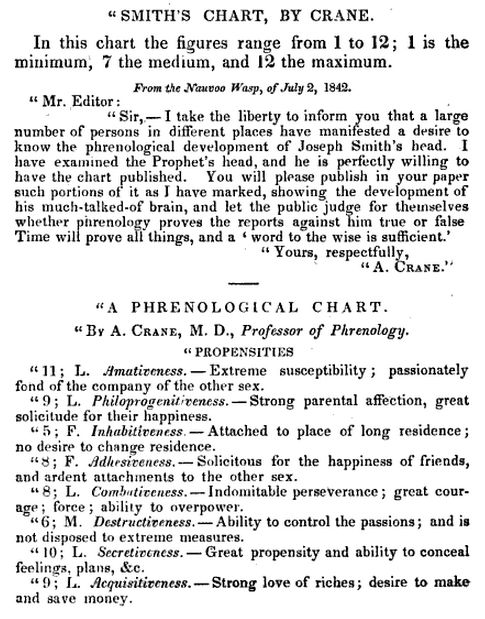
What I am most surprised by as I go through these articles is the number and variety of prominent historical characters who underwent phrenological analysis. These include Herman Melville, Edgar Allan Poe, Clara Barton, most of the Northern generals in the Civil War, and the exhumed skull of Jonathan Swift. When these personages were not available for direct examination, phrenologists would base their analyses on paintings and busts of the figures. One of the most intriguing was a phrenological analysis of Joseph Smith, the founder of Mormonism. The Nauvoo Wasp on 2 July 1842 printed a letter from Smith’s phrenologist, Dr. A. Crane. which he prefaces with:

“Sir, I take the liberty to inform you that a large number of persons in different places have manifested a desire to know the phrenological development of Joseph Smith’s head. I have examined the Prophet’s head, and he is perfectly willing to have the chart published. You will please publish in your paper such portions of it as I have marked, showing the development of his much-talked-of brain, and let the public judge for themselves whether phrenology proves the reports against him true or false[.] Time will prove all things, and word to the wise is sufficient.”

Smith1

Smith2

Smith3

Smith4

Smith6

smith5

(source: Bennet, The History of the Saints)

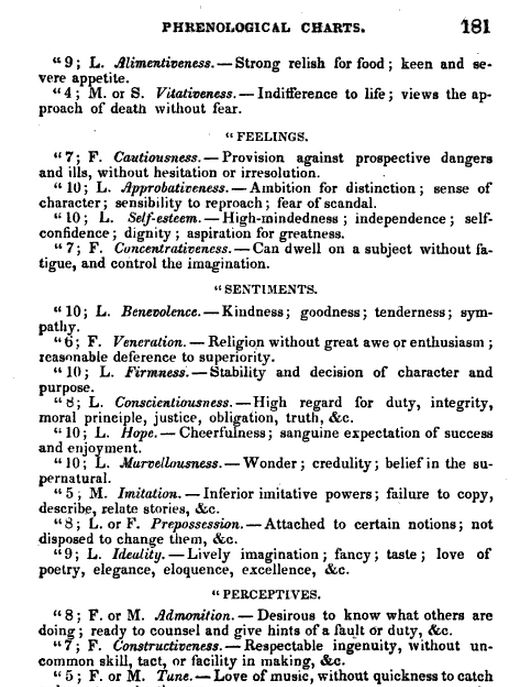
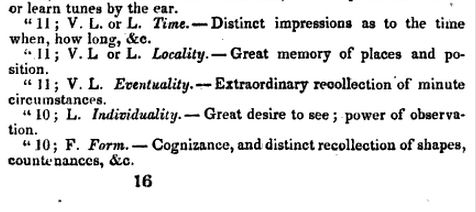
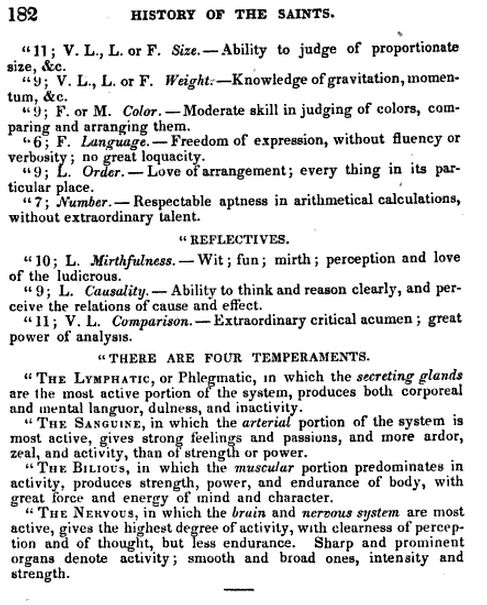
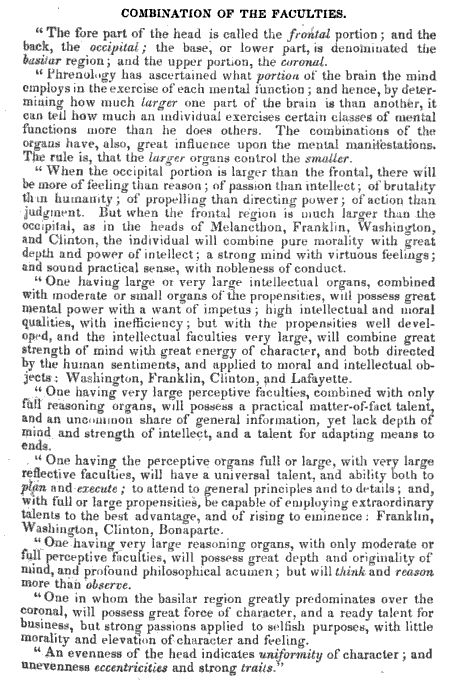
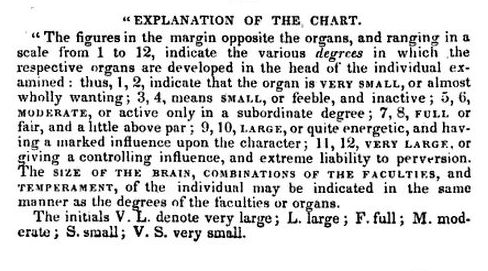
The scores range from 1-12, twelve meaning that the part of the brain in question is very large. It turns out, according to Dr. Crane, Smith was extremely susceptible to and desirous of the opposite sex. A lot. Like 11 out of 12 a lot.  Also, he was judged to have an enlarged region of critical acumen. He scored low on “attachment to places of long residence,” musical aptitude, destructiveness, indifference to life, and, interestingly, the sentiment of “veneration,” which is described as “religion without great awe or enthusiasm” and “reasonable deference to superiority.”

Mark Twain also had his head examined. In a series of articles published in the 1970s, literary scholars debated to what degree Twain was a believer in phrenology. Certainly he was familiar with phrenology and other forms of bunkum. It’s low hanging fruit, and he often deployed his satirical skills against popularly discredited practices. The exchange that these scholars were having, however, seem to miss the point that whenever Twain was writing for a large popular audience, he was uniformly damning of phrenology, which suggests to me that was likely his attitude toward the topic. In Huck Finn, the King and the Duke, two traveling confidence men included phrenology among their skills. Wandering phrenologists would come to his hometown of Hannibal, MO and give readings for a quarter. In his Autobiography, he recounted:

The phrenologist took great delight in mouthing [the] great names [of cranial features]; they gurgled from his lips in an easy and unembarrassed stream, and this exhibition of cultivated facility compelled the envy and admiration of everybody. By and by the people became familiar with these strange names and addicted to the use of them and they batted them back and forth in conversation with deep satisfaction– a satisfaction which could hardly have been more contenting if they had known for certain what the words meant.

“It is not at all likely, I think, that the traveling expert ever got any villager’s character quite right, but it is a safe guess that he was always wise enough to furnish his clients character-charts that would compare favorably with George Washington’s. It was a long time ago and yet I think I still remember that no phrenologist ever came across a skull in our town that fell much short of the Washington standard.

Twain also recounts a visit to a London phrenologist, once under a fake identity, and then again several months later under his own nomme de plume. He found that the two readings in no way matched, and that the second one was clearly far more specifically tailored to his public persona. I will include a detailed phrenological reading of Mark Twain that found–surprise, surprise–that he was very funny indeed.

I would be remiss if I did not add one final literary figure who received a phrenological analysis. Walt Whitman employed the language of phrenology in his Leaves of Grass. For instance, when he praises “the noble character of mechanics and farmers, especially the young men, he lauds:

The freshness and candor of their physiognomy, the copiousness and decision of their phrenology,

The picturesque looseness of their carriage, their fierceness when wrong’d,

The fluency of their speech, their delight in music, their curiosity, good temper, and open-handedness—the whole composite make,

The prevailing ardor and enterprise, the large amativeness[…]

And later in the poem, he questions himself:

Who are you, indeed, who would talk or sing to America?

Have you studied out the land, its idioms and men?

Have you learn’d the physiology, phrenology, politics, geography, pride, freedom, friendship, of the land? its substratums and objects?

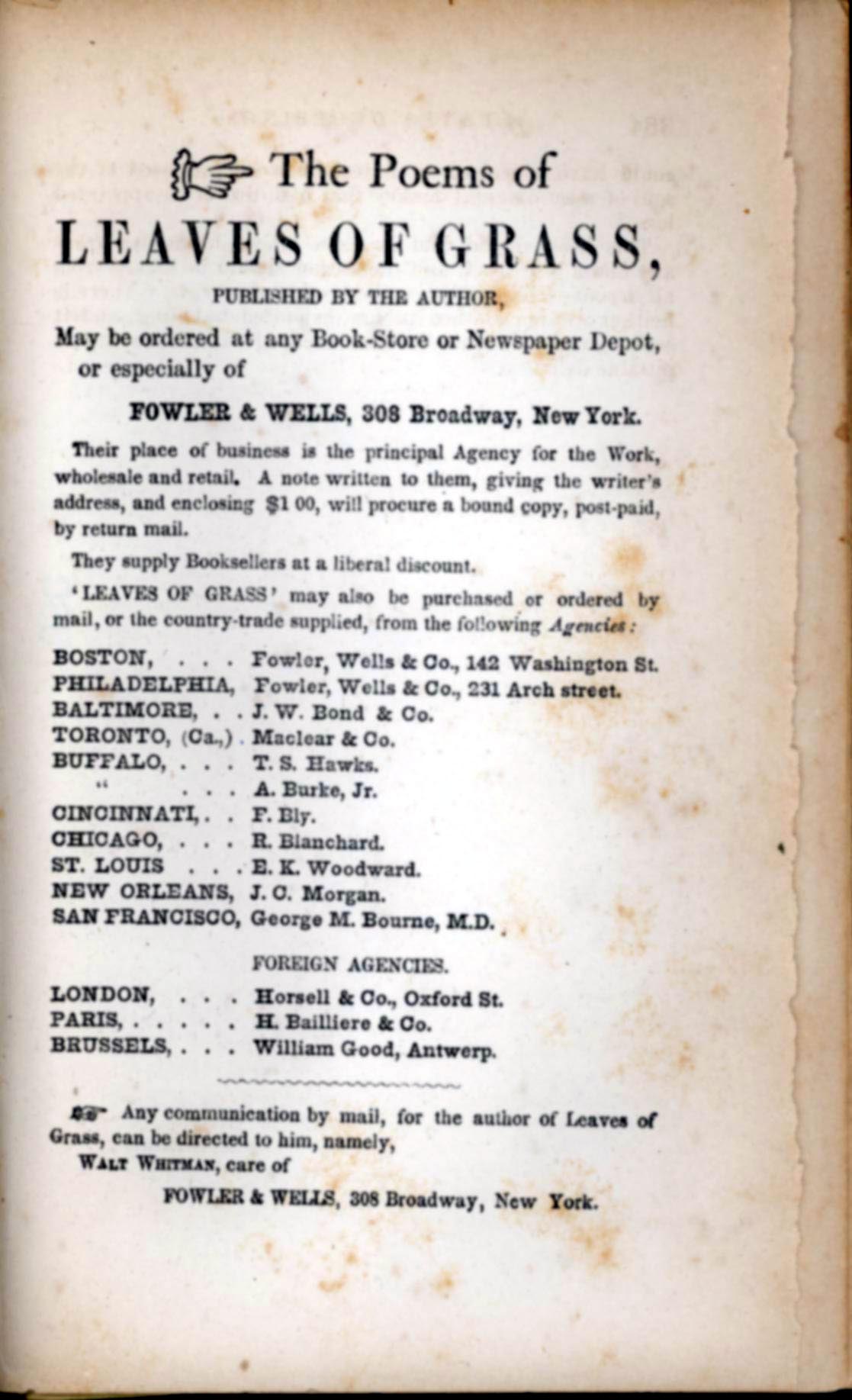
But Whitman didn’t just use the language of phrenology in terms like “amativeness” (a phrenological feature suggesting sexual desire) and as a metaphor for understanding the deeper truths of American character; he also praised phrenologists alongside geologists, chemists, mathematicians, and oddly, spiritualists, as the “lawgivers of poets,” those who reliably illuminated the objective reality that poets use to fashion their verses. Furthermore, early printings of Leaves of Grass were initially distributed by Fowler and Wells, the New York publishers of the long-lived Phrenology Journal. Their office actually received Whitman’s professional correspondence for a time:

whitman1856b

(Source: http://bit.ly/15rjSRN)

Further, Whitman published his phrenological readings by Lorenzo Fowler in several editions of Leaves of Grass.

For all its misuses and silliness, phrenology seems to have nonetheless left its mark on American culture. Indeed, at least a basic understanding of the pseudoscience is essential to understanding one of America’s most important literary works.

RJB

Works Consulted:

  • Bennett, John C. The History of the Saints: Or, An Exposure of Joe Smith and Mormonism. New York: Leland and Whiting, 1842.
  • Claggett, Shalyn. “Putting Character First: The Narrative Construction of Innate Identity in Phrenological Texts.” Victorians Institute Journal 38 (Jan 2010): 103-162.
  • Gribben, Alan. “Mark Twain, Phrenology and the “Temperaments”: A Study of Pseudoscientific Influence” American Quarterly 24.1 (Mar., 1972): 45-68.
  • Hungerford, Edward. “Walt Whitman and His Chart of Bumps.” American Literature 2.4 (Jan., 1931): 350-384.
  • Mackey, Nathanial. “Phrenological Whitman.” Conjunctions 29 (Fall 1997).  http://www.conjunctions.com/archives/c29-nm.htm
  • Riegal, Robert E. “The Introduction of Phrenology to the United States.” The American Historical Review 39.1 (Oct 1933): 73-78.
  • Stern, Madeline B. “Mark Twain Had His Head Examined.” American Literature 41.2 (May, 1969): 207-218.
  • Wrobel, Arthur.  “Corroborating His Phrenology”: The American Phrenological Journal, The Great American Crisis, and U. S. Grant. Journal of American & Comparative Cultures (24.3-4): 161-169.

False takedown claims filed against Burzynski critic…

April 18, 2013

Apparently, someone thinks that they are the only person allowed to have a public opinion about Burzynski in a moving picture, as false takedown order attributed by Google to Burzynski movie director Eric Merola’s production company has been issued against c0nc0rdance, who posted a very good video about the Clinic in February. Whoever did this, well, they done somethin’ ornery.

The thing is that c0nc0rdance didn’t use any footage from Merola’s stinky toilet movie, possibly because it makes all critical thinkers feel sticky and dirty.

This is intolerable. The video remains down on youtube, but a kind person has mirrored the video, and it is now spreading around the Internet. Well done! Here’s my part to fight bullying:

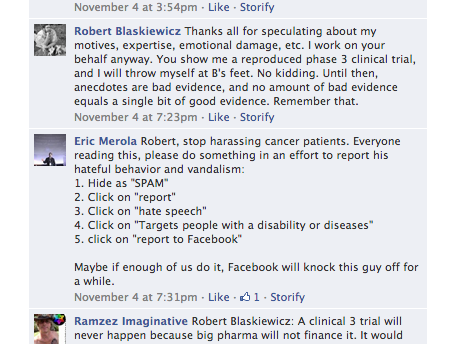
If it’s true, it is actually starting to become a thing with Merola. Merola once tried to have me kicked off of facebook by encouraging people to lie about me to admins, saying that I was directing hate speech against sick people. Really. He did that.

267110276850143232

You will remember that he is also the dude who contacted my employer about articles I had written and statements I had made, promised my employer that I would feature heavily in his shitty sequel, and then did not name me or show my face. It’s being a bully. It’s wrong. And every time he calls us slippery or dirty, I marvel at such a minimal level of self-awareness.

Lastly, he reportedly told an audience who had been subjected to his new flick that the reason people like me were not getting sued was because we’d make a big stink online and try to hide behind our “B.S. free speech.” This is perhaps the only thing he has been right about in public. Except for the BS part. That’s real, and you better realize it, kiddo.

RJB


Boston Marathon Conspiracy Theories

April 16, 2013

This is a preview of a report coming up on the live Google+ hangout webshow, The Virtual Skeptics, which will air in its entirety on Wednesday, 8PM Eastern at virtualskeptics.com. (It’s like Meet the Press with chupacabras.)

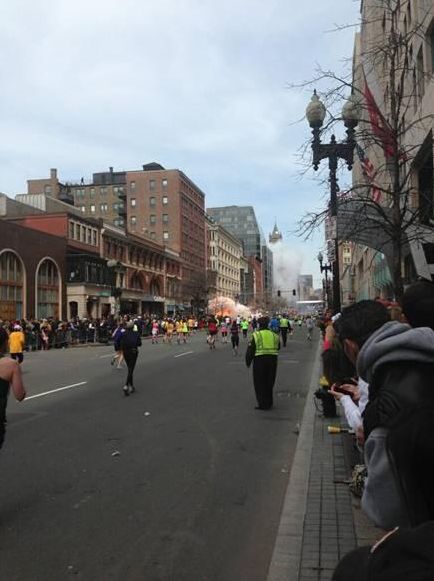
On Monday bombs went off at the finish line of the Boston Marathon. Of course, the police are keeping many details of the young investigation confidential, and that opens up a lot of airtime to speculate about who was responsible. This morning the news suggested that the investigation was trending toward domestic terrorism, so we’ll see if this line of evidence holds up.

But just because there is very little information available doesn’t mean that you won’t have wall to wall coverage, and this means that every little detail that was mentioned in front of a microphone will come under intense scrutiny and be tortured to the point of uselessness.

Actually, I see an opportunity here. Lately in the states, we’ve been getting weary of mass killings. I mean, it’s actually becoming dispiriting. And with that aggravation comes impatience with being fed crummy news, bogus analysis, and speculation. For me, it’s the false sense of confidence that the talking heads have that I find particularly irksome. And for that reason, I think, one group is finding itself increasingly despised, the group that is most sure of its boneheaded proclamations at times of genuine confusion and that regards human tragedy as a type of pornography: conspiracy theorists.

After Aurora and Sandy Hook many of us were plunged into a parallel twitterverse of conspiracy and paranoia. And you know what? The speculation is getting old. My first thought, was how is this going to be spun as an argument for gun control related false flag? Well, a false flag narrative seemed to arrive almost immediately, but Alex Jones and his cohort of sycophants and imbeciles, spun it in a surprising way, as a way of expanding the authority of the TSA into the streets. This is very odd. If you visit the TSA website you see that their mandate is to “protect the Nation’s transportation systems to ensure freedom of movement for people and commerce.” This means airport screening, baggage checking, bomb sniffing dogs, that sort of thing. They are not trained to execute martial law or patrol the streets; they couldn’t. The idea is as absurd as Alex Jones is loud. And absurd.

The first seed of a conspiracy theory came very shortly after the bomb went off just before 3PM. Within an hour and a half, a news outlet in Mobile mentioned that a local college cross country coach, Ali Stevenson who was participating in the Marathon had commented that there were bomb sniffing dogs on site before the explosion:

“They kept making announcements to the participants do not worry, it’s just a training exercise,” Coach Ali Stevenson told Local 15.

Stevenson said he saw law enforcement spotters on the roofs at the start of the race. He’s been in plenty of marathons in Chicago, D.C., Chicago, London and other major metropolitan areas but has never seen that level of security before.

“Evidently, I don’t believe they were just having a training exercise,” Stevenson said. “I think they must have had some sort of threat or suspicion called in.”

CNN reports a state government official said there were no credible threats before the race.

A major problem with his testimony, of course, is that he has never been in a race that exploded before. It seems only natural that salient measures of security are now receiving his attention after the Boston Marathon when they haven’t before. Basically, this is a post-9/11 world. There is security at all major events. The presence of bomb dogs is not surprising. Further I want to talk about “police spotters” on roofs. How does he know they were police spotters?

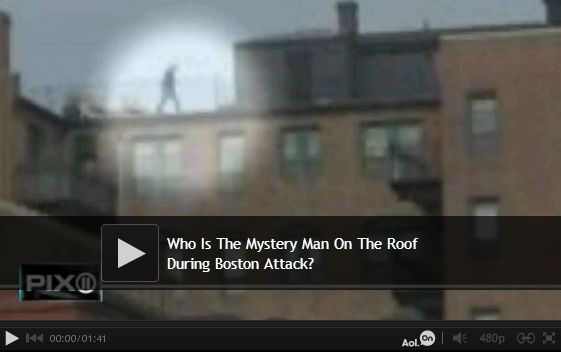
One person who actually was walking on a roof near the explosion has actually received a lot of attention on the Internet. Here he is:

ManOnRoof

What? You don’t see him? Here’s a close up of this sinister character.

Mysterymancloseup

I think it’s Bigfoot.

I understand that as much of the crime scene as possible needs to be documented, but that this guy was being circulated on twitter sort of befuddles me. There is nothing peculiar about someone being on the roofs along the Boston Marathon route. In fact, at the finish line, this is common. Actually the police had been enforcing rules against the gatherings after a young man fell through a skylight in 2011. So, it’s clearly not unexpected that there would be people on the roof.

One of Alex Jones’ defective correspondents, Dan Bidondi, managed to get into a couple of press briefings. First he asked what actually would have been a reasonable question. Had a threat been called in (referring to the Stevenson narrative of dogs and drills)? The answer? No. Security had been upped as a matter of course. At a later conference, the same guy asked the governor a question if it was a false flag operation to take away our civil liberties and let the TSA slip their hands down our pants. The governor said, “No, next question,” basically slam dunking the idiot back into irrelevancy.

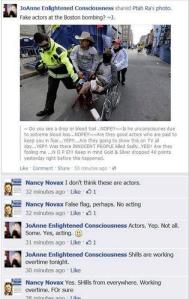
A trend being rehashed from the Sandy Hook conspiracy theories, and the idea of a “crisis actors,” which are supposed to be actors paid to act out drama. Take for instance this image, which comes from Peter Tierney’s collection of rather depressing facebook shots:

BombingHorrid

Crisis actors actually seem to me to be a manifestation of something that you often see in the conspiracy world, what Michael Barkun calls “fact-fiction reversals.” Conspiracy theorists see fiction as more real than reality, so they take the 1970s April fools “documentary” about elites secretly going to Mars (Alternative 3) as factual and think that aliens are putting story lines into the heads of Star Trek writers to prepare us for the alien invasions to come, while simultaneously believing that the news is being staged. For some reason, conspiracy theorists seem to be unable to believe in reality.

One last type of evidence that we see is searching for predictions of the event in popular culture. The only one I have seen so far is supremely cynical, in my opinion, which has to do with a recutting of a Family Guy episode so that it suggests Peter is detonating a bomb at the Boston Marathon. Seth MacFarlane has slammed the conspiracy theory, calling it “abhorrent.”

Actually, I’m hopeful that people are starting to pay attention to the horridness that is the conspiratorial mindset. One clever, civic-minded netizen grabbed up a number of likely conspiracy theory website domain names with the purpose of “keeping some conspiracy theory kook from owning it,” which gives me a small measure of hope.

RJB


Links:

The seeds of the Boston Marathon Conspiracy:

http://www.local15tv.com/mostpopular/story/UM-Coach-Bomb-Sniffing-Dogs-Spotters-on-Roofs/BrirjAzFPUKKN8z6eSDJEA.cspx

Alex Jones is horrid:

http://www.salon.com/2013/04/15/alex_jones_labels_boston_explosion_a_false_flag/

In the Infobunker with an Infochick. Also, Info.

http://www.youtube.com/watch?v=kQWH2epffQY&feature=youtu.be

“Hands in our pants” comment:

http://deadspin.com/the-first-question-for-the-governor-was-from-a-conspira-473064054

The man on the roof:

http://news.yahoo.com/blogs/lookout/boston-marathon-roof-man-mystery-012843805.html

Human toilet Mike Adams opines:

http://t.co/g9dzlrtprh

Family Guy predicted the bombing. Also, I hate Earth:

https://www.facebook.com/photo.php?fbid=328397323949106&set=a.220793581376148.48959.100003365224508&type=1&comment_id=739392&ref=notif&notif_t=comment_mention&theater

Seth MacFarlane replies to the Family Guy conspiracy:

http://tv.yahoo.com/news/seth-macfarlane-rips-edited-family-guy-clip-depicts-233737274.html


Hispter Demonologists and the Brotherhood of the Black T-shirt (Virtual Skeptics #32)

March 28, 2013

Now with extra Viking!

RJB (With thanks to Torkel for stepping up and filling in!)


A Letter to the PBS Ombudsman about CPT12’s Airing of “Burzynski”

March 26, 2013

On Friday, PBS Ombudsman Michael Getler responded to CPT12’s recent airing of the first Burzynski movie as part of a fundraiser. PBS has always been quite responsive to its critics, and this is something that I have not seen in many large broadcasters in the past. He contacted a lot of the interested parties at the station, the FDA, and CPT12. I have no doubt that Getler took this subject seriously, and I appreciate this very much.

Furthermore, Burzynski is not Getler’s fight. To understand the complexities and history involved takes a lot of work, far more than we could possibly expect of Mr. Getler. The station is not his responsibility, nor is it PBS’s role to censor a member station. This was clear from his first post in the run-up to the airing of the documentary.

That said, however, I do disagree with some of his conclusions. (You could see that coming a mile away, couldn’t you?)

Getler starts off:

[Burzynski] is a long program — two and a half hours, with about 45 minutes of that devoted to pledge drive discussions and promotions of the film. It is about the decades-long struggle of a Polish-born physician and biochemist, Stanislaw Burzynski, who set up a clinic in Texas in 1976, to achieve acceptance for a cancer-cure therapy based on a treatment he developed based on what he calls “Antineoplastons.” [ANP]

I submit this is already wrong. There is little evidence that Burzynski is at all serious about developing antineoplastons for wider marketing. If that were true, surely he would have managed to have completed and published a single advanced trial in 35 years. If you look at the trials he’s been required to register at clinicaltrials.gov, you see over 60 trials, 1 completed, and none published. NONE. This is important because he is restricted to giving his ANP in clinical trials. But he apparently abandons his trials, almost all of them. This is not normal. He charges patients out the nose to participate in the clinical trials. This is not normal. This is not the behavior of someone who intends to market the product widely later and expects a return on an investment. It sure looks like someone taking the money while he can.

I put the word “documentary” in quotes above because while the actual film does indeed document very well Burzynski’s seemingly endless battle to win acceptance and approval for his treatment against the FDA, National Cancer Institute, patent challenges and big pharmaceutical companies — and includes very powerful filmed interviews with cancer survivors who say his treatment (in Texas, where it was allowed) saved them — it doesn’t have the kind of critical other-side that one is used to in other documentaries.

That last part is true. the movie is one-sided. Of course, why this is might be more apparent if Mr. Getler had realized that Merola’s cousin was a patient of Burzynski (she later died, of course) and that Merola raised funds for his cousin’s treatments on his website. Merola is not impartial. He has skin in the game. He has sunk an enormous amount into Burzynski.

Mr. Getler mentions that Shari Bernson, the person responsible for the programming and who appeared in fundraising spots, described the movie as “controversial.” To someone on the outside, it may appear to be controversial. To someone who understands the science and process of publication and who has found endless descriptions of how patients end up making really, really bad choices out of desperation at that clinic, however, there is no controversy. The fact remains that after 35+ years, the Clinic has never produced a single reproducible result that would constitute the barest minimum for serious consideration among experts. It just hasn’t. Should that ever happen (I’m not holding my breath), then, hell, yes, we’ll be on board cheering the advance of science. But he has to play by the rules.

And this is important too, playing by the rules that all real researchers abide to. Part of the FDA’s job is to ensure that Burzynski’s people are doing this. And on February 7th, they were doing just that; they were in the facility inspecting to make sure that Burzynski’s team was playing by the rules.

In a FOIA release this week, the FDA revealed a number of things that had been found out and reported to the clinic by the time the movie aired. By law, the Clinic had 15 days to respond, so if they responded, it was before CPT12’s love-in. (The observational notes can be found here:  https://skepticalhumanities.com/wp-content/uploads/2013/03/burzynskiform483feb2013.pdf)

Two investigators observed:

  • “The IRB [Institutional Review Board] used an expedited review procedure for research which did not appear in an FDA list of categories eligible for expedited review, and which had not previously been approved by the IRB. Specifically, your IRB routinely provided expedited approvals for new subjects to enroll under Single Patient Protocols.” [2 adults and 3 pediatric patients are mentioned]
  • “The IRB approved the conduct of research, but did not determine that the risks to subjects were reasonable in relation to the anticipated benefits (if any) to subjects, and to the importance of the knowledge that might be expected to result. Specifically, your IRB gave Expedited Approval for several Single Patient Protocols (SPP) without all the information necessary to determine that the risk to subjects are minimized.” [4 examples follow]
  • “The IRB did not determine at the time of initial review that a study was in compliance with 21 CFR Part 50 Subpart D, ‘Additional Safeguards for Children in Clinical Investigations.’ Specifically, an IRB that reviews and approves research involving children is required to make a finding that the study is in compliance with 21 CFR Part 50 Subpart D, ‘Additional Safeguards for Children in Clinical Investigations.’ Your IRB approved research involving children without documentation of the IRBs finding that the clinical investigation satisfied the criteria under Subpart D.” [3 examples follow and there is a note that this is a repeat observation that had been found in an Oct 2010 Inspection.]
  • “The IRB did not follow its written procedure for conducting its initial review of research. Specifically, the IRB is required to follow its written procedures for conducting initial and continuing review. Your IRB did not follow your written procedures for conducting initial and continuing review because these subjects received IRB approval via an expedited review procedure not described in your Standard Operating Procedures. If your IRB would have followed your own SOP for initial and continuing review, the following subjects would have received review and approval from the full board rather than an expedited review.” [2 adults and 3 pediatric patients are listed.]
  • “The IRB has no written procedures for ensuring prompt reporting to the IRB, appropriate institutional officials, and the FDA of any unanticipated problems involving risks to human subjects or others. Specifically, your current SOP-2012 v2-draft doc does not describe the requirements on Investigators on how unanticipated problems are reported to the IRB, Institutional Official, and the FDA, such as time intervals and the mode of reporting, or otherwise address how the prompt reporting of such instances will be ensured.”
  • “The IRB has no written procedures [in the SOP-2012 v2-draft doc] for ensuring prompt reporting to the IRB, appropriate institutional officials, and the FDA of any instance of serious or continuing noncompliance with theses [sic] regulations or the requirements or determinations of the IRB.”
  • “A list of IRB members has not been prepared and maintained, identifying members by name, earned degrees, representative capacity, and any employment or other relationship between each member and the institution.”

You have to play by the rules. I’m not sure that this round of investigation is over yet, as the audience at the premier of the sequel was apparently told that the FDA was still on site. Researchers should not be playing fast and loose with the rules that protect children (a protected subject population, like prisoners and students–yeah, I’m IRB certified). There should be procedures in place to see that proper oversight and reporting of unexpected events is ensured. Hell, there was apparently no document even saying WHO was on the IRB!

This is not a report on a serious research institution. It’s more like the observations of the IRB of a clown school.

Back to Mr Getler’s letter:

On the other hand, Bernson’s sidekick on the in-studio, pledge-drive promotion who was interviewing the clinic spokesman, made me gag when she said, “I’m Rebecca Stevens and I’m proud to be a journalist who asks the hard questions.” There were no hard questions. [I believe the question that followed up this statement was, “What is peer-review?”–RJB]

And where Bernson may have gone too far, depending on who you believe, was in her statement that: “Antineoplaston therapy has had significant success rates with terminal brain cancer patients and especially in children.”

No, she went too far no matter who you believe, and his next paragraph demonstrates this:

The National Cancer Institute, reporting last month on Antineoplastons, said, among other things: “No randomized, controlled trials showing the effectiveness of antineoplastons have been published in peer-reviewed scientific journals” and that they are “not approved by the U.S. Food and Drug Administration for the prevention or treatment of any disease.”

Aaaand…how’s that controversial? In light of this, how could Sherri possibly be right?

My bottom line is that CPT12 obviously has a right to show this film.

Nobody questions that. What we wanted, and what was offered to the station, was the opportunity to have an independent oncologist in the studio at the time of the broadcast, you know, to stir up the kind of informed discussion the station says they want to have instead of settling for two True Believers talking to two CPT12 pitch people. When the station had that opportunity, they walked away from it. That’s indefensible. Especially when you consider that the people we are worried about, patients and their families, may NOT be as discerning as your average viewer, as CPT President Willard Rowland suggests in his response to the ombudsman:

“The program’s airing is grounded in the station’s mission, specifically those portions about respecting our viewers as inquisitive and discerning citizens, addressing social issues and public concerns not otherwise adequately covered in the community, and cultivating an environment of discovery and learning.”

Some of them haven’t had good news since their diagnosis. Then they hear that some lone genius with the cure for cancer is operating in Houston and they are on the next flight down. I’ve seen it dozens of times, and I have hundreds more patients on deck to write about. These are vulnerable, vulnerable people who deserve the best information from their public broadcasters.

I’m fairly disappointed by the tepid response, honestly. I have a hard time imagining that Mr. Getler, or Mr Willard Rowland for that matter, could possibly think that this program was anything but misleading if they spent a half hour at The OTHER Burzynski Patient Group, which chronicles, in patients’ own words, what goes on in that Clinic. All of the people told that getting worse is getting better (for decades being fed the same line!), the children having strokes (unrelated to their tumors) while on the medicine, the “terrifying” amounts of sodium that go into patients. The quasi-legalistic threats and phone calls to dissatisfied cancer patients. The untested chemo cocktails given to most of his patients. None of that was mentioned in the CPT12 fundraiser.

Of course, that’s not Mr. Getler’s fight.

RJB